Cardiopulmonary exercise testing is a frequently used measure of cardiovascular health, as it allows insight into cardiac and pulmonary responses to exercise and is a robust tool for predicting worse cardiovascular outcomes in adult congenital heart disease (CHD) patients. Reference Inuzuka, Diller and Borgia1–Reference Burstein, Menachem and Opotowsky4 The measurement of functional capacity using peak oxygen consumption during the exercise test is a conventional indicator of cardiac-related events in adult CHD patients. Reference Kempny, Dimopoulos and Eebing5,Reference Buys, Cornelissen and Bruaene6 However, the peak oxygen consumption is highly influenced by age, sex, patient’s effort and physical fitness, exercise test protocol, and underlying CHD. Reference Ogawa, Spina and Martin7,Reference Woo, Derleth, Stratton and Levy8 Previous studies have shown that adult CHD patients sometimes terminate exercise tests before reaching their cardiovascular limit, which may be a serious shortcoming to the evaluation of the prognostic value of peak oxygen consumption. Reference Inuzuka, Diller and Borgia1,Reference Ramos-Barbon, Fitchett, Gibbons, Latter and Levy9
The peak respiratory exchange ratio, a ratio of carbon dioxide production and oxygen consumption measured via respiratory gas analysis, has been used as an objective criterion of effort. Reference Mezzani, Corra and Bosimini10 Current exercise testing guidelines recommend to achieve a peak respiratory exchange ratio of ≥1.10 as a criterion for maximal effort. Reference Gibbons, Balady and Bricker11 The impact of respiratory exchange ratio on the prognostic role of exercise variables in adult CHD patients remains uncertain. Therefore, the objective of this study was to analyse the differences in exercise parameters in adult CHD patients who had maximal effort versus those who had sub-maximal effort during exercise tests and to evaluate whether attainment of a respiratory exchange ratio of ≥1.10 during the exercise test affects the prognostic value of exercise variables with their short-term cardiac-related events during follow-up.
Methods
The study protocol was approved by the ethics committee of the Memorial Healthcare System (MHS.2018.036). Given the anonymised nature of the data, the requirement for informed consent was waived. This was a retrospective, single-centre study cohort design evaluating adult CHD patients (≥18 years) who performed symptom-limited cardio-pulmonary exercise tests using a treadmill according to a modified Bruce-protocol between August, 2014 and April, 2018 at the adult CHD centre, Memorial Healthcare System, Hollywood, Florida. The indication for CPET was routine practice in all ACHD patients referred to our centre. All exercise tests were performed in accordance with the institutional protocol, and the guidelines from the American College of Cardiology/the American Heart Association, Reference Fletcher, Ades and Kligfield12 using the Ultima2 CPX™ (MedGraphics, St Paul, MN, United States of America), Tango M2™ (German Healthcare Export Group, Germany) blood pressure cuff, and Mortara ECG™ (Spacelab Healthcare, United Kingdom). All three components interacted and input data into Breeze software™ (MedGraphics, St Paul, MN) for analysis. The exercise was terminated when the patient had subjective exhaustion (modified Borg score of 7 or more).
The Ultima2 CPX™ provides a conventional Wasserman 9 plot graphs and data were analysed for peak oxygen consumption, carbon dioxide production, minute ventilation, ventilatory anaerobic threshold, and oxygen consumption at the anaerobic threshold as a percentage of total oxygen consumption. Peak respiratory exchange ratio, peak heart rate and blood pressure were taken at maximum exercise. The anaerobic threshold was measured using the V-slope method. Reference Fletcher, Ades and Kligfield12 A peak respiratory exchange ratio was measured at peak exercise, and value ≥1.10 was considered as maximum exercise effort. Reference Gibbons, Balady and Bricker11 Other variables included in the analysis were the oxygen uptake efficiency slope, double product, and exercise oscillatory ventilation during exercise tests. The oxygen uptake efficiency slope was calculated by plotting logarithmically transformed minute ventilation over the entire exercise duration against the oxygen consumption. Reference Baba, Nagashima and Goto13,Reference Hollenberg and Tager14 The myocardial oxygen uptake, defined as the amount of oxygen consumed by the myocardium during exercise, was estimated by the product of peak heart rate and systolic blood pressure (double product). Reference Nelson, Gobel, Jorgensen, Wang and Taylor15,Reference Sadrzadek, Dwey and Sungar16 The exercise oscillatory ventilation was defined as regular oscillations with amplitude >15% of average minute ventilation during the exercise test, which were present for >60% of total exercise duration. Reference Brawner, Ehrman and Myers17 Patients were excluded if they had incomplete exercise test data.
Demographic and clinical characteristics were obtained via medical record extraction, and consisted of age, gender, body mass index, and New York Heart Association (NYHA) functional class. Patients were followed up for a median of 21 months from the day of exercise test for the incidence of cardiac-related events, including death, heart transplantation, hospitalisation for heart failure, cardiac device implantation (pacemaker or ICD), and corrective cardiac surgery for an underlying cardiac condition. A principal diagnosis was determined for every patient and classified according to the 32nd Bethesda conference. Reference Webb and Williams18 The NYHA class was determined for each patient by physician assessment of patients’ self-reported symptoms before the exercise test or estimated from the patient narrative from the medical record.
Statistical analysis
Results are expressed as mean ± SD for continuous variables and as a number or percentage for categorical variables. Comparisons between subgroups were performed using unpaired t-test or the Chi-square test, as appropriate. Exercise variables were first assessed using univariable Cox hazard analysis, and subsequent multi-variable Cox analyses were performed to detect independent predictors associated with cardiac-related events. For all analyses, a two-sided p value of <0.05 was considered statistically significant. Statistical analyses were performed using IBM SPSS version 26.0 (IBM, Armonk, NY, United States of America) and GraphPad Prism 7 (Graph Pad Software Inc., La Jolla, CA, United States of America).
Results
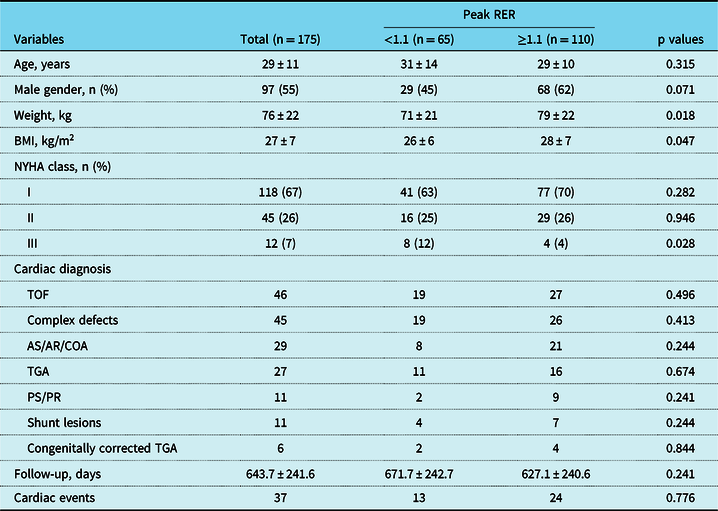
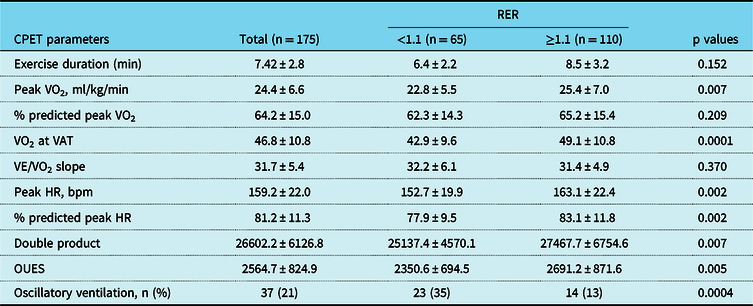
A total of 175 adult CHD patients were included in the study (mean age = 29 ± 11 years, male (55%), had cardiopulmonary exercise tests and follow-up data. Of the 175 patients, 110 (63%) reached a respiratory exchange ratio of ≥1.10, whereas 65 (37%) patients had a ratio of <1.10. There was no significant difference in duration of exercise and reason for termination of exercise between two groups. The mean Borg score was 7 ± 2 in both respiratory exchange ratio <1.1 and ≥1.10 groups. The patient’s demographic and clinical characteristics based on the respiratory exchange ratios are summarised in Table 1. The median peak oxygen consumption for the entire patient cohort was 24.4 ± 6.6 ml/kg/minute, percentage predicted oxygen consumption was 64.2 ± 15, the median percentage oxygen consumption at the anaerobic threshold was 46.8 ± 10.8 (expressed as a percentage of peak oxygen consumption), peak heart rate was 159 ± 11 bpm, and percentage predicted peak heart rate in percentage was 81 ± 11. Upon comparison between maximal effort versus sub-maximal effort, age and gender distributions were comparable between the two groups. Patients with high body mass index and body weight were noted more frequently among those in a respiratory exchange ratio of ≥1.1 sub-group compared to a respiratory exchange ratio of <1.1, with p values of 0.018 and 0.047, respectively. There were more patients with NYHA functional class III in a respiratory exchange ratio of <1.1 sub-group (p = 0.028). Tetralogy of Fallot was the most common diagnosis (26.3%), followed by complex CHD (25.7%). Complex CHD consisted of single-ventricle physiology and all patients were palliated with Fontan surgery. All other diagnoses including tetralogy of Fallot, transposition of great arteries, congenitally corrected transposition, aortic stenosis, and coarctation of aorta were completely repaired. The common exercise variables were compared between the two groups and are presented in Table 2. Of the variables, peak oxygen consumption, oxygen consumption at the anaerobic threshold, peak heart rate, percentage predicted peak heart rate, double product, and oxygen uptake efficiency slope were significantly decreased in patients with a respiratory exchange ratio of <1.10 compared to those with a respiratory exchange ratio of ≥1.10. However, there was no significant difference in percentage predicted peak oxygen consumption between both groups. Furthermore, oxygen consumption at the anaerobic threshold in both groups was >40%, suggesting normal sub-maximal exercise capacity. Interestingly, the number of patients with exercise oscillatory ventilation is higher in respiratory exchange ratio <1.1 versus respiratory exchange ratio ≥1.1 group despite the higher number of patients with NYHA class III in the latter group.
Demographic and clinical characteristics by peak RER status

AS = aortic stenosis; AR = aortic regurgitation; COA = coarctation of aorta; BMI = body mass index; PS = pulmonary stenosis; PR = pulmonary regurgitation; RER = respiratory exchange ratio; TGA = transposition of great arteries; TOF = tetralogy of Fallot
Cardiopulmonary exercise testing data by RER status

HR = heart rate, OUES = oxygen uptake efficiency slope; VAT = ventilator anaerobic threshold
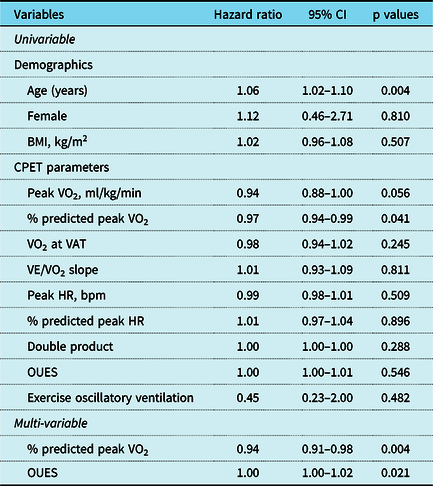
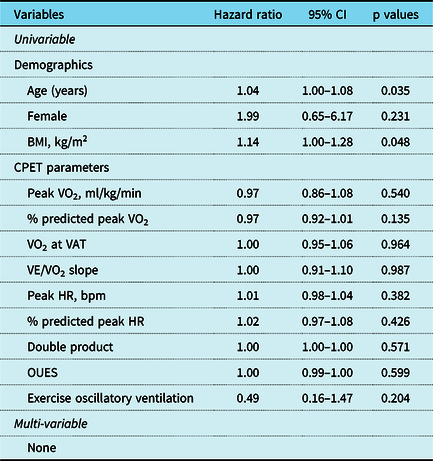
During a median follow-up period of 21 months (mean 18 ± 8 months with IQR, 13–28 months), the cardiac-related event rate was 21% (37/175). The univariate analysis of exercise variables that can be associated with cardiac-related events in the group with respiratory exchange ratio ≥1.1 and respiratory exchange ratio <1.1 are shown in Tables 3 and 4. Older age, female sex, obesity, higher ventilatory equivalent for carbon dioxide value, percentage predicted heart rate and the oxygen uptake efficiency slope were found to be associated with cardiac-related events (hazard ratio >1). The multivariate Cox proportional hazard analysis showed that lower percentage predicted peak oxygen consumption and oxygen uptake efficiency slope corresponded with a higher risk of cardiac-related events only in patients who had a respiratory exchange ratio of ≥1.1 during exercise testing (Table 3), but not with a respiratory exchange ratio of <1.1 (Table 4).
Risk factors of the cardiac events in patients with RER ≥ 1.1

HR = heart rate; OUES = oxygen uptake efficiency slope; VAT = ventilator anaerobic threshold
Risk factors of the cardiac events in patients with RER < 1.1

HR = heart rate; OUES= oxygen uptake efficiency slope; VAT = ventilator anaerobic threshold
Discussion
A number of studies have found that the peak oxygen consumption is one of the best predictors of morbidity or mortality in a variety of cardiovascular conditions including congestive heart failure, Reference Mancini, Eisen and Kussmaul19,Reference Arena, Myers and Guazzi20 pulmonary hypertension, Reference Wensel, Opitz and Anker21 tetralogy of Fallot, Reference Giardini, Specchia and Tracy22 transposition of the great arteries, Reference Giardini, Hagger and Lammers23 and Fontan circulations. Reference Udholm, Aldweib and Hjortdal3 The study by Inuzuka et al Reference Inuzuka, Diller and Borgia1 found that peak oxygen consumption and heart rate reserve data can be used to generate estimates for 5-year survival in many adults with CHD. However, in their study a majority of patients had low peak respiratory exchange ratio values <1.1, suggesting that a large fraction of the patients did not expend adequate effort and terminated exercise before reaching their cardiovascular limit. This may constitute a serious shortcoming for a study that seeks to evaluate the prognostic value of peak exercise data, for it permits factors unrelated to a subject’s cardiovascular health (e.g. the patient’s level of motivation on the day of the exercise test) to contaminate the data and analyses.
Previous studies have shown that one-third of patients with heart failure were unable to reach the maximal effort (peak respiratory exchange ratio ≥1.10) and that the test results are deemed insufficient for estimating prognosis. Reference Chase, Kenjale and Cahalin24,Reference Rostagno, Olivo and Comeglio25 The main difference between our study and prior studies published Reference Inuzuka, Diller and Borgia1,Reference Udholm, Aldweib and Hjortdal3,Reference Mancini, Eisen and Kussmaul19–Reference Giardini, Hagger and Lammers23 is that we emphasised the peak respiratory exchange ratio to determine maximal or sub-maximal effort during CPET rather than subjective Borg score. In our study, adult CHD patients (63%) had attained a respiratory exchange ratio of ≥1.1, and is the highest percentage compared to most prior studies published. We analysed the commonly used exercise variables to evaluate whether attainment of the peak respiratory exchange ratio of ≥1.1 during exercise test affects the prognostic power of exercise variables among adult CHD patients all of whom have achieved a Borg score of ≥7. This is the novel finding in our study.
The peak respiratory exchange ratio is a useful variable, both as a marker of effort and as an indicator of the contribution of anaerobic metabolism. Reference Mezzani, Corra and Bosimini10,Reference McManus and Leung26 The respiratory exchange ratio is the ratio of CO2 exhaled to the O2 uptake per unit time Reference Mezzani, Corra and Bosimini10 and reflects tissue level exchange of gasses (measured by the respiratory quotient). For normal adults, respiratory exchange ratio values at peak oxygen consumption during treadmill exercise are 1.10. Reference Mezzani, Corra and Bosimini10 As expected, exercise variables such as peak oxygen uptake, oxygen uptake at ventilatory anaerobic threshold, peak heart rate, percentage predicted heart rate, double product, OUES are all decreased substantially with sub-maximal efforts in adult CHD patients. But, there was no difference in the median percentage predicted oxygen consumption between the two groups. Furthermore, the median oxygen consumption at the anaerobic threshold in both groups were above the lowest cut-off of normal value (<40% has been suggested as a threshold to determine the functional capacity). Reference Fletcher, Ades and Kligfield12 Previously suggested, children with CHD can have normal sub-maximal exercise performance. Reference Muller, Bohm, Semsch, Oberhoeffer, Hess and Hager27 Perhaps, a selected cohort of ACHD patients, as seen in our study, may have normal sub-maximal exercise performance.
In our study, the exercise test was performed as a part of the routine evaluation of adult CHD patients. When we analysed the exercise variables obtained whether these variables can predict cardiac-related events in short-term follow-up, percentage predicted peak oxygen consumption and the oxygen uptake efficiency slope were independently associated with the risk of cardiac-related events only in patients who had the peak respiratory exchange ratio of ≥1.1. None of the CPET parameters were found to be predictive of cardiac-related events in ACHD patients who had peak respiratory exchange ratio was <1.1 during the exercise test despite both groups reached a Borg score of 7 or more subjectively. There was no significant difference in how exercise is terminated and exercise duration between those with peak respiratory exchange ratio ≥ 1.1 and peak respiratory exchange ratio < 1.1. Our findings suggest that if patients did not achieve adequate peak respiratory exchange ratio during the exercise stress test, the exercise variables obtained are not be predictive of cardiac-related events in adult CHD patients.
Exercise variables that are reported to be useful as prognostic markers during sub-maximal exercise tests include the ventilator equivalent for carbon dioxide, the oxygen consumption at the anaerobic threshold as a percentage of peak oxygen consumption, and the oxygen uptake efficiency slope. Reference Malhotra, Bakken, D’Elia and Lewis28 In our study, an elevated ventilator equivalent for carbon dioxide (>34) Reference Kempny, Dimopoulos and Eebing5 was not associated with an increased risk of cardiac-related events. Prior studies have shown that ventilator equivalent for carbon dioxide is not an adequate predictor of outcomes in Fontan patients Reference Fernandes, Alexander and Graham29,Reference Ohuchi, Negishi and Noritake30 and has weak prognostic value in ACHD patients. Reference Inuzuka, Diller and Borgia1,Reference Buys, Comelissen and Van De Bruaene31
In our study, the oxygen consumption at the anaerobic threshold was found normal (>40%) in adult CHD patients with both respiratory exchange ratio groups. In daily life, peak oxygen consumption does not reflect the amount of oxygen needed to cope with daily activities of normal life. This suggests that adult CHD patients reach normal sub-maximal results and these explain why they are asymptomatic with their normal activities but have markedly decreased exercise capacity. The oxygen consumption at the anaerobic threshold is only reported in a few studies as the anaerobic threshold is not always identifiable in all patients. Reference Atz, Zak and Mahony32 In our study, there is no clear evidence for its role as a potential predictor for cardiac-related events.
There are limited publications investigating the predictive value of the oxygen uptake efficiency slope in adult CHD patients. Reference Buys, Comelissen and Van De Bruaene31,Reference Giardini, Specchia and Gargiulo33 The oxygen uptake efficiency slope represents the rate of increase of oxygen uptake in response to a given ventilator equivalent during incremental exercise, indicating how effectively oxygen is extracted and taken into the body. Reference Baba, Nagashima and Goto13,Reference Hollenberg and Tager14 The oxygen uptake efficiency slope is influenced by both the metabolic acidosis and the physiological pulmonary dead space. The oxygen uptake efficiency slope is a variable that indicates the status of both systemic and pulmonary perfusion, and which explains the high correlation with percentage predicted oxygen consumption. The advantage of the oxygen uptake efficiency slope is that it can be calculated from sub-maximal exercise test data and is therefore effort-independent. Reference Baba, Nagashima and Goto13 The oxygen uptake efficiency slope seems to have an additive value to the percentage predicted oxygen consumption in adult CHD patients. However, possible use of oxygen uptake efficiency slope in cyanotic patients is debatable, as it is s not linear during the exercise tests in Fontan patients. Reference Giardini, Hagger and Lammers23
Previously, in adults with heart failure, Stelken et al Reference Stelken, Younis and Jennison34 found that 50% of predicted peak oxygen consumption was the most significant predictor of cardiac death and that the area under the curve for percent of predicted peak oxygen consumption was superior to peak oxygen consumption. Other studies, did not find any difference in prognostic values between these two parameters. Reference Pardaens, Van Cleemput, Vanhaecke and Fagard35 Unlike, adults with normal heart, in the CHD population, predicted peak oxygen consumption is different for different underlying cardiac diagnoses, e.g. in single-ventricle physiology 60% predicted is normal. Those patients, who are unable to perform the maximal exercise, sub-maximal exercise data should be useful. But in adults with CHD, although sub-maximal exercise capacity is preserved the exercise parameters found to be not useful for prognostication for cardiac-related events. The peak oxygen consumption is somewhat dependent on patient motivation as well as investigator analysis, but this is less true if the patient reaches a respiratory quotient ≥1.1. In conclusion, the percentage predicted oxygen consumption is more useful for risk stratification than peak oxygen consumption for adult CHD patients and oxygen uptake efficiency slope data has additional value for the risk prediction.
Exercise oscillatory ventilation refers to regular oscillations in minute ventilation during exercise. Reference Brawner, Ehrman and Myers17 Its presence correlates with heart failure severity and worse prognosis in adults with acquired heart failure and Fontan physiology. Reference Nathan, Laukas and Moko36,Reference Cahalin, Chase and Arena37 However, wide-scale data in adult CHD cohorts are not available to compare with our study.
Limitations
Despite the importance of the findings presented here, there are a few limitations to our study. Firstly, this was a single-centre retrospective observational study with the inherent limitations associated with a study of this design. The exercise stress tests are done in most patients presenting to adult CHD clinics for routine evaluation and most patients are stable haemodynamically at the time of testing. Some patients underwent exercise stress tests as part of an anticipatory surgical procedure for residual lesions or newly developed cardiac valve disease, therefore selection bias cannot be excluded. Secondly, the influence of medications and other comorbidities may be interesting and worthwhile, but not included in the analysis. Due to overall small data, there are possibilities of Type I errors in the correlation analysis of the power of the percentage predicted peak oxygen consumption, peak heart rate, and oxygen uptake efficiency predicting cardiac-related events in adult CHD patients. Also, several factors may affect the exercise performance, including autonomic dysregulation, comorbidities (such as obesity, anaemia, and diabetes mellitus), Fontan-associated liver disease, vascular dysfunction, muscle abnormalities, and most importantly, patient psychological wellbeing and motivation to exhibit maximum effort during the exercise stress test.
Conclusions
Sub-maximal exercise performance can be preserved in stable adult CHD patients. The percentage predicted oxygen consumption rather than peak oxygen consumption and the oxygen uptake efficiency slope are two independent predictors for short-term cardiac-related events in ACHD patients only with the respiratory exchange ratio of ≥1.1 during the cardiopulmonary exercise test.
Acknowledgements
We thank the ACHD team at MHS, Hollywood, FL for their contribution to data collection.
Financial Support
This research received no specific grant from any funding agency, commercial or not-for-profit sectors.
Conflicts of Interest
None.
Ethical Standards
The study protocol was approved by IRB (MHS-2018-036).