Introduction
Recent years have been marked by numerous mergers of companies in the food industry. One outcome of these mergers has been the fulfilment of several market niches; at the same time, the development of retail trade has increased and thus enabled its suppliers to grow. In order for producers to meet the ever increasing demands of consumers, maintain quality and traceability, they have had to greatly improve their systems of quality control and hygiene, as well as increase product safety. All these factors have given rise to a closer bond with poultry breeders in order to ensure traceability over the entire production chain. This market situation and the higher demands of consumers typically translate as higher costs for the producers. These costs are further increased by the increased investment in environment protection and the concern for more welfare-friendly and humane livestock breeding methods. Consumers, especially commercial chains and the institutions that represent them, are getting stronger each year, thus putting increased pressure on producers.
The importance and management of brands
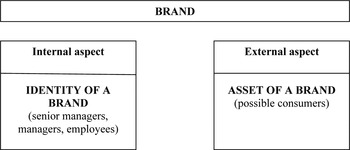
The literature contains much advice and many rules regarding creating a successful brand. The discipline of brand management is discussed by several authors, such as Kapferer (Reference KAPFERER1992), De Chernatony (Reference DE CHERNATONY1999), Aaker and Joachimsthaler (Reference AAKER and JOACHIMSTHALER2000) and Vukasovič (Reference VUKASOVIČ2009b), who analysed brand concepts from the manager’s point of view. The work of Barwise (Reference BARWISE1993), Keller (Reference KELLER1993), and Aaker (Reference AAKER1996) discuss the concept of ‘brand asset’, both from the financial and the consumer’s point of view. It can be accepted that both points of view must be considered in any brand evaluation. Firstly, companies investing in a certain brand and ensuring they seek the right balance between investment and a desired result must be considered. At the same time consumers, who ultimately decide which brands to purchase are also key in the determination of successful brands and must not be forgotten. In the entire food chain, a consumer is the link influencing a brand asset from the financial aspect. Experts suggest that both are co-dependant and connected in the modern analysis of brands (Figure 1; De Chernatony, Reference DE CHERNATONY1999).

In the balanced view of a brand, both identity and asset play an important role. Brand identity defines how it should be perceived and understood by consumers and what type of relationship should be created between a brand and its purchasers. This is an element which passes on messages to the wider audience regarding products, activities and slogans. The essence of identity is in brand individuality, values, the future, properties and the external image of a product (Kapferer, Reference KAPFERER1992).
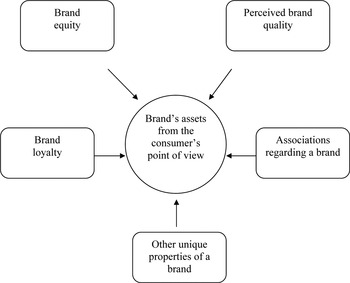
Various authors stress different factors influencing the success of creating a brand identity. Authors agree that, when defining a concept of identity, it is crucial to present a brand from the internal aspect - i.e. how different groups within a company look upon a brand (De Chernatony, Reference DE CHERNATONY1999). These groups must be capable of harmonising their perception of a brand in order to communicate its values to the final consumer. Brand asset, in its external aspect, increases as its consumer following becomes higher. Brand loyalty, equity, perceived quality, clear associations regarding a brand and other unique properties of a brand. The Aaker model (Figure 2) is among the most famous conceptual models, and aims to define and explain factors of brands assets from the consumer's point of view.

The food industry is highly competitive, and marketing plays a central and leading role, whereas management and positioning of brands represents a major challenge. For companies within the industry, it is essential to own or create strong brands which correspond to the selected target sales segment.
An established brand and loyal consumers - a key to market success
The basic purpose of branding is, according to professional and scientific publications, a differentiation between one producer's products and those of his competitors. Such concepts are hardly new, as labelling of this kind were already established practises in ancient times. The industrial revolution proved an important milestone in brand definition and since then brands have been looked upon in a more complex manner. Modern brand-defining elements, which form closer ties between a product and its consumer, are used alongside basic logotype and legal protection of products.
The producers of high-volume products are aware that a company's leading role in the market is ensured through strong and established brands and loyal consumers. Today, labelling is such a strong factor that there are hardly any products without branding. Various publications are available which provide advice on how to create or shape a successful brand. On the other hand, decisions regarding the policy of branding products are far from being straight-forward and require numerous considerations (Vukasovič, Reference VUKASOVIČ2010).
Brands have two basic functions: differentiation among products of the same type and building trust regarding quality or other aspects for the consumer. A high quality and/or well established brand increases tolerance and stability for the product (e.g. against new competition) which may negatively influence business efficiency. Besides functional or sensory properties, a strong and established brand ensures confidence for the consumer as well. The basic meaning of a brand is to create a relationship between consumer and product. Consumers may decide to buy higher quality products, but this is only a precondition for brand creation. A brand must have its own personality, identity, image and a character. Based on the latter it can be determined that brand equity has become more important.
Brand positioning
There is no greater marketing truth in this era than the term ‘killer competition’, with high proliferation of brands and constant bombardment via advertisement (Sengupta, Reference SENGUPTA2007). Consumers are overwhelmed by information about products, services and brands. Their position can be viewed as a complex set of perceptions, impressions and sensations, which arise whenever they make a comparison among different brands (Barnes, Reference BARNES1997). The position of a brand depends on the way the consumers perceive quality, advantages and disadvantages, price, value, and image (Dibb and Simkin, Reference DIBB and SIMKIN1993). Ries and Trout (Reference RIES and TROUT1993) were pioneers in the field of positioning and determined that positioning requires careful planning and consideration of the consumer's preferences and needs, environmental factors, position characteristics of competitive products and their possibilities. The process of positioning is a well-considered, proactive and interactive process that enables defining, measuring, changing and controlling of the consumers’ perceptions according to individual elements of the offer. Success depends on the importance that consumers give on extent of brand differentiation (Upshaw, Reference UPSHAW1995, Blankson and Kalafatis, Reference BLANKSON and KALAFATIS1999, Walker et al., Reference WALKER, HARPER BOYD and LARRECHE1999, Hooley et al., 2008).
Successful positioning requires four important factors (Jobber, Reference JOBBER1995):
• Clarity: the idea of positioning needs to be clear, both in the aspect of target market and in the aspect of competitive advantage.
• Consistency: consumers are overwhelmed by large amount of messages every day and therefore need a message that will be used consistently.
• Credibility: the selected message of competitive advantage needs to be credible for target consumers.
• Competitiveness: the products need to have a competitive advantage. They have to offer to consumers an added value which the competition does not have.
The process of positioning
The process of positioning can be divided into three groups, as described by Myers (Reference MYERS1996). In the first step, a company determines a current situation of all products and brands that are available in the offer to a certain segment of consumers. The situation is determined by information acquired by market researches and analyses. The most useful way to determine the current situation is with the help of ‘perceptual maps’ based on the perceived similarity/dissimilarity among brands from the same category of products. The perceptual map describes the perception of one's own brand and competitive brands regarding characteristics that define its value. The next step is to define the consumer's preferences of selected brands. A company has two options in this respect; firstly, the traders can consider, from the consumer's point of view, the ideal combination of the brand's characteristics. By doing this, they can assess the desired and actual characteristics of a brand, i.e. quality or price. The second option is that consumer's assess not only a degree of familiarity among competitive brands, but, at the same time, show their preferences towards every single one of them. With the help of perceptual maps, it is possible to determine market niches that remain unexploited, characteristics of products which consumers most prefer and their attitude towards brands. The third step in the process of positioning is forming a marketing cluster, i.e. a set of marketing decisions on a certain brand, made by the managing staff of a company in order to implement a marketing strategy which will ensure that the set goals are achieved (Doyle and Stern, Reference DOYLE and STERN1999).
The food industry context
The food industry is one of the most competitive and is in a mature stage of development. In order to maintain a competitive position, companies have to constantly prove themselves by providing innovative products and processes, as these play an important role in this industry. Based on the following example, we can demonstrate the applicability of the research in the process of brand evaluation, determining the positioning and communication guidelines for food products brands (Vukasovič, Reference VUKASOVIČ2009a).
The present example is used to illustrate the application of this framework and outline the research method. This shows how the process of positioning of a poultry brand was tackled by the leading food company in Slovenia. The results were subjected to the conceptual model of the strategic positioning of the brand, and by performing a market research of consumers of high-volume products (FMCG - Fast Moving Consumer Goods) brands and adding a detailed analysis of the poultry meat category and products.
Cross - national positioning concepts: case for Slovenian poultry brand
The company tackled the modernisation of a brand thoroughly, on a long term basis and by applying modern marketing approaches. The company used the conceptual model of strategic positioning of the brand - Cross National Positioning Concepts (Ogilvy, Reference OGILVY2006), with the main objective being to find the added value of the brand that will help distinguish it from the competition.
The following research phases were performed as a part of the model:
• analyses of competition
• brand scan: analysis of the brand's key elements: product, image, consumer, visual, channel, goodwill
• brand challenges
• consumer context - qualitative market research
• conclusions: development and testing of positioning concepts
• recommendations: selection of the best suitable concept and new positioning of the brand
Methodology and sampling
Market research guidelines that emphasised the determination of key variables, the use of multi-item measurement scales and of various research plans were considered in the analyses of the results (Malhotra et al., Reference MALHOTRA, PETERSON and KLEISER1999). Details of the research methods can be found in Vukasovič (Reference VUKASOVIČ2009b), Strašek (Reference STRAŠEK2010), Strašek (Reference STRAŠEK2011) and Vukasovič (Reference VUKASOVIČ2011). In this section, the key characteristics of the samples are summarized. The results from the focus groups in Slovenia and in the selected foreign markets (Austria, Czech Republic, Switzerland and Germany) were carried out in Ljubljana (Slovenia) where 10 women from rural areas, aged from 40 to 55 years participated, and in Maribor, where 8 women from urban areas, aged from 20 to 40 years participated. The participants of the focus groups were responsible for purchasing food in their households and were loyal to Perutnina Ptuj brand. Most of the participants had completed higher or post-graduate education (65%), 28.3% completed high school, while 6.7% of the participants only finished elementary school. The focus groups in the foreign markets (Austria, Czech Republic, Switzerland and Germany) were carried out later in the re-positioning process, as part of testing possible concepts in brand re-positioning. Women, aged from 20 to 55 years, 50% of them from rural and 50% from urban areas, were included in the samples in all the markets.
the first step: analyses of competition
In the first step the analysis of the competitors on the international poultry meat and products markets (Austria, Czech Republic, Switzerland and Germany) was carried out. Within the selected markets, 120 competitor products were included. Their position mainly focused on health, tradition, taste, quality. Some were more oriented towards social aspects and convenience. The competitors’ positioning and images concentrated on similar points, thus giving a wide range of possibilities for differentiation.
brand scan follow up (2nd step)
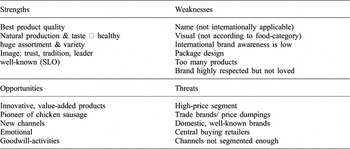
A structured investigation included what strengths and weaknesses the brand currently had (Table 1) and what opportunities and threats it may encounter in six interrelated key brand areas: product, image, consumer, packaging, sales channels and goodwill. The result of the brand scan SWOT analysis (Figure 3) shows how the challenges were defined.
Brand scan summary.

Brand scan.
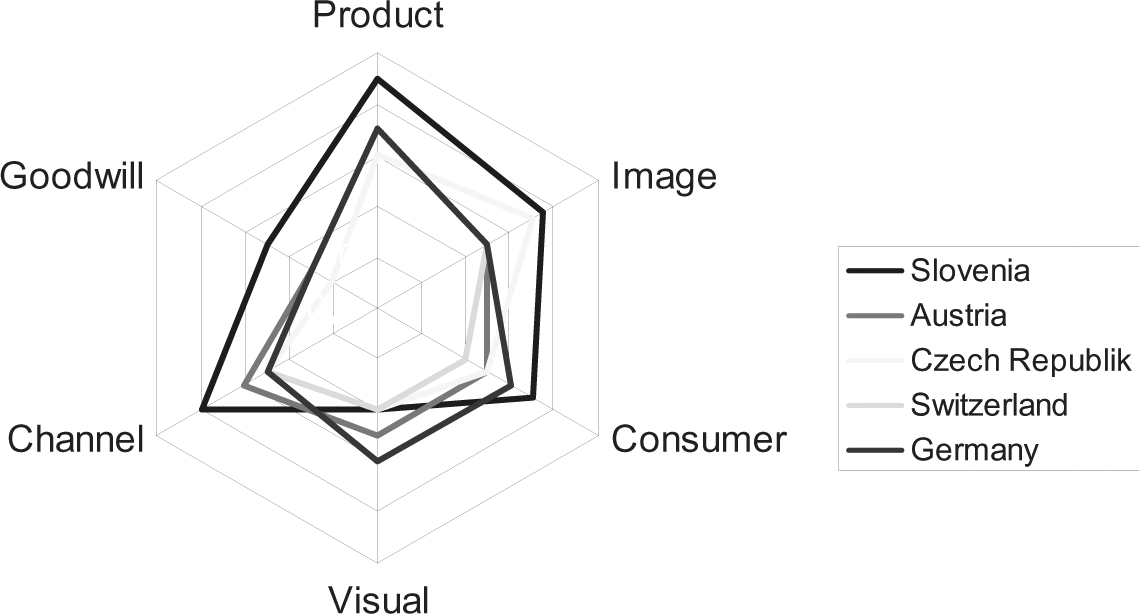
The Slovenian poultry brand is considered as a trustworthy market with alot of positive associations: attractive packaging, reasonable price, wide product range with long presence. Brand perception is more concerned with taste, health, rural associations and family.
follow up brand challenges (3rd step)
Activities for step three were oriented towards defining the improvements that need to be considered alongside the new brand positioning. This identified how best to build a position in the market, and aspects that needed to be rectified in order for the brand to maintain its position.
Brand challenges:
• Rename brand for the international markets
• The new brand name needs to stand as the umbrella brand above all products offered by the company
• Build consumer loyalty
• Raise awareness, positive associations and trust in the brand
• Get closer to the consumer segments and become more independent from local food trade
follow up consumer context - qualitative market research (4th step)
Consumers have a different point of view concerning the market, category and competition. The goal of this step was to identify target groups that define themselves by lifestyle, ideas, values and their relationship to the brand. Qualitative market research revealed 'insights' relating to the brand. Qualitative research provided a proposal for the assortment (non-met needs and expected core competence of the brand) and an image of Slovenian Products.
Participants of the two focus groups were women (20-40 years and 40-55 years) who purchase household food and are loyal to the brand. By implementing the qualitative research aided by the method of focus groups, the following were established: the general attitude towards poultry product category, brand knowledge, position, image (picture, tonality, strengths and weaknesses, personality, promise, relevance), market position (products, competitiveness, involvement, uniqueness), purchase habits/target groups, brand market communication and future issues. In conclusion, the following was determined:
• Slovenian branded poultry is a well known and trusted market leader in Slovenia
• Positioning is similar to the competitors’ positioning in their respective markets
• Consumers want safe natural food that keeps them not only healthy (like many competitors claim) but keeps them slim.
Key findings of the marker research that lead to the new position of the brand are described in the steps five and six, which illustrate the concept selected for the positioning model and the new positioning of the brand.
follow up development and testing of positioning concepts (5th step)
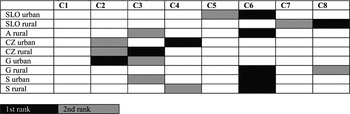
Eight concepts (based on the results of these studies) apart from common poultry positioning were developed. They were based on social trends, consumer values and product features. The concepts were tested in Slovenia, Austria, Czech Republic, Germany and Switzerland in the focus groups with women responsible for the food purchases made, consuming poultry at least once a week, aged 20 - 55 years, 50% of them from urban and 50% of them from rural areas. Table 2 shows the development of possible concepts.
Development of positioning concepts.

Overall the most preferred concept was concept six, which states that Slovenian branded poultry products are healthy. This perceived high quality comes from the strict quality control in the food chain. Products have only very little fat, but are tasty. The low fat content and the high palatability and nutrient levels contribute to percieved eating value. The realisation of concept six, with the integration of positive aspects of other concepts in order to better underline safety, naturalness and nutrient quality appears ideal in terms of meeting consumer needs. This enables Slovenian poultry producers to position themselves within the desired target markets.
the last step: the new positioning for Slovenian branded poultry
The results of the competition, brand and consumer analysis, and the testing of possible concepts in the food market have provided a starting-point for the new positioning for Slovenian poultry, with the message titled ‘Naturally fit’. With the new positioning of the brand, the company switched their focus from the product to benefits for consumers, whereby 'Naturally fit' has become the common thread between the product (which is healthy, safe and high quality) and a consumer (who wants healthy nutrition and wishes to be active). The new positioning of the ‘Naturally fit’ brand has brought us to the heart of the brand which reads as follows: The best way to keep yourself fit in the natural way - Naturally fit.
Conclusions
Brands are part of our daily life. Today, brand labelling is such a strong factor that there are hardly any products not bearing a brand. Consumers are demanding more, they have higher expectations regarding quality and functionality, as well as brand image. As the values of consumers change so to do their attitudes towards branding. The need to understand purchasing behaviour has become greater as manufacturing, sales and marketing orientation have developed.