The genesis of this narrative literature review was a music education conference held at the University of Waikato in January 2013. While the conference was co-hosted by the University and Orff New Zealand Aotearoa (ONZA), a professional body of teachers involved with Orff principles and practices, there were two themes that made this conference atypical of an Orff convention. The first was its focus on both music education research and pedagogy, and the invitation to presenters to avoid (should they wish) a narrow focus on Orff traditions and pedagogies. The second was the enactment of the conference within the framework and protocols (kawa) of New Zealand's indigenous Māori culture, reflected in its opening ceremony (pōwhiri), a number of its workshops and cultural entertainment items and in its closing ceremony (poroporoaki). The title of the conference — Tui Tuituia — suggests unity among peoples and with place. The conference then, brought together two distinct traditions: a relatively ‘mainstream’ approach to music education with its origins in Bavaria, and an indigenous performing arts tradition in which music was learned through enculturation (Campbell, Reference Campbell2000, p. 7).
As explained below, reviews are undertaken for various reasons and with different degrees of systematicity. Typically, a doctoral literature review aims to canvass a topic, and identify relevant research, conceptual debates and gaps. In our case, the aim was somewhat different. In identifying ways in which the scholarly and professional literature had addressed the relationship between mainstream music education and indigenous performing arts traditions, we were seeking guidance in respect of how a teacher educators and music teachers might begin shaping a policy in relation to specific issues such as programming, resource selection, activity design and so on, in a country with a strong indigenous performing arts tradition.
We brought a postcolonial lens to the project, believing that music education approaches developed in the western world often paid lip service to nonwestern music and performing arts traditions. How might those of us shaped by western musicking discourses engage intersubjectively with the indigenous ‘other’ in ways that honoured indigenous arts doing and making, while attending to those factors that militate against one's capacity to respond adequately in a Levinasian sense (Derrida, Reference Derrida, Brault and Naas1999). We were asking: What does it mean to do music education or to do music education research in settings where there are strong, indigenous performing arts practices and traditions operating? The review was timely, not just because of our specific purposes, but because acknowledging indigenous performing arts in schools is receiving growing international attention (Marsh, Reference Marsh2000; Rose, Reference Rose1995; Wemyss, Reference Wemyss1999).
This selective literature review discusses ways in which indigenous musics and performing arts in general are currently addressed in music education settings in selected ‘new world’ countries, most particularly Australia and New Zealand. This review explores some areas of research and the wider literature regarding: the place of indigenous music in mandated curriculums, teacher training in indigenous performing arts, curriculum design and programming, resource selection, activity design and school and community relationships.
‘Indigeneity’ and Decolonisation
An official definition of ‘indigenous’ has not been adopted by any UN agency owing to the diversity of indigenous peoples (United Nations, 2006). However, we have adopted for our purposes a widely used definition based on Martinéz Cobo's Report to the UN Sub-Commission on the Prevention of Discrimination of Minorities (1986/7) is as follows:
Indigenous communities, peoples and nations are those which, having a historical continuity with pre-invasion and pre-colonial societies that developed on their territories, consider themselves distinct from other sectors of the societies now prevailing in those territories, or parts of them. They form at present non-dominant sectors of society and are determined to preserve, develop and transmit to future generations their ancestral territories, and their ethnic identity, as the basis of their continued existence as peoples, in accordance with their own cultural patterns, social institutions and legal systems (International Work Group for Indigenous Affairs, 2013, para 11).
Expressed thus, the concept of indigeneity is bound up with colonisation. However, as a reference to actual historical events and as a signifier with various meaning potentials (Fairclough, Reference Fairclough1992), colonisation can be applied to a range of situations, including those without large-scale, territorial alienation (Ireland, for example). The indigenous peoples referenced in this review were certainly colonised, but in addition were dispossessed to such a degree that they became relatively powerless and marginalised minorities within the borders of their ancestral lands. They became a particular variant of the Fourth World: a subnation within a nation (Veeder, Reference Veeder1995).
We are mindful that there is a relationship between the topic of this review, and the broad issue of culturally responsive education or multicultural education, which has been extensively theorised and categorised (e.g. Banks, Reference Banks1999). The position we operate from is a critical multicultural one, which acknowledges the role of ethnicity and culture in identity formation without essentialising them (May, Reference May, Peters, Lankshear, Olssen and Kincheloe2003). Nevertheless, we agree with Barnhardt and Kawagley (Reference Barnhardt and Kawagley2005) that it is legitimate to regard ‘indigenous people [as having] their own ways of looking at and relating to the world, the universe and each other’ (p. 10) while viewing these characterising qualities as ‘tendencies rather than fixed traits’ (p. 11).
Decolonisation begins with the recognition of the ways indigenous epistemologies, knowledges and cultural practices ‘have been jeopardized by the spread of social structures and institutionalized forms of cultural transmission’ (Barnhardt & Kawagley, p. 10). It proceeds to an active valorisation of indigenous knowledges, works to maintain them, and recognises ways in which, as Battiste (Reference Battiste2002) puts it: ‘Indigenous knowledge fills the ethical and knowledge gaps in Eurocentric education, research, and scholarship’ (p. 5).
Unsurprisingly, decolonisation thus described was an orientation shared by a number of the authors we reviewed. Dillon and Chapman (Reference Dillon, Chapman, Shehan Campbell, Drummond, Dunbar-Hall, Howard, Schippers and Wiggins2005), for example, characterised musicians with a European background as inclining to see music as an expressive and aesthetic activity that can be objectified, while Aboriginal people's music practices were a way of knowing the environment. Similarly, Power and Bradley (Reference Power and Bradley2011) saw the heart of Aboriginal culture as attachment to and significance of place, with singing about important sites as affirming their existence and their connections with traditional occupiers. York (Reference York1995) noted the central role music plays in Torres Strait Island culture as a vehicle for participation and a means by which Islanders affirm their association with and position within Islander. In Aotearoa/New Zealand, Māori use song and rhythmic speech to argue points, express ideas and emotions and to transmit important traditions from generation to generation through story (Nyce, Reference Nyce2012).
We are mindful of the politics of naming indigenous groups. As McGrath (Reference McGrath2014) points out, words such as ‘indigenous, aboriginal, and native’ are English terms and ‘such naming and labeling’ can be viewed as ‘assertions of the colonial mindset to distort realities of truth’ (p. 21). She cites Glenn Words, a Torres Strait islander, who has described such labelling as reconstructing ‘the indigeneity of indigenous peoples into a series of racialised, homogenised and generally static icons that can be easily engaged and serviced’ (Woods, Reference Woods2005, cited in McGrath, Reference McGrath2014, p. 21). Throughout this review, the term ‘indigenous’ will refer to the native peoples of New Zealand (Māori) and Australia (Aborigine and Torres Strait Islanders). Following McGrath (Reference McGrath2014), we will use it with a small ‘i’, as a generally descriptive term rather than a name or label (proper noun), and likewise use ‘western’ with a small ‘w’. Indigenous music includes types and styles of music such as traditional, ethnic, national, regional and folk. Also included in the term are the varied forms of indigenous music which incorporate song, dance, storytelling, instrumental music, games and drama (Rose, Reference Rose1995).
Methods
Systematic reviews have their advocates (e.g. Davies, Reference Davies2000), as well as their critics (e.g. Clegg, Reference Clegg2005; MacLure, Reference MacLure2005), and are characterised by systematicity in selection in accordance with defined criteria, comprehensiveness and explicit evaluation of studies, selected on the basis of research design (with a bias favouring positivist models of research) and likely validity in terms of their findings (Hammersley, Reference Hammersley2001). Viewed positively, such reviews are seen as offering ‘cumulative evidence of “what works” and what does not (and, indeed, what constitutes “working” and “not working” in education)’ (Davies, Reference Davies2000, p. 366).
The project undertaken here, however, has more in common with a traditional narrative review, in that we set out to identify what had been written on the topic across a range of methodologies, epistemologies and conceptual frameworks. Narrative reviews have been described as ‘selective, if not haphazard’ lacking in systematicity, rigour and comprehensiveness, and ‘opportunistic’ (Davies, Reference Davies2000, p. 367 [italics his]). However, this does not have to be the case. Drawing on Badger and colleagues (Reference Badger, Nursten, Williams and Woodward2000), we brought a degree of systematicity to the review as described below.
Search Strategy
A number of databases were used as a means of locating the articles reviewed, in particular, the Indigenous Education Research Database (IERD) and ProQuest Education. Key words included ‘music education’, ‘performing arts education’, ‘indigenous’, ‘multicultural music education’ and also names for different countries and ethnicities (e.g. Inuit, Métis, First Nations, etc.). Extensive use was also made of article (especially review article) reference lists in locating suitable articles. In breaking down the review question, we drew on Eisner's (Reference Eisner2002) curriculum framing (see below) in seeking articles that dealt specifically with curriculum design and programming, resource selection, and activity/task design.
Selection Criteria
While we did not have a fixed ‘published after’ date, we concentrated on items published after 1995. We restricted our search to articles written in English, and focused on ‘New World’ nations on the Pacific Rim, i.e. Australia, New Zealand, the US and Canada, where the language of the colonisers was English. However, we have constrained our focus in this article to Australia and Aoteroa/New Zealand.Footnote 1
Types of Studies
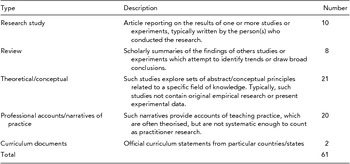
Peer reviewed articles were prioritised in the review. However, other types/genres were reviewed when more scholarly material was unavailable. In total, an analysis of 61 documents contributed to the review findings. Of these, 37 were peer reviewed (plus two theses). Numbers of articles/documents by type are listed in Table 1.
Types of Articles Reviewed

Data Extraction
Compared to systematic review procedures, our approach to evaluation was informal, with more weight being given to studies, we viewed as methodological rigorous. Because of the wide range of article types, data from quantitative studies were not extracted as happens in systematic reviews with a positivist orientation. We approached the task of ‘extraction’ with a wide brief. We were interested in small studies for the indicative value of their findings. We were interested in articles with a conceptual orientation, because we were interested in others’ views on what it means to do music education or to do music education research in settings where there are strong, indigenous performing arts practices and traditions operating. In addition, we were interested in practitioner narratives/research related to the topic.
Findings
In undertaking this review, we were interested in what the literature had to say about the presence of indigenous music in the curriculums of selected countries, teacher education in indigenous performing arts, curriculum design and programming, resource selection, choice of tasks/activities and school and community relationships. Each of these topics is addressed separately below.
Indigenous Music in Mainstream Curriculum Documents
The official curriculum can be thought of as the state's mandated description of what it deems its learners should know, be able to do, and value. As a legal document, it represents a powerful set of intentions that a school's intended curriculum (Eisner, Reference Eisner2002, p. 32) is meant to reflect. While some countries provide examples of official curriculums written specifically for the purpose of indigenous educational needs (as in New Zealand), our focus here is on ways in which mainstream curriculum documents construct a place for indigenous performing arts in relation to mainstream music education.
Australia
Australia has recently moved towards a national curriculum (Power & Bradley, Reference Power and Bradley2011). In the draft Arts curriculum, special attention is given to three cross-curriculum priorities, one of which is Aboriginal and Torres Strait Islander histories and cultures (Australian Curriculum Assessment and Reporting Authority [ACARA], 2012). The official intention is that Aboriginal and Torres Strait Island cultures be incorporated throughout the five Arts disciplines of Dance, Drama, Media Arts, Music and Visual Arts. All disciplines, apart from drama, have examples to support the Achievement Objectives that specifically mention Aboriginal and Torres Strait Islander performing arts. For example, Dance Objective 2.2 is: ‘Identify the elements of body, space, time, dynamics and relationships when expressing ideas through dance movement’ (ACARA, 2012, p. 26). The suggested activity is for children to make up a story about animals in the form of a dance, choosing and combining sounds and movements that mimic the animal in its environment, as shown in the traditional dance of Aboriginal and Torres Strait Islander people.
Prior to the development of the national curriculum, not all states and territories included specific mention of Australian indigenous music, and there was no mandate to include Australian indigenous music in the classroom (Power & Bradley, Reference Power and Bradley2011). In an effort to ensure the maintenance of Torres Strait Islander identity and culture, Island song has been increasingly promoted in Torres Strait schools (York, Reference York1995). In 1993, a project designing a curriculum for all Torres Strait schools was developed, entitled ‘A Culturally Appropriate Music Curriculum for Torres Strait Island Schools’. Its aim was to ensure a central place in the curriculum for Island song and dance and to foster their use in the music education of Islander children. While informally endorsed by the Queensland Education Department, this project was undertaken independently by Island elders, teachers, principals and researchers Lois Choksy and Frank York (York, Reference York1995).
New Zealand/Aotearoa
The Zealand curriculum document states that Arts education ‘embraces toi Māori, valuing the forms and practices of customary and contemporary Māori performing, musical, and visual arts’ (Ministry of Education, 2007, p. 20). However, of the four arts disciplines, only Music specifically mentions Māori culture. The document asserts that, ‘Value is placed upon the musical heritages of New Zealand's diverse cultures, including traditional and contemporary Māori musical arts’ (Ministry of Education, 2007, p. 21).
Since 2002, the New Zealand Qualifications Authority (NZQA) has recognised kapa haka as an academic subject in mainstream secondary schools, thus enabling Māori students who participate in kapa haka the opportunity to gain academic credits (Whitinui, Reference Whitinui2010b). Whitinui (Reference Whitinui2010b) argued that schools and teachers were likely to show a greater appreciation for Māori language, culture and traditions if kapa haka was included as an academic subject and not merely as a cultural add-on.
Teacher Education in Indigenous Musics and Performing Arts
Lack of teacher training in indigenous music
An overarching theme in the research is that many teachers feel ill-equipped in relation to both content and pedagogy in relation to indigenous performing arts (Dunbar-Hall, Reference Dunbar-Hall, Gifford, Brown and Thomas1997; Marsh, Reference Marsh2000; Murphy-Haste, Reference Murphy-Haste2009; Whitinui, Reference Whitinui2010a). In an Australian study, Marsh (Reference Marsh2000) found that many teachers cited shortcomings in their pre-service training in providing models for teaching Aboriginal music programmes as explaining their lack of confidence (Marsh, Reference Marsh2000). A survey in 1997 of 161 music teachers in a range of New South Wales’ schools found that only 14 per cent of teachers received pre-service training in the teaching of Aboriginal and Torres Strait Islander music (Dunbar-Hall, Reference Dunbar-Hall, Gifford, Brown and Thomas1997).
In terms of pre-service teacher education programming, two broad types of strategic response emerge from the literature, methods courses and immersion experiences.
Sands (2005, cited in Wang & Humphreys, Reference Wang and Humphreys2009) argued that separate multicultural music methods classes courses could play a role in enhancing multiculturalism in music teacher education programmes. Similarly, Campbell (1994, cited in Wang & Humphreys, Reference Wang and Humphreys2009) also suggested that preservice music teachers receive exposure to musical cultures other than the European art tradition in their music education methods classes. Such authors, however, represent a broad focus on multicultural education without attending to a specific engagement with indigenous arts. An example of the latter, however, are tertiary programmes at the University of Queensland featuring courses on ‘Indigenous Women's Music and Dance’ (MacKinlay, Reference MacKinlay2001) and ‘Aboriginal music: Performing place, Power and Identity’ (MacKinlay, Reference MacKinlay2005). Both courses used an embodied pedagogical practice, where experiential teaching and learning allowed ‘indigenous ways of understanding music and dance to be presented, privileged and empowered’ (MacKinlay, Reference MacKinlay2005, p. 113). Indigenous Australian performers shared their knowledge of various performance styles and genres through interactive workshops, and students were enabled to talk to the singers, musicians and dancers and to perform alongside them. It was this aspect of the course that MacKinlay (Reference MacKinlay2005) believed opened up the possibility for students to reflect upon their own personal and political positioning in relation to indigenous Australian peoples.
A crosscultural project which did involve indigenous musicians took place at the Winanjji-kari Music Centre in Tennant Creek, Australia (Bartleet, Reference Bartleet2011). Undergraduate music students from Brisbane participated in an immersive learning experience, spending two weeks living and working in this remote indigenous community. They created music with local musicians and took part in Warumungu language and culture classes. The students used field diaries to record their thoughts and interpretations of what was going on, were given video cameras to create a digital story of their experiences and were interviewed individually during the trip. It was found that new learning spaces were consequently opened up, where relationship-building and task-sharing were prioritised. Students began to address the devastation inflicted on indigenous peoples by colonisation and to understand how dialogue can foster reconciliation. The involvement of indigenous musicians and elders as teachers enabled indigenous ways of knowing and learning to be privileged.
Curriculum and Programming
Tokenism aside, the stipulation of indigenous knowledge and learning in an official curriculum is no guarantee that the intention will translate into either the intended or operational curriculum at mainstream school level (Eisner, Reference Eisner2002). As Eisner defines it, a curriculum ‘can be conceived of as a series of planned events that are intended to have educational consequences for one or more students’ (p. 31). But as Rose (Reference Rose1995) emphasises, ‘Curriculum’ can also have a more all-encompassing and complex definition, as the total set of experiences provided for a child/student in school programmes. In this wider sense, it includes what Eisner calls the implicit curriculum (and others the hidden curriculum), for example, the behavioural expectations and values that students are expected to comply with. Particularly pertinent to this review is Eisner's concept of the null curriculum — what schools don't teach in terms of both content and meaning-making processes. According to Eisner,
Many of the most productive modes of thought are nonverbal and illogical. These modes operate in visual, auditory, metaphoric, synesthetic eways and use forms of conception and expression that far exceed the limits of logically prescribed criteria or discursive or mathematical forms of thinking (2002, p. 98).
In noting the absence of these modes in contemporary schooling, he might well have had indigenous epistemologies in mind.
Taking a proactive stance, Australian researcher, Robert Smith (Reference Smith2002) proposed establishing a research centre to alert music educators to the increasingly indigenous focus in music pedagogies evolving in Australia and New Zealand. He contended that this evolution would ‘benefit by documentation and some level of democratically exercised and discretionary intervention within the process or processes of its development’ (Smith, Reference Smith2002, p. 69), and had the potential to produce a truly Australasian perspective drawing on each other's ways of learning and teaching in music.
Indigenous music and culture
Some indigenous and non-indigenous educators call for inclusive curriculums that acknowledge and incorporate indigenous knowledges and perspectives. A criticism of ‘inclusionary’ programmes, however, is that they are often celebratory rather than interrogatory, and reinforce cultural stereotypes while doing little to challenge hegemonic practices (Costigan & Neuenfeldt, Reference Costigan and Neuenfeldt2002). Writing in the Australian context, Dunbar-Hall (Reference Dunbar-Hall2005) suggests defining music education as cultural studies, where the focus of investigation is the uneven power relationships between different cultures and analysing the processes through which these relationships can be identified and circumvented (Dunbar-Hall, Reference Dunbar-Hall2005). A cultural studies approach to the music curriculum would require teachers to be aware of the social and political roles of music in various cultures.
Decolonising the curriculum
As mentioned earlier, some researchers and agencies have sought to decolonise and indigenise curriculums (Dillon & Chapman, Reference Dillon, Chapman, Shehan Campbell, Drummond, Dunbar-Hall, Howard, Schippers and Wiggins2005; Russell, Reference Russell2006a). Writing generally, Russell (Reference Russell2006a) argues that a decolonised curriculum needs to be co-constructed by teacher and students, noting that, ‘When curriculum builds upon the kinds of experiences that students have identified as meaningful, there is potential for increasing their awareness of their own sociocultural positionings’ (p. 239). Though situated in the tertiary context, Dillon and Chapman (Reference Dillon, Chapman, Shehan Campbell, Drummond, Dunbar-Hall, Howard, Schippers and Wiggins2005) investigated with the Oodgeroo unit the formal process involved in indigenising the music curriculum at Queensland University of Technology. They saw a grasp of indigenous arts as dependent on an understanding of the people and culture, and the historical and present relationships between a dominant white culture and the peripheral indigenous culture. First, they located an understanding of indigenous music in a context of world issues and perspectives including colonialism, postcolonialism and postmodernism. Second, they emphasised addressing the music from an indigenous worldview rather than/or at least as well as from a western worldview, focusing on meaning rather than sound. Third, they engaged students in issues of music and identity by having them personalise their perspective. Finally, they advocated having indigenous music presented by indigenous Australians (Dillon & Chapman, Reference Dillon, Chapman, Shehan Campbell, Drummond, Dunbar-Hall, Howard, Schippers and Wiggins2005).
Community involvement in curriculum development
The contributions of local, indigenous community members have been identified as an important component in curriculum design and delivery (Costigan & Neuenfeldt, Reference Costigan and Neuenfeldt2011). Wemyss (Reference Wemyss1999) believed that it is only through stringent and localised consultative measures that the integrity of curricular content, repertoire and methodology can be assured. Costigan & Newenfeldt (Reference Costigan and Neuenfeldt2011) also argue that dedicated and talented community members can contribute towards encouraging cultural practices and identity formation.
An important issue here is the localisation of consultation from community members who are experts on place (Wemyss, Reference Wemyss1999). This is important, because there is often considerable diversity among indigenous cultures. For example, in Australia, there are major differences between the cultures and musics of the two broad categories of indigenous Australians — Aborigines and Torres Strait Islanders, and notable diversity within each of these. There are currently 90 distinct Aboriginal languages and cultural groups and four broad cultural groups of Torres Strait Islanders, each group exhibiting specific characteristics that differentiates it from others (Wemyss, Reference Wemyss1999).
Curriculums within and beyond the mainstream curriculum
There are instances in the literature of specific programmes within programmes which embody indigenous performing arts, targeting indigenous students but sometimes open to nonindigenous students. A major instance is kapa haka in New Zealand. In 2009, it was estimated that over 50,000 children participated in kapa haka in schools (Whitinui, Reference Whitinui2010a). However, despite its links to performing arts, kapa haka tends to occupy a place as an extracurricular activity alongside the school's music programme.
Though not based in an attempt to reform the mainstream music curriculum, there are alternative education programmes, which use music to cater specifically to indigenous youth. The Australian ‘Holyoake DRUMBEAT’ programme, for example, uses hand drumming to engage young people in social learning that assists them in integrating more fully into mainstream school and community life (Faulkner et al., Reference Faulkner, Ivery, Wood and Donovan2010). A recent quantitative and qualitative study into the programme conducted by Ivery, Wood, Rosenberg & Donovan (2009, cited in Faulkner et al., Reference Faulkner, Ivery, Wood and Donovan2010) found that participants improved their levels of self-confidence, and reduced their levels of antisocial behaviour.
Integration
Some researchers in the field of multicultural music education explore the concept of integration (e.g. Murphy-Haste, Reference Murphy-Haste2009; Rose, Reference Rose1995). In this context, integration refers to the design of programmes where students approach topics, problems or tasks employing the knowledge-producing methods of a range of subjects or disciplines (Author 1, 2009). Indigenous music offers opportunities for curriculum integration, as it can readily be incorporated into curricular areas such as social studies, language, creative writing, enterprise education, history, politics, economy and the arts (Rose, Reference Rose1995).
Music and story are closely aligned in indigenous cultures, and story is a natural vehicle for integration. Boyea (Reference Boyea2000) states, ‘When cultural music is integrated into the curriculum, it should not be taught in isolation, especially where there is social, cultural or personal narrative to support the integration’ (p. 15). A practical means is through indigenous films, which allow students to develop analytical, musicological and performance skills, in order to better understand aspects of indigenous musical cultures and experience (Webb & Fienberg, Reference Webb and Fienberg2011). Indigenous films also communicate insider understandings of a musical culture, which Fienberg (Reference Fienberg, Mackinlay and Forrest2011) describes as invaluable when teaching an unfamiliar culture in a sensitive way.
School and Community Relationships
Understanding cultural context
The importance of multicultural music education being taught in relation to its cultural context is widely acknowledged (Boyea, Reference Boyea1999; Boyea, Reference Boyea2000; Dunbar-Hall, Reference Dunbar-Hall2001, Reference Dunbar-Hall2005; Murphy-Haste, Reference Murphy-Haste2009; Parsons, Reference Parsons1999; Power & Bradley, Reference Power and Bradley2011; Shi, Goetze & Fern, Reference Shi, Goetze and Fern2006). All songs and musical games are culture-specific in their purpose, value and contexts of use and production. They reflect a culture's values and ways of being in the world and embody a way of life. Not acknowledging the cultural implications of music when using music from a range of sources can result in a superficial version of multicultural education (Dunbar-Hall, Reference Dunbar-Hall2005).
Understanding the contexts which give rise to music and through which music is supported is essential in the teaching and learning of music. Dunbar-Hall (Reference Dunbar-Hall2001) argues that in the teaching of indigenous musics, such contexts can become frameworks through which pedagogy can proceed. This approach acknowledges the voices of indigenous peoples in the educational area and is both a ‘response to and a result of postcolonisation’ (Dunbar-Hall, Reference Dunbar-Hall2001, p. 1). An emphasis on indigenous contexts for musicking practices can also enable students, both indigenous and non-indigenous, to examine how politics and colonial practices have impacted, and still impact, on indigenous lives, and thus collaborate to interrogate and disrupt those colonising practices still operating (Costigan & Neuenfeldt, Reference Costigan and Neuenfeldt2002). Research confirms that contextual understanding can offer a way of teaching unfamiliar music (Dunbar-Hall, Reference Dunbar-Hall2001; Power & Bradley, Reference Power and Bradley2011). This involves teachers exposing students to historical, social and cultural elements that have contributed to the creation of the music (Dunbar-Hall, Reference Dunbar-Hall2001; Murphy-Haste, Reference Murphy-Haste2009).
Working with the community and ‘Culture Bearers’
In relation to indigenous musics, a way to provide this contextual understanding is to work with community members and musicians (Kennedy, Reference Kennedy2009; Marsh, Reference Marsh2000; Murphy-Haste, Reference Murphy-Haste2009; Parsons, Reference Parsons1999; Power & Bradley, Reference Power and Bradley2011). Such an approach calls for ‘an understanding of the context from which music arises, essential in any music teaching and learning’ (Power & Bradley, Reference Power and Bradley2011, p. 36). Parsons (Reference Parsons1999) highlights the importance of this in the teaching of waiata (singing) in New Zealand schools, asserting that ‘In the case of the waiata, an understanding of the art form requires an understanding of its cultural function; knowledge and understanding of the waiata results in a knowledge and understanding of the physical, social and emotional life of the Māori’ (Parsons, Reference Parsons1999, ‘Role of Arts within society’, para 7).
Inviting elders and ‘Culture Bearers’ into classrooms to visit, share and teach is a way of exposing students to indigenous culture (Kennedy, Reference Kennedy2009; Murphy-Haste, Reference Murphy-Haste2009). Such exposure can also result in changes in attitudes towards unfamiliar cultural traditions (Power & Bradley, Reference Power and Bradley2011). For example, a project conducted with preservice education students at a university in Sydney found that contact with an Aboriginal performer in residence enabled students to participate in a significant and authentic learning process, since it allowed students to learn through indigenous rather than western perspectives (Marsh, Reference Marsh2000). Moreover, personal contact with a culture bearer positively affected student attitudes to the teaching of Aboriginal music in educational settings and created new levels of crosscultural understanding. When including indigenous people in the classroom, MacKinlay (Reference MacKinlay2011) suggests music educators use the ‘multi-faceted potential of “relationship” as a teaching and learning approach. . .Relationship as pedagogical method is performed through an “ethic of friendship”, of mutual respect and trust, of coming to know Self in relation to the Other, of shared histories and experiences, of feeling empathy, and of on-going dialogue’ (p. 20).
Resource Selection and Use
Accessing resources
A survey of New South Wales’ music teachers in 1997 found a high number citing a lack of resources as a problem when teaching Aboriginal and Torres Strait Island music (Dunbar-Hall, Reference Dunbar-Hall, Gifford, Brown and Thomas1997). A contradiction was noted in these responses, however, as many teachers managed to list specific books, recordings and videos that they used to teach the topic. Dunbar-Hall (Reference Dunbar-Hall, Gifford, Brown and Thomas1997) sought to explain this anomaly by suggesting that teachers may perceive resources as textbooks suitable for class use rather than the music itself. Teachers may be unsure how to utilise the music in the classroom, when it is not notated and bears little relationship to their training. He recommended strategies for teaching music outside the western art music tradition, such as transcribing didgeridoo parts as a teaching and learning activity. In addition to notating rhythm and pitch with standard symbols, students would be required to invent notation or modify existing notation, to manage the range of sounds produced on the instrument and so develop aural skills. However, he acknowledged that such a strategy was still a western mode of analysis, at odds with the holistic approach that indigenous musicians adopt.
Abril (Reference Abril2006a) called on teachers to find music representative of the culture being studied, stating that to recognise the representative characteristics of a particular culture requires immersion in the music through listening, attending concerts, performing, reading and watching videos. Such immersion was supported by Bieber (Reference Bieber1999), who stated that the more thoroughly the teacher understands a piece of world music and is familiar with its cultural context, the greater the chance of producing an arrangement that can claim some degree of authenticity. He encouraged teachers of instrumental music programmes to arrange indigenous music for western instruments.
Song ownership and obtaining permission
The issue of song ownership within indigenous cultures is a key one for this review (Costigan & Neuenfeldt, Reference Costigan and Neuenfeldt2011; Kennedy, Reference Kennedy2009; Russell, Reference Russell2006b). Much indigenous music belongs to a person or a ceremony, so it cannot be performed without permission and acknowledgement. Torres Strait Islander artists, for example, must consider cultural protocols and intellectual property rights regarding who owns a song or dance and how that song or dance can be used. It is therefore crucial to seek permission from the appropriate language group or family (Costigan & Neuenfeldt, Reference Costigan and Neuenfeldt2011). It can be a challenge, then, for teachers to find songs that are in the public domain and suitable for classroom use (Russell, Reference Russell2006b). Educators must be careful when accessing material via CD or the Internet and establish whether permission to use the material has been given (Kennedy, Reference Kennedy2009).
The use of indigenous popular music can circumvent the problem of obtaining permission. However, some researchers caution against using ‘Americanised’ or popularised versions of music. While such forms can facilitate accessibility and be preferred by children, Abril (Reference Abril2006a) argues that it can result in the loss of the very qualities that made the music unique to begin with. This view was shared by Palmer (Reference Palmer1992), who, whilst believing that some compromise is inevitable in representing a musical culture in a school setting, asserted that educators should determine at what point that musical experience is no longer acceptable as a representation of a culture.
Using resources appropriately
If a postcolonial approach is to occur, educators must avoid the tendency to extract musical concepts from their cultural context and use western European methods of analysis to frame and teach the concepts (McIntyre, Reference McIntyre2012). Dunbar-Hall (Reference Dunbar-Hall2005) provides an Australian music education example, where it is common practice to use traditional Australian music as a teaching resource. These musical selections are studied as examples of pitch patterning, durational practices and musical structure. However, breaking down the music via concepts used to analyse western music removes the holistic approach that indigenous musicians adopt — an approach where pitch cannot be separated from the words of a song, the rhythms of the music, the dance it accompanies, the story it describes or the places where it can be performed. MacKinlay (Reference MacKinlay2001) states that in her tertiary programmes at The University of Queensland, part of the challenge is to, ‘address the complex set of power relations and interactions that underscore each musical moment and the way teaching and learning takes place between, from, and through non-Indigenous and Indigenous participants in social space which historically has been dominated and controlled by Western mainstream systems of knowledge [capitals sic] (p. 3).
Specific resources
The review provided a number of examples of resources that address the need to adequately and appropriate situate indigenous material in context. Kapua Gutchen, a Torres Strait Islander artist, developed traditional and contemporary music and dance from Erub (Darnley Island) Torres Strait. His community CD/DVD, ‘Erub Era Kodo Mer: Traditional and contemporary music and dance from Erub (Darnley Island) Torres Strait’, aimed to pass on knowledge of cultural practices and language to younger generations. Kapua Gutchen ensured that his music addressed contemporary issues and was not taught in isolation but rather in relevant sociocultural and environmental contexts (Costigan & Neuenfeldt, Reference Costigan and Neuenfeldt2011).
The 1991 release of the song ‘Treaty’ by Yothy Yindi led to the development of a series of teaching resources in Australia. The song was in Ian Dorricott's secondary music textbook Listen to the Music, Australian Music Centre teaching kits (Australian popular music: supplement) and, most recently, the ABC Pure Drop online teaching resource, The pure drop: An exploration and celebration of world music (Fienberg, Reference Fienberg, Mackinlay and Forrest2011). Fienberg (Reference Fienberg, Mackinlay and Forrest2011) notes that these resources provide teachers with a ‘safe’ entry point into Australian indigenous culture. In New Zealand, the waiata anthology Hei Waiata, He Whakakoakoa was distributed free to all schools with an audio recording of all the material. This publication informs the classroom teacher when songs may be sung as well as the appropriate manner of their performance (Parsons, Reference Parsons1999).
Designing Tasks and Activities
Relatable activities for non-indigenous students
Ethnographic studies of children's songs and singing games, and studies of ritual chants and other musical practices, demonstrate their reciprocal relationship with the culture and values of their communities (Russell, Reference Russell2006b). If a split occurs between what children experience at school and what they experience in their community, a dissonance may result and ‘students may find it difficult to relate what they learn in school to those things that are more meaningful to them. They may fail to be engaged’ (Russell, Reference Russell2006b, p. 20).
Native musics can be made accessible to non-Native ears and minds through story (Boyea, Reference Boyea2000). The music may sound ‘alien and incomprehensible’, but ‘stories help ease the relationship, expose the beauty and soften the initial exposures to these odd and difficult sounds’ (Boyea, Reference Boyea2000, p. 16). Boyea (Reference Boyea1999), for example, suggests using traditional lullabies together with their background stories and translations.
Incorporating indigenous popular music in school curricula is another way to make the music relatable (Dunbar-Hall & Wemyss, Reference Dunbar-Hall and Wemyss2000; Fienberg, Reference Fienberg, Mackinlay and Forrest2011; Power & Bradley, Reference Power and Bradley2011; Wemyss, Reference Wemyss1999). Some researchers argue that contemporisation is necessary to maintain cultural validity in a changing world and that it is essential that contemporary forms of ‘tradition’ be presented to students (Wemyss, Reference Wemyss1999). She argued that indigenous popular served:
as a means to cultural tolerance, as a role model for indigenous community members, as a source of musical knowledge, as a current social comment or as emblematic of cultural intricacies; or it may be viewed as a combination of all these things in a synthesis of function akin to the concept of musical fusion inherent in the genre itself (p. 36).
Several case studies highlight the effectiveness of using indigenous popular music. In a case study involving a Year 8 music class at a Sydney high school, students were asked to choose and record a cover version of a song by an indigenous artist (Fienberg, Reference Fienberg, Mackinlay and Forrest2011). A number chose a song by Jessica Mauboy, who had recently risen to fame through Australian Idol and released two albums. For most non-indigenous students, their familiarity with Mayboy's work facilitated engagement and identification with a contemporary form of indigenous music. In another case study, two teachers successfully incorporated Aboriginal musics into their music programmes. One used an indigenous rap performance, which she identified as a style her students favoured listening to (Power & Bradley, Reference Power and Bradley2011).
Burton & Dunbar-Hall (Reference Burton and Dunbar-Hall2002) further comment that in countries where teachers lack confidence or poorly understand the ethical and religious implications of traditional musics, teaching through and about contemporary indigenous music provides a solution. This was borne out in research by Dunbar-Hall (Reference Dunbar-Hall, Gifford, Brown and Thomas1997), who found that for Australian music educators, teaching indigenous music through recordings of Australian Aboriginal and Torres Strait Islander rock groups alleviated problems arising from expectations that indigenous musics be included in the music curriculum.
Relatable activities for indigenous students
The experiential process of observing, trialing and experimenting appears in various articles regarding indigenous music education (Faulkner, Ivery, Wood & Donovan, Reference Faulkner, Ivery, Wood and Donovan2010; MacKinlay, Reference MacKinlay2001; Smith, Reference Smith and Harrison2009). This is the traditional mode of learning in Aboriginal communities, and therefore the focus of the DRUMBEAT programme mentioned previously (Faulkner et al., Reference Faulkner, Ivery, Wood and Donovan2010). This traditional learning style allows indigenous boys to play whatever instruments are on display on arrival in a music classroom (Smith, Reference Smith and Harrison2009). MacKinlay (Reference MacKinlay2001) used the experiential teaching and learning process in her university setting to challenge the authority of western knowledge production. Hooks (1994, cited in MacKinlay, Reference MacKinlay2001) suggests that, ‘focusing on experience allows students a knowledge base from which they can speak’ (p. 148). An example from one of MacKinlay's (Reference MacKinlay2001) sessions has an indigenous artist demonstrating dance moves, and students given verbal instruction and then imitating the dance moves for themselves.
As an educator who works with indigenous boys, Smith (Reference Smith and Harrison2009) notes that adolescent indigenous Australians enthusiastically identify with nationally and internationally acclaimed Aboriginal musicians and often favour genres such as reggae and rap. He further states that indigenous students across the Northern Territory in Australia are making ‘new and increasingly exciting original music, matched by equally compelling lyrics. . . .Music teachers are finding that almost all they need do is provide the hardware and software resources and a collaborative learning environment for their Aboriginal students, and the students do the rest’ (p. 90).
A collaborative approach to learning is important in indigenous cultures (Smith, Reference Smith and Harrison2009), who notes that traditionally, indigenous children learn in the company of familiar people and that if the boys don't like the adults they are working with, they may passively or even actively resist and ignore them. The DRUMBEAT programme deliberately avoids any opportunity for competition and instead focuses strongly on teamwork and the benefits of working with others (Faulkner et al., Reference Faulkner, Ivery, Wood and Donovan2010).
Oral learning
An emphasis on oral instruction appeared in several articles regarding teaching indigenous performing arts at tertiary level (MacKinlay, Reference MacKinlay2001; Kennedy, Reference Kennedy2009). Kennedy (Reference Kennedy2009) specifically notes that by being taught by watching and listening, she was ‘reminded of the value of oral/rote learning and the importance of developing our aural skills’ (p. 178). Smith (Reference Smith and Harrison2009) discusses the aural acuity of indigenous musicians, which led him to give up explaining and echo-singing new songs, but plunging straight into them — something he states proved far more effective and acceptable to students.
Use of instruments
Some researchers encourage educators to use authentic indigenous instruments (Abril, Reference Abril2006b; Burton, Reference Burton and de Quadros2000). Kacanek (Reference Kacanek2011) believes that the Native American flute has many positives, including being easy to play and produce a pentatonic scale. Programmes from a number of countries included the making of indigenous instruments as a key component. For example, creating a drum and its rattles made up four classes of a 13-week ‘Earthsongs’ course in Canada (Kennedy, Reference Kennedy2009). A class in Sydney created their own didgeridoo-like shapes following a visit from a local culture-bearer who had explained different techniques for playing it (Power & Bradley, Reference Power and Bradley2011).
Performing
Many researchers concur that students experience music best through performing it and in so doing gain a unique perspective on, appreciation for and understanding of the culture that produced the music (Bieber, Reference Bieber1999; Fienberg, Reference Fienberg, Mackinlay and Forrest2011; MacKinlay, Reference MacKinlay2001; Parsons, Reference Parsons1999). For example, in both case studies conducted by Fienberg (Reference Fienberg, Mackinlay and Forrest2011), experiencing music through performance was crucial to their relative success. Dialogue from students indicated how important this was in motivating them to listen to indigenous music and enhance their understanding of it.
Personal learning and embodied practice
Some researchers (Dillon & Chapman, Reference Dillon, Chapman, Shehan Campbell, Drummond, Dunbar-Hall, Howard, Schippers and Wiggins2005; MacKinlay, Reference MacKinlay2005) believe that an embodied pedagogical practice in indigenous education opens up a process of decolonisation. Through this approach, students are encouraged to theorise about their experiences but also to actively engage with political and ethical issues (MacKinlay, Reference MacKinlay2005). Kisluik (1997, cited in MacKinlay, Reference MacKinlay2005) asserts that a renewed emphasis on experience in ethnomusicology is gradually shifting the discipline towards a reflexive, nonobjectivist scholarship and further away from historically colonialist approaches. Dunbar-Hall (1998, cited in MacKinlay, Reference MacKinlay2005) agrees, and further suggests that in both music education and ethnomusicology, combining an ethnographic approach with a focus on personal experience is a way to direct student theorising. MacKinlay (Reference MacKinlay2005) emphasises ‘the limitless potential of an embodied pedagogy for chipping away, disturbing and deconstructing the formidable control and authority colonial discourse has on the ways in which we as nonindigenous Australians imagine, encounter, interact with and ultimately come to know about Aboriginal and Torres Strait Islander peoples and performance practice’ (p. 121). Though directed at the tertiary education context, these sentiments have clear implications for the compulsory schooling sector.
Conclusion
There is a growing body of research, theory and commentary regarding music education that addresses indigenous culture, with much discussion and debate surrounding the topic. A number of key themes have arisen in this review. First is the perceived need for tertiary programmes to provide preservice teachers with much more guidance in the teaching of indigenous musics. While some researchers argue for methods courses that enhance culturally responsive pedagogy, others suggest immersion experiences, where participants spend time in an authentic indigenous community, while engaging in/with indigenous performing arts and pedagogy.
A second theme is the need to develop pedagogical practices that highlight the cultural context of indigenous music and performing arts — a version of place-based education. The involvement of culture-bearers can provide this contextual understanding, as it makes the learning authentic, accessible and relatable to nonindigenous students. In an ironically reflexive way, a focus on such contextual understanding may provide a vehicle for renovating mainstream music education by incorporating indigenous epistemological understandings of the relationship between the arts and the spirit of place.
A third theme is the issue of song ownership, the need for sensitivity and awareness, and the omnipresent danger of cultural appropriation and offence. Educators have a responsibility to ensure that permission has been granted before using a resource or artefact, which raises difficulties when these are accessed via the Internet or other source. Some researchers recommend the use of indigenous popular music in the classroom, as it is relatable to students and circumvents the issue of cultural misrepresentation.
Finally, as music educators adopting a decolonising stance recognise, none of these issues can be separated from questions of power and privilege in society. All curriculums are the result of somebody's versions of what our students need to know, do and behave. These somebodies and the discourses they subscribe to have to be held to account for discourse effects, including the marginalisation of indigenous students and their cultural knowledges in mainstream educational systems. It is not good enough, for example, to consign kapa haka to a co-curricular activity in the Aotearoa/New Zealand context.
As Morton (Reference Morton, May and Sleeter2010) puts is, we need to eschew ‘musical tourism — a token form of multicultural education that showcases soundscapes from around the world, but fails to provide spaces to foster intercultural understanding, critical dialogue or sociopolitical action’ (p. 203). The challenge, in critical multicultural terms, is to acknowledge the role of ethnicity and culture in identity formation without essentialising them, and to recognise unequal power relations as a part of life and that ‘individual and collective choices are circumscribed by the ethnic categories available at any given time and place’ (2003, p. 209). We also need to keep reminding ourselves of the ways in which certain cultural knowledges are marginalised in society, and finally to own the social situatedness and provisionality of the positions we all speak from.
About the Author
Terry Locke is Professor of Arts and Language Education at the University of Waikato. His research interests include writing and writing pedagogy, the teaching of literature, power relations in curriculum development and arts education. He has published in the British Journal of Music Education, Thinking Skills and Creativity and The International Journal of Music Education. His most recent book is Developing Writing Teachers (Routledge, 2015).
Lauren Prentice is a postgraduate student in music education in the Faculty of Education at the University of Waikato and is current completing a dissertation on the use of GarageBand as a compositional tool on iPads within a Year 5 and 6 generalist classroom. In 2012, she won a University of Waikato Summer Scholarship to undertake this review.