Introduction
Zambia is amongst the many developing countries in Africa with a marked population of children living in low socioeconomic communities that lack access to safe water and sanitation (Chimbari et al., Reference Chimbari, Dhlomo, Mwadiwa and Mubila2003; Halwindi et al., Reference Halwindi, Magnussen, Meyrowitsch, Handema, Siziya and Olsen2010; Salam et al., Reference Salam, Maredia, Das, Lassi and Bhutta2014). In such impoverished settings, children are more susceptible to urogenital and intestinal helminth infections when compared with any other age group (Hotez et al., Reference Hotez, Bundy, Beegle, Brooker, de Silva and Montresor2006; Tchuem Tcuenté, Reference Tchuem Tcuenté2012). This vulnerability is particularly heightened by their regular contact with snail-infested (Bulinus globosus or Biomphalaria spp.) water bodies or faeces-contaminated soils (Mubila & Rollinson, Reference Mubila and Rollinson2002; Chimbari et al., Reference Chimbari, Dhlomo, Mwadiwa and Mubila2003). Infected children will eventually develop chronic disease conditions, including multi-organ damage, malnutrition, micronutrient deficiencies, stunted growth and impaired cognitive development, as well as reduced physical fitness (Bethony et al., Reference Bethony, Brooker, Albonico, Geiger, Loukas, Diemert and Hotez2006; Njenga et al., Reference Njenga, Mwandawiro, Muniu, Mwanje, Haji and Bockarie2011; Tchuem Tcuenté, Reference Tchuem Tcuenté2012; Mugono et al., Reference Mugono, Konje, Kuhn, Mpogoro, Morona and Mazigo2014; Salam et al., Reference Salam, Maredia, Das, Lassi and Bhutta2014). These morbidities are principally instigated by water-borne S. haematobium and S. mansoni, which cause urogenital and intestinal schistosomiasis, respectively. Similarly, these morbidities also result from the triad of soil-transmitted helminths (STH): hookworm, Ascaris lumbricoides and Trichuris trichiura (Ekundayo et al., Reference Ekundayo, Aliyu and Jolly2007; Tchuem Tcuenté, Reference Tchuem Tcuenté2012; Mugono et al., Reference Mugono, Konje, Kuhn, Mpogoro, Morona and Mazigo2014). Infected individuals generally encounter these parasites early in their childhood and some infections may remain subclinical until adulthood, when the most severe clinical manifestations occur, especially with heavy infections (Njenga et al., Reference Njenga, Mwandawiro, Muniu, Mwanje, Haji and Bockarie2011; Tchuem Tcuenté, Reference Tchuem Tcuenté2012; Mugono et al., Reference Mugono, Konje, Kuhn, Mpogoro, Morona and Mazigo2014).
In endemic areas school-age children have the highest infection intensities, and this gradually reduces with age, with the exception of hookworm, which inversely peaks in adulthood (Bethony et al., 2002; Tchuem Tcuenté, Reference Tchuem Tcuenté2012; Mugono et al., Reference Mugono, Konje, Kuhn, Mpogoro, Morona and Mazigo2014). High prevalence rates in children are frequently used as a measure of recent infections and also indicate active foci of transmission (Hira, Reference Hira1969). However, from a public health perspective, any infected person, regardless of age, represents a source of infection to the rest of the community due to the parasitic eggs they discharge in their faeces and urine (WHO, 2002). Yet mass drug administration against schistosome and STH infections specifically promotes the deworming of under-five and school-age children at health centres and schools, respectively (Halwindi et al., Reference Halwindi, Magnussen, Meyrowitsch, Handema, Siziya and Olsen2010; Mwandawiro et al., Reference Mwandawiro, Nikolay, Kihara, Ozier, Mukoko and Mwanje2013; Salam et al., Reference Salam, Maredia, Das, Lassi and Bhutta2014; Shawa et al., Reference Shawa, Mwase and Simonsen2014). This approach has been previously shown to provide externality benefits to the untreated persons, especially adults that live in the same community as the treated children (Njenga et al., Reference Njenga, Mwandawiro, Muniu, Mwanje, Haji and Bockarie2011). However, there is very little information on the extent to which untreated adults act as a reservoir for reinfection of treated children (Njenga et al., Reference Njenga, Mwandawiro, Muniu, Mwanje, Haji and Bockarie2011). This study therefore sought to determine the potential contribution of adult populations to the maintenance of schistosome and STH transmission in southern Zambia.
Methods
Study area and population
The catchment areas for the two districts were Magoye (16.0017S, 27.6041E) and Munjile (16.019 2S, 27.5010E) in Mazabuka, and Matuwa (16.4004S, 28.6843E), Nabutezi (16.4339S, 28.5433E) and Manchamwva (16.4670S, 28.4004E) in Siavonga. Geographically, Siavonga District is very mountainous and spreads out along the north bank of Lake Kariba in the Zambezi Valley. The valley is very hot in the summer months from October to March but is cooled by the summer rains from November to April. Fishing is a major activity for local villagers (Chimbari et al., Reference Chimbari, Dhlomo, Mwadiwa and Mubila2003). Mazabuka District lies 120 km south of the capital Lusaka and the terrain is generally flat with numerous small rivers. The majority of the population in Magoye and Munjile are subsistence farmers involved in the household and in cash crop production. In both the Siavonga and Mazabuka study sites formal education levels are low, rarely going beyond 7th grade (11–13 years old). Access to sanitation facilities and clean water is low in all the study sites, and schistosome and STH infections are common. Currently, control programmes in Zambia against schistosomiasis and STH are targeting children aged less than five years and school-aged children using the Mass Drug Administration (MDA) approach. There are currently no MDA initiatives against schistosomiasis and STH in adults. However, the first countrywide MDA against lymphatic filariasis was done in 2015, but there was still the challenge of low treatment coverage in some areas, which left some adults untreated and therefore still with the potential to contribute to transmission of the infections. There is also the problem of lack of the drugs praziquantel, mebendazole and albendazole for routine use in health facilities in Zambia. Praziquantel, in particular, is unavailable in most health centres most of the time.
Study design and sampling
This cross-sectional study was conducted in April and May 2013, and was part of a baseline survey for a larger study focusing on the cost-effectiveness of community-directed treatment of schistosomiasis and STHs in school-age and under-five children. Villages in each of the five study sites (the catchment areas of each health facility included in the study) were grouped into local geographical areas (LGAs) based on the existing neighbourhood health committee zones. Five LGAs were created in each site. The stratified sampling method, using LGA as stratum, was used to select the households from which participants would be sampled. A total of 125 households in Siavonga and 250 households in Mazabuka were selected from each LGA. That is, 500 households were selected from each of the three sites in Siavonga District, and 750 households from each of the two sites in Mazabuka District. The sampling frame for all eligible adults, both female and male, was created by conducting a census. The systematic random sampling method was then used to select the 3000 study participants, from which stool and urine samples were collected.
Sample collection and examination
Parasitological data were collected using the standard Kato-Katz technique and urine filtration method. The stool and urine samples were collected between noon and 4 pm. For stool samples, a duplicate 41.7 mg Kato-Katz cellophane thick smear of a single stool sample was examined from each participant. Each participant was given a plastic container in which to put the sample. Samples were collected from the participants by field assistants the following day and examined within 60 minutes of preparation of slides for hookworm eggs and later that day or the next day for other STH eggs (Mugono et al., Reference Mugono, Konje, Kuhn, Mpogoro, Morona and Mazigo2014). Egg counts were expressed as eggs per gram of stool (EPG).
The urine filtration method was used to process urine samples, which were collected in wide-mouth plastic containers. Immediately the urine was collected, 10 ml were aliquoted using disposable syringes and filtered through 12 μm polycarbonate membrane filters. Only one urine sample was collected for the diagnosis of S. haematobium. Infection intensities of S. haematobium were expressed as number of eggs counted per 10 ml urine. Quality control was ensured by re-examining a randomly selected 5% of sample of all slides by the principal investigator. No significant discrepancies in readings of slides were observed.
Data handling and analysis
Microsoft Excel spreadsheets were used for data entry. All statistical analysis was performed using STATA 13 (StataCorp, College Station, TX, USA). Proportions were computed to report prevalence and heavy infection intensities. Crude egg counts were recorded and converted to EPG for S. mansoni and STH infections and eggs per 10 ml of urine for S. haematobium. As described by Njenga et al. (Reference Njenga, Mwandawiro, Muniu, Mwanje, Haji and Bockarie2011), infected individuals were categorized as having light or heavy infection intensity based on the WHO classifications (WHO, 2006). For S. mansoni infections, light infections were 1–399 EPG and heavy intensity infections were ≥400 EPG. For S. haematobium, light-intensity infections were 1–49eggs/10 ml of urine and heavy-intensity infections ≥50eggs/10 ml of urine. Hookworm infections were classified as light intensity when egg counts were 1–1999 EPG, and heavy intensity when counts were ≥2000 EPG. Ascaris lumbricoides infections were classified as low-intensity infections when egg counts were 1–4999 EPG and heavy-intensity infections when counts were ≥5000 EPG. The analysis on infection intensity was done only on infected individuals.
Ethical considerations
The research proposal was reviewed and approved by the ERES CONVERGE ethics review committee in Zambia (ref.: 2013-jan-001). In addition, the Ministry of Community Development, Mother and Child Health reviewed and approved the protocol. During the study, written informed consent was sought from each participant after an explanation of the objectives and data collection methods of the study. Confidentiality and anonymity were ensured. Participants found positive were followed up and treated.
Results
Characteristics of study population
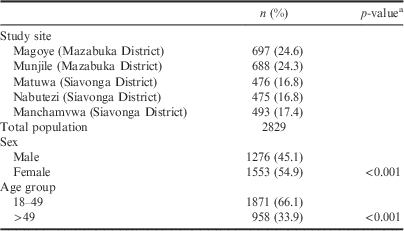
Table 1 summarizes the distribution of the included adults by study site, age group and sex. A total of 2829 individuals were sampled in the two districts: 1385 (49.0%) from the Siavonga sites and 1444 (51.0%) from the Mazabuka sites. The proportion of females was significantly higher than that of males (p<0.001). Of the sampled adults, 66.1% were aged between 18 and 49 years, and 33.9% were older than 49 years. The median age for the whole sample was 39 years.
Characteristics of the study population, Zambia, 2013
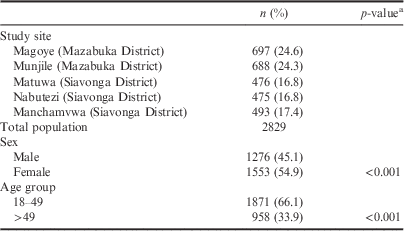
a Pearson’s χ 2.
Prevalence of S. mansoni and S. haematobium
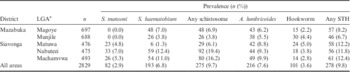
Table 2 summarizes the results for the prevalence of schistosome and STH infections. The overall prevalence of S. mansoni was 2.9% (95%CI 2.3–3.5), with the highest prevalence (7.0%; 95%CI 4.7–9.3) being recorded at the Nabutezi site. The district-aggregate prevalence for S. mansoni was significantly higher in Siavonga District (5.7%; 95%CI 4.5–6.9) compared with Mazabuka District (0.0%) (p<0.001). The overall prevalence of S. haematobium for all sites was 6.8% (95%CI 5.9–7.7), with the highest prevalence (12.4%; 95%CI 9.4–15.4) being recorded in the Nabutezi site. The district-aggregated prevalence of S. haematobium was significantly higher in Siavonga District (8.2%; 95%CI 6.8–9.6) compared with Mazabuka District (5.3%; 95%CI 4.1–6.5) (p<0.001). The overall prevalence of any schistosome infection for all sites was 9.7% (95%CI 8.6–10.8), with Siavonga District sites having a significantly higher prevalence (13.9%; 95%CI 11.3–16.5) compared with the Mazabuka District sites (5.3%; 95%CI 4.2–6.5) (p<0.001).
Prevalence of S. haematobium, S. mansoni and STH infections in adults, by study site, Zambia, 2013
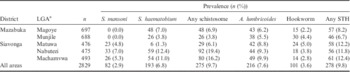
a LGA=Local Geographical Area, a grouping of neighbouring villages within a defined geographical location.
Prevalence of STH
The overall prevalence of A. lumbricoides for all sites was 4.6% (95%CI 3.8–5.4), with the highest prevalence (9.9%; 95% CI 7.3–12.5) being recorded in the Manchamvwa site. The district-aggregated prevalence of A. lumbricoides was significantly higher in the Siavonga sites (9.3%; 95%CI 7.8–10.8) compared with the Mazabuka sites (5.8%; 95%Cl 4.6–7.0) (p<0.001). The overall prevalence for hookworm for all sites was 3.6% (95% CI 2.9–4.3). The highest hookworm prevalence was 5.1% (95%CI 3.1–7.1), recorded at the Matuwa site. The district-aggregate prevalence of hookworm did not differ significantly between the Siavonga (3.9%; 95%CI 2.9–4.9) and Mazabuka District sites (3.2%; 95%CI 2.3–4.1) (p=0.37). The overall prevalence of any STH in all sites was 9.8% (95%CI 8.7–10.9), with Siavonga District sites having a significantly higher prevalence (12.1%; 95%CI 10.4–13.8) compared with the Mazabuka District sites (7.4%; 95%CI 6.0–8.8) (p<0.05).
Infection intensities for S. mansoni, S. haematobium and STH
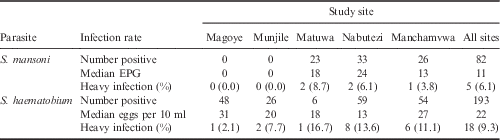
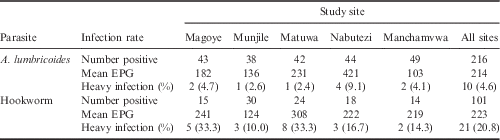
The intensities of S. mansoni, S. haematobium, A. lumbricoides and hookworm infections in the five study sites are summarized in Tables 3 and 4. The majority were light-intensity infections. Overall, 6.1% (95%CI: 0.90–11.3) and 9.3% (95%CI 5.2–13.4) of individuals infected had a high-intensity infection of S. mansoni and S. haematobium, respectively. It is worth noting that there were no adults with high-intensity infections of S. mansoni in the two Mazabuka District study sites (Magoye and Munjile). The highest proportions of infection with S. mansoni and S. haematobium were both in the Matuwa site: 8.7%, (95%CI 2.8–20.2) and 16.7% (95%CI 13.1–46.5), respectively.
Infection intensity of S. mansoni and S. haematobium in adults by study site, Zambia, 2013
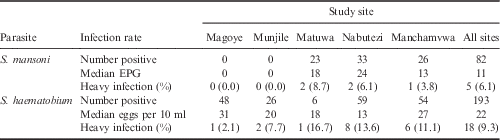
S. mansoni: light intensity=1–399 EPG; heavy intensity=≥400 EPG.
S. haematobium: light intensity=1–49 eggs per 10 ml; heavy intensity=≥50 eggs/10 ml.
Infection intensity of A. lumbricoides and hookworm in adults by study site, Zambia, 2013
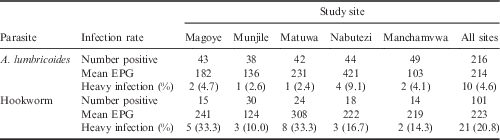
A. lumbricoides: light intensity=1–4999 EPG; heavy intensity=≥5000 EPG.
Hookworm: light intensity=1–1999 EPG; heavy intensity=≥2000 EPG.
Overall, 4.6% (95%CI 1.8–7.4) of adults infected with A. lumbricoides had high-intensity infections, with the highest proportion being in the Nabutezi site (9.1%; 95%CI 0.6–17.6). For hookworm infections, 20.8% (95%CI 12.9–28.7) of adults in all five sites had high-intensity infections, with the highest proportions being observed in the Magoye (33.3%; 95%CI 9.5–57.2) and Matuwa sites (33.3%; 95%CI: 14.5–52.2).
Discussion
Studies to quantify the extent of schistosome and STH infections in populations have traditionally focused on school-age children living in endemic areas as the majority of public health interventions targeting STH and schistosome infections use school-based deworming, which has been shown previously to provide benefits to untreated groups within populations (Miguel & Kremer, Reference Miguel and Kremer2004). Recently, studies have begun to focus on infections in adult populations, recommending a change in treatment strategy to include other population groups, in addition to school-age children (Njenga et al., Reference Njenga, Mwandawiro, Muniu, Mwanje, Haji and Bockarie2011; Abou-Zeid et al., Reference Abou-Zeid, Abkar and Mohamed2012). The current study has demonstrated a relatively high prevalence of S. haematobium and A. lumbricoides infections in the adult population of Mazabuka and Siavonga Districts, Zambia. The WHO guidelines recommend regular preventive chemotherapy with anthelminthic drugs as a public health intervention to control these infections and reduce morbidity (WHO, 2006). The results of this study, however, suggest that if adults are left untreated in areas where the prevalence of helminthic infections is high in this group, the adults may perpetuate transmission of infections and may act as a source of reinfections of school-age children, and thus reverse or reduce the gains achieved by deworming the children. This is particularly a potential risk for populations where there are no MDA initiatives in adult populations using praziquantel against schistosomiasis, mebendazole against STH and albendazole against STH or lymphatic filariasis, or where there is low treatment coverage. Treatment for lymphatic filariasis with albendazole, however, is likely to impact STH infection rates.
Past studies conducted in Zambia have shown that schistosome and STH infections are widespread and endemic in most parts of the country, though with varying prevalence (Bhagwandeen, Reference Bhagwandeen1976; Mutengo et al., Reference Mutengo, Mudenda, Mwansa, Kaonga, Sianongo, Wamulume and Shinondo2009; Halwindi et al., Reference Halwindi, Magnussen, Siziya, Handema, Meyrowitsch and Olsen2011; Shawa et al., Reference Shawa, Mwase and Simonsen2014). Although all age groups get infected, these diseases disproportionately affect the poor, especially children, and culminate in serious chronic disease conditions (Salam et al., Reference Salam, Maredia, Das, Lassi and Bhutta2014). For instance, records at the University Teaching Hospital in Lusaka, Zambia, dating as far back as 1976, show that over 141 cases of urinary schistosomiasis in adults resulted in carcinoma of the bladder – the third most important malignancy seen in the Zambian population. Furthermore, between 2001 and 2007, Mutengo et al. (Reference Mutengo, Mudenda, Mwansa, Kaonga, Sianongo, Wamulume and Shinondo2009) reviewed records of 38 patients, mostly adult females, with prominent cases of genital schistosomiasis, a condition with egg granuloma inflammation causing prostatitis and infertility in men and in female genitalia leading to cervical and vaginal ulcers, ectopic pregnancies and miscarriages in women, as well as infertility and suspected increased risk of HIV infection. Most of these cases were not suspected and only detected accidentally during the course of other examinations or from post-mortems and histopathology studies (Mutengo et al., Reference Mutengo, Mudenda, Mwansa, Kaonga, Sianongo, Wamulume and Shinondo2009).
Njenga et al. (Reference Njenga, Mwandawiro, Muniu, Mwanje, Haji and Bockarie2011) reported 41.7% prevalence of hookworm and 18.2% prevalence of S. haematobium infection among adults living in the rural villages of Kwala District, costal Kenya. Poole et al. (Reference Poole, Terlouw, Naunje, Mzembe, Stanton and Betson2014) in Malawi, using soluble egg antigen ELISA, reported 94.5% prevalence of S. haematobium in mothers in Chikhwawa District whose general awareness of the disease was very low. Yet, they daily bathed or washed with their children in open waters, a behaviour likely to sustain high transmissions within that community. In southern Kordofan State in Sudan, Abou-Zeid et al. (Reference Abou-Zeid, Abkar and Mohamed2012) demonstrated an overall 6.9% prevalence of urogenital schistosomiasis in an adult population with variations according to geographical location. Mothers were also found to have the highest prevalence, with illiteracy being highly associated with the disease. According to Ekundayo et al. (Reference Ekundayo, Aliyu and Jolly2007) in Nigeria, a strong correlation exists between parental socioeconomic status and intestinal parasitosis in children; hence infections were highest in children whose parents are unemployed or petty traders. Chimbari et al. (Reference Chimbari, Dhlomo, Mwadiwa and Mubila2003), in southern Zambia, found a higher incidence of urogenital and intestinal schistosomiasis among the adult fishing population of Siavonga than in school-aged children.
The findings of this study support previous observations on infection levels in adult populations. It is likely that the adult populations of Mazabuka and Siavonga Districts suffer from chronic pathology, and potentially transmit infection in southern Zambia. Although the majority of these infections were categorized as light intensity, 5–10% of S. mansoni and S. haematobium infections could be characterized as heavy infections, and heavy infections with hookworm were found in more than 20% of infected adults. According to Ekundayo et al. (Reference Ekundayo, Aliyu and Jolly2007), individuals that are heavily infected in such communities ought to be identified and treated, preferably in the dry season when transmission conditions are least favourable. Otherwise, widespread dispersal of ova and larvae is expected to continue and children are in danger of perpetual infection and reinfection throughout their lives.
Some of the factors that propagate the transmission of schistosoma infections in Siavonga include the local population’s regular fishing activities, washing and vegetable watering, school-aged children wading and bathing and tourists’ swimming and boating activities. Chimbari et al. (Reference Chimbari, Dhlomo, Mwadiwa and Mubila2003) suggested an overall reduction in schistosoma infection prevalence over the years: 35.5% in 1994, 19.4% in 2001 and the current 8.2% for S. haematobium, and 60.1% in 1994, 33.5% in 2001 and 5.7% for S. mansoni. It is worth noting that in the catchment area of Nabutezi alone, the prevalence was higher for both S. haematobium (12.4%) and for S. mansoni (7.0%) than the aggregated district prevalence, indicating that predisposing factors differ from place to place. Chimbari et al. (Reference Chimbari, Dhlomo, Mwadiwa and Mubila2003) attributed the high prevalence in Siavonga to a combination of deficient toilet facilities and easy access to the snail-infested Lake Kariba. The lack of basic social amenities also affects the adult population in Mazabuka, who are highly susceptible to faecal-contaminated soils, as witnessed by the 33.3% of the hookworm positives who had heavy infection intensity. In consonance with Ekundayo et al. (Reference Ekundayo, Aliyu and Jolly2007), hookworm infections were persistent in the subsistence farming adult population. This indicates that the sampled adult population, and especially pregnant women, also have the potential risk of having iron-deficiency anaemia due to intestinal blood loss (Njenga et al., Reference Njenga, Mwandawiro, Muniu, Mwanje, Haji and Bockarie2011). The current study did not detect any infection caused by T. trichiura in adults.
Continued yearly treatment of school-aged children and under-fives alone has the potential to drastically moderate the worm burden in Zambia and elsewhere (Halwindi et al., Reference Halwindi, Magnussen, Siziya, Handema, Meyrowitsch and Olsen2011; Mwandawiro et al., Reference Mwandawiro, Nikolay, Kihara, Ozier, Mukoko and Mwanje2013; Shawa et al., Reference Shawa, Mwase and Simonsen2014; Salam et al., Reference Salam, Maredia, Das, Lassi and Bhutta2014). However, this study’s findings, and those of Njenga et al. (Reference Njenga, Mwandawiro, Muniu, Mwanje, Haji and Bockarie2011) and Abou-Zeid et al. (Reference Abou-Zeid, Abkar and Mohamed2012), suggest that infected adults have the potential to be a reservoir of continued transmission and thereby a cause of reinfection among treated children under current control programmes, and thus present an impediment to these. Furthermore, the findings agree with the suggestion of Njenga et al. (Reference Njenga, Mwandawiro, Muniu, Mwanje, Haji and Bockarie2011) that the inclusion of adults in control programmes might have the prospective of significantly improving the efficacy and effectiveness of current control strategies. With the low levels of formal education in the two sampled adult populations of Mazabuka and Siavonga, which depend on subsistence farming and fishing for their livelihoods, drug administration alone may not be effective. Rather, it is imperative to couple chemotherapy with improvements in sanitation and health education that mainly focus on promoting healthy behaviour in order to disrupt the transmission cycle of schistosomes and STHs (Halwindi et al., Reference Halwindi, Magnussen, Siziya, Handema, Meyrowitsch and Olsen2011; Salam et al., Reference Salam, Maredia, Das, Lassi and Bhutta2014).
Although the current mass drug administration against urogenital and intestinal helminths primarily targets children, who are certainly the most vulnerable, this study’s findings show that adult populations harbour infections and could contribute to disease transmission in their respective communities. There is a need to consider alternative treatment strategies that include adults, and the necessity to improve in water and sanitary facilities should not be ignored.
Acknowledgments
The authors wish to thank the Mazabuka and Siavonga district health offices for allowing the study to be conducted in the area, the health centres and the parents and children in the catchment areas for participating in the study. The authors also acknowledge the European Foundations Initiative for African Research into Neglected Tropical Diseases (EFINTD) for providing financial support. The authors have no conflict of interest concerning the work reported in this paper.