Introduction
Major depressive disorder (MDD) is a common, serious and disabling mental illness that has a serious impact on patients, their families and caregivers. It is associated with a high level of personal disability, poor quality of life, high morbidity and high risk of suicide, as well as high direct (healthcare utilization) and indirect (lost workdays) cost. The World Health Organization estimates that MDD will be the number one cause of disability in both the developed and developing worlds by 2030 (WHO, 2008).
Typically, antidepressant pharmacotherapy is used for patients with MDD, with selective serotonin reuptake inhibitors (SSRIs) and selective serotonin–noradrenaline reuptake inhibitors (SNRIs) considered first-line treatment options. However, approximately 40% of patients do not respond to initial antidepressant treatments (Anderson, Reference Anderson2003), and more than half (55–73%) do not achieve remission of symptoms (Thase et al. Reference Thase, Entsuah and Rudolph2001; Gaynes et al. Reference Gaynes, Rush, Trivedi, Wisniewski, Balasubramani, McGrath, Thase, Klinkman, Nierenberg, Yates and Fava2008). In addition, current treatments have a delayed onset of action, with antidepressants typically requiring 4–6 weeks to achieve full therapeutic effect. Other drawbacks are reduced treatment compliance and early treatment discontinuation; 28% of patients discontinue antidepressant treatment within the first month (Masand, Reference Masand2003). The delay in efficacy seen with current therapies is likely to contribute to poor compliance and early treatment discontinuation (Machado-Vieira et al. Reference Machado-Vieira, Salvadore, Luckenbaugh, Manji and Zarate2008). Hence, there is a clinical need for therapies with faster onset of antidepressant effects not only to reduce depressive symptoms quickly, but also to help improve patient compliance and outcomes (Keller et al. Reference Keller, Hirschfeld, Demyttenaere and Baldwin2002).
There is considerable evidence that depression is associated with a relative reduction in activity of serotonergic neurons, the so-called serotonin hypothesis of depression. Multiple malfunctions in the serotonin system, both presynaptic and postsynaptic, have been documented in depression and suicide (Celada et al. Reference Celada, Puig, Amargos-Bosch, Adell and Artigas2004; Gillespie et al. Reference Gillespie, Garlow, Schatzberg, Nemeroff, Schatzberg and Nemeroff2009).
SSRIs deactivate the serotonin transporter, thereby preventing the presynaptic reuptake of serotonin and increasing the synaptic concentrations of serotonin. This results in increased stimulation of all serotonin receptors, including the postsynaptic 5-HT1A receptor. The therapeutic mode of action of SSRIs is not fully understood, but the increased extracellular fluid concentrations of serotonin also activate 5-HT2A receptors by a negative feedback mechanism, which is believed to reduce 5-HT1A receptor stimulation. This may partly account for the delayed onset of the therapeutic effect of SSRIs; a negative feedback mechanism operating at presynaptic 5-HT1A autoreceptors in response to increased synaptic serotonin concentrations may also be involved. In this hypothesized feedback mechanism, activation of the 5-HT1A autoreceptors dampens firing of serotonergic neurons, thus reducing the synaptic serotonin concentrations until autoreceptor desensitization occurs (Kinney et al. Reference Kinney, Taber and Gribkoff2000; Artigas, Reference Artigas2001; Watson & Dawson, Reference Watson and Dawson2007; Moulin-Sallanon et al. Reference Moulin-Sallanon, Charnay, Ginovart, Perret, Lanfumey, Hamon, Hen, Fagret, Ibáñez and Millet2009). The key role of 5-HT1A stimulation is supported by a recent report that polymorphisms of the 5-HT1A receptor correlate with differential responses to antidepressant drugs (Kato et al. Reference Kato, Fukuda, Wakeno, Okugawa, Takekita, Watanabe, Yamashita, Hosoi, Azuma, Kinoshita and Serretti2009). Another mechanism that could explain the lack of optimal response to SSRIs is their effect on noradrenergic transmission, because evidence from animal models has shown that serotonin reuptake inhibition also reduces the firing of noradrenaline (NE) neurons. This effect is mediated by increased activation of excitatory 5-HT2A receptors on inhibitory G-aminobutyric acid (GABA) interneurons (Blier et al. Reference Blier and Szabo2005). Use of a highly selective 5-HT2A antagonist combined with a SSRI was suggested to enhance stimulation of postsynaptic 5-HT1A receptors (Celada et al. Reference Celada, Puig, Amargos-Bosch, Adell and Artigas2004; Landen & Thase, Reference Landen and Thase2006), and concomitantly prevent dampening of noradrenergic tone (Blier et al. Reference Blier and Szabo2005), thus increasing the efficacy of SSRIs.
However, because blocking of 5-HT2A transmission is associated with enhancing the availability of dopamine in mesocortical systems, increased dopamine D4 receptor activation may result in behavioural deregulation (Svensson & Mathe, Reference Svensson, Mathe, D'Haenen, den Boer and Willner2002). Thus, simultaneous blockade of 5-HT2A and D4 receptors has been postulated as a means of improving the therapeutic effect of SSRIs.
Pipamperone is a relatively weak neuroleptic drug approved in some European countries. At its usually recommended antipsychotic dose (120–360 mg/d), it has relatively weak neuroleptic activity because it is only moderately effective as a dopamine D2-receptor antagonist, even at high doses. At low doses (5–15 mg/d), pipamperone is a highly selective dopamine D4 and 5-HT2A receptor antagonist (Buntinx et al. Reference Buntinx, Peremans, Schlaepfer, Audenaert, De Spiegeleer and Megens2008; Peremans et al. Reference Peremans, De Spiegeleer, Buntinx, Dobbeleir, Vermeire, Vandermeulen, De Vos, Megens, Eersels and Audenaert2008). With these pharmacologic properties, we hypothesized that pipamperone will block 5-HT2A activity, leading to increased serotonin receptor (including 5-HT1A) signal transduction in postsynaptic neurons, and also block dopamine D4 receptors. As such, pipamperone should increase the antidepressant effect of SSRIs or SNRIs.
The present study was designed to test this hypothesis, by comparing the combination of citalopram, a highly selective SSRI with a favourable adverse event profile, plus low doses of pipamperone versus citalopram and placebo in terms of both the magnitude and onset of antidepressant effect.
Method
Patient population
Eligible patients were aged 18–65 years, had spontaneously reported to their primary-care physician, and were diagnosed with moderate to severe MDD based on DSM-IV criteria (APA, 2000) with depressed mood and loss of interest/anhedonia lasting from 4 to 26 weeks. The diagnosis of MDD was confirmed by the Mini International Neuropsychiatric Interview, version 5.0.0. Inclusion criteria also required a Clinical Global Impression – Severity of Illness (Guy, Reference Guy and Guy1976) score of ⩾4 (moderately ill), a 17-item Hamilton Depression Scale (Hamilton, Reference Hamilton1960) total score of ⩾18, and a non-psychotic state. Exclusion criteria included: significant risk of suicide or scoring ⩾5 on the Montgomery–Asberg Depression Rating Scale (MADRS; Montgomery & Asberg, Reference Montgomery and Asberg1979) item 10 (suicidal thoughts); resistant depression as defined by failure to respond to two previous antidepressants (taken at adequate dosage for ⩾4 weeks during the current episode) or failure to respond to augmentation therapy with an atypical antipsychotic drug; and significant physical illness, excessive alcohol use, or other psychiatric illness that could interfere with trial assessments. Patients with epilepsy, history of cardiac dysrhythmia, or renal or hepatic impairment, women who were pregnant or breast-feeding, and those who had recently used antidepressants, benzodiazepines, or other psychotropic agents or had electroconvulsive therapy during the current episode were also excluded.
The study was conducted in central Scotland by CPS Research using a network of primary care physicians. Trained research nurses visited the sites to assist in carrying out study assessments to ensure homogeneity. The clinical study protocol was approved by the relevant ethics committees, and written informed consent was obtained from all patients before enrolment in the study.
Study design
This was a phase IIa, randomized, double-blind, parallel-group study in patients with MDD (Clinicaltrials.gov identifier no. NCT00672659). Patients were randomly assigned to receive pipamperone 5 mg twice daily (BID) and citalopram 40 mg once daily (QD) (PipCit) or citalopram 40 mg QD and placebo BID (in a ratio of 1:1) orally for 8 weeks. In both groups, treatment with citalopram was started at a dose of 20 mg QD, which was force-titrated up to 40 mg QD after 1 week. Efficacy and safety were assessed at baseline (week 0), at weeks 1, 2, 4, 6 and 8, and with a telephone follow-up 28 days after the final clinic visit.
Randomization and blinding
Patients were randomly assigned to treatment groups using an interactive voice response system provided by the Robertson Centre for Biostatistics at the University of Glasgow. This system instructed the site which treatment pack number had been assigned to each patient. All study personnel and participants were blinded to the treatment assignment for the duration of the study. The use of placebo capsules identical to pipamperone capsules (apart from the lack of active ingredient) and identical packaging and labelling ensured that both the patient and investigator were blinded to the administered treatment.
Objectives
The primary objective of the study was to determine whether combining pipamperone with citalopram in patients with MDD augments the therapeutic effect obtained with citalopram monotherapy. The main secondary objectives were to determine whether the addition of pipamperone to citalopram accelerates the onset of the therapeutic effect and to assess the safety and tolerability of the combination regimen.
Outcome measures
The primary outcome measure, as defined in the protocol, was the mean change in MADRS score from baseline to week 8. Secondary outcome measures included mean changes in the MADRS scores from baseline to weeks 1, 2, 4 and 6, and mean changes in Clinical Global Impression – Improvement (CGI-I) scale and Beck Depression Inventory (BDI) scores at weeks 1, 2, 4, 6 and 8. The number of patients responding, or partially responding (⩾50%, or ⩾20% improvement from MADRS baseline score, respectively) were determined at weeks 1, 2, 4, 6 and 8. The number of patients with a sustained response or a partial response (⩾50% or ⩾20% improvement from baseline score at weeks 2 and 4, respectively), and sustained remission (MADRS score ⩽10 at weeks 6 and 8) were also determined.
Safety and tolerability were assessed by: the evaluation of treatment-emergent adverse events, treatment-related adverse events, and discontinuations due to adverse events; laboratory tests, including serum prolactin and electrocardiogram (ECG); vital signs; and physical examination including body weight.
Sample size
It was estimated that 65 patients per group were required to detect a significant difference in the primary outcome variable between PipCit and citalopram at the 5% level with 90% power, assuming a 30% improvement in the performance of the combination over citalopram and placebo. Assumptions on the performance of citalopram were based on the performance of escitalopram in a previous study in patients with a baseline MADRS score of 28.7 (Wade & Friis Andersen, Reference Wade and Friis Andersen2006). To account for loss to follow-up (21%), the target recruitment number of patients was 165.
Statistical methods
The primary analysis comparing the change in MADRS score from baseline to week 8 between treatment groups was analysed using the two-sample t test with the estimated between-group difference. For the secondary analyses, the continuous variables (MADRS, CGI-I and BDI scores) were compared between treatment groups using the two-sample t test or a linear regression model, and the categorical variables (numbers of patients who discontinued, achieved response, or achieved remission) were analysed using a Fisher exact test or a logistic regression model. Mixed-effects models for repeated measures (MMRM) were used to estimate the difference between treatment groups over the 8 weeks. Post-hoc MMRM analyses were also performed over the first 4 weeks. Treatment group, time point, baseline score (where applicable), age, sex, duration of current episode of MDD >12 weeks, and history of two previous psychiatric conditions were included in the MMRM model. General covariance structures were assumed in all models. MADRS item scores were also analysed using the above methods in post hoc analyses.
Statistical analyses were performed using S-Plus for Windows, version 7.0 or higher (Tibco, USA). The intent-to-treat population, which consisted of all randomized patients, was used to analyse all efficacy outcome variables, body weight and serum prolactin. Patients were analysed according to the group assignment. Analyses were performed on observed cases (OC) and using the last observation carried forward (LOCF) approach to account for missing data. Treatment differences were reported with 95% confidence intervals (CIs) and p values. No corrections were made for multiple analyses. Adverse event data have been summarized descriptively for the safety population, which included all randomized patients who received at least one dose of study medication.
Results
Patient disposition
A total of 172 patients were enrolled in the study between February and November 2008; 165 patients were randomized to treatment (citalopram and placebo, n=82; PipCit, n=83). The last patient completed the study in February 2009. A Consolidated Standards of Reporting Trials (CONSORT) flow diagram is given in Fig. 1. The proportion of patients discontinuing the study before endpoint was not significantly different between the treatment groups [citalopram and placebo, 21/82 (26%); PipCit, 14/83 (17%); p=0.19]. However, in the first 4 weeks of treatment a higher number of patients discontinued from the citalopram and placebo treatment group [15/82 (18%)] than from the PipCit group [3/83 (4%), p=0.003]. The main reason for discontinuation from both treatment groups was ‘loss to follow-up’.
Patient disposition. ITT, Intent to treat; PipCit, citalopram 40 mg once daily plus pipamperone 5 mg twice daily.

Patient characteristics
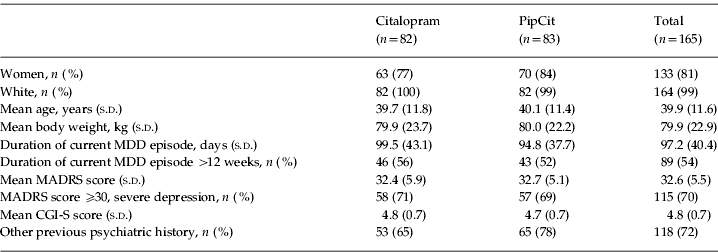
At baseline, the treatment groups had generally similar demographic and clinical characteristics (Table 1). However, there were more women and patients with any psychiatric history in the PipCit group than in the citalopram and placebo group. Most patients were women and 70% had severe depression (MADRS score ⩾30). Treatment compliance over the 8-week period was >95% in both groups, and there were no significant between-group differences in the use of any class of concomitant medication.
Demographic and clinical characteristics of the study population at baseline

PipCit, Citalopram 40 mg once daily plus pipamperone 5 mg twice daily; s.d., standard deviation; MDD, major depressive disorder; MADRS, Montgomery–Asberg Depression Rating Scale; CGI-S, Clinical Global Impression – Severity of Illness.
Efficacy
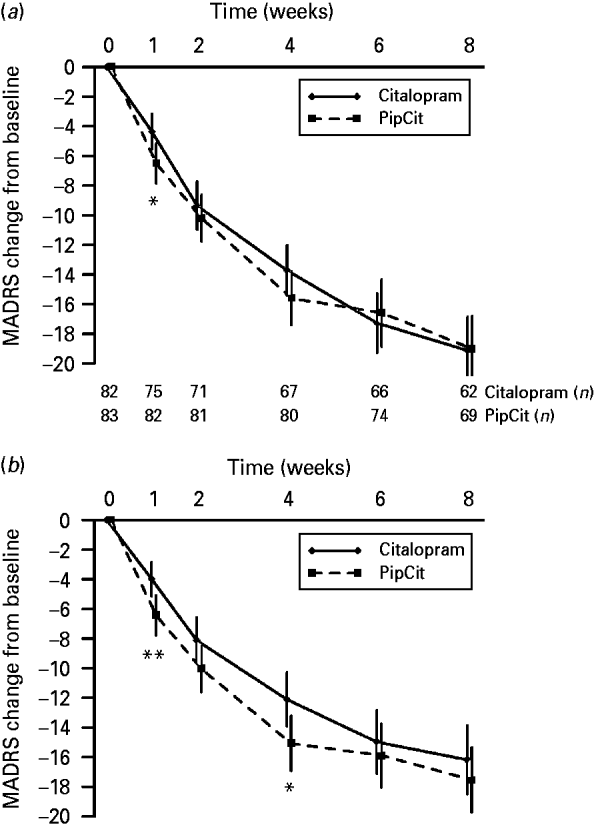
In the primary analysis, there was no evidence that the change in MADRS score from baseline to 8 weeks differed between the groups (OC two-sample t test: estimated difference, 0.1, 95% CI −3.0 to 3.3, p=0.943). However, as shown in Fig. 2, there was evidence of a difference between treatment groups at other time points. In both the OC and LOCF, the PipCit group had a significantly greater reduction in MADRS score compared with the citalopram+placebo group at 1 week (OC two-sample t test estimated difference on change from baseline −2.14, 95% CI −3.95 to −0.33, p=0.021; LOCF estimated difference −2.43, 95% CI −4.18 to −0.68, p=0.007). At week 2 there was a non-significant improvement using LOCF (p=0.089), but there was again significant improvement in MADRS score from baseline at week 4 in the LOCF (estimated difference, −2.95, 95% CI −5.53 to −0.37, p=0.025). Similar results were obtained when the data were analysed using a linear regression model.
Change in depressive symptoms according to the Montgomery–Asberg Depression Rating Scale (MADRS) score from baseline to each scheduled visit in the intent-to-treat population: (a) observed cases analyisis and (b) last observation carried forward (LOCF) analysis. –◆–, Citalopram; - -▪- -, citalopram 40 mg once daily plus pipamperone 5 mg twice daily (PipCit). Values are means, with standard deviations represented by vertical bars. Mean value was significantly different from that of the citalopram group: * p<0.05, ** p<0.01.

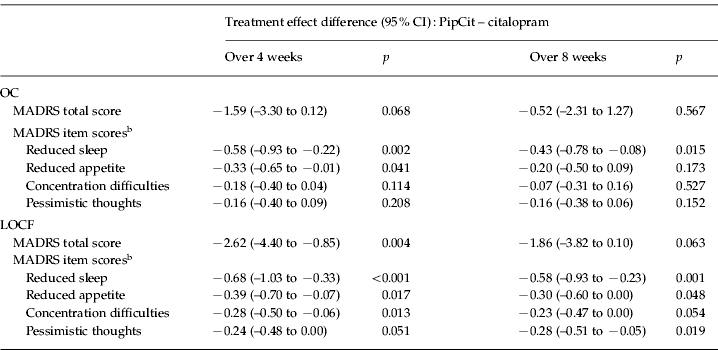
The MADRS total scores and item scores that showed any significant treatment effect differences averaged over 4 and/or 8 weeks, estimated using an MMRM for OC and LOCF, are summarized in Table 2. A significant benefit in favour of PipCit was demonstrated over 4 weeks (LOCF, p=0.004). Over 8 weeks, a numerical advantage that failed to reach significance (LOCF, p=0.063) was observed in favour of PipCit. Among OCs, no significant differences were observed in total MADRS scores, but there were significant improvements in the PipCit group compared with the citalopram and placebo group in reducing sleep-related problems over 4 and 8 weeks and appetite-related problems over 4 weeks. Using an LOCF analysis, the PipCit group was superior to the citalopram+placebo group in improving depressive symptoms related to sleep (4 and 8 weeks), appetite (4 and 8 weeks), concentration (4 weeks) and pessimistic thoughts (8 weeks).
Treatment effect differenceFootnote a over 4 and 8 weeks between PipCit and citalopram+placebo for MADRS total and item scores

PipCit, Citalopram 40 mg once daily plus pipamperone 5 mg twice daily; MADRS, Montgomery–Asberg Depression Rating Scale; CI, confidence interval; OC, observed cases; LOCF, last observation carried forward.
a Estimated using a mixed-effects model for repeated measures in the intent-to-treat population.
b MADRS item scores were analysed post hoc.
Response by MADRS criteria using LOCF was significantly more likely in the PipCit group than in the citalopram and placebo group over the first 4 weeks (MMRM, odds ratio 2.18, 95% CI 1.18–4.02, p=0.013), but not over 8 weeks (MMRM, odds ratio 1.62, 95% CI 0.96–2.73, p=0.071). There was no evidence of any between-group differences in partial MADRS response, sustained early partial response, remission or sustained remission rates during the study. Sustained early response was achieved by 21% (17/80) of PipCit patients compared with 9% (6/67) of citalopram and placebo patients (OC) (Fisher exact test, p=0.067); the difference was significant using a logistic regression model (odds ratio 2.9, 95% CI 1.0–8.1, p=0.046). Using the LOCF approach, the treatment differences approached significance with both analyses.
The PipCit group had a significantly greater improvement on the CGI-I than the citalopram and placebo group at week 1 (OC and LOCF, two-sample t test: estimated difference −0.39, 95% CI −0.64 to −0.14, p=0.002), but there were no significant differences in CGI-I between the groups at any other time point. There was no evidence of any significant between-group differences on the BDI.
A post hoc analysis comparing the changes in total MADRS score from baseline in patients who discontinued in the first 2 weeks with patients who continued treatment for the full 8 weeks demonstrated that the early drop-outs had significantly less improvement in symptoms at week 1 than those continuing treatment (p=0.014, Wilcoxon).
Safety and tolerability
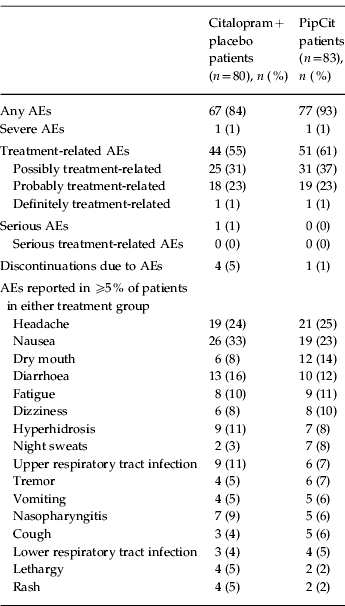
Treatment-emergent adverse events with an incidence of ⩾5% for either treatment group are shown in Table 3. The adverse event profile of both treatment groups was similar with no significant between-group differences. Both treatments were generally well tolerated.
Treatment-emergent AEs in the safety population

AE, Adverse event; PipCit, citalopram 40 mg once daily plus pipamperone 5 mg twice daily.
The mean increase in serum prolactin from baseline to week 8 was significantly greater in the PipCit group than in the citalopram and placebo group (3.75 v. 0.74 ng/ml, estimated difference 3.01, 95% CI 1.01–5.01, p=0.003). However, there were no cases of hyperprolactinaemia in either treatment group at week 8. Other laboratory results were unremarkable.
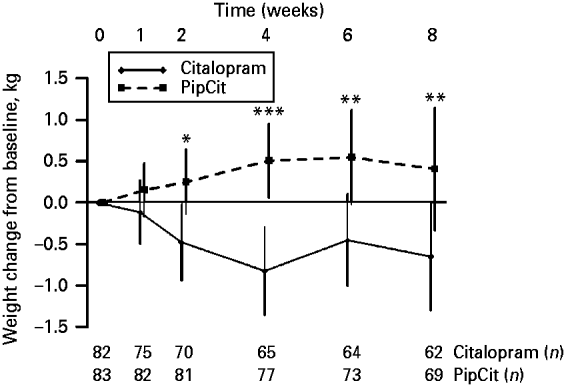
As shown in Fig. 3, we found that there were significant between-group differences in body weight during the 8 weeks. The PipCit group had significantly increased weight compared with the citalopram+placebo group at 2 weeks (p<0.05), 4 weeks (p<0.001), 6 weeks and 8 weeks (p<0.01), the difference also being significant over the 8 weeks (overall MMRM, p=0.001). However, the changes were not significant within the treatment groups. There were no clinically relevant differences between the treatment groups regarding ECG or physical examinations.
Body weight over time (mixed-effects model for repeated measures estimates), intent-to-treat population, observed cases. –◆–, Citalopram; - -▪- -, citalopram 40 mg once daily plus pipamperone 5 mg twice daily (PipCit). Values are means, with standard deviations represented by vertical bars. Mean value was significantly different from that of the citalopram group: * p<0.05, ** p<0.01, *** p<0.001.

Discussion
This exploratory study was the first randomized double-blind evaluation of low-dose pipamperone as an adjunct to citalopram. The main aim of the study was to assess whether low-dose pipamperone enhances the magnitude or onset of the therapeutic effect of citalopram in patients with moderate to severe MDD.
PipCit showed a significant advantage over citalopram and placebo in magnitude of antidepressant effect in the early weeks of the study (weeks 1 and 4) but statistical significance was lost at weeks 6 and 8. Improved sleep and appetite were the main symptoms that improved with PipCit compared with citalopram and placebo.
Study completion rates were within the expected ranges for depression studies: 74% with citalopram and placebo and 83% with PipCit. In the first 4 weeks, 18% of citalopram and placebo patients had withdrawn, compared with only 4% of PipCit patients. Thereafter, more PipCit patients withdrew, partially restoring the balance. The exact reasons for the different withdrawal patterns are unclear. The lower rate of discontinuation in the PipCit group during the first 4 weeks may be clinically important. Higher drop-out rates in short-term studies are usually associated with higher adverse event rates (Demyttenaere et al. Reference Demyttenaere, Enzlin, Dewe, Boulanger, De Bie, De Troyer and Mesters2001). In this study, adverse event profiles were similar, suggesting that the early lower rate of discontinuation in the PipCit group may reflect a more rapid antidepressant action, with patients staying in the study because they felt some benefit from treatment.
Delayed onset of action with antidepressants has also been reported as a cause of poor treatment adherence (Keller et al. Reference Keller, Hirschfeld, Demyttenaere and Baldwin2002). A post-hoc analysis demonstrated that patients who had dropped out in the first 2 weeks of the study also had significantly less improvement in symptoms at week 1 than did those patients who continued with treatment, a finding that supports this hypothesis.
The main limitation of the study is the disproportionate rate of discontinuation between the treatment groups in the first 4 weeks of treatment. The exact reasons for discontinuation are unknown in the majority of cases (loss to follow-up, 14 out of 35; inability to continue, seven out of 35), and it would be important for future studies to document this more thoroughly. Bias may result when the reasons for discontinuation are unknown, especially if there is a between-group difference in drop-out rates, as was observed in this study.
The LOCF approach was originally specified as a means of partially offsetting the uncertainty associated with discontinuations. However, because more citalopram and placebo patients withdrew in the first 4 weeks, the LOCF analysis tended to accentuate early differences between treatment groups in favour of PipCit. However, the majority of the drop-outs at week 2 had not improved significantly in the first week, raising the possibility that significant later improvement in these patients would be limited (Stassen et al. Reference Stassen, Angst and Delini-Stula1998). Hence, the LOCF approach may yield clinically meaningful results. These conclusions are further supported – albeit with limited statistical significance – by an MMRM analysis that demonstrated a similar pattern of early benefit with PipCit.
In this study, pipamperone was used at a dosage four to 36 times lower than that used in routine clinical practice. Hence, problems with specific adverse events associated with typical antipsychotic agents were neither expected nor observed; for example, there were no reports of extrapyramidal symptoms. PipCit was generally well tolerated. Body weight initially increased in the PipCit group compared with citalopram and placebo but then appeared to stabilize. This could have been caused by improved appetite; no PipCit patient reported increased weight as an adverse event.
There was sufficient evidence in this study to suggest that pipamperone has some additional beneficial effect when used in combination with citalopram at apparently no detriment to safety. This is of particular interest because the augmentation with atypical antipsychotics (e.g., risperidone, olanzapine, quetiapine) in patients that fail or only partially respond to an adequate antidepressant medication leads to more rapid response and a higher remission rate (Keitner et al. Reference Keitner, Garlow, Ryan, Ninan, Solomon, Nemeroff and Keller2009), but their association with weight gain and the metabolic syndrome is problematic. Low doses of pipamperone apparently provide similar therapeutic advantage without the metabolic adverse events. The advantages of the observed earlier response are likely to include improved treatment compliance, which should further benefit patients' outcomes.
Further studies with larger patient numbers and close monitoring of patients' precise reasons for discontinuation are warranted to confirm the impact on early resolution of depressive symptoms of pipamperone in combination with citalopram and to see whether the improvements observed in this study are sustained over the long term.
Acknowledgements
This study was funded by PharmaNeuroBoost. Acknowledgment is given to technical writers Rosemary Collier and Steve Tiger for their assistance in the preparation of the manuscript. The authors are entirely responsible for the scientific content of the manuscript. The ClinicalTrials.gov identifier no. is NCT00672659.
Declaration of Interest
This research was sponsored by PharmaNeuroBoost N.V., Alken, Belgium. A.G.W. and G.M.C. are directors of CPS Research, which conducted this research on behalf of PharmaNeuroBoost. C.B.N., A.F.S. and T.S. are members of the Scientific Advisory Board of PharmaNeuroBoost and are also shareholders in the company. They have also consulted for Lundbeck (C.B.N., A.F.S. and T.S.) and Forest Laboratories (C.B.N. and A.F.S.). A.F.S. also owns equity in Forest Laboratories. A.M. is a senior statistician at the Robertson Centre for Biostatistics, University of Glasgow, and conducted the statistical analyses on behalf of PharmaNeuroBoost. L.H., representative of Envision BVBA, is chief medical officer and E.B., representative of Anima BVBA, is chief executive officer, chief scientific officer and managing director of PharmaNeuroBoost. Anima BVBA is also a shareholder in PharmaNeuroBoost.
In the past year, C.B.N. served on the scientific advisory boards of CeNeRx, AstraZeneca, National Alliance for Research on Schizophrenia and Depression (NARSAD), and the American Foundation of Suicide Prevention (AFSP). He sits on the board of directors of NovaDel Pharma, Mt. Cook Pharma, AFSP and the George West Mental Health Foundation. He owned equity in NovaDel Pharma, CeNeRx BioPharma, Reevax Pharma and Corcept Therapeutics. He owns two patents: one for ex vivo measurement of transporter occupancy and one for transdermal delivery of lithium.