Implications
High-yielding dairy cows are often fed maize-based rations to meet their energy and nutrient requirements. Ensiled beet pulp as a by-product of the sugar beet industry is a valuable feedstuff in ruminant nutrition. The present study shows that the substitution of beet pulp silage for maize silage does not affect the performance of dairy cows. The observed in vitro parameters indicate a time-delayed degradation of fibre fractions and a lower microbial protein synthesis in the rumen when using beet pulp silage compared to maize silage only.
Introduction
High-performing dairy cows require energy-rich diets in order to meet their requirements. Forages were often substituted by grains such as wheat or maize in order to increase both feed and energy intake. The high inclusion of feedstuffs high in non-structural carbohydrates decreases the content of fibre fractions in the diet and results in the risk of disorders like rumen acidosis following reduced chewing activity and saliva secretion as well as depression of fibre digestion and milk fat percentage (Sudweeks et al., Reference Sudweeks, Ely, Mertens and Sisk1981). Ensilaged maize products play an important role in the feeding of high-yielding dairy cows in Europe because they are high in energy content and its starch is relatively slowly fermented in the rumen.
Some non-forage fibre sources have structural carbohydrate content similar to forages, but the composition of polysaccharides, the kinetics of degradation in the rumen and the rate of digestion are different (DePeters et al., Reference DePeters, Fadel and Arosemena1997; Oba and Allen, Reference Oba and Allen1999). Beet pulp is a by-product of the sugar beet industry and contains high amounts of neutral detergent fibre (NDF), especially pectins (Kelly, Reference Kelly1983). Pectins do not ferment to lactic acid (Howard, Reference Howard1961), therefore reducing the risk of ruminal acidosis. The low dry matter (DM) content (<30%) and the high amounts of readily available nutrients reduce the shelf life of fresh beet pulp (Kamphues and Dayen, Reference Kamphues and Dayen1983). Because drying is an energy- and cost-intensive procedure, ensilaging of pressed beet pulp has become a popular method of preservation in Europe (Weber et al., Reference Weber, Kaiser and Steinhöfel2003).
There is little information on the effects of fresh or ensilaged pressed beet pulp contained in dairy cows ration. Previous studies with fresh beet pulp indicated an increase in milk yield and a decrease in milk fat content (Hemingway et al., Reference Hemingway, Parkins and Fraser1986; Parkins et al., Reference Parkins, Hemingway and Fraser1986). Experiments with rations containing dried beet pulp have reported inconsistent effects on feed intake, milk yield and fat-corrected milk yield (Mansfield et al., Reference Mansfield, Stern and Otterby1994; Clark and Armentano, Reference Clark and Armentano1997). However, in all experiments the performance of dairy cows was on a low level. The responses of dried, pelleted beet pulp, substituted for high moisture corn in rations for high-yielding dairy cows, were only reported by Voelker and Allen (Reference Voelker and Allen2003a, Reference Voelker and Allen2003b and Reference Voelker and Allen2003c).
The objective of this study was to examine the effects of pressed beet pulp silage included in maize-based rations of high-yielding dairy cows. The digestibility of nutrients with sheep and parameters of rumen fermentation in vitro were also studied. Our hypothesis was that a high inclusion of pressed beet pulp silage in the diet has no negative effects on the performance of cows and rumen fermentation.
Material and methods
Diet composition
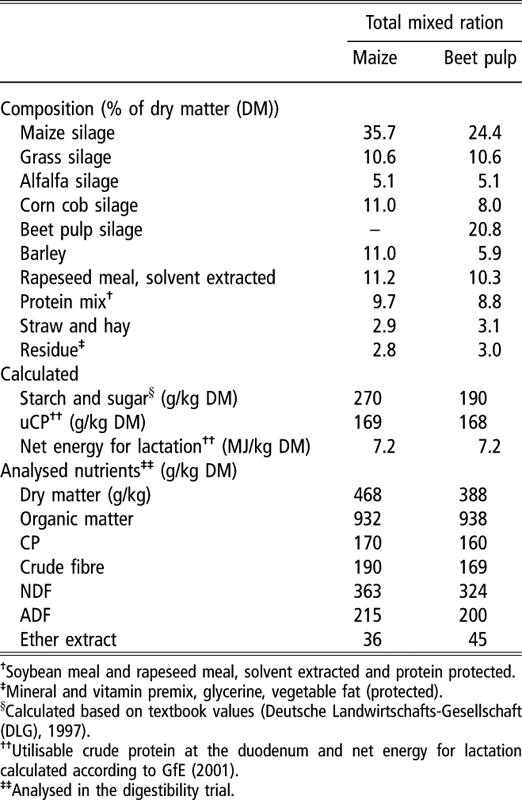
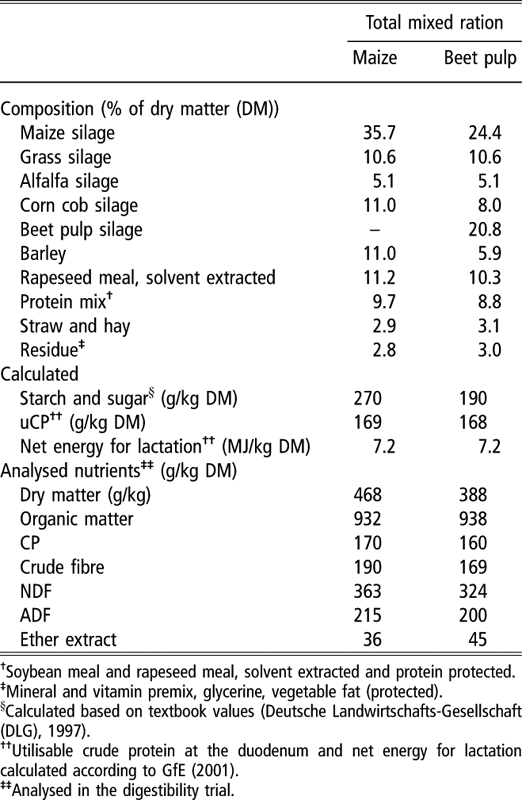
Two diets were fed as total mixed rations (TMR). TMR Maize contained (on DM basis) 35.7% maize silage, 10.6% grass silage, 5.1% alfalfa silage, 11.0% corn cob silage and 2.9% straw and hay (Table 1). For TMR Beet pulp, parts of the maize silage (−11.3%) and corn cob silage (−3.0%) were substituted by pressed beet pulp that had been ensiled in bags. The inclusion of barley grain and protein-rich ingredients was also adjusted in a way that the calculated concentrations of net energy for lactation (NEL) and utilisable crude protein at the duodenum (uCP; Gesellschaft für Ernährungsphysiologie (GfE), 2001) were equal for both TMR. The pressed beet pulp silage had a DM content of 221 g/kg and contained (in g/kg DM): 101 crude protein (CP), 217 crude fibre (CF), 16 ether extract, 534 NDF and 260 acid detergent fibre (ADF).
Ingredients, calculated and analysed nutrient composition of the experimental diets
†Soybean meal and rapeseed meal, solvent extracted and protein protected.
‡Mineral and vitamin premix, glycerine, vegetable fat (protected).
§Calculated based on textbook values (Deutsche Landwirtschafts-Gesellschaft (DLG), 1997).
††Utilisable crude protein at the duodenum and net energy for lactation calculated according to GfE (2001).
‡‡Analysed in the digestibility trial.
The TMR differed in the calculated content of starch plus sugar (270 and 190 g/kg DM, respectively) as well as the analysed concentrations of CF (190 and 169 g/kg DM, respectively) and NDF (363 and 324 g/kg DM, respectively) (Table 1). The analysed content of CP was 170 and 160 g/kg DM for TMR Maize and Beet pulp, respectively.
Feeding trial
Animals and housing
The feeding trial was conducted for 118 days from January to May 2007. Sixty-three multiparous dairy cows (Holstein Friesian and crossbreeds Brown Swiss × Holstein Friesian) were allocated to two groups. Equal distributions to the treatments was made on the basis of milk yield in the previous lactation (on average, 10 580 l milk with 4.06% fat and 3.46% protein), body weight (661 kg, s.d. = 52 kg) and the days in milk (DIM) at the start of the experiment (50, s.d. = 22). Additionally, eight and seven primiparous Holstein Friesian were assigned to the groups by taking into account their body weight (613 kg, s.d. = 45 and 582 kg, s.d. = 25, respectively). In total, 35 Holstein Friesian and four crossbreeds were fed TMR Maize and 31 Holstein Friesian and eight crossbreeds were fed TMR Beet pulp. All cows were housed in a freestall barn and milked in a side-by-side milking parlour three times a day. The TMR were supplied twice daily and offered for ad libitum intake with a targeted refusal of about 5%. Feed was given in single troughs equipped with a weighing unit and a sensor to identify each cow (Institut für Landtechnik und Tierhaltung, Bayerische Landesanstalt für Landwirtschaft, Grub, Germany). This allowed for a continuous measurement of the feed intake of the individual cows. All animals had continuous access to water.
Data collection and chemical analysis
Daily DM intake was calculated individually for each cow by using feed intake data and the DM content of the TMR analysed daily.
Samples of forages were taken once a week and analysed for crude ash (Naumann and Bassler, Reference Naumann and Bassler1976; method 3.1), CP (Naumann and Bassler, Reference Naumann and Bassler1976, 3rd supplement, 1993; method 4.1.1), ether extract (Naumann and Bassler, Reference Naumann and Bassler1976, 2nd supplement, 1988; method 5.1.1) and CF (Naumann and Bassler, Reference Naumann and Bassler1976, 3rd supplement, 1993; method 6.1.1). Based on these values, the NEL and uCP concentrations were calculated according to the equations of GfE (2001). The concentrates were additionally analysed for starch and sugar according to Naumann and Bassler (Reference Naumann and Bassler1976), method 7.1.1, and Naumann and Bassler (Reference Naumann and Bassler1976, 1st supplement, 1983), method 7.2.1, respectively.
Milk yield was measured after each milking time. Milk samples were collected once a week from the three milking times of the same day and analysed for fat, protein and urea, based on Fourier transform infrared spectroscopy (CombiFoss™ FT 6000; Foss Electric, Hamburg, Germany).
Urine samples were collected fortnightly to determine the pH level and the net acid base excretion (NABE) according to Lachmann and Schäfer (Reference Lachmann and Schäfer1985). Because renal regulation plays a central role in acid-base equilibrium, Lachmann and Schäfer (Reference Lachmann and Schäfer1985) proposed that the pH and the NABE are more sensitive indicators for diagnosing metabolic acidosis or alkalosis than any blood tests. The cows were manually stimulated to urinate, and a sample of urine, from midstream, was collected. The chemical analysis followed the specification by Kutas (Reference Kutas1965) based on the method by Jørgensen (Reference Jørgensen1957). All cows were weighed at the start and the end of the experimental period. Backfat thickness was measured with an ultrasonographic instrument (Aloka SSD 210 DXII; Aloca Corp. Ltd, Tokyo, Japan) on an imaginary line between the hooks and pins at the sacral examination site (Schröder and Staufenbiel, Reference Schröder and Staufenbiel2006).
Digestibility and energy concentration
The digestibility of crude nutrients of the TMR was determined with wether sheep (breed Rauhwolliges Pommersches Landschaf) according to standard procedures applied in Germany (Ausschuss für Bedarfsnormen (AfBN), 1991). The TMR, taken at about the middle of the dairy cow feeding trial, were weighed in daily portions and frozen at −18°C until the day of feeding. Daily amounts were calculated to meet the maintenance metabolisable energy (ME) requirement of the sheep. Each TMR was offered in two meals per day to four wethers in parallel. A 7-day period of quantitative faeces collection followed a 21-day period of adaptation to the respective TMR. Feed intake was complete. Faeces were immediately weighed, an aliquot bulk-sampled and frozen at −18°C until being further processed.
Feeds were dried at 65°C for 24 h and faeces were freeze-dried. Dried feeds and faeces were ground through a sieve with 1 mm pore size and analysed for crude nutrients as described above. NDF and ADF were analysed according to Naumann and Bassler (Reference Naumann and Bassler1976, 2nd supplement, 1988), methods 6.5.1 and 6.5.2, respectively, using a heat stable amylase for NDF and were expressed exclusive of residual ash.
The ME content of the TMR was calculated from digestible crude nutrients according to GfE (2001). The concentration of NEL was calculated according to van Es (Reference van Es1975).
Determination of fermentation parameter
For the in vitro trials, the individual feed ingredients were the same as in the dairy cow feeding trial and were ground and mixed on a small scale according to Table 1. Representative samples of all ingredients and of the TMR were taken during this preparation for subsequent analysis.
Rumen simulation
A semi-continuous rumen simulation technique (Rusitec, Czerkawski and Breckenridge, Reference Czerkawski and Breckenridge1977) consisting of four vessels with a volume of 800 ml each was used. Two identical 14-day incubation periods were carried out in a way so that in both periods two vessels received each of the two TMR. Thus, the number of replicated measurements was four.
The general incubation procedure was described in detail by Boguhn et al. (Reference Boguhn, Kluth and Rodehutscord2006). The inoculum was obtained from six rumen-cannulated sheep that were fed 200 g of a concentrate and 10 g of a mineral and vitamin mix per day and grass hay ad libitum. The flow through the vessels was maintained by continuous infusion of artificial saliva (following McDougall (Reference McDougall1948)) at a rate of 600 ml/day. Ammonium chloride (47 mg/l, 11.5% 15N) was added to the artificial saliva as a marker to determine microbial protein synthesis. Each vessel was supplied with two nylon bags (pore size 100 μm) containing 15 g of TMR. At 24-h intervals, one bag was replaced with a new one so that each bag was incubated for 48 h. For the first 24 h, one bag was filled with pooled rumen solids (60 g) instead of TMR for starting the system. On seven consecutive days, following a 7-day period of adaptation, samples of feed residues in the bags after 48 h of incubation, the liquid effluent and microbes from the liquid effluent were collected. The feed residues were dried at 65°C for 24 h, ground through a sieve with 1 mm pore size and analysed for crude nutrients and detergent fibre fractions as described above. The extent of fermentation of crude nutrients and detergent fibre fractions was determined as the difference between input and output of the respective nutrient in relation to its input. No correction was made for nutrients originating from microbes attached to the feed residues. A mixed microbial fraction was isolated from the liquid effluent by differential centrifugation according to Boguhn et al. (Reference Boguhn, Kluth and Rodehutscord2006), freeze-dried and ground. Amino acid (AA) concentrations in the microbial fraction were measured as described by Rodehutscord et al. (Reference Rodehutscord, Kapocius, Timmler and Dieckmann2004). The concentrations of tryptophan, histidine and tyrosine were not determined. For the comparison of AA patterns, the ratio between each individual AA and the sum of all analysed AA was calculated on a N basis.
Following the first step of centrifugation of the liquid effluent, 15 ml of the supernatant were sampled daily, bulked into one sample per replicate and analysed for short-chain fatty acids (SCFA) using a gas chromatograph (GC 14B Shimadzu, Japan) with a flame ionisation detector. The sample preparation was performed with formic acid containing 4% 2-metyl-valeric acid following Geissler et al. (Reference Geissler, Hoffmann and Hickel1976). Additionally, 30 ml of the supernatant were bulk-sampled and freeze-dried to determine the DM of the liquid effluent and to prepare it for the analysis of 15N content.
An isotope mass spectrometer (DELTA V advantage; Thermo Fisher Scientific, Bremen, Germany) coupled with an elemental analyser (EuroEA; HEKAtech GmbH, Wegberg, Germany) was used for the analysis of N contents in the effluents and microbes as well as 15N in ammonium chloride, feed, feed residues, effluents and microbes.
The amount of microbial N (NM) leaving the vessel with effluent was calculated as described by Boguhn et al. (Reference Boguhn, Kluth and Rodehutscord2006). The amount of microbial crude protein (MCP) was calculated as NM × 6.25. The efficiency of MCP synthesis was expressed as g of MCP/kg of fermented organic matter (OM) and as g of MCP/MJ of ME.
Gas production
Rumen fluid from three of the six rumen-cannulated sheep was used for the incubation procedure following the official method (Naumann and Bassler (Reference Naumann and Bassler1976, 5th supplement, 2004); method 25.1) to determine the gas production (GP) during 92h of incubation. Two identical incubation runs were carried out in a way that each feed was replicated eightfold. Approximately 200 mg of both the dried TMR and the respective feedstuffs were weighed in glass syringes with a volume of 150 ml. Thirty millilitres of a rumen liquid–buffer medium mixture were added. GP was recorded for each syringe at 1, 2, 3, 4, 6, 8, 10, 12, 14, 16, 20, 24, 28, 32, 40, 48, 56, 68, 80 and 92 h after the incubation had begun. The values were corrected for blank values. The mean correction factors for hay and concentrate as the two standard feedstuffs (each in triplicate) were 1.0 and 1.1, respectively, which was within the range of tolerance for this method.
The following model was used to describe the cumulative GP (Beuvink and Kogut, Reference Beuvink and Kogut1993):

with b, plateau value of gas production; μr, rapid gas production rate during early stages of fermentation (ml/h); Dr, fractional decay constants for μr; μs, slower gas production rate during later stages of fermentation (ml/h); Ds, fractional decay constants for μs; t, time after incubation started (h).
The parameters were estimated by using the software GraphPad Prism 5.01 for Windows (GraphPad Software, Inc., La Jolla, USA). The GP rate is maximal in the point of inflection (calculated from the first derivative) at which the second derivative is zero (Beuvink and Kogut, Reference Beuvink and Kogut1993; Boguhn et al., Reference Boguhn, Kluth, Bulang, Engelhard, Spilke and Rodehutscord2008). The statistical comparison of the estimated plateau value of GP was based on Horn and Erdmann (Reference Horn and Erdmann1978) using the confidence interval of this parameter.
Statistical analysis
The software package SAS for Windows (version 9.1, 1999–2001; SAS Institute, Inc., Cary, NC) was used for the statistical analysis.
In the analysis of the performance data from the feeding trial with dairy cows, the ration was to be considered as a fixed effect. Furthermore, the test day (fixed), the lactation curve as a function of DIM (as special time-dependent covariates; Mielenz et al., Reference Mielenz, Spilke, Krecjova and Schüler2006), and the random animal effect were considered in the following mixed linear model:

with μ, general mean; Ri, fixed effect of ration i; TDk, fixed effect of test day k; βim, fixed regression coefficient within the treatment; xm, covariate (x 1 = DIM/305; x 2 = x12; x 3 = ln(305/DIM); x 4 = x32); animall, random effect of animal l, animall ∼ N (0; ð2animal); eiklr, random residual effect, eiklr ∼ N (0; ð2residual).
The used SAS program code was described in detail by Mielenz et al. (Reference Mielenz, Spilke, Krecjova and Schüler2006). The procedure MIXED in combination with the restricted maximum likelihood method was used to estimate the variance components and approximation of the degrees of freedom (Kenward and Roger, Reference Kenward and Roger1997). The dynamics of the milk yield on the DIM were modelled by using covariates within the ration dependent on DIM (Ali and Schaeffer, Reference Ali and Schaeffer1987). Modelling of covariance structure and calculations for comparison of milk yields during different sub-periods of the lactation were done according to the method described by Mielenz et al. (Reference Mielenz, Spilke, Krecjova and Schüler2006). A separation of the total lactation period into sub-periods from 20th to 60th and 61st to 200th DIM was made. For the variable DM intake with a specific dynamic during the lactation, the covariables were adapted according to Bulang et al. (Reference Bulang, Kluth, Engelhard, Spilke and Rodehutscord2006). The milk urea concentration showed no specific dynamic during the lactation period and was analysed using equation (2) without the covariables. Treatment effects were declared significant at P < 0.05 for each parameter. The probability value of 5% was assumed for each estimation procedure.
NABE and pH in urine as well as results of the digestibility trial and the in vitro studies were analysed by a one-way ANOVA using the GLM procedure of SAS (pairwise comparisons, t-test) with a probability value of 5%.
Results
Dairy cow feeding trial
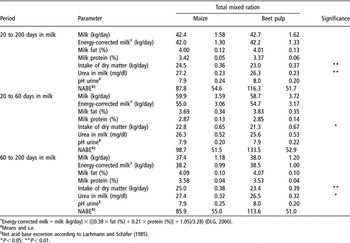
The mean daily milk yield was higher than 42 kg in the total experimental period (Table 2). The maximum milk production (approximately 60 kg/day) was achieved in the first period of lactation between the 20th and 60th DIM. No significant differences in milk yield were observed between the treatments. The milk fat and protein concentrations were on a similar level for the cows fed TMR Maize or Beet pulp and ranged from 4.00% to 4.01% and 3.42% to 3.37%, respectively. As expected, the fat concentrations were lower in the first lactation period than in the second. There were no differences in energy-corrected milk yield between the treatments within each sub-period. The milk urea concentration was approximately 1 mg/dl lower in the group fed TMR Beet pulp. This difference was significant in the total experimental period and the period between the 60th and 200th DIM.
Milk yield, dry matter intake and urine parameters of dairy cows fed two different rations (least square means and s.e.)

†Energy-corrected milk = milk (kg/day) × {{[0.38 × fat (%) + 0.21 × protein (%)] + 1.05}/3.28} (DLG, 2000).
‡Means and s.e.
§Net acid base excretion according to Lachmann and Schäfer (Reference Lachmann and Schäfer1985).
*P < 0.05; **P < 0.01.
The average feed intake in the total period was 24.5 and 23.0 kg DM of TMR Maize and Beet pulp per day, respectively (Table 2). Differences in DM intake were significant in the total period and the two sub-periods.
The average pH in urine was between 7.9 and 8.0 and very similar in the two treatments. The NABE was between 86 and 99 for the cows fed TMR Maize and between 114 and 134 for the cows fed TMR Beet pulp. However, no significant differences were detected between the treatments because the standard errors were high.
The reduction in backfat thickness during the total period was −0.31 mm (s.d. = 4.7) and −0.84 mm (s.d. = 4.5) for the cows fed TMR Maize and TMR Beet pulp, respectively. This difference was not statistically significant.
Digestibility study with sheep
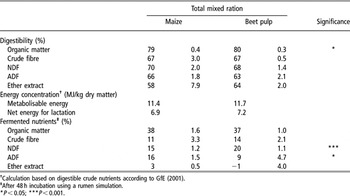
The digestibility of crude nutrients and detergent fibre fractions was on a similar level for both TMR (Table 3). Due to the low standard deviation, the digestibility of OM was significantly higher for TMR Beet pulp than TMR Maize (80% v. 79%). The fibre fractions had a digestibility of 67% (CF), 68% to 70% (NDF) and 63% to 66% (ADF) for TMR Beet pulp and Maize, respectively. The energy concentrations, calculated on the basis of digestible crude nutrients, were lower for TMR Maize (11.4 MJ ME and 6.9 MJ NEL/kg DM) compared to TMR Beet pulp (11.7 MJ ME and 7.2 MJ NEL/kg DM).
Digested and fermented nutrients, and energy concentration (means and s.d., n = 4)

†Calculation based on digestible crude nutrients according to GfE (2001).
‡After 48 h incubation using a rumen simulation.
*P < 0.05; ***P < 0.001.
Fermentation parameters and microbial protein synthesis
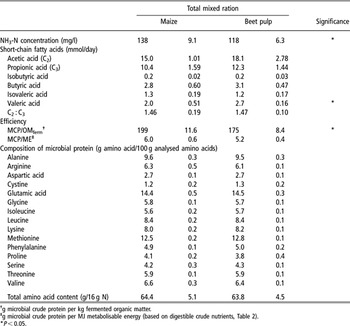
The in vitro fermentation of OM and CF was similar for the two TMR and ranged from 37% to 38% and 14% to 11%, respectively (Table 3). The NDF fermentation in the Rusitec was significantly higher for TMR Beet pulp than for TMR Maize (20 v. 15%), whereas the fermentation of ADF was significantly higher for TMR Maize (16 v. 9%). The ammonia-N concentration was lower for TMR Beet pulp (118 mg/l) compared to TMR Maize (138 mg/l) (Table 4). No differences were observed in the amounts of SCFA in the effluent with the exception of valeric acid. The acetic to propionic acid ratio was 1.5 for both TMR. The efficiency of the MCP synthesis was significantly lower for TMR Beet pulp compared to TMR Maize (175 v. 199 g MCP/kg fermented OM, Table 4). The AA composition of the microbial protein was not affected by the treatment.
Ammonia-N and short chain fatty acids in the Rusitec liquid effluent, efficiency of microbial crude protein synthesis and content of amino acids in microbial crude protein (n = 4, means and s.d.)

†g microbial crude protein per kg fermented organic matter.
‡g microbial crude protein per MJ metabolisable energy (based on digestible crude nutrients, Table 2).
*P < 0.05.
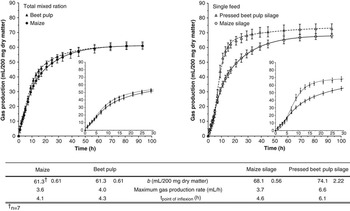
The estimated plateau value of GP was identical for both TMR (Figure 1). However, the maximal GP rate was reached 0.2 h later and was 0.4 ml/h higher for TMR Beet pulp than TMR Maize. When the single feeds were incubated, both the potential of GP and the maximal GP rate were higher for the beet pulp silage than for the maize silage. However, the point of the maximal GP rate was reached later for the beet pulp silage than for the maize silage.
Cumulative gas production during 92 h and the first 30 h of incubation, estimated capacity of gas production (b), calculated maximum gas production rate, and its time of occurrence based on equation (1) of the total mixed rations and the two main single feeds (n = 8, means and s.d.).

Discussion
The achievement of high milk yields of dairy cows depends on both high DM intake and the energy concentration in the ration. This is especially the case in the early phase of lactation when the peak in milk production but not in DM intake is reached. The responses in DM intake to the inclusion of different beet pulp products in rations at the expense of maize have not been consistent in the literature. According to Voelker and Allen (Reference Voelker and Allen2003b), the DM intake was constant with increasing level of dried beet pulp inclusion in the diet up to 24%. Mansfield et al. (Reference Mansfield, Stern and Otterby1994) reported a reduction in feed consumption because of the poor acceptance of the pelleted beet pulp. The replacement of alfalfa fibre with beet pulp fibre increased the DM intake by 0.4 kg/day in the study of Clark and Armentano (Reference Clark and Armentano1997). Moisture content of silages has been reported to be negatively related to DM intake (Gordon et al., Reference Gordon, Derbyshire, Jacobson and Humphrey1965). The DM content of the TMR Beet pulp was less than that of the TMR Maize (Table 1), which could have resulted in a lower DM intake. However, according to Allen (Reference Allen2000), the DM intake of high moisture forages is more likely limited by fermentation products than moisture content per se. The lower DM intake of TMR Beet pulp in the present study may have been compensated by the higher energy concentration found in this TMR in comparison to TMR Maize. We did not study the ME concentration of the single feeds. But De Visser and Hindle (1990) observed a higher OM digestibility and energy concentration of pressed beet pulp silage in comparison with maize silage. Also, the NDF digestibility was higher for diets with beet pulp than with maize or barley fed to dairy cows (Huhtanen, Reference Huhtanen1987 and Reference Huhtanen1988; Voelker and Allen, Reference Voelker and Allen2003a). The present sheep study did not indicate a positive effect of beet pulp silage inclusion on the digestibility of fibre fractions. However, the sheep were fed at maintenance level. A higher passage rate at higher feeding level may have restricted the degradation in the rumen of dairy cows. In consequence, neither was the mean daily NEL intake of the cows different between the treatments nor were the yields of milk, milk fat and milk protein affected. These findings are in agreement with previous studies comparing maize with beet pulp in TMR (Mansfield et al., Reference Mansfield, Stern and Otterby1994; Clark and Armentano, Reference Clark and Armentano1997; Voelker and Allen, Reference Voelker and Allen2003b). It is worth mentioning that both the inclusion level of beet pulp silage in the ration (20% of DM) and the level of milk yield were very high in the present study.
NDF generally ferments and passes slower from the reticulo-rumen than other dietary constituents and has a greater filling effect over time than non-fibrous feed components (Allen, Reference Allen1996). A statistical evaluation has shown that enhanced NDF digestibility of forage improves DM intake (Oba and Allen, Reference Oba and Allen1999). Therefore, the slightly lower NDF digestibility of TMR Beet pulp in the present study may have caused the lower DM intake compared to TMR Maize.
In contrast, in vitro fermentation of NDF was significantly higher for TMR Beet pulp than for TMR Maize. According to Voelker and Allen (Reference Voelker and Allen2003a), the NDF in beet pulp ferments extensively and at a faster rate in the rumen, resulting in an increased digestibility of NDF. The course of the cumulative GP by the incubation of the beet pulp silage in the present study indicates that the degradation started later but was more intense than in the maize silage. The fermentation of pectin depends on microbes that are associated with the solid phase in the rumen (Marounek et al., Reference Marounek, Bartos and Brezina1985). Therefore, the colonisation of the feed particle is essential for its degradation, but this process is time-consuming.
Beet pulp contains high amounts of pectic polysaccharides that consist of α-1,4-d-galacturonan, a highly branched l-arabinan, and α/β-1,4-galactan (Worth, Reference Worth1967). The pectins contain both structural and non-structural carbohydrates. More than 40% of the total carbohydrates in beet pulp are cellulose and hemicellulose (Kamphues and Dayen, Reference Kamphues and Dayen1983), which are analytically recovered in the NDF fraction. However, the extent of ruminal NDF digestion for beet pulp was very high (Bhatti and Firkins, Reference Bhatti and Firkins1995; DePeters et al., Reference DePeters, Fadel and Arosemena1997).
Differences in the type of carbohydrates fed may cause changes in the ruminal fermentation rate (Tamminga et al., Reference Tamminga, van Vuuren, van Der Koelen, Ketelaar and van der Togt1990) and pattern of SCFA (Bach et al., Reference Bach, Yoon, Stern, Jung and Chester-Jones1999). Acetate comprised more than 80% and 70% of the produced SCFA by incubation of pectin and starch, respectively, whereas the propionate production was higher by using starch (Marounek et al., Reference Marounek, Bartos and Brezina1985). The substitution of pelleted beet pulp for high-moisture maize increased the molar proportion of acetate and butyrate and decreased propionate in the rumen (Voelker and Allen, Reference Voelker and Allen2003c). The ratios of acetate to propionate increased significantly from 2.2 to 2.8 with increasing level of beet pulp in the dairy cows’ ration. In contrast, the SCFA amounts were similar between the in vitro incubated TMR in the present study. Differences between in vitro and in vivo responses may be explained by the absorption of SCFA from the rumen. The ratio of acetate to propionate between 1.5 and 3 to 1 reported in other studies (Abel et al., Reference Abel, Schröder, Lebzien and Flachowsky2006; Seng et al., Reference Seng, Bonorden, Nissen, Isselstein and Abel2008) seems to be specific for the used Rusitec system.
Compared to the incubation of starch, the lactic acid production was very low in in vitro experiments using hemicelluloses and pectins (Marounek et al., Reference Marounek, Bartos and Brezina1985). Voelker and Allen (Reference Voelker and Allen2003c) observed low lactate concentrations and similar pH values between 5.4 and 6.6, irrespective of the starch content of the used diets. As a neutral pH is optimal for pectinolytic enzymes (Wojciechowicz et al., Reference Wojciechowicz, Heinrichova and Ziolecki1980), the fermentation of pectins by cellulolytic microbes may be promoted.
The NABE in the urine observed in the present study indicate a stable acid-base balance. According to Lachmann and Schäfer (Reference Lachmann and Schäfer1985), values between 83 and 215 mmol/l are tolerable. However, a NABE <118 mmol/l combined with a starch-rich feeding are considered to indicate a ‘primary metabolic acidosis’. Thus, the cows fed TMR Maize may have been closer to the risk of acidosis than the cows fed TMR Beet pulp.
Energy and nitrogen are the factors that may limit an animal’s performance as a result of the restricted microbial synthesis in the rumen (Clark et al., Reference Clark, Klusmeyer and Cameron1992). With increasing ratio between protein and energy, the urea concentration in milk increases following an increase in blood urea N (Oltner and Wiktorsson, Reference Oltner and Wiktorsson1983). The significantly lower milk urea concentrations of cows fed TMR Beet pulp may be explained by the lower CP and higher ME concentration in this diet. Perhaps the restricted N supply in TMR Beet pulp was the reason for the significantly lower efficiency of MCP synthesis found in the present in vitro study. The flow of microbial N in the duodenum of dairy cows decreased when pelleted beet pulp substituted high-moisture maize (Voelker and Allen, Reference Voelker and Allen2003c), but the efficiency of MCP synthesis was not affected in this study.
Theoretical calculations by Boisen et al. (Reference Boisen, Hvelplund and Weisbjerg2000) indicate that different AA limit the milk production in different feeding situations. In the present study the AA composition of the MCP was independent of the used feedstuffs. However, there is no information about the uCP or the AA content at the duodenum because the composition of dietary protein escaping ruminal degradation is unknown. Irrespective of the calculated lower amount of MCP, the milk production was not restricted by using beet pulp silage in the diet.
Conclusions
Silages prepared from pressed sugar beet pulp can be included in rations for high-yielding dairy cows at a level of up to 20% of DM without affecting milk yield. Feed intake of cows may be reduced by the inclusion of beet pulp silage due to slower fermentation and lower passage rate, but this is compensated by a higher energy concentration of the ration.
Acknowledgement
The authors are grateful for the support given for these studies by the Wirtschaftliche Vereinigung Zucker e.V., Bonn, Germany.