Introduction
Dryland farming is vital to China’s food security by virtue of its role in staple crop production (Zhao et al., Reference Zhao, He, Siddique and Gao2024). In the Loess Plateau of China, a typical ecologically fragile dryland area, dryland farming covers about 12.8 million ha, accounting for 80% of its arable land (Hu et al., Reference Hu, Zheng, Sadras, Ding, Yang and Zhang2018). Winter wheat (Triticum aestivum L.) is a major crop in the Loess Plateau, and its yield and profitability are heavily affected by limited precipitation (Chai et al., Reference Chai, Chai, Han, Li, Ma, Li, Cheng, Chang and Chai2022). Conservation tillage such as straw mulching has been encouraged to conserve soil and water resources, and improve wheat yield and water use efficiency (WUE) (Hu et al., Reference Hu, Zheng, Sadras, Ding, Yang and Zhang2018; Wang et al., Reference Wang, Zheng, Fan, Zhang and Huang2021; Qin et al., Reference Qin, Niu, You, Cui, Chen and Li2024). Compared to conventional tillage, straw mulching alters the soil microenvironment and has substantial effects on soil biochemical processes and wheat growth, leading to changes in nitrogen (N) availability, N use efficiency, and accumulation of residual N in soil (Gao et al., Reference Gao, Li, Zhang, Liu, Dang, Cao and Qiang2009; Stagnari et al., Reference Stagnari, Galieni, Speca, Cafiero and Pisante2014). Conventional N management strategies may be less effective under straw mulching. Therefore, developing tailored N management strategies for straw mulching is crucial to maximizing wheat yield and N use efficiency, and minimizing environmental costs.
Appropriate rate and frequency of N application are the most critical components of N fertilizer management, directly influencing wheat yield, N use efficiency, and environmental outcomes (Wu et al., Reference Wu, Ma, Fan, Sun, Yi, Guo and Voldeng2019; Hu et al., Reference Hu, Sadras, Lu, Zhang, Han, Liu, Xie, Yang and Zhang2021). The recommended N application rate for wheat varies by region, depending on factors such as soil, climate, and management practices. Recent global-scale meta-analyses suggested that applying 100 – 200 kg/ha of N was the optimal rate for maximizing wheat yield, grain protein content, and water productivity (Wu et al., Reference Wu, Wang, Wang, Xu, Zörb, Geilfus, Xue, Sun and Ma2022; Wang et al., Reference Wang, Peng, Lin, Wang, Jia and Zhang2023a). Under rainfed Mediterranean conditions, the N application rate of 120 – 160 kg/ha is optimal for maximizing yield and grain protein content (Tedone et al., Reference Tedone, Ali, Verdini and De Mastro2018; Souissi et al., Reference Souissi, Bahri, Cheikh M’hamed, Chakroun, Benyoussef, Frija and Annabi2020; Carucci et al., Reference Carucci, Gatta, Gagliardi, Vita and Giuliani2020; Francioni et al., Reference Francioni, Palmieri, Fiorentini, Deligios, Monaci, Vischetti, Rossa, Trozzo, Bianchini, Rivosecchi, Ledda, Orsini, Santilocchi and D’Ottavio2024; Khlila et al., Reference Khlila, Baidani, Hnizil and Amamou2025). In the Loess Plateau of China, the optimal N rate with the trade-off between wheat yield and grain quality is 134 – 147 kg N/ha under no mulch and 146 – 167 kg N/ha under plastic film mulching (Luo et al., Reference Luo, Hui, Wang, Zhang, Xie, Gao, Chai, Lu, Li, Sun, Chang, Bai and Malhi2019). This indicates that plastic film mulching requires more N input than no mulching (Luo et al., Reference Luo, Wang, Huang, Hui, Wang, Zhao, He, Zhang, Diao, Cao, Ma and Liu2018). However, under straw mulching, it remains uncertain whether increasing N input is necessary to achieve higher yield and grain quality.
Split N application is often proposed for N management to improve yield, grain quality, and N use efficiency by matching N supply with crop needs, while reducing environmental losses from volatilization, denitrification, and leaching (Hu et al., Reference Hu, Sadras, Lu, Zhang, Han, Liu, Xie, Yang and Zhang2021; Wu et al., Reference Wu, Wang, Wang, Xu, Zörb, Geilfus, Xue, Sun and Ma2022; Wang et al., Reference Wang, Peng, Lin, Wang, Jia and Zhang2023a). A previous global-scale meta-analysis indicated that split N application obviously led to an increase in winter wheat yield and grain protein content compared with single N application under conventional tillage, but had no effect on yield and in some cases led to a reduction in protein content under straw mulching (Hu et al., Reference Hu, Sadras, Lu, Zhang, Han, Liu, Xie, Yang and Zhang2021). However, under straw mulching, it is unclear whether a single N application is feasible or may lead to more N residue, loss, or low N use efficiency. Furthermore, systematic understanding of how N rate, N application frequency, seasonal conditions, and their multi-level interactions affect wheat production under straw mulching remains limited. Thus, the objective of the current research was to test the three-way interaction between N rate, N application frequency and seasonal condition, and its impact on yield, and its components, grain protein content, residual soil N, water- and N-use efficiency of winter wheat under straw mulching.
Materials and methods
Site, soil and climate
Four-year field experiments were conducted at Wangdong village (35°8′ N, 107°25′ E, 1206 m a.s.l.), located in Shaanxi Province in the Loess Plateau. The soil, classified as an aridic, loamy, Cumulic Haplustoll, has a silt loam texture and originates from loess deposits (Hu et al., Reference Hu, Zheng, Sadras, Ding, Yang and Zhang2018, Reference Hu, Sadras, Lu, Zhang, Yang and Zhang2019a). Before the establishment of the experiment, the topsoil (0 – 20 cm) contained 14.2 g/kg organic matter, 0.95 g/kg total nitrogen, 12.9 mg/kg nitrate nitrogen, 1.8 mg/kg ammonium nitrogen, 18.7 mg/kg available phosphorus, 157 mg/kg available potassium, and had a bulk density of 1.21 g/cm3.
As described in the previous study (Hu et al., Reference Hu, Sadras, Lu, Jin, Xu, Ye, Yang and Zhang2019b), the experimental site has an average annual precipitation of 578 mm, with over 60% occurring during the summer fallow period. The average annual pan evaporation is 1552 mm, and the mean annual temperature is 9.3 °C, accompanied by a frost-free period of 194 days. The groundwater table lies more than 60 m below the surface, rendering groundwater unavailable for crop growth.
Experimental design and crop husbandry
The experiment included six treatments resulting from the factorial combination of three N application frequencies and two N application rates, i.e., conventional and high N rate. The N application frequencies were: single-time (one), i.e., 100% at sowing; two-times (two), i.e., 50% at sowing and 50% topdressing at jointing; and three-times (three), i.e., 50% at sowing, 40% topdressing at jointing, and 10% applied via foliar spraying at anthesis. The high N rate (HN) was 200 kg N/ha in the first three seasons and 180 kg N/ha in the last season; the conventional N rate (CN) was 150 kg N/ha in the first three seasons, which is the locally recommended rate for conventional tillage, and 120 kg N/ha in the last season. Nitrogen rate was adjusted due to high pre-sowing soil nitrate-N content in the fourth season (nitrate-N accumulated to 74 kg N/ha for CN and 98 kg N/ha for HN within the 1 m soil depth) and the absence of significant yield differences between conventional and high N rates in prior seasons. The dosage adjustment was informed by the experimental design of Wang et al. (Reference Wang, Palta, Wei, Chen and Deng2018), which used 120 and 180 kg N/ha as medium and high N rates in a study conducted in this same region. Treatments were arranged in a randomized block design with four replicates. Plot size was 22 m2 (4×5.5 m) contained 22 rows spaced at 0.25 m.
The experiments involved growing a single crop, beginning with sowing in late September or early October and continuing until harvest in late June or early July of the subsequent year, separated by a fallow period of 3.5 months. Wheat straw mulching maintained 0.6 kg/m2 of stubble throughout the experimental period. At sowing, the wheat straw was temporarily removed while fertilizers were incorporated into the soil using a rotary plough. Fertilizers included different doses of nitrogen as urea and 75 kg P2O5/ha as triple superphosphate. After sowing the wheat manually, the straw was evenly redistributed back onto the plots. Winter wheat variety (cv. Changhan 58) was grown at the recommended seeding rate of 150 kg/ha, and field management practices, including pesticide and herbicide applications, followed the recommendations outlined in Hu et al. (Reference Hu, Zheng, Sadras, Ding, Yang and Zhang2018, Reference Hu, Sadras, Lu, Jin, Xu, Ye, Yang and Zhang2019b).
Sampling and measurements
Winter wheat phenology was systematically tracked using the Decimal Code (DC) system developed by Zadoks et al. (Reference Zadoks, Chang and Konzak1974). Wheat shoot population density was counted at emergence (DC15), winter tillering (DC25), jointing (DC35), and anthesis (DC65). At maturity (DC92), the number of culms or ears was counted from a 0.5 m2 area in each plot, excluding culms without spikes.
Soil water content in the soil profile, down to 3 m at 0.2 m intervals, was measured gravimetrically at sowing and maturity (DC92) in a pooled sample of two soil cores per replicate. Soil nitrate-N content was measured down to 1 m at 0.2 m intervals per replicate at maturity (DC92), except in the first season, where measurements were taken to 0.9 m at 0.3 m intervals in the bottom layer. Soil nitrate-N was extracted from 5 g fresh soil with 50 ml of 1 mol/L KCl and measured using an AA3 continuous segmented flow analyzer (SEAL Analytical).
At maturity, grain yield, aboveground biomass, ear number, grains per ear and grain weight were measured, and harvest index (grain yield-to-shoot biomass ratio) and grain number per unit area were calculated. The estimation of both grain yield and shoot biomass was based on a 4 m2 area per plot. The number of grains per ear was counted from ten randomly selected ears in each plot. Grain number per unit area was calculated as grain number per ear multiplied by ear number. Following manual harvest, the aboveground plant material was separated into straw (including stems and leaves), chaff and grain after air-drying. The weights of straw, chaff, and grain samples were determined after drying at 65 – 70°C to a constant weight and subsequently used to calculate the biomass of straw and chaff, and grain yield. Nitrogen contents of grain, chaff and straw subsamples were determined by the Kjeldahl procedure.
Calculations and statistical analyses
The aridity index (AI) is a numerical index that quantifies regional dryness, calculated as follows:
 $$AI = {{MAP} \over {MAE{T_0}}}$$
where MAP (mm) is mean annual precipitation and MAET 0 (mm) is mean annual reference evapotranspiration (ET). Following the United Nations Environment Programme’s (UNEP) classification, AI < 0.2 for Arid, 0.2 – 0.5 for Semi-Arid, 0.5 – 0.65 for Dry Sub-Humid, and AI > 0.65 for Humid (UNEP, 1997). The soil water storage was calculated with the following equation:
 $$W = \mathop \sum \limits_{i = 1}^n \left( {{w_i} \times {h_i}/10} \right)$$
where W (mm), soil water storage; w i (%), soil volumetric moisture content in each soil layer; h i (cm), soil depth; n, soil layers.
Crop ET (mm) and WUE (kg/ha/mm) were calculated with the following equations:
 $$ET = P + \Delta W$$
 $$WUE = {Y \over {ET}}$$
where P (mm) and ΔW (mm) were defined as the cumulative precipitation and the change in soil water storage (0 – 3 m) from sowing to harvest, respectively. Runoff and deep percolation were not considered in the current study, as outlined in previous studies (Hu et al., Reference Hu, Sadras, Lu, Zhang, Yang and Zhang2019a); Y (kg/ha) is wheat grain yield.
Wheat grain protein content, nitrogen efficiency and soil nitrate-N accumulation were calculated as follows (Mariotti et al., Reference Mariotti, Tomé and Mirand2008; Gao et al., Reference Gao, Li, Zhang, Liu, Dang, Cao and Qiang2009; Wang et al., Reference Wang, Zhang, Beebout, Zhang, Liu, Yang and Zhang2016; Liu et al., Reference Liu, Sadras, Xu, Hu, Yang and Zhang2021):
 $$GPC = GNC \times 5.7$$
 $$NUtE = {Y \over {TNU}}$$
 $$PFPN = {Y \over {NR}}$$
 $$NHI = {{GNU} \over {TNU}} \times 100$$
 $$SNA = \mathop \sum \limits_{i = 1}^n \left( {{P_i} \times B{D_i} \times {h_i}/10} \right)$$
where GPC (%), grain protein content; GNC (%), grain nitrogen concentration; 5.7, conversion factor (Mariotti et al., Reference Mariotti, Tomé and Mirand2008); NUtE (kg/kg), nitrogen utilization efficiency; Y (kg/ha), grain yield; TNU (kg N /ha), total nitrogen uptake at maturity; PFPN (kg/kg), nitrogen partial factor productivity; NR (kg N /ha), nitrogen rate; NHI (%), nitrogen harvest index; GNU (kg N /ha), grain nitrogen uptake at maturity; SNA (kg N/ha), soil nitrate-N accumulation at maturity; P i (mg NO3–N /kg), soil nitrate-N concentration in each soil layer; BD i (g/cm3), soil bulk density in each soil layer; h i (cm), soil depth; n, soil layers.
The effects of season, N rate, N application frequency and their interactions on crop traits were tested using repeated measures analysis of variance (ANOVA) (general linear model). When F-values were significant, multiple comparisons of means were performed using the least significant difference method at 0.05 probability. The conceptual framework was created using the BioRender tool. All statistical analyses were performed with SPSS 18.0.
Results
Weather
During the experimental period, total precipitation was below the long-term average (578 mm) in the first and fourth seasons, but exceeded the average in the second and third seasons (Fig. 1(a)). Despite lower total precipitation in the fourth season, in-crop precipitation reached 223 mm, accounting for 51% of the total precipitation. Drought conditions were particularly severe in the first season, with an aridity index of 0.17 during the growing season (Fig. 1(b)).
Precipitation and aridity index during three periods: fallow (from wheat harvest at the end of June or early July to sowing in late September or early October), in-crop season, and total (fallow + in-crop season) during the four seasons. The blue numbers on the column represent the total precipitation (fallow + in-crop season). Aridity index (AI) returns arid (AI < 0.2), semi-arid (0.2 < AI < 0.5), dry sub-humid (0.5 < AI < 0.65) and humid (AI > 0.65) environments.

Wheat shoot population density dynamics
Wheat shoot population density was highest in the second season, and lowest in the first season, with values in the first season being lower than in the third and fourth seasons (Fig. 2). Except for the third season, wheat shoot population density after wintering was slightly higher under high N application rate than under conventional N rate, especially with a single N application. The frequency of N application showed season- and usage-dependent effects on wheat population size. Under conventional N rate, N application frequency had no effect on wheat population size across all growth stages and seasons (Fig. 2(a1 – a4)). However, under high N rate, wheat shoot population density was significantly higher with a single N application than with split applications at jointing and anthesis stages in the first season (p < 0.05), and at jointing stage in the second and fourth seasons (p < 0.05), with no significant differences at other stages (p > 0.05) (Fig. 2(b1), (b2) and (b4)).
Dynamics of wheat shoots in a factorial experiment combining three N application frequencies (one, two and three times), two N application rates (conventional and high N rate), and four seasons. Crop stages are S, Seedling; W, Wintering; J, Jointing; A, Anthesis; M, Maturity. Different letters indicate significant differences among N application frequencies.

Yield, its components and water use efficiency
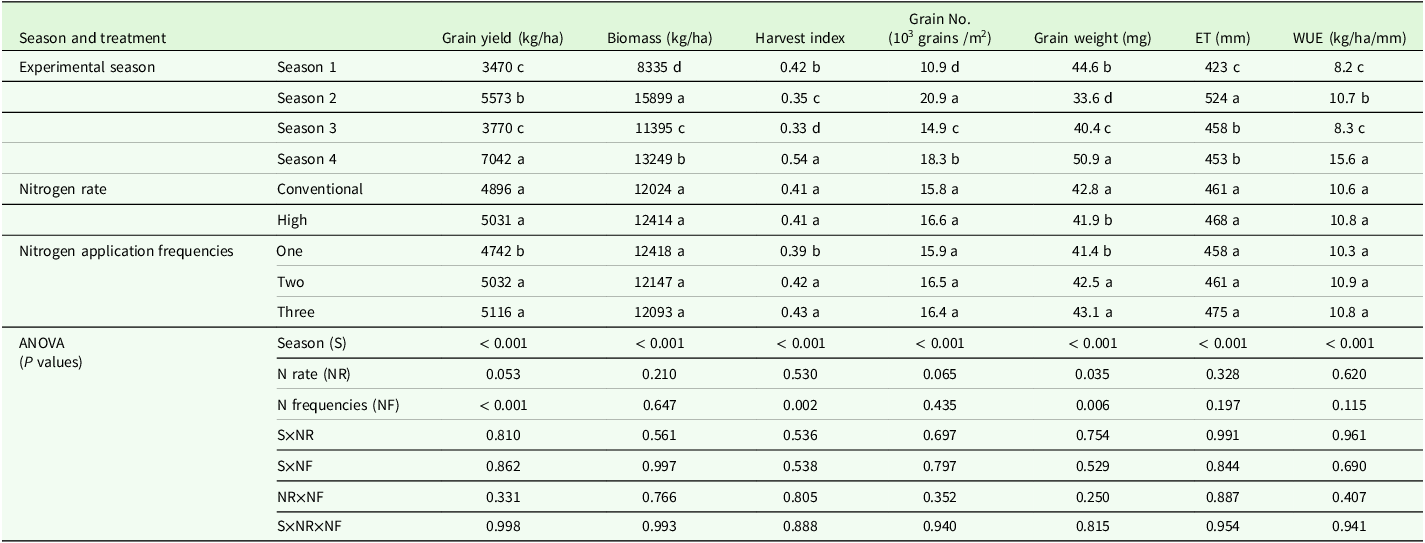
Wheat yield varied from 3470 to 7042 kg/ha across the four experimental seasons (Table 1), primarily influenced by seasonal fluctuations in precipitation and extreme weather events including frost and hail damage. ANOVA showed significant seasonal effects on grain yield (p < 0.001), ranked as follows: season 4 > season 2 > season 3 > season 1. Seasons also affected biomass, harvest index (HI) and yield components. Nitrogen rate only markedly affected grain weight, and grain weight decreased at high N rate. Split N application significantly enhanced grain yield (6 – 8%, p < 0.001), HI (8 – 10%, p = 0.002), and grain weight (3 – 4%, p = 0.006) compared to single N application, but no difference between two- and three-times N applications. Seasons significantly affected ET and WUE (p < 0.001), while N application rate and frequency had no effect on either. The variation in WUE ranged from 8.2 kg/ha/mm in the first season to 15.6 kg/ha/mm in the fourth season. The two-way and three-way interactions among season, N application rate, and N application frequency had no significant effect on all five yield-related traits, ET and WUE (p > 0.05) (Table 1).
Yield, yield components, evapotranspiration and water use efficiency of winter wheat crops in a factorial experiment combining three nitrogen application frequencies (one, two and three times), two nitrogen rates (conventional and high nitrogen rate) and four seasons

ET, evapotranspiration; WUE, water use efficiency; N, nitrogen.
Means followed by different lowercase letters within the same column are significantly different (P < 0.05).
Protein content, N use efficiency and post-harvest soil nitrate-N content
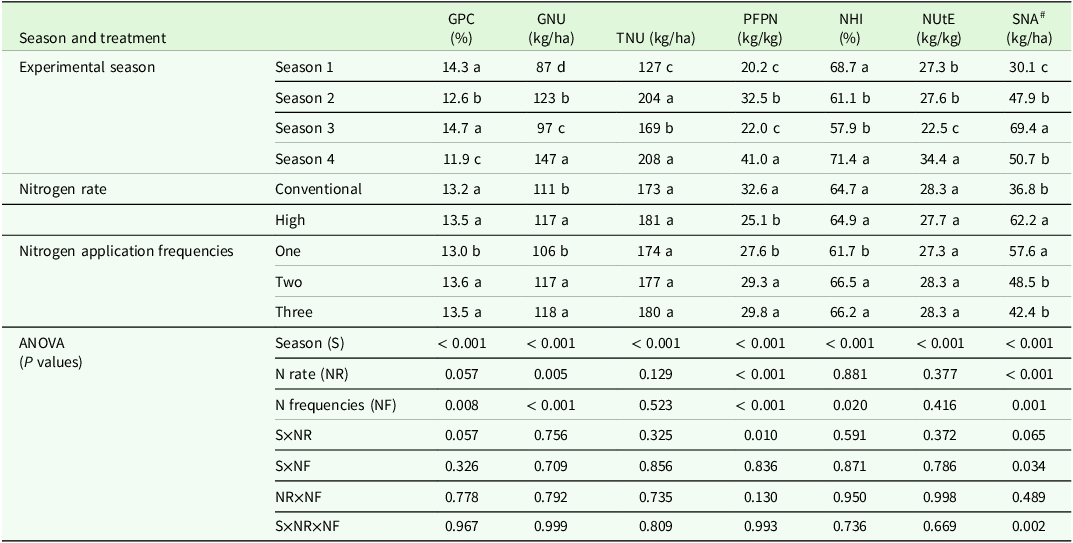
Season significantly influenced grain protein content, N uptake, N efficiency indicators, and soil nitrate-N accumulation at maturity (p < 0.001) (Table 2). Grain protein content ranged from 11.9% in the fourth season to 14.7% in the third season across the four experimental seasons. Higher N uptake and N efficiency were observed in the fourth season than in the others. Post-harvest soil nitrate-N accumulation (SNA) in the third season was considerably higher than in the other seasons. Nitrogen rate markedly influenced grain N uptake, PFPN and SNA. Specifically, a higher N rate increased grain N uptake and SNA while reducing PFPN. Split N application significantly increased grain protein content, grain N uptake, PFPN and NHI while reducing SNA compared to single N application (p < 0.05). However, no difference between two- and three-times N applications. Grain protein content, N uptake and N efficiency were not significantly influenced by any two- or three-way interactions among season, N rate and N application frequency (p > 0.05), except for a significant season × N rate interaction on PFPN (p = 0.01). Post-harvest soil nitrate-N accumulation was significantly affected by both the season × N frequency and season × N rate × N frequency interactions (p < 0.05); for example, split N application significantly reduced soil nitrate-N accumulation at maturity compared to single application in the first, second and fourth seasons (p < 0.05), but did not have a significant effect in the third season despite a 13.6% decrease (p > 0.05).
Grain crude protein content, nitrogen uptake, nitrogen partial factor productivity, nitrogen harvest index and nitrogen utilization efficiency of winter wheat crops in a factorial experiment combining three nitrogen application frequencies (one, two and three times), two nitrogen rates (conventional and high N rate) and four seasons

GPC, grain protein content; GNU, grain N uptake; TNU, total N uptake; PFPN, nitrogen partial factor productivity; NHI, nitrogen harvest index; NUtE, nitrogen utilization efficiency; SNA, soil nitrate-N accumulation at maturity; N, nitrogen.
# Soil depth: 0 – 90 cm in the first season and 0-100 cm in other seasons.
Means followed by the different lowercase letter within the same column are significantly different (P < 0.05).
At harvest, soil nitrate-N content in the 0 – 100 cm (0 – 90 cm in the first season) soil layer was higher under high N rate than under conventional N rate across N application frequencies and four seasons (Fig. 3). Under conventional N rate, split N application (especially for three-times N application) showed significantly lower soil nitrate-N content in the 20 – 60 cm layer in the third season and in the 40 – 60 cm layer in the fourth season compared to single N application (p < 0.05) (Fig. 3(a3) and (a4)). Under high N rate, single N application resulted in significantly higher nitrate-N content in the 0 – 60 cm layer in the first season (Fig. 3(b1)), 40 – 80 cm layer in the second season (Fig. 3(b2)), and 20 – 40 cm layer in the fourth season (p < 0.05) (Fig. 3(b4)), with no differences across all soil layers in the third season (p > 0.05) (Fig. 3(b3)).
Distribution of soil nitrate-N content in the 0 – 100 cm soil layers after harvest in a factorial experiment combining three N application frequencies (one, two and three times), two N application rates (conventional and high N rate), and four seasons. Error bars represent standard deviation. Different letters indicate significant differences among N application frequencies.

Relationships between grain yield and grain protein content or grain N removal
Grain protein content was negatively correlated with grain yield, with rates of change falling from −0.73%/Mg under high N rate to −0.69%/Mg under conventional N rate (Fig. 4(a)), and from −0.76%/Mg under single N application to −0.70%/Mg under three-times N application (Fig. 4(b)). Nitrogen removal per unit yield showed no significant difference between two N rates (p > 0.05) (Fig. 4(c)). Owing to higher grain N uptake with split N application, the amount of N removed in grain increased from 16.1 kg N/Mg with single N application to 17.0 kg N/Mg with three-times N application (Fig. 4(d)).
Correlations between grain yield and grain protein content (a, b), and between grain yield and grain N removal (c, d) at two N application rates and three N application frequencies. CN: conventional N rate; HN: high N rate.

Discussion
Wheat grain yield was significantly influenced by seasonal variations. Yield in the first and third seasons was substantially lower than that in the second and fourth seasons. Yield reduction in the first season was primarily attributed to severe drought stress (Fig. 1), while yield loss in the third season mainly resulted from combined frost and hail damage. These extreme environmental conditions impaired tiller formation and spike development, as evidenced by the reduced population density (Fig. 3), and ultimately reduced the number of grains per unit area. Higher water- and N-use efficiency in the second and fourth seasons than that in the first and third seasons was mainly due to the higher grain yield and greater N uptake in grain. Conversely, the lower grain crude protein content in the second and fourth seasons than that in the first and third seasons may be mainly due to a dilution effect. Despite the observed variations in grain yield, protein content, and water- and nitrogen-use efficiencies across seasons, the lack of significant season × N management interactions for these parameters indicates that the efficacy of the N management strategies remained stable.
Under straw mulching in the current study, N application rate had no significant effect on grain yield, grain protein content, water- and N-use efficiency. The lack of yield response to N application rate was primarily attributed to the pronounced reduction in grain weight at high N rate, which offset the increase in grain number per unit area, although not significant. Similar results were obtained in experiments in Bangladesh (Rahman et al., Reference Rahman, Chikushi, Saifizzaman and Lauren2005), in the corn belt of northeast China (Zhang et al., Reference Zhang, Peng, Zhang, Li and Weng2025), in the North China Plain (Li et al., Reference Li, Zhang, Li, Qiao, Du, Tian, Zhu, Leng, Yue, Cheng, Chen and Li2022), in the Guanzhong Plain of Northwest China (Akhtar et al., Reference Akhtar, Wang, Ren, Khan, Enguang, Khan, Feng, Yang and Wang2020; Li et al., Reference Li, Wang, Shi, Tian and Ye2023; Li et al., Reference Li, Zhang, Liu, Zhu, Xiao, Shan, Hussain, Wang, Zhou and Chen2025), and in Hetao Irrigation District of North China (Zhang et al., Reference Zhang, Yang, Jin, Liu and Lou2020). In all these experiments, it was found that straw mulching does not require more N input than conventional tillage to achieve a better trade-off between crop yields and environmental impacts. However, the current study contrasts with those of Luo et al. (Reference Luo, Wang, Huang, Hui, Wang, Zhao, He, Zhang, Diao, Cao, Ma and Liu2018, Reference Luo, Hui, Wang, Zhang, Xie, Gao, Chai, Lu, Li, Sun, Chang, Bai and Malhi2019) in the Loess Plateau of China under plastic film mulching, who reported that plastic film mulching boosted wheat yield but reduced grain protein content, necessitating higher N input to sustain both yield and grain protein content comparable to no mulch. This discrepancy might be ascribed to (i) the distinct mechanisms of N transformation and supply under the two mulching systems. Plastic film mulching accelerated early-season N mineralization via improved soil temperature and moisture, which created a concentrated but often asynchronous N supply (Dong et al., Reference Dong, Yang, Yu and Feng2018; Wang et al., Reference Wang, Liu, Zhai, Zhu and Xu2023b). In contrast, straw mulching triggered transient N immobilization due to carbon input, which reduced early N loss and enabled a better synchronization of nitrogen release with crop demand through later mineralization (Zhao et al., Reference Zhao, Wang, Xiong, Zhou, Zhu, Wang, Wang, Wesly, Xue, Cao, Zhang, Tao and Xiong2023; Wang et al., Reference Wang, Liu, Zhai, Zhu and Xu2023b; Dang et al., Reference Dang, Liang, Guo, Fan, Li, Ma and Zhang2025); (ii) plastic film mulching enhancing crop yield and biomass more than straw mulching, leading to higher N uptake (Wang et al., Reference Wang, Zheng, Fan, Zhang and Huang2021; Wei et al., Reference Wei, Zhang, Zhang, Qin, Zhang, Sun and Huang2022; Wang et al., Reference Wang, Liu, Zhai, Zhu and Xu2023b). Additionally, the current study revealed that higher N application rate led to greater nitrate N residues at harvest compared to conventional N rate, along with a significantly lower nitrogen partial factor productivity (PFPN), in line with previous studies (Zhang et al., Reference Zhang, Yang, Jin, Liu and Lou2020; Wang et al., Reference Wang, Li, Zhu, Khan, Tao, Huang, Liu, Zhang, Tao, Gong, Song and Xiong2023; Lai et al., Reference Lai, Zhang, Ding, Liao, Zhang, Yu, Pei, Dou, Li and Fan2024; Adil et al., Reference Adil, Lv, Cao, Lu, Lu, Gul, Bashir, Wang, Li and Feng2024; Zhang et al., Reference Zhang, Peng, Zhang, Li and Weng2025).
Under straw mulching splitting N application resulted in higher grain yield and grain protein content compared to a single N application. This is in agreement with the results of previous studies (Garrido-Lestache et al., Reference Garrido-Lestache, López-Bellido and López-Bellido2004, Reference Garrido-Lestache, López-Bellido and López-Bellido2005; Grahmann et al., Reference Grahmann, Govaerts, Fonteyne, Guzmán, Soto, Buerkert and Verhulst2016; Fatima et al., Reference Fatima, Abbas, Khan, Hussain, Ali, Abbas, Younis, Naz, Ismail, Shahzad, Nadeem, Farooq, Khan, Javed, Khan, Ahmed, Khan and Ahmad2018; Hu et al., Reference Hu, Sadras, Lu, Zhang, Han, Liu, Xie, Yang and Zhang2021; Wu et al., Reference Wu, Wang, Wang, Xu, Zörb, Geilfus, Xue, Sun and Ma2022; Zhang et al., Reference Zhang, Zhao, Liu, Liao and Han2022; Yokamo et al., Reference Yokamo, Irfan, Huan, Wang, Wang, Ishfaq, Lu, Chen, Cai and Wang2023). The increase in grain yield was mainly driven by greater grain weight rather than by a higher grain number per unit area; correspondingly, the increase in grain protein content was principally due to greater grain N uptake without a change in total N uptake. Split N application drove the synergistic improvement in yield and quality through the following key mechanisms: (i) delaying leaf senescence to enhance post-anthesis N uptake, which provided a direct N source for grain filling (Wu et al., Reference Wu, Fan, Wang, Zheng, Chen, Li and Guo2014; Kong et al., Reference Kong, Xie, Hu, Feng and Li2016); and (ii) promoting the remobilization of pre-anthesis N reserves to the grains (Fuertes-Mendizábal et al., Reference Fuertes-Mendizábal, González-Murua, González-Moro and Estavillo2012; Ma et al., Reference Ma, Zhang, Fang, Wang, Wang, Jiang, Wang and Hao2025). However, due to the influence of wheat genotype, climate, soil and management practices (e.g. N rate), the dominant regulatory mechanism reported in the literature remains inconsistent (Fuertes-Mendizábal et al., Reference Fuertes-Mendizábal, González-Murua, González-Moro and Estavillo2012; Wu et al., Reference Wu, Fan, Wang, Zheng, Chen, Li and Guo2014; Kong et al., Reference Kong, Xie, Hu, Feng and Li2016; Ma et al., Reference Ma, Zhang, Fang, Wang, Wang, Jiang, Wang and Hao2025), and the underlying mechanism needs to be clarified. Additionally, no significant difference in yield and grain protein content was observed between two- and three-time N applications. This might be explained by the specific conditions under straw mulching, where the combination of a high C/N ratio and favourable soil moisture conditions enhanced microbial activity (Grahmann et al., Reference Grahmann, Verhulst, Peña, Buerkert, Vargas-Rojas and Govaerts2014; Hu et al., Reference Hu, Zheng, Sadras, Ding, Yang and Zhang2018). This resulted in the temporary immobilization of a portion of the applied N, which was subsequently mineralized and released (Fig. 5) (Mohammed et al., Reference Mohammed, Kelly, Chim, Rutto, Waldschmidt, Mullock, Torres, Desta and Raun2013; Cao et al., Reference Cao, Zhao, Zhang, Zhu and Xiao2020), thereby functioning as a natural split N application and effectively reducing the need for additional splits compared to other conditions (Hu et al., Reference Hu, Sadras, Lu, Zhang, Han, Liu, Xie, Yang and Zhang2021).
A conceptual framework of how split N application under straw mulching synchronizes soil N supply with wheat N demand to improve yield, grain protein content, and N use efficiency while reducing N residue. C, carbon; N, nitrogen; SOM, soil organic matter; HI, harvest index; GPC, grain protein content; PFPN, nitrogen partial factor productivity; NHI, nitrogen harvest index.

The lack of improvement in WUE under split N application was primarily attributed to increased ET, particularly under the three-time application regime, which offset potential yield gains. In addition, split N application led to an increase in PFPN and N harvest index (NHI) while reducing nitrate-N residues at harvest, as reported in previous studies (López-Bellido et al., Reference López-Bellido, López-Bellido and Redondo2005; Fatima et al., Reference Fatima, Abbas, Khan, Hussain, Ali, Abbas, Younis, Naz, Ismail, Shahzad, Nadeem, Farooq, Khan, Javed, Khan, Ahmed, Khan and Ahmad2018; Yokamo et al., Reference Yokamo, Irfan, Huan, Wang, Wang, Ishfaq, Lu, Chen, Cai and Wang2023). Single N application displayed a more typical and stronger negative correlation between grain yield and grain protein content (Grahmann et al., Reference Grahmann, Govaerts, Fonteyne, Guzmán, Soto, Buerkert and Verhulst2016; Hu et al., Reference Hu, Sadras, Lu, Zhang, Han, Liu, Xie, Yang and Zhang2021; Wu et al., Reference Wu, Wang, Wang, Xu, Zörb, Geilfus, Xue, Sun and Ma2022), while split N application alleviated the negative correlation, and increased grain N removal per unit yield. This mitigation might be attributed to the synergistic effect between split N application and the favourable soil conditions under straw mulching through enhanced soil moisture availability and microbial activity (Hu et al., Reference Hu, Zheng, Sadras, Ding, Yang and Zhang2018; Wang et al., Reference Wang, Liu, Zhai, Zhu and Xu2023b). These factors collectively promoted better synchronization between soil N supply and crop N demand (Fig. 5) (Hu et al., Reference Hu, Sadras, Lu, Zhang, Han, Liu, Xie, Yang and Zhang2021; Wu et al., Reference Wu, Wang, Wang, Xu, Zörb, Geilfus, Xue, Sun and Ma2022), thereby simultaneously supporting both yield formation and protein accumulation, as reflected in the increased grain weight and grain N uptake.
Reducing labour input is another major challenge for future agricultural development, apart from increasing crop production and minimizing environmental costs. Split N application improves grain yield and quality, but it needs more labour input due to additional farm operations (Grahmann et al., Reference Grahmann, Govaerts, Fonteyne, Guzmán, Soto, Buerkert and Verhulst2016; Hu et al., Reference Hu, Sadras, Lu, Zhang, Han, Liu, Xie, Yang and Zhang2021). This could be tempered by topdressing N fertilizer with drones (Ahmad et al., Reference Ahmad, Ordoñez, Cartujo and Martos2020; Suresh et al., Reference Suresh, Rao and Kumar2024), or by using controlled-release urea to replace the split application of normal urea (Zhang et al., Reference Zhang, Zhao, Liu, Liao and Han2022). Optimizing controlled-release urea production to reduce costs and implementing government subsidies, along with raising farmers’ awareness of the environmental and ecological benefits of controlled-release urea, are crucial for promoting its broader adoption.
Conclusion
The current study demonstrated that under straw mulching, exceeding the conventional recommended nitrogen (N) application rate (established for conventional soil management practice) provided no agronomic benefits for grain yield and quality, and even significantly reduced nitrogen partial factor productivity while increasing soil N residue. Splitting N applications significantly improved grain yield, protein content, and N use efficiency, while reducing soil N residue. Notably, increasing the frequency from two to three split applications provided no additional benefit. Both the conventional N rate and two-split application effectively alleviated the negative correlation between grain yield and protein content. Additionally, the absence of significant interactions among season, N rate, and N application frequency on grain yield, protein content, and N efficiency indices indicates that the conventional N rate applied in two splits is well-suited for straw mulching systems in the drylands of China’s Loess Plateau.
Data availability statement
The data presented in the current study are available on request from the corresponding author.
Author contributions
Shulan Zhang, Changlu Hu and Xueyun Yang conceived and designed the study. Liurong Li, Juanni He, Ruimin Gao, Xiaoyong Wen and Yanfei Xue conducted data gathering. Changlu Hu, Liurong Li, Yanfei Xue and Runze Zhang performed statistical analyses. Liurong Li, Changlu Hu and Shulan Zhang wrote the article.
Funding statement
This research was financially supported by the Shaanxi Provincial Key Research and Development Program Project (2024NC2-GJHX-24), the National Key Research and Development Program of China (2023YFD1900402), Shaanxi G & M Natural Resources Investment Construction Co., LTD Key Scientific Research Special Project (KY2024-25), and Talent Fund of Weinan Normal University (No. 2024RC03).
Competing interests
The authors declare no conflict of interest.
Ethical standards
Not applicable.