Introduction
The term “suboptimal prescribing” encompasses not only overuse of medications or polypharmacy, but also the underuse of safer or more effective alternatives (Hohl et al., Reference Hohl, Dankoff, Colacone and Afilalo2001). Among the methods that have been developed to assess the appropriateness of individual medications for older adults (Shelton et al., Reference Shelton, Fritsch and Scott2000), the Revised Beers Criteria (RBC) is one of the most widely used (Beers, Reference Beers1997; Fick et al., Reference Fick, Cooper, Wade, Waller, Maclean and Beers2003). The RBC was developed using a modified Delphi method to achieve consensus among nationally recognized experts in geriatric care and pharmacology (Fick et al., Reference Fick, Cooper, Wade, Waller, Maclean and Beers2003) and is composed of 48 medications or classes of medications. These include amiodarone, amitriptyline, barbiturates, cimetidine, diazepam, fluoxetine, indomethacin, meperidine, nitrofurantoin, reserpine and thioridazine.
A large and growing amount of scientific evidence has confirmed suboptimal use of medicines in older patients. Medication-related problems are implicated in 10–30% of hospital admissions in the elderly (Grymonpre et al., Reference Grymonpre, Mitenko, Sitar, Aoki and Montgomery1988; Col et al., Reference Col, Fanale and Kronholm1990; Hohl et al., Reference Hohl, Dankoff, Colacone and Afilalo2001; Passarelli et al., Reference Passarelli, Jacob-Filho and Figueras2005). One study uncovered the prescription of adversely interacting drugs to a quarter of the older patients admitted to the general medical and geriatric beds of a teaching hospital, of which at least 65.5% could have been avoided (Gosney and Tallis, Reference Gosney and Tallis1984).
Older patients are more vulnerable to suboptimal prescribing and are at higher risk of adverse drug reactions (Egger et al., Reference Egger, Bachmann, Hubmann, Schlienger and Krähenbühl2006). Although older patients with dementia may be especially vulnerable to adverse effects of suboptimal prescribing (Larson et al., Reference Larson, Kukull, Buchner and Reifler1987), to date, there have been no studies assessing whether optimizing the use of medicines in hospitalized geriatric psychiatry patients with co-morbid dementia correlates with improvement in functioning. Therefore, the aims of the present study were to compare the prevalence of suboptimal prescribing according to the RBC in a population of older patients with co-morbid dementia before and after admission to a geriatric psychiatry inpatient ward and to evaluate a possible correlation between suboptimal use of medicines and clinical functioning.
Methods
After obtaining approval from the University of California, San Diego (UCSD) Human Research Protections Program, one of the authors (VC) reviewed the medical charts of patients admitted to the UCSD Senior Behavioral Health Inpatient Unit (SBHU) over a period of 20 months (August 2004 to March 2006). The SBHU is a 14-bed, secure, acute geriatric psychiatry inpatient unit within a university hospital. Patients spend most of their morning hours in an area of the unit where the ambient lighting level is approximately 2000 lux.
One hundred and eighteen consecutively admitted older patients who met Diagnostic and Statistical Manual of Mental Disorders, Fourth Edition, Text Revision (DSM-IVTR) criteria for a dementia diagnosis were included in this study (American Psychiatric Association, 2000). Within 24 hours of admission, both a board-certified geriatric internist and a board-certified geriatric psychiatrist made their respective diagnoses using appropriate sources of information: history, physical examination and diagnostic test results. Demographic and clinical variables – including length of stay, Mini-mental State Examination (MMSE) score (Folstein et al., Reference Folstein, Folstein and McHugh1975), Mattis Dementia Rating Scale (DRS) score (Mattis, Reference Mattis, Bellak and Karasu1976), DSM-IVTR Axis I diagnoses, and numbers and types of active medical illnesses – were entered into a database. Active medical illnesses were defined as illnesses currently requiring some form of monitoring or treatment. Variables recorded at both time of admission and time of discharge included: numbers and types of medications including RBC medications from Table 1 in the publication by Fick et al. (Reference Fick, Cooper, Wade, Waller, Maclean and Beers2003) (“Criteria for potentially inappropriate medication use in older adults: independent of diagnoses or conditions”), Global Assessment of Functioning (GAF) score (American Psychiatric Association, 2000), and the Scale of Functioning (SOF) score (Rapaport et al., Reference Rapaport, Bazzetta, McAdams, Patterson and Jeste1996).
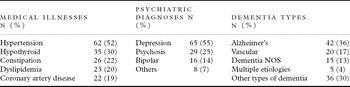
Summary of common medical illnesses, psychiatric diagnoses and types of dementia

The hypotheses were: (1) reduction in use of RBC medications from time of admission to time of discharge will occur in a population of patients who are cared for on a geropsychiatry inpatient unit; and (2) reduction in use of RBC medications will correlate with improvement in patient functioning. Data were examined for normal distribution and homogeneity of variance and were normalized if needed. Clinical variables on admission and discharge were compared using two-tailed paired t-tests for continuous data and chi-square (χ2) tests for categorical data. The RBC was used to identify medications or classes of medications as potentially inappropriate for the elderly (Beers, Reference Beers1997; Fick et al., Reference Fick, Cooper, Wade, Waller, Maclean and Beers2003). The nurses who administered the SOF achieved an overall interclass correlation coefficient of 0.92, indicating high inter-rater reliability. Pearson correlations were used to examine the correlation between the change in SOF scores and the change in RBC medications from time of admission to time of discharge.
Results
The mean (SD) patient age for our samples was 81.5 (6.2) years and the majority (86%) were Caucasians. Seventy-eight percent of the patients were female, 66.7% of the patients lived at home, and 89% were high school graduates. The mean scores (SD) on the MMSE and the DRS were 22.1 (6.2) and 116.6 (18.7), respectively. The mean (SD) number of active medical illnesses was 4 (2), and both the median and mode were 4. The mean (SD) length of stay was 14 (7) days.
The most common medical conditions, psychiatric diagnoses, and types of dementia are listed in Table 1. Among the four psychiatric diagnostic groups, there was no significant difference in the change in number of medications from admission to discharge (χ2 = 0.78, df = 3, p = 0.85).
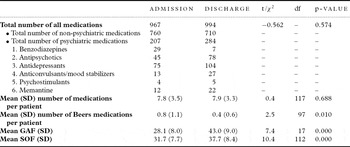
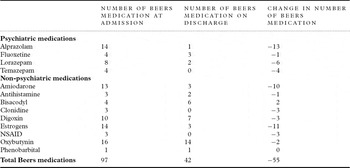
Patients were taking an average of 7.8 (3.5) medications with a range 0–16 on admission; and an average of 7.9 (3.3) medications and a range 1–20 on discharge (t = 0.40, df = 117, p = 0.688) (Table 2). There was no significant difference between the total number of prescribed medications for the entire sample at admission (967) versus at discharge (994) (Wilcoxon Signed Ranks Test = −0.562, p = 0.574). However, when medications were separated into groups of psychiatric and non-psychiatric medications, there was a significant increase in the total number of psychiatric medications from 207 at admission to 284 at discharge and a significant decrease in the total number of non-psychiatric medications from 760 at admission to 710 at discharge (χ2 = 13.4, df = 1, p = 0.001). Benzodiazepines were decreased by 76%. Twelve patients were initiated on acetylcholinesterase inhibitor, 10 on memantine, and 11 on gabapentin. The total number of RBC medications for the entire sample decreased from 97 at admission to 42 at discharge, a 56.7% reduction. The mean number of RBC medications per patient decreased significantly from 0.8 (1.1) to 0.4 (0.6) (t = 2.5, df = 97, p = 0.010) (Table 2). Table 3 lists the RBC medication at admission versus discharge.
Comparison of clinical variables at admission versus discharge

SD = standard deviation; GAF = Global Assessment of Functioning score; SOF = Scale of Functioning score
Beers medications at admission versus discharge

The clinical outcome measures – the mean GAF and SOF scores – increased significantly from 28.1 (9.1) to 43.0 (9.0) (t = 7.42, df = 17, p = 0.000) and from 31.7 (7.7) to 37.7 (8.4) (t = 10.4, df = 112, p = 0.000) respectively (Table 2). We found a significant negative correlation between the change in the number of RBC medications and the change in SOF score from time of admission to time of discharge (r = −0.44, df = 97, p = 0.000).
Discussion
Suboptimal medication use is a potential source of iatrogenic morbidity and loss of function in older patients. Previous research has provided estimates of the frequency and consequences of this phenomenon in older patients. The primary goals of this study were to determine if a senior behavioral health inpatient unit was able to reduce suboptimal prescribing in older patients with co-morbid dementia and to measure the impact of suboptimal prescribing on the function of these patients. Using the RBC as an indicator, the results confirmed that a senior behavioral health inpatient unit did indeed reduce by 56.7% the number of potentially inappropriate medications prescribed. Data analysis revealed a statistically significant correlation between the reduction in RBC medications and improvement in two different measures of daily function.
Although the total number of psychiatric medications prescribed at discharge was greater than at admission, within each category of medications (psychiatric and non-psychiatric), there was a significant reduction in the use of RBC medications suggesting that it may not be only polypharmacy itself that causes undesirable clinical outcomes but also the underuse of safer or more effective alternatives. In addition, the increase in the number of psychiatric medications may reflect the underuse of potentially helpful medications due to incomplete assessment of psychiatric disorders. On the other hand, the fact that 44 RBC medications were still being prescribed at discharge underscores the reality that, in some instances and for a variety or reasons (such as the nonexistence of an equally efficacious and more well-tolerated medicine in the same category), it may not be possible to replace a medication.
It is important to acknowledge that it is likely that other factors besides refinement of medication regimens contributed to the improved function of the patients in the study. These other factors include the identification and treatment of previously unrecognized medical illnesses (Woo et al., Reference Woo, Daly, Allen, Jeste and Sewell2003) and the non-pharmacological interventions that are part of the therapeutic milieu such as occupational therapy, physical therapy, recreational therapy and exposure to therapeutic levels of bright light (Ancoli-Israel et al., Reference Ancoli-Israel2003).
This study has a number of strengths: it is the only study of suboptimal prescribing in a homogenous sample of hospitalized geriatric patients with dementia even though patients living with dementia may be more vulnerable to adverse effects of suboptimal prescribing (Larson et al., Reference Larson, Kukull, Buchner and Reifler1987); psychiatric and medical diagnoses were made by board-certified geriatric specialists; data extraction was completed by only one author (VC); established criteria were used to identify suboptimal medications; and inter-rater reliability for one of the measures of function was demonstrated.
The limitations of this study include: the fact that it is a modestly sized and predominantly Caucasian female sample, which leaves open the possibility that the findings might not apply to other populations; the absence of assessment of possible adverse effects of drug-drug interactions, drug-disease interactions or of drug dose-dose effects; and the lack of inclusion of nutraceuticals, herbal products, and over-the-counter medications which research has shown are used by older patients and have the potential for side effects, drug interactions (Bruno and Ellis, Reference Bruno and Ellis2005; Yoon and Schaffer, Reference Yoon and Schaffer2006) and subsequent impact on patient function. Yet another concern is the possibility that the reduction of RBC medications is partly, or even solely, an incidental consequence of the improvement that resulted from the usual hospital treatment provided to these patients. In other words, perhaps some patients had their RBC medications reduced because they got better, while others got better because their RBC medications were reduced.
Despite this study's acknowledged limitations, it spotlights the potential negative impact of suboptimal prescribing on function in patients with dementia. Additional research with improved methodology will add to our understanding of the impact of suboptimal prescribing. Lastly, although the term “suboptimal prescribing,” as currently defined in the literature, does not encompass the underuse of medications due to overlooked medical diagnoses in patients with dementia, future published definitions of the term should include this circumstance as well.
Conflict of interest
None
Description of authors' roles
V.T. Chan, B.K.P. Woo, D.D. Sewell, and J.W. Daly designed the study. V.T. Chan, B.K.P. Woo, and S. Golshan were responsible for the statistical design of the study and for carrying out the statistical analysis. D.D. Sewell and E.C. Allen established psychiatric diagnoses, and J.W. Daly established internal medicine diagnoses. V.T. Chan extracted the data and D.D. Sewell, V. Rice, and A. Minassian supervised data collection. All authors contributed to the preparation and writing of the manuscript.
Acknowledgments
This research was conducted at the University of California, San Diego and was presented at the 160th Annual Meeting of the American Psychiatric Association, San Diego, CA, 19–24 May 2007. It was supported in part by grants from the National Institute of Mental Health, Department of Veterans Affairs, and the John A. Hartford Foundation.