The classification of overweight or obese adolescents has seen market increases on a global scale over the past 40 years. 1 In more developed countries the rate of obesity has increased 30–50% per decade. 1 As such, overweight and obese adolescences are rapidly becoming a population of concern for healthcare providers. To this point, various physiological risks are associated with increased body fatness; however, modifications in cardiovascular regulation may be of the greatest concerns.Reference Blom, Olsson, Serlachius, Ericson and Ingvar 2
Maximal and submaximal exercise testing is a common tool for the assessment of cardiovascular health and fitness among at-risk adults.Reference Francica, Bigongiari and Mochizuki 3 In recent years, the addition of post-exercise evaluation of cardiac autonomic function has been added in order to evaluate the stress placed on the autonomic nervous system, as well as its ability to recover. Prolonged periods of autonomic nervous system imbalance the following periods of physical exertion that have been shown to increase the risks of acute cardiovascular events.Reference Albert, Mittleman, Chae, Lee, Hennekens and Manson 4 Therefore, information regarding the acute recovery of the autonomic nervous system following exercise becomes a pragmatic tool in the assessment of exercise risk, as well as autonomic nervous system health.
In this context, a non-invasive measure of autonomic nervous system can be achieved through heart rate variability. The analysis of heart rate variability is achieved through measure of consecutive RR intervals derived from an electrocardiogram or beat-to-beat collection device.Reference Vanderlei, Pastre, Hoshi, Carvalho and Godoy 5 This method provides valid information regarding health impairment induced by autonomic dysfunction, since high heart rate variability represents good health and reduced heart rate variability indicates physiological injury. Heart rate variability can be assessed using several different indexes; however, the root mean square of successive differences and the frequency domain index of high frequency are well-established markers of parasympathetic activity and are highly sensitive to physiological stressors placed on the system.Reference Camm, Malik and Bigger 6 Thus, the use of heart rate variability is an appropriate tool to assess transient strain on the cardiovascular system.
Traditionally, graded exercise tests are performed in adult populations; nonetheless, the use of this type of assessment is greatly understudied in overweight and obese adolescents. Consequently, we investigated heart rate autonomic responses to submaximal aerobic exercise in obese and overweight adolescents.
Methods
Participants
We recruited 40 adolescents between 10 and 17 years old. We did not include volunteers with related cardiovascular, metabolic, including diabetes and thyroid disorders, respiratory, and neurological disorders or other pathological conditions that impeded the accomplishment of the protocols, participants who presented series of RR intervals with <95% of sinus beats, and also those who did not complete all stages of the experimental protocol.
The sample was collected from volunteers with nutritional diagnosis of obesity and overweight, presenting body mass index according to gender and age, ranging from 10 to 19 years old (Z-scores). We divided the adolescents into two groups: (1) overweight group comprising 10 boys and 10 girls with Z-score between +1 and +2 and (2) obese group comprising 10 boys and 10 girls with Z-score above >+2.
All volunteers signed a consent letter and was informed of the procedures and objectives of the study. The procedures followed by this study were all approved by the Research Ethics Committee of the Faculty of Juazeiro do Norte, Ceará, Brazil (Number 2.076.929).
Study design
The experiments were performed between 2 and 5 pm to standardise the circadian influence, with temperature between 23 and 28°C and humidity between 40 and 70%. All volunteers were advised to abstain from caffeinated beverages, food, and strenuous exercise for at least 24 hours before each testing session and consume a light meal 2 hours before the experimental procedure. Before the onset of the exercise protocol, body weight measurements on a digital scale using Welmy W 200/5, Brazil and height in stadiometer ES 2020, Sanny, Brazil were recorded.
Exercise protocol
All the volunteers were advised to abstain from caffeinated beverages, food, and strenuous exercise for at least 24 hours before each protocol and consume a light meal 2 hours before the experimental procedure.
Before beginning the exercise protocol, the heart rate receiver – Polar RS800CX, Finland – was placed in the volunteers to register heart rate beat-to-beat. Subsequently, the volunteers had an initial supine rest for 15 minutes.
After these measurements, the participants performed exercise on a treadmill at a slope of 0% with 70% of the maximal estimated heart rate (220 – age) for 20 minutes. At the end of the activity, the volunteers were again placed in supine position and were monitored for over 20 minutes. To avoid errors in the measurements of the parameters evaluated, a single evaluator performed these measurements during the entire experiment.
Analysis of heart rate variability
The heart rate variability analysis was performed during the experimental protocol using the heart rate receiver, Polar RS800CX, Finland. The equipment was previously validated to capture the pulse rate of the heart.Reference Barbosa, da Silva, de Azevedo, Pastre and Vanderlei 7 The heart rate variability indices were analysed at the following periods: 10–15th-minute of rest (T1), 15–20 minutes during exercise (T2), 5–10 minutes after exercise (T3), and 15–20 minutes after exercise (T4).
During the autonomic evaluation, the adolescents were instructed to remain awake, in silence, and breathe normally.
The recording analyses had 256 consecutive RR intervals and underwent a digital filtering supplemented by manual filtering, for eliminating artefacts. Only series with more than 95% of sinus heart rate were included in the study. The time domain indexes of heart rate variability included standard deviation of the average of all normal RR intervals and square root of the average of the square of the differences between normal RR intervals adjacent.Reference Vanderlei, Pastre, Hoshi, Carvalho and Godoy 5 , Reference Camm, Malik and Bigger 6
For the analysis of the heart rate variability in the frequency domain, the spectral component high frequency in ms2 extracted from the fast-Fourier transform was used. The frequency bands used for each component was 0.15–0.40 Hz.Reference Vanderlei, Pastre, Hoshi, Carvalho and Godoy 5 , Reference Camm, Malik and Bigger 6
The heart rate variability analysis software – Kubios, Biosigna Analysis and Medical Image Group, Department of Physics, University of Kuopio, FinlandReference Tarvainen, Niskanen, Lipponen, Ranta-aho and Karjalainen 8 – was used to analyse the heart rate variability indices.
Statistical analysis
The sample size was attained by the calculation based on a pilot test, wherein the online software provided by the website www.lee.dante.br was required taking into consideration the root mean square of successive differences index as a variable. The significant difference in magnitude assumed was 14.11 ms, with a standard deviation of 12.8 ms, per α risk of 5% and β of 80%, and the sample size determined was a minimum of 13 individuals per group.
We evaluated normal Gaussian distribution through Shapiro-Wilk goodness-of-fit test with z-value >1.0. Comparisons of heart rate variability indices between protocols, such as obese versus overweight, and periods such as resting versus exercise versus recovery from exercise were carried out through the analysis of variance technique to model repeated measures on the two factors scheme. Data from repeated measurements were verified for the evaluation of sphericity using the Mauchly test. Greenhouse-Geisser correction was applied when the sphericity was violated.
We applied the Bonferroni post-test for parametric distribution or Dunn’s post-test for non-parametric distribution. Statistical significance value of p was set as <0.005. To measure the magnitude of difference between groups and between significant differences, the effect size was calculated using Cohen’s d. The effect size was considered large for Cohen’s d⩾0.9, medium for Cohen’s d between 0.9 and 0.5, and small for Cohen’s d between 0.5 and 0.25.Reference Quintana 9
In order to verify the role of confounding factors, simple linear regression models were used to model the heart rate variability indices like mean heart rate, root mean square of successive differences, and high frequency with body mass index.
Results
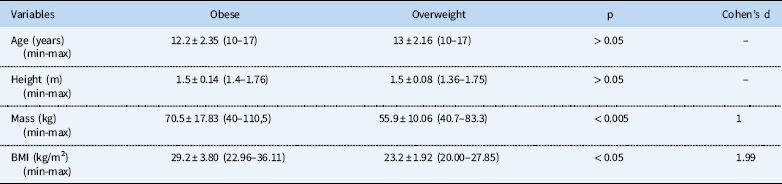
Table 1 presents data regarding age, height, mass, and body mass index of the groups. As expected, the obese group showed higher mass for large effect size.
Descriptive statistics of age, height, mass, and body mass index of the obese and overweight groups.

BMI=body mass index; min-max=minimum–maximum
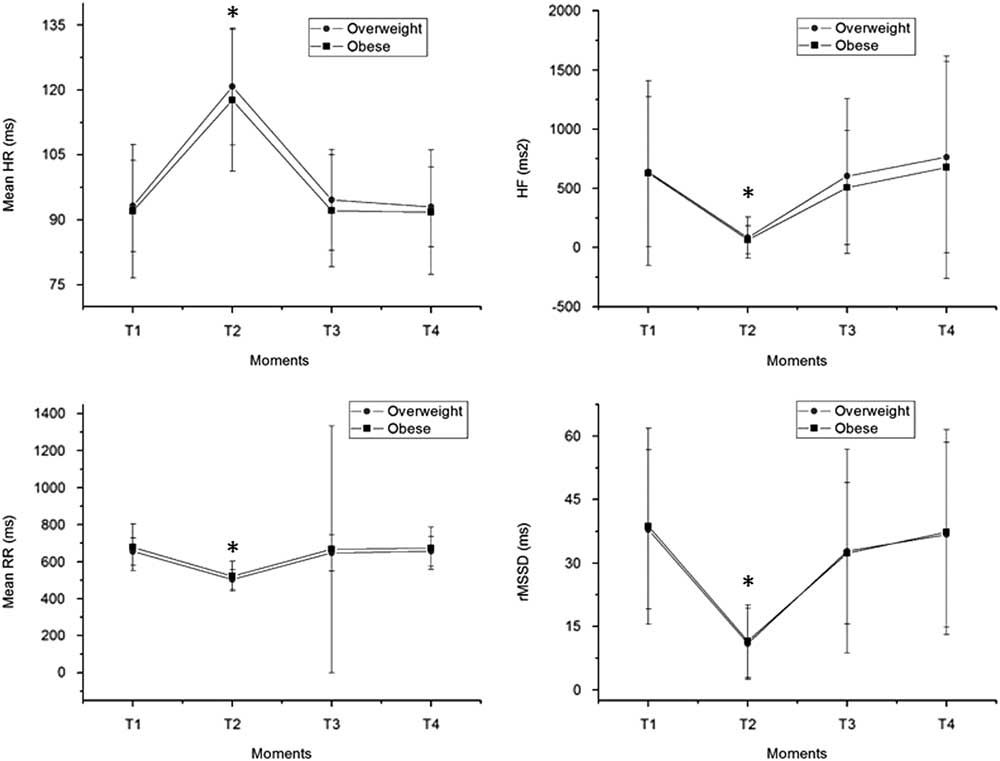
There was significant increase during exercise compared to rest in the overweight group with Cohen’s d=2.28 for large effect size, and in the obese groups with Cohen’s d=1.61 for large effect size; however, it was not different between rest and 5–10 minutes and 15–20 minutes after exercise in both the groups (Fig 1).
Mean values and their respective standard deviations of heart rate, mean RR intervals, root mean square of successive differences, and high frequency during rest, exercise, and recovery, obtained in the overweight and obese groups. Legend: *Values with significant differences in relation to rest in overweight and obese groups.
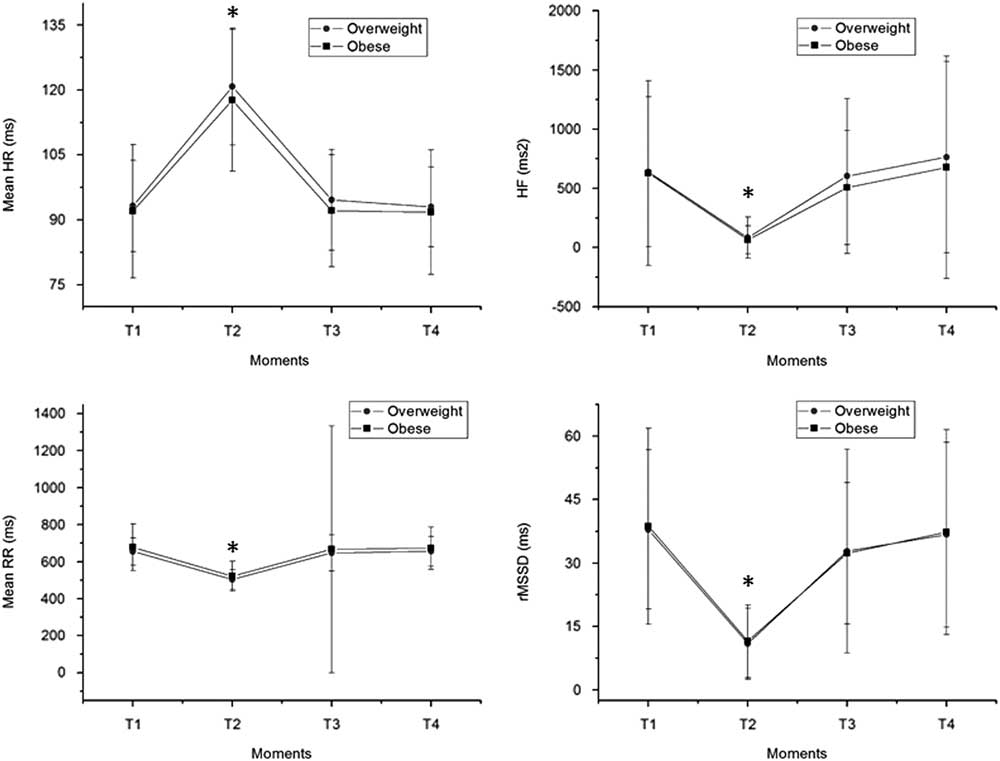
In relation to the mean RR interval, we observed significant decrease during exercise compared to rest in the overweight group with Cohen’s d=2.33 for large effect size and in the obese groups with Cohen’s d=1.47 for large effect size (Fig 1).
With respect to the high frequency in the frequency domain analysis, we evidenced significant reduction during exercise compared to rest in the overweight group with Cohen’s d=1.19 for large effect size and in the obese groups with Cohen’s d=1 for large effect size (Fig 1).
The same response was reported for the root mean square of successive differences index, which significantly reduced during exercise compared to rest in the overweight group with Cohen’s d=1.85 for large effect size and in the obese groups with Cohen’s d=1.55 for large effect size (Fig 1).
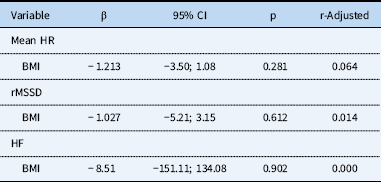
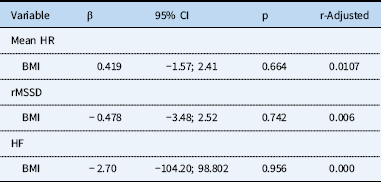
In relation to the relationship between body mass index and high rate variability we performed linear regression analysis in both groups. We noted no significant association between both variables in the overweight (Table 2) and obese groups (Table 3).
Simple linear regression model between resting heart rate variability indices and body mass index in the overweight group.
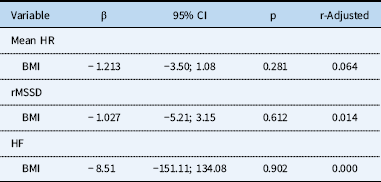
BMI=body mass index; CI=confidence interval; HF=high frequency; HR=heart rate; rMSSD=root mean squares of the successive differences between adjacent RR
Simple linear regression model between resting heart rate variability indices and body mass index in the obese group.
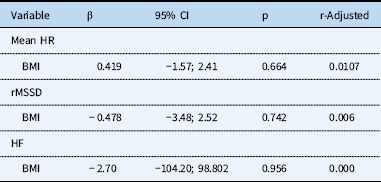
BMI=body mass index; CI=confidence interval; HF=high frequency; HR=heart rate; rMSSD=the square root of the mean of the squares of the successive differences between adjacent RR
Discussion
Recent literature has reported changes in autonomic activity within obese adolescents, demonstrating this as an important negative condition related to the increased risk of morbidity and mortality.Reference Ricci-Vitor, Rossi and Hirai 10 , Reference Vanderlei, Pastre, Freitas Júnior and Godoy 11 In this context, we investigated autonomic responses to exercise in both overweight and obese adolescents in order to determine differences in risk. To accomplish this, heart rate variability, mean heart rate, and RR intervals were analysed at rest, during exercise, and after exercise. The primary findings of this study, heart rate, mean RR interval, high frequency, and root mean square of successive differences indices of heart rate variability, significantly changed during exercise compared with resting values in overweight and obese groups. Moreover, we also reported no significant difference of resting parasympathetic control of heart rate between obese and overweight adolescents. Further points of consideration are provided later.
Examination of heart rate autonomic regulation through heart rate variability provides relevant information for autonomic dysfunction in adolescents and children.Reference Cho, Craig, Jopling, Chan and Donaghue 12 , Reference Parish, Todman and Jain 13 Heart rate variability analyses oscillations of RR intervals and is able to detect phenomena related to the autonomic nervous system. High heart rate variability indicates good adaptation of the system, characterising a healthy individual with effective autonomic nervous system. On the contrary, reduced heart rate variability is related to abnormal autonomic function, representing physiological malfunction, suggesting further examination of the patient.Reference Camm, Malik and Bigger 6 The evaluation of cardiac autonomic activity is generally understudied in the adolescent population, with even less information available regarding weight stratification. However, a previous study performed by Vanderlei et alReference Vanderlei, Pastre, Freitas Júnior and Godoy 11 evaluated resting heart rate variability in obese children and found a decrease both resting parasympathetic and sympathetic components of heart rate variability in time and frequency domain analysis. Importantly, Vanderlei et alReference Vanderlei, Pastre, Freitas Júnior and Godoy 11 compared between obese and eutrophic children that provides a wider gap in health status. Unlike the findings of Vanderlei et al,Reference Vanderlei, Pastre, Freitas Júnior and Godoy 11 we did not observe differences in markers of resting heart rate variability. This difference is likely due to the differences in the participants evaluated, where we examined obese and overweight adolescents. The findings of the current study are an important observation because they indicate that resting cardiac autonomic activity is equally depressed in overweight adolescents. This finding is suggestive that the threshold for risks associated with autonomic nervous system function occurs earlier than reaching the obese classification.
For instance, Silvetti et alReference Silvetti, Drago and Ragonese 14 evaluated healthy children and adolescent resting heart rate variability and found that the average root mean square of successive differences ranged from 60 to 80 ms in adolescents 13–17 years old, while the average root mean square of successive differences observed in this study was 35 ms for both overweight and obese populations, presenting a relationship between body adiposity and resting vagal activity. Furthermore, our results are in accordance with Freitas et al,Reference Freitas, Miranda, Mira, Lanna, Lima and Laterza 15 which analysed heart rate autonomic regulation in normotensive obese children. The authors showed that high frequency, root mean square of successive differences, and mean RR intervals were not significantly different between obese and non-obese groups.
Like the resting values, the indexes of autonomic recovery were nearly equivalent between the overweight and obese groups following the exercise bout. Similar results between obese and overweight adolescents were very recently reported. Jezdimirovic et alReference Jezdimirovic, Stajer, Semeredi, Calleja-Gonzalez and Ostojic 16 investigated body fat percentage in 183 children and adolescents comprising 132 boys and 51 girls in the age group 15.0±2.3 years. They were submitted to a maximal graded exercise test on a treadmill and evaluated heart rate recovery following exercise. As a main conclusion, the authors did not find significant association between heart rate recovery and body fatness in non-obese children and adolescents. An important distinction between this study and the current study is the measure of heart rate variability, which has been shown to recover at a different rate and traditional heart rate measures.
The evaluation of heart rate variability following the exercise bout in adolescents is a unique aspect of this study that provides more detailed information regarding the autonomic recovery following stress. In this line, considering that delayed autonomic recovery followed exercise is associated with increased risk for cardiovascular events,Reference Albert, Mittleman, Chae, Lee, Hennekens and Manson 4 , Reference Rossi, Vanderlei and Gonçalves 18 we expected that obese adolescents would take longer to recover heart rate variability and heart rate after exercise. On the contrary, we failed to confirm this initial hypothesis. Rossi et alReference Rossi, Vanderlei and Gonçalves 18 concluded that obese young people presented higher blood pressure and heart rate values at rest and autonomic impairment, characterised by a reduction in parasympathetic activity and relative predominance of sympathetic activity.
Overall, the findings of this study are indicative that overweight and obese adolescents experience similar alterations in cardiac autonomic control. Body fatness has often been used as an overall indicator of health and fitnessReference Friendemann, Heneghan, Mahtani, Thompson, Perera and Ward 19 and the increased likelihood of cardiovascular disparities. There are several purported mechanisms as to why this relationship exists such as system inflammation, dyslipidaemia, decrease glucose regulation, etc. However, body fatness may also result in lower levels of cardiac autonomic markers due to body fluid and vascular found in adipose tissue. This fluid, that is blood, is not being assisted by muscle pump function, which will ultimately result in the heart to increase work in order to maintain cardiac output. This being a possible reason for the observed resting heart rate variability in both overweight and obese adolescents. Regardless of the mechanism, it is important to note that changes in autonomic nervous system activity can occur earlier in the body fatness spectrum and should become a point of concern for general practitioners.
There are some points to be addressed in our study. We did not measure fat free mass directly, but instead used body mass index to stratify the population. Future studies of this type should implement bioelectrical impedance analysis, in that it has been shown to be more reliable than body mass index in fit and unfit adolescences as well as provide additional information regarding body fluid.Reference Meleleo, Bartolomeo and Cassano 20 On the contrary, the Z-score is a widely used method for overweight and obese classification.Reference Price, Cohen, Pribis and Cerami 21 , Reference Miguel-Berges, Reilly, Moreno Aznar and Jiménez-Pavón 22 Eutrophic adolescents were not investigated, since our focus was to verify differences between overweight and obese subjects. Lastly, we obtained data from 40 volunteers and divided them into two groups of 20 adolescents each. This is a small sample size in relation to the rest of the world. Nevertheless, we performed sample size calculation, which provided a minimum of 13 subjects per group. We encourage additional studies with large sample to support our data.
Our data provide evidence that overweight adolescents may present similar cardiovascular risks compared to obese adolescents. We call attention to paediatric cardiologist in order to take similar care with overweight population in this age, since we demonstrated that autonomic responses to exercise were identical between overweight and obese patients.
Conclusion
There was no significant difference of autonomic responses elicited by submaximal aerobic exercise between overweight and obese adolescents. This finding reinforces us to take similar care with both overweight and obese adolescents.
Acknowledgements
We thank the School of Juazeiro do Norte and UNESP from providing the necessary support.
Financial Support
This research received no specific grant from any funding agency, or from commercial or not-for-profit sectors.
Conflicts of Interest
The authors declare no competing financial interests.
Ethical Standards
All procedures performed in studies involving human participants were in accordance with the ethical standards of the institutional and/or national research committee and with the 1964 Helsinki Declaration and its later amendments or comparable ethical standards. All volunteers signed a consent letter and was informed of the procedures and objectives of the study. The study’s procedures were all approved by the Research Ethics Committee of the Faculty of Juazeiro do Norte, Ceará, Brazil (Number 2.076.929).