Implications
This study determined whether a novel synthetic emulsifier product, consisting of vegetal bi-distillated oleic acid and glyceryl polyethyleneglycol ricinoleate, could have beneficial effects on the growth performance of chickens for fattening and weaned piglets. The current observations may be of significant value to commercial feed manufacturers and farmers as they may give rise to important savings in the industry.
Introduction
Low hepatic bile acid synthesis may result in poor lipid digestion in weaned piglets (Lewis et al., Reference Lewis, Oren, Wang, Moyer, Beitz, Knight and Mott2000), and inefficient digestion and absorption of fat also occurs in young chickens, possibly due to a low level of natural endogenous lipase production (Al-Marzooqi and Leeson, Reference Al-Marzooqi and Leeson1999). These observations have generated considerable interest in and research on the use of emulsifiers to improve the utilisation of fats in young chicks (Al-Marzooqi and Leeson, Reference Al-Marzooqi and Leeson1999) and post-weaning piglets (Jones et al., Reference Jones, Hancock, Harmon and Walker1992). Lecithin, an emulsifier, has been reported to depress free fatty acid absorption, probably by increasing the size of bile salt micelles, which diffuse more slowly through the luminal water interface, retarding the delivery of free fatty acids to the absorptive cell surface (Saunders and Sillery, Reference Saunders and Sillery1976). Compared with lecithin, glyceryl polyethyleneglycol ricinoleate is more hydrophilic and dissolves free fatty acids, which are largely insoluble in bile salt micelles alone (Dierick and Decuypere, Reference Deol, Howell, Dorling and Symonds2004). Roy et al. (Reference Roy, Haldar, Mondal and Ghosh2010) reported that supplementation of exogenous emulsifiers in diets containing moderate quantities of added vegetable fats may substantially improve broiler performance. In addition, emulsification of fat (as in sow milk) may improve the growth performance of weaned pigs fed supplemental fat (Xing et al., Reference Xing, van Heugten, Lit, Touchette, Coalson, Odgaard and Odle2004).
To the best of our knowledge, the use of emulsifiers in association with vegetable oils in animal feed has not yet been thoroughly investigated, even though the interest in using exogenous emulsifiers has increased in the last several decades. Experiments were therefore conducted with the aim of assessing the effect of a novel synthetic emulsifier product (AVI-MUL TOP), consisting of vegetal bi-distillated oleic acid and glyceryl polyethyleneglycol ricinoleate, on the growth performance of chickens for fattening and weaned piglets.
Material and methods
The experimental protocol was reviewed and approved by the Animal Care and Use Committee of the University of Milan. Both experiments were performed at the facility for Animal Production Research and Teaching Centre of the Polo Veterinario, Università degli Studi di Milano (Lodi, Italy).
The emulsifier product (AVI-MUL TOP; SEVECOM S.P.A., Milan, Italy), consisting of 50% vegetal bi-distillated oleic acid emulsified with 50% ethoxylated castor oil E484, which belongs to the glyceryl polyethyleneglycol ricinoleate family (Community Register of Feed Additives – EU Reg. No. 1831/2003), was mixed with other ingredients before the pelleting process. The animal fat consisted of 50% poultry fat and 50% lard and vegetable oils (soybean oil) were used in experiment 1, whereas only vegetable oils (soybean oil and coconut oil) were used in experiment 2. The experimental diets were produced by Veronesi Verona S.P.A., Verona, Italy.
Experiment 1
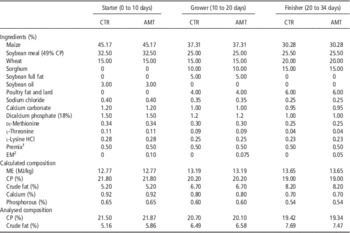
In experiment 1, 480 female Cobb500 chickens for fattening (44.46±0.96 g) were obtained from a local hatchery at 1 day of age and allocated to 48 pens with 10 birds in each pen, measuring 1.25×1.00 m. All of the chickens were vaccinated against Marek’s disease, Newcastle disease and infectious bronchitis via coarse spraying at hatching. The 48 pens were randomly assigned to two treatments, consisting of a non-supplemented basal diet (CTR) and the basal diet supplemented with the emulsifier (AMT, 1 g/kg inclusion rate from day 0 to day 10, 0.75 g/kg from day 10 to day 20 and 0.5 g/kg from day 20 to day 34 of the trial). The diets (Table 1) were formulated to meet the nutrient requirements defined by the National Research Council (NRC) (1994). The diet during the starter and grower periods was provided in crumble form, and the diet during the finisher period was provided as pellets. The birds were housed in an environmentally controlled room in separate floor pens with white wood shavings as bedding, under a photoperiod of 24 h of light from day 0 to day 7 and 23 h light : 1 h dark from day 7 to day 34. Room temperature was maintained at 35°C from day 1 to day 3 and was then decreased by 2.5°C/week, to a final temperature of 24°C at day 34. Feed and water were provided for ad libitum consumption. The animals were checked twice daily and any dead animals were removed, weighed and recorded. All birds were individually weighed on days 0, 10, 20 and 34 of age. The average daily gain (ADG), average daily feed intake (ADFI) and feed conversion ratio (FCR) values were calculated for each pen. At days 20 and 34, the gait score of each bird was characterised according to a three-point gait-scoring system: 0=no impairment of walking ability; 1=obvious impairment, but still ambulatory; 2=severe impairment and inability to walk without great difficulty. At 34 days of age, one bird exhibiting the average BW for the pen was chosen and marked to measure the carcass yield. Following a 12-h overnight fast, all of the chickens were sent to a commercial slaughter house and stunned in water bath (125 Hz AC, 80 mA/birds, 5 s) before killing via exsanguination. The dressing percentage was calculated by dividing the eviscerated weight by the live weight. Breast muscle was removed and weighed, and the breast muscle yield was calculated as the percentage of eviscerated weight.
Ingredients and calculated analysis of the basal diet for chickens for fattening (as-fed basis)

CTR=basal diet without supplementation; AMT=CTR+EM; EM=emulsifier; ME=metabolisable energy.
1 Provided the following per kilogram of diet: vitamin A, 11 250 IU; vitamin D3, 5000 IU; vitamin E, 60 mg; MnSO4·1H2O, 308 mg; ZnSO4·1H2O, 246 mg; FeSO4·1H2O, 136 mg; CuSO4·5H2O, 39 mg; KI, 2.4 mg; Na2SeO3, 657 μg; 6-phytase EC 3.1.3.26, 750 FTU; endo-1, 4-β-xylanase EC 3.2.1.8, 2250 U.
2 AMT group: 1 g/kg during day 0 to day 10, 0.75 g/kg during day 10 to day 20, 0.5 g/kg during day 20 to day 34.
Experiment 2
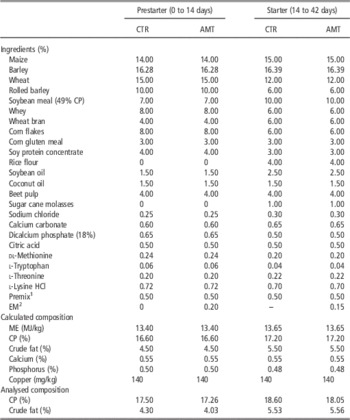
In total, 96 crossbred weaned barrow piglets (Stambo HBI×Dalland, 24 days old, 8.04±1.32 BW) were selected for a 42-day experiment from a commercial swine herd. All of the piglets were vaccinated for Mycoplasma hyopneumoniae at 2 days of age. The piglets were randomly allotted to two dietary treatments according to their initial BW (12 replicates of four piglets each per treatment). The experimental unit was defined as one pen. The two dietary treatments consisted of two different diets: (1) control (CTR), basal diet; and (2) AMT, basal diet+emulsifier (2 g/kg from day 0 to day 14 and 1.5 g/kg from day 14 to day 42 of the trial). All of the diets were provided in pellet form and were formulated to meet the recommended requirements of the NRC (2012) for a feeding programme (Table 2). The piglets were housed in one environmentally regulated room with a slatted plastic floor (4 piglets/pen, 1.20×1.00 m). Each pen was equipped with a one-sided self-feeder and a nipple waterer to allow the pigs ad libitum access to feed and water throughout the experimental period. The temperature of the pig barn was set between 26°C and 28°C, with a 12-h light : dark cycle. All of the piglets were individually weighed on days 0, 14, 28 and 42 of the trial. The ADG, ADFI and FCR values were calculated for each pen.
Ingredient and calculated analysis of the basal diet for weaned piglets (as-fed basis)

CTR=basal diet without supplementation; AMT=CTR+EM; EM=emulsifier; ME=metabolisable energy.
1 Provided the following per kilogram of diet: vitamin A, 20 000 IU; vitamin D3, 2000 IU; vitamin E, 100 mg; MnSO4·1H2O, 154 mg; ZnSO4·1H2O, 356 mg; FeSO4·1H2O, 425 mg; CuSO4·5H2O, 628 mg; KI, 3.1 mg; Na2SeO3, 657 μg; 6-phytase EC 3.1.3.26, 1500 FTU; endo-1, 4-β-xylanase EC 3.2.1.8, 1220 U; endo-1, 3(4)-β-glucanase EC 3.2.1.6, 125 U; citric acid, 5000 mg.
2 AMT group: 2 g/kg during day 0 to day 14, 1.5 g/kg during day 14 to day 42.
Statistical analysis
The data from both experiments were analysed in accordance with the GLM Procedure of SAS version 9.2 (SAS Institute Inc., Cary, NC, USA). The pen was used as the experimental unit for the growth performance of the chickens and piglets, whereas the individual chicken was considered to be the experimental unit for the carcass yield of chickens. The gait score data were analysed using the MIXED procedure for repeated measurements, and the pen represented the experimental unit. Treatment differences were assessed via the least squares means with the Tukey adjustment. Treatment effects were considered significant at P⩽0.05, whereas a trend for a treatment effect was noted for P⩽0.10.
Results
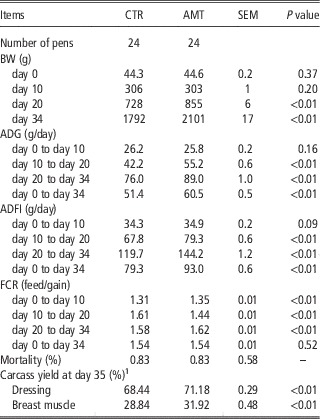
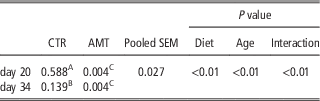
The effects of the AMT on the BW, ADG, ADFI and FCR of chickens for fattening are shown in Table 3. There was no detectable effect of the diet on BW from day 0 to day 10 (P>0.05). AMT supplementation increased BW compared with the CTR group on day 20 and day 34 (P<0.01). An increased ADG was observed in the AMT chickens in comparison with the CTR birds from day 10 to day 20, from day 20 to day 34 and from day 0 to day 34 (P<0.01). Compared with the CTR group, dietary AMT supplementation increased the ADFI from day 10 to day 20, from day 20 to day 34 and from day 0 to day 34 (P<0.01). In addition, AMT supplementation tended to increase the ADFI from day 0 to day 10 compared with the CTR diet (P=0.09). A reduced FCR was observed in the AMT group compared with the CTR group from day 10 to day 20, whereas the AMT chickens exhibited a higher FCR than the CTR birds from day 0 to day 10 and from day 20 to day 34 (P<0.01). AMT supplementation significantly increased the percentages of dressing and breast muscle (P<0.01, P<0.01, respectively). The gait scores of the AMT chickens were lower than those of the CTR birds on day 20 and day 34 (P<0.01; Table 4). A significant interaction between the diet and age was observed (P<0.01), which was due to the decreased values recorded from day 20 to day 34 in the CTR group (P<0.01), whereas there was no change in the AMT group.
Effect of emulsifier (EM) supplementation on growth performance of chickens for fattening

CTR=basal diet without supplementation; AMT=CTR+EM (1 g/kg during day 0 to day 10, 0.75 g/kg during day 10 to day 20 and 0.5 g/kg during day 20 to day 34); ADG=average daily gain; ADFI=average daily feed intake; FCR=feed conversion ratio.
1 The dressing percentage was calculated by dividing the eviscerated weight by the live weight and breast muscle yield was calculated as the percentage of eviscerated weight.
Effect of emulsifier (EM) supplementation on gait scoreFootnote 1 of chickens for fattening

CTR=basal diet without supplementation; AMT=CTR+EM (1 g/kg during day 0 to day 10, 0.75 g/kg during day 10 to day 20 and 0.5 g/kg during day 20 to day 34).
A,B,CValues within the same column or row with different superscripts differ significantly at P<0.01.
1 Gait scores were recorded using a three-point scoring system: 0=none; 1=obvious impairment; 2=severe impairment.
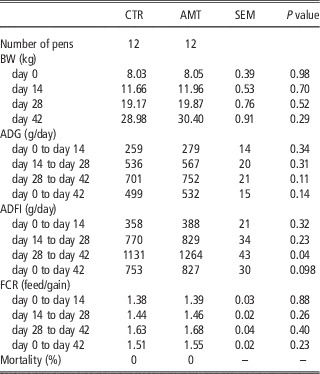
The effects of AMT supplementation on the growth performance of weaned piglets are shown in Table 5. The AMT piglets presented a higher ADFI compared with the CTR group from day 28 to day 42 (P=0.04). In addition, AMT supplementation tended to increase the ADFI from day 0 to day 42 (P=0.098) and numerically increased the ADG from day 28 to day 42 (P=0.11). The addition of AMT to diet also promoted greater mean BW on day 42 (30.40 kg), although in this case, the difference compared with the CTR group (28.98 kg) was not significant (P=0.29).
Effect of emulsifier (EM) supplementation on growth performance of weaned piglets

CTR=basal diet without supplementation; AMT=CTR+EM (2 g/kg during day 0 to day 14, 1.5 g/kg during day 14 to day 42); ADG=average daily gain; ADFI=average daily feed intake; FCR=feed conversion ratio.
Discussion
This experiment was performed with the aim of evaluating the effect of a synthetic emulsifier, consisting of vegetal bi-distillated oleic acid emulsified with glyceryl polyethyleneglycol ricinoleate, on the growth performance of chickens for fattening and weaned piglets. The results showed that the addition of emulsifier to the feed significantly increased the ADG and ADFI of chickens for fattening and tended to increase the ADFI of weaned piglets during the entire experimental period, which is in agreement with the findings of previous studies (Xing et al., Reference Xing, van Heugten, Lit, Touchette, Coalson, Odgaard and Odle2004; Roy et al., Reference Roy, Haldar, Mondal and Ghosh2010; Price et al., Reference Price, Lin, van Heugten, Odle, Willis and Odle2013). The increased growth and feed intake may be due to certain effects of the dietary emulsifier on pellet quality and fat digestibility (Jones et al., Reference Jones, Hancock, Harmon and Walker1992; Roy et al., Reference Roy, Haldar, Mondal and Ghosh2010).
It is well known that emulsifiers can reduce the surface tension of water and increase the penetration and improve the distribution of water in press meal (van der Heijden and de Haan, Reference Van der Heijden and de Haan2010). In the current study, the AMT product was mixed with feed compounds before pelleting process, which may increase humidity, reduce pellet press energy consumption and improve pellet quality by modulating the moisture content during the pelleting process and, consequently, improve feed intake and performance of animals. Lecithin, as an emulsifier, has been reported to enhance the apparent digestibility of unsaturated fatty acids in lard (Soares and Lopez-Bote, Reference Soares and Lopez-Bote2002). Dierick and Decuypere (Reference Deol, Howell, Dorling and Symonds2004) reported that the addition of an emulsifier improved the digestibility of major nutrients, which may reduce the viscosity of the digestive contents and increase the transit of the digesta as well as feed intake (Lázaro et al., Reference Lázaro, Latorre, Medel, Gracia and Mateos2004). In this study, the incorporation of vegetal bi-distillated oleic acid and glyceryl polyethyleneglycol ricinoleate may have also improved the growth performance of animals via the emulsification of supplemental fatty acids (Xing et al., Reference Xing, van Heugten, Lit, Touchette, Coalson, Odgaard and Odle2004). However, there was no significant influence of AMT supplementation on the ADFI during the first phase in the chickens and piglets, possibly due to the insufficient digestion and absorption of fat in young animals (Dierick and Decuypere, Reference Deol, Howell, Dorling and Symonds2004).
In experiment 1, a high incidence of tibial dyschondroplasia, an abnormality of the growth cartilage that occurs in chickens, was observed in the CTR chickens on day 20 and day 34, which may have been due to the rapid growth rate (Kestin et al., Reference Kestin, Su and Sørensen1999) and the broiler strain used (Dinev et al., Reference Dierick and Decuypere2012). Leg problems are of serious consequence for welfare as lame birds have difficulty reaching diet and water (Mc Geown et al., Reference Mc Geown, Danbury, Waterman-Pearson and Kestin1999), and seriously lame birds may lose weight (Kestin et al., Reference Kestin, Su and Sørensen1999). However, the growth of the CTR chickens in our study was normal compared with the reference value (Cobb Vantress, 2013; weight on day 34, 1792 v. 1829 g). Interestingly, our results indicated that there was no incidence of poor gait in the AMT group during the entire experimental trial, which may due to the possible improvements in the pellet quality and nutrients digestibility of birds by AMT supplementation. However, the present data are insufficient to demonstrate that the lack of leg weakness in the AMT chickens was due to emulsifier supplementation, more research should be conducted to identify the effect of emulsifier on nutrients absorption and determine whether it would influence the incidence of leg weakness. In addition, increased feed intake was observed in the weaned piglets during the last period in experiment 2, which may suggest that the synthetic emulsifier can positively affect growth performance for both chickens and piglets by increasing feed intake. However, the effect of the emulsifier on the growth of piglets was weaker than on chickens, possibly due to the high copper intake of the piglets. The piglets’ diets contained 140 mg/kg copper, which is close to the maximum authorised level for weaned piglets (175 mg/kg) according to the EU (European Commission, 2003) and could affect the gut flora (Højberg et al., Reference Højberg, Canibe, Poulsen, Hedemann and Jensen2005), the metabolism of bile acids (Deol et al., Reference Dinev, Denev and Edens1992) and eventually interfere with the effect of the emulsifier. It has been reported that the dietary fat level may influence the apparent fat digestibility (Lauridsen et al., Reference Lauridsen, Bruun Christensen, Halekoh and Krogh Jensen2007). In this study, the fat intake of piglets was lower than chickens, which may also influence the effect of the emulsifier. The digestive system of swine is monogastric that is different from the avian digestive system found in poultry. Jones et al. (Reference Jones, Hancock, Harmon and Walker1992) concluded that addition of emulsifiers increased digestibility of nutrients but had minimal effect on growth performance in weanling pigs. In addition, the CTR chickens had better FCR than the AMT birds during the finishing phase, possibly due to the improved feed efficiency during compensatory growth when the tibias of the CTR chickens were recovering from day 20 to day 34 (Zubaira and Leeson, Reference Zubair and Leeson1996). Scheele (Reference Scheele1997) noted that the growth of the pectoral muscles primarily occurs during the late stages of developmental growth in fast-growing birds. In the present study, an increased slaughter yield was also observed in the treated group, suggesting that the relatively rapid growth of the AMT-fed chickens in the grower and finisher phases may have contributed to the comparable increases in carcass and breast muscle yields. The increased growth performance recorded in the present work was probably supported by digestive and physiological mechanisms/processes (Dierick and Decuypere, Reference Deol, Howell, Dorling and Symonds2004; Roy et al., Reference Roy, Haldar, Mondal and Ghosh2010); however, these processes were not considered in our experiments. Future studies are in progress to specifically assess the possible improvement of digestibility and fat utilisation.
In conclusion, the current observations indicated that the supplementation of a novel synthetic emulsifier consisting of vegetal bi-distillated oleic acid and glyceryl polyethyleneglycol ricinoleate has the potential to significantly improve the growth performance of chickens for fattening, although only numerical improvements were noted in the growth performance of weaned piglets under supplementation with the synthetic emulsifier product.
Acknowledgements
This work was funded by SEVECOM S.P.A., Milan, Italy. The authors gratefully acknowledge Dr Roberto Bombardieri, and Dr Roberto Zaupa and Paolo Chignola (Veronesi Group) for kind support and technical assistance.