Introduction
Long-term poverty, precarious employment, low pay, the increased pension age and real-term reductions in welfare benefits, including bereavement allowances, have brought into focus the financial vulnerability of many older women aged 55 years and older in the United Kingdom (UK) (Department for Work and Pensions (DWP), 2013a, 2018a; Burchardt et al., Reference Burchardt, Obolenskaya, Vizard, Lupton, Burchardt, Hills, Stewart and Vizard2016; Age UK, 2018a, 2018b; Step Change, 2018a; United Nations, 2018). Poverty can persist in older age despite the fact that the financial circumstances of many older women have improved, in part because of the triple lock protection for pensions (which guarantees that pensions rise by the same as average earnings, the Consumer Price Index or 2.5 per cent – whichever is the highest) (Willets, Reference Willets2010; Age UK, 2013; McKee and Stuckler, Reference McKee and Stuckler2013; Dermott and Pantazis, Reference Dermott and Pantazis2014; Patsios, Reference Patsios2014; Loopstra et al., Reference Loopstra, McKee, Katikireddi, Taylor-Robinson, Barr and Stuckler2016; Joseph Rowntree Foundation (JRF), 2018; Ebbinghaus et al., Reference Ebbinghaus, Nelson and Nieuwenhuis2019).
In the UK, 2.1 million pensioners (17%) live in households in relative income poverty (defined as income below 60% of the median household income) (before housing costs) (McGuiness, Reference McGuiness2018). Seven per cent of pensioners live in persistent poverty (defined as living in relative income poverty in the current year and for at least two out of the three preceding years). Single female pensioners, older pensioners and those from ethnic minority backgrounds are more likely to live in poverty (Age UK, 2018a). Pension Credit, the means-tested income support for pensioners on low income in the UK, is claimed by more than 1.5 million people, with more than 1.3 million people entitled to it but not claiming (Thurley, Reference Thurley2019). Research by Age UK (2018b) has highlighted that nearly 1.4 million older people aged 65 years and older have unmet social care needs. For further discussion of the complexity of social care needs in later life, see Vlachantoni (Reference Vlachantoni2019).
Evidence suggests that older women tend to be financially poorer and at greater risk of poverty than older men (Price, Reference Price2006; Vlachantoni, Reference Vlachantoni2012). Women across their working lives earn considerably less than men (Office for National Statistics (ONS), 2018a). Whilst older people are increasingly working longer, often the work can be part-time and low paid (DWP, 2017a; Leinonen et al., Reference Leinonen, Chandola, Laaksonen and Martikainen2020). Moreover, working in older age may not be an option for those older women in poor health, for those with caring responsibilities and those who cannot find employment (Chandler and Tetlow, Reference Chandler and Tetlow2014; Price et al., Reference Price, Bisdee, Daly, Livsey and Higgs2014; Grover, Reference Grover2015; Centre for Ageing Better, 2017). There has also been an increase in job insecurity and zero-hours employment where employees are not guaranteed a set number of working hours, which can lead to fluctuations in income (ONS, 2018b).
Around 20 per cent of older people in the UK have little or no private pension, housing assets or material wealth, and retiring with debt is a growing problem (Banks et al., Reference Banks, Nazroo and Steptoe2012). Women, including many women from ethnic minority backgrounds, are less likely to have a private pension than men and overall women's pensions are of a lower value (Matthews and Nazroo, Reference Matthews, Nazroo, Banks, Batty, Nazroo and Steptoe2016; Oldfield, Reference Oldfield, Banks, Batty, Nazroo and Steptoe2016; Ní Léime and Street, Reference Ní Léime and Street2017; Vlachantoni et al., Reference Vlachantoni, Feng, Evandrou and Falkingham2017). Many older women do not have full access to a state pension, having not paid full National Insurance contributions if, for example, they were looking after their children and not in paid work. It is also estimated that 2.6 million women, particularly those born in the 1950s, have been negatively affected by the changes to the state pension age and a recent legal claim of discrimination has been rejected (Thurley and Keen, Reference Thurley and Keen2018; Peachey, Reference Peachey2019).
Recent evidence in the UK suggests personal debt levels are at a record high (Harari, Reference Harari2018; ONS, 2018b; National Audit Office, 2019; Trades Union Congress, 2019; Dagdeviren et al., Reference Dagdeviren, Balasuriya, Luz, Malik and Shah2019). Financial debts are classified into priority and non-priority debts (Citizens Advice, 2018). Priority debts are those that may lead to a person losing their home and a prison sentence. They include rent or mortgage, council tax, gas and electricity, maintenance to children or former partners, and the TV licence fee. Non-priority debts include credit cards and loans. Over-indebtedness, or what is termed problem debt, is when a person is unable to pay their debts or other household bills. Evidence suggests that 8.3 million people in the UK have problem debts (Money Advice Service, 2017). Moreover, people on low incomes are saving less of their incomes than at anytime in the last 20 years and 13 per cent of adults have no cash savings (Rowlingson and Mckay, Reference Rowlingson and Mckay2018).
Bankruptcy involves a person losing their main assets, including potentially their home in exchange for their debts being cleared. For those people who are able to pay back their debts in small amounts they can set up agreements with creditors and certain debts may be written off. Evidence from the debt support charity Step Change (2018a) has highlighted the increasing numbers of female single parents seeking debt advice. It is notable that one high-profile pay day loan company was fined for targeting children in their advertising and not having adequate affordability assessment procedures (Competition and Markets Authority, 2015; Mahony and Pople, Reference Mahony and Pople2018). The levels of insolvency in the UK are also increasing and are higher amongst women. In 2017 in England and Wales there were 90,930 insolvencies, a rise of 13 per cent compared to 2015; 53 per cent of new insolvencies were from women; 12 per cent of insolvency cases were from people aged between 55 and 64 years old, and 6 per cent were from people aged 65 years and older (Insolvency Service, 2017).
Research using in-depth interviews has shown that many older married and divorced women have experienced a lifetime of their husbands controlling the money in the home and continue to do so (Bisdee et al., Reference Bisdee, Daly and Price2013a, Reference Bisdee, Price and Daly2013b). Research in the 1980s highlighted that the different types of financial management in the home are shaped by the culture of marriage and power in relationships typically based around the ‘male breadwinner’ role, where women would be expected to ensure the money covered household needs such as food and clothing for the children (Pahl, Reference Pahl1989; Vogler and Pahl, Reference Vogler and Pahl1993a, Reference Vogler and Pahl1993b). More recent research by Bisdee et al. (Reference Bisdee, Daly and Price2013a) has identified three types of responses by women: ‘accepters’ who accept financial inequality and dominance by their husbands; ‘resenters’ who recognise the inequalities but resent them; and ‘modifiers/resisters’ who retain financial independence and power within their relationships. Some women have been found to be trying to overcome control by their husbands and partners by secretly giving money to their children from savings they have made by sacrificing their own needs (Price, Reference Price2006). Moreover, research suggests women protect their husbands from the impact of reductions in money whilst reducing spending on their own needs including food (Bisdee et al., Reference Bisdee, Price and Daly2013b). When there was a fall in the male partner's income, e.g. if they had become unwell, some women would try to protect their husband's ‘identity’ as the controller of the household finances. Whilst there is evidence of a long-term shift towards more equal control of household finances amongst younger couples, inequalities in the labour market can still be replicated in the home, with men having a greater role in the more significant spending decisions and with women's earnings being seen as less important (Irwin and Bottero, Reference Irwin and Bottero2000; Vogler et al., Reference Vogler, Brockmann and Wiggins2006; Price et al., Reference Price, Bisdee, Daly, Millns and Wong2017). Following divorce, women can have more difficulties in paying off their debts compared to divorced men (Andress and Hummelsheim, Reference Andress and Hummelsheim2009).
Financial debts can have a negative impact on people's health and wellbeing and may also place increased demands on the welfare state if people need additional support (Clayton et al., Reference Clayton, Liñares-Zegarra and Wilson2015; French and McKillop, Reference French and McKillop2017; Hiilamo and Grundy, Reference Hiilamo and Grundy2020). Older people may also be reluctant to seek financial advice due to anxiety and a lack of trust (Van Dalen et al., Reference Van Dalen, Henkens and Hershey2017). Moreover, research suggests that 18 per cent of adults in the UK have been the victim of economic abuse – where a person has their ability to acquire, use and maintain their financial resources controlled by another person (Sharp-Jeffs, Reference Sharp-Jeffs2018). Amongst those women experiencing economic abuse, the research found that for 78 per cent of women the abuse had lasted more than five years. Evidence suggests that 60 per cent of victims of domestic abuse are struggling with coerced debt, where their partner forced them to take out debt or took out debt in their name without permission (Surviving Economic Abuse, 2019). Research also points to evidence of economic abuse of older people (Davidson et al., Reference Davidson, Rossall and Hart2015).
This article examines the financial circumstances and challenges facing older women aged 55 years and older in the UK following a relationship breakdown or the death of a long-term partner. The key research questions are as follows:
• To what extent do older women (aged 55 years and older) in the UK face financial difficulties and how have they tried to manage their debts?
• How have older women's finances been affected by separation, divorce and widowhood?
• To what extent have older women's former husbands or partners controlled their finances during their lives?
The article addresses a gap in the evidence base by drawing on survey data, and in-depth qualitative observation and interview data from older women with debt problems. The survey data document the financial problems that older women can face, and the observations of the debt support interviews and the very personal testimonies of the women given during a time of financial crisis provide a detailed picture of the individual experiences of how financial debts were impacting on their lives. Whilst previous research has examined the financial circumstances of older women, the new data and analysis, including the women's personal descriptions of how they got into debt, their decision-making and coping mechanisms, the impact on their families and relationships, and their experiences of coercive control and economic abuse, provide unique and much needed insights.
Methodology and ethics
The research used a mixed-methods approach bringing together survey data about women aged 55 years and older in the UK and evidence from observations and interviews with a sample of older women who were receiving debt advice in a case study urban area of the North West of England. The use of a mixed-methods approach adds considerable value by bringing together the statistical strengths of quantitative data analyses with insights gained from the observations and in-depth semi-structured interviews (Bryman, Reference Bryman2006; Fielding and Fielding, Reference Fielding, Fielding, Alasuutari, Bickman and Brannen2008). Whilst survey data can provide evidence on the scale of the issue, detailed qualitative data are needed to understand the impact debt has on people's everyday lives. This includes the details of people's individual circumstances, their decision-making and how they cope. Three debt advisors were also interviewed.
The case study location was selected as it was an urban area with high levels of economic deprivation. This was to enable a focus on a specific population of older women living on low incomes in an urban area, but of course debt problems are not limited to people living in such areas. In addition, as part of the background research a Freedom of Information request to the government's Insolvency Service for information on bankruptcies amongst older women was made.
Age group focus – women aged 55 years and older
The definition of what constitutes old age is subject to some debate (Phillipson, Reference Phillipson2013). The focus in this research was on the broad age group of women aged 55 years and older because of the likely lifestage of such women, including their marital status and their having spent years caring for children who were now grown up. In certain areas healthy life expectancy (the years someone may expect to live in good health) can be as low as 48 years for women (ONS, 2018d). Therefore, for this age group health issues are also likely to be a factor. Of course, older women are not a homogenous group and have different household circumstances and economic resources (DWP, 2017a).
Survey data analysis
Secondary data analysis was conducted on the 2016 Wealth and Assets Survey (ONS, 2018c). This survey is a multi-stage stratified nationally representative sample of over 30,000 private households administered by the ONS. It is one of the main data sources on people's financial circumstances. Respondents are asked for details about their assets and savings, personal income, level of debt and approaches taken to financial planning. Descriptive analysis and logistic regression modelling were conducted in R software using survey weights to account for survey design and non-response. The key factors were examined including: age, gender, marital status and socio-economic status using the National Statistics Socio-economic Classification (NS-SEC; ONS, 2014). Aspects of the analysis were limited due to the sample size for certain combinations of variables.
Participant observation and interviews with older women seeking debt advice and with debt advisors from the Citizens Advice service
In order to capture the detailed circumstances and experiences of older women (aged 55 years and older) debt support interviews were observed and semi-structured qualitative interviews were conducted with older women who had sought debt advice from the Citizens Advice service in the North of England. The Citizens Advice is a charity which provides a free source of advice on what options people in debt have. Advisors can also make the case for household evictions to be delayed and support applications for charity funding to cover urgent needs.
Debt support meeting observations
In total, 13 debt support meetings were observed and follow-up interviews conducted. Prior to the debt support meeting the older women (clients) were asked if they would be happy to participate in the research. All of the selected participants approached agreed to take part. The debt support meeting involved the client answering a series of questions about their financial circumstances and also providing financial information including bank statements and bills. In line with good practice, the observations were conducted discretely and handwritten notes were made (Guest et al., Reference Guest, Namey and Mitchell2013).
Interviews
Following the observation of each debt support meeting interviews were then conducted with each of the older women. The interviews were semi-structured and designed to explore the women's individual experiences (Ayres, Reference Ayres and Given2008; Mabry, Reference Mabry, Alasuutari, Bickman and Brannen2008). The questions covered such issues as financial decision-making, family support, budgeting and issues of financial control. Demographic information was also collected including: age, marital status, number of children, employment and health. Overall, each observation and interview lasted around one and a half hours.
Sample and debts
The women were selected from the Citizens Advice client database based on the target age group. The age of the women ranged from 55 to 68 years. All of the women were no longer living with their former husband or former partner as a result of divorce, separation or being widowed, apart from one who had recently reunited with her former husband and was now caring for him. All of the women, apart from two, were living in social rented accommodation. Seven of the women had long-term health problems. Four of the women were working part-time on zero-hours contracts, including as a cleaner, in a bar, in a cafe and as a care worker.
The average amount of debt of the women interviewed was £6,000 and ranged from £1,300 to £19,500. The debts included priority and non-priority debts to credit card companies, gas and electricity suppliers, water utilities, the TV licence, internet and mobile phone providers, as well as debts to family and friends.
Analysis
To encourage participation, no audio recordings were made; instead, detailed handwritten notes were taken and verbatim quotes written down. The notes from each of the semi-structured interviews were coded manually in relation to the different issues raised by each interviewee. The key themes emerging from the coding were then identified, and indicative quotes selected to illustrate the themes.
Debt advisor interviews
Follow-up interviews were also conducted with three debt support advisors. These interviews covered general issues about how the advice service worked and also about the debt process and the type of support available. Direct quotes from these interviews are not cited in this article but have been drawn on for background information.
Informed consent was obtained and all the information collected was anonymised. The research was approved by the University of Manchester's research ethics committee. Good practice guidelines were adhered to when conducting research with vulnerable groups and in relation to fieldworker safety (Lundgren, Reference Lundgren2012; Iphofen and Tolich, Reference Iphofen and Tolich2018).
Findings
The quantitative survey data were analysed to examine the extent of financial difficulties amongst older women in the UK. Issues relating to debt, spending, decision-making and coercive control were then explored through the observation of the debt support meetings and follow-up interviews.
Older women's financial difficulties – survey evidence
Difficulties paying bills and running out of money
Firstly, the issue of managing debts and keeping up with bills is examined. Evidence from the Wealth and Assets Survey suggests that 28.7 per cent of women aged 55 years and older compared to 24.6 per cent of men were having difficulties ‘keeping up with bills and credit commitments’. Specifically, amongst people aged between 55 and 64 years old, 35.7 per cent of women stated they were having difficulties compared to 31.3 per cent of men. Amongst people aged 65 years and older again women were more likely than men to state they were having difficulties – 24.8 per cent compared to 20.4 per cent. All the percentage differences between comparison groups reported in this section were statistically significant at the 5% level.
Focusing specifically on women, in terms of marital status 44.3 per of women aged 65 years and older who were divorced reported having some difficulties ‘keeping up with bills and credit commitments’ compared to 18.7 per cent of married women in this age group. Amongst women aged between 55 and 64 years old, 56.0 per cent who were separated or divorced stated that they were having some difficulties compared to 26.7 per cent of married women. Amongst women aged between 55 and 64 years, those in routine and semi-routine occupational categories were much more likely to state that they were having difficulties compared to those in managerial and professional categories – 51.7 per cent compared to 23.8 per cent. Amongst women aged 65 years and older, 32.6 per cent of those in routine and semi-routine occupational categories stated that they were having difficulties compared to 17.4 per cent of women in managerial and professional occupational categories.
Running out of money was also an issue for many older women. Overall, 13.2 per cent of people aged 55 years and older reported that they ‘sometimes, always or most of the time ran out of money at the end of the week or month’. Older women were more likely to report that they ran out of money compared to older men – 17.0 per cent compared to 11.8 per cent. Focusing specifically on older women, 35.2 per cent of women aged between 55 and 64 years who were divorced or separated stated that they ran out of money compared to 14.9 per cent of married women in the same age group. Amongst women aged 65 years and older, 18.1 per cent of those who were divorced or separated stated that they ran out of money compared to 6.9 per cent of married women. Although the survey sample size limits breaking down the data further, it is notable that the percentage of older women aged between 55 and 64 years old who ran out of money was much higher amongst those in the lower-skilled occupational categories compared to women in the managerial and professional occupational categories – 28.3 per cent compared to 15.0 per cent.
Worsening finances, debt burden and informal borrowing
In terms of the changing financial position of women, 36.6 per cent of women aged between 55 and 64 years who were separated stated that their ‘financial position was worse’ than two years ago compared to 17.4 per cent of men who were separated. Focusing specifically on women, those aged between 55 and 64 years who were divorced or separated were much more likely than women who were married to state that their debts were a ‘heavy burden’ or ‘somewhat of a heavy burden’ – 40.8 per cent compared to 15.3 per cent. Amongst women aged 65 years and older who were divorced or separated, 25.9 per cent stated that their debts were a ‘heavy burden’ or ‘somewhat of a heavy burden’ compared to 7.4 per cent of those who were married. Women aged between 55 and 64 years old in routine and semi-routine occupational categories were much more likely than those in managerial and professional occupational categories to state their debts were a ‘heavy burden’ or ‘somewhat of a heavy financial burden’ – 35.8 per cent compared to 17.4 per cent.
It is also important to consider whom older women can turn to when they run out of money. Overall, of those people who stated that they run out of money each month, those aged 65 years and older were the least likely of all age groups to state that they would ‘borrow money from friends and family when they ran out’ – 18.4 per cent of those aged 65 years and older, 23.8 per cent of those aged between 55 and 64 years old, and 66.2 per cent of people aged between 16 and 24 years old. Amongst women, those aged between 55 and 64 years old who were divorced or separated were more likely than married women in the same age group to state that they ‘borrow from friends or family when they run out’ – 34.9 per cent compared to 17.2 per cent. In terms of occupational category, amongst women aged between 55 and 64 years old, 30.7 per cent who were in the routine and semi-routine occupational categories stated that they ‘borrow money from friends or family when they run out’ compared to 20.8 per cent of women in the managerial and profession categories. Amongst those women in the routine and semi-routine occupational categories, the level of ‘borrowing from friends or family when they run out’ was higher amongst women aged between 55 and 64 years old compared to women aged 65 years and older – 30.7 per cent compared to 22.6 per cent. This could be linked to the more limited informal support options some women aged 65 years and older may face when they have financial problems and it could also be linked to feelings of not wanting to ask for help. However, further research would be needed to establish this.
Combined measure – financial problems in older age
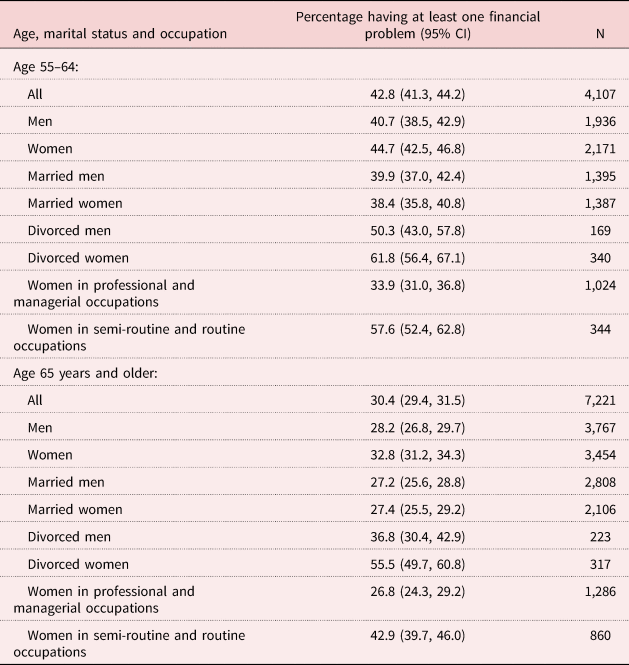
To examine these issues further and to compare the circumstances of older women and men in more detail, a combined measure of financial problems was created based on the person meeting at least one of the following criteria: (a) ‘financial position being worse than two years ago’; (b) having ‘some difficulties keeping up with bills and credit commitments’; (c) ‘always, most of the time or sometimes running out of money at the end of the week or month’; and (d) ‘debts owed being a heavy or somewhat of a burden to pay back’.
Table 1 summarises the prevalence of reported financial problems of older men and women by marital status and occupational categories (NS-SEC; ONS, 2014).
Financial problems amongst people aged between 55 and 64 years and 65 years and older

Note: CI: confidence interval.
Source: Wealth and Assets Survey.
As highlighted in Table 1, older women were more likely than older men to report having at least one financial problem, although the confidence intervals for men and women aged between 55 and 64 years old overlap, thus limiting what can be generalised to the wider population. Focusing specifically on women, overall those women aged between 55 and 64 years old were much more likely than women aged 65 years and older to report having at least one financial problem. Divorced women in both age groups were much more likely to report having at least one financial problem compared to married women. Moreover, divorced women in both age groups were much more likely to report having at least one financial problem compared to divorced men, although again the confidence intervals for men and women aged between 55 and 64 years old overlap. Women in both age groups who were in the routine and semi-routine occupational categories were much more likely to report having at least one financial problem compared to those women in the professional and managerial occupational categories.
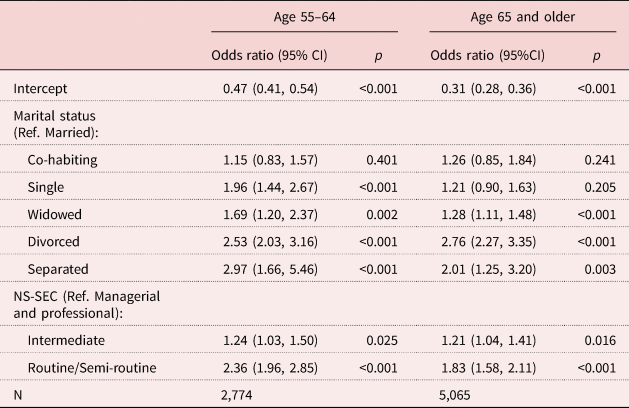
In order to explore these differences further, the likelihood of older women having at least one of the financial difficulties was examined using a logistic regression model, taking account of marital status and occupational categories.
As the model results show in Table 2, the likelihood of women having at least one of the financial problems varies by marital status and social class. Older women in both age groups who were not married, particularly those who were divorced or separated, were significantly more likely to have at least one financial problem compared to those women who were married. Those women who were in routine and semi-routine occupational categories were much more likely to report having at least one financial problem compared to those women in managerial and professional occupational categories.
Women aged 55–64 years and 65 years and older and the likelihood of having at least one financial problem

Notes: CI: confidence interval. Ref.: reference category. NS-SEC: National Statistics Socio-economic Classification.
Source: Wealth and Assets Survey.
In order to examine the financial problems many older women can face in more depth, the individual circumstances and experiences of older women seeking debt support advice are now considered, including feelings of shame, coping strategies, coercive control and resilience.
Observation of debt support meetings and interviews
As outlined in the Methodology section, debt support meetings were observed and follow-up interviews were conducted with the older women seeking debt advice.
Whilst all of the women arrived for the debt support meetings with some information about their debts, including unpaid bills, the information they had was not always complete. An issue for many of the women was not being sure about which organisation(s) they owed money to and the total amount of money owed. One woman did not have the official paperwork relating to her debts and only had a handwritten list. This issue was linked to a sense of the women being overwhelmed by their financial situation, but also because some women had not been allowed by their former husbands or partners to open the bills and/or had not been told about all the debts that were in their name. A further aspect was when their debts had been passed to a different debt company from the one that the original loan had been taken out from. This can happen when one company takes over the management of the debts of another company.
All of the women were asked by the debt advisors to provide details of their weekly spending. This could be considered quite intrusive. For example, one woman was asked how often she had a bath and another was asked how much she spent on toilet paper each week. All of the women became upset at some point during the meeting. One woman held her head in her hands and was visibly shaking. The debt support advisors seemed quite used to their clients being upset as it happened so frequently.
Financial pressures and struggling to cope
The financial pressures facing all of the women were acute, including the risk of being made homeless. All of the women described the financial pressures they faced and how they were struggling to cope. The debts were dominating their daily lives and affecting their families, their relationships and their health. As one woman, who had two children and debts of around £3,400, stated:
It's hard, I'm drowning. They won't give me any more hours at work. I'm just chasing myself all the time. Someone told me to sell myself on the street. (Two children, divorced, aged 56)
Highlighting her fears and anxiety, one woman, who was separated with one child and debts of around £1,300, commented:
A lot of it is fear … I get calls. The calls keep coming! (One child, separated, aged 61)
For many of the women, their financial problems were impacting their lives to the extent that they had become desperate. One woman, who had one grown-up child, was separated and who had debts of around £3,500, described how:
Everything just got on top … It just got too much, you just throw the towel in. (One child, separated, aged 68)
Highlighting her sense of being overwhelmed, one woman, who was a widowed mother of four with debts of around £3,400, stated:
I have never been in debt. It does crush you. I just want to get out of this debt. (Four children, widowed, aged 56)
Another woman, who was a mother of three grown-up children, widowed and who had debts of around £5,800 described how worried she felt about her future and how she viewed the ruthlessness of the loan companies:
Everything is going to disappear on me. They want blood from me. (Three children, widowed, aged 57)
Describing the impact on her life and even her personality, one woman, who was a mother of two with debts of around £8,000, commented:
I wake up and just check I'm ok. People say I have changed. They say I'm ‘just not mum anymore’. I don't even visit friends. (Two children, divorced, aged 55)
One woman tragically described how her debts had made her consider taking her own life. The woman, who was a mother of two children, and who had debts of around £6,000, commented:
I was that far from doing you know what. I don't want to see the evening. I don't want to wake up anymore. I've had enough. (Two children, divorced, aged 56)
The levels of desperation experienced by the women highlight the far-reaching impact the debts were having on their daily lives, their health and their families.
Denial, secrecy and shame
All of the women described how they had been reluctant to attend the debt support meeting and how they had put off coming. A number of factors had contributed to the women not seeking debt advice sooner and this had led to their debts getting larger. These factors included: not being aware of the debts taken out in their name, being prevented from coming by their former husbands or partners, being intimidated by the debt support process, being in denial about the significance and level of the debts, wanting to keep the debts a secret from family and friends which was linked to feelings of shame, failure and a fear of being judged for not being able to manage their finances. As one woman, who was a widowed mother of three with debts of around £5,800, commented:
I keep saying to myself everyday ‘stop running away’ but I've got a big drawer that has got lots of envelopes in. I don't open them as I know I can't pay them. After the death of my husband the bills kept coming in his name and I just threw them away. I know what I should do but … I've never had anything like this in my life. (Three children, widowed, aged 57)
Highlighting her feelings of shame and failure, one woman, who was a divorced mother of two with debts of around £2,200, stated:
My mother would have never forgiven me if she had known I had money owing. (Two children, divorced, aged 56)
An aspect of this was they way some women had been treated by the loan providers. One woman, who was a mother of two and who had debts of around £9,400, commented:
Some people speak to you like a piece of dirt. (Two children, divorced, aged 55)
This highlights the experiences of many of the women in trying to manage their debts and engage with creditors. Many felt it was a very negative experience and that they were being unfairly judged. The reasons why the women had gone into debt are now considered in more detail.
Reasons for going into debt
The women who were interviewed gave a range of reasons for having gone into debt. These included: having no money and being in acute need of food and other essential goods and services, precarious employment and changes in working hours, changes in welfare benefits, low pay, health problems and the linked costs, travel costs to visit family in an emergency, a lack of knowledge and confidence in dealing with financial issues, and as a result of coercive control, economic abuse and fraud.
One woman, who had accumulated debt after taking out a payday loan, explained how she had needed the original loan to buy food. Another woman described how she owed nearly £1,000 for a washer she had bought from a rent-to-buy shop. Highlighting her desperation, but also her desire to provide for her family, one woman, who was a divorced mother of two, with debts of around £9,400, described how:
When you've got no money you will do anything. I don't know … it's madness. I never buy stuff for myself, just for the family. I'm the soft one. I took out a payday loan last Christmas. (Two children, divorced, aged 55)
The additional costs of the Spare Room Subsidy tax (a government policy which reduces the Housing Benefit paid to social housing tenants if they have one or more spare bedrooms; DWP, 2013b) had led to one of the women going into debt. The policy was designed to incentivise people to move to smaller homes and so free up larger houses. However, the woman felt that she could not move from her present home as she wanted to remain close to her granddaughter as she looked after her before and after school.
A lack of employment and low pay were also factors linked to being in debt, as a mother of one who had debts of around £1,300 commented:
I have been paying it off, but it's really killing me. The boss closed the chip shop for three nights and I didn't get the wages. I was paying bits off. In my eyes at least, I was paying something. (One child, separated, aged 61)
Having their working hours reduced was a major concern for some of the women who were living on very limited budgets. One woman who was a widowed mother of four with debts of around £3,400 explained how she lived in fear of her hours at work being reduced. She reflected:
What would happen if they took my hours off me? (Four children, widowed, aged 56)
Explaining the challenge and frustration of not being healthy enough to work, one woman, who was a divorced mother of two with debts of around £9,400, stated:
I can't explain the frame of mind I am in. I'd love to work. (Two children, divorced, aged 55)
Another woman explained how she used to have three part-time jobs until she became unwell. One woman, who was a divorced mother of two, with debts of around £6,000, stated:
I want to work, my body does, but my brain says I can't keep doing what I am doing. (Two children, divorced, aged 56)
Long-term health issues, including mental health problems, were an issue for many of the women, and this had affected their ability to prioritise and deal with their financial problems. One woman, who was separated, with one child and debts of around £3,500, explained:
I'll be honest with you, the debts all started when I got cancer. You just don't think about spending £20 on a taxi to get to the hospital. I don't care, sometimes it gets too much. You just don't want to know. (One child, separated, aged 66)
The need for money in a crisis was a recurring issue. One woman, who was a mother of three and had debts of £4,700, had gone into debt to cover the costs of a flight to visit her own mother who was dying. She explained:
Last year my mother died. I borrowed from a cash loan. I didn't know where to go. These people kept calling me. (Three children, separated, aged 56)
Financial decision-making and being able to manage their spending was an issue for some of the women. As one woman, who was a divorced mother of two with debts of around £6,000, commented:
I don't trust myself with money. (Two children, divorced, aged 56)
Another woman, who was a widowed mother of four with around £3,400 of debt, explained:
I don't understand the bills and letters when they come. I just wish my brain worked better. (Four children, widowed, aged 56)
For some of the women, the lack of involvement in financial decisions had left them feeling overwhelmed when they had to start dealing with the family finances. One woman, who was a widowed mother of three with debts of around £5,800, stated:
I think I have got an invisible fairy around me and things will get paid. I've never dealt with a bill in my life. My husband did it. (Three children, widowed, aged 57)
Moreover, another woman described how following her husband's death she had found out about a bank account she had never previously known existed.
Fraud was another issue that some of the women had experienced. One woman explained how the new tenants where she used to live had bought things in her name and this had led to her debts. Another woman explained how her landlord had refused to give her access to the gas and electricity meters so she was not able to check the readings. The issues of fraud, coercive control and economic abuse by former husbands and partners and within families are considered in more detail below.
Coercive control and economic abuse within families
Many of the women interviewed felt that they had not had full control of their finances during their marriages and relationships, and for some women the controlling behaviour and economic abuse were still ongoing. For example, a number of the women had been told not to come to the debt support meeting by their former husbands or partners. One woman, who had two teenage children, described how her former husband did not want his financial details and outstanding bills shown to the debt advisor. Another woman described how her husband had left her in debt when he disappeared and never returned.
Highlighting the issue of coercive control and economic abuse, one woman, who was a divorced mother of two with debts of around £6,000, described how the bills were kept from her:
He used to wish me dead on the phone and ask ‘You've not died yet’? If I don't talk to him politely enough he won't pay the bills. I have to do as I am told. He'll always have control. He still has the keys to the house and all the bills are in his name. He still comes round and opens the letters and tears them up or burns them. I never get to see the letters! (Two children, divorced, aged 56)
The coercive control, economic abuse and fraud that the women reported experiencing took different forms. One woman explained how she was forced by her former husband to take out a loan, which he claimed was for house repairs, but he had used it to gamble. Another woman described how her former husband was still using their joint credit card without her permission even though this constitutes fraud.
A number of the women who were interviewed reported how other family members were also being controlling. One woman, who was a divorced mother of two with debts of around £9,400, described how she saved money to go shopping with her granddaughter once a month as a treat, but her daughter-in-law had tried to spend the money on herself. She stated:
I have a shopping day with my granddaughter, which I really look forward to, but my daughter-in-law tried to take the money for herself. (Two children, divorced, aged 55)
Another woman, who was a widowed mother of three with debts of around £5,800, described how her son had used her card without her permission:
I think my son might have been using my credit card. I wouldn't put it past him, I put his name on it … you trust your lad don't you. It's my fault. My friends have got my card now in a safe so I can't use it and neither can my son. (Three children, widowed, aged 57)
These comments highlight how the older women's debt problems and wider issues of financial insecurity could impact on, but were also linked with, their family relationships. Finally, the different ways the women were trying to cope with their financial problems are examined below.
Resilience and support
All of the women reported having very little money. One woman described how she needed new shoes and her hair needed cutting but she did not have enough money. Two of the women were using food banks to survive. Many of the women described how they were very careful in their budgeting, as one woman, who was separated with one child and debts of £3,500, commented:
I know the costs of all my shopping each week right down to the last penny. I go to the market each week. I make my own soup. I go to Quality Save for my toilet rolls. (One child, separated, aged 68)
Describing her desperate attempts to save money, one woman, who was separated with one child and with debts of around £1,300, commented:
I don't even use the hair dryer. I'm always reading the meter. I go down every morning to check it. (One child, separated, aged 61)
Another woman, who was a mother of three children, who was divorced and had around £4,700 of debt, described how she:
Always put a bucket in the bath to save water. (Three children, divorced, aged 56)
To avoid spending any money, one woman, who was a mother of three, widowed and with debts of around £5,800, described how she just went to bed:
I just go to bed rather than put money in the meter. Next door fills my hot water bottle. I just want to pay it back. I just feel so thick that I am in all this debt. (Three children, widowed, aged 57)
All of the women wanted to sort out the debts they owed. A number of the women explained that they were determined to pay the money back if it was possible. As one woman, who was a widowed mother of three with debts of £5,800, stated:
I just want to pay it back. I want to show willing to everyone. I don't want debt. (Three children, widowed, aged 57)
Demonstrating her determination and resilience, one divorced mother, who had two children and who had a long-term limiting illness and debts of around £9,400, stated:
It puts me under, but I can deal with it. I'm not saying I am not paying, just that I've got no money this week. (Two children, divorced, aged 55)
However, there was also a sense of frustration and confusion amongst the women about what to do next and not being sure about who to go to for help. One woman, who was a divorced mother of two with debts of around £4,000, described:
I didn't know which way to turn. Working all week just to hand over all the money when the bailiffs came. Different people have given me different advice. (Two children, divorced, aged 61)
For one woman there was a sense that she could not cope without the support and supervision of her daughter. She was a mother of two with debts of around £19,500 and who was now caring for her former husband. She came to the meeting with her daughter who was providing support. Her daughter commented:
I go to the shops with my mum now. She can't manage with money. We don't want mum getting into any more trouble. (Daughter of woman with two children, aged 55)
The observations of the debt support meetings and the follow-up interviews highlight the dramatic impact the debts were having on the women's daily lives, including their health and their relationships. The issues raised by the research and the implications are considered in the Discussion section below.
Discussion and conclusions
This article has examined the extent to which older women aged 55 years and older in the UK can face financial difficulties and how they have tried to manage their debts. Whilst previous research has examined the financial circumstances of older women, these new data and analysis have provided much needed evidence and insights. The national-level survey data have highlighted the financial problems that older women can face and the observations of the debt support and follow-up interviews have documented the women's personal testimonies of how they got into debt, their decision-making and coping mechanisms, the impact on their families and relationships, and their experiences of coercive control and economic abuse.
The impact of long-term poverty, precarious employment, low pay, the increased pension age and real-term reductions in welfare benefits including bereavement allowances, and increases in the costs of essential goods and services, have led to increased pressure on household finances. Whilst older women are not a homogenous group, many have spent their lives in low-paid jobs and juggling debts, usually as a result of trying to provide for their families.
The survey evidence suggests that older women generally have more financial difficulties than older men, particularly those women aged between 55 and 64 years old who were separated or divorced and who were in low-paid jobs. Older women were also more likely than men to report that their finances were getting worse. The differences in the levels of financial problems comparing those older women who were married to those who were separated or divorced are striking. The women who were observed and interviewed revealed the damaging impact that being in debt had on their lives, including on their health and their relationships. All of the women had made financial sacrifices to support their children and maintain their home but were now facing financial penalties for this. The debts had taken over their lives. Some of the women were being threatened with eviction and some were relying on food banks and did not have enough money to take care of their physical appearance.
Of those older women who were in paid employment all were employed on zero-hours contracts. Those who were not in employment had long-term health problems, which had affected their ability to work and in some cases their capacity to make financial decisions. A number of the women were living in fear of the consequences of being in debt and also in fear of being controlled by their former husbands or partners. Whilst many of the women were frustrated at not being able to pay back their debts and had shown resilience in trying to manage, including budgeting and trying to save money, all of the women had in different ways been avoiding dealing with their debts. This was part of the secrecy and shame attached to being in debt, but also linked to being in denial and being confused about the debts they had built up. Amongst some older women, there was a reluctance to ask for help but also a lack of people to turn to in a crisis.
For some of the women, their debt problems were linked to coercive control and economic abuse in their relationships, not only by their former husbands and partners but also in some instances by their wider families. This includes former husbands and partners having secret bank accounts, fraudulently applying for credit in their name and using money as a tool for coercion. The historical long-term control of household finances by men means older women are particularly financially vulnerable if they separate, get divorced or if their long-term partner dies. Some women were still being controlled by the actions of their former husbands even after their death due to ongoing debts that were built up when they were alive. Here it is possible to build on the classification of Bisdee et al. (Reference Bisdee, Daly and Price2013a), examined above, about the ways women respond to money management in coupledom by taking more account of those women who are the subject of coercion, economic abuse and fraud in their relationships.
It is notable that the laws in England on domestic abuse, including coercive control such as depriving someone of the means needed for independence, are being extended to include economic abuse (May, Reference May2018). This is an important step forward, which should help address the abusive economic control that can take place within a relationship. However, at the same time, the introduction of the social security benefit Universal Credit (DWP, 2017b) has raised concerns about the risks of economic abuse within a household as the benefit is paid into a single account unless evidence of any abuse is provided, although changes to this are under way (House of Commons, 2018).
Despite the common perception that pensioners are wealthy, poverty still persists in old age in the UK and welfare reform has led to reductions in public spending on support services (Hills, Reference Hills2015; Burchardt et al., Reference Burchardt, Obolenskaya, Vizard, Lupton, Burchardt, Hills, Stewart and Vizard2016; Lupton et al., Reference Lupton, Burchardt, Hills, Stewart and Vizard2016; Patrick, Reference Patrick2017). For example, the overall level of financial support provided by the state for people who have been bereaved has been reduced (Age UK, 2018c). Research by the charity Shelter (2019) has also identified the increased risk of homelessness amongst older people who privately rent their homes. The financial problems faced by older women are linked to issues of poverty, precarious employment, low pay, high-interest credit and coercive control within relationships. The triple lock on pensions, the National Living Wage (which is a legal minimum wage rate for workers; DWP, 2018b), the cap on prepayment energy and water meter charges (which are often relied on by low-income households even though they can be more expensive) and new regulations to govern payday loan companies (Davies et al., Reference Davies, Finney and Hartfree2016; Purdam et al., Reference Purdam, Royston and Whitham2017; JRF, 2018) will help address some of the challenges facing older women. However, more government support, including funding and financial advice, needs to be provided to older women who face financial difficulties following separation, divorce or the death of their long-term partner. Pension reforms need to take account of the time many women have spent away from the workplace due to caring for families, the predominance of women in low-paid work and the gender pay gap. Increased awareness raising and training across a range of professions, including amongst health and social welfare practitioners, the police and financial professionals, about the financial problems facing many older women, including signs of coercive control and economic abuse, are a priority.
Furthermore, in the context of a predatory marketplace it is clear that skills in financial decision-making are also a priority. There is scope for increased financial skills training for older women and initiatives such as those led by the debt charity Step Change (2018b) and Age UK (2018d). The government-supported Money and Pensions Service should be extended. Recent research by the Money Advice Service (2018) has identified the unmet demand for debt advice in the UK. At the same time, the observations of the debt support meetings highlighted how the process can be upsetting and intrusive, and perhaps more could be done to make the meetings less daunting.
In terms of addressing the issue of credit and the cost of high-interest loans, the government should restart the Crisis Loan scheme (which was a government-supported interest-free loan fund for families in urgent financial need). This would help older women avoid having to turn to high-cost credit or having to rely on family and friends. Alternative and more affordable sources of credit do exist in the UK, including credit unions, however, the sector is limited in its reach (Step Change, 2017).
With evidence of increasing levels of poverty amongst some older people, precarious employment, low pay, rising living costs and reductions in welfare support, it is likely that the financial challenges facing many older women in the UK will increase. As the size of the older population continues to grow and given the longer life expectancy of women, it is important that any pension reforms, changes to minimum wage rates, and new divorce and domestic abuse legislation and welfare policies take account of the circumstances of separated, divorced and widowed older women. More financial support and advice needs to be provided to older women facing financial difficulties.
Limitations
Firstly, as outlined, the broad categorisation of older women aged 55 years and older includes women in very different socio-economic circumstances. However, given the variations in lifestages and the work-limiting health problems amongst many older women in this age group, this broad focus is important. There is, however, a need for further research about particular older female populations, including different age groups, those living in a range of family settings, and women living with health problems and disabilities. Secondly, the quantitative analysis relies on the accuracy of the survey answers. It is important that surveys which focus on older people accurately capture their circumstances (Patsios, Reference Patsios2014). Finally, the qualitative component of the research was undertaken in a single city in England and the older women who attended the debt support meetings and interviews were a self-selected sample. Many women may be reluctant or unable to seek such support, including, for example, due to coercive control and economic abuse by their husbands or partners.
Despite these limitations, the analysis provides important insights into the financial challenges faced by many older women in the UK. The personal accounts are particularly important in the context of the political debates around long-term poverty, precarious employment, low pay, welfare reform, financial debt and economic abuse in the UK.
Acknowledgements
Thank you to the debt support charity and to the women who shared their experiences. We would also like acknowledge the research support provided by Harry Taylor and Oliver Beatson from the University of Manchester. The Wealth and Assets Survey is made available via the Office for National Statistics Social Survey Division.