Chest pain in children and adolescents is a common presenting complaint to paediatricians, paediatric cardiologists, and paediatric emergency departments.Reference Feinstein and Daniel 1 – Reference Gastesi Larrañaga, Fernández Landaluce, Mintegi Raso, Vázquez Ronco and Benito Fernández 2 Paediatric chest pain can be classified broadly into cardiac chest pain or non-cardiac chest pain. Non-cardiac chest pain can be defined as recurrent sub-sternal chest pain thought to be unrelated to the heart after a reasonable cardiac evaluation. As opposed to adults, the most common aetiologies in children and adolescents are benign and include musculoskeletal, gastrointestinal, pulmonary, idiopathic, and psychogenic causes.Reference Danduran, Earing, Sheridan, Ewalt and Frommelt 3 – Reference Thull-Freedman 9 Psychogenic chest pain in children and adolescents occasionally can result from anxiety or depression triggered by recent stressors in personal or family life. Reference Reddy and Singh 10 A clinical study in youngsters with non-cardiac chest pain had shown higher rates of anxiety, anxiety sensitivity, and physiological arousal compared to asymptomatic youngsters with benign heart murmur. Reference Lipsitz, Masia-Warner and Apfel 11 Another study in children and adolescents with non-cardiac chest pain suggested that youngsters with non-cardiac chest pain may have high level of anxiety (56%), but depressive symptoms are rare. Reference Lipsitz, Masia-Warner and Apfel 12 Psychiatric symptoms were found in about 75% of another sample of youngsters with non-cardiac chest pain, with anxiety being the most common symptom. Reference Tunaoglu, Olgunturk, Akcabay, Oguz, Gucuyener and Demirsoy 13 These psychiatric problems usually tend to be persistent, and these patients tend to have recurrent visits to emergency rooms and cardiology clinics. For this reason, physicians should be aware about psychiatric problems in children and adolescents with recurrent chest pain, and psychiatric evaluation should also be included to diagnostic workup for preventing unnecessary medical diagnostic procedures.
The objective of this study was to determine the association between non-cardiac chest pain and attention-deficit/hyperactivity disorder. Secondary objective was to assess the psychiatric comorbidity (anxiety and/or depression) rate in patients referred to a paediatric cardiology clinic for the complaint of chest pain who were diagnosed with a non-cardiac aetiology for their pain.
Material and methods
Patients were recruited from paediatric cardiology department of Dr. Sami Ulus Children Hospital between March 2015 and May 2016 in this prospective cross-sectional study. A total of 76 young aged (8–18 years) participants were included in the study. All patients underwent a comprehensive cardiac examination including history, physical exam, electrocardiogram, and echocardiogram. Those patients who showed no evidence of cardiac disease or other obvious medical pathology were considered eligible for this study. Patients were excluded if they had known psychiatric diseases, mental retardation, organic brain diseases, or chronic organic problems. Informed consent forms were obtained from patients and their parents. The Beck Anxiety Inventory and Children’s Depression Inventory were given to the patients who showed no evidences of cardiac disease or other medical conditions. Conners’ Comprehensive Behavior Rating Scales parent form was given to patients’ parents to determine whether patients have attention-deficit/hyperactivity disorder. The control group was chosen from patients who referred to the paediatric cardiology unit for sport participation or innocent murmur and had no psychiatric diseases or any medical conditions. These three forms also were given to control group and their parents. We obtained written informed consent from the parents and written assent from the children/adolescents before beginning the evaluation.
The Child Depression Inventory has been designed to measure self-rated assessment of depressive symptoms for school-aged children and adolescents in 1992 by Kovacs. Reference Kovacs 14 This questionnaire consists of 27 items that assess negative mood, interpersonal difficulties, negative self-esteem, ineffectiveness, and anhedonia in children aged 7–17 years. Each item offers respondents three alternatives scored 0, 1, or 2 and accordingly raw scores range from 0 to 54. Patient should cross one answer that characterises the feelings present in the last 2 weeks. The Child Depression Inventory was adapted to Turkish and its validity and reliability studies were conducted in 1990 by Oy. Reference Oy 15
The Beck Anxiety Inventory created by Beck and colleagues in 1988 is a multiple-choice self-report inventory that measures the severity of an anxiety in adults and adolescents. Reference Beck, Epstein, Brown and Ster 16 Because the items in the Beck Anxiety Inventory describe the emotional, physiological, and cognitive symptoms of anxiety but not depression, it can discriminate anxiety from depression. It has a total of 21 items. Each symptom item has four possible answer choices: not at all, mildly (it did not bother me much), moderately (it was very unpleasant, but I could stand it), and severely (I could barely stand it). The clinician assigns the following values to each response: not at all = 0, mildly = 1, moderately = 2, and severely = 3. The values for each item are summed, yielding an overall or total score for all 21 symptoms that can range between 0 and 63 points. A total score of 0–7 is interpreted as a “minimal” level of anxiety, 8–15 as “mild”, 16–25 as “moderate”, and 26–63 as “severe”. The reliability and validity study and Turkish adaption of Beck Anxiety Inventory were performed in 1998 by Ulusoy et al. Reference Ulusoy, Şahin and Erkmen 17
The Conners Parent Rating Scale-48 items is one of the most used behavioural scales in clinical and research settings, with children suffering from neurodevelopmental disorders and particularly with children having attention-deficit and hyperactivity disorder. Reference Conners 18 This scale provides an interesting qualitative and quantitative picture of the emotional and behavioural children’s attitude by including five subscales assessing conduct problem, learning problem, anxiety, impulsive/hyperactive behaviour, and psychosomatic feelings. Reference Goyette, Conners and Ulrich 19 Questions on this scale are based on a rating scale that is divided into four degrees from none to very high and scores of 0–3. This questionnaire was answered by one of the parents. The reliability and validity study and Turkish adaption of Conners Parent Rating Scale-48 items were performed in 2007 by Dereboy et al. Reference Dereboy, Şener and Dereboy 20
Statistical analysis
Statistical Package for the Social Sciences (Statistical Package for the Social Sciences Inc.; Chicago, Illinois, United States of America) Windows 20.0 was used for the statistical analysis of the data acquired in this study. Nominal variables were analysed by the χ 2 test. Student t-test was used for the variables that were normally distributed and Mann–Whitney U-test was used for the variables that were not normally distributed. Nominal variables were presented as numbers and percentages, while measured variables were presented as mean and standard deviation. The significance level was set at p<0.05.
Results
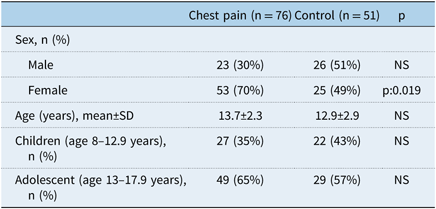
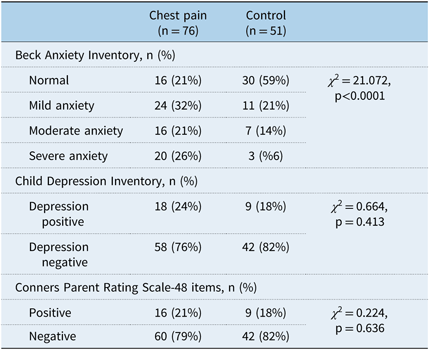
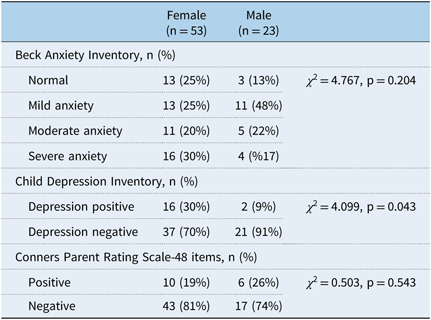
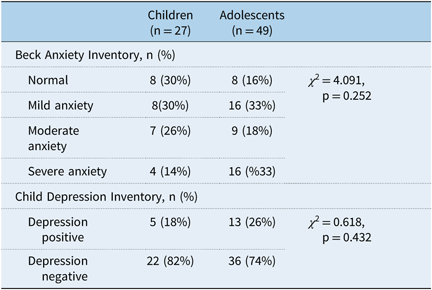
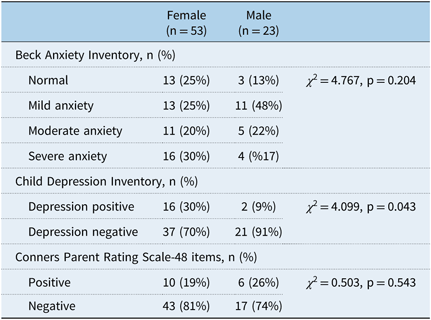
A total 127 children and adolescents (78 female and 49 male) included in the study, with the participants’ age ranging 8–18 years. Non-cardiac chest pain group consisted of 53 females and 23 males with the mean age of 13.7±2.3 years. The control group had 26 males and 23 females with the mean age of 12.9±2.9 years. Mean age did not differ across groups. There was a significant female sex dominance in non-cardiac chest pain group according to control (Table 1). The Beck Anxiety Inventory test results showed statistically significant high anxiety in non-cardiac chest pain group when compared to control (Table 2). There was no significant difference between depression rate of non-cardiac chest pain and control groups according to Child Depression Inventory (Table 2). The Conners Parent Rating Scale results showed similar attention-deficit and hyperactivity disorder rates in non-cardiac chest pain (21.1%) and control (17.6%) groups and there was no statistical difference (Table 2). The non-cardiac chest pain group Beck Anxiety Inventory, Child Depression Inventory and Conners Parent Rating Scale results were analysed in terms of gender (Table 3). There was no significant difference in anxiety rate between boys (87%) and girls (75.5%) with non-cardiac chest pain. The depression rate in girls (31%) with non-cardiac chest pain was statistically significantly higher when compared with boys (9%). There was no significant difference in attention-deficit and hyperactivity disorder rate between boys (26%) and girls (18%) with non-cardiac chest pain. The anxiety and depression rates in patients with non-cardiac chest pain were analysed, according to age groups (children; 8–12 years and adolescents; 13–18 years) (Table 4). The anxiety rates of age groups (70% for children and 84% for adolescents) were similar. There was no significant difference in depression rates of age groups (18.5% for children and 26.5% for adolescents).
Patients’ characteristics

NS = not significant.
χ 2 = 5.528, p = 0.019.
Anxiety, depression, and attention-deficit and hyperactivity disorder rates in patient and control groups

Anxiety, depression, attention-deficit and hyperactivity disorder according to sex in non-cardiac chest pain patients
Anxiety and depression according to age group in non-cardiac chest pain patients

Discussion
Results of this study suggest that children and adolescents with medically unexplained chest pain had a higher prevalence of anxiety than healthy controls. This finding is consistent with earlier observations by Lipsitz et al. Reference Lipsitz, Masia-Warner and Apfel 12 Of the 27 children and adolescents with non-cardiac chest pain, 15 (56%) were diagnosed with anxiety disorder. Tunaoglu et al Reference Tunaoglu, Olgunturk, Akcabay, Oguz, Gucuyener and Demirsoy 13 showed 75% psychiatric disorder and 21% anxiety symptoms in 74 youngsters with non-cardiac chest pain in a paediatric cardiology service, based on Diagnostic Statistical Manual of Mental Disorders, Third Edition-R. Another study in children and adolescents with unexplained chest pain, who presented to paediatric emergency department, showed high rates of psychopathology (27 of 32 children, 84%) using Diagnostic Statistical Manual of Mental Disorders, Fourth Edition and a large percentage of the sample (81%) had anxiety disorder. Reference Lipsitz, Gur and Sonnet 21 Finding is also consistent with the result of other study by Lipsitz et al Reference Lipsitz, Hsu and Apfel 22 in youngsters with non-cardiac chest pain. They found a higher prevalence of Diagnostic Statistical Manual of Mental Disorders, Fourth Edition, psychiatric disorders in children and adolescents with medically unexplained chest pain compared to a control sample with innocent heart murmur (74% versus 38%), and anxiety was again found most common (70%) in psychiatric disorders. In our study population, non-cardiac chest pain group had 79% anxiety symptoms and 26% of them had severe anxiety. The different anxiety ratios in different studies can be attributed to the different scales for psychiatric evaluation.
Depressive symptoms were reported in 4–15% of youngsters with non-cardiac chest pain in previous studies.Reference Lipsitz, Masia-Warner and Apfel 12 , Reference Tunaoglu, Olgunturk, Akcabay, Oguz, Gucuyener and Demirsoy 13 In present study, there was no evidence of high prevalence of depressive symptoms in children and adolescents with non-cardiac chest pain. According to 19 cut-off point, the non-cardiac chest pain group had 24% and control group had 18% Child Depression Inventory score above 19 and depression did not differ significantly across groups. This may explain that the peak onset of depressive disorders is at age 15 years, which is higher than our study group mean age. Therefore, our study population may have been at lower risk of beginning of depressive symptoms. Similarly, Lipsitz et alReference Lipsitz, Masia-Warner and Apfel 11 showed that youngsters with non-cardiac chest pain and benign heart murmur had similar mean scores on Child Depression Inventory depressive symptoms, and depression rates (11% of non-cardiac chest pain and 7% of benign heart murmur groups) did not differ across the groups. Another study of Lipsitz et alReference Lipsitz, Hsu and Apfel 22 between children and adolescents with medically unexplained chest pain and innocent heart murmur showed higher prevalence (9% versus 0) of any depression in the chest pain group using Diagnostic Statistical Manual of Mental Disorders, Fourth Edition: Child and Parent version.
Enough studies are not available about the association of non-cardiac chest pain and attention-deficit and hyperactivity disorder in children. In a study about the association of somatic complaints and psychopathology, a strong relationship was shown between persistent abdominal pain and attention-deficit and hyperactivity disorder in boys.Reference Egger, Costello, Erkanli and Angold 23 Additionally Lipsitz at alReference Lipsitz, Masia-Warner and Apfel 12 showed 11% attention-deficit and hyperactivity disorder in children and adolescent with non-cardiac chest pain. In our study population, attention-deficit and hyperactivity disorder was identified in 21% of non-cardiac chest pain group and in 18% of the control group, and there was no statistically significant difference between the two groups.
Previous study in children and adolescents with chest pain showed that psychogenic chest pain was more common in girls than in boys.Reference Selbst, Ruddy and Clark 24 Furthermore, same study concluded that adolescents with chest pain had 2.5 times higher probability of psychogenic causes for chest pain compared to children. In our study, there was not statistically significant gender difference in anxiety and attention-deficit and hyperactivity disorder symptoms in children and adolescent with non-cardiac chest pain. But depressive symptoms were significantly higher in girls with non-cardiac chest pain when compared to boys. Because previous studies about somatic complaints and psychiatric disorders showed that somatic complaints were strongly associated with emotional disorders (as depression) in girl.Reference Egger, Costello, Erkanli and Angold 23 , Reference Kişlal, Kutluk and Cetin 25
In conclusion, physicians should consider the possibility of psychiatric disorders in youth with chest pain after ruling out cardiac and other acute medical causes. Current findings highlight the importance of psychiatric screening with the help of short screening test such as Beck Anxiety Inventory, Child Depression Inventory, and The Conners Parent Rating Scale in children and adolescents with non-cardiac chest pain. Because these three questionnaires contain a total of 96 items and can be completed in 5 minutes by patients and their parents, these questionnaires can be easily applied and evaluated in paediatric cardiology and paediatrics outpatient clinics. Systematic screening may increase the recognition of psychological symptoms in this population and facilitate appropriate treatment of those with anxiety disorder and other disorders.
Limitations: There are several limitations to the current investigation that are important to note. First, we did not use a questionnaire to assess non-cardiac chest pain variable including severity, frequency, and time since onset. Second, we did not evaluate other factors that could be related to non-cardiac chest pain such as home environment, school success, other psychosomatic complaints and psychosomatic disorders in parents. Because multiple factors from biological, psychological, social, familial, and developmental domains are potentially relevant to the aetiology of non-cardiac chest pain.
Acknowledgments
None.
Financial Support
This research received no specific grant from any funding agency, commercial or not-for-profit sectors.
Conflicts of Interest
None.
Ethical Standards
The authors assert that all procedures contributing to this work comply with the Helsinki declaration of 1975, as revised in 2008, and has been approved by the Institutional Ethics Committee.