Introduction
End-stage renal disease (ESRD), an increasingly prevalent multi-symptom illness complex resulting from chronic kidney failure, has been shown to co-occur with abnormal brain function. For example, patients with ESRD often develop uremic or dialysis encephalopathy accompanied by prefrontal, basal ganglia, and white matter abnormalities on neuroimaging (see Krishnan & Kiernan, Reference Krishnan and Kiernan2009). Furthermore, even adequately dialyzed individuals frequently present with cognitive problems (e.g., Evans, Wagner, & Welch, Reference Evans, Wagner and Welch2004; Harciarek, Biedunkiewicz, Lichodziejewska-Niemierko, Dębska-Ślizień, & Rutkowski, Reference Harciarek, Biedunkiewicz, Lichodziejewska-Niemierko, Dębska-Ślizień and Rutkowski2011; Lux et al., Reference Lux, Mirzazade, Kuzmanovic, Plewan, Eickhoff, Shah and Eitner2010) that increase their mortality, dementia risks, and costs of medical care (Griva et al., Reference Griva, Stygall, Hankins, Davenport, Harrison and Newman2010; see also Koushik, McArthur, & Baird, Reference Koushik, McArthur and Baird2010). Consistently with reported neuroimaging findings, cognitive changes in subjects receiving dialysis typically represent deficits in frontal-subcortical cognitive functions, such as executive problems and psychomotor slowing (Pereira et al., Reference Pereira, Weiner, Scott, Chandra, Bluestein, Griffith and Sarnak2007).
There are several possible explanations why dialyzed patients may preferentially develop frontal-subcortical cognitive deficits. First, many dialyzers, due to the sieving characteristics of the membrane, are still not able to remove all the toxins, middle–large molecules in particular (Ronco & La Greca, Reference Ronco and La Greca2002), and, for unknown reasons, these toxins have been shown to particularly affect frontal white matter as well as basal ganglia (Okada, Yoshikawa, Matsuo, Kanno, & Oouchi, Reference Okada, Yoshikawa, Matsuo, Kanno and Oouchi1991). Additionally, despite its beneficial effects, the dialysis process itself, mostly by repeatedly inducing cerebral ischemia or cerebral edema, may result in microvascular lesions and, thus, produce new or amplify pre-existing (e.g., vascular) cognitive impairment (Koushik et al., Reference Koushik, McArthur and Baird2010). Of note, white matter hyperintensities have been shown to preferentially impair frontal lobe function regardless of their location (Tullberg et al., Reference Tullberg, Fletcher, DeCarli, Mungas, Reed, Harvey and Jagust2004). Furthermore, selective cognitive problems in dialyzed subjects may also result from ESRD comorbidities (e.g., diabetes, hypertension) as well as their treatment, most of them shown to predominantly impact fronto-subcortical systems (see Adams & Grant, Reference Adams and Grant2009).
It has been demonstrated that, whereas frontal-subcortical lesions may impair both phonemic and semantic verbal fluency, phonemic fluency, relying mainly on the central executive and phonological components of working memory, tend to be more sensitive to the effects of such lesions (e.g., Stuss et al., Reference Stuss, Alexander, Hamer, Palumbo, Dempster, Binns and Izukawa1998). Furthermore, disproportionally decreased phonemic fluency has been observed in subjects with more general widespread microvascular infarcts (see Libon et al., Reference Libon, Price, Swenson, Penney, Haake and Pennisi2009) and, as mentioned, such infarcts have been often reported in patients receiving dialysis (Krishnan & Kiernan, Reference Krishnan and Kiernan2009). By comparison, semantic fluency, depending more heavily on access to lexical representations of semantic concepts, has been predominantly impaired following injury to the temporal lobes (e.g., Baldo, Schwartz, Wilkins, & Dronkers, Reference Baldo, Schwartz, Wilkins and Dronkers2006; Birn et al., Reference Birn, Kenworthy, Case, Caravella, Jones, Bandettini and Martin2010).
Nonetheless, although phonemic and semantic fluency are frequently used methods for studying the relative impact of disease-related process to networks involving frontal and temporal resources, and the brain systems involved in phonemic fluency have been preferentially affected in dialyzed subjects (Krishnan & Kiernan, Reference Krishnan and Kiernan2009), verbal fluency in these patients has not been systematically studied. Lux and coworkers (2010) as well as Murray and coworkers (2006) demonstrated that patients receiving hemodialysis may present with decreased phonemic fluency when compared to healthy controls, whereas our recent studies suggest a relatively normal performance on both phonemic and semantic fluency in adequately dialyzed patients (e.g., Harciarek et al., Reference Harciarek, Biedunkiewicz, Lichodziejewska-Niemierko, Dębska-Ślizień and Rutkowski2011). However, due to several limitations (e.g., only phonemic fluency used, patients on peritoneal dialysis not included, small sample sizes of relatively healthier dialyzed subjects awaiting kidney transplant), the interpretation of previous findings in this regard is difficult to generalize. Furthermore, although cognitive impairment in patients on dialysis has been shown to be progressive, often resulting in dementia (Griva et al., Reference Griva, Stygall, Hankins, Davenport, Harrison and Newman2010), to our knowledge there are no longitudinal studies assessing selective changes in functional systems involving language skills in this population, and it may be that verbal fluency (phonemic and semantic) can serve as a tool to assess these changes.
The purpose of this study was to longitudinally compare the performance on verbal fluency tasks between dialyzed patients and matched controls without nephrological problems. Specifically, we hypothesized that phonemic fluency, relying on functions of frontal-subcortical systems, might be particularly sensitive to the constellation of physiological pathological processes associated with ESRD and dialysis. Additionally, we wanted to learn if the degree of potential decline of verbal fluency in dialyzed patients would be associated with some demographic and clinical factors.
Methods
Participants
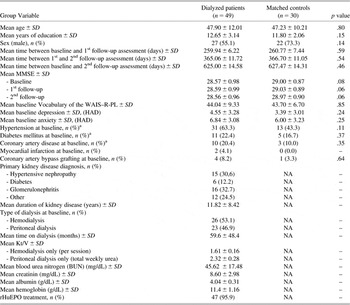
All individuals were right-handed, native Polish speakers who completed neuropsychological testing on the following longitudinal schedule: baseline, 8, and 20 months. The detailed demographic and clinical group characteristics are presented in Table 1.
Group characteristics

aThe number of participants with this condition changed over the time of the study: 1 dialyzed patients developed hypertension, 1 developed diabetes, and 1 developed coronary artery disease.
MMSE = Mini-Mental State Examination; HAD = Hospital Anxiety and Depression Scale; WAIS-R-PL = Polish adaptation of the Wechsler Adult Intelligence Scale-Revised; Kt/V = Kinetic transfer/Volume; rHuEPO = recombinant human erythropoietin.
Patients with ESRD
Charts of 99 dialyzed patients with ESRD from the Department of Nephrology, Transplantology, and Internal Medicine, Medical University of Gdańsk, who received neuropsychological testing from January 2005 to September 2008, were available for review. However, for the purpose of this study, 50 persons were excluded from the analyses (4 had a stroke and/or evidence of dementia, 3 had a history of alcoholism, 3 were older than 65, 2 suffered from psychiatric disorders, 32 received kidney transplant shortly after the first neuropsychological assessment, 2 died over the time of the study, and 4 did not return for follow-up). Hence, 49 dialyzed patients aged between 21 and 65 years of age, who had no malignancies or clinically evident cerebrovascular disease (e.g., stroke) as reflected by neurological deficits, had no uncontrolled hypertension, uncontrolled diabetes and/or anemia, mental retardation, speech or learning disabilities, psychiatric disorders, psychoactive drug treatment, dementia, alcohol abuse, clinically relevant visual or hearing difficulties, or other major organ failure (e.g., liver disease) were the participants of the study. The fulfillment of the above criteria was determined by interviewing both participants and their relatives as well as by reviewing medical records. Of note, during the study period, none of the patients was converted from hemodialysis to peritoneal dialysis or vice versa. Also, all dialyzed patients received at least 1 year of dialysis.
Matched controls
A comparison group consisted of 30 matched controls (MC), with no history of nephrological problems (mean GFR = 116.12 mL/min/1.73 m2; SD = 10.73). These participants were subject to the same exclusion criteria as were patients with ESRD. Of note, to better understand the impact of ESRD-specific factors on cognition, we attempted to match both groups on demographics and ESRD-comorbidities. Thus, MCs were recruited after the dialyzed subjects were enrolled. Hence, having known the demographics and the comorbidities of our dialyzed patients, 16 participants were recruited from a group of 20 individuals from the Outpatient Hypertension and Diabetology Clinic, Medical University of Gdańsk, and 14 subjects were selected from a pool of 30 randomly recruited citizens of Gdańsk.
Procedure
All participants were tested in the same way and the neuropsychological measures were given in the same order. Each subject was evaluated at the same time of the day (±3 hr) and patients on hemodialysis were tested ∼24 hr after the last dialysis. All participants were examined in the same testing room and blood samples for biochemical data were always obtained shortly after completion of cognitive assessment. Also, each subject underwent a complete neurological and cardiac evaluation. None of participants were ill or hospitalized during the assessment. All data were obtained in compliance with regulations of our institutions, and before testing informed consent was acquired from each study participant.
Neuropsychological Assessment
Cognitive status and premorbid intelligence
The cognitive status of all participants was longitudinally assessed with the MMSE (Folstein, Folstein, & McHugh, Reference Folstein, Folstein and McHugh1975). Additionally, premorbid intelligence and baseline semantic knowledge were tested using the Vocabulary sub-scale of the Polish adaptation of the Wechsler Adult Intelligence Scale–Revised (Brzeziński, Gaul, Hornowska, Machowski, & Zakrzewska, 1996).
Verbal fluency
Verbal fluency was assessed with the phonemic and semantic verbal fluency tasks. Based on previous works (e.g., Sitek, Bilińska, Wieczorek & Nyka, Reference Sitek, Bilińska, Wieczorek and Nyka2009), we have used the letter “K” for phonemic fluency and names of animals for semantic fluency. The letter “K” was chosen because, in Polish, words beginning with this letter have a relatively high frequency of usage, similar to that of the letter “F” in English.
Affect
Depressive and anxiety symptoms were measured by a Polish adaptation of Zigmond and Snaith's Hospital Anxiety and Depression Scale (HAD) (Majkowicz, Reference Majkowicz1994).
Statistical Analysis
A series of t tests for independent samples (for continuous data) and χ2 tests (for categorical data) were performed using SPSS version 18 to compare groups on demographics and selected clinical measures, with alpha level of .05 (two-tailed).
A series of 3 × 2 repeated measures analysis of variance (ANOVA) was used to prospectively assess the performance on cognitive measures. The within-subject factor was time of testing (baseline vs. first follow-up vs. second follow-up) and the between subject factor was group (dialyzed vs. MC). The dependent variables were raw scores in each test; for example, the number of words generated in 60 s for each fluency task. The effect sizes in ANOVA (ηp2) were computed using the procedure implemented in SPSS, whereas estimates of Cohen's d (d) were calculated using t test values, n, and correlations for paired values (for within-group effects). Post hoc comparisons of between-group effects were conducted using the t test for independent samples, and the within-group differences were analyzed using the dependent t test. Additionally, we calculated the percentage of change for each fluency task using the following formula: [(2nd follow-up score – baseline score)/score baseline] × 100%. This percentage of change was then correlated with selected baseline demographic and clinical variables using a Spearman rank order test.
We acknowledge that all data included in this manuscript was obtained in compliance with regulations of our institutions, and human research was completed in accordance with the guidelines of the Helsinki Declaration (http://www.wma.net/e/policy/17-c_e.html).
Results
Demographics and Clinical Factors
There were no significant group differences in demographics, premorbid intelligence, anxiety or depression at baseline (see Table 1). Additionally, groups did not differ from each other in incidence of hypertension, diabetes, coronary artery disease, or coronary artery bypass grafting.
Longitudinal Cognitive Assessment
General cognition
Next, we aimed to identify longitudinal changes in general cognition, as measured by the MMSE. However, no statistically significant effects emerged. Also, none of MMSE scores was below 27 (see Table 1).
Verbal fluency
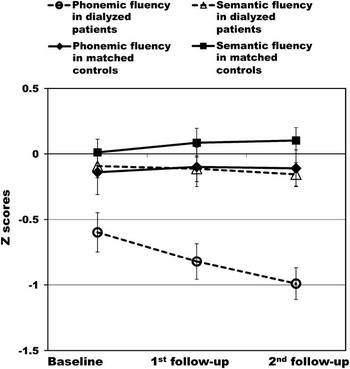
For the phonemic fluency task, the AVOVA model revealed a group × time interaction, F(2,76) = 7.43, p = .001, ηp2 = .16. Between-group comparisons showed that there was a baseline trend for dialyzed subjects to perform worse on phonemic fluency, t(1,77) = 1.82, p = .075, d = −.23, reaching its significance at the first follow-up, t(1,77) = 3.40, p = .001, d = −.69, and continuing through the second follow-up, t(1,77) = 4.19, p < .001, d = −.92. Furthermore, between baseline and the last follow-up, a significant decline of 8% was observed in the dialysis group, t(48) = 4.47, p < .001; d = .55, whereas a non-significant learning effect of 0.5% was noted in controls.
No statistically significant interactions or main effects emerged for the semantic fluency task.
Relationship Between Decline on Letter Fluency and Selected Baseline Factors
Lastly, we wanted to learn if the percentage of change observed on the phonemic fluency task in dialyzed patients was associated with the demographic and clinical baseline factors from Table 1 (except for primary kidney disease diagnosis and kinetic transfer/volumeFootnote 1). The exploratory correlation analysis revealed a significant correlation only for hypertension, rho = −.43, p = .002, and blood urea nitrogen (BUN), rho = −.35, p = .015, indicating that the greater decline on phonemic fluency task was seen in dialyzed patients with comorbid hypertension and higher BUN. Of note, there was also no significant correlation between the percentage of change on phonemic fluency and semantic knowledge or the baseline MMSE.
Discussion
The purpose of this study was to longitudinally compare the performance on verbal fluency tasks between dialyzed patients and matched controls without nephrological problems. Overall, this study demonstrates that despite normal and relatively stable cognitive status as well as a comparable performance on a semantic fluency task, in contrast to well-matched controls, dialyzed patients produce significantly fewer words on a phonemic fluency task. Furthermore, the performance of patients receiving dialysis was not only below that of controls but it also significantly declined over a time period of approximately 2 years.
The exact mechanism of progressively decreasing phonemic fluency with relatively stable and well-preserved semantic fluency in our dialyzed patients remains unclear. Previous studies provided converging evidence that, whereas category fluency is mostly subserved by temporal lobes, performance on tests of phonemic fluency relies primarily on frontal-subcortical systems. For example, Stuss and coworkers (1998) showed that particularly patients with lesions to left dorsolateral prefrontal cortex and/or striatum experienced difficulties on phonemic fluency tasks. Additionally, the central role of frontal regions in phonemic fluency was supported by neuroimaging studies with healthy subjects (e.g., Birn et al., Reference Birn, Kenworthy, Case, Caravella, Jones, Bandettini and Martin2010). Thus, consistent with neuroimaging research indicating that structural and/or functional abnormalities in dialyzed subjects encompass predominantly frontal-subcortical regions (Krishnan & Kiernan, Reference Krishnan and Kiernan2009), our findings might indirectly support the notion that this population present with a selective decline on performance on cognitive tasks primarily processed by these regions (Pereira et al., Reference Pereira, Weiner, Scott, Chandra, Bluestein, Griffith and Sarnak2007; see also Koushik et al., Reference Koushik, McArthur and Baird2010). Nonetheless, since we do not have neuroimaging data, this speculative explanation needs to be tested in future studies. Furthermore, when compared to healthy individuals (Sitek et al., Reference Sitek, Bilińska, Wieczorek and Nyka2009), this impairment is rather mild (see Figure 1). Also, it is not specific for ESRD, since decreased phonemic fluency as a sign of dysexecutive impairment has been frequently described in other major neuromedical disorders (e.g., diabetes, hypertension, HIV/AIDS; see Grant & Adams, 2009).
Longitudinal trends in verbal fluency performance in patients receiving dialysis and matched controls without nephrological problems: mean Z scores for phonemic and semantic verbal fluency showing trends in performance from baseline to 8, and 20 months follow-up. The Z scores are standardized relative to the performance of healthy individuals from the study by Sitek et al. (Reference Sitek, Bilińska, Wieczorek and Nyka2009), whose mean value is therefore zero. The Z scores have been adjusted for age, sex, and education. Error bars indicate the standard error of the mean of each measure.

In the present study, however, the extent of the decline on the phonemic fluency task was significantly greater in individuals with hypertension and higher BUN. Thus, our results seem to provide further evidence supporting the concept of reno-cerebrovascular disease and accelerated vascular cognitive impairment in a dialyzed population (Murray et al., Reference Murray, Tupper, Knopman, Gilbertson, Pederson, Li and Kane2006).
As mentioned, the general cognitive status of both our groups was similar and did not change over time. This finding indicates that the MMSE is not sensitive enough to detect rather subtle frontal-subcortical cognitive deficits seen in dialyzed patients. Thus, it is recommended that, when evaluating cognition in subjects receiving dialysis, a typically used screening tool like the MMSE should be supplemented with a task such as the verbal fluency, phonemic fluency in particular. This might, in turn, help to better predict risk of dementia, impairments in activities of daily living, and adherence to complex regimens of renal replacement therapy.
This study has several limitations. First, since our subjects had no neuroimaging assessment, we could not directly analyze the neuroanatomical correlates of the performance as well as the decline seen on phonemic fluency in dialyzed patients. Hence, overall, our findings might be best perceived in terms of mild dysexecutive impairment in the context of major neuromedical conditions with vascular risk factors. Second, only two fluency tasks were administered, with only one letter and one category used. Also, it is possible that the lack of decline on semantic fluency in our patients was due to the choice of semantic category (i.e., names of animals) that may potentially have lower degree of frontal involvement than other semantic categories (e.g., supermarket items). Thus, future clinico-neuroimaging and autopsy studies using more comprehensive cognitive testing are needed to better understand the pathophysiology of a relatively selective cognitive decline in dialyzed individuals.
Acknowledgments
Authors acknowledge that this manuscript is original and is not currently under review by any other publication. This manuscript has never been published either electronically or in print as well as there is no financial or any other relationship with any institution that could be perceived as a potential conflict of interests. While preparing this manuscript, the corresponding author was receiving a scholarship from the Kosciuszko Foundation as well as the scholarship from the Polish Ministry of Science and Higher Education. The corresponding author thanks Dr. Ola A. Selnes from Johns Hopkins Hospital and School of Medicine for his helpful comments. Special thanks also go to Dr. Emilia Sitek from Medical University of Gdańsk for providing us with the appropriate control data that allowed us to transform raw verbal fluency data into the standardized scores.