

I. Introduction
Since the quality of a bottle of wine is unknown to the potential buyer before consumption, there is a growing body of literature on various aspects of perceived risk (Georgantzis and Tisserand, Reference Georgantzis and Tisserand2019). Like for other experience goods (Ashton, Reference Ashton2014), wine purchase decisions draw on consumers’ use of prior knowledge and experience, and various product cues (Gustavsen and Rickertsen, Reference Gustavsen and Rickertsen2019), such as price, brand, vintage, and expert rating, which all may impact their perceived cork-taint risk (Outreville and Desrochers, Reference Outreville and Desrochers2016).
Although there is a rich body of literature evaluating the impact of wine bottle closures on quality perception and purchase decisions of consumers in different countries and considering different genders, little is known about the relationship between perceived cork-taint risk, price, and how closure types affect consumer expectations and the willingness to purchase the wine.
The objective of this paper is to analyze purchasing decisions when wine consumers face a potential functional risk associated with the closure of the bottle. We study several potentially explanatory factors such as the wine's price and various buyer characteristics, for example, gender and regional differences in risk perception. In particular, we examine the risk of buying a bottle of wine subject to the possibility that the bottle is cork-tainted and the willingness to buy a bottle with alternative closure types in order to avoid this risk. The study draws from Lecat, Le Fur, and Outreville (Reference Lecat, Le Fur and Outreville2016), considering perceived risk for “corked” bottles by consumers, and is in line with studies by Barber, Taylor, and Dodd (Reference Barber, Taylor and Dodd2009), considering how wine bottle packaging and gender influence wine purchase decisions.
II. Literature Review
An estimated 2–15% of all wine bottles using natural cork exhibit a musty taint commonly referred to as being “corked” (Choi, Garcia, and Friedrich, Reference Choi, Garcia and Friedrich2010).Footnote 1 The cork taint is caused by various organic compounds, the most important of which is called 2,4,6-Trichloroanisole, also known as TCA. TCA is the result of metabolic products of various fungi present in the cork.
Synthetic corks or screw caps have been used as risk-reduction devices, although they may also affect the perceived quality of a wine. The type of closure for a bottle of wine can directly influence the intrinsic attributes of wines. Various types of closures such as natural or synthetic corks, screw caps (Stelvin), glass closures (Vinilok), and Zork closure can be considered by consumers to be a direct reflection of the wine quality, influencing their purchase decision to some extent (Marin and Durham, Reference Marin and Durham2007; Barber, Taylor, and Dodd, Reference Barber, Taylor and Dodd2009). Marin and Durham (Reference Marin and Durham2007) examine the effects of natural cork, synthetic cork, and screw cap on the consumers’ intention to purchase and their price expectation for two commercial wines, a Chardonnay and a Merlot. The results indicate that consumers expect to pay significantly less for a bottle with a screw cap for both wines. Barber, Taylor, and Dodd (Reference Barber, Taylor and Dodd2009) find that different types of wine bottle closures, such as natural cork, synthetic cork, and screw caps, in the retail affects consumers’ purchase decision.
Although an individual's perception of risk is subjective, the manner in which the available information is evaluated is partially explained by an individual's family background, gender, age, education, prior experience, and geographical location (Dohmen et al. Reference Dohmen, Falk, Huffman, Sunde, Schupp and Wagner2011). The issue of gender plays a role in packaging preferences, including the type of closure (Thach and Olsen, Reference Thach and Olsen2004). However, as Bruwer, Saliba, and Miller (Reference Bruwer, Saliba and Miller2011) argue, these studies do not account for other individual characteristics that may impact gender differences. Variations in attitude, value orientations, education, and culture, in general, may lead consumers to vary their purchase behaviors in many ways (Williams, Reference Williams2002). Risk attitudes should also be considered since investigations in the field or the laboratory find that women are more risk-averse than men (Eckel and Grossman, Reference Eckel and Grossman2008).
III. Methodology
Our study draws on data from a questionnaire administered among young adults. The questionnaire is structured into five main parts. The first part asks for various socio-demographic and attitudinal traits. The second part measures wine involvement of respondents by asking questions about wine consumption frequency, willingness to pay for a bottle of wine to be drunk during a dinner at friends’ and subjective wine knowledge (Flynn and Goldsmith, Reference Flynn and Goldsmith1999). In the third section, we collect information about the preferred closure type and experience with the corked wine. The fourth section includes a choice experiment. Respondents were asked to imagine having the opportunity to buy a bottle of wine at six different price levels (5, 10, 20, 35, 55, and 80 euros) in a specialty store; they should include the risk that the wine might be cork-tainted. Respondents were asked to elicit the probability that the wine was corked at the different price levels and to declare if they would have bought the bottle with the traditional cork closure, or alternative closure types mitigating the risk, namely synthetic cork, screw cap, glass closure, or Zork.
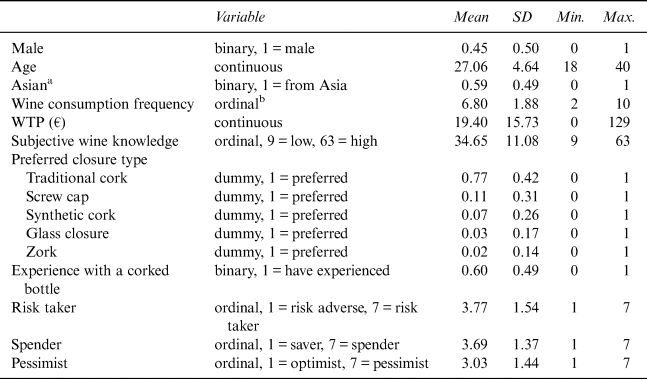
In order to meet the research objectives, the questionnaire was translated into five languages (English, French, Italian, Simplified Chinese, and Traditional Chinese) and digitized. It was submitted to students attending the international master in Wine Management at the Burgundy School of Business in France, and they were asked in turn to forward the questionnaire to 15 of their acquaintances outside the school. Due to this snowball sampling, we collected 804 usable questionnaires. Table 1 shows the relevant descriptive statistics.
Descriptive Statistics (n = 804)

a Respondents come from China (36%), France (33%), Hong Kong (18%), Italy (3%), the United States (3%), Taiwan (3%), other Western countries (United Kingdom, the Netherlands, Germany, Belgium, Luxemburg) (2%), other Asian countries (South Korea, Thailand, Japan) (2%).
b 10 = every day; 9 = 5–6 times a week; 8 = 3–4 times a week; 7 = 1–2 times a week; 6 = 2–3 times a month; 5 = once a month; 4 = 6–11 times a year; 3 = 2–5 times a year; 2 = once a year; 1 = never
The sample is balanced between males (45%) and females (55%) with an average age of 27 years. We record whether subjects are from Asia (59%) or have a Western (i.e., European and American) background (41%). Thirty-six percent of the respondents are from China, and 18% from Hong Kong, accounting for the largest part of the sample's Asian group. The Western group of respondents is mostly composed of French young adults (33%). The mean wine consumption frequency of the sample is close to seven, indicating that, on average, they consume wine once or twice a week. As expected, the preferred closure type is traditional cork, and 60% of the respondents have experienced a corked bottle of wine at least once. The variable “subjective wine knowledge” is the aggregated sum of nine items constructed by Flynn and Goldsmith (Reference Flynn and Goldsmith1999) and adapted to wine.Footnote 2 Individuals in the sample also provide a self-reported attitude towards risk propensity and spending behavior. On a Likert scale ranging from 1 to 7, both variables display average values around 3.7. Similarly, on a 1–7 Likert scale (1 = optimist, 7 = pessimist), our respondents describe themselves as being moderately optimistic (3.03).
IV. Results
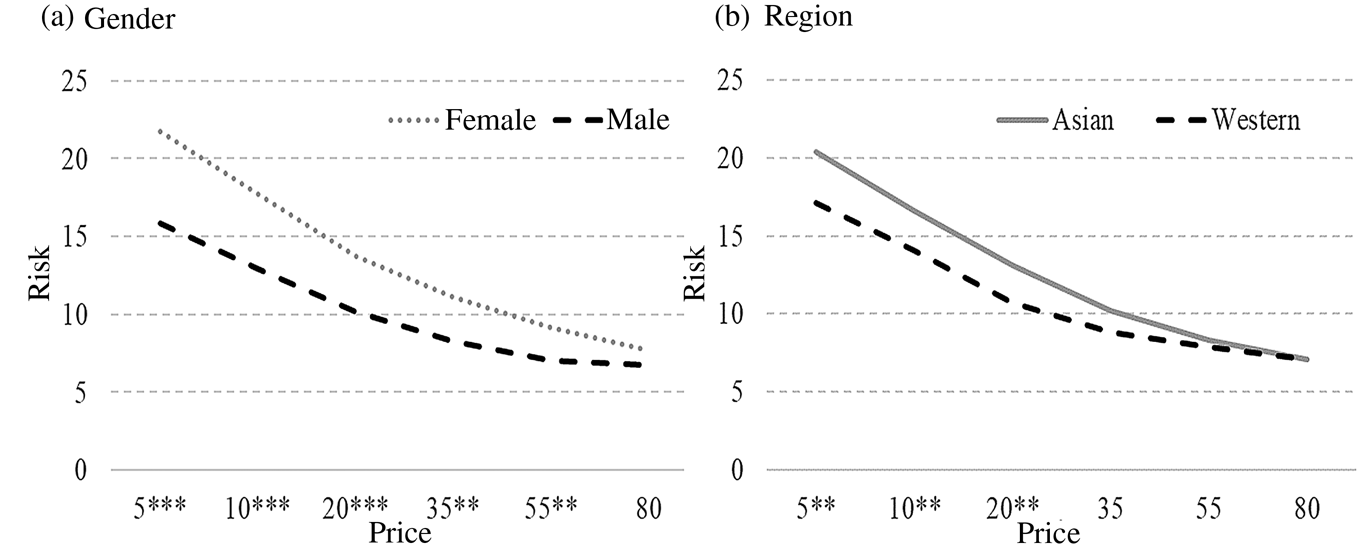
We perform a one-way ANOVA analysis in order to identify differences in risk perception at each price level, separately by gender and region of the subject's origin. We find that respondents’ perceived cork-taint risk is inversely related to the price (Figure 1). Females exhibit higher perceived risks than males, except for the most expensive wines (Figure 1, Panel a). Regional differences in risk perception emerge for wines priced €20 and below, with Asian respondents’ risk perception being higher than that of people from Western countries (Figure 1, Panel b).
Gender and Regional Differences in Risk Perception by Price
Note: *** and ** denote statistical significance at the 1 and 5% levels, respectively.

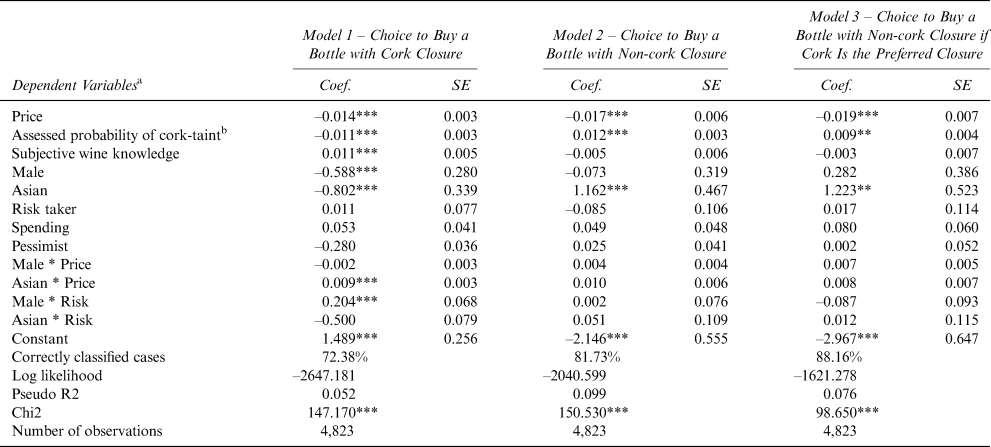
We estimate cross-sectional logit models with individual clustered standard errors and individual-fixed effect logit models to study the determinants of purchasing probability for: (i) the highest risky wine with the traditional cork closure type (Model 1); (ii) a bottle of wine with a closure type different than cork (synthetic, screw cap, glass closure, and/or Zork) avoiding cork-related risks (Model 2); (iii) a bottle of wine with a closure type different than cork, despite the fact that the traditional cork closure was reported as the preferred one (Model 3). Table 2 shows the estimation results for the logit regressions with clustered standard errors.Footnote 3
Logit Regressions Predicting Buying Behavior with Different Closure Types

Notes: *** and ** denote statistical significance at the 1 and 5% levels, respectively. SE = standard errors.
a Model 1: The dependent variable assumes value 1 if respondents choose to buy the bottle with cork closure, 0 if they do not choose the cork closure. Model 2: The dependent variable assumes value 1 if respondents choose to buy the bottle with a closure type different from cork (screw cap and/or synthetic cork and/or glass closure and/or zork), 0 if they choose cork closure or do not buy the bottle at all. Model 3: The dependent variable assumes value 1 if respondents choose to buy a bottle with a closure different from cork, even if they indicated cork as the preferred closure type.
b Subject-assessed probability, from 0 to 100, that a wine may be corked.
Model 1 shows that, despite the cork-taint risk, the probability of choosing a bottle with a cork closure is indirectly correlated with the price of wine (coefficient –0.014). People with a lower degree of risk perception, that is, who assign a lower cork-taint probability, are more prone to buy the wine with this closure type (–0.011); the same applies to females, as suggested by the negative coefficient for the male variable. Also, people with high subjective wine knowledge and people from Western countries are more willing to buy a bottle with the traditional closure type. The interaction terms suggest that high risk-taking males are more prone to buy the riskier bottle of wine (+0.204); the same applies to the interaction between Asian and wine price (+0.009).
According to Model 2, the choice to buy a bottle with a closure type different than cork is negatively correlated with the price of the wine (coefficient –0.017) and positively correlated with the risk perceived that the bottle with a cork closure is cork-tainted (0.012). Asian subjects are more likely to buy wine with alternative closure types (1.162). This may be due to their higher exposure to screw cap bottles, mainly of Australian origin.
Model 3 estimates the probability of buying a bottle with a non-cork closure even if the preferred closure type is cork. The perceived risk that the bottle with a traditional cork is faulty has also a positive effect in switching to a bottle with an alternative closure type, even if the cork closure type is the preferred one (0.009). The buying probability increases with the decreasing of the price (–0.019), and respondents from Asia are more prone to exhibit this pattern of behavior (1.223).
Individual behavioral variables, that is, risk, spending, and pessimist behaviors, remain insignificant in all model variants and do not seem to impact purchase decisions. We also tested the inclusion of all possible interaction terms as independent variables, but these additional results are either non-significant or meaningless in explaining purchasing behavior.
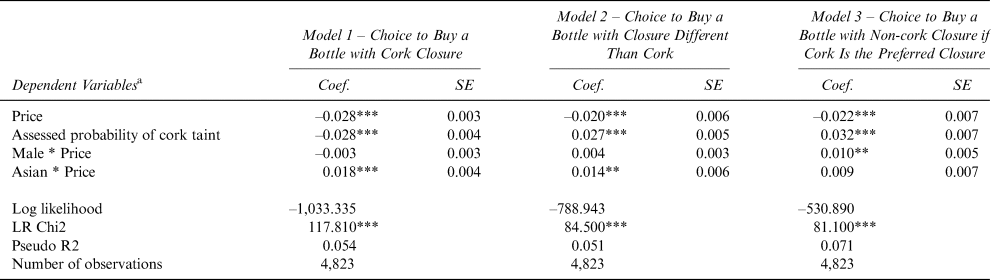
In Table 3, we report the results of three logit regressions, equivalent to Table 2, but with individual-fixed effects. When having to do with multiple observations for each respondent, fixed-effects models analyze the impact of the variables that vary for each respondent in each observation. Therefore, the estimation procedure does not allow “individual-invariant” variables (such as the gender, region of origin, and any other feature that is constant for each individual) to be included in the model.
Individual-Fixed Effect Logit Regressions Dependent Variable: Purchase Wine with Different Closure Types

Notes: *** and ** denote statistical significance at the 1 and 5% levels, respectively. SE = standard errors.
a Model 1: The dependent variable assumes value 1 if respondents choose to buy the bottle with cork closure, 0 if they do not choose the cork closure. Model 2: The dependent variable assumes value 1 if respondents choose to buy the bottle with a closure type different from cork (screw cap and/or synthetic cork and/or glass closure and/or zork), 0 if they choose cork closure or do not buy the bottle at all. Model 3: The dependent variable assumes value 1 if respondents choose to buy a bottle with a closure different from cork, even if they indicated cork as the preferred closure type.
The overall results are similar to those presented in Table 2, with the choice to buy a bottle with price increase having a negative effect on the three hypothesized dependent variables and the elicited probability that the bottle is corked negatively influencing the buying behavior of a bottle with traditional cork closure (coefficient –0.028) and positively influencing the buying behavior of a bottle with alternative closure types (+0.027), even if the cork is reported as the preferred closure (+0.032). The interaction between Asian subjects and the wine's price suggests a higher probability of buying a riskier bottle of wine, that is, a cork-closure bottle which exhibits some risk of being corked (Model 1, +0.018) and the less risky wines with no-cork closure (Model 2, +0.014). The interaction between gender and the wine's price exhibits a higher probability of buying a no-cork bottle despite cork is considered the preferred closure type (+0.010).
V. Conclusion
In this study, we analyze the wine purchasing behavior of a sample of 804 young adults from two regional origins, Asian and Western. We find differences in risk perception and risk-mitigating strategies according to the region of subjects’ origin and gender when people are faced with the risk that a bottle of wine may be cork-tainted. Females self-assess the cork-taint risk higher than males but are still more likely than men to take risks and display a higher propensity to buy a bottle with a cork closure, the riskiest option. Young consumers from Asia are more risk-averse than people from Western countries. Gender and regional differences vanish for wines in higher price brackets.