INTRODUCTION
Leishmaniasis comprises several diseases caused by protozoans of the genus Leishmania and affects millions of individuals worldwide causing serious morbidity and mortality. Visceral leishmaniasis (VL) caused by Leishmaniasis donovani and Leishmaniasis infantum (syn L. infantum chagasi) is the second most common parasitic cause of death and is prevalent in 47 countries with about 200 million people at risk and an estimated annual incidence of approximately 500 000 cases (Pereira-Carvalho et al. Reference Pereira-Carvalho, Mendes-Aguiar, Oliveira-Neto, Covas, Bertho, Da-Cruz and Gomes-Silva2013) . The LV infection spreads from the skin to the spleen, liver and bone marrow causing hepatomegaly and splenomegaly and death if untreated (WHO Technical Report Series, 2010).
During visceral leishmaniasis T cell mediated immunity plays a central role in host responses and the outcome of infection is determined by the magnitude/quality of parasite-specific Th1 immune response regardless of Th2 response or Th1/Th2 cytokines production balance (De Oliveira Gomes et al. Reference De Oliveira Gomes, Da Silva Costa Souza, De Matos Guedes, Lopes and Rossi-Bergmann2011; Yadav et al. Reference Yadav, Amit, Chaudhary, Chandel, Mahantesh, Suman, Singh, Dikhit, Ali, Rabidas, Pandey, Kumar, Das and Bimal2015). The major mechanisms underlying protective immune response against Leishmania parasites involve the secretion of mononuclear cell-recruiting chemokines and also macrophage-activating cytokines such as IFN-γ and tumour necrosis factor alfa (TNF-α), which are responsible for inducing the killing mechanisms (Stäger and Rafati, Reference Stäger and Rafati2012). Although the inflammatory immune response is responsible to induce the leishmanicidal mechanisms, an exaggerated pro-inflammatory immune response has been associated with failure in LV control and contributes to pathological tissue damage observed during cutaneous and mucocutaneous leishmaniasis (Faria et al. Reference Faria, Gollob, Barbosa, Schriefer, Machado, Lessa, Carvalho, Romano-Silva, De Jesus, Carvalho and Dutra2005; Terrazas et al. Reference Terrazas, Varikuti, Kimble, Moretti, Boyaka and Satoskar2015). Beyond immunity, other factors such as intrinsic genetic characteristics (Castellucci et al. Reference Castellucci, Jamieson, Almeida, Oliveira, Guimaraes, Lessa, Fakiola, Jesus, Nancy Miller, Carvalho and Blackwell2012); parasite species (Zijlstra et al. Reference Zijlstra, Musa, Khalil, El Hassan and El-Hassan2003) or strain (Alimohammadian et al. Reference Alimohammadian, Darabi, Ajdary, Khaze and Torkabadi2010); age (Carvalho et al. Reference Carvalho, Amorim, Barbosa, Lago and Carvalho2015); and nutritional status (Malafaia et al. Reference Malafaia, Serafim, Silva, Pedrosa and Rezende2009) of the host may directly influence the establishment and outcome of Leishmania infection;). The influence of some of these factors, especially nutritional status is still poorly understood.
Obesity is a world public health concern and the main causal factor for metabolic syndromes, which significantly increases the risk for the development of type 2 diabetes, respiratory disorders, cardiovascular diseases, insulin resistance and non-alcoholic fatty liver diseases (Scarpellini and Tack, Reference Scarpellini and Tack2012). Obesity is characterized by a chronic and systemic inflammatory condition that directly impact the innate and adaptive immune function reducing the capacity of leucocytes phagocytosis; decreasing regulatory T cells frequency and dysregulating cytokine/chemokine production (Fuentes et al. Reference Fuentes, Roszer and Ricote2010; Yang et al. Reference Yang, Youm, Vandanmagsar, Ravussin, Gimble, Greenway, Stephens, Mynatt and Dixit2010). These altered functions enhance the risk of cancer development (Kraus and Arber, Reference Kraus and Arber2009; Rodríguez-Hernández et al. Reference Rodríguez-Hernández, Simental-Mendía, Rodríguez-Ramírez and Reyes-Romero2013) and susceptibility to pathogens (Barth et al. Reference Barth, Remick and Genco2013; Onofrio et al. Reference Onofrio, Arocena, Paroli, Cabalén, Andrada, Cano and Gea2015) and also decrease vaccine effectiveness (Farmaki et al. Reference Farmaki, Kanakoudi-Tsakalidou, Spoulou, Trachana, Pratsidou-Gertsi, Tritsoni and Theodoridou2010; Chen et al. Reference Chen, Akbar, Miyake, Abe, Al-Mahtab, Furukawa, Bunzo, Hiasa and Onji2014).
Several obesity experimental models including diet- and genetic- induced have been used provide a robust characterization of the immunological and metabolic obesity consequences (Neves et al. Reference Neves, Miranda de Barros Alencar, Costa-Silva, Águila, Mandarim-de-Lacerda, Machado-Silva and Gomes2007; Kentish et al. Reference Kentish, Frisby, Kritas, Li, Hatzinikolas, O'Donnell, Wittert and Page2015). Diets based on high concentrations of sugar and fat that reproduce more closely a typical western dietary pattern have been shown to promote not only weight gain compatible with obesity but also metabolic and inflammatory-related alterations in mice (Maioli et al. Reference Maioli, Gonçalves, Miranda, Martins, Horta, Moreira, Godard, Santiago and Faria2015).
In this work, we used a well-described obesity model induced by the consumption of high amounts of sugar and fat targeting investigates its possible association with the visceral leishmaniasis susceptibility. We hypothesized that the inflammatory environment promoted by hyper-caloric diet-induced obesity could potentially influence the development and the outcome of infection caused by L. infantum chagasi. Considering the world increasing concern about obesity epidemics in association with the growth of the emerging visceral leishmaniasis in urban centres, we consider this a clinically relevant topic.
MATERIALS AND METHODS
Animals and diet-induced obesity
Six weeks old female C57BL6 mice were originally purchased from Jackson Laboratory (Bar Harbor, Maine) and maintained at our own facilities. Mice (8–12)/group were assigned at random to either receive ad libitum the standard diet (Ctrl) (4·0 kcal g−1) or high-sugar and butter diet (HSB) (5·0 kcal g−1) as described recently in (Maioli et al. Reference Maioli, Gonçalves, Miranda, Martins, Horta, Moreira, Godard, Santiago and Faria2015) throughout the experimental time. The mice were weighed weekly and food intake monitored over the 14 weeks. Gonadal adipose mass was determined from all mice 4 weeks after Leishmania infection. The euthanasia was performed 4 weeks after Leishmania infantum chagasi infection. The obesity and immunological parameters were determined individually after euthanasia and the experimental protocols used in this work were approved by the Ethical Committee for Experimental Animal Use established in the Universidade Federal do Espírito Santo under referential number 014/2011.
Parasites and infection
Leishmania (infantum) chagasi strain MHOM/BR/1975/PP75 was cultured at 26 °C in GRACE'S medium (Sigma-Aldrich), pH 7·2, supplemented with 10% heat-inactivated fetal bovine serum (Cultilab, Brazil), 2 mm L-glutamine (Gibco, USA), 25 mm HEPES (Sigma-Aldrich) and 20 µg mL−1 of gentamicin (Sigma-Aldrich). The mice were infected in the eighth-week after the start of diets by the intravenous (i.v.) route with 107 L. chagasi promastigotes at the stationary phase of growth, as described in De Oliveira Gomes et al. (Reference De Oliveira Gomes, Da Silva Costa Souza, De Matos Guedes, Lopes and Rossi-Bergmann2011).
Parasite burden
On day 28 of infection, the parasite burden in each liver and spleen was individually determined by limiting dilution assay (LDA) as described in Gomes et al. (2012), (De Oliveira Gomes et al. Reference De Oliveira Gomes, Da Silva Costa Souza, De Matos Guedes, Lopes and Rossi-Bergmann2011). Briefly, each organ was weighted and homogenized in GRACE'S medium (pH 7·2), supplemented with 10% heat-inactivated fetal bovine serum. The volume of cell suspension was adjusted with supplemented GRACE'S according with tissue weight (100 mg of tissue per mL) and plated in a 96 well plate (Corning, USA). Serial dilutions of single-cell suspensions were individually performed followed by culture for 10 days at 26 °C. The original number of parasites in each organ was calculated from the reciprocal of the highest dilution containing promastigotes.
Production of cytokines and Nitrite production
Liver, spleen or gonadal adipose tissue were isolated and individually homogenized in 1 mL of PBS with addition of protease and phosphatase inhibitors (Sigma-Aldrich) using a glass tissue grinder (Thomas, USA). The volume of cell suspension was normalized with PBS according with tissue weight (100 mg of tissue per mL) and centrifuged (10 min, 20·000 g at 4 °C) to supernatants collection. In situ cytokine quantification (TNF-α, IFN-γ, TGF-β, IL-6 and IL-10) were performed in supernatants by ELISA assay following the manufacturer's instructions considering the sensitivity of each test (R&D Systems, USA). The nitrite production was measured in the collected supernatants using Griess method (Green et al. Reference Green, Wagner, Glogowski, Skipper, Wishnok and Tannenbaum1982). Briefly, 50 µL of supernatants were mixed with 50 µL of Griess reagent (1 mL of sulphanilamide (Sigma-Aldrich) and 0·1 mL of N-1-naphthylethylenediamin dihydrochloride (Sigma-Aldrich) in 2·5 mL o-phosphoric acid (Tedia, USA) and incubated at room temperature for 10 min. The nitrite concentrations were determined at 540-nm wavelength using a standard sodium nitrite curve.
Histology and cell area image analysis
Samples with 3- 5 mm of gonadal adipose tissue, spleen and liver were individually fixed in paraformaldehyde (Sigma-Aldrich), embedded in paraffin (TBS, USA), cut into 5 µm sections and stained with haematoxylin and eosin (TBS, USA). The sections were viewed at 100× or 400× magnification as indicated in figures and the images obtained with the DV-130 digital camera (Hawking Technology, USA). Adipocytes diameter and area were calculated using the LissView image program (Hawking Technology, USA).
Statistics
Data were analysed using the GraphPad Prism software version 6.0 for Mac. Means of normally distributed variables were compared by analysis of variance (ANOVA) analysis simple factorial test and by one-way ANOVA -Tukey's honestly significant difference (Tukey's HSD) post-hoc. Data were considered significantly different when P < 0·05.
RESULTS
Body and adipose tissue parameters are changed with the HSB diet
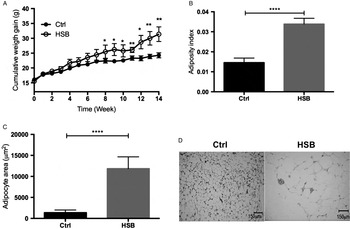
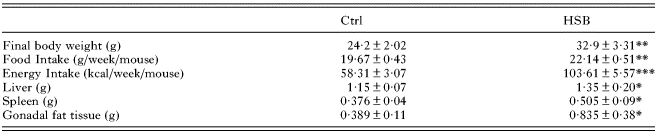
A significant increase in body weight (Fig. 1A); adiposity index (Fig. 1B) and morphological changes in adipocyte (Fig. 1C and D) of mice fed with HSB diet were observed at the end of experiment compared with that of the control diet mice. In addition, HSB diet group showed significant increase in the weight of spleen, liver, gonadal adipose tissue and final body and also presented higher food/energy intake during the experiment (Table 1).
Body, tissue and cell morphological abnormalities associated with diet-induced obesity. Mice were feeding with control (Ctrl) or high- sugar and butter diet for 14 weeks. Weekly body weight gain (A); Adiposity index (B); Adipocytes area (C) and Gonadal adipose tissue histology (D) (100× magnification) in the 14-week after diets feeding. Results are represented as arithmetic means ± s.d. from three independent experiments. *P < 0·05, **P < 0·01, ****P < 0·0001.

Physiological parameters of mice fed with Control (Ctrl) or High-sugar and butter (HSB) diets
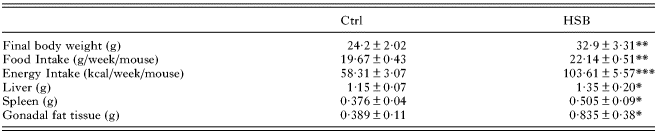
Values are expressed as mean ± s.d. with Control n = 15 and HSB n = 15.
Data were compared by two-tailed T test *P < 0·05, **P < 0·01, ***P < 0·001.
Diet-induced obese mice are more susceptible to Leishmania infantum chagasi infection
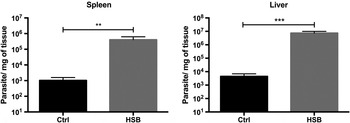
Much evidence has demonstrated that obesity increases the severity of bacterial and viral infections in humans and experimental models (Easterbrook et al. Reference Easterbrook, Dunfee, Schwartzman, Jagger, Sandouk, Kash, Memoli and Taubenberger2011; Louie et al. Reference Louie, Acosta, Samuel, Schechter, Vugia, Harriman and Matyas2011). In order to investigate the consequences of obesity on the specific immunity against Leishmania parasite, both control and HSB diet groups were infected with 107 L. infantum chagasi promastigotes (8 weeks after diets commenced) and euthanized 4 weeks post infection, which corresponds to the peak of spleen and liver parasitism. As we expected, obese mice exhibited a significantly higher parasite burden in both liver and spleen when compared with control-diet group (Ctrl) (Fig. 2).
Effect of diet-induced obesity in the control of L. infantum chagasi infection. Mice fed as described in Fig. 1 were infected at 8 week after diet initiation with 107 L. infantum chagasi promastigotes. The parasite burden/mg of tissue was individually measured in both liver and spleen four weeks after infection by limiting dilution assay. Results are represented as arithmetic means ± s.d. from three independent experiments. **P < 0·01, ***P < 0·001.

Diet-induced obese mice exhibit greater inflammation and tissue damage during Leishmania infection
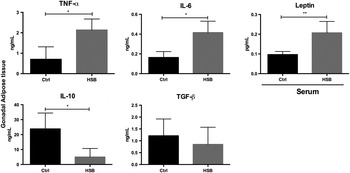
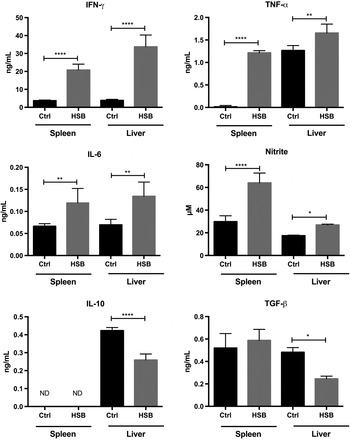
To assess potential mechanisms involved in the discrepancies of parasite burden between dietary groups, we evaluated pro- and anti-inflammatory mediators produced by adipose tissue, spleen and liver from all experimental groups. Diet-induced obese mice exhibited a massive production of pro-inflammatory cytokines and serum leptin levels compared with control diet (Fig. 3). Increased levels of TNF-α and IL-6 and decreased levels of anti-inflammatory IL-10 were observed in the gonadal adipose tissue of these mice (Fig. 3). Likewise, obese animals showed higher amounts of IFN-γ, TNF-α, IL-6 and nitrite and reduced amounts of IL-10 and TGF-β in the liver when compared with control diet-mice (Fig. 4). No IL-10 or difference in the TGF-β production was observed in the spleen or adipose tissue from both groups (Figs 3 and 4). Production of IFN-γ and nitrite was not detected in the gonadal adiposity tissue (Fig. 3).
Effect of diet-induced obesity in the cytokine production by gonadal adipose tissue. Gonadal adipose tissue from fed-infected mice were individually collected and processed at 14-week. In situ production of TNF-α, IL-6, TGF-β, and IL-10 and serum leptin levels were assayed by ELISA assay and the results represented as arithmetic means ± s.d. from three independent experiments. *P < 0·05, **P < 0·01.

Effect of diet-induced obesity in the cytokine production by Leishmania infected tissues. Spleen and liver from fed-infected mice were individually processed in the 14 of experimental week. In situ production of TNF-α, IFN-γ, IL-6, IL-10, TGF-β and nitrite were assayed by ELISA or Griess. Results are represented as arithmetic means ± s.d. from three independent experiments. *P < 0·05, **P < 0·01, ****P < 0·0001.

Tissue inflammation in obese-infected mice
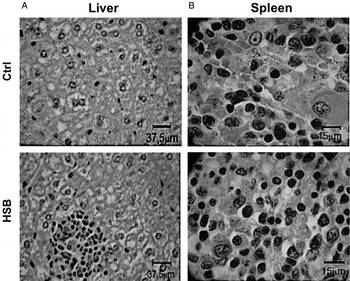
In order to verify morphological changes in liver and spleen caused by the inflammatory process or Leishmania infection we performed the haematoxylin and eosin staining in tissues sections from both experimental groups obtained 4 weeks after challenge. Compared with control group, liver photomicrographs from HSB-diet mice showed hepatocytes fat accumulation compatible with steatohepatitis and occurrence of immature granuloma structure with poor-developed mononuclear cell mantle surrounding a core without parasites presence (Fig. 5A). Additionally, spleens section from this group showed inflammatory foci and cell hyperplasia (Fig. 5B). These morphological changes were seen neither in the liver or spleen from control fed mice group (Fig. 5A and B).
Tissue inflammation in obese-infected mice. Spleen and liver tissue from fed-infected mice were subjected to haematoxylin and eosin at 100× or 400× magnification. Granulomatous inflammation and steatosis foci in the liver (A) and hyperplasia in the spleen (B). All results are shown in the 14-week and were representative of three independent experiments.

DISCUSSION
Obesity is caused by excessive lipid accumulation in adipocytes that results in metabolic syndromes and systemic chronic inflammation (Weisberg et al. Reference Weisberg, McCann, Desai, Rosenbaum, Leibel and Ferrante2003). Adipose tissue is responsible to produce and release a variety of adipokines (leptin, adiponectin, resistin and visfatin) and proinflammatory cytokines, which are associated with increased susceptibility to post-surgical infections, periodontal disease and reduced response to vaccination and antimicrobial treatment (Chen et al. Reference Chen, Akbar, Miyake, Abe, Al-Mahtab, Furukawa, Bunzo, Hiasa and Onji2014; Onofrio et al. Reference Onofrio, Arocena, Paroli, Cabalén, Andrada, Cano and Gea2015).
In this study, we provided the first evidence that diet-induced obesity could promote increased susceptibility to Leishmania infantum chagasi infection and development of visceral leishmaniasis. In this study we fed C57BL/6 mice with a well-described diet rich in sugar as a source of carbohydrate and butter as a source of lipids (HSB diet), which was able to promote significant body weight gain and change in the gonadal adipose mass and adipocytes morphology (Maioli et al. Reference Maioli, Gonçalves, Miranda, Martins, Horta, Moreira, Godard, Santiago and Faria2015). Diets based on high concentrations of sugar and fat closely reproduce more closely a typical western dietary pattern and also promote metabolic and inflammatory-related alterations in mice (Maioli et al. Reference Maioli, Gonçalves, Miranda, Martins, Horta, Moreira, Godard, Santiago and Faria2015). In obese people and in experimental models, the regular consumption of diet rich in sugar and fat is responsible by fat mass expansion via adipocyte hyperplasia and/or adipocyte hypertrophy (Siriwardhana et al. Reference Siriwardhana, Kalupahana, Cekanova, LeMieux, Greer and Moustaid-Moussa2013), which also was confirmed in our findings. Moreover, in this study mice fed with the same HSB diet presented body weight gain after 2 weeks of feeding (Yang et al. Reference Yang, Miyahara, Takeo and Katayama2012; Maioli et al. Reference Maioli, Gonçalves, Miranda, Martins, Horta, Moreira, Godard, Santiago and Faria2015).
Previous reports provide strong evidence that changes in lipid and lipoprotein metabolism during obesity are commonly associated with exaggerated inflammatory response and increased susceptibility to infections (Gregor and Hotamisligil, Reference Gregor and Hotamisligil2011; Ouchi et al. Reference Ouchi, Parker, Lugus and Walsh2011). The gonadal adipose tissue acts producing abnormal amounts of pro-inflammatory cytokines resulting in a chronic inflammation profile (Ramalho and Guimarães, Reference Ramalho and Guimarães2008). In addition are observed decreased frequency of regulatory T (Maioli et al. Reference Maioli, Gonçalves, Miranda, Martins, Horta, Moreira, Godard, Santiago and Faria2015); increased adipocytes oxidative stress activity/hypoxia and abnormal expression of MHCII, which has been implicated with high production of IFN-γ during obesity (Jovicic et al. Reference Jovicic, Jeftic, Jovanovic, Radosavljevic, Arsenijevic, Lukic and Pejnovic2015; Liu et al. Reference Liu, Li, Xiao, Wu, Gao, Peng, Li, Zhang, Du, Wang, Yang, Zhen and Ge2016). In our study, obese hosts presented increased levels of various cytokines compared with the control diet group. HSB-diet group exhibited upregulation of pro-inflammatory cytokines including IFN-γ and nitrite (used as an indirect marker of nitric oxide production) and downregulation of the inhibitory cytokines IL-10 and TGF-β produced not only by gonadal adiposity tissue, but also from liver and spleen.
Inflammatory alterations in obesity has been linked also to hyperleptinemia that impairs the insulin sensitivity and promotes lipid accumulation (Gregor and Hotamisligil, Reference Gregor and Hotamisligil2011; Zhang et al. Reference Zhang, To, Li, Lau, Poon, Chan, Zheng, Hung, Lam, Xu and Yuen2013). Consistent with Maioli et al. (Reference Maioli, Gonçalves, Miranda, Martins, Horta, Moreira, Godard, Santiago and Faria2015), we found that obesity causes hyperleptinemia concomitant with cytokines difference during L. infantum infection. Hyperleptinemia has been suggested to suppress IL-10 and activate the IL-1β, as TNF-α, IL-8 and IL-6 production mediated by NF-κB activation (Wolf et al. Reference Wolf, Wolf, Rumpold, Enrich and Tilg2004; Ouchi and Walsh, Reference Ouchi and Walsh2007).
Upregulation of inflammatory factors in obese mice is associated with increased mortality and severity of infection such as influenza virus; Trypanosoma cruzi; Schistosoma mansoni and Plasmodium berghei (Bacellar et al. Reference Bacellar, Lessa, Schriefer, Machado, De Jesus, Dutra, Gollob and Carvalho2002; Neves et al. Reference Neves, Miranda de Barros Alencar, Costa-Silva, Águila, Mandarim-de-Lacerda, Machado-Silva and Gomes2007; Ouchi and Walsh, Reference Ouchi and Walsh2007; Nagajyothi et al. Reference Nagajyothi, Weiss, Zhao, Koba, Jelicks, Cui, Factor, Scherer and Tanowitz2014). In our work, we extended these findings for visceral leishmaniasis model showing that obese mice challenged with L. infantum chagasi exhibit significantly higher parasite burden in both liver and spleen compared with control-diet mice. Although the effective Th1-type response with IFN-γ- activated macrophages and increased of TNF-α and nitric oxide production are crucial against Leishmania infection (Leal et al. Reference Leal, Mosquini, Covre, Stagmiller, Rodrigues, Christensen, Guedes, Rossi-Bergmann and Gomes2015), deficient control of inflammation or exaggerated pro-inflammatory immune response were associated with tissue damage and failure to control the parasite during visceral and cutaneous leishmaniasis (Pirmez et al. Reference Pirmez, Yamamura, Uyemura, Paes-Oliveira, Conceicao-Silva and Modlin1993; Melby et al. Reference Melby, Yang, Zhao, Perez and Cheng2001; Marques-Da-Silva et al. Reference Marques-Da-Silva, Coelho, Gomes, Vilela, Masioli, Tavares, Fernandes, Afonso and Rezende2005; Carvalho et al. Reference Carvalho, Passos, Bacellar, Lessa, Almeida, Magalhães, Dutra, Gollob, Machado and Ribeiro De Jesus2007). Undue production of IFN-γ and TNF-α were observed in both in vitro responses and in situ analysis of cutaneous leishmaniasis lesions and correlated with severe tissue destruction in mucocutaneous leishmaniasis (Faria et al. Reference Faria, Gollob, Barbosa, Schriefer, Machado, Lessa, Carvalho, Romano-Silva, De Jesus, Carvalho and Dutra2005; Carvalho et al. Reference Carvalho, Passos, Bacellar, Lessa, Almeida, Magalhães, Dutra, Gollob, Machado and Ribeiro De Jesus2007). In addition, the acute phase of human VL with high parasitism develops concomitant with elevated expression of IFN-γ mRNA in spleen and bone marrow, as well as increased circulating pro-inflammatory cytokines levels (IL-12, IFN-γ and TNF-α) and chemokines (Hailu et al. Reference Hailu, Van Der Poll, Berhe and Kager2004; Nylén et al. Reference Nylén, Maurya, Eidsmo, Manandhar, Sundar and Sacks2007; Kumar et al. Reference Kumar, Singh, Gautam, Singh, Gidwani, Rai, Sacks, Sundar and Nylen2014). In support of our findings, these results imply that the failure to eliminate the parasite even in the presence of cytokines is not due to an inability to mount protective Th1 responses per se, but rather to induction of suppressive resulting in an inefficient immune function (Vouldoukis et al. Reference Vouldoukis, Becherel, Riveros-Moreno, Arock, Da Silva, Debre, Mazier and Mossalayi1997). Moreover, exaggerated production of inflammatory cytokines has been correlated also with tissue hyperplasia and liver granuloma development during visceral leishmaniasis (Gaze et al. Reference Gaze, Dutra, Lessa, Lessa, Guimarães, De Jesus, Carvalho, Machado, Carvalho and Gollob2006; Terrazas et al. Reference Terrazas, Varikuti, Kimble, Moretti, Boyaka and Satoskar2015). Although the occurrence of granuloma is an important way of controlling liver parasites, the higher presence of immature granuloma (as we observed in HSB diet fed mice) does not necessarily guarantee antimicrobial function and microbicidal mechanism during visceral leishmaniasis in C57BL/6 mice (Murray, Reference Murray2001; Kaye et al. Reference Kaye, Svensson, Ato, Maroof, Polley, Stager, Zubairi and Engwerda2004), which supports our findings and its association with increased parasite burden in the liver.
Overall this study addresses the link between chronic inflammation in obesity caused by high sugar and fat diet and its impact on the outcome of visceral leishmaniasis. The establishment of the relationship between these two clinical conditions would be important to provide effective intervention practices in the future.
ACKNOWLEDGEMENTS
G.D.S., L.P.C., F.E.P.L., H.L.M.G., R.D. and A.M.C.F. performed the experiments; D.C.O.G., T.U.M., R.R.R. designed the study; D.C.O.G. and T.U.M. wrote the paper. All authors read and approved this final version and declared no financial or commercial conflicts of interest.
FINANCIAL SUPPORT
This work was supported by the Conselho Nacional de Desenvolvimento Científico e Tecnológico- CNPq (grant #482167/2013-0 to DCOG) and Fundação de Amparo à Pesquisa do Estado do Espírito Santo – FAPES (grant #54685532/2011 to DCOG).