BACKGROUND
Noticing: One Concept, Two Faces
The general research question we address in this article is whether second language (L2) learners pay more attention to unknown words during leisure reading and, if so, whether or not the increased amount of attention given to those words positively influences the likelihood of their retention. The impetus for the study was Richard Schmidt’s noticing hypothesis (Schmidt, Reference Schmidt1990, Reference Schmidt and Ellis1994, Reference Schmidt and Schmidt1995, Reference Schmidt and Robinson2001). In its original, strong form, this hypothesis took noticing to be the “necessary and sufficient condition for the conversion of input to intake” (Schmidt, Reference Schmidt1990, p. 129); that is, novel linguistic material (e.g., a new word) that is in the input will not be represented mentally (i.e., become intake) unless the L2 learner notices it. Intake is the representation of a stimulus in long-term memory, however temporary, and is a prerequisite for further processing and integrating the newly represented language material into the interlanguage system (Wong & Simard, Reference Wong and Simard2000). In later publications, Schmidt (Reference Schmidt and Ellis1994, Reference Schmidt and Schmidt1995, Reference Schmidt and Robinson2001) has upheld a weaker version of the hypothesis in which noticing is said to be at least facilitative of learning.
Although now a fixture in the SLA literature (e.g., de Bot, Lowie, & Verspoor, Reference de Bot, Lowie and Verspoor2005; Dörnyei, Reference Dörnyei2009; R. Ellis, Reference Ellis2008; Gass & Selinker, Reference Gass and Selinker2008; Lightbown & Spada, Reference Lightbrown and Spada2006; Ortega, Reference Ortega2009), the term noticing is not at all common usage in the neighboring fields of cognitive psychology and bilingualism (see Truscott & Sharwood Smith, 2011). Rather, in these fields, learning and memory phenomena are frequently studied from the perspectives of attention and awareness (or consciousness; e.g., Baars & Gage, Reference Baars and Gage2010; Baddeley, Reference Baddeley2007; Cowan, Reference Cowan1995). When such a view is adopted, it turns out that noticing as described by Schmidt (Reference Schmidt1990, Reference Schmidt and Ellis1994, Reference Schmidt and Schmidt1995, Reference Schmidt and Robinson2001) is actually a hybrid concept because it entails both attention and awareness. According to Schmidt (Reference Schmidt and Schmidt1995), “a low level of awareness, called here ‘noticing,’ is nearly isomorphic with attention, and seems to be associated with all learning” (p. 1). In a more recent publication, Schmidt (Reference Schmidt and Robinson2001) places greater emphasis on attention. He contends that “conscious and unconscious processes probably interact in all domains of language, but that there is little evidence for learning without attention (one reading of ‘unconscious’) in any of them” (p. 4).
Although intuitively appealing, Schmidt’s ideas about the practical equivalence of attention and awareness present a conceptual challenge. As Cowan (Reference Cowan1995) observes, “attention typically is used as a relative term, whereas consciousness typically is used as an absolute term” (p. 200). Put differently, although one can allocate different amounts of attention to a stimulus, people usually consider themselves to be either conscious of a piece of information or not. At a theoretical level, then, we are confronted with a mapping problem: It is as of yet unclear how the continuous variable of attention should be linked with the dichotomous (or at least discrete) variable of awareness, and vice versa.
In the field of SLA, it is empirical evidence of the role of awareness that has been presented in the majority of noticing studies to date (see the next section for a review). The focus of the present article, however, is noticing as attention. We use a quantitative measure of the attention given by L2 readers to novel words and gauge the degree to which this measure is associated with learning. This does not mean that we discard the role of awareness in learning. In fact, we hope that the procedure we describe will pave the way for the triangulation of attention and awareness measures. This, in turn, would help to evaluate whether or not it might be useful—for practical purposes as well as theoretical ones—to tease apart attention and awareness in the construct of noticing as it is applied in SLA. If attention and awareness turn out to be flip sides of the same noticing coin, we would still need to determine how the two mechanisms should be mapped onto each other.
The present study uses Robinson’s (Reference Robinson1995, Reference Robinson, Doughty and Long2003) model of memory, which builds on Cowan (Reference Cowan1988, Reference Cowan1995), to account for the constitutive role of attention in noticing. Robinson conceives of noticing as detection plus rehearsal in working memory. Detection is an attentional function (see Posner & Rothbart, Reference Posner, Rothbart, Milner and Rugg1992; Tomlin & Villa, Reference Tomlin and Villa1994) that amounts to the cognitive registration of stimuli in short-term memory. The initial memory encoding of a detected stimulus is further enhanced by means of subvocal rehearsal mechanisms. Rehearsal can take one of two forms (see Craik & Lockhart, Reference Craik and Lockhart1972; Craik & Tulving, Reference Craik and Tulving1975): either maintenance rehearsal, which consists of “data-driven, instance-based processing” (Robinson, Reference Robinson, Doughty and Long2003, p. 654), or elaborative rehearsal, which involves “conceptually-driven, schema-based processing” (Robinson, Reference Robinson, Doughty and Long2003, p. 654). Importantly, either type of rehearsal is “a consequence of the allocation of [attentional] resources to fulfil task demands” (Robinson, Reference Robinson1995, p. 297, citing Baddeley, 1986, p. 99) and is believed to give rise to awareness. Finally, the traces left by this additional processing (i.e., rehearsal) are what constitute long-term memory representations (i.e., intake). Given that rehearsing or recycling information mentally takes time, we can assume that, all other things being equal, the amount of time spent processing a novel linguistic element (such as a word [e.g., ox] or a morphological feature [e.g., the unusual plural in oxen]) is a measure of the amount of cognitive engagement with the material. In keeping with the noticing hypothesis, we can then predict that the longer stimuli are attended to, the more likely they are to leave attestable long-term memory traces.
Operationalization and Measurement of Noticing
Given its early position in the chain of learning subprocesses, the outcome of noticing (i.e., intake) is particularly susceptible to time-based decay. Without reactivation, the newly created memory trace will fade away. Thus, a delayed, product-oriented measure of intake may be invalid as a measure of noticing, as it may be unable to detect whether noticing occurred. This provides a strong argument for using online, process-oriented techniques to gauge noticing, which permit data collection while the participants are engaged with the L2 materials. The following techniques have been employed in SLA studies to measure noticing online: (a) note taking (Hanaoka, Reference Hanaoka2007; Izumi, Reference Izumi2002), (b) underlining (Izumi & Bigelow, Reference Izumi and Bigelow2000; Izumi, Bigelow, Fujiwara, & Fearnow, Reference Izumi, Bigelow, Fujiwara and Fearnow1999; Uggen, Reference Uggen2012), and (c) verbalizations (e.g., Alanen, Reference Alanen and Schmidt1995; Hama & Leow, Reference Hama and Leow2010; Jourdenais, Ota, Stauffer, Boyson, & Doughty, Reference Jourdenais, Ota, Stauffer, Boyson, Doughty and Schmidt1995; Leow, Reference Leow1997, Reference Leow2000; Rosa & Leow, Reference Rosa and Leow2004; Rosa & O’Neill, Reference Rosa and O’Neill1999; Sachs & Polio, Reference Sachs and Polio2007). We briefly review each method so as to explain how noticing has been operationalized within each line of inquiry and if the interpretation of findings distilled from these different methods has focused on noticing as attention, noticing as awareness, or an undefined mix of both.
Among the studies that have looked into the noticing function of output (see Swain, Reference Swain, Cook and Seidlhofer1995, Reference Swain, Doughty and Williams1998, Reference Swain and Hinkel2005),Footnote 1 two have operationalized noticing as self-reports through note taking. In Hanaoka (Reference Hanaoka2007), participants were instructed to take notes of whatever problems they noticed while writing a story and while subsequently comparing their stories to two native-speaker models. Izumi (Reference Izumi2002) asked English as a second language (ESL) students to note down during reading “any and every word” that they found “important, necessary or useful” (p. 553) for either text comprehension or text reconstruction purposes. Despite the similarity of the tasks and chosen methodology, the authors do not concur in their interpretation of the data. Whereas Izumi (Reference Izumi2002) frames his findings almost entirely in terms of attentional processes (see, e.g., pp. 552, 568), Hanaoka (Reference Hanaoka2007) does not attempt to distinguish in his measurement between attention and awareness (see, especially, p. 464).
Compared to taking notes, underlining the relevant parts of written input seems a faster and less intrusive task. Three studies employed the underlining technique to tap into the noticing function of output. Izumi and Bigelow (Reference Izumi and Bigelow2000), building on Izumi et al. (Reference Izumi, Bigelow, Fujiwara and Fearnow1999), requested that participants “underline the word, words or parts of words” in a text passage that they felt were “particularly necessary” (p. 250) to complete a subsequent writing or comprehension task successfully. Although the authors discuss their results exclusively in terms of their participants’ attentional foci (see pp. 255–257), they claim that their methodology is suitable for measuring Schmidt’s noticing construct (which also involves awareness) “because underlining was assumed to involve at least a minimum level of awareness” (p. 250). Uggen (Reference Uggen2012), a recent conceptual replication of Izumi and Bigelow (Reference Izumi and Bigelow2000), also took underlining to reflect first and foremost learners’ attentional processes.
Finally, the majority of studies that have attempted to gauge noticing online have utilized concurrent verbalizations, or think-aloud protocols (e.g., Alanen, Reference Alanen and Schmidt1995; Hama & Leow, Reference Hama and Leow2010; Jourdenais et al., Reference Jourdenais, Ota, Stauffer, Boyson, Doughty and Schmidt1995; Leow, Reference Leow1997, Reference Leow2000; Rosa & Leow, Reference Rosa and Leow2004; Rosa & O’Neill, Reference Rosa and O’Neill1999; Sachs & Polio, Reference Sachs and Polio2007). Think-aloud protocols are a learner’s real-time verbal report of the thoughts that he or she has while carrying out a particular task. Depending on the nature of the information (i.e., verbal or nonverbal) and the amount of detail to be verbalized, different types of verbalization have been distinguished (Ericsson & Simon, Reference Ericsson and Simon1993). All of the SLA studies cited have used the least intrusive Type I or nonmetalinguistic verbalization, in which participants are required to simply say their thoughts out loud while performing the primary language task. For example, in Leow (Reference Leow1997, Reference Leow2000), L2 Spanish students were instructed to speak their thoughts aloud while completing the preterit endings of mostly irregular (i.e., stem-vowel-changing) verbs in a crossword puzzle. Participants’ verbal reports served as the main measure to classify each individual as either more or less aware (Leow, Reference Leow1997) or aware or unaware (Leow, Reference Leow2000) of the irregular stem vowels, after which the pre- to posttest learning gains for each group were compared.
Verbal reports in noticing studies have been interpreted primarily with reference to awareness rather than attention (e.g., Hama & Leow, Reference Hama and Leow2010; Leow, Reference Leow1997, Reference Leow2000; Rosa & Leow, Reference Rosa and Leow2004; Rosa & O’Neill, Reference Rosa and O’Neill1999; Sachs & Polio, Reference Sachs and Polio2007; but see Alanen, Reference Alanen and Schmidt1995, for a counterexample). In particular, the verbal nature of think-aloud protocols seems especially suited to study the qualitative aspects of awareness, be they expressed as awareness levels (Leow, Reference Leow1997; Rosa & Leow, Reference Rosa and Leow2004; Rosa & O’Neill, Reference Rosa and O’Neill1999) or in terms of the content or “quality” of a verbal episode (Sachs & Polio, Reference Sachs and Polio2007, pp. 79–80). Furthermore, verbal reports have a long tradition in cognitive science as a behavioral index of conscious experience (see, e.g., Baars, Reference Baars1988, Reference Baars1997; Dehaene & Changeux, Reference Dehaene, Changeux and Gazzaniga2004; Dehaene & Naccache, Reference Dehaene and Naccache2001; Gazzaniga, LeDoux, & Wilson, Reference Gazzaniga, LeDoux and Wilson1977; and Weiskrantz, Reference Weiskrantz1997), given that “reportability [is] a key property of conscious representations” (Dehaene & Changeux, Reference Dehaene, Changeux and Gazzaniga2004, p. 1145).
The aim of this brief review of online measures (namely, note taking, underlining, and thinking aloud) has been to uncover the frequent disagreement among researchers about which cognitive process—attention or awareness—a given measure of noticing probes primarily (cf. differential interpretations of written notes by Hanaoka, Reference Hanaoka2007, and Izumi, Reference Izumi2002, or of verbal protocols by Alanen, Reference Alanen and Schmidt1995, and other researchers). Only for underlining do researchers seem to concur in their interpretation of the data as reflecting attention. Although attention and awareness co-occur to some extent on a practical, behavioral level (James, Reference James1890; Koch, Reference Koch2004; Posner, Reference Posner1994; Schmidt, Reference Schmidt and Schmidt1995; Wyart & Tallon-Baudry, Reference Wyart and Tallon-Baudry2008), we believe that researchers should be as explicit and precise as possible regarding which process—attention or awareness—a given measure aims to gauge. In this vein, we contend that, by virtue of their verbal nature, participant reports of their thought processes seem better suited to measure awareness than attention. Furthermore, if verbal reports are chosen as data, we recommend collecting information about participants’ conscious processing in spoken rather than written form, as the former is less time consuming and “physically demanding” (Hanaoka, Reference Hanaoka2007, p. 464) for the participants to produce and will, therefore, be less likely to interfere with the primary language task.Footnote 2
For the final online measure of noticing—underlining—the consensus has been that it is indicative of attention. Izumi and Bigelow (Reference Izumi and Bigelow2000) argue that the ease and speed of underlining may benefit the completeness of the measure as an index of attention but may be detrimental to its precision, given that the “relative ease [of underlining] may mean that one underlines items not perceived as particularly important” (p. 270). Even if learners underline the forms to which they attend and do not underline the forms to which they do not attend, the act of underlining cannot inform us about different degrees of attention that participants pay to a given form. Put differently, underlining, at best, indicates the locus of attention, but it never quantifies attention. In what follows, we propose an alternative online technique for measuring noticing as attention—namely, eye-tracking, which, we think, not only performs well on the criteria of completeness and precision but also provides a measure of the amount of attention that participants allocate to target forms in the input.
An Alternative Technique: Eye-Tracking
Eye-tracking is the online registration of a participant’s eye-movement behavior, in particular (a) their eye fixations (i.e., where and for how long a participant is looking) and (b) their saccades or eye movements (i.e., where the eyes move next). The use of eye-tracking data in psychological research rests on the assumption of an “eye-mind link” (Reichle, Pollatsek, & Rayner, Reference Reichle, Pollatsek and Rayner2006, p. 4)—that is, the existence of a close relationship between the eyes and the mind. Under this assumption, overt attention (as manifested by the exact eye location) and covert attention (mental focus) are tightly linked, and cognitive processing is considered a major determinant of when and where the eyes move during complex task performance, such as reading (Just & Carpenter, Reference Just and Carpenter1980; Rayner, Reference Rayner2009).
In reading research, a host of lexical variables have been shown to influence fixation times. The “big three” predictors are frequency, contextual constraint or predictability, and word length (Kliegl, Nuthmann, & Engbert, Reference Kliegl, Nuthmann and Engbert2006, p. 13). Other potential confounds include word familiarity, age of acquisition, part of speech, concreteness (i.e., imageability), and frequency in spoken language (see Liversedge & Findlay, Reference Liversedge and Findlay2000; Rayner, Reference Rayner1998, Reference Rayner2009; Starr & Rayner, Reference Starr and Rayner2001, for reviews). The effect of word frequency has been observed consistently and across a wide variety of contexts: When other factors are held constant, readers spend more time fixating low-frequency (i.e., difficult) words than high-frequency (i.e., easy) words (e.g., Kliegl, Grabner, Rolfs, & Engbert, Reference Kliegl, Grabner, Rolfs and Engbert2004; Rayner & Duffy, Reference Rayner and Duffy1986; Rayner, Sereno, & Raney, Reference Rayner, Sereno and Raney1996; White, Reference White2008). Interestingly, especially with a view to using eye-tracking to capture attention, the frequency effect is attested even if the word on which the reader fixates disappears after 60 ms. This has been established in disappearing-text studies (Liversedge et al., Reference Liversedge, Rayner, White, Vergilino-Perez, Findlay and Kentridge2004; Rayner, Inhoff, Morrison, Slowiaczek, & Bertera, Reference Rayner, Inhoff, Morrison, Slowiaczek and Bertera1981; Rayner, Liversedge, & White, Reference Rayner, Liversedge and White2006; Rayner, Liversedge, White, & Vergilino-Perez, Reference Rayner, Liversedge, White and Vergilino-Perez2003) and has been instrumental in discriminating between models of eye-movement control that make different predictions about the influence of cognitive factors on fixation times (see Reichle et al., Reference Reichle, Pollatsek and Rayner2006).
In the disappearing-text paradigm, each word disappears (or is masked) 60 ms after the onset of fixation. Surprisingly, this manipulation does not disrupt the reading process: Participants read equally fast and with the same level of comprehension as in normal text conditions (Liversedge et al., Reference Liversedge, Rayner, White, Vergilino-Perez, Findlay and Kentridge2004; Rayner et al., Reference Rayner, Inhoff, Morrison, Slowiaczek and Bertera1981, Reference Rayner, Liversedge, White and Vergilino-Perez2003). Specifically, fixation times are still influenced by word frequency: Even though the word is no longer there after 60 ms, the eyes will remain in the empty space longer for low-frequency words than for high-frequency words. Rayner et al.’s (Reference Rayner, Liversedge and White2006) interpretation of these findings is that 60 ms is sufficient to encode the word; it approximates the duration of the “eye-to-brain lag” (Reichle et al., Reference Reichle, Pollatsek and Rayner2006, p. 5). Once the visual information has been transmitted to the brain, higher-level cognitive processing and programming of the next saccade can occur both in parallel to and in the absence of the fixated word. Hence, Rayner et al. (Reference Rayner, Liversedge and White2006) claim that lexical processing, rather than low-level visual or oculomotor factors, is the engine that drives the eyes through the text. In short, the findings of the disappearing-text studies lend strong empirical support to the eye-mind link and to the validity of eye movements as a measure of attention.
The experiment we report on in the present study was set up to measure the extent to which advanced L2 learners’ attention to novel words while reading (as measured by their eye-fixation durations) predicts their ability to recognize these words on an unannounced posttest. Although still a relatively novel technique in SLA, the number of studies using eye-tracking to investigate L2 phenomena has grown in recent years (e.g., Godfroid, Winke, & Gass, Reference Godfroid, Winke and Gass2013). At the time of acceptance, however, only two published studies had piloted eye-tracking procedures to investigate noticing (but see Godfroid & Uggen, Reference Godfroid and Uggen2013; Winke, Reference Winke2013). Godfroid, Housen, and Boers (Reference Godfroid, Housen, Boers, Pütz and Sicola2010) presented preliminary evidence of increased visual attention to novel words during L2 reading and discussed how eye-tracking may enrich current approaches to measuring noticing. Smith (Reference Smith and Hult2010) measured eight ESL learners’ noticing of “intensive recasts” (p. 85) of whatever lexical and grammatical errors they made during a synchronous computer-mediated chat session. Smith operationalized noticing as an “eye fixation on the target item of 500 ms or longer” (p. 87) because he claims that “fixations shorter than about 250 ms are of little interest” (p. 88). We believe that the proposed 500 ms cutoff point for establishing noticing is somewhat arbitrary and unsupported by the eye-tracking literature. Although a recent review does suggest that the average eye fixation of a native speaker (not a L2 learner) reading an English word is between 225 and 250 ms in length (Rayner, Reference Rayner2009), effects smaller than 250 ms abound. In a follow-up study, Smith (Reference Smith2012) replaced the 500 ms cutoff point by a heat map color—namely, the second coolest color in the spectrum, blue. As heat map colors are defined “relative to the length of the eye gaze recording” (Smith, Reference Smith2012, p. 63) rather than in relation to a control condition, this approach does not fundamentally address the criticism leveled against Smith’s (Reference Smith and Hult2010) operationalization of noticing. In particular, neither absolute fixation durations nor heat map colors take into account that the number and length of eye fixations are influenced by word length, word frequency, and predictability, among other factors. Therefore, Smith’s (Reference Smith and Hult2010, Reference Smith2012) approach has the undesirable effect that the noticing threshold will be reached more easily for some (e.g., long, infrequent, unpredictable) words than for other (e.g., short, frequent, predictable, etc.) items. In our study, we avoid this pitfall by working with different conditions, including a control condition, for which eye-fixation times can be compared. Noticing in our study, then, is operationalized in relative, rather than absolute, terms—that is, as an increase in fixation time relative to a baseline condition.
In the field of psychology, Williams and Morris (Reference Williams and Morris2004) pursued a question similar to ours. They examined the effects of different measures of word familiarity on eye-fixation times during reading. In their second experiment, native English-speaking college students read 48 target sentences in their first language (L1). These consisted of a neutral introduction, a target word, and a highly constraining posttarget context. There was one novel word condition in which readers had no prior knowledge of the target word (e.g., Sheila selected the MASDOR [capitals added] for her bouquet). After the reading session, participants had to select the correct meaning of the novel word from two possibilities on an unannounced vocabulary posttest. Williams and Morris (Reference Williams and Morris2004) established an association between online reading patterns and posttest performance. Readers tended to spend less initial processing time (i.e., shorter gaze duration) on those target words whose meaning they later identified correctly. However, reanalysis (as measured by second pass time) was associated positively with posttest accuracy. Although our own participants and materials differ from Williams and Morris’s, it is of interest to explore whether or not the processing times collected for our sample predict learning gains in a similar fashion.
Incidental Vocabulary Acquisition while Reading
The lexical targets for noticing in our study (i.e., pseudowords) were embedded into 9- to 13-line paragraphs, which participants were instructed to read at a leisurely pace.Footnote 3 Given that participants were initially unaware of the true aim of the experiment and of the ensuing vocabulary posttest, this experiment also fits into the body of research on incidental vocabulary acquisition during reading. Vocabulary acquisition is incidental—rather than intentional—when learners commit new words or phrases to memory “without having explicit instructions about a forthcoming memory test” (Mäntylä, Reference Mäntylä, Smelser and Baltes2001, p. 7262; see also Dörnyei, Reference Dörnyei2009; Hulstijn, Reference Hulstijn, Doughty and Long2003). In this case, lexical knowledge “accrues as a by-product of language usage” (Schmitt, Reference Schmitt2010, p. 29) such as “reading a novel simply for pleasure with no stated goal of learning new lexical items” (Schmitt, Reference Schmitt2010, p. 29). Although picking up new vocabulary as a by-product of reading can and does occur, this is typically a gradual, error-prone, and, hence, rather inefficient process (see Laufer, Reference Laufer, Foster-Cohen, García Mayo and Cenoz2005; Read, Reference Read2004). Therefore, if the aim is to expand learners’ vocabulary through reading, it seems desirable to enhance or complement reading activities by some form-focused component aimed at drawing the learners’ attention more explicitly toward the targeted lexical forms (e.g., Huckin & Coady, Reference Huckin and Coady1999; Hulstijn, Reference Hulstijn and Robinson2001; Laufer, Reference Laufer, Foster-Cohen, García Mayo and Cenoz2005; Nation, Reference Nation2001; Read, Reference Read2004; Schmitt, Reference Schmitt2008, Reference Schmitt2010).
One relatively nonintrusive way to accomplish this is by modifying the reading input so that it becomes more informative as to the meaning of the target word, thereby facilitating the lexical inferencing process. Watanabe (Reference Watanabe1997) tested the effect of three types of input modification on English as a foreign language (EFL) learners’ text comprehension and vocabulary learning while reading. The simplest form of input modification consisted of a synonym or paraphrase of a target word that was inserted between commas immediately after the lexical item (e.g., Each year in the U.S. about 7,000 infants die in their cribs, BABIES’ BEDS [capitals added], for no apparent reason). Watanabe conjectured that such appositive cues may make the context more helpful for vocabulary learning given the “(a) proximity of the illuminating context to the unknown word, (b) clarity of the connection between the context and the unknown word, (c) explicitness of the contextual information, and (d) completeness of the contextual information” (p. 288). However, contrary to expectations, learners in the appositive group did not exhibit significantly higher levels of vocabulary retention or reading comprehension than students who read the original, unmodified text. Watanabe attributed this zero effect to a lack of clarity of the semantic connection between the explanation and the word to be explained. Furthermore, he argued, even if participants do perceive the explanatory nature of the appositions, the question remains as to whether or not they will exploit their potential for vocabulary learning because, “if their purpose for reading is to understand a passage,” then “students may choose to ignore unfamiliar words and just read their explanations” (Watanabe, Reference Watanabe1997, p. 301, referring to Coady, 1993, p. 18).
In our study, we also enhanced the semantic informativeness of the context in which the novel words appeared by adding appositive cues in two out of the three critical conditions. Our study differs from Watanabe (Reference Watanabe1997), however, in two respects. First, appositions were signaled by the coordinating conjunction or rather than by commas. Second, the order of the defined expression (i.e., the novel word) and the definer (i.e., the known, existing word) was varied (see Quirk, Greenbaum, Leech, & Svartvik, Reference Quirk, Greenbaum, Leech and Svartvik1985, for a comprehensive account of appositions in English). Thus, our appositive conditions came in one of two forms, as illustrated by the following example: (Condition III) One demographical group stands out as being most likely to push PANIPLINES DEFINEDOR BOUNDARIES DEFINERand break rules, and (Condition IV) One demographical group stands out as being most likely to push BOUNDARIES DEFINEROR PANIPLINES DEFINEDand break rules (capitals added; see the Materials section for a description of Conditions I and II). Evidence from paired-associate learning and translation studies suggests that learners find it easier to link unknown words with known words than the other way around (e.g., Kroll & Stewart, Reference Kroll and Stewart1994; Mondria & Wiersma, Reference Mondria, Wiersma, Bogaards and Laufer2004; Webb, Reference Webb2008). It is an open question as to whether or not this pattern still holds when words are not presented in isolation but in a sentence context.
DEFINITIONS AND RESEARCH QUESTIONS
For the purposes of this study, we define noticing as a cognitive process in which the amount of attention paid to a new language element in the input exceeds a critical threshold, which causes the language element to enter working memory and become the object for further processing (e.g., rehearsal); the traces of this additional processing are stored in long-term memory and, hence, represent intake. The focus of this study, as previously explained, is the attentional constituent of noticing. We adopt Lamme’s (Reference Lamme2003) definition of attention as “a selection process where some inputs are processed faster, better or deeper than others, so that they have a better chance of . . . being memorized” (p. 14).Footnote 4 We operationalize attention as a quantitative, continuous variable that is reflected in a participant’s eye-fixation times during reading: When other factors are held constant, words to which more attention is paid will attract longer eye gazes than their matched controls. On the basis of these premises, we aim to evaluate a weak version of Schmidt’s noticing hypothesis, which states that more attention to novel language elements leads to more learning (Schmidt, Reference Schmidt and Ellis1994, Reference Schmidt and Schmidt1995, Reference Schmidt and Robinson2001; see also Baars, Reference Baars1988).
The principal research questions that we seek to address, therefore, are the following:
1. Do L2 learners fixate completely novel words in written L2 input longer than matched, already known words?
2. Do L2 learners’ eye-fixation durations on novel words in written L2 input predict how likely they are to recognize those words in an unannounced immediate posttest?
Additionally, the study aims to answer the following secondary research questions:
3. Does the addition of an appositive cue to a novel word influence fixation times for the novel word as compared to an unmodified text condition? If so, does the position of the appositive cue relative to the novel word (before or after) have a differential effect on the fixation times for the novel word?
4. Does the presence of an appositive cue to a novel word influence the likelihood that L2 learners will recognize the novel word in an unannounced immediate posttest? If so, does the position of the appositive cue relative to the novel word (i.e., before or after) have a differential effect on learners’ recognition of the novel word?
Given the background previously described, we predict an affirmative answer to Research Questions 1 and 2. The effect of appositions on incidental vocabulary acquisition has been researched less (yet see Watanabe, Reference Watanabe1997, for a notable exception); consequently, our predictions for Research Questions 3 and 4 are more tentative. The appositives in Conditions III and IV were included on the basis of suggestions made in the literature that incidental vocabulary learning through reading (one supposedly crucial element of which is noticing the novel words) is largely inefficient or erratic without some additional form-focused component. Input modification by means of appositions is one type of text-based manipulation that can direct learners’ attention toward the targeted lexical forms by making them more salient. Hence, we hypothesize that longer gazes will be observed at novel words in apposition with known items than at novel words that stand alone (for Research Question 3) and that superior posttest recognition will be found of those novel words that were accompanied by an appositive cue in the reading materials as compared to novel words that were not (Research Question 4). As to the effect of the position of the novel word relative to its appositive cue, no directional hypotheses are formulated.
THE STUDY
Participants
Twenty-eight female Dutch-speaking college students volunteered to participate in the study. They were all second- or third-year English language majors (age range 19–28) who had started to learn EFL from age 13 onward in secondary school in Belgium. Their level of proficiency in English was at the B2 (upper intermediate) or C1 (lower advanced) levels of the Council of Europe’s (2001) Common European Framework of Reference. All participants had either normal or corrected-to-normal eyesight.
Apparatus
Eye movements were recorded with the EyeLink II, a head-mounted eye-tracker manufactured by SR Research. The texts were presented in Courier New, 18-pt font, on a 19-in Dell computer monitor set up at 68 cm from the participants’ eyes. At this distance, 4.0 character spaces equaled 1° of visual angle. The use of corneal reflections in combination with pupil tracking (i.e., pupil + CR mode) allowed for more stable tracking of the participants’ point of gaze. Participants took the unannounced vocabulary posttest on the same computer after they had taken off the headband. Each participant was debriefed and informed about the true purpose of the experiment at the end of her session.
Materials
Participants read 20 short paragraphs in English (length: 83–122 words) while an eye-tracker recorded their eye movements. The reading passages consisted of authentic newspaper and magazine extracts that were adapted to suit the participants’ estimated proficiency level. Out of the 20 paragraphs that participants read, 8 paragraphs were fillers, and 12 were critical (i.e., they contained a new, unknown word in all but the control condition). See Appendix A for an example of two full paragraphs. On the computer monitor, text lines were displayed with two hard returns in between to assure accurate recording of participants’ gaze position. As a result, each paragraph took up three screens, and participants moved from one screen to the next by pressing a button; participants could not, however, return to an earlier part of the same text. The lexical target area always appeared roughly in the middle of the second screen (i.e., never as the first or final word of a line or at the top or bottom of the screen).
Great care was taken to ensure that the texts contained no unfamiliar items except for the targeted unknown words. The preparation of the materials consisted of two steps. First, we ran the paragraphs through Range (Heatley & Nation, Reference Heatley and Nation1994), a software program that categorizes the words of a given text into frequency bands. All words that did not belong to the 3,000 most frequent word families were considered for substitution by a more common paraphrase. Next, we pretested the adapted reading materials with first-year English-language majors at the same university.Footnote 5
The first-year students were asked to translate a number of predetermined, potentially difficult words in the texts into Dutch and to mark (i.e., by underlining or circling) any of the remaining words of whose meaning they were not sure (see Godfroid, Reference Godfroid2010, for the complete pretest materials). Analysis of participants’ translation scores revealed that, apart from one word (i.e., synaesthesia), students’ receptive knowledge of all words was fairly good. In other words, although the students did not perform flawlessly, the error rates for most words were similar; only synaesthesia stood out, with only half of the students being familiar with it. Therefore, no changes were made other than to replace the synaesthesia paragraph with another text.
The various modifications that resulted from the frequency analysis and the pretest allow us to assume that all words in the paragraphs, including the existing words serving as appositive cues (e.g., boundaries), were known by the participants of the actual experiment, who had at least one more year of intensive formal English instruction than the participants in the pretest. Given that critical paragraphs were about 100 words long and contained one novel word, lexical coverage is estimated at around 99%; this constitutes a known-word density favorable to successful guessing from context (Nation, Reference Nation2001). In view of this high vocabulary coverage, it is also unlikely that participants’ failure to pay increased attention to a novel word in a paragraph resulted from their being distracted by some other unfamiliar lexical item in the same text.
Pseudowords
We included pseudowords as learning targets in our texts to control for prior word knowledge. The lexical targets were controlled for part of speech and syntactic function—only nouns in direct object position were selected for substitution or modification by a novel word. To minimize the effect of low-level visual factors on eye-fixation times, the existing words and their corresponding pseudowords (e.g., boundaries-paniplines) were matched for word length and number of syllables (see Appendix B).
Several steps were taken to ensure the plausibility and homogeneity of our pseudoword set. First, we excluded words with Dutch cognates as well as words with English or Dutch pseudohomophonesFootnote 6 because the similarity of such stimuli with existing Dutch or English words might cause readers to process them faster or acquire them more easily (Dijkstra, Reference Dijkstra, Kroll and de Groot2005). Next, we consulted lists of pseudoword stimuli provided in previous studies, especially Duncan and Seymour (Reference Duncan and Seymour2003) and Duncan, Seymour, and Bolik (Reference Duncan, Seymour and Bolik2007). Often the original pseudowords still had to be considerably modified so that they would match in terms of length and number of syllables with the existing words that they were to replace in the texts in our study. Finally, four near-native speakers of English inspected the list of pseudowords for plausibility, including perceived English word likeness and plausibility of the form-meaning mapping, and made further improvements where appropriate. Appendix B contains the final list of word–pseudoword pairs.
Latin Square Design
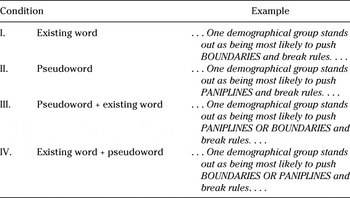
Table 1 shows the four experimental conditions for a single critical paragraph. Each participant read all 12 experimental paragraphs but read each paragraph in only one of four versions. These versions are identical except for the realization of the target area. The paragraphs were presented to the participants according to a 4 × 4 Latin square design (Hinkelmann & Kempthorne, Reference Hinkelmann and Kempthorne2008; Kutner, Nachtsheim, Neter, & Li, Reference Kutner, Nachtsheim, Neter and Li2005), so that, in the end, each participant read three paragraphs per condition, in a counterbalanced fashion.
The four experimental conditions, illustrated with (an excerpt of) one paragraph

Note.
The target areas have been capitalized in Table 1 for ease of reference but appeared in regular print in the actual experiment.
Condition I is the control condition. The paragraph contains a known, existing target word (e.g., boundaries). In contrast, the pseudowords (e.g., paniplines) in the critical conditions II, III, and IV are hypothesized as targets for noticing and learning. The critical conditions differ from one another in the degree of contextual support that they offer to the novel word. In Conditions III (e.g., paniplines or boundaries) and IV (e.g., boundaries or paniplines), a known, appositive cue provides a direct, explicit hint as to the meaning of the novel word. Although appositive constructions normally imply a relationship of coreferentiality between the two nouns or noun phrases (e.g., Crystal, Reference Crystal1997; Quirk et al., Reference Quirk, Greenbaum, Leech and Svartvik1985), the interpretation of an appositive construction ultimately falls to the reader. Meyer (Reference Meyer1987) notes that units in apposition can be “co-referential, hyponymous, synonymous, or attributively related” (p. 103). In all of these cases, the juxtaposed known word is a strong clue that can facilitate the semantic integration of the novel word into the sentence.
To comply with our Latin square design, we ran a 4 (conditions) × 4 (paragraph sets) × 4 (groups) ANOVA with seven different participants nested within each of the groups. We included only main effects (i.e., no interaction terms). Condition and paragraph set constituted fixed and random within-subjects variables, respectively, and group was a fixed between-subjects factor. The significance level α was set at .05 for all analyses. In the next section, we present the four fixation time measures that served as the dependent variables.
Processing Measures
Eye-movement analyses were performed on participants’ first fixation duration, gaze duration, second pass time, and total time in the interest area. First fixation duration is the duration of the first fixation in an interest area when that area is encountered during forward reading (i.e., in English, left to right) for the first time. Given that first fixation duration is the earliest measure of processing time, it has been argued to reflect very fast cognitive processes (Rayner & Pollatsek, 1987, cited in Rayner, Reference Rayner1998). First fixation duration along with any other fixations made on a word during the initial visit make up gaze duration. Both first fixation duration and gaze duration are indices of initial processing, or first pass reading. If the eyes reenter an interest area after they had left, the sum of the fixations made during this second pass equals second pass time. Second pass time captures rereading episodes, which are indicative of the reader’s reanalysis of the interest area. It is conceivable that the addition of an appositive cue following the novel word (as in paniplines or boundaries) will induce higher second pass reading times for the novel word (Research Question 3). That is because the unexpected increase in contextual richness associated with encountering a useful cue after one has already processed the novel word may lead participants to revisit the novel word for (re)interpretation. In contrast, when the appositive cue precedes the novel word (as in boundaries or paniplines), there is no shift in informativeness at the novel word or just after. Accordingly, we expect second pass time for the pseudoword to be lower in Condition IV than Condition III.
Finally, the sum of all fixations over all passes is expressed in the measure total time. This is the primary measure that we use to assess the relationship between eye-fixation times (and, hence, attention) and vocabulary learning (Research Question 2).
Vocabulary Posttest
After the reading task, participants received an unannounced vocabulary posttest that assessed their ability to recognize the target items. The format of the vocabulary posttest is the result of careful pilot testing (see Godfroid et al., Reference Godfroid, Housen, Boers, Pütz and Sicola2010). It is essentially a gap-fill exercise under time pressure. For each target item, we followed a two-staged testing procedure. First, the participant read the exact same sentence she had encountered during the preceding reading task but in which the pseudoword (Conditions II–IV) or the corresponding existing word (Condition I) was replaced by a dotted line.Footnote 7 When ready, she pressed a button.Footnote 8 An array of 18 possible candidates for the missing word then appeared above the sentence. The participant had 15 s to scan the array and enter the number of the missing word. After that, a blank screen allowed the test taker to rest for half a minute, until the next sentence was presented. Sentences were generated in a random order, and, for each test item, the array was arranged completely anew. The whole procedure was repeated until all 12 items were completed.
The 15-s time limit only allowed participants to scan the various options. We reasoned that if participants had noticed the target word during the reading task, they would be able to quickly recognize it here too. If not, then 15 s would not suffice for them to reason the answer out, for example, by eliminating possibilities on the basis of grammatical number (i.e., singular vs. plural) or previously given answers. Thus, we would claim that the vocabulary posttest measures participants’ recognition of a target word’s written form within its original, meaning-bearing context (i.e., a form of receptive vocabulary knowledge). More than half of the distractors on the test were pseudowords that the participants had also encountered while reading. Mere recognition of an orthographic form as something that looked vaguely familiar did not, therefore, suffice to select the correct word. Rather, the novel word had to be matched with the right, meaning-bearing context in which it had been encountered.Footnote 9
RESULTS
Reading Task: Eye-Tracking Data
In what follows, we present the results of the eye-movement analyses for the known versus unknown words (Analysis 1), the known words (Analysis 2), and the words in the postcritical area (Analysis 3).
Analysis 1: Known versus Unknown Words
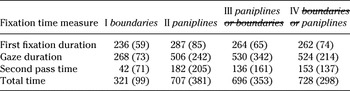
To examine the effect of word novelty on fixation times (Research Question 1) as modulated by the degree of contextual support (Research Question 3), the first analysis compares participants’ viewing times for the pseudowords in Conditions II–IV with their viewing times for the known, existing word in the control condition (Condition I). Table 2 presents the mean processing times for each of the interest areas.
Mean processing times (in ms, with standard deviations in parentheses) per condition

Note.
The reported values pertain to the words that are not struck through. Thus, for this analysis the target word for Conditions III and IV is paniplines.
As predicted, participants looked for a longer time at the novel (i.e., pseudo) words than at the known control words, first fixation duration: F(3, 78) = 3.57, p = .018; gaze duration: F(3, 78) = 13.50, p < .001; second pass time: F(3, 81) = 6.21, p = .001; and total time: F(3, 78) = 27.75, p < .001. Gaze duration, second pass time, and total time differed between the control word and the pseudowords in all three conditions (Tukey post hoc tests, .01 < p < .05 or smaller), but, interestingly, fixation durations for the pseudowords did not differ across Conditions II, III, and IV. Contrary to our expectations, the pseudowords in Condition III (i.e., paniplines or boundaries) were not revisited significantly more often, despite the contextual cue that participants encountered right after leaving the novel word.
The findings for first fixation duration are slightly different: The control condition was processed significantly faster than Condition II only (Tukey post hoc test, p = .006). The mean first fixation durations in Conditions III and IV were remarkably similar but did not differ significantly from the control condition (or from Condition II, for that matter). Again, the pseudowords seem to have been processed to the same extent, regardless of whether they were accompanied by an apposition.
Finally, we note that, with the exception of first fixation duration, standard deviations for all fixation time measures in Conditions II, III, and IV are very large. This suggests that there was considerable inter- and intraindividual variation. Participants responded very differently from one another to the novel words that they encountered in the texts, and the same participants may have processed the different novel words to varying levels. In the next analysis, we consider whether the apparent zero effect of appositive cues on the processing of the novel word extends to the processing of the appositive, known word itself.
Analysis 2: Known Words
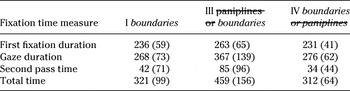
Although Analysis 1 revealed that the inclusion of an appositive cue does not influence the processing of the novel word (relative to an unmodified text condition), it does not rule out the possibility that the known word itself is processed differently depending on its status in the sentence. Conditions III and IV differ from the control condition (i.e., Condition I) in that the existing, known word occurs in apposition to a novel word rather than by itself. Furthermore, within the appositive conditions, the position of the explanatory cue in relation to the word to be explained may well engender different viewing times too, if only because it determines the order in which readers will initially encounter the familiar and the unfamiliar information. Table 3 presents an overview of the mean processing times for the known word in the control condition and in Conditions III and IV.
Mean processing times (in ms, with standard deviations in parentheses) for the existing word in Conditions I, III, and IV

Note.
The reported values pertain to the words that are not struck through. Thus, for this analysis the target word for Conditions III and IV is boundaries.
Viewing times on the known words (e.g., boundaries) are longest in Condition III. The difference is significant or nearly significant on all measures, first fixation duration: F(2, 51) = 4.52, p = .016; gaze duration: F(2, 54) = 11.37, p < .001; second pass time: F(2, 81) = 2.42, p = .095; and total time: F(2,81) = 14.84, p < .001, and for the two comparisons—namely, for Condition III versus the control condition and for Condition III versus Condition IV (Tukey post hoc test, first fixation duration, .01 < p < .05 for both comparisons; gaze duration and total time, p ≤ .001 for both comparisons).Footnote 10 Additionally, similar to the processing of the pseudowords in Conditions II, III, and IV, learners seem to display considerable variability in their processing of the known word in Condition III (e.g., boundaries in paniplines or boundaries) as standard deviations for gaze duration and total time are quite large. Finally, we note that boundaries in boundaries or paniplines (Condition IV) is not processed significantly faster than in the control condition, despite its occurrence in an appositive construction in this condition as well (Tukey post hoc tests for the four dependent variables, α = .05).
Two plausible explanations for this result present themselves. On the one hand, the longer viewing times on the known appositive word in paniplines or boundaries could reflect sentence-integration processes—that is, the use of different sources of information to build “a semantically-integrated representation that combines each word with a preceding context” (Yang, Perfetti, & Liu, Reference Yang, Perfetti and Liu2010, p. 85). On this account, readers may recognize boundaries as a clue about the meaning or function of the underspecified preceding word, paniplines, and they may tap into their semantic or syntactic knowledge of boundaries to integrate paniplines better with the prior context. In brief, an integration account of the data holds that readers exploit boundaries to make more sense of paniplines in the sentence.
On the other hand, the longer viewing times on the known appositive word in Condition III could also be due to the effortful processing of the pseudoword spilling over onto the immediately following words, which, in Condition III, just happen to be words that provide a contextual cue for the interpretation of the pseudoword (see, e.g., Rayner & Duffy, Reference Rayner and Duffy1986, and White, Reference White2008, for spillover effects with low-frequency words). To gauge the likelihood of the spillover explanation, we checked whether or not processing slowed after the pseudoword in Conditions II and IV as well.
Analysis 3: The Postcritical Area
The postcritical area consists of the word or two words that follow the target noun in Conditions I and II, and that follow the entire appositive construction in Conditions III and IV.Footnote 11 Therefore, the postcritical area is the same for all four experimental conditions (e.g., and break is the postcritical area for the example paragraph in Table 1).
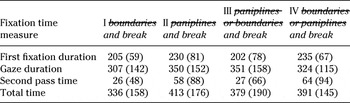
The postcritical area has the interesting property of being preceded directly by the pseudoword in Condition II (. . . push paniplines and break . . .) and Condition IV (. . . push boundaries or paniplines and break . . .), but following the known, existing word in Condition I (. . . push boundaries and break . . .) and Condition III (. . . push paniplines or boundaries and break . . .). The crucial question, then, is whether processing times for the postcritical area will be inflated in Conditions II and IV as compared to Conditions I and III. Table 4 summarizes the mean processing times per condition.
Mean processing times (in ms, with standard deviations in parentheses) for the postcritical region per condition

Note.
The reported values pertain to the words that are not struck through. Thus, for this analysis the region of interest is and break for all conditions.
Statistically, only the difference in total time between the control condition and Condition II is marginally significant, total time: F(3, 78) = 2.74, p = .049; Tukey post hoc test: p = .056. For the other processing time measures, there is a trend toward an effect of condition—first fixation duration: F(3, 78) = 2.19, p = .096; gaze duration: F(3, 78) = 2.12, p = .104; and second pass time: F(3, 105) = 2.58, p = .058, but post hoc comparisons do not reveal any particular contrast to be significant (Tukey post hoc tests for all comparisons for the three measures, α = .05). Therefore, we could not establish any clear-cut differences among conditions; it appears that the posttarget area is processed roughly the same in all four conditions. This finding lends some support to the interpretation that the longer fixation times on the known appositive word in Condition III are not the result of the processing of the difficult pseudoword spilling over onto the present, known word but do, in fact, reflect sentence-integration processes, which involve readers’ exploiting their knowledge of the current word to create a more elaborate representation of the preceding, novel word.Footnote 12
Vocabulary Posttest
Descriptive Statistics
The unannounced vocabulary posttest gauged participants’ ability to recognize the 12 target items: nine pseudowords (presented in Conditions II–IV) and three known words (from the control condition). The mean recognition score for the three known words was 2.1 (SD = 0.92): Even though they were not at ceiling, the participants generally performed well on the control items. We took this as an indication that our test, although fairly difficult, was likely to capture cases in which the representation of the pseudoword had been firmly established in the participants’ memory.
Not surprisingly, recognition scores for the novel words were lower. Participants recognized between 0 and 5 out of 9 items, with a mean accuracy of 2.1 items or 23% (SD = 1.45). As each target item was presented amid 17 distractors, chance-level performance was 0.5 correct items or one out of every two participants guessing one item correctly. In all, 24 out of 28 participants identified at least one novel word correctly, a performance that is significantly above chance, two-tailed one-sample t test, t(27) = 5.87, p < .001. Thus, a single, incidental exposure to completely novel words during leisure reading resulted in participants’ ability to recognize a significant number of those words in context later on. After the reading task, some of the pseudowords had been encoded in memory in a form that allowed for subsequent cued retrieval. The question that arises now is whether or not more attention to a word during reading (as indexed by longer fixation times) increased the chances of successful retrieval; that is, whether or not more attention led to more learning.
Relationship between Fixation Times and Learning Gains
Given that “the cognitive processing associated with a fixated word is the engine driving the eyes through the text” (Rayner, Reference Rayner2009, p. 1473), we expect to find a positive association between fixation time for a novel word X and recognition of X on the posttest. We tested this prediction by means of a generalized estimating equation (GEE) analysis (Hardin & Hilbe, Reference Hardin and Hilbe2003), a powerful statistical technique that we used to fit a repeated measures logistic regression. Logistic regression is appropriate because recognition on the vocabulary posttest is a binary dependent variable. The repeated measurements refer to the different test items taken by a single participant.
We first assessed whether or not fixation durations for a given pseudoword predicted the probability of posttest recognition of that pseudoword, irrespective of condition (i.e., regardless of whether the pseudoword appeared by itself or with an appositive cue in the text). A GEE with test items (i.e., pseudowords) as repeated measures within participants and total time as the only covariate reveals that total fixation time is a significant predictor of the probability of posttest recognition, Wald χ 2(1) = 3.94, p = .047, b 1 = 0.055.Footnote 13 For every second longer that a participant looked at a pseudoword, the probability that she would recognize it on the posttest increased by 8%.Footnote 14 Thus, total time and learning gains are positively associated. Separate analyses for first fixation duration, gaze duration, and second pass time all yielded positive, albeit nonsignificant, regression coefficients, which suggests that the different component measures of total time all contribute to memory encoding.
As mentioned, there were pronounced individual differences in fixation behavior, with some participants almost consistently spending longer on the pseudowords than the group average. However, when we tested whether the total times of these long fixators predicted their learning gains to a significantly larger extent than those of short fixators, the interaction between total time and fixator type turned out not to be significant (α = .05).Footnote 15 It appears, then, that there is a positive, albeit fairly small, effect of total fixation time on learning gains, which holds for short fixators and long fixators alike.
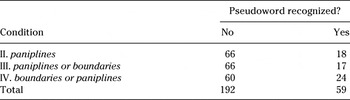
We now turn to the question of whether or not the presence of an appositive, semantic cue in the reading passages influenced the vocabulary posttest scores. Out of a total of 252 observations, 59 (23%) were correct answers, 192 (76%) were wrong, and 1 value (< 1%) was missing. Table 5 displays the response accuracy over the three critical conditions. Proportions of success are quite similar across conditions; Condition III does not stand out, even though analysis of the participants’ reading behavior revealed additional processing of the appositive cue in this condition (see Analysis 2). A GEE with test items (i.e., pseudowords) as repeated measures within participants and condition as the only factor confirms that there is no effect, Wald χ Footnote 2(2) = 2.64, p = .267.Footnote 16 The presence or absence of a clarifying, known word during reading did not affect the probability of recognition of the pseudoword on the posttest.
Number of pseudowords recognized by condition

DISCUSSION
We have presented an eye-tracking procedure that attempts to gauge learners’ noticing of new words in written input. More precisely, we have tried to measure instances of focal attention, one of the constituent processes of the noticing construct. We have also assessed whether learners’ fixation times on new words, which are indicative of the amount of attention deployed, are positively associated with subsequent learning gains.
The Processing of Unknown Words while Reading: Eye-Tracking Data
We predicted for Research Question 1 that unknown words would attract longer fixation times during leisurely reading than familiar words. This prediction is borne out by the data: Pseudowords were indeed fixated significantly longer than their matched controls. This corroborates previous eye-tracking studies and other psycholinguistic research that have repeatedly shown that readers spend more time processing low-frequency words than high-frequency words (see N. Ellis, Reference Ellis2002, and Rayner, Reference Rayner1998, Reference Rayner2009, for reviews). Frequency effects in reading are often taken to reflect difficulties with lexical retrieval and sentence integration (see Rayner & Duffy, Reference Rayner and Duffy1986, p. 195). For pseudowords, which, by definition, do not match any entry in the mental lexicon, lexical access is likely to be particularly problematic, as it requires the reader to assemble at least part of the grapheme-phoneme correspondences bottom-up.
Although many psycholinguists seem to consider frequency effects a natural, automatic side effect of processing that is unrelated to explicit learning (and, hence, noticing), it is worth emphasizing that frequency effects only occur when participants attempt to process the input semantically. In two studies aimed at evaluating the role of lexical processing in eye-movement control, Rayner and Fischer (Reference Rayner and Fischer1996) and Rayner and Raney (Reference Rayner and Raney1996) found that the frequency effects evidenced during normal reading disappear when participants are scanning lines of text for a target word or pretend to be reading the same lines of text transformed into meaningless z strings. The upshot for our study, then, is that the longer processing times for the pseudowords in Conditions II, III, and IV relative to the known words in Condition I signal the learners’ genuine attempts to access the novel words’ meanings; readers were trying to make sense of the paragraphs, including the novel words that they contained.
A secondary research question to be addressed by the eye-tracking data concerned the effect of an appositive cue on target-word processing. Surprisingly, eye-fixation times for the novel words did not differ as a function of whether or not their interpretation was supported by an appositive cue. However, when an appositive cue was present and, more specifically, followed the novel word (e.g., boundaries in paniplines or boundaries), the known cue itself elicited longer gazes than it did in boundaries or paniplines or boundaries by itself. Analysis 3 indicated that this result is not simply due to a spillover of processing from the preceding novel word paniplines; rather, we believe that sentence-integration processes are at work here. Under this interpretation, our participants recognized that boundaries carried some sort of information about paniplines, which they then exploited. In the following, we present three mutually compatible explanations about the type of information that learners may have extracted from known, appositive words that came after novel targets.
First, at a syntactic level, the addition of or and the known, appositive word turns the critical area from a simple noun phrase (NP) into a conjoined NP. The constituents in a conjoint construction (such as a conjoined NP) are in an identical syntactic relationship with their head (Quirk et al., Reference Quirk, Greenbaum, Leech and Svartvik1985): In our example, paniplines and boundaries are both nouns acting as the direct object of the transitive verb push. Given this similarity in syntactic dependency, the integration of boundaries with the head verb push is likely to facilitate the syntactic integration of paniplines into the verb phrase (VP) as well.
A slightly stronger interpretation is that our participants realized that the two nouns in paniplines or boundaries are not only syntactically but also semantically related. When participants first look at the pseudoword paniplines, it is not yet embedded in any semantic network; sentence comprehension is impeded. Reading the following or boundaries phrase may activate the mental categories associated with boundaries and then increase processing time as a result of the readers’ attempt to understand paniplines in terms of the categories associated with boundaries (A. Mackey, personal communication, October 3, 2009). In contrast, in Condition IV, the known word occurs first, which enables instant and satisfactory comprehension of the current VP. When participants next read or paniplines, they are less inclined to dwell longer on the nonword or to return to the known, appositive cue because it is no longer necessary for comprehension.
Finally, readers may view the pseudoword and the known appositive in paniplines or boundaries as nearly synonymous, in which case the information transfer from known to novel is almost complete. We can state, in general, that the more overlap readers perceived between the known word and the novel word, the better they could put the appositive cue to use, and, thus, the greater the potential for learning.
If the higher fixation times on boundaries in paniplines or boundaries are indicative of the learners’ attempts at better syntactic and semantic integration of paniplines, then why was this not reflected in the vocabulary posttest scores? Target-word recognition for Condition III did not differ significantly from that for Conditions II or IV. One possibility is that the posttest format, which involved contextually cued recognition of written form, rewarded knowledge of the target-word form more heavily than knowledge of the target-word meaning.Footnote 17 Whatever the exact nature of the processes that gave rise to the longer fixations on boundaries in paniplines or boundaries, it is unlikely that they contributed to better formal (i.e., orthographic) knowledge of paniplines, given that participants were not even looking at the pseudoword during this time. We argue that learners might have looked longer at boundaries because they capitalized on the semantic similarity that they perceived to exist between the known clue and the novel target. Future research could test this hypothesis by including a more direct test of learners’ semantic knowledge of the target words.
Incidental Vocabulary Acquisition while Reading: Posttest Data
The data support the hypothesis that the fixation duration on a novel word, which indexes focal attention, predicts posttest recognition of that word: For every second longer that a participant looked at a novel word while reading, she was 8% more likely to identify that word correctly on the subsequent vocabulary test. This significant positive association was found despite the fact that four participants did not recognize any novel words on the posttest. The associations between the component measures of total time (i.e., first fixation duration, gaze duration, and second pass time) and posttest recognition were also all positive but did not reach significance, possibly because of the limited sample size.
Interestingly, Williams and Morris (Reference Williams and Morris2004) found gaze duration and second pass time to have opposite effects on vocabulary posttest accuracy: Correctly defined words were associated with shorter gaze durations but longer second pass times. There are several theoretical and methodological differences between Williams and Morris (Reference Williams and Morris2004) and our study that could account for these seemingly contradictory findings. For one thing, Williams and Morris examined L1 reading of single sentences, whereas our study deals with L2 reading of multisentential texts. Second, Williams and Morris administered a relatively simple semantic knowledge test, whereas we used a more complex cued recognition test in which orthographic knowledge of the target word was more important. Finally, Williams and Morris concede that, although the higher second pass times for words that were later defined correctly make sense, they cannot really account for the negative correlation between gaze duration and posttest performance (pp. 337–338). One possibility is that this negative correlation reflects the effect of a confounding variable—namely, word length—that influences fixation time and perhaps also word learning. A reanalysis of their data should reveal whether or not shorter (i.e., four- to five-letter) words were identified correctly more often in their study than longer (i.e., six- to seven-letter) words, in which case the association between correct answers and shorter gaze durations is to be expected because shorter words are processed faster and skipped more often. However, this interpretation would not account for the longer second pass times that they observed. For this, we concur with Williams and Morris’s interpretation that “the second pass time on the novel word reflects the process of connecting the newly acquired contextual information to the unfamiliar word” (p. 337).
In summary, Williams and Morris (Reference Williams and Morris2004) and our study both indicate that eye movements are predictive of word learning. Although the negative correlation between gaze duration and vocabulary learning in Williams and Morris would require further analysis, both studies show that increases in later fixation time measures—second pass time and total time—facilitate word learning. In other words, paying focused attention to a novel word while reading has a beneficial effect on the encoding of that word in memory.
CONCLUSION
This study has explored the potential of eye-tracking technology to capture incidences of noticing at the level of attention (e.g., Robinson, Reference Robinson1995, Reference Robinson, Doughty and Long2003; Schmidt, Reference Schmidt and Robinson2001). The high spatial and temporal resolution of eye-tracking makes it a suitable technology to study the dynamics of cognitive processes online with a great amount of detail. A second benefit of eye-tracking is that it does not involve a secondary task and, therefore, does not carry a risk of altering the very process that it is intended to measure (Tinker, Reference Tinker1936; see also Duyck, Van Assche, Drieghe, & Hartsuiker, Reference Duyck, Van Assche, Drieghe and Hartsuiker2007); thus, unlike studies that incorporate thinking aloud or note taking, eye-tracking experiments need not face up to potential reactivity issues. Finally, eye-tracking differs from underlining, another technique that has been employed to gauge noticing as attention, in that it registers not only the locus of attention but also the duration of attention. The quantitative nature of our attention measure has enabled us to assess the nature and magnitude of the relationship between eye-fixation time during leisure reading and incidental vocabulary learning. Indeed, the key finding of this study is that there is a direct, positive relationship between amount of attention and amount of learning. This supports Paribakht and Wesche’s (Reference Paribakht and Wesche1999) claim that “vocabulary learning through reading is in some fundamental sense not ‘incidental,’ at least from the learner’s perspective” (p. 215). The words that adult L2 learners are likely to learn are the ones with which they engage longer and, presumably, more deeply during reading (see also Laufer & Hulstijn, Reference Laufer and Hulstijn2001; Schmitt, Reference Schmitt2008). Thus, using vocabulary as a test case, this study complements the existing empirical support from awareness studies for Schmidt’s noticing hypothesis by showing that not only more awareness but also more attention lead to more learning (Schmidt, Reference Schmidt and Ellis1994, Reference Schmidt and Schmidt1995, Reference Schmidt and Robinson2001).
However, as Logan (Reference Logan1988) observed many years ago, “attention to an item may be sufficient to encode it into memory, but the quality of the encoding will depend on the quality and quantity of attention” (p. 494, emphasis added).Footnote 18 Because eye-movement data are quantitative, they do not tap into the quality of the cognitive operations that give rise to extended processing times. We cannot, therefore, on the basis of our data, make any claims about the role of awareness in L2 vocabulary acquisition through reading. Although we can safely assume that our participants were consciously perceiving (i.e., visually aware of) the unfamiliar words at which they were looking, we cannot tell whether learners were also aware that they were giving special attention to some of these novel items.
To date, opinions diverge on which mechanism—attention or awareness—is associated more closely with learning. Richard Schmidt (Reference Schmidt1990, Reference Schmidt and Ellis1994, Reference Schmidt and Schmidt1995) has placed greater emphasis on awareness (but see Schmidt, Reference Schmidt and Robinson2001), whereas Peter Robinson (Reference Robinson1995, Reference Robinson, Doughty and Long2003) favors an attentional account in which awareness is a by-product of focal attention (i.e., is epiphenomenal), and Tomlin and Villa (Reference Tomlin and Villa1994), Truscott (Reference Truscott1998), Truscott and Sharwood Smith (2011), and Carroll (Reference Carroll, Gurski and Radisic2006a, Reference Carroll, Grantham O’Brien, Shea and Archibald2006b) argue that only input and attention, not awareness, are necessary for learning. We believe eye-tracking may be a valuable addition to the SLA research arsenal in this regard because triangulating eye-tracking data, retention data, and awareness data (obtained, e.g., from consecutive verbal reports, as in stimulated recall) may ultimately help to answer the question as to whether or not it is noticing at the level of attention or, rather, noticing at the level of awareness that is the necessary condition for converting linguistic input into intake.
Appendix A TWO EXAMPLES OF READING PASSAGES USED IN THE STUDY
John Trinkaus of the City University of New York studies ordinary people going about their everyday lives. One of his specialties is the study of minor acts of dishonesty and antisocial behaviour.* In his 25 years of research, he has found that one demographical group has come to stand out above all others as being most likely to push / BOUNDARIES / PANIPLINES / PANIPLINES OR BOUNDARIES / BOUNDARIES OR PANIPLINES / and break / rules. These are not teenagers nor football hooligans.* They are women van drivers. Among other things, Trinkaus found that as many as 96 per cent of them break the speed limit, compared with 86 per cent of male offenders. (Adapted from Wiseman [Reference Wiseman2007])
Jillian Clarke received the Ig Nobel Prize, an award for strange but funny science, for testing the popular belief that dropped food is safe to eat if it has spent no more than five seconds on the floor.* In tests with floors deliberately contaminated with the E. coli bacteria, Clarke found that gummy bears and cookie pieces picked up the / BACTERIA / EVIDOSES / EVIDOSES OR BACTERIA / BACTERIA OR EVIDOSES / in less / than five seconds, thus showing the five-second rule is a myth.* However, tests on real floors at the University of Illinois, where she worked, failed simply because they had no detectable bacterial contamination—suggesting the cleaning staff might deserve their own award. (Adapted from Hecht [2004])
Note. Slashes are used here to delimit the different versions of the target area and the posttarget area (see Analysis 3). Participants read only one version of each paragraph; target areas appeared in regular print in the actual experiment. Asterisks indicate where participants would move to the next screen by pressing a button.
APPENDIX B THE TARGET WORDS