In 2011, the Swedish government, holding a slim majority in parliament, consisted of a coalition of four parties: the Moderate party, the Centre party, the Liberal People's party and the Christian Democrats. The biggest party in parliament, the Social Democrats, enjoying no less than thirty-three seats' advantage over the party of the prime minister, occupied the opposition benches. A stalemate following the 2010 Dutch elections ended with formation of a minority coalition government of the Liberals (VVD) and the Christian Democrats (CDA), the first and fourth largest parties, respectively, in the 150-seat parliament. The leader of the VVD, Mark Rutte, was appointed prime minister of the fifty-two seat coalition, supported by the Party for Freedom (PVV), the extreme right party. The United Kingdom had been for many years ruled by a single party that enjoyed a majority of seats in the House of Commons. Following the 2010 elections, however, a coalition government of the Conservatives and the Liberal Democrats, the first and third parties in size, was formed.
These are but a few examples of quintessential parliamentary politics. As they suggest, parliamentary politics varies greatly across countries. In some a single party governs while in others a coalition of several parties is the norm. In some the formateur is the head of the biggest party, while in others she/he is not. Some governments are minority governments and others enjoy a solid majority in parliament, and some oppositions have significant authority, while others are left out in the cold.
In this article I provide a framework for systematic research on how quintessential parliamentary politics and in particular coalition politics affects voter considerations. A series of steps take place from the time votes are cast until policy is drafted. Not all of them take place in all democracies, and undoubtedly every polity has its own idiosyncrasies. Yet, in general, the inclusive set of steps consists of allocation of parliamentary seats, selection of a formateur, negotiations with potential coalition partners, the formation of a government and the division of the pie of portfolios among governmental parties.
How does each of these steps affect voter considerations? In recent years political scientists have examined some of these steps and the way they affect voters, usually in the specific context of a particular election in a given country.Footnote 1 Findings suggest that not only do voters have views about which multi-party government they prefer, but they also have a perception of the likelihood of different coalitions emerging and cast their ballot accordingly.Footnote 2 The research agenda I call for sets a framework that maps consecutive legislative steps onto incentives for voters. Identifying voter strategies that are motivated by different stages of the parliamentary game allows me to bring insights from these studies together and develop a comprehensive approach to thinking about voter choice under different parliamentary regimes. This, in turn, puts strategic voting under the First-Past-the-Post system (FPTP) into context. Lastly, it allows me to identify a set of conditions from which I derive testable hypotheses about the likelihood of voters engaging in different strategies in different contexts.
For over five decades since Duverger conjectured how plurality electoral rule affects voters’ (and parties’) considerations,Footnote 3 political scientists have invested great efforts and extended our understanding of both the theoreticalFootnote 4 and empiricalFootnote 5 aspects of voter behaviour under the Anglo-American model. At the heart of Duverger's Law are voters who are concerned with policy. Under FPTP, this policy-motivated choice implies concern with wasting votes on unviable parties, and therefore voters rallying around the leading parties (see discussion of Gary Cox's insights on multi-member districts below). This is the familiar version of strategic voting. Under FPTP, once seats are allocated the subsequent steps are usually either skipped or automatically unfold, as if the valve of the first step in the post-electoral process is pulled fully open, and others are closed – the party winning the majority of seats becomes the government party, and the other parties serve in opposition. While the familiar version acknowledges the incentives that the Anglo-American electoral model poses to voters, other versions of policy-oriented choice correspond with subsequent steps of legislative and coalition politics that take place under consensual democracy.
I generalize policy-minded voting from the familiar version of strategic voting. Voter considerations under the Anglo-American model, I argue, have been reified as voter behaviour in democratic polities at large, yet they are only a specific case of policy-minded voting. While under FPTP conversion of votes to seats is perhaps the most thorny business in the entire electoral game for voters, under other electoral and legislative regimes, like that of Sweden, like that of the Netherlands, it is subsequent steps that may lead voters to think twice about their choice.Footnote 6
This article commences with a brief review of the familiar version of strategic voting as presented by Duverger and updated, clarified and modified by others. The next section presents an empirical starting point for a research agenda, and the following one maps the main parliamentary steps taking place after votes have been counted to incentives for voters and the corresponding strategies voters engage in. It also places recent works in this broader context. In the penultimate section a set of empirical implications at the country, party and voter level is identified and the final section offers a conclusion.
Strategic voting – the familiar version
Duverger's Law is one of the most broadly accepted stylized facts in political science. As Duverger writes: ‘the simple-majority single-ballot system favours the two-party system’.Footnote 7 As is well known, Duverger's Law works via two routes, mechanical and psychological. The mechanical effect refers to the disproportionality caused by the transition from votes to seats, which inflates the seat share of large parties and deflates that of smaller parties and thus has an overall reducing effect on the number of parties. The psychological effect refers to voters’ tendency to shy away from parties that they consider unviable and instead rally around the one most acceptable to them among the two leading parties.
Later works bring in federalism and the vertical division of power as important factors explaining those cases in which evidence supporting Duverger's Law is found at the district but not at the national level. As clarified by these works, the basic principle should be adapted to the relevant levels of governance.Footnote 8 Yet, later works show how the effect spills over from one electoral institution to anotherFootnote 9 and how it is contingent on social heterogeneity.Footnote 10 But even in its modified form, Duverger's Law is broadly regarded as a benchmark for our understanding of both voter behaviour and party systems. Once modified to the district level, the psychological effect has a clear implication. Voters in FPTP systems often vote strategically if they perceive their favourite party as an unviable one or predict that their least preferred party might win in their district.
Drawing on this principle in his path-breaking work, Cox theorizes and demonstrates the conditions under which proportional representation with relatively small district magnitude encourages similar strategic behaviour on the voter's part.Footnote 11 In multimember districts, he shows, a vote for a party that is only marginally popular in one's district carries the risk of a wasted vote. Thus, he shows, in a district with M seats there are no more than M+1 viable parties. Cox predicts that when the number of seats per district exceeds five, strategic voting motivated by considerations of party viability will fade away. This is because the information about a party's viability, which, by definition, depends on the predicted vote share of other parties, is harder to attain under large district magnitude.Footnote 12
An empirical puzzle
Key implication of this logic is that voters will be more likely to support their most preferred party in those systems in which district magnitude is larger in comparison to those in which district magnitude is small. Put differently, other things being equal, both the incentive to support a less preferred party for strategic considerations having to do with viability of a parliamentary seat and the mere ability to calculate a party's viability decline as the district magnitude increases. Voting under an almost perfectly proportional system, Swedish voters are liberated from strategic considerations that may be on the minds of British voters.
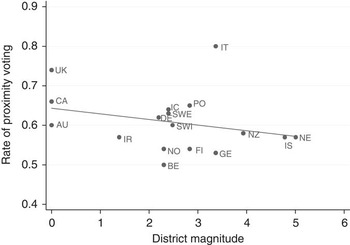
Following Duch, May and Armstrong,Footnote 13 I take support for the party ideologically most similar to a voter by her/his self-report as an indication that that party is most preferred by the voter.Footnote 14 The logic above should lead us to expect that because under large district magnitude voters are less constrained, the rate of proximity voting – the proportion of voters who support the party ideologically most proximate to them – will increase with district magnitude. An examination of the data, however, reveals a different pattern. Figure 1 presents the (logged) magnitude of the median legislator's district on the horizontal axis against the proportion of voters supporting the party ideologically most similar to them on the vertical axis in seventeen elections in seventeen countries.Footnote 15 The data are extracted from the Comparative Study of Electoral Systems (Modules 1 and 2).Footnote 16 In each of the cases, respondents were asked to place themselves as well as the main parties in their country on a general left–right ideology scale, allowing us to calculate for each respondent the distances between her (his) own position and that of each of the parties. Since respondents also reported their vote choice, for each reported voter we are able to examine whether the party they supported was the one they perceived as ideologically most similar to them. The scores on the vertical axis are simply the proportions of those who did – these are raw data from the sample.Footnote 17
Proximity voting and district magnitude Note: Election years: Australia 2004, Belgium (Flanders) 1999, Britain 2005, Canada 2005, Denmark 2001, Finland 2003, Germany 2002, Iceland 2003, Ireland 2002, Israel 2006, Italy 2006, The Netherlands 2002, New Zealand 2002, Norway 2001, Portugal 2005, Sweden 2002, Switzerland 2003.

Contrary to this expectation, the figure shows no relationship between the (logged) magnitude of the median legislator's district and the proportion of respondents supporting the party ideologically proximate to them, and perhaps even a slightly negative one. Single-member district systems like Britain and Canada are characterized by similar or even slightly higher rates of proximity voting compared with consensual Netherlands or consociational Switzerland (74 per cent and 66 per cent versus 57 per cent and 60 per cent, respectively). Obviously, like all voters, non-proximity voters choose the parties they support for a variety of reasons. In all systems included in the figure, voters have multiple allegiances, and various factors pull them in different directions. Religious affinities, class relations and ethnic identities all play a part in the voters’ vote choice. I do not presume to analyse all factors affecting voter choice in this study. Simply, the figure suggests that voters are pulled away from their ideologically preferred parties under permissive electoral systems just as much as they are under systems that pose high barriers for parliamentary party entry.Footnote 18
The lack of relationship demonstrated in the figure does not necessarily imply that past theorizing about the familiar version of strategic voting is wrong.Footnote 19 But it does suggest that it is only part of the picture. It reveals that, in addition to the familiar version of strategic voting focusing on the identity of the parties entering parliament, something else is at play, and that something else overwhelms the effect theorized by students of electoral politics. This is the empirical starting point for the research agenda I discuss below.
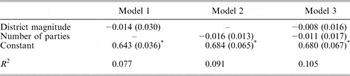
Before we continue, one additional wrinkle needs to be ironed out. A natural suspect for the non-increasing rate of proximity vote in systems characterized by high district magnitude is simply the number of parties, which tends to be higher where district magnitude is large. More parties may cause more measurement error in the ideological placement of parties and hence reduce the measured rate of voters who voted for the party ideologically most proximate to them and mask a positive relationship. In other words, perhaps it is simply harder to measure party placement where district magnitude is high and thus harder to detect proximity voting there. Two things should be noted in this context. First, party placements used to calculate the rate of proximity voting are measured as perceived by the respondent herself/himself rather than by some external measure. Second, the figure is based on a conservative calculation by which, if a respondent is equidistant from more than one party, she/he is considered a proximity voter as long as the party she/he supported is one of the minimum distant parties. Given the generally positive correlation between district magnitude and the number of parties, it should be easier to detect the expected positive relationship between proximity voting and district magnitude: if the party system is more crowded in systems characterized by high district magnitude, the voter is more, not less, likely to be coded as a proximity voter. For these two reasons, it is unlikely that the lack of relationship found here is simply a measurement artefact. Finally, Table 1 presents regression results of the effect of both district magnitude and the number of parties on the rate of proximity voting (the latter included for the reasons mentioned here rather than as a causal factor). As the second and third columns of the table demonstrate, the inclusion of the number of parties on the right-hand side, whether on its own or alongside district magnitude, does not account for the rate of proximity voting.
Proximity Voting

Notes: N = 17. Standard errors in parentheses. *p < 0.01.
After Votes Are Cast: beyond ‘First Past the Post’
Why, then, does the proportion of voters who support the party ideologically most proximate to them not increase with permissiveness of the electoral system? The theoretical starting point for the research agenda I identify asks how quintessential parliamentary politics of multi-party government affects voter considerations. Indeed, as I suggest above, Swedish voters are liberated from the considerations of party viability that may occupy British voters; they may, however, be preoccupied with others. What these considerations are, under what circumstances they are likely to emerge and how they affect voter strategy are questions we should focus on. The direction I am indicating takes into consideration the particular parliamentary context with respect to government formation, under which voter decisions in different countries take place.
For decades, political scientists have focused their efforts on understanding strategic incentives of the Anglo-American type. With a few exceptions and some recent works in progress, we neglected the various incentives offered to voters at other stages in the political game. From the time votes are cast until the government engages in policy formation, a chain of institutional post-electoral steps take place. The process is detailed and nuanced, yet it can be generally described as consisting of at least four steps. First, votes are turned into legislative seats and a parliamentary party system emerges. Second, a formateur is selected by the head of state. Third, potential partners are approached and often a coalition is formed.Footnote 20 And fourth, portfolios are allocated to cabinet members. Once this process is completed, the formation of policy begins, involving different cabinet members, parliamentary committees and members of parliament from both the coalition and the opposition. Although in practice these steps may blend into each other, in terms of their effect on voters we can think of them as distinct. Each step, I argue, provides voters with different incentives to engage in policy voting. Importantly, not all steps take place after all elections and in all countries: which steps are activated and which are muted depends on the institutional regime and election results.
Before investigating these steps, it is important to note a potential additional step, one that takes place before the elections. This is the formation of pre-electoral coalitions. In her innovative work, Sona Golder investigates the conditions under which parties enter pre-electoral coalitions.Footnote 21 Pre-electoral coalitions are either parties running separately but announcing ahead of time their preference to coalesce after the elections or parties running under a single list. Unlike their post-electoral counterparts, she argues, pre-electoral coalitions are formed because they may affect the parties’ electoral fortunes, especially under disproportional electoral systems. The former type in particular may be formed when voters are risk averse about the policy positions of a potential future government, and thus a pre-electoral coalition may attract a greater number of votes than does any party competing independently. Under these circumstances, voters prefer to identify a governmental alternative associated with their vote to a state of uncertainty about one.
I am not the first to note that strategic voting is not only about votes turned into seats. In recent years students of electoral politics have examined different ways in which coalition considerations play out in voter choice. In the discussion that follows, I draw on insights from these studies. The framework of mapping legislative politics onto electoral ones allows me to organize these findings and seek further ones in a systematic fashion. Incorporating the post-electoral legislative process as a whole allows me to identify for each parliamentary step the strategies that target it. Strategic voting of the type common in the Anglo-American model is then but a special case of a broader category of strategies which I call policy voting.
Before examining the specific strategies, consider again the Swedish case I mentioned at the outset of this essay. One might wonder if voters are indeed able to comprehend such complexity. Multi-party systems are regularly characterized by multi-party governments. If voters in majoritarian democracies engage in strategic voting, having to do with the transformation of votes into seats (a problem they face every election), there is no reason to think that voters in consensual democracies ignore a step they encounter time and again. Indeed, evidence suggests that voters have a taste for coalitions. Bowler et al. found that many New Zealanders preferred coalition government to single-party government.Footnote 22 In a separate study in New Zealand, Vowles showed that respondents supporting small parties preferred coalition to single-party government more than those who supported large parties, as did respondents who believed in consensus rather than a majority as a principle for aggregating preferences.Footnote 23 Those holding an authoritarian worldview, by contrast, preferred a single-party government at higher rates.Footnote 24 Over five elections between 1993 and 2005, voters repeatedly believed that multi-party governments were more effective than single-party governments in keeping promises and complying with the will of the electorate.
Not only do voters have a preference for or against a multi-party government, they are also able to think analytically about coalitions and conduct their business in the voting booth accordingly. Analysing the 2003 Israeli elections, Blais et al. found that voting for coalitions was not confined to political elites; both the informed and the less informed were as likely to vote for a coalition.Footnote 25 The authors concluded that ‘voters think ahead about the coalitions that might be formed after the election, at least when they are provided sufficient information about the possible options’.Footnote 26
It is also found that voters respond to information about potential coalitions and channel their vote accordingly. Bowler et al. reported that in New Zealand voters were more likely to turn out when they perceived a disliked party to have a particularly high likelihood of being included in the government.Footnote 27 In an experimental study in the Netherlands, Irwin and van Holsteyn showed that respondents held reasonable perceptions of the likelihood that different coalitions would emerge.Footnote 28 And when presented with scenarios of different seat distributions, voters altered their intended vote choice depending on their coalition expectation. Similarly, in a survey experiment conducted before the 2006 Austrian elections, Meffert and Gschwend presented to respondents four potential coalitions through vignettes of hypothetical scenarios in which different parties announced their inclinations to coalesce with particular parties.Footnote 29 They found that a non-negligible number of respondents shifted their reported vote once presented with the scenarios and, in particular, voters who initially had no clear vote intention found it easier to choose a party once parties had announced their coalition intentions.
While in practice the process of coalition formation is a muddled one, it is important to identify the incentives for voters offered at each step in the process. I turn now to examining these steps.
Votes Are Turned into Legislative Seats
The familiar form of strategic voting pertains to this first step. The psychological effect of Duverger's Law states that not only will parties field candidates selectively, but also voters may desert their most preferred party and instead rally around one of the leading parties out of concern that in the transition from votes to seats their vote will be wasted.Footnote 30 As Cox shows,Footnote 31 since voters in proportional systems too are concerned with more than expressing their opinion, considerations of party viability are relevant under proportional representation with small district magnitudes as well (see also analysis of various incentives of strategic voting having to do with the first step under different versions of proportional representation in the theoretical work by Cox and Shugart).Footnote 32
Numerous additional studies have examined this version of strategic voting. While a thorough review of this voluminous literature is beyond the scope of this article, in addition to the ones mentioned above, a few are of particular relevance. Analysing tactical voting in the 1987 British elections, Niemi, Whitten and Franklin found that, unlike what had been previously reported, ‘as many as one in six British voters claimed to have made their decision at least partly on the basis of tactical considerations’ and that this figure increased substantially when the circumstances were favourable to strategic voting.Footnote 33 These findings were contested on methodological grounds by Evans and Heath, to whom Niemi, Whitten and Franklin responded, and subsequently Heath and Evans commented.Footnote 34 Like Niemi and his colleagues, Galbraith and Rae found that tactical voting in the 1987 British general election was more prevalent than previously argued.Footnote 35
Tactical voting continued to be a topic of investigation in subsequent years. Evans, Curtice and Norris found that the rate of anti-conservative tactical voting in British general elections had increased from 1992 to 1997, and although the absolute number of tactical voters was not high in both cases, it affected a considerable number of seats.Footnote 36 Alvarez and Nagler reported that studies had found between 5 and 17 per cent of voters to be engaging in strategic voting, depending on the empirical approach and the election analysed.Footnote 37 The authors themselves, however, found a rate of 3 per cent. Fisher and Curtice found a decline in strategic voting between Labour and the Liberal Democrats from 2001 to 2005.Footnote 38 They hypothesized that this decline was related to a decline in hostility towards the Conservative party. In a study of strategic voting in US presidential elections, Burden identified both expressive and instrumental votes for third candidates.Footnote 39 Consistent with expectations, a third candidate lost support where major-party contestation was competitive (Nader 2000) and gained support where contestation was not competitive (Perot 1992 and 1996). Finally, analysing survey data from Hungary in the late 1990s, Duch and Palmer showed that, like their counterparts in established democracies, voters in new democracies engage in strategic voting.Footnote 40
Selection of a Formateur
In this stage the formateur of the government, who is likely to be the next prime minister, is selected by the head of state, either directly or indirectly via a formateur. The selected formateur is often, though not always, the head of the biggest party. In other cases, it is the person whom the head of state perceives as most likely to be able to attain a parliamentary majority or the support of a majority. One can imagine voter choice taking into account this important step. For instance, voters may desert a favourite small party and instead support a larger party if they think this party may be the largest or the one chosen to lead the government.
Formation of a Coalition
Once the formateur is selected, she or he holds meetings with leaders of various parties and attempts to form a governing coalition. Voters may engage in one of at least two strategies to affect the governing coalition. First, a voter may directly vote to affect the likelihood of a preferred coalition. This is consistent with the preference voters have for a particular coalition, as mentioned above. Second, and perhaps more nuanced, is what Gschwend defined as a coalition insurance strategy. Under this strategy, voters support a small party, the potentially junior member of a preferred coalition, when they perceive this party to be in danger of falling below the electoral threshold necessary for gaining a parliamentary seat.Footnote 41 Gschwend found support for this strategy among German voters who split their ticket, using their first ballot to sincerely support a large party and their list ballot strategically to support a small, preferred coalition partner when they were unsure if it would pass the parliamentary threshold.
Portfolio Allocation
The prospective coalition partners negotiate both policy framework and how the pie of ministerial portfolios, deputy positions and, on occasion, lower posts will be divided. And while co-operative game theory suggests that a party being pivotal to the set of potential coalitions is key for the allocation of portfolios, empirical studies demonstrate that seat share is as important if not more critical a predictor.Footnote 42
The target of voter choice I describe immediately above affects the likelihood of one coalition emerging rather than another. The target here, however, is the relative weights of different parties given expectations about the likely coalition. If she/he perceives her/his favourite party as an unviable coalition partner, a voter may desert that party and instead support the party she/he considers the lesser of the evils among viable coalition partners. By targeting the relative weights of coalition partners, a voter may affect the policy formed by the government or the distribution of portfolios among coalition partners. Indeed, in the study mentioned earlier, Bowler et al. found that, in New Zealand, voters who perceived their favourite party as having little chance of being in government were more likely to support their second best party.Footnote 43 Additionally, in a study of the 2006 Israeli elections, Bargsted and Kedar showed that ideologically and otherwise similar voters supported different parties depending on their coalition expectations.Footnote 44 Voters on the centre-left were more likely to desert the Labour party and instead support the centre party, Kadima, if they expected a centre-right coalition to emerge. Similarly, voters on the right tended to desert the Likud party and support Kadima if they predicted that a Kadima–Labour coalition would emerge.Footnote 45
Types of policy voting targeted at these four objects are motivated by different stages of the political game. Just as in many democracies more than one parliamentary stage is activated, so are the electoral projections of these parliamentary steps; different motivations can coexist. A voter may simultaneously be concerned about, say, a party's viability of gaining a parliamentary seat and about the coalition that will emerge after the elections. Each type of policy voting I identify may be activated or not, or prevalent to different degrees under different circumstances. The different considerations may pull a voter in different directions. Analysing voter choice in the 2006 Austrian elections, Meffert and Gschwend traced several types of strategic voting in which voters engage.Footnote 46 The first was the familiar version concerned with a party passing the threshold. The second was a direct vote to affect the winning coalition. Lastly, in line with Gschwend's analysis, the authors found supporters of a big party voting for a small one in danger of not passing the electoral threshold.Footnote 47 Similarly, Martin Rosema discussed five potential objects of strategic voting: a candidate, a government, a leader, party size and policy.Footnote 48 He showed that a substantial proportion of Dutch voters not only voted for the party other than their most favourite but also reported their intention to do so before the elections had taken place.
It is easy to see that various strategies can lead voters to support different parties. A left-leaning voter in a three-party system with parties Left, Centre and Right may support the Left party in an attempt to increase the likelihood of a Centre-Left coalition emerging or to affect the appointment of the formateur. Alternatively, suspecting that a Centre-Right government will emerge, a voter may choose to strengthen the Centre party in government and hence desert the Left party.Footnote 49
Under the majoritarian model, typically, once seats are allocated the other steps follow in a linear fashion: the formateur is the head of the party holding the majority of the seats, the government is usually a single-party government, and the opposition has little power. The first step, then, motivates voters to vote strategically, while other steps, and thus other considerations, are muted. Thus, under the majoritarian model, viability considerations aside, any vote to further one cabinet over another is observationally equivalent to a sincere vote for the preferred party. Or to put it differently, since the steps following seat allocation are roughly determined under FPTP, strategic considerations are only activated with regard to the first step. The familiar strategic voting under FPTP is a case in which the first is activated, and the latter three are not. It is an important, but nonetheless only one, form of policy voting. Under proportional representation with small district magnitudes this consideration is still activated, and as the magnitude increases it becomes less and less relevant. Relatedly, as the likelihood of a multi-party government increases it is other considerations that are activated. In other words, every electoral system and every particular race are likely to have some considerations activated and others not, depending on the potency of each of the four steps I have set out above.
Empirical Implications: Some Testable Hypotheses
An important difference between the familiar type of strategic voting aimed at attaining a parliamentary seat and the other three types I mention here is the opportunity costs involved. All forms of policy voting involve an expressive cost of refraining from supporting one's favourite party, whether for policy-related or expressive considerations. The standard version of strategic voting involves no additional cost: the voter assumes that loyalty to her unviable, preferred, party will likely (or with high enough probability that will offset the potential benefit) result in a waste of her vote. In contrast, under the other types of policy voting a tangible cost is involved: in supporting a less preferred party the voter weakens the parliamentary base and, in some cases, even the governmental base of her/his favourite party. Why, then, and under what circumstances would a voter weaken her/his favourite party in parliament?
Generally, we can think of costs and benefits involving the decision to engage in strategic behaviour. The cost has to do with the policy pursued. The party gaining the support of the policy-oriented voter is a compromise choice and will hence not pursue her/his most preferred policies compared with the first-choice party, but rather a somewhat different policy. The benefit has to do with the degree to which the party's policy is pursued. An implicit assumption behind policy voting is that the party supported strategically will have a greater impact than the most preferred one. Thus, a voter may be more or less likely to engage in policy voting depending on how much benefit is gained by doing so and the level of cost involved. In this section I identify various factors that affect the relevant costs and benefits of a policy vote. This allows us to formulate empirical implications of the conditions under which we may observe more or less policy voting of different types.Footnote 50 My list is by no means an exhaustive one. Rather, I indicate only a small sample of such factors: institutional conditions, party characteristics and voter characteristics.
Institutional (and Other) Context
Institutional characteristics of both the electoral and the parliamentary arena are likely to affect incentives for voters. The most obvious institutional factor is the electoral system. As has been shown with regard to the familiar version of strategic voting, a smaller district magnitude encourages strategic voting. Policy voting aimed at the second, third or fourth step is generally more likely under greater district magnitudes and where other mechanisms encouraging a plethora of parties, and thus multi-party government, are present.
But other factors are relevant as well. Opposition empowerment is one such relevant factor. In some parliaments the opposition is granted substantial authority via a set of parliamentary norms and practices, while in others it is left out in the cold. Regular meetings and negotiations with coalition members,Footnote 51 agenda-setting power over the plan of the day in plenary discussions,Footnote 52 and chairmanshipFootnote 53 and other mechanisms for opposition representation in committeesFootnote 54 are some of the ways in which parliamentary oppositions have an impact on policy. The more inclusive of the oppositions are parliamentary, and in particular legislative, procedures, the smaller the differential impact of a coalition party compared to an opposition party, and hence, the smaller the incentives for voters to engage in coalition-related policy voting.
A related factor that may affect voters’ tendency to cast their ballot with governmental or coalition considerations in mind is the prevalence of minority governments. Minority governments vary greatly in their frequency, largely, but not solely, because of the presence of institutional mechanisms allowing for members of parliament to influence policy from the opposition benches.Footnote 55 While their average prevalence hovers around 35 per cent, it varies from 10–20 per cent in some countries to a solid majority in others.Footnote 56 By definition, minority governments rely on members of the opposition for their survival and hence give the opposition voice in the formation of policy. Since under minority government the differential in policy impact between a coalition and an opposition party is relatively small compared to that under majority government, a high prevalence of minority governments reduces the incentives for voters to base their votes on coalition considerations.
These relationships lead us to the following hypotheses:
– The more the number of mechanisms encouraging a plethora of parties in the electoral system, the more likely is policy voting aimed at the cabinet and the less likely is strategic voting aimed at turning votes into seats.
– The more say in the legislative process the opposition has, the less likely is policy voting aimed at cabinet composition.
– The higher the occurrence of minority governments, the less likely is policy voting based on coalition considerations.
Party Characteristics
Different types of policy voting may apply to different parties, and some parties may be more likely to be the object of voters’ policy considerations than others. At least two party characteristics affect the benefit of particular strategies for voters: party size, and the frequency in which a party served in government in the past. Perhaps the most obvious factor for us to examine is party size. Small parties (in a given district) are, of course, vulnerable to the standard version of strategic calculations that may reduce their vote share. Moderate or large parties, or, more generally, parties that are considered viable in a given district, may benefit from such strategic considerations. Blais and Gschwend found that supporters of weak parties were more likely to defect strategically from them in non-proportional systems, but that the gap was smaller the more proportional the system.Footnote 57 Relatedly, under proportional representation, small parties may benefit from strategic voting that attempts to affect the composition of the coalition. Indeed, Gschwend's insurance vote for small parties, which I mention above, is one such strategy.Footnote 58 A large party, by contrast, may enjoy policy voting intended to increase the likelihood of a formateur being selected from that party. Thus, depending on its size, a party may be a target of different types of policy voting, and be either a net beneficiary or a net contributor of electoral fortunes.
Just as some parties are viable contenders for a parliamentary seat and others are not, some parties are viable contenders for government membership and others are less so. A party that is perennially in opposition may be less likely to draw voters who engage in coalition-type policy voting compared with a party that is a candidate for government membership. The party's policy impact in past parliaments may serve as a clue to its likely place in the legislative process.Footnote 59 Indeed, Duch et al. constructed a model whereby the weight of coalition considerations in a voter's utility for a party depends on how extensive that party's past governmental experience is.Footnote 60
These insights lead to the following hypotheses:
– Depending on its size in early stages of the campaign, a party may be an object of strategic voting aimed at the conversion of votes into seats or of coalition considerations. In particular, a party with limited support in its district is likely to be an object (whether as net beneficiary or contributor) of strategic voting aiming to affect the conversion of votes to seats, while a party that is expected to be large enough to enter parliament may be an object of strategic voting aiming to affect government formation stage.
– The more the party has served in the government in the past, the more likely it is to be an object of coalition-targeted policy voting.
Voter Characteristics
Some voters may be more likely to engage in policy voting than others. Several voter characteristics may be relevant to the degree to which voters shy away from the party ideologically closest to them and support another. I focus here on three, but additional voter characteristics may be relevant.
First, policy voting may require a somewhat higher level of political sophistication than sincere voting. Put differently, the cognitive cost involved in policy voting is, on average, lower for the politically sophisticated. Thus, voters with greater resources for understanding the political process may engage in considerations about some of the post-electoral steps while voters with fewer such resources may be less likely to do so. Indeed, Karp et al. showed that well-informed voters tended to defect from supporting an unviable candidate to an ideologically proximate competitive one more than others did in single-member districts in the New Zealand mixed-member system.Footnote 61
Voting for a party that is not one's favourite carries a psychological and perhaps even an emotional cost. The strong partisan may find defection from a most preferred party too costly and thus remain loyal to the party to which she/he is attached. Additionally, just as partisanship affects voters’ perceptions of political events and figures,Footnote 62 the strong partisan may simply resist the intake of unfavourable electoral expectations and hence may be less prone to strategic calculations. This is consistent with findings reported in work by Blais and Gschwend.Footnote 63
Lastly, those holding relatively intense views may find an electoral compromise too costly and may be more inclined to vote sincerely. Indeed, Aldrich et al. found that among right-leaning Israeli voters, supporters of strongly right-leaning coalitions were more likely to vote sincerely than those supporting more inclusive coalitions.Footnote 64 Bargsted and Kedar, however, did not find a relationship between coalition voting and ideological extremity. The authors also reported negative findings on the other two factors mentioned above, sophistication and partisanship.Footnote 65 These modifying effects, however, were not the focus of their study and should be explored further. It is possible that the state of dealignment of the 2006 Israeli party system accounted for at least part of the negative effect.
These relationships lead to the following hypotheses:
– The more cognitive resources and/or political knowledge the voter has at her/his disposal, the more likely she/he is to engage in policy voting.
– The more strongly attached to a party a voter is, the less likely she/he is to engage in policy voting.
– The more extreme are a voter's positions, the less likely she/he is to engage in policy voting.
These implications above at the national, party and individual level, serve as a basis for testable hypotheses. This is by no means an exhaustive list, of course. Rather, spelling out the incentives posed by consecutive steps and identifying the electoral piece they affect allows me to organize this emerging field of knowledge and identify room for future contributions.
Conclusion
Parliamentary politics differs greatly across countries. How do these differences affect voters? In this article, I have reflected on the set of incentives posed to voters, and in particular on the ones posed by the formation of multi-party government. The strategies I have set out may seem far-fetched at first. It may be doubted whether voters are able to comprehend a complicated, multi-step political reality involving many actors. Yet, an emerging body of evidence that I have mentioned in this article, produced by different scholars employing both observational and experimental data in countries varying from Britain to New Zealand to Finland to Germany to Israel, systematically suggests that voters are concerned not only with parliamentary seats but also with seats around the cabinet table. Such recent works have indicated the existence of an array of strategies in which voters engage under different circumstances.
Putting potential strategies in a parliamentary framework enabled me to revisit our understanding of the familiar version of strategic voting and see it as a special case of an array of strategies, a case activated by the first of several post-electoral steps, the allocation of parliamentary seats. While political scientists have invested a great effort in understanding these steps in and of themselves, they have commonly focused on the single step crucial in the Anglo-American model as informing, and indeed defining, the motivation of policy-minded voters. But barriers to attainment of a parliamentary seat are one in a set of parliamentary filters that make votes count (or not).
The emerging body of work I have identified accumulates evidence for the various ways in which voters make their votes count. Leveraging on these insights, further systematic comparisons are now needed. This article proposes a unifying framework, but as an intellectual community, we are only beginning to realize how much is still unknown to us. On the theoretical side, identification of further strategies, additional empirical implications, further clarification of the effects of parliamentary processes on voters, and an extension of their account beyond the formation of government, are only a few potential insights that future studies can yield. Empirically, in different polities different steps are activated to a different degree; parties vary in how likely they are to be the object of strategic considerations and voters vary in how likely they are to engage in them. So, observational data at the individual level, multiple elections in a given country and cross-country comparisons, along with experimental data, can help to shed light on this topic. Equipped with the toolkit used by comparativists, political scientists are well positioned to embark on this challenge.