Since the early 1990s, North Americans have participated in a large political-economic experiment in a regional trade bloc called the North American Free Trade Agreement (NAFTA). With NAFTA now over 10 years old, the non-NAFTA countries have been debating the merits and shortcomings of creating an expanded version of the trade agreement that would encompass virtually every state in the Americas. The Free Trade Area of the Americas (FTAA) would encompass 34 western hemisphere countries, over 800 million consumers, and a total economy of over $12 trillion. The debate over the FTAA raises a long list of important practical questions for each of the potential member states and their citizens. The debate also raises a host of pedagogical questions for students of the entire region and beyond. This paper describes a student-based simulation that taps into those practical and pedagogical questions. As in other simulations, such as the Model United Nations, students role-play while vicariously experiencing the opportunities and constraints facing each country as they negotiate for policy preferences.
It is our contention that students can effectively understand the complexity of important FTAA issues through the active learning afforded by simulations. Instead of students being passive recipients of the instructor's knowledge, students take an active part in learning what state and sub-state actors like and dislike about the FTAA. In the simulation, students have a more direct, albeit second-hand, stake in the decision to join FTAA and what the FTAA's provisions should be. As a result, students are more likely to be motivated to learn about the topic and more likely to retain knowledge of the social, political, and economic concepts related to the FTAA. For students who may otherwise find the FTAA topic dull or dry, active participation in the simulation can bring the subject alive, especially because it involves collaboration with other students in both cooperative and competitive situations.
Another interesting aspect of the simulation is that in some ways it is terra incognita. The FTAA does not officially exist, and students in the simulation confront the same types of issues as those faced by actual political and economic leaders throughout the Americas. In this respect, this simulation differs from Model UN or EU simulations that are based on the routine political processes of preexisting international organizations. The fact that the FTAA's ongoing negotiations have lasted for more than 10 years is in itself a lesson for students regarding the complexity of establishing a large international trade agreement.
Little has been published in the pedagogical literature regarding NAFTA, and there is little specifically related to the FTAA. One active learning technique related to the FTAA is the ICONS program, run through the University of Maryland. The ICONS simulation, however, is a three-week long event that brings together students from many universities via the Internet.1
ICONS, www.icons.umd.edu/pls/iconsusr/resource_center.output_scenario?simnum=201&name=13554#topic_1 (downloaded July 3, 2004).
Educational Objectives
The FTAA is a multifaceted topic, and instructors can use the simulation to convey any of a number of important concepts. Some instructors, for example, may prefer to highlight the FTAA's economic aspects; others may wish to highlight its social, environmental, or democratic implications. Some may choose a U.S.-centric perspective, while others may deliberately wish to avoid just such a perspective. This simulation allows instructors to make the crucial decisions about which concepts to emphasize. Nevertheless, let us spell out several important topics that are likely to prove valuable in most courses in international relations, international political economy, American foreign policy, comparative politics, or, more specifically, Latin American politics.
First, the simulation can help students grasp the merits and shortcomings of neo-liberal economic policies and their centrality to the Latin American political economy. For example, students will debate whether the FTAA is a zero-sum game skewed to the advantage of wealthier states or a positive-sum game in which there are more winners than losers. Second, the simulation can direct student discussion of the opportunities and risks of bi-lateral trade deals or sub-hemispheric regional trade agreements as opposed to the FTAA. Third, the simulation can also encourage students to consider the compatibility of international trade agreements on the one hand, and effective labor standards on the other. Fourth, similar evaluations may be made regarding trade agreements and environmental regulations. Fifth, the simulation can help stimulate debate over the degree of democratic accountability in free trade agreements (Sousa 2004). Sixth, the simulation highlights concepts of cooperation and regime building, illuminating the conditions necessary not only for cooperation between nations, but also the conditions necessary for the establishment of transnational trade rules and norms that will persist over time. Finally, the simulation can help students explore the dynamics of coalition formation and negotiating strategies; for example, in the simulation, students negotiate the policy preferences of two issues thus providing opportunities for logrolling.
Country Selection and Description of Stakeholders
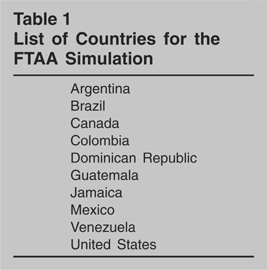
Given the large numbers of countries involved in the FTAA negotiation (34 countries without Cuba), we recommend that instructors limit the number of countries utilized in the simulation. In this simulation, there are 11 stakeholders: 10 country groups and one civil society group to provide input for a number of non-governmental organizations from throughout the region. One to four students may represent the same country, depending on class size and the number of countries chosen. An advantage of having students work in small groups is that students can teach each other throughout the simulation's preparation phase and during the simulation itself. The instructor may allow students to choose a country that they would like to represent, but the instructor must ensure that very important countries, such as the U.S. and Brazil, are represented. In the selection of the countries, we recommend that priority be given to states from different regions (Central America, Caribbean, the Southern Cone and the Andes) and with different economic conditions so that students can obtain an understanding of the variety of regional and national contexts and how they affect the trade position of a respective nation. The 10 countries listed in Table 1 are indicative of a set of countries that reflect geographic and economic diversity.
List of Countries for the FTAA Simulation

Diversity in country selection is also important as it allows for the formation of coalitions as well as defections from proposed coalitions. For example, the members of the Southern Common Market, MERCOSUR—a customs union2
Generally speaking, a free trade area significantly reduces or eliminates tariff and non-tariff barriers to trade among member states. A customs union goes further by establishing a common external tariff for the member states.
In early July 2006, MERCOSUR members agreed to admit Venezuela as its fifth member.
National representatives must focus on the concessions and pressures that hemispheric free trade can present. Their goal is to find the right set of proposals that would allow an agreement to succeed on both domestic and international levels (Putnam 1988). Thus, not only must the FTAA proposals be acceptable to other countries, they must also overcome domestic political pressures from farmers, labor unions, and domestic industries fearful of international free trade.
The non-state stakeholder in the simulation is the Civil Society Committee. A mechanism set up in the FTAA solicits and then delivers comments from non-governmental organizations (NGOs), to the central negotiators through the Committee of Government Representatives on Civil Society established by the Trade Negotiations Committee of the FTAA. The committee is solely consultative, allowing NGOs, labor unions, and small- and medium-sized businesses an opportunity to comment on the issues involved in the FTAA negotiations. The committee may also comment on the impact of a final agreement and oversee its eventual implementation. According to the third draft agreement of the FTAA, agreed to in November 2003, the committee must “facilitate the formulation of positions, suggestions, contributions, and recommendations by civil society for the consideration of governments.”4
The establishment of such a committee in the simulation creates an opportunity for class discussion beyond the national pros and cons of regional trade agreements, allowing an exploration of the global social movement that has emerged in response to what some of these groups have referred to as “corporate globalization.” Students can research those groups that have successfully had their grievances, suggestions, and/or challenges considered by the negotiating governments.
Simulating Specific Provisions of the FTAA
The FTAA is being negotiated through regular ongoing meetings between trade representatives of the different governments, as well as through high-level “summits” in which the national executives of the different governments come together to discuss the progress of the agreement. In 1998, the 34 nations set up a Trade Negotiations Committee (TNC), consisting of vice ministers of trade and foreign relations from every country, to administer the overall negotiating process. Its central purpose is to ensure that the negotiations of specific topics are consistent with the aim of a free trade and market area (Duquette and Rondeau 2004, 62). The negotiating process has been divided into nine separate “working groups” with responsibility over central elements of the FTAA, such as groups on agriculture, on intellectual property rights, and on market access. Since 1998, working groups have met on their respective issues every few months. The TNC has generally met several times a year, with trade ministers meeting once a year to review the progress of the negotiations.
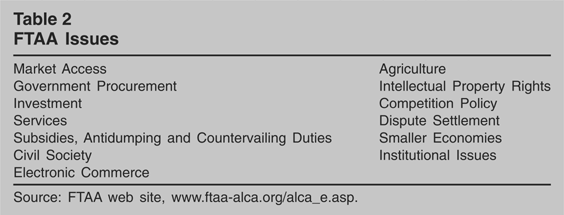
The numerous issues that are addressed in a free trade agreement can overwhelm a scholar, let alone the average class of undergraduates. Thirteen separate issues are being negotiated in the FTAA (see Table 2), each encompassing a broad range of sub-issues that a researcher would have to examine in order to appreciate fully their complexity or prepare official positions in a class simulation.
FTAA Issues

In order to examine the FTAA in the time frame of one or two classes, we suggest that instructors restrict the simulation to specific provisions of the agreement. The simulations that we have run centered on agricultural policy and textiles,5
Textiles-related issues involve many of the areas covered in Table 2 including subsidies, investments, and antidumping and countervailing duties.
Organizing the Simulation
The instructor is the facilitator for the simulation, providing students general background information and suggestions for delegation work on restructuring plans, encouraging student interaction, and moderating the formal presentations of those plans. Member states have already adopted a draft FTAA plan, but final agreement has so far been unattainable. However, the agreement does explicate the objectives of the FTAA, specifically what those objectives are for specific issues. The instructor should have students view the latest draft agreements on the FTAA's web site, and specifically examine the chapters relevant to the issues chosen for the simulation.
Several practical arrangements should be made for the simulation to run as smoothly as possible. For example, it helps to have copies of all country profiles available for students (either as a handout or online through, say, Blackboard). If possible, students should be provided with laptops and/or access to a computer lab and a copier in order to type up and amend proposals. The instructor should make a placard for each participating country as well as one for the Civil Society Committee. If possible, the instructor should book a nearby empty room to serve as an extra location for some of the delegates to meet during one or more of the caucus sessions.
The simulation's voting rules can be quite simple since the students' objective is to reach a consensus in support of a final agreement on two key provisions, in this case agriculture and textiles policies. The declaration of the San José trade ministerial meeting in March 1998 stresses that a guiding principle for a final agreement is that all decisions must be reached by consensus (Duquette and Rondeau 2004, 63).
The Main Phases of the Simulation
The entire simulation can take place in two one-hour class periods or during a three-hour class period. When running the simulation, the instructor can be a little flexible with time because each phase may go more quickly or last a little longer depending on the types of proposals students create and how accommodating or stubborn they are in negotiations.
Phase One: Presentation of National Statements
At the start of class, students should be given about five minutes within their respective national delegation to formulate a uniform strategy for the simulation. During this time, the student groups must select a spokesperson to present their proposals to the class. Each national statement should include the following information:
- Name of country being represented.
- General orientation of their country to the FTAA: supportive, in opposition, neutral? Why?
- Their country's position on the two issues being negotiated. For example, is the country's agricultural sector prepared for the intensification of international competition? Does the country need more time or require exemptions to free trade rules such as substantial subsidies to assist with the costs of transitioning to greater international competition?
The Civil Society Committee will also make a formal presentation.
After the completion of the presentations, students should distribute typed copies of their statements to representatives of the other countries and the Civil Society Committee. This gives students the means to keep track of all the statements from the different countries. Phase One of the simulation should last about 20 minutes.
An alternative suggestion for national proposals is that they be written and made available one week before the simulation. Copies could be distributed on paper or uploaded to Blackboard or a class web site. The simulation can move more quickly, at least initially, if students can access national proposals before simulation day.
Phase Two: Evaluating the Initial National Proposals
In this phase of the simulation, students in their groups should spend five minutes reviewing the various national statements. They must consider which are acceptable and unacceptable with an eye toward forming coalitions with other countries in order to pass or block specific proposals. They should also be thinking about logrolling possibilities and potential amendments to their own or other proposals. At this point, or before the simulation begins, the instructor could also remind students about transitional periods in which, say, trade barriers are gradually removed over a period of years.
Phase Three: Informal Discussions of Initial National Proposals
During this first informal caucus, national representatives circulate to negotiate among themselves. Throughout this and other informal caucus sessions, the Civil Society Committee will attempt to meet with national representatives in an effort to influence the direction of the formal negotiating stages. After 10 to 15 minutes, provide a five-minute break so that students can consolidate their information within their delegation and hone their next negotiating moves. This break may be especially helpful when detailed proposals already exist regarding both the agriculture and textiles issues.
After the brief break, inter-group negotiations continue with the aim of consolidating overlapping proposals and eliminating ideas that are extremely unlikely to pass. If necessary, remind students that they need to develop a consensus and that they have to consider ways of ensuring that all states are minimally satisfied with the final product.
These negotiating stages can be limited to 15 or 20 minutes each, or longer in three-hour classes. By the end of the session, students should type up and distribute new or modified proposals to all of the delegates as well as the members of the Civil Society Committee. This process goes faster if a copier and laptops or a nearby computer lab are available. In addition, to speed things along, each country delegation (and the Civil Society Committee) must designate a typist to write up the proposals.
Phase Four: Formal Discussion of Proposals
This is the first formal session in which students vote on various proposals. To ease the discussion, the instructor can serve as the chair during this phase. Alternatively, and to add realism, students representing Brazil and the U.S. could chair the meeting. It is likely that the national delegations are far from a consensus on any one proposal. If so, this phase of the simulation could be very short, perhaps five minutes. If this occurs, or if a drawn-out discussion (up to 15 minutes) fails to reach conclusion, another caucus session is required. Note that for the sake of realism, the Civil Society Committee is not allowed to take part in these discussions.
Phase Five: Informal Discussions
Another caucus session will, hopefully, allow students to hammer out their differences. The length of this phase of the simulation can last from 15 to 30 minutes or more depending on how close the national delegations are to agreement (and depending on how much time the instructor wishes to devote to the simulation). Using their best judgment, instructors should designate a certain time by which the caucus session should end. By the end of the session, new or modified proposals should be typed up and available for all of the delegates as well as the members of the Civil Society Committee.
Phase Six: Final Vote on FTAA
The second-to-last part of the simulation is the final vote of proposals affecting both agriculture and textiles. Consensus is required for proposals to pass. Since it is assumed that governments have reached agreement in all other substantive areas of the FTAA negotiations (e.g., intellectual property rights, investments, market access), either a consensus is reached on the textiles and agriculture proposals or the FTAA does not come into existence.
Phase Seven: Debriefing the Simulation
The final phase is the debriefing session in which the lessons of the simulation are discussed. The instructor or students may lead the debriefing. A student-led debriefing, for example, might see students (in the country delegation or Civil Society Committee) write down what ideas they found most important from the simulation. Students can draw different lessons depending on whether FTAA passed (and on what terms) or failed (and why). We suggest that students be asked to consider what was and was not realistic about the simulation. After students work in their groups for about five minutes, the instructor can then go from group to group eliciting their findings.
The instructor should fill in any gaps. For example, recalcitrance on the part of several countries (including the U.S., Brazil, and Venezuela) now virtually ensures that FTAA negotiations will drag on into 2007 when U.S. Trade Promotion Authority will have expired. Students should recognize this as a problem (if you want FTAA to pass, do it quickly) or an opportunity (if you want FTAA to fail, delay the negotiations). The instructor might also need to point out the possibility of an “FTAA-lite,” an idea that surfaced during the Miami FTAA Ministerial in November 2003. FTAA-lite would allow members to pick and choose the depth of their obligations to the trade agreement. The U.S., for example, could keep most of its agricultural barriers and subsidies and not reform its antidumping laws. Likewise, Brazil could go slow on intellectual property protection, maintain tariffs on some manufactured goods, and selectively liberalize services. The instructor could point out the merits and shortcomings of such an arrangement. As Hufbauer and Yee (2005) have noted, for example, as sensitive sectors are taken off the bargaining table, the potential payoff from the FTAA is progressively eroded.
In short, the debriefing process should review the educational high points of the simulation. Whether student- or instructor-led, the debriefing session should drive home the important political, economic, and social lessons that did—and did not—surface during the simulation. It is also a final opportunity for the instructor to answer any of the students' questions.
In terms of problems that can work themselves into the simulation, the instructor should be prepared to deal with the following issues. First, the quality of national statements (phase one) and substantive proposals may be weak and provide the rest of the class little to work with. Second, as with any simulation, students may not represent their country accurately. If this is a result of poor research, it is difficult to get around the problem. One way is to grade performance during the simulation. In addition, if students are gently reminded to play their roles realistically, they usually return to proper behavior. It also helps to require student papers be turned in before simulation day. Third, when the formal meetings take place—when proposals are made and voted on—the Civil Society Committee members may feel left out since their only role is to observe. We suggest that they be able to pass notes discretely to national representatives if they wish.
Preparing Students for the Simulation
The overall goal of the simulation is for students to develop, debate, and critically examine the proposals from, and expectations for, each country in the construction of the FTAA. As noted earlier, students should attempt to devise plans that would benefit their respective countries while simultaneously contributing to the building of a consensus in support of the FTAA. Once students have their assigned roles, they need to consider the potential benefits and risks to agreeing to the FTAA. They should consider the politics of their national leaders (pro or con FTAA), the level of opposition in their respective legislatures and/or in civil society, and any concessions that their country would require in order to agree to the specific provisions of the FTAA being proposed in the simulation.
To prepare students for these considerations, both the instructor and the students have work to do. For the instructor, in the weeks preceding the simulation, it is important to provide the essential background information necessary for students to appreciate the context of the proposed agreement. Such background information should include an examination of: free trade and protectionism, economic globalization, regional trade agreements, NAFTA and the FTAA, the major state and non-state actors that are relevant for the FTAA agreement, and some background on the divisions within Latin American states and between Latin America and the U.S. The instructor should also provide appropriate readings. Important journals that cover Latin American economic and political issues include Latin American Perspectives, Latin American Weekly Reports, Latin American Research Review, North American Congress on Latin America and Latin American Politics and Society. In addition, the Latin American Information Network Center (http://lanic.utexas.edu/) offers an excellent web site which provides detailed information on every country in the hemisphere. More potential sources are listed in Appendix 1.
For students to be well prepared for the simulation, we recommend grading student performance during the simulation. One simple method is to grade students using plusses or a zero depending on their oral contributions. Other grading schemes can be used prior to the simulation. For example, a simple quiz could ask country-specific questions such as GDP, population size, and general trade orientations (is your country likely to support FTAA? Does your country have a favorable trading relationship with the U.S.?).
In terms of pre-simulation student work, we also highly recommend a four- to six-page paper (double-spaced) to be completed a week or more before the simulation so that the instructor can provide a grade (and thus feedback) before the simulation. An early paper deadline could also provide an effective check on the quality of research being conducted. Since we recommend two or more students per country, this is a co-authored paper. The paper should include the following elements:
a) National policy preferences: For students to feel comfortable about their own country's attitudes toward FTAA, instructors should require students to consider political, social, and economic factors that influence their country's attitudes on the agriculture and textiles issues. Students should also be aware that lively debates may exist within their own country. In other words, their country's final approach toward FTAA is contingent on such things as trends in the health of the economy, the dynamics of opposing interest group pressures, or changes in the government itself. For example, support for FTAA suddenly became more questionable in Ecuador when anti-globalization protesters forced Ecuador's president out of office in April 2005 and in Bolivia when anti-globalization activist Evo Morales was elected president in January 2006.
b) Negotiating strategy: Aside from exploring the dynamics affecting national policy preferences, students should also explain in the paper what they—as representatives of their country—would like to see in an FTAA agreement. Some of the questions that students should consider include:
[bull ] Under what conditions would their country support FTAA?
[bull ] Which policies are worth fighting for and which could be safely bargained away?
[bull ] Do bilateral trade deals or smaller regional trade agreements (sub-hemispheric)—or even no trade deals at all—offer better opportunities and fewer risks than FTAA?
c) An opening statement: Part of the paper should include an opening statement (a half page to three quarters of a page but no longer) that is presented orally in the first phase of the simulation.
Students on the Civil Society Committee must also prepare an opening statement that addresses their particular concerns. Students should address questions such as the following: Does the committee have fundamental problems with free trade agreements? Under what conditions would it support FTAA? Which policies are considered central and tangential to the committee? The Civil Society Committee's paper, in contrast to the rest of the class, must address the policy preferences of one or more specific NGOs of their choosing.
Author Bios
Bob Switky is associate professor at the University of Nebraska at Kearney. He and Bart Kerremans are co-authors of The Political Economy of Regional Trade Blocs (Ashgate Publishers). He is also co-author (with W. Raymond Duncan and Barbara Jancar-Webster) of the IR textbook World Politics in the 21st Century (4th edition forthcoming from Houghton-Mifflin).
William Avilés is associate professor of political science at the University of Nebraska at Kearney. His work on Columbian civil-military relations, political violence, and U.S. foreign policy in Latin America has been published in Latin American Perspectives and the Journal of Latin American Studies. His book Global Capitalism, Civil-Military Relations and Democracy in Colombia (SUNY Press, 2006) examines the relationship between capitalist globalization and political change in Colombia.
Appendix 1
Suggested Reading Assignments
All students should have at least some baseline knowledge about FTAA and NAFTA. We recommend assigning two or more of the following articles:
Jane Bussey, “Trade Negotiations Are Everywhere, But Can They Reach Fruition?,” Foreign Policy (January 2005).
Mario F. Carranza, “MERCOSUR and the End Game of the FTAA Negotiations: Challenges and Prospects after the Argentine Crisis,” Third World Quarterly 25 (March 2004): 319–37.
Jorge G. Castañeda, “NAFTA at 10: A Plus or a Minus?” Current History 670 (February 2004): 51–5.
John Cavanagh, Sarah Anderson, Jaime Serra, and J. Enrique Espinosa, “Happily Ever NAFTA?” Foreign Affairs (September/October 2002): 58–65.
Michel Duquette and Maxime Rondeau, “The Puzzle of Institutionalizing a Free Market Continental Zone,” in Free Trade Area of the Americas?, eds. Paulo Vizentini and Marianne Wiesebron, 59–76 (London: Zed Books, 2004).
Richard Feinberg “Regionalism and Domestic Politics: U.S. Latin American Trade Policy in the Bush Era,” Latin American Politics and Society 44 (January 2002).
Aparajita Gangopadhyay “South American Free Trade Area or Free Trade Area of the Americas? Open Regionalism and the Future of Regional Economic,” Latin American Politics and Society 44 (January 2002).
Andy Klom “Latin America and International Trade: Regionalism and Beyond,” Latin American Research Review (Jan. 1, 2005).
Jose Manuel Salazar-Xirinachs, “The FTAA Process: From Miami 1994 to Quebec 2001,” in Toward Free Trade in the Americas, eds. Salazar-Xirinachs and Maryse Robert (Washington, D.C.: Brookings Institution Press, 2003).
David J. Sousa, “Democracy and Markets: The IPE of NAFTA,” in Introduction to International Political Economy, Third Edition, eds. David N. Balaam and Michael Veseth, 264–80 (New York: Pearson-Prentice-Hall, 2004).
Internet Sources of Information
Aside from traditional library resources, the Internet is extremely valuable. The Internet offers a large number of web sites devoted to trade in the Americas including the NAFTA and FTAA agreements. For better or for worse, the large majority of web sites oppose FTAA. Nevertheless, as a starting point, we recommend the following web sites. Students can search the Internet for sites that directly address the two main topics of the simulation (agriculture and textiles).
Pro-FTAA Groups & Official Sources
[bull ] International Trade Association: www.mac.doc.gov/ftaa2005/.
[bull ] FTAA Official home page: www.ftaa-alca.org/alca_e.asp. This site contains government contact points. If students act early, they can call ahead, they may be able to get the information they need.
[bull ] The Third Draft FTAA Agreement (November 20, 2003): www.ftaa-alca.org/Ministerials/Miami/Miami_e.asp
[bull ] Civil society reports can be found at www.ftaa-alca.org/spcomm/soc/3Brazil_e.asp#Market_Access.
[bull ] FTAA official web site list of subjects from A to Z: www.ftaa-alca.org/index_e.asp.
[bull ] Latin Business Chronicle: www.latinbusinesschronicle.com/links/trade/ftaa.htm
[bull ] U.S. Chamber of Commerce for FTAA: www.uschamber.com/government/issues/international/ftaa.htm
[bull ] U.S. Department of Agriculture, e.g., on FTAA benefits for U.S. farmers www.ers.usda.gov/publications/agoutlook/apr2000/ao270e.pdf.
[bull ] U.S. Department of Commerce: www.commerce.gov/
[bull ] U.S. Trade Representative site for FTAA: www.ustr.gov/Trade_Agreements/Regional/FTAA/Section_Index.html. See also the web site of the U.S. Trade Representative (USTR): www.ustr.gov/.
[bull ] Canadian government(s): www.dfait-maeci.gc.ca/tna-nac/ftaa1-en.asp
[bull ] Government of British Columbia: www.cse.gov.bc.ca/ProgramsAndServices/Trade/FTAA.htm
Online Anti-FTAA Organizations
[bull ] The AFL/CIO: www.aflcio.org/issuespolitics/globaleconomy/ftaamain.cfm
[bull ] www.ftaa-alca.org/
[bull ] The Alliance for Responsible Trade, www.art-us.org/. The web site contains an alternative draft of the FTAA agreement: “Competing Visions for the Hemisphere: The Official FTAA Draft versus Alternatives for the Americas.”
[bull ] www.citizen.org/trade/ftaa/
[bull ] www.faireconomy.org
[bull ] Global Exchange: www.globalexchange.org/campaigns/ftaa/
[bull ] www.healthgap.org/camp/ftaa.html
[bull ] www.ftaaresistance.org/
[bull ] Oxfam America: http://ga0.org/campaign/ftaa/explanation
[bull ] http://stopftaa.org/
Online Evaluative Studies of NAFTA
[bull ] “The High Cost of ‘Free’ Trade: Lessons from NAFTA,” Alliance for Responsible Trade, www.art-us.org/.
[bull ] Carnegie Endowment for International Peace, “NAFTA's Promise and Reality: Lessons from Mexico for the Hemisphere,” www.ceip.org/files/publications/NAFTA_Report_full.asp.
[bull ] U.S. General Accounting Office: www.gao.gov/cgi-bin/getrpt?GAO-03-700T
[bull ] World Bank's “Lessons” from NAFTA: http://wbln0018.worldbank.org/LAC/LAC.nsf/ECADocByUnid/32E02C48D1A7695685256CBB0060CA65?Opendocument
Sources on Latin American Countries
Academic Journals: Journal of Inter-American Studies and World Affairs (now titled Latin American Politics and Society); Journal of Latin American Studies; Latin American Research Review; Journal of Inter-American Economic Affairs; NACLA Report on the Americas; Latin American Perspectives; Bulletin of Latin American Research; Third World Quarterly; Foreign Affairs; Foreign Policy; Current History (especially February or March edition each year, which is dedicated to Latin America); Journal of Democracy; Latin American Weekly Reports.
Useful web sites
- Latin American Network Information Center: http://lanic.utexas.edu/
- For U.S. State Dept. policy toward the western hemisphere and toward specific countries go to www.state.gov/www/regions/wha/index.html.