In an essay such as this on science and politics in a PSA session on science and politics one might expect to encounter some science and politics. Even so, there may be more here than expected. I had best lay my cards on the table. In science, I’m a realist; or, more to the point, I think scientific objectivity is always possible and often achieved. But there are important instances of failure. In politics I am a socialist. Science and politics have little to do with one another much of the time, but on occasion they are intimately related. Medical research is a case in point. The relations between medical science and politics are complex, the epistemic and social problems that arise are serious, and the solution that I will outline is bound to be contentious, because it aims to solve an epistemic problem through political means.
Anyone who mixes politics with science is immediately charged with naivete or of having sinister motives. Lysenko is thrown in his face. It might surprise readers to find that I am happy to keep science and politics apart—at least as far as this issue is concerned. I’m going to discuss intellectual property rights and the harm they are doing to medical research. Politics intruded on science when it introduced patents. Keep this fact firmly in mind when thinking who mixed science and politics in the first place. Though I don’t like to think of myself as a reactionary, in this case I am indeed reacting to a terrible situation brought about by a social institution. And I feel perfectly justified in using all the tools available, both epistemic and political, in trying to set things right—for the sake of science and for the sake of society. The argument to follow will depend (in part) on an analogy between medical research on the one hand and socialized medicine on the other. I will begin with the latter.
1. Two Principles
Long before the Bolshevik Revolution, socialists of all kinds agreed on two fundamental principles. Though aimed at the organization of society, they will turn out to apply to the organization of science as well.
1. Socialism is the one and only way to achieve social justice.
2. To best achieve efficiency and effectiveness, any institution should be run along socialist lines.
The history of these two principles is remarkable. A century ago all socialists—Marxists, Social Democrats, Fabian socialists—would have embraced both. Though neither implies the other, they were taken to be intimately linked. The Bolshevik Revolution took its toll, however, with one principle seen as holding at the expense of the other. The industrialization of the Soviet Union in a single generation and the huge growth in its economy—to the point where it could take on and defeat Hitler—were stupendous achievements. There was near universal agreement among socialists and antisocialists alike that the second principle is indeed true: socialism is by far the most efficient way to run an economy. The major complaint was that the first principle is hopelessly false. Socialism meant the horrors of Stalinism, and that entailed anything but social justice, no matter how you defined it.
More recent times have seen a complete reversal of opinion. Now it is widely conceded that the first principle (justice) might be right but that the second (efficiency) is hopelessly wrong. The collapse of the Eastern Bloc has resulted in the common view that socialist economies are so inefficient that they simply buckle under the weight of their own bureaucracies. The mad-dog capitalism of the Thatcher-Reagan era strikes many as terribly unjust with its pauperization of huge numbers of people throughout the globalized world. Yes, socialism would be more just, many will concede, but it's just too inefficient. That's the received wisdom one can often find among academics, in the editorial pages of most newspapers, and in chitchat at the local café. But is it right?Footnote 1
In several of the more industrialized countries, medicine is given a very different role to play in the economy. Specifically, medicine is socialized. The citizens of France, Germany, Denmark, Canada, and many other countries support broadly free-enterprise policies, but not when it comes to health. Medical care is provided to all on the basis of need, not ability to pay. Not all societies take this view. The United States is the striking exception among richer nations. It alone takes medical care to be just another commodity, to be bought and sold like autos and iPods.
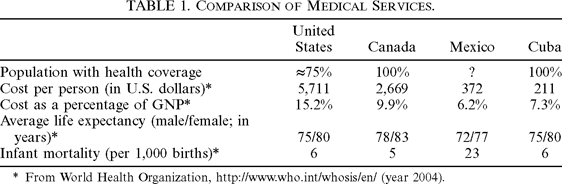
When we compare the nature of medical services in the United States with that in other nations, we find some striking contrasts. Canada, which is typical of countries with socialized medicine, has a health care system in place with several notable features: it costs much less than the U.S. system, it covers the whole population (compared with only three-quarters coverage in the United States), and it yields healthier people. Table 1 includes two rich countries and two poor ones. One of each pair has a socialized system of health care (Canada, Cuba); the other does not (United States, Mexico).

| United States | Canada | Mexico | Cuba | |
| Population with health coverage | ≈75% | 100% | ? | 100% |
| Cost per person (in U.S. dollars)* | 5,711 | 2,669 | 372 | 211 |
| Cost as a percentage of GNP* | 15.2% | 9.9% | 6.2% | 7.3% |
| Average life expectancy (male/female; in years)* | 75/80 | 78/83 | 72/77 | 75/80 |
| Infant mortality (per 1,000 births)* | 6 | 5 | 23 | 6 |
* From World Health Organization, http://www.who.int/whosis/en/ (year 2004).
Are there any conclusions we can draw from these data with respect to the two principles I mentioned at the outset? Obviously. The first principle concerning social justice is clearly upheld in socialized medicine. There is full coverage, regardless of one's ability to pay. Even more remarkable, given today's dominant opinions on matters economical, the second principle concerning effectiveness and efficiency is also upheld. Socialized medicine is able to provide full coverage and get better results for less money. In sum, socialized medicine is one of the twentieth century's great success stories.
So much for medicine. What about medical research? Socialized medicine applies what we have discovered in a highly efficient and fair manner. But what about the discoveries themselves? How should we organize medical research so as best to produce medical knowledge in a highly effective way?
Currently, medical research is carried out by scientists who are funded typically by public sources (e.g., government agencies, foundations), by private ones (e.g., pharmaceutical companies), or by some mix of the two. Over the past 25 years, private funding has grown enormously, and so has its ability to direct and control research. Perhaps this is a good thing. The entrepreneurial spirit is often said to accomplish magical results. Maybe it is doing so in medicine. Then, again, maybe not. We shall soon see.
2. Current Medical Research
There have been a number of studies of what gets published in medical journals. The results are often surprising and disturbing. One of the most recent is Bekelman et al. Reference Bekelman2003. The authors arrive at quite pessimistic conclusions about the influence of corporate funding. Their results incorporate much of the previous work done in this area. Some examples will illustrate the cause for concern.
Richard Davidson (Reference Davidson1986) examined 107 published papers that compared rival drugs; the drug produced by the sponsor of the research was found to be superior in every single case. If we took the probability of any particular outcome when comparing two products to be favorable to the sponsor to be 50%, then the chance of getting 107 favorable outcomes in a row is one in 2107, the same as the chance of tossing heads 107 times in succession. (There are times when “intelligent design” is the right hypothesis.) Friedberg et al. (Reference Friedberg1999) found that only 5% of published reports on new drugs that were sponsored by the developing company gave unfavorable assessments. By contrast, 38% of published reports were unfavorable when the investigation of the same drugs was sponsored by an independent source.
Stelfox et al. (Reference Stelfox1998) studied 70 articles on calcium-channel blockers. The articles were classified as favorable, neutral, or critical: 96% of the authors of favorable articles had financial ties with a manufacturer of calcium-channel blockers, 60% of the authors of neutral articles had such ties, and 37% of authors of unfavorable articles had financial ties. Only two of the 70 published articles revealed the financial connection.
Clearly, something is very wrong. The obvious reaction—but is it the right one?—is to regulate. This is exactly what many do, including the leading medical journals. The International Committee of Medical Journal Editors (ICMJE) has been meeting annually since 1978. This group includes the editors of the Journal of the American Medical Assocation, the New England Journal of Medicine, Lancet, Canadian Medical Association Journal, MEDLINE, and others, about a dozen leading journals in all. They produced and occasionally update the “Uniform Requirements for Manuscripts Submitted to Biomedical Journals: Writing and Editing for Biomedical Publication.”Footnote 2 Issues covered by these guidelines include:
• Patient privacy, etc.
• Conflict of interest (disclosure required)
• Obligation to register trials (this is a new requirement)
• Possible required independent testing in the future
Recent events illustrate how hard it is to enforce the good intentions of the regulations. Cohen et al. (Reference Cohen2006) make the claim that women who discontinue antidepressant use during pregnancy are much more likely to relapse into depression. The authors made a limited conflict of interest disclosure. A subsequent letter to JAMA from Adam Urato said that “readers [should] be aware that the majority of the authors have been paid by companies that manufacture antidepressants, and that the lead author appears to have received support from at least 8 such companies. … In 2004, Dr. Cohen declared that he received support from AstraZeneca, Berlex, Eli Lilly [etc., and similar remarks about other authors]. … In sum, all 9 of the physician coauthors have been paid by antidepressant manufactures, while only 2 reported disclosures” (JAMA 296 [July 12, 2006]: 166).
In the issue of August 23/30, 2006, Catherine DeAngelis, the editor of JAMA, remarked on the general situation. She was clearly fed up and complained that marketing is dominating science; that there is often a refusal to provide full data; that sometimes only 6 months of a 12-month trial will be reported; that harmful effects are not being reported; and that she has heard rumors to the effect that some corporate-funded results are not being submitted to JAMA, now that the journal requires independent statistical analysis. DeAngelis wondered aloud What can be done? but offers a pessimistic answer:
Leveling sanctions against an author who fails to disclose financial interests by banning publication of his or her articles for some time period would only encourage that author to send his or her articles to another journal; it cleans our house by messing others. So what about all editors, or at least a group, such as the International Committee of Medical Journal Editors, agreeing to share the information and jointly to ban the offending authors? Those who suggest this approach have not considered the risk of antitrust suits. (DeAngelis Reference DeAngelis2006, E2)
3. DeAngelis's General Orientation
In her forceful piece, DeAngelis paints a picture of a strong regulator. That is, she is seriously concerned with for-profit medicine and she proposes a number of regulations to deal with the problems. Her general orientation is that properly regulated for-profit medicine is a good thing. I’m sure that speaking as the editor of JAMA, she speaks for a great many. She makes three general claims in her August 2006 article; I’d like to take up each of them.
First, she says for-profit medical research has been beneficial; there are more new products and treatments coming from private than from public funding. This is a widespread belief, but is it true?
During the period 1998–2002 the Food and Drug Administration (FDA) approved 415 new drugs and classified them as follows:
• 14% were new innovations;
• 9% were significantly improved old drugs;
• 77% were no better than existing drugs.
The last of these are the so-called “me too drugs.” They are copies of existing drugs (not exact copies, since they have to be different enough to be patentable). The FDA is obliged to grant approval as long as a new drug is not known to be harmful and is “effective,” that is, does better than a placebo in a clinical trial. In 2002 the FDA approved 78 new drugs. Only seven were classified as improvements over older drugs. Not one of these seven was produced by a major U.S. drug company.Footnote 3 So much for the bold entrepreneur who benefits us all, thanks to his risk taking. The only risks being taken are with the public's health.
DeAngelis's second claim is that financial interests can and do corrupt research. Agreed. Given the evidence now available, only the willfully ignorant could deny it.Footnote 4 Unfortunately, all she has in mind when considering corrupted research is fraudulent claims that stem from a direct conflict of interest. This is a huge problem and she is right to tackle it, but there are several related issues that she omits. The most important of these is that private funding skews research toward patentable solutions to health problems. For instance, for-profit research will ignore exercise, diet, and environmental factors when investigating health issues, since research into these will not result in intellectual property rights. There will be a preference for ongoing treatments for chronic conditions rather than, say, vaccines. More profitable problems will be investigated over those involving people unable to pay high royalties (e.g., high blood pressure over malaria). There will also be motivation to find solutions to industry-created problems, such as Eli Lilly's Sarafem to treat premenstrual dysphoric disorder. Outright corruption is a serious problem, and DeAngelis is right to take aim at it. The skewing of research direction, however, might be even more significant to the well-being of science than the falsified data often submitted.
DeAngelis's third claim is actually more of an admission. She thinks the problem of nondisclosure might be uncontrollable, since we can’t check everyone and we can’t punish cheaters, because of potential lawsuits.
4. Disclosure Is No Panacea
What good is conflict of interest disclosure anyway? We act as though it's a panacea: If we could get researchers truly to disclose their economic relations with the various parties involved, then we could solve all these problems. Again, the belief is widespread, but is it right? Let's consider what's involved. In particular, what are we to make of the claims in the published results of a clinical trial when financial interests are at issue?
If the author(s) of a research report (honestly) has nothing to disclose, then all is well; we can trust the results, at least with respect to bias due to financial interests.
If the author(s) does disclose a financial interest, then what are we to think of the claims made in the published article? There are four different attitudes we might adopt:
• Don’t worry; financial interests have no effect on the quality of research.
• Reject the results as untrustworthy and don’t accept the article for publication.
• Accept the claims, but with an appropriately reduced level of confidence in their reliability.
• Subject the claims to a second, independent test.
None of these seems in the least a reasonable response. Anyone who believes the first is a fool. The second is so drastic that it would end all research in which the participants had any commercial interest in the result. The third seems reasonable, since it's what we do when considering claims in pure science. For instance, I’m 80% sure the neutrino has mass. But what it means is that I’m completely confident in the physicist's honesty but not completely convinced of her line of reasoning. In cases of a drug, this is reversed. If the data are as reported, then I’m convinced of the conclusion, but I don’t completely trust the reporting of the data. If we know that everyone is a little dishonest at $1,000 and quite dishonest at $1,000,000, then I might know how to weigh things objectively. But individuals vary wildly. The final option is out of the question since, at millions of dollars per trial, the public would in effect be duplicating the original work and paying the costs, whereas private funders would reap the benefits that come from owning the intellectual property rights.
A moral one might draw is that all testing, including the design and analysis of clinical trials, should be done by an independent body right from the start. This has on occasion been suggested. It would be yet another regulation, one that is quite powerful and promising, but it has its own problems that I won’t pursue here.Footnote 5
Most people who worry about the disclosure problem (including the ICMJE) are trying to fix things by means of regulation. But this seems rather unpromising, or at least somewhat limited. Disclosure rules are always a step behind. And those rules often have little or no bite. Moreover, even if perfected, they may be largely useless, according to DeAngelis's admission concerning legal matters.
The even bigger problem is that regulations in general don’t address the problem of seeking only patentable solutions to medical problems. At best they would ensure honesty in justification. But they leave a bias in discovery (i.e., nonpatentable approaches are discouraged), and this bias is intolerable. Some of the best solutions to health problems will be ignored—consciously, deliberately—since they yield no intellectual property rights.
5. Proposal
I wish to offer a simple solution to the cluster of problems that I have raised. The problem is epistemic: how can we organize medical research so as to produce the best solutions to health problems? The solution is political. Perhaps a better way of putting it is to say that the problem and the solution are at once both political and epistemological.
Socialize research. Eliminate intellectual property rights in medicine. Make all funding public (including government and independent foundations and charities).
In most industrialized Western countries, there is some sort of public health system in place. The public view is that this is one area of the economy that should not be treated as a commodity. Medical care should not be available on an ability to pay basis, but rather is something like a right of citizenship. This is not so in the United States, which is quite anomalous in this regard. American citizens are understandably horrified with their situation, but the combined forces of a powerful medical establishment, insurance companies, and corrupt lawmakers keep the system in place.
We saw at the beginning that when it comes to fairness and efficiency, socialized medicine is supreme. I want to draw on this now by pointing out the analogy between socialized medicine, on the one hand, and socialized medical research, on the other. Not only are they analogous in the sense of social justice and in the sense of efficiency, but the socialization of medical research fits naturally into any system of socialized medicine. Any market society (Canada, Europe) with socialized medicine must see for-profit medical research as anomalous. Like medicine itself, it should be roped off from the rest of the economy on grounds of fairness, but above all on grounds of efficiency and effectiveness. Medicine is not part of the market economy, and medical research should not be either.
Let me pause for a moment and sum up things so far. The argument has two main ingredients. The first is the empirical evidence that the quality of current medical research is seriously flawed. There is evidence of corruption and there is evidence of a skewed research agenda, one that aims only at profitable solutions to health problems rather than the most beneficial. Second, there is a deep analogy with existing health care systems in many countries, an analogy between socialized medicine and socialized research. Given that socialized medicine is demonstrably better and given the demonstrable problems with market medical research, the very reasonable conclusion to draw is that medical research should be socialized.
There is a worry that I would like to head off. Someone might argue that my view leads to the following: If the argument for socializing medical research is a good one, then, by a similar argument, we should socialize all research; there should be no patents in any field. This will be seen as a reductio ad absurdum by some, who will conclude that socialized medical research is wrong. And it will be embraced by others, who want everything nationalized. I reject both of these all-or-nothing stances. One lesson we have learned in political economy is that all or nothing is a mistake. Neither public ownership of everything nor complete privatization has proven optimal. Mixed economies are the most successful. Which segments best fall on which side is an empirical matter. It seems that education, health care, and mass transit are best in public hands, whereas the clothing industry and restaurants are best in private hands. I do not know how electronics research would fare if patents were eliminated. Nothing I say about medical research implies that intellectual property rights either help or hinder the quality of electronic inquiry.
6. What Is Scientific Method?
Scientific method covers an awful lot of stuff. At a fairly high level, we have proposals about its nature ranging from Baconian inductivism to Popper's falsificationism to subjective Bayesianism, and so on. I have no intention of wading into these controversies. Let me instead focus on scientific method at a lower level. This is the level at which science creates its own methods. The process is simple, at least from a logical point of view. A discovery is made; we realize that what is discovered has an effect on the nature of testing; so we alter the methods of testing to take the discovery into account. In short, the discovery of a fact leads to the institution of a new methodological norm.
A classic example is the discovery of the placebo effect. On realizing the implications for testing things like drugs, it was realized that test subjects should be unaware of what they are taking, so blind tests were instituted. Further refinement has led to the full randomized clinical trial, where subject and examiners are both unaware of who is taking the test drug and who is taking the placebo.
Philosophers of science are, of course, very interested in scientific method. Unfortunately, they focus mainly on high-level issues such as novel predictions, the importance of falsifiability, and so on. Low-level methods, how they come about, how they evolve, should be the subject of much more philosophical investigation. There are lots of wonderful examples: Optical knowledge has greatly influenced how we make observations by microscopes and telescopes. The discovery of various chemical assays led to new methods of identification. Discovery of various software properties has led to computer proofs of various mathematical theorems. In the social realm, the discovery of particular forms of male bias and the realization that they cannot be eliminated by telling people “just be open-minded” has led to the recruiting of female scientists. These methodological changes have led to improved science.
The last example, the recruitment of female scientists, is particularly interesting. It can be seen as highly political. And, of course, it was. There were battles galore over affirmative action. Much of it had to do with a sense of fairness; women ought to have their share of the jobs and were cheated out of them in the past. But the recruitment of women into the sciences should also be seen in terms of epistemology. We have learned something about how the world works (placebo effects, optical illusions, male bias), and this led to methodological change (blind tests, tissue-staining techniques, recruitment of rival theorizers with different biases). Sometimes methodological response to the discovery of new facts will have nothing whatsoever to do with political and social concerns—but sometimes it will. Why should we think a political response could never be the right methodological response, when we want to improve the ways we acquire knowledge?
The evidence I gave at the outset showing the influence of corporate funding on medical research should be seen as the empirical discovery of a fact, namely, that corporate funding corrupts medical research. I have proposed a methodological change: eliminate patents. The pattern is the same: the discovery of a fact can lead to a new methodological norm. Of course, those who propose new regulations also want new norms. It's just that they want different norms than I want. So now it's a question of which response is the best one to the initial problem.
Just in case there is principled resistance to this proposal by those who refuse to countenance politics mixing with science, let me remind them that I did not start this. Long ago, politics got into science by instituting the system of patents. For those who would feel better about it, I could put it this way: Get politics out of science by getting rid of intellectual property rights.
Normally, methodological issues are internal to science. Science governs itself and institutes methodological changes on its own. But this need not always be so. In some cases, good scientific method requires political intervention, and that means taking the case to the wider society: scientists must become (part-time) politicians. At the outset, I described the twin beliefs of socialists long ago. Social justice and efficiency should be our twin targets once again, in society, in general, and in medical research, in particular.