


Introduction
The contemporary revitalization of xiqu (戏曲, Chinese traditional opera) has increasingly become a site for rethinking the ontology of performance and the intercultural vocabulary through which it is interpreted.Footnote 1 Within this broader renaissance, kunqu opera – renowned for its lyrical restraint and stylized precision – has emerged as a fertile ground for negotiating the tension between heritage continuity and aesthetic innovation.Footnote 2 Recent works such as Shishuo Xinyu [A New Account of Tales of the World] explore this negotiation through the evocation of vast imaginative worlds. These productions raise fundamental questions about the relationship between materiality, embodiment, and imagination that lie at the heart of xiqu aesthetics. This article approaches contemporary kunqu performance as a locus where aesthetic practice and theory meet in mutual articulation. Rather than treating xiqu merely as an object of interpretation within western performance frameworks, it considers kunqu’s indigenous aesthetic logic as a resource for rethinking the ontology of theatre itself. The central question is how kunqu – through its own epistemology of embodiment, rhythm, and imagination – might generate new perspectives on the relationship between materiality and perception, illusion and participation, tradition and renewal. In this sense, the paper develops what may be called an intercultural hermeneutic: a framework that takes xiqu’s internal principles as theory, while situating them in dialogue with global performance discourse.
Within this interpretive horizon of kunqu, the Shishuo Xinyu project offers a particularly fertile case. Produced by the Jiangsu Province Kun Opera Theatre since 2018, this ongoing cycle of short adaptations transforms fragmentary Wei-Jin anecdotes into a contemporary performance experiment. By revisiting the refined eccentricity and contemplative freedom of Wei-Jin culture, the project translates literary sensibility into xiqu theatrical form. Attention is here focused on three vignettes: Fang Dai (Visiting Dai); Wu Jue (The Last Dance); and Tiao Zheng (Tuning the Zither). These scenes provide a record of aesthetic inheritance, as well as a field of theoretical experimentation, where embodied performance itself becomes a mode of thinking. With each episode standing as an aesthetically unified statement, the full sequence illuminates Wei-Jin literary self-consciousness and the era’s recognition of the individual as an aesthetic subject.Footnote 3
Such a perspective resonates with the classical literati’s emphasis on sincerity, spontaneity, and the intermingling of intellect and emotion. Yet, as in Fang Dai, Wu Jue, and Tiao Zheng, these principles extend beyond pure formalism to pose critical questions about moral conviction, freedom, and the confrontation with life’s brevity – issues no less urgent for contemporary viewers than they were for the Wei-Jin aristocrats described by Lu Xun.Footnote 4 In exploring this dynamic, Fang Dai sets up a night journey in swirling snow to reflect spontaneous desire versus societal constraints; Wu Jue uses a mirror to highlight existential fragility; and Tiao Zheng frames the zither’s sonic protest against stifling political structures. In all three, the intangible illusions interact with the main actor Shi Xiaming’s onstage subjectivity, suggesting a deeply intersubjective environment linking performer, historical spirits, and spectators.
By placing kunqu’s epistemology in dialogue with Irina Rajewsky’s concept of intermedial reference and Erika Fischer-Lichte’s theory of the autopoietic feedback loop, this article is designed to explore how xiqu aesthetics articulate a distinct, relational model of theatrical mediation. While seeking to foreground xiqu aesthetics as a theoretical interlocutor capable of extending global debates on intermediality, embodiment, and performative ontology, it investigates how these three short kunqu vignettes articulate a ‘cultural intervention’, generating fresh dialogues on identity, mortality, and artistry in a milieu that transcends old dichotomies between heritage and modernity.Footnote 5 Further, this article treats xiqu aesthetics as conceptual resources in their own right – capable of reframing global debates on theatrical presence, embodiment, and intermediality. By situating the Shishuo Xinyu vignettes within broader intangible heritage debates, akin to those shaping Balinese dance or Japanese Noh modernization, it illustrates the potential for classical forms to generate renewed cultural agency.
Xiqu Aesthetics in Global Dialogue
The aesthetic vocabulary of xiqu constitutes a self-sufficient theoretical system that has long articulated the dynamics between body, material, and imagination. Core principles such as codified formalization, using the virtual to evoke the tangible, vital resonance, and strategic blankness shape both the ontology and the semiotics of kunqu. These principles describe a logic of transformation through which the performer recreates reality by means of symbolic action.
The Logic of Transformation: The Codified Formalization and Virtual–Tangible Reciprocity
Wang Guowei first formalized this logic in his theory of aesthetic realm, asserting that the highest level of Chinese performance art lies in the generation of an affective space where emotion and scene mutually constitute each other. His observation that ‘likeness in spirit, not in form, makes it true’ foreshadows the modern notion of performative mimesis as a relational act.Footnote 6 In xiqu, the chengshi (程式, codified formalization) operates precisely within this paradox: codified gestures and vocal patterns, while formally fixed, allow infinite variations of rhythm, energy, and mood, thereby creating vitality through repetition.Footnote 7
The interplay of xu (the virtual) and shi (the tangible) underpins the xiqu ontology of performance. The principle yixu tuoshi (以虚托实, using the virtual to evoke the tangible) posits that illusion is not opposed to reality but is its very mode of manifestation.Footnote 8 Specifically, xiqu actors rely on symbolic gestures to enact virtual actions: without real objects – or using only the simplest props – they creatively simulate or evoke the material world through codified gestures. A whip, lightly held, becomes a galloping horse across the vast grasslands; a turn of the wrist or a shift in weight conjures doors opening and closing, or the ascent and descent of invisible stairs.Footnote 9 Through such economy of means, the stage becomes a site of perceptual imagination, where suggestion activates the spectator’s sensory and emotional participation. As Baihua Zong observes, this dialectic of ‘void and plenitude’ in Chinese aesthetics originates from a cosmology of qi transformation, in which rhythm generates visibility and being.Footnote 10 Yet, as recent scholarship emphasizes, Zong’s aesthetics also arises from a semiotic ontology that views art as a symbolic form. Drawing on and transcending Cassirer’s ‘philosophy of symbolic forms’,Footnote 11 Zong situates the artistic realm within the dynamic process by which external forms become vehicles for inner emotion through symbolic transformation.Footnote 12 In this sense, vital resonance does not merely describe the vitality of the brush or the performer’s motion but the symbolic act through which form becomes spirit – a mediation between perceptual appearance and metaphysical rhythm. The theatrical space thus becomes a field of energetic modulation instead of an architectural container.Footnote 13 In the kunqu context, this semiotic transformation manifests when minimal stage elements – a sleeve, a mirror, a musical tone – serve as ‘living symbols’ that guide the audience’s perceptual imagination from the tangible to the imaginary. Thus, what appears as formal stylization in kunqu is, following Zong, a process of continual transformation of external signs into inner life-experience. The physical affordances generate imaginative expansion through a process by which tangible signs trigger multi-sensory and emotional realities.Footnote 14 Kunqu operates through embodied association – a mode in which meaning arises from relational movement rather than symbolic replacement. The prop on stage is a kinetic trigger for the audience’s imagination. A riding crop, for instance, does not stand in for a horse; it is through the actor’s measured rhythm, codified gesture, and controlled breath that the sensation of galloping is produced. This creative reciprocity exemplifies xiqu’s view of the performer’s body as the true medium of transformation. Meaning is activated through performance, where gesture and rhythm invite spectators to co-create the illusion. The economy of means thus becomes an economy of imagination – one that depends on the audience’s aesthetic literacy and rhythmic attunement to complete the performance’s living circuit of sense.
Rhythmic Resonance and Co-Presence: Vital Resonance and Strategic Blankness
The notion of qiyun shengdong (气韵生动, vital resonance),Footnote 15 first articulated in Xie He’s ‘Six Principles of Painting’, offers a vital key to understanding kunqu’s performative ontology.Footnote 16 Zong reinterprets it as the circulation of qi – a rhythmic life-energy linking artistic creation with the cosmic order.Footnote 17 Applied to performance, it describes not representation but resonance: a dynamic exchange among actor, prop, and spectator, closer to vibration than to imitation. Each breath, pause, or tonal inflection becomes a medium through which qi flows, binding multiple bodies within a shared rhythm of becoming. As Luo suggests, this rhythmic vitality may also be read through an eco-somatic lens: kunqu performance integrates voice and movement as an ecology of sensing, in which breath, gesture, and sound collectively enact the ‘spiritual echo’ between human presence and natural flow.Footnote 18 The performer’s body is a living membrane – transducing the energies of air, music, and audience attention into embodied motion. This somatic ecology resonates with Hanna’s definition of somatics as ‘the body experienced from within’, foregrounding proprioceptive awareness as a mode of knowledge.Footnote 19 In kunqu, such inward sensing externalizes as aesthetic rhythm, fusing physiology and metaphysics through the pulse of qi.
Equally crucial is the aesthetic of liubai (留白, strategic blankness). More than visual economy, liubai governs kunqu’s temporal and spatial rhythm: the interval between gestures or musical phrases becomes a field of activation where meaning emerges through absence. Such compositional openness invites imaginative completion,Footnote 20 transforming the spectator into co-creator. In this sense, xiqu anticipated what performance theory now calls ‘co-presence’ – achieved by shared attunement to the resonant field of performance. The minimalist stage of yizhuo eryi (一桌二椅, one table and two chairs)Footnote 21 thus materializes liubai as architecture: a strategic emptiness through which qi circulates and imagination takes form.
Dialogues with Western Theory: Reframing Intermediality
While these concepts constitute a robust indigenous framework, their affinities with contemporary performance theory invite a productive dialogue that situates kunqu as a theoretical interlocutor of western theories. Such approaches as vital energy and strategic blankness echo postdramatic theatre’s emphasis on ‘latent textuality’Footnote 22 and the ‘aesthetics of absence’,Footnote 23 where silence, void, and implication generate performative potency. By resisting over-determined exposition, the production harnesses the audience’s imaginative agency, affirming that spectators are not passive recipients but active translators of the performance. This approach acknowledges the spectator’s role as a co-creator of the narrative’s invisible architecture – a dynamic that Jacques Rancière identifies as the fundamental emancipation found in the shared capacity for story-making.Footnote 24
Rajewsky’s distinction between intermedial reference (one medium pointing to another) and intermedial transposition (the transfer of content from one medium to another) is also particularly useful.Footnote 25 Kunqu’s use of minimal props is a prime example of intermedial reference – a semantic hybridization achieved through embodied action. Kunqu thus offers a model of intermediality that is corporeally grounded and semiotically condensed, extending theatre and performance debates that have frequently focused on intermediality in relation to digital or technological media. While intermedial phenomena are as old as the oldest media, kunqu foregrounds a corporeal and rhythmic form of intermediality that sits uneasily with the digital-centric emphases of much recent intermedial theatre theory. Kunqu’s aesthetic proposes a relational ontology where these elements are co-constituted in rhythmic resonance, offering a non-dualistic alternative for theorizing theatrical presence.
Meanwhile, Fischer-Lichte’s focus on the transformative power of performanceFootnote 26 and the autopoietic feedback loopFootnote 27 find a profound parallel in vital resonance. However, the kunqu principles introduce a crucial difference: the transformative power is rooted in a pre-existing cosmological order (qi). The autopoietic feedback loop (referring to the self-renewing circulation of energy between performer and spectator that continuously generates theatrical meaning) illustrates in the context of kunqu a social and cosmic phenomenon. Qi is the circulating life force that animates the actor, the prop, the music, and the audience. This process is achieved through the rigorous discipline of codified formalization, which paradoxically liberates the actor’s qi by channelling it through fixed forms. The audience, attuned to this rhythmic flow, is drawn into the performance’s energetic field, transforming the theatre space into a temporary, shared context. The performance does not create vitality ex nihilo ; it taps into and channels the universal vitality. This shifts emphasis from emergence to resonance, proposing continuity as a productive category in performance theory. Furthermore, Emily Wilcox observes that xiqu performance generates meaning through the body’s codified repertoire of movement – an embodied semiotic system in which gesture, rhythm, and breath collectively ‘translate’ cultural memory into action.Footnote 28 Within this framework, the kunqu principle of yi shen chuan yi (expressing meaning through the body) articulates an epistemology of knowledge-through-performance, distinct from western representational paradigms. It foregrounds the performer’s body as both archive and interpretive instrument, capable of generating new intercultural understandings of theatrical presence. Thus, positioning kunqu within this cross-hermeneutic frame allows us to recognize it as a living system of thought, contributing a non-western paradigm to the evolving discourse of world performance theory.
Case Studies in Shishuo Xinyu: The Material Affordance of Minimal Props
In the ongoing Shishuo Xinyu kunqu opera project, audiences encounter an evolving tapestry of Wei-Jin anecdotes, each newly re-imagined for the contemporary stage. Initiated in 2018 by the Jiangsu Performing Arts Group, the Shishuo Xinyu [A New Account of Tales of the World] cycle forms part of a broader experimental current in twenty-first-century kunqu that seeks to rediscover the literary and philosophical temperament of the Wei-Jin period (220–420 CE). Drawing inspiration from Shishuo Xinyu, the series treats the classical text as a reservoir of fragmentary narratives – each vignette complete in itself yet resonant within a collective aesthetic composition. The cycle coheres around the Wei-Jin ethos of fengliu (风流): a refined eccentricity marked by spontaneity, intellectual freedom, and an elegant withdrawal from worldly constraints. In this respect, the project revitalizes kunqu’s tradition of zhezixi (折子戏, highlighted excerpts), while at the same time engaging in a form of classical literary reinvention attuned to contemporary sensibilities of minimalism and heritage renewal.Footnote 29 The present study narrows its scope to three of these vignettes – Fang Dai (Visiting Dai), Wu Jue (The Last Dance), and Tiao Zheng (Tuning the Zither) – all performed by the actor Shi Xiaming, whose artistry exemplifies how xiqu’s core aesthetic principles can be mobilized as conceptual instruments for rethinking theatrical presence. By focusing on three isolated vignettes performed by a single lead, Shi Xiaming, the analysis may identify how xiqu’s core principles are realized across distinct material situations (fabric, mirror, musical instrument), thereby strengthening the comparative claim about intersemiotic performance.
The Cloak and Intermedial Reference in Fang Dai
The first vignette, Fang Dai (Visiting Dai), foregrounds fabric and motion as primary vehicles of intersemiotic transformation. Fang Dai adapts an anecdote from Shishuo Xinyu in which Wang Huizhi rides through snow to visit his friend Dai Kui, only to turn back, remarking, ‘I came on a whim, and now the whim is over.’ In Shi Xiaming’s staging, this fleeting gesture of cultivated eccentricity ( fengliu ) becomes a meditation on friendship, restraint, and transience. Studies of theatre intermediality frequently stress how stage productions shift away from straightforward realism to foreground process and co-creation, compelling audiences to imagine worlds that are not fully rendered by physical sets alone. In Shishuo Xinyu, we see a parallel phenomenon: Fang Dai plunges the audience into a darkened stage where the colour contrast (black backdrop versus red cloak) amplifies every subtle motion – instead of literal scenic painting or digital projection of snow, the ephemeral suggestion emerges from precise choreographic gestures and lighting (Figure 1). The presentation accentuates the kunqu tradition of ‘using the virtual to evoke the real’ by employing sparse designs and carefully curated props.Footnote 30
Fang Dai (Visiting Dai). Photo courtesy of Jiangsu Kun Opera Theatre.

In Fang Dai, almost the entire stage is reduced to a black backdrop, while the protagonist’s red cloak and swaying gestures conjure the image of a snow-laden boat journey. The cloak, embodying the xiqu principle of strategic blankness ( liubai ), functions as a kinetic and intermedial medium – a vessel through which fabric, motion, and light coalesce into poetic imagery. Zong’s notion of pictorialization – the pictorial transmutation of feeling into visible rhythm – anticipates such visual dramaturgy, where gesture and prop together generate what he calls the ‘painted realm’ of emotion made visible.Footnote 31
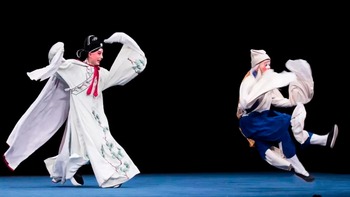
As it unfolds, the cloak alternately evokes in the imagination a river current, a mountain path, and a drifting snowscape, its transformations enacted through rhythm. A production photo of Fang Dai illustrates how the performer’s body effectively substitutes for conventional scenery (Figure 2). The image captures the actors in mid-air, their sweeping sleeves and splayed limbs articulating a vibrant presence against the negative space of the black void. In a classical stage design, one might have placed painted backdrops or sculpted props to evoke mountainous terrain or swirling snow. Here, however, the body’s motion and the cloak’s swing become the primary conveyors of the environment. By emphasizing minimal set pieces, the play invests every gesture with increased rhetorical force.
Fang Dai (Visiting Dai). Photo courtesy of Jiangsu Kun Opera Theatre.

The performance thus reaffirms kunqu’s unique capacity to animate absence – where one gesture, one fold of cloth, becomes an entire landscape perceived through breath and imagination. Through codified formalization, especially the sleeve-derived water technique, Shi transforms the fabric into snow, current, or mountain path. Its texture and momentum constitute what Rajewsky terms an intermedial reference:Footnote 32 a single material element gesturing toward absent media – landscape painting, calligraphy, and poetic imagery – without recourse to scenic illusion. The cloak’s arc and weight produce a visual rhythm that conjures the Wei-Jin landscape through motion alone. As Zong observes, the aesthetics of the Wei-Jin literati were grounded in Daoist cosmology, valuing simplicity, distance, and the quiet apprehension of the ineffable. For thinkers and artists of the period, beauty was not an external goal but an inner process – to act without purpose yet with complete sincerity. This tradition, Zong explains, founded a millennium of Chinese aesthetics in which ‘the value of beauty lies in the process itself, not in any external end’.Footnote 33 Shi’s choreography of the cloak and water sleeves embodies precisely this spirit: the act of movement becomes both perception and creation, a living echo of the Wei-Jin ideal of finding the Way through aesthetic spontaneity.
Each intangible or partial scenic element invites the audience’s imaginative collaboration, effectively expanding the performance space. This strategy of rendering the intangible – such as a silent snowfall – via kunqu’s codified gestures aligns with Judith Butler’s argument that the very accessibility and materialization of the theatrical scene are ‘dependent on’ and ‘coincident with’ an imaginary schema. The performers employ stylized constraints as ‘regulatory ideals’ by which the performance is shaped in the spectator’s consciousness, forming a discursive effect co-created through the constitutive imagination of the audience.Footnote 34 As playwright Luo Zhou recalls:
Writing Fang Dai was like living through a dreamlike snowy night. For the first time in my life, I wept as I wrote – though the story itself was joyful. What moved me was the sense of sharing, across a thousand years, that one and only snowy night in the history of Chinese culture – so beautiful it felt like a dream – and within that dream, I drifted.Footnote 35
Light and spatial economy further articulate kunqu’s aesthetic of liubai (strategic blankness). A single sidelight carves moving shadows from the cloak’s folds; the audience perceives shifting topographies of light and darkness. Each suspension of gesture becomes a suspension of time, where the interval itself acquires expressive density. As Feng observes, xiqu fundamentally reconfigures the stage–audience relationship by replacing illusion with heightened perception.Footnote 36 Unlike the Brechtian model of estrangement, which alienates the spectator through critical distance, xiqu achieves reflection through intimacy – by situating the audience within a continuum of performance energy. In Fang Dai, this continuum unfolds through the choreography of light, breath, and fabric: the minimal stage becomes a sensorial field where the spectator’s consciousness resonates with the actor’s motion. Absence thus turns generative; the chill of imagined snow is felt through the rhythmic breath that animates emptiness.
The leading actor Shi Xiaming explains that the absence of scenic clutter magnifies every gesture and line, compelling a heightened awareness of co-presence between performer, object, and space:
We stand on an entirely bare stage for more than thirty minutes. Every movement, every word, is amplified. Whether I am treading a mountain path or crossing a river, those scenes appear vividly before me, and through my performance, I trust they will appear in the audience’s imagination as well. In Fang Dai, we dismantled and reassembled traditional chengshi [codified forms] piece by piece, until, through this emptiness, the journey of Wang Huizhi – his snowy road, his fleeting joy – finally came alive as a world of luminous clarity onstage.Footnote 37
This reflection indicates how kunqu’s minimalism redistributes meaning and extends historical perception beyond representation. Through the dialogue between body, prop, and light, the empty stage becomes a shared imaginative space where material absence cultivates aesthetic presence. Shi’s distilled technique turns codified formalization into a mnemonic device: each gesture carries the ghost/spirit of previous performances while rewriting them in the present tense.Footnote 38 In this embodied historiography, the cloak becomes both prop and archive – a living conduit through which the ethos of Wei-Jin is re-experienced.
The Mirror and Virtual–Real Reciprocity in Wu Jue
Wu Jue (The Last Dance) centres on a mirror and self-regard as modes of existential embodiment. In Wu Jue, the onstage mirror and the final dance sequence intensify the existential dimension of Wang Meng’s fate, bridging an initially playful self-admiration with the dawning anxiety of mortality (Figure 3). In the narrative anecdote Wu Jue, Wang Meng – celebrated in the Wei-Jin period as one of China’s most graceful and handsome scholars – receives belated appointment as magistrate of Dongyang only when he is gravely ill. Knowing his life is nearing its end, he recounts his few pleasures to a close friend, then performs a final dance before the mirror, bidding farewell to the mortal world with poise and self-awareness. Shi Xiaming’s Wu Jue channels this vitality and pathos into a choreography of contrasts – flamboyance giving way to restraint, external beauty dissolving into inner stillness. The mirror sequence becomes the emotional and visual fulcrum of the piece: an image of self-delight turning gradually into a meditation on mortality.
Wu Jue (The Last Dance). Photo courtesy of Jiangsu Kun Opera Theatre.

The key challenge here is to present self-infatuation not only as vanity but as an expression of self-pity, given the character’s awareness that his life will be cut tragically short. Instead of reading the mirror sequence merely as a choreographic flourish, the production invests it with philosophical weight: Wang Meng’s reflection signals both longing for life’s pleasures and the inevitability of loss. This tension culminates in a dance that merges classical kunqu footwork and fleeting modern steps, culminating in a quiet farewell as he leaves ritual robes and cap behind and symbolically carries his shoes offstage (Figures 4 and 5). Such staging gestures highlight the ephemeral boundary between life and death, evoking the Wei-Jin fascination with transient beauty while placing it in dialogue with modern theatrical sensibilities.
Wu Jue (The Last Dance). Photo courtesy of Jiangsu Kun Opera Theatre.

Wu Jue (The Last Dance). Photo courtesy of Jiangsu Kun Opera Theatre.

From the vantage point of cultural history, these short opera vignettes thus become significant ‘cultural agents’, bridging classic and current realities. He and Yang’s notion of ‘cultural intervention’ highlights how new theatrical forms can spark critical awareness of the past’s living potential, rather than confining it to scholarly archives.Footnote 39 Indeed, experts attending the Shishuo Xinyu performances emphasize that the plays’ success lies not only in their fidelity to kunqu’s core stylistic codes but also in their openness to innovation, thus exemplifying a broader practice of rediscovery and re-presentation of the Wei-Jin ethos.Footnote 40 Beyond its phenomenological precision, Wu Jue re-embodies the Wei-Jin ideal of self-illumination – ethical introspection achieved through aesthetic experience. The gradual slowing of movement, from ritualized gesture to near stillness, mirrors Wang Meng’s retreat from worldly ambition into contemplative freedom. As Li observes in her anthropological study, circular motion and rhythmic repetition often serve as ‘bodily expressions of cultural memory’, transforming movement into a mode of historical continuity.Footnote 41 In Wu Jue, the mirrored rotation and measured gestures perform a similar mnemonic function: the actor simultaneously enacts the historical figure and the modern self reflecting upon that history.
The Zither and Embodied Rhythm in Tiao Zheng
Tiao Zheng (Tuning the Zither) turns sound and tactile rhythm into a dialogue between political history and aesthetic restraint. In Tiao Zheng, the zither is less a musical instrument than a conduit of embodied rhythm and moral emotion. The story, adapted from Shishuo Xinyu, recounts a rare moment of fragility in the life of Xie An – the legendary Wei-Jin statesman known for his composure and grace. After the victory at the Battle of Feishui, Xie An’s rising prestige provoked imperial jealousy. Slandered and dismissed from court, he prepared to depart for Yangzhou. During the farewell banquet hosted by the emperor, courtiers remained silent under the weight of imperial tension. Only Huan Yi, renowned for his integrity, dared to step forward and perform a farewell song on the zither – Cao Zhi’s ‘Yuan Ge Xing’ (‘Song of Resentment’). Tiao Zheng places a zither by the side of the stage, using its resonant strings to channel the tension between personal dignity and political intrigue among historical figures like Xie An and Huan Yi. Such minimal and symbolic choices resonate strongly with the Wei-Jin cultural emphasis on spontaneity, refined eccentricity, and a preference for subtle aesthetic markers over grand spectacle. Unlike Fang Dai and Wu Jue, where visual presentations dominate, Tiao Zheng relies on acoustic interventions: the zither effectively ‘speaks’ to both performers and audience, colouring the atmosphere with alternating moments of serenity and disquiet (Figure 6).
Tiao Zheng (Tuning the Zither). Photo courtesy of Jiangsu Kun Opera Theatre.

Placed slightly to one side of the stage, the zither enters as witness. The performer sometimes sits behind the zither, sometimes circles around it, giving the impression that the instrument is an equal partner in the drama, while the instrument’s sudden dissonant chords repeatedly alter her rhythmic pacing, highlighting the interplay between bodily expression and musical impetus. In performance, the contrast between Xie An and the plaintive lyricism of Huan Yi’s farewell highlights kunqu’s expressive duality. The aria ‘Wulinghua’, drawn from the xiao guan sheng (young official) role type, demands technical precision and deep emotional control; its fluid phrasing conceals an undercurrent of suppressed passion. The music becomes an act of moral courage – a sonic confession voiced through gesture. As Huan Yi ‘plays’ the zither, his hands move lightly over the strings, yet the true zheng music issues from the orchestra, allowing his body to translate sound into visible rhythm. The mimed touch and real sound intentionally decouple, to stage using the virtual to evoke the tangible. Each movement – fingers hovering, wrists turning, sleeves unfolding – renders perceptible the invisible flow of qi. At moments his hands leave the instrument altogether: a slow sweep of the watery sleeves traces the air, then one sleeve lifts to wipe away a tear. This interplay between feigned playing and expressive motion fuses vocality, gesture, and restraint, embodying kunqu’s principle of virtual–real reciprocity.
Here, the zither shifts from being a functional prop to becoming an object-image – a concrete physical element charged with emotional intentionality. Imagery is generated when an external object is activated by the actor’s embodied affect, creating a fused field where physical object and inner emotion co-produce meaning.Footnote 42 In Tiao Zheng, the ‘Wangshu Zither’ acts precisely in this capacity: its historical provenance, its timbre, and its ritual handling by Huan Yi allow it to carry the accumulated tensions of loyalty, grief, and moral clarity. When Huan Yi’s gestures hover between playing and lamenting, the zither becomes an object-image that catalyzes a dense imagery – an affective image of dignified sorrow that the spectator apprehends not through narrative exposition but through rhythmic embodiment. As Huan Yi’s song ends, the orchestral zither continues alone, becoming the background to Xie An’s spoken lament. The two voices – instrumental and human – cross in counterpoint, forming a fleeting harmony of mutual recognition, a moment of zhiyin (知音, mutual recognition between kindred listeners) in which understanding surpasses speech. The performance in Tiao Zheng thus unfolds through temporal layering: mimed touch, real sound, and living silence. It translates the literati tradition of qin music into embodied historiography. Shi’s staging revitalizes this lineage by rendering that alignment visible through the body’s tempo.
Embodied Historiography: Repertoire, Cultural Memory, and the Wei-Jin Ethos
While the performances in Shishuo Xinyu represent the Wei-Jin literati culture, they also re-live its modes of thinking through gesture, tempo, and restraint. This process constitutes what can be termed embodied historiography, defined as the process by which performance reanimates historical sensibility through bodily practice: in Shishuo Xinyu, historiography turns kinetic. The actor’s body functions, in Carlson’s sense, as a memory machine, where each action cites prior stages while rewriting them in the present tense.Footnote 43 Wilcox similarly shows that xiqu meaning emerges from a codified repertoire of movement, gesture, rhythm and breath, translating cultural memory into action.Footnote 44
Within this frame, the kunqu principle of expressing meaning through the body acquires an archival force: movement carries historical temperament. Li’s account of circular motion as a ‘bodily expression of cultural memory’ clarifies how patterned rotation and rhythmic repetition embody continuity across time.Footnote 45 Read alongside Wang’s formula of ‘likeness in spirit’,Footnote 46 we see how kunqu aesthetics designates an affective space where body and scene co-constitute historical presence. The archive is the collection of documents, texts, and physical remains; the repertoire is the embodied knowledge, the performance, the memory passed on through action. Kunqu thus becomes a powerful example of the repertoire reanimating the archived Shishuo Xinyu. Actors’ bodies serve as both interpreter and medium, translating the ancient discourse of cultivated eccentricity into present-tense affect. This process of reanimation is crucial for heritage modernization, demonstrating that tradition is not a static object to be preserved, but a dynamic practice to be continually re-enacted and re-interpreted.
The Inward Turn: Qi, Rhythm, and Minimal Means
The cycle’s strategic minimalism – black voids, spare props, suspended tempi – redirects attention to qi as rhythmic vitality. Zong reads vital resonance as the circulation of life-energy linking artistic creation to the cosmological order, and treats theatrical space as a field of energetic modulation.Footnote 47 On stage, such modulation is audible in breath and visible in measured pauses, aligning with Fischer-Lichte’s autopoietic feedback loop, where performer and spectator co-produce meaning through reciprocal sensing.Footnote 48 The convergence of technique, reflection, and temporal awareness constitutes what may be termed embodied historiography: the use of the performing body as a historiographical medium.
This aesthetic economy also resonates with postdramatic concerns for latent textuality and absence,Footnote 49 yet, crucially, kunqu grounds transformation in resonance with an antecedent order of qi. In practice, that order is channelled by formalization: fixed forms that paradoxically liberate the actor’s energy through disciplined variation. This process cultivates a specialized mode of ‘living archive’, within which framework the formal beauty of the performance survives through the audience’s sensory memory.Footnote 50 The tension between the visibility of the stylized gesture and the withdrawal of its underlying qi produces what might be termed a profound ‘seduction’, engaging the spectator in an active process of cultural survival and transmission. The result, as Feng argues for xiqu more broadly, is heightened perception: audience attention is schooled to perceive the work of suggestion itself.Footnote 51 Each bodily action simultaneously recalls and transforms tradition, making the stage a site where history is produced through physical thought.
Spectatorship and Co-Presence: Liubai and Intermedial Reference
A strategic blankness structures the semiotics of these vignettes: unpainted backdrops, gestural abbreviation, and the temporal interval between phrases create spaces the spectator must complete for themselves. Zong describes this as the play of ‘void and plenitude,’ where perception arises from rhythmic transformation.Footnote 52 In Fang Dai, for instance, a cloak’s arc can variously evoke in the imagination of a snowscape, a river current, or a mountain path; the ephemeral snow alludes to the impermanence of human desires, setting out on a whim and departing when interest wanes; the prop becomes a kinetic trigger. Kunqu becomes a vehicle through which Wei-Jin existential queries, mortality, vanity, and spontaneity, find a theatrical form that both acknowledges tradition and taps modern spectators’ tastes for sensory immersion.Footnote 53 As Evans notes, such openness invites spectators to participate in the imaginative labour of translation.Footnote 54
Intermedially, these minimal props operate as references to absent media – painting, calligraphy, poetic image, artificial snowflakes – without technological fusion.Footnote 55 Their efficacy depends on the audience’s rhythmic attunement: through co-presence, qi circulates among body, object, and gaze, and history is produced as physical thought. Within the live encounter, this reciprocity is intensified through a mutual attunement of energies that produces meaning through co-presence.Footnote 56 In this sense, embodied historiography names a method where movement is the medium through which the Wei-Jin ethos becomes legible, present, and newly thinkable. Such an approach revitalizes an intangible heritage by prompting what Lu Xun once emphasized regarding the Wei-Jin literati: that their dedication to authenticity, even in artful retreat from worldly pressures, sustains a complex moral and intellectual outlook.Footnote 57
Conclusion
By placing kunqu’s indigenous aesthetics in conversation with contemporary performance theory, this essay has shown how the Shishuo Xinyu vignettes articulate a relational model of theatrical mediation that neither replicates western models nor stands outside them. The readings of the cloak, the mirror, and the zither reveal that xiqu’s material economy already embeds a sophisticated poetics of transformation – anticipating many concerns central to later theorizations of intermediality, phenomenology, and postdramatic performance. Each vignette reactivates a philosophical tenet – yixu tuoshi (using the virtual to evoke the tangible), chengshi (codified formalization), liubai (strategic blankness), and qiyun shengdong (vital resonance) – into embodied action that co-produce meaning through gesture, rhythm, and sensory reciprocity. Foregrounding these concepts as analytical tools reframes kunqu as a generative partner in global theory-making. This study suggests that intermedial relations may also arise from rhythmic continuity and ontological resonance – an ecology of performance in which body, object, and world vibrate in shared temporality.
The notion of embodied historiography further situates the actor’s craft as a mode of historical cognition, one in which heritage survives not through archival replication but through corporeal renewal. In Shishuo Xinyu, history is not represented but re-experienced: revitalized each time a sleeve carves snow from empty space, a mirror refracts a shifting self, or a zither’s imagined vibration elicits ethical resonance. Seen in this light, kunqu’s aesthetic epistemology is theoretically generative – a resource that invites reconsideration of how performance thinks, remembers, and imagines. Its minimal stage becomes a site where history moves, consciousness unfolds, and theatrical worlds emerge from the continuous, vital flow between the virtual and the tangible.