Introduction
Ideal Antimicrobial Stewardship programs (ASP) would include an infectious disease (ID) physician, an ID pharmacist, and a clinical microbiologist, which is not feasible at many institutions, especially in rural areas. Reference Leuthner and Doern1–3 Telehealth offers a means to extend ID expertise to support Antimicrobial Stewardship programs in smaller hospitals. Reference Klatt, Schulz and Fleischman4
The Veterans Health Administration (VHA) has implemented a system-wide approach to ASPs, emphasizing multidisciplinary teams and standardized practices across its facilities. Reference Chou, Graber and Jones5 To support consistent and scalable implementation, the VHA developed and validated an objective staffing calculator that estimates personnel needs based on hospital size and stewardship activities. Reference Echevarria, Groppi, Kelly, Morreale, Neuhauser and Roselle6 The most recent VHA recommendations for staffing ASPs indicate a minimum of 100% of a full-time equivalent (FTE) for pharmacists and 62.5% FTE for physicians for Veterans Affairs Medical Centers (VAMCs) with acute and long-term care service. 7 This staffing model has helped standardize ASP resources across VA facilities and supports the integration of stewardship activities into inpatient, outpatient, and long-term care settings. Reference Hawes, Greene, Ratz, Fowler, Kendall and Patel8
For Veterans Affairs (VA) medical centers without local ID experts, VHA’s robust telehealth infrastructure has supported effective Antimicrobial Stewardship. Reference Livorsi, Abdel-Massih and Crnich9,Reference Livorsi, Sherlock and Cunningham Goedken10 A previous pilot study demonstrated the feasibility of using telehealth to support Antimicrobial Stewardship at rural Veterans Affairs medical centers (VAMCs) by pairing them with an ID consultant from a larger, geographically distant VAMC. Reference Stevenson, Banks and Stryczek11,Reference Wilson, Banks and Crnich12 This program, called the Videoconference Antimicrobial Stewardship Team (VAST), emphasized discussion of patients with ID concerns selected by the champion or requested by the caring provider and additional relevant clinical topics with a multidisciplinary team at the rural VA. The VAST only included review of the patient medical record; the patients themselves were not included in the VAST session. This program demonstrated success in reducing antibiotic use at rural sites and continued years beyond the intended 6-month intervention. Reference Stevenson, Banks and Stryczek11,Reference Wilson, Banks and Crnich12 We recently described the dissemination of VAST to additional VAMCs. Reference Jump, Bej and Vivo13 Over 90% of participating surveyed staff perceived VAST as improving the quality of Veteran care Reference Jump, Bej and Vivo13 and agreed that recommendations provided by ID consultants were timely.
The time and effort required of the Antimicrobial Stewardship champions (i.e., pharmacists, infection preventionists) at the rural VAMCs and the ID consultants to participate in VASTs, however, has not been previously described. Understanding the workload associated with this program is important for consideration in order to expand and sustain VASTs across the VA. Additionally, creating a process map or flowchart of the sequence of actions assists in visualizing all the steps for each VAST and lays the groundwork for consensus and improvement in line with the workload. Reference Heher and Chen14 Here, we describe the FTE associated with staff regularly involved with VAST-related activities and use process maps to assess general workflow, variations in implementation, and the potential to make modifications that support efficiency while maintaining quality.
Methods
Study design and sample
This was a mixed methods process evaluation of the workload and workflow of VASTs implemented from September 2021 through February 2024. The goal of VAST was to discuss patients at the rural site who had ID concerns and provide guidance on antibiotic use and other aspects of clinical care. ID consultants were paired with rural VAMCs without ID experts on staff. All the rural sites had ≤50 acute care beds and a VA nursing home, termed a Community Living Center (CLC). A research assistant (RA) from the ID consultant’s site assisted with clinic setup and data collection. Details of the study and recruitment have been reported previously. Reference Jump, Bej and Vivo13 One of the 10 rural VAMCs that participated in a VAST chose to withdraw before the end of the study period and was not included in this analysis. The remaining VASTs (lettered A–H) involved ID consultants from one VAMC pairing with a rural VAMC to form a dyad. Two months into the study period, a second rural VAMC joined VAST C. As the two rural VAMCs shared the same weekly meeting period, they were analyzed as VASTs C.1 and C.2. The VA Central Institutional Review Board (IRB) approved the study protocol.
Data collection
VAST was conducted over a 12-month intervention period, where after the first 4 months of the intervention period, the primary research team gathered basic information on VASTs from discussions with local RAs and champions, including the duration and scheduled frequency of sessions, details on specific VAST activities at rural sites, and the time champions spent on all VAST activities. Emails sent to the ID consultants requested information about the time allocated to all VAST activities each month and aspects of VAST implementation: identifying cases, choosing discussion topics, advance preparation for meetings, the frequency and general structure of VAST meetings, the nature of any unscheduled sessions if they occurred, and documentation, including workload capture. Upon completion of the study period, the primary research team obtained total patients discussed and Current Procedural Terminology (CPT) codes associated with clinical encounters for each VAST from the VHA Corporate Data Warehouse for the entire 12-month period as previously described. Reference Jump, Bej and Vivo13 CPT codes indicate the time in minutes associated with a medical encounter or procedure (Supplemental Table 1).
Workload estimates
To estimate total workload, we expressed time estimates for all VAST-related activities performed by the champions and ID consultants as a percentage of FTEs. These activities included all aspects of VAST (i.e., intended length and frequency of VAST meetings, meeting preparation, clinical work, and documentation) and were reported by ID consultants and champions after the first 4 months of the intervention. The percentage of FTE used for clinical encounters, which generate work relative value units used to measure clinical productivity, was calculated based on the maximum time associated with the CPT codes used and the number of times each VAST’s ID consultant selected those CPT codes in the 12-month intervention. The FTE used by the champions and ID consultants for other VAST activities (e.g., preparing and presenting educational materials, searching for cases to discuss) was calculated by subtracting the FTE used to complete clinical encounters from the total workload FTE estimates.
Process map development
The responses from the RAs, champions, and the ID consultants informed development of role-based process maps for each VAST. 15 Process maps assessed the general phases of workflow within each VAST, considered specific tasks within each phase, and the personnel involved in completing those tasks. RAs, champions, and ID consultants reviewed their VAST’s process map at least twice and made changes to improve accuracy.
Results
Workload estimates
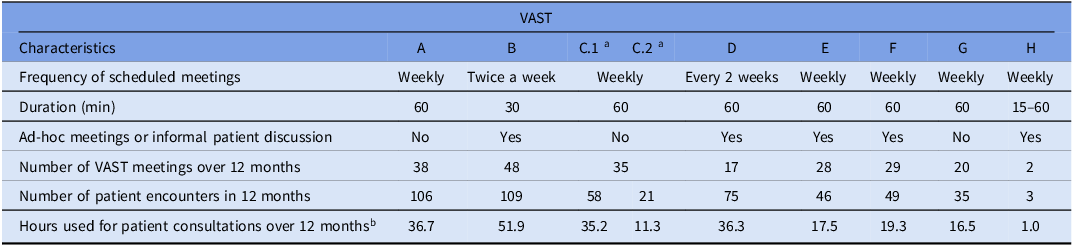
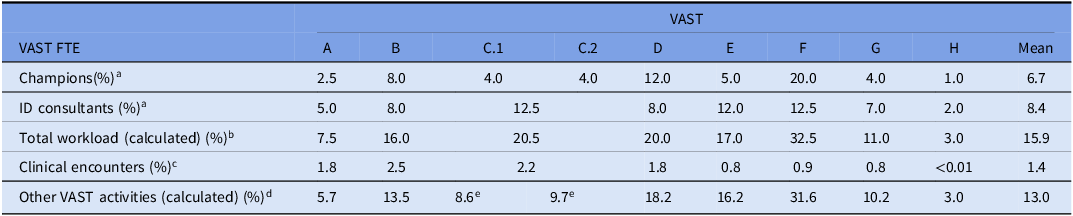
Based on the total number of sessions that occurred and patients discussed in the 12-month intervention, the 8 VASTs averaged 27.1 meetings (range 2–48) and completed clinical encounters on 55.6 patients (range 3–109) (Table 1). Based on CPT codes, the time used to complete clinical encounters averaged 25.1 (range 1–36.7) hours over the 1-year study period. The average time champions and ID consultants estimated allocating to VAST was 6.7% (range 1%–20%) and 8.4% (range 2%–12.5%) of an FTE, respectively (Table 2). The total workload, accounting for the time of both the champions and ID consultants, averaged 15.9% (range 3.0%–32.5%) of an FTE. Based on CPT codes, the average FTE used to complete clinical encounters was 1.4% (range < 0.01%–2.5%) of an FTE. Subtracting the FTE for clinical encounters from the total workload yielded an average of 13.0% (range 3.0%–31.6%) of an FTE not directly supported by clinical encounters.
VAST characteristics

Note. VAST, videoconference Antimicrobial Stewardship team; VAMCs, veterans affairs medical centers; CPT, current procedural terminology.
a Two rural VAMCs held shared meetings.
b Determined based on the maximum minutes indicated for CPT codes associated with encounters attributed to VAST activities.
Estimates of workload for VAST activities as the percentage of 1.0 full-time equivalent (FTE)

Note. VAST, videoconference Antimicrobial Stewardship team; FTE, full-time equivalent; ID, infectious disease; CPT, current procedural terminology; VAMCs, Veterans Affairs Medical Centers.
a Based on estimates reported by champions and ID consultants with regular participation in VAST activities after the first 4 months of 12-month intervention.
b Calculated based on estimates of VAST FTE reported by champions and ID consultants.
c Determined based on the maximum minutes indicated for CPT codes associated with encounters attributed to VAST activities within the 12-month intervention.
d Calculated by subtracting the FTE used to complete clinical encounters from the estimated total workload.
e Distributes the workload of the ID consultant based on the proportion of time used to complete clinical encounters for patients at VAMCs C.1 and C.2.
Process maps
The process maps were developed to visualize workflow and task allocation among the VASTs, which in turn helped identify opportunities to improve efficiency. Four phases were common to all the VASTs: case finding, meeting preparation, team meeting, and documentation (Figure 1). Among these phases, case finding and documentation had the most variability in tasks and the team members routinely completing them.
Summary of role-based process maps for videoconference Antimicrobial Stewardship teams (VASTs). The first column lists phases common to the VASTs (bold text) and tasks associated with each phase. The center grid indicates which tasks each VAST engaged in and who performed those tasks. Blue boxes indicate tasks performed by the champions. Yellow boxes indicate tasks performed by the infectious disease (ID) consultant. Green boxes indicate tasks performed by both the champions and ID consultants. The final columns summarize the number of VASTs with champions and ID consultants engaged in specific tasks.

Figure 1 Long description
The table summarizes role-based process maps for videoconference Antimicrobial Stewardship teams (VASTs). It lists phases common to the VASTs and tasks associated with each phase. The center grid indicates which tasks each VAST engaged in and who performed those tasks. Blue boxes indicate tasks performed by the champions. Yellow boxes indicate tasks performed by the infectious disease (ID) consultant. Green boxes indicate tasks performed by both the champions and ID consultants. The final columns summarize the number of VASTs with champions and ID consultants engaged in specific tasks. The table has 4 main phases: Case Finding, Meeting Preparation, Team Meeting, and Documentation. Each phase includes several tasks. For example, under Case Finding, tasks include informal communication, review weekly reports of antibiotic use, contact clinicians to request cases for discussion, query the electronic health record (EHR), clinicians request to have a case discussed, electronic tools external to the EHR, and select cases to discuss from interfacility consult (IFC) request. The table shows the number of VASTs with champions and ID consultants engaged in each task.
For case finding, VASTs A-G all used informal communication with at least two additional methods. VAST H relied exclusively on clinicians requesting to discuss a case and reported just 3 patient encounters over 12 months. Given that case finding was the initial, necessary step for the subsequent phases, the overall assessment of workflow for VAST H was limited.
To prepare for meetings, team members at the rural VAMCs for VASTs A-G reviewed and prepared cases for discussion. The ID consultants for VASTs C.1, D, E, and G also contributed to this task. Placing consult requests in the electronic health record (EHR) was primarily performed by team members at the rural VAMCs, while preparing educational presentations was the domain of the ID consultant. Educational sessions and topics were not required but were requested by champions or offered by ID consultants based on recent cases discussed or specific interest. During the team meetings for all VASTs, case presentations were largely completed by team members from the rural VAMCs, with participants from both sites engaging in discussion. The ID consultant provided subsequent recommendations and general education. ID consultants also performed most of the documentation, which included entering notes at their VAMC as well as reviewing and, when indicated, making addenda to notes entered into the EHR where the patients were located. Only VASTs C.2 and F indicated that ID consultants or champions communicated recommendations to the clinicians caring for the patients discussed after the VAST session. This suggests that those clinicians were typically not present at VAST meetings and may indicate that other VASTs relied upon documentation within the EHR for communication.
VAST B had a distinct approach to workflow. Both the champions and ID consultants discussed which of the cases reviewed should become a formal consultation, with the champion placing that request as part documentation, the last phase of the process. VAST B was also the only team in which the ID consultant indicated not being involved in general education during the meetings. VAST F was notable in that the rural champion reported the highest proportion of FTE dedicated to VAST activities; it was also the only team in which participants from the VAMC with ID expertise engaged in more tasks than team members at the rural VAMC, and team members from both sites were engaged in tasks across all phases of work.
Discussion
This analysis examined the FTE and processes associated with implementing and sustaining VASTs. Except for VAST F, the champions at rural VAMCs and all the ID consultants estimated using <12.5% FTE on VAST activities. The work productivity generated by clinical encounters slightly offset the total workload, such that the operating costs of most VASTs were <20% of an FTE. Even without accounting for clinical encounters, the estimated FTE for VAST activities is a fraction of the 100% pharmacist and 62.5% physician FTE recommended for VAMCs with <60 beds and a CLC. Reference Echevarria, Groppi, Kelly, Morreale, Neuhauser and Roselle6,7,Reference Doernberg, Abbo and Burdette16,17 From an organizational perspective, allocating up to 12.5% FTE from the ASP of a rural VAMC to support an ID consultant at a geographically distant VAMC offers a cost-effective approach to sustaining VASTs. Clinical staff would continue to carry out the majority of ASP activities and be able to routinely call upon the skills and expertise of an ID consultant with whom they have an ongoing professional relationship.
Process maps revealed potential changes that could help to improve workflow efficiency. VASTs that used electronic tools to identify potential cases met more frequently and served more Veterans. For VAST F in particular, process maps indicated that both the champion and ID consultants were involved in identifying cases as well as communicating recommendations to the patient’s providers. Streamlining these tasks such that only the local champions are engaged in these activities would reduce the effort of the ID consultant. For most VASTs, the ID consultant indicated they invested time in preparing educational presentations. While education is a fundamental part of effective ASPs, 18,19 forgoing slides or similar formal didactic modalities in favor of more extemporaneous teaching may help optimize ID consultants’ time. The participation of two rural VAMCs in VAST C was an efficient use of the ID consultant’s time. In economic terms, the fixed cost of time was spread out over more than one institution, which has the potential to leverage economies of scale. Reference Anderson, Rinne, Orlander, Cutrona, Strymish and Vimalananda20 The joint sessions also exposed attendees to a greater number and variety of cases as well as reducing professional isolation, similar to benefits associated with the Specialty Care Access Network-Extension for Community Healthcare Outcomes programs. Reference McBain, Sousa and Rose21
This study had several limitations. First, this analysis assessed effort after the first 4 months of the intervention period and assumed a fixed time dedicated to VAST activities. Changes that occurred as the VASTs progressed were not accounted for. VASTs likely required more time early in implementation, with decreasing requirements as the program progressed, and the personnel involved in VASTs established working relationships and routines. Second, the time dedicated to VAST activities was self-reported and may not have reflected the true effort required to run the VAST. Particularly during the early phase of the study period, efforts related to VAST implementation may have led to an overestimation of the time reported by the champions and ID consultants. In particular, ID consultants may have reported overall clinical effort based on labor maps or similar official designations related to organization charts. Additionally, the time set aside for VAST activities was not always used, as evidenced by the number of sessions that occurred per year. Other factors influencing effort may have included the training and experience of the champions and ID consultants, the complexity of the patients discussed, and institutional culture. Third, the time attributed to clinical encounters was based in CPT codes, the use of which varied among ID consultants. Reference Jump, Bej and Vivo13 Whether these variations related to differences in patient complexity or in billing practices is unknown and may be an important element to consider when assessing e-consults. Reference Vimalananda, Orlander and Afable22 Lastly, VAST was implemented in a highly integrated health system. Replicating it outside the VA may incur challenges, including financial barriers that can hinder implementation of telestewardship partnerships. Reference Baus, Patel, Lepak and Rose23
In conclusion, workload varied across VASTs, with process maps demonstrating the necessary implementation activities and indicating areas where VASTs could reduce their workload and improve efficiency. Adjusting workload and team members may ensure VAST sustainability. Future work will aim to identify which aspects of the preparation, team meeting, or documentation phases are associated with successful ASPs, including an assessment of both quantitative and qualitative outcomes. Investing <12.5% of the FTE allocated to ASPs to support the time of an ID consultant from another VAMC can help VASTs achieve staffing sustainability and ultimately cost savings related to potential decreases in antibiotic expenditures and antibiotic-related adverse events.
Supplementary material
The supplementary material for this article can be found at https://doi.org/10.1017/ice.2026.10452.
Acknowledgements
None.
Financial support
This work was supported by the United States (U.S.) Department of Veterans Affairs Health Systems Research Merit Award Number I01 HX003364 (R.J. and C.E.) and Research Career Scientist MRA0-001-24W (C.E.). It was also supported by funds and facilities provided by the TECH-Geriatric Research Education and Clinical Center (GRECC) at the VA Pittsburgh Healthcare System.
The funders had no role in the design and conduct of the study; collection, management, analysis, and interpretation of the data; preparation, review, or approval of the manuscript; and decision to submit the manuscript for publication.
Competing interests
Potential conflicts of interest. All authors report no conflicts of interest relevant to this article.
Disclaimer
The findings and conclusions in this document are those of the authors, who are responsible for its content, and do not necessarily represent the views of the Department of Veterans Affairs or of the US Government.
Previous presentations
Some of the content was previously presented at the Society for Healthcare Epidemiology of America (SHEA) Spring 2024 Conference in Houston, Texas, USA.