


Introduction
Transdiagnostic treatments, or ‘those that apply the same underlying treatment principles across mental disorders, without tailoring the protocol to specific diagnoses’ (McEvoy et al., Reference McEvoy, Nathan and Norton2009, p. 21), are based on two principles: (1) some disorder categories have common underlying symptoms and (2) evidence-based psychotherapy (EBP) protocols designed to address these symptoms contain overlapping components. This is particularly true for the affective disorders (depressive disorders, anxiety disorders, obsessive-compulsive and related disorders, and trauma- and stressor-related disorders) and their disorder-specific cognitive behavioural therapy (CBT) protocols. As such, a number of transdiagnostic treatment approaches have been developed for and studied in the affective disorders based on these hypotheses (Andersen et al., Reference Andersen, Toner, Bland and McMillan2016; Newby et al., Reference Newby, McKinnon, Kuyken, Gilbody and Dalgleish2015; Norton and Paulus, Reference Norton and Paulus2017; Pearl and Norton, Reference Pearl and Norton2017; Reinholt and Krogh, Reference Reinholt and Krogh2014), with preliminary outcomes demonstrating moderate-to-high treatment effect sizes (Barlow et al., Reference Barlow, Farchione, Bullis, Gallagher, Murray-Latin and Sauer-Zavala2017; Farchione et al., Reference Farchione, Fairholme, Ellard, Boisseau, Thompson-Hollands and Carl2012; Gros, Reference Gros2014; Norton, Reference Norton2012b; Schmidt et al., Reference Schmidt, Buckner, Pusser, Woolaway-Bickel, Preston and Norr2012).
In addition to financial savings and improved efficiency in training offered by transdiagnostic treatments (Gros, Reference Gros2014, Reference Gros2015), the potential efficiency of transdiagnostic CBT groups is another compelling argument for the shift to transdiagnostic practices (Norton, Reference Norton2012a). In traditional disorder-specific group settings, at least eight patients are needed to fill each separate group in order to begin treatment. Unfortunately, these types of groups either require very large clinics (e.g. clinics that receive tens of new qualifying patients weekly) or necessary lengthy wait times (e.g. waiting 3 months until eight patients with same diagnosis are enrolled) to initiate these disorder-specific groups. In contrast, transdiagnostic CBT groups could enrol the first eight patients across all qualifying diagnoses (e.g. two with panic disorder, four with social anxiety disorder, and two with obsessive compulsive disorder) in a much quicker timeframe.
Currently, the most investigated group transdiagnostic CBT is Group Cognitive-Behavioral Therapy of Anxiety (GCBT) (Norton, Reference Norton2012a). GCBT consists of 12 weekly group sessions lasting 120 minutes each. These sessions involve psychoeducation, cognitive restructuring, exposure to feared stimuli, and relapse prevention. GCBT was designed to treat the Diagnostic and Statistical Manual for Mental Disorders, 4th edition (DSM-IV) anxiety disorders (i.e. panic disorder, agoraphobia, social anxiety disorder, generalized anxiety disorder, and specific phobia) (American Psychiatric Association, 1994). Investigations of GCBT include: (1) an early pilot test showing significantly greater improvements on symptom measures after GCBT compared with a waitlisted control group (Norton and Hope, Reference Norton and Hope2005), (2) a randomized controlled trial that compared GCBT with relaxation training and found significant and statistically equivalent improvement in symptoms across groups (Norton, Reference Norton2012b), and (3) a second randomized controlled trial comparing GCBT with disorder-specific group protocols and demonstrated equivalence between the protocols in reducing symptoms of principal and comorbid diagnoses (Norton and Barrera, Reference Norton and Barrera2012). Of note, another well-studied transdiagnostic CBT protocol, Unified Protocol for Transdiagnostic Treatment of Emotional Disorders (Barlow et al., Reference Barlow, Farchione, Fairholme, Ellard, Boisseau and Allen2011, 2017), was recently studied in a group of patients with Diagnostic and Statistical Manual for Mental Disorders edition 5.0 (DSM-5) (American Psychiatric Association, 2013) anxiety disorders and demonstrated significant improvements across symptoms (Laposa et al., Reference Laposa, Mancuso, Abraham and Loli-Dano2017). In addition, transdiagnostic treatments have been shown to be easy to learn and implement due in part to their straightforward behavioural protocols (Gros et al., Reference Gros, Allan and Szafranski2016). Together, these studies demonstrate that group transdiagnostic CBT can be delivered successfully in patients with anxiety disorders.
Despite most trials for individual and group transdiagnostic CBT protocols being tested exclusively in patients with anxiety disorders, transdiagnostic treatments have been hypothesized to be effective beyond the anxiety disorders (Barlow et al., Reference Barlow, Allen and Choate2004; Gros et al., Reference Gros, Allan and Szafranski2016). One example of a transdiagnostic treatment studied across the affective disorders is Transdiagnostic Behaviour Therapy (TBT). TBT is a newly developed transdiagnostic psychotherapy designed to treat veterans with affective disorders, including major depressive disorder (MDD), panic disorder (PD), agoraphobia, social anxiety disorder (SOC), generalized anxiety disorder (GAD), post-traumatic stress disorder (PTSD), obsessive compulsive disorder (OCD), and specific phobia (SP) (Gros, Reference Gros2014, Reference Gros2015; Gros et al., Reference Gros, Allan and Szafranski2016). In addition to its incorporation of the depressive disorders, TBT also stands out as the only transdiagnostic psychotherapy developed and investigated in patients with PTSD (Judah et al., Reference Judah, Lancaster, Gros, Back and Vujanovic2017), increasing its treatment scope beyond GCBT and other transdiagnostic protocols. However, thus far, TBT has only been investigated via an individual psychotherapy format and only in veteran samples. Although the initial data on TBT have been quite promising with large treatment effects for patients with various affective disorders and comorbidities (Gros, Reference Gros2014; Gros et al., Reference Gros, Allan and Szafranski2016), an expansion of its scope to a group protocol and in a non-veteran sample would further improve its usability and efficiency in patient care.
The present study involved the delivery and investigation of a group format of TBT in patients with affective disorders, including patients with DSM-5 anxiety disorders, depressive disorders, OCD and PTSD. In addition, the present study sought to compare the effectiveness of group TBT and disorder-specific treatments matched to patient presenting problems (e.g. CBT for patients with SOC). The present study was conducted in a naturalistic clinical setting and thus represents a pilot or feasibility study of TBT in a naturalistic setting with a large non-veteran clinical sample. Participants were assigned to TBT group (vs disorder-specific group) based on patient preference and/or clinician recommendation. As the study was completed as part of ongoing clinical care not all self-report measures were administered across all groups. We hypothesized that group TBT would be effective in addressing a wide range of symptoms in patients with affective disorders. In addition, we predicted that group TBT would demonstrate superior outcomes on measures of transdiagnostic impairment compared with the disorder-specific treatments.
Method
Participants
Participant responses were collected from an outpatient sample at specialized clinics for assessment and treatment of anxiety and depressive disorders within a Canadian hospital setting. Participants were referred to the clinic by a physician (usually their family doctor or psychiatrist). Study inclusion criteria included: (1) meeting diagnostic criteria for at least one DSM-5 anxiety disorder, depressive disorder, PTSD or OCD on a diagnostic interview, (2) being at least 18 years of age, and (3) being clearly competent to provide informed consent.
For the purposes of the present study, participant data were gathered from all participants that completed the TBT group (n = 37) or one of the disorder-specific CBT groups during the same period, including CBT for PD (n = 18), CBT for SOC (n = 39), and CBT for OCD (n = 15).
Procedure
The authors assert that all procedures contributing to this work comply with the ethical standards of and approved by the local Institutional Review Board and with the Helsinki Declaration of 1975, and its most recent revision. The procedures and measures used in this study were approved by the local institutional review board and incorporated standard practices in the clinic. Upon receiving the referral, each participant was scheduled for an intake appointment where they were given a questionnaire battery to be completed at home at their own pace and returned at their intake interview. At the intake appointment, participants provided full informed consent and completed the Mini International Neuropsychiatric Interview (MINI; Sheehan et al., Reference Sheehan, Lecrubier, Sheehan, Amorim, Janavs, Weiller, Hergueta, Baker and Dunbar1998), Structured Clinical Interview for the DSM (SCID; First et al., Reference First, Spitzer, Gibbon and Williams1996), or a similar diagnostic interview to establish principal and additional diagnoses for both current and lifetime conditions. The principal diagnosis was defined as the current disorder causing the most distress or functional impairment. Participants were then assigned to either: (1) the transdiagnostic treatment option, TBT, or (2) a disorder-specific CBT for PD, SOC or OCD based on their principal diagnosis. Assignment was based on patient preference following discussion of the available treatment options between the clinician and the patient. All treatments consisted of 12 weekly 120-minute manualized group psychotherapy sessions. The groups were led by two or three clinicians with formal training in CBT for PD, SOC and OCD including at least one senior doctoral-level clinician with extensive experience as well as one to two junior/graduate-level clinicians. The same clinicians delivered the TBT and disorder-specific protocols. Therapy groups typically contained between six to eight participants. Pre- and post-self-report treatment questionnaires were administered through the group at session 1 and session 11, respectively. The diagnostic measures were not repeated at post-treatment.
Treatments
Transdiagnostic Behavior Therapy
TBT was developed as a streamlined protocol to educate on, prepare for, and practise and master four different types of exposure techniques for negative emotions (situational/in vivo, physical/interoceptive, thought/imaginal, and [positive] emotional/behavioural activation) to reduce transdiagnostic avoidance and lead to symptom remission. TBT has received initial support as an individual therapy (Gros, Reference Gros2014; Gros et al., Reference Gros, Szafranski and Shead2017), and was revised slightly to fit into a group format (e.g. added group ice-breakers in first session). The optional modules of coping statements and safety behaviours were included in all groups; other modules were included if requested by group members (e.g. sleep disruption). The final session covers a review of treatment progress and relapse prevention strategies.
Disorder-specific CBT groups
Separate treatment groups were delivered for PD, SOC and OCD. Each protocol involved a manualized CBT protocol based on existing models within the PD, SOC and OCD treatment literatures (Barlow, Reference Barlow2014). In general, treatment components included psychoeducation, cognitive restructuring, and in-session and between-session exposure exercises, although there were variations across the protocols (e.g. SOC group included social skill training; OCD group included response prevention).
Measures
Depression Anxiety Stress Scales, 21-item version (DASS-21)
The DASS-21 (Lovibond and Lovibond, Reference Lovibond and Lovibond1995) is a 21-item measure with three subscales designed to assess dysphoric mood (depression subscale; DASS-21-D), symptoms of fear and autonomic arousal (anxiety subscale; DASS-21-A), and symptoms of tension and agitation (stress subscale; DASS-21-S). Items are rated on a 4-point Likert scale, ranging from 0 (did not apply to me at all) to 3 (applied to me very much), and summed to compute the three subscales. Support for the factor structure and convergent and discriminant validity of the DASS has been found in community samples (Lovibond and Lovibond, Reference Lovibond and Lovibond1995). Additional support for the internal consistency of the scale was found in the present study (α > .81). The DASS was completed by participants in the TBT, PD and SOC treatment groups.
Illness Intrusiveness Ratings Scale (IIRS)
The IIRS (Devins et al., Reference Devins, Binik, Hutchinson, Hollomby, Barré and Guttmann1983) is a 13-item transdiagnostic questionnaire that assesses the extent to which a disease interferes with important domains of life, including health, diet, work and several others. Each item is rated on a 7-point Likert scale, ranging from 1 to 7. The total summed scale score was used in the present study, rather than the three subscales, due in part to the sample size and planned analyses (Devins, Reference Devins2010). The IIRS has been shown to have strong psychometric properties in the previous literature in participants with physical and/or emotional health concerns (Devins et al., Reference Devins, Dion, Pelletier, Shapiro, Abbey and Raiz2001; Devins, Reference Devins2010). Additional support for the internal consistency of the scale was found in the present study (α > .84). The IIRS was completed by all participants.
Mini International Neuropsychiatric Interview (MINI)
The MINI is a clinician-rated structured diagnostic interview designed to provide a brief, but accurate, assessment of a wide range of DSM-5 psychiatric disorders, including depressive and anxiety disorders, and substance use disorders (Sheehan et al., Reference Sheehan, Lecrubier, Sheehan, Amorim, Janavs, Weiller, Hergueta, Baker and Dunbar1998). Similar training procedures were used for the MINI as were used for the SCID-5. The MINI has demonstrated adequate inter-rater and test–retest reliability across most disorders, and specifically has shown good inter-rater reliability with other structured diagnostic interviews (Sheehan et al., Reference Sheehan, Lecrubier, Sheehan, Amorim, Janavs, Weiller, Hergueta, Baker and Dunbar1998). The MINI was completed by all participants.
State-Trait Inventory for Cognitive and Somatic Anxiety – Trait Version (STICSA)
The STICSA is a 21-item measure designed to assess trait cognitive and somatic anxiety (Gros et al., Reference Gros, Antony, Simms and McCabe2007; Ree et al., Reference Ree, French, MacLeod and Locke2008). The cognitive and somatic subscales have been supported by factor analysis and both subscales have been found to have high internal consistency (α > .87; Gros et al., Reference Gros, Antony, Simms and McCabe2007). In addition, the STICSA-Trait scale was found to remain stable over repeated administrations during several stress manipulations (r > .65; Ree et al., Reference Ree, French, MacLeod and Locke2008). Additional support for the internal consistency of the scale was found in the present study (α > .82). The STICSA was only completed by participants in the TBT treatment group.
Structured Clinical Interview for DSM-5 (SCID-5)
The SCID-5 is a semi-structured diagnostic interview designed to assess the DSM-5 diagnostic criteria for psychiatric disorders (First et al., Reference First, Spitzer, Gibbon and Williams1996). Interviewers were psychologists, supervised postdoctoral fellows or senior graduate students, each of whom received extensive training and supervision in conducting this interview. Initial training included watching three interviews and conducting three interviews under observation. In addition, all SCID-5 interviews for this study were presented at a weekly team meeting chaired by a psychologist with more than 10 years of experience in training others to administer the SCID-5. At the meeting, diagnostic questions were reviewed and any disagreements were resolved in order to reach a consensus diagnosis. The SCID has shown adequate interrater reliability for all disorders (r range: .69 to 1.0) and adequate test–retest reliability over a 1–3 week interval in clinical samples (r range: .40 to 1.0) (Williams et al., Reference Williams, Gibbon, First, Spitzer, Davies and Borus1992).
Data analysis
Data from the measures administered to all participants (demographic, diagnostics, and self-report measures) were inspected for missing values. Three participants from the TBT group and six participants from the disorder-specific groups were excluded from all analyses for significant missing data (>10% of items on any scale). Thus the final samples consisted of 34 TBT participants and 66 disorder-specific participants. Within scale mean substitution was used to replace missing values in participants with minimal missing data (<10% of items on any scale). Analyses were completed for the TBT group alone, as well as in comparison with the disorder-specific groups. For TBT group analyses, participants’ pre-treatment and post-treatment scale scores were compared using paired samples t-tests for the each of the outcome measures (DASS, IIRS, STICSA), with Cohen's d computed to investigate and compare effect sizes. For the group comparison analyses, analyses of covariance (ANCOVAs) were used to investigate group differences in treatment outcome variables with the matching baseline symptom measure entered as a covariate. Partial η2 and Cohen's d were computed to investigate and compare effect sizes.
Results
TBT group treatment outcome
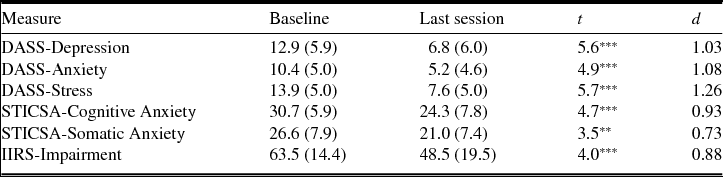
Participants in the TBT group (n = 34) completed the DASS, STICSA and IIRS; the treatment outcome findings for the TBT group participants are given in Table 1. TBT group participants demonstrated significant improvements across all outcome measures (t > 3.4; p < .01), with moderate-to-large effect sizes (d ranged from 0.73 to 1.26).
Treatment outcome for TBT group (n = 34)

DASS, Depression, Anxiety and Stress Scale; STICSA, State Trait Inventory for Cognitive and Somatic Anxiety – Trait Version; IIRS, Illness Intrusiveness Rating Scale. ***p < .001; **p < .01; *p < .05.
Group differences in full sample
Demographics and diagnoses
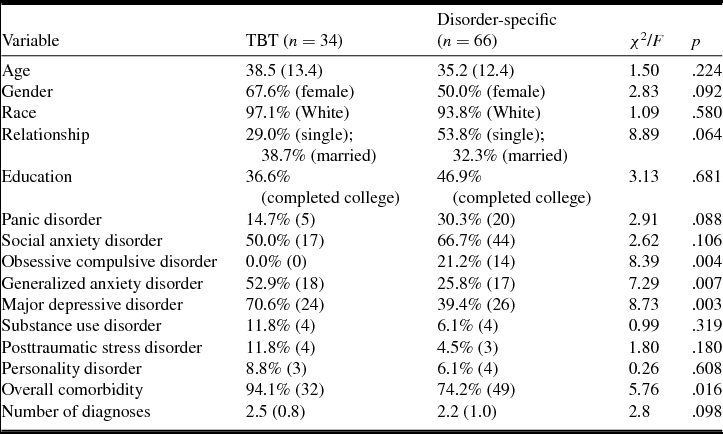
Across the TBT (n = 34) and disorder-specific (n = 66) groups, participants were predominantly women (67.6%), White (95.5% White, 4.5% Asian American), single (41.5% single, 36.9% married, 13.8% cohabiting, and 6.2% divorced, separated or widowed), completed college (37.5% completed college, 34.4% completed some college, 10.9% complete high school, and 10.9% completed some high school), and had a mean age of 38.4 years (SD = 12.6). Group differences in demographics were investigated, and are given in Table 2. There were no differences between the TBT and disorder-specific groups on any of the demographic variables (t > .091). Group differences in diagnosis and comorbidity were also investigated between the two groups, and are presented in Table 2. The two groups differed in presence of OCD (0.0% TBT; 21.2% disorder-specific; χ2 = 8.39, p = .004), GAD (52.9% TBT; 25.8% disorder-specific; χ2 = 7.29, p = .007), and MDD (70.6% TBT; 39.4% disorder-specific; χ2 = 8.73, p = .003), as well as the percentage of participants with diagnostic comorbidity (94.1% TBT; 74.2% disorder-specific; χ2 = 5.76, p = .016).
Demographics among participants in TBT and disorder-specific groups

With the exception of the first row for age (means and standard deviations with F-value for group differences), percentages are presented in the TBT and Disorder-specific columns with χ2 for group differences. The diagnoses were identified via diagnostic interview.
Impairment and treatment response
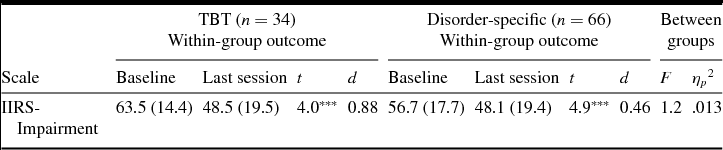
Due to limitations of the measurement methodology, the IIRS (transdiagnostic impairment) was the only measure collected across all treatment groups. IIRS data across groups is given in Table 3. Significant pre- to post-treatment within-group differences were observed in both groups (t > 3.9; p < .001). Although no statistical differences were observed in the within-group treatment responses (F = 1.23; p = .269), within-group effect sizes appeared to vary between the groups. More specifically, the TBT group effect (d = 0.88) was nearly double that of the effect for the disorder-specific CBT (d = 0.46) on the IIRS. Of note, no between-group differences were evidenced in pre- or post-treatment symptomatology (F < 3.7; p > .057).
Comparison of TBT and disorder-specific groups

IIRS, Illness Intrusiveness Rating Scale. ***p < .001; **p < .01; *p < .05.
Group differences in subset of participants with social anxiety disorder
Due to the observed differences in diagnoses and comorbidity in the full sample, a separate analysis of a specific subset of participants, based on SOC diagnosis, was completed to better estimate observed outcome differences between the treatments. The SOC diagnosis was selected due to the representation in the sample (TBT n = 17; disorder-specific n = 44); however, only participants receiving CBT for SOC were selected for the comparison group (n = 36) to improve measurement matching as well as more directly compare treatments. Data were included for the IIRS and DASS scales. All demographic and diagnostic variables were compared across groups, with only gender demonstrating reliable difference between the two treatment groups (TBT: 76.5% female; disorder-specific: 46.0% female; χ2 = 4.4, p = .036). As such, gender was entered as a covariate in the ANCOVA analyses.
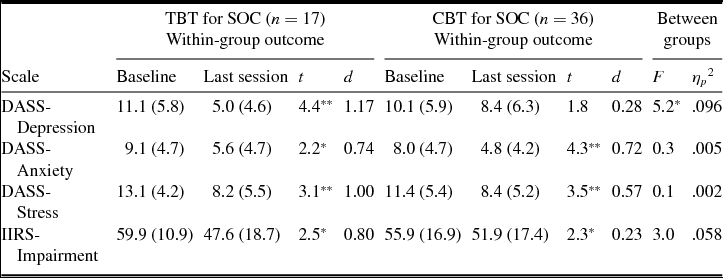
The findings for the analyses for the TBT and CBT for SOC groups in participants with SOC are given in Table 4. Participants in the TBT group demonstrated reliable symptom improvements across all scales, with moderate to large effect sizes (d ranged from 0.74 to 1.17). In contrast, participants in the CBT for SOC group demonstrated reliable symptom improvements on the DASS-Anxiety and DASS-Stress scales with moderate effect sizes (d ranged from 0.57 to 0.72). However, participants in the CBT for SOC group demonstrated small effect sizes on DASS-Depression (d = 0.28) and IIRS (d = 0.23). The difference in treatment response on the DASS-D (F = 5.2, p = .027), but not the IIRS (F = 3.0; p = .089), was supported by the ANCOVA findings. Of note, no between-group differences were observed in the pre-treatment DASS and IIRS scales (F < 1.4, p > .240).
Comparison of TBT and disorder-specific groups for social anxiety disorders

DASS, Depression, Anxiety and Stress Scale; IIRS, Illness Intrusiveness Rating Scale. **p < .01; *p < .05.
Discussion
The present pilot study was the first investigation of a group adaption of a transdiagnostic psychotherapy developed for patients with affective disorders, TBT, in a non-veteran naturalistic clinical sample. The findings support the preliminary effectiveness of group TBT in participants with a wide range of diagnoses and across symptoms of depression and anxiety as well as general impairment/functioning. In general, no significant statistical differences were observed in comparisons between group TBT and the disorder-specific group treatments. The lone group difference observed was in the SOC-only comparison in which participants in the TBT group evidenced significantly larger treatment effects for depression compared with participants in the CBT for SOC group. In addition, differences in within-group treatment effect sizes were identified across analyses. More specifically, group TBT demonstrated nearly double the treatment effect on the measure of transdiagnostic impairment compared with the disorder-specific groups. Together, these findings provide initial support for the group adaptation of TBT, with effectiveness across multiple symptoms as well as outcomes comparable to traditional, disorder-specific groups.
Transdiagnostic group treatments may offer several benefits over traditional disorder-specific group treatments. These benefits include treating groups of patients with varying diagnoses (versus awaiting sufficient numbers of patients for each disorder-specific group), addressing principal and additional diagnoses (versus focusing solely on principal diagnosis in disorder-specific group), and training providers on only one treatment for a set of disorders (versus receiving training in a separate disorder-specific treatment for each separate disorder). However, despite these potential advantages, only a few transdiagnostic treatments have been studied in a group format (Laposa et al., Reference Laposa, Mancuso, Abraham and Loli-Dano2017; Norton and Barrera, Reference Norton and Barrera2012; Riccardi et al., Reference Riccardi, Korte and Schmidt2017; Zemestani et al., Reference Zemestani, Imani and Ottaviani2017), and with only one compared with disorder-specific group treatments (Norton and Barrera, Reference Norton and Barrera2012). The present study adds to this literature demonstrating the preliminary effectiveness of group TBT. With effectiveness demonstrated (pending replication), additional research is needed to empirically test the noted potential benefits of transdiagnostic CBT groups (e.g. training costs, influence on comorbid conditions, and patient wait times to initiate group treatment).
The present findings provide preliminary support for the inclusion of group TBT into the list of potentially effective transdiagnostic group treatments. Apart from GCBT, these transdiagnostic group treatments rely on the findings of one or two published studies, and no studies comparing the treatments against one another. Despite these limitations, the design/protocol of the studies suggest that group TBT may offer benefits over the other transdiagnostic group treatments. Most significantly, group TBT is the only transdiagnostic group treatment to be developed for/studied in participants with depressive disorders. In fact, one third of participants in the present study endorsed symptoms consistent with a principal diagnosis of a depressive disorder. In addition, a large effect size for treatment improvements in depressive symptoms across the entire TBT sample and superior treatment response in the SOC-only comparison was found. Although other transdiagnostic groups have reported improvements in depressive symptoms as well (Laposa et al., Reference Laposa, Mancuso, Abraham and Loli-Dano2017; Norton and Barrera, Reference Norton and Barrera2012; Zemestani et al., Reference Zemestani, Imani and Ottaviani2017), all of these studies have been completed in patients with anxiety disorders, not in patients with principal diagnoses of a depressive disorder.
However, prior to drawing conclusions from these findings or highlighting potential implications for clinicians, the procedures included the present study had several limitations related to its naturalistic setting. Many of these limitations are related to noted challenges in transdiagnostic treatment research, including selection of participant diagnoses, comparison psychotherapies, and randomization procedures (Gros, Reference Gros2015). Participants in the present study were encouraged to select the treatment group that best met their perceived needs, potentially resulting in some selection bias as well as explaining the differences in diagnoses (e.g. more GAD and MDD in TBT groups; more OCD in disorder-specific groups). Although the SOC-only comparison reduced the diagnostic differences in that subgroup analyses, the study would have benefited from full randomization into groups. Also related to the naturalistic setting, the measures were not selected specifically for the study and thus were not administered across all groups (e.g. DASS was administered in CBT for SOC group, but not CBT for OCD group). Other limitations included: (1) the TBT sample was relatively small, limiting the interpretation of the group differences without supporting inferential statistics for the large differences in effect sizes, (2) the comparison group only contained disorder-specific groups for specific disorders (i.e. PD, SOC and OCD), limiting the interpretation of the findings for depression symptoms as well as the patients with MDD and PTSD, and (3) no data were available on the participants that did not complete the treatment protocols.
The present study was the first investigation of group TBT and our encouraging findings add to the mounting literature that transdiagnostic group treatments have comparable outcomes to disorder-specific versions (Norton and Barrera, Reference Norton and Barrera2012). The present study included several significant limitations in terms of its naturalistic setting, limiting the interpretation and implications of the observed differences in depressive symptom outcomes and effect sizes for transdiagnostic impairment. However, pending replication and randomized controlled studies, transdiagnostic group CBT protocols, such as group TBT, may provide an effective option for evidence-based therapy for patients with affective disorders.
Acknowledgements
Ethical statement: The authors assert that all procedures contributing to this work comply with the ethical standards of and approved by the local Institutional Review Board and with the Helsinki Declaration of 1975, and its most recent revision. The procedures and measures used in this study were approved by the local institutional review board and incorporated standard practices in the clinic.
Conflicts of interest: There are no conflicts of interest to disclose.
Financial support: This study was supported by Department of Veteran Affairs Clinical Sciences Research and Development Career Development Award CX000845 (principal investigator: Daniel F. Gros). The views expressed in this article are those of the authors and do not necessarily reflect the position or policy of the Department of Veterans Affairs or the United States government.



Comments
No Comments have been published for this article.