1. Introduction
High-Mg andesites (HMAs) are characterized by high MgO content (> 5 wt%), low Al2O3 (< 16 wt%) and CaO (< 10 wt%) contents, as well as low FeOt/MgO (< 1.5) ratios, which differ from typical island-arc andesites (Tatsumi, Reference Tatsumi2001). HMAs include boninites (Bloomer & Hawkins, Reference Bloomer and Hawkins1987; Le Bas, Reference Le Bas2000), bajaites (Rogers et al. Reference Rogers, Saunders, Terrell, Verma and Marriner1985; Saunders et al. Reference Saunders, Rogers, Marriner, Terrell, Verma, Weaver and Johnson1987), high-Mg adakites (Kay, Reference Kay1978; Yogodzinski et al. Reference Yogodzinski, Kay, Volynets, Koloskov and Kay1995) and sanukitoids (Tatsumi & Ishizaka, Reference Tatsumi and Ishizaka1981; Shirey & Hanson Reference Shirey and Hanson1984). Although HMAs are rarely formed in the present day, they are important to reveal the crustal growth and evolution, the subduction of oceanic/continental crust, crustal delamination and mantle interactions with fluids or melts (Kay, Reference Kay1978; Cameron et al. Reference Cameron, Nisbet and Dietrich1979; Shiraki et al. Reference Shiraki, Kuroda, Urano and Manuyama1980; Tatsumi & Ishizaka, Reference Tatsumi and Ishizaka1981, Reference Tatsumi and Ishizaka1982; Rogers et al. Reference Rogers, Saunders, Terrell, Verma and Marriner1985; Wang et al. Reference Wang, Zhao, Bai, Xiong, Mei, Xu, Bao and Wang2004 b, Reference Wang, Wyman, Xu, Dong, Vasconcelos, Pearson, Wan, Dong, Li and Yu2008 a, b; Tatsumi, Reference Tatsumi2008; Tang & Wang, Reference Tang and Wang2010; Khanna et al. Reference Khanna, Sai, Bizimis and Krishna2015; Yang et al. Reference Yang, Song, Su, Allen, Niu, Zhang and Zhang2019).
The Central Asian Orogenic Belt (CAOB), bounded by the Baltic Craton to the west, the Siberian Craton to the north, and the Tarim and North China Craton to the south (Fig. 1a), is the world’s largest Phanerozoic accretionary orogen (Sengör et al. Reference Sengör, Natal’in and Burtman1993; Han et al. Reference Han, Wang, Jahn, Hong, Kagami and Sun1997, Reference Han, Ji, Song, Chen and Li2004; Jahn et al. Reference Jahn, Wu and Chen2000; Jahn, Reference Jahn2004; Xiao et al. Reference Xiao, Windley, Badarch, Sun, Li, Qin and Wang2004, Reference Xiao, Windley, Huang, Han, Yuan, Chen, Sun, Sun and Li2009, Reference Xiao, Huang, Han, Sun and Li2010 a, Reference Xiao, Windley, Allen and Han2013; Wang et al. Reference Wang, Wyman, Zhao, Xu, Bai, Xiong, Dai, Li and Chu2007; Windley et al. Reference Windley, Alexeiev, Xiao, Kröner and Badarch2007; Su et al. Reference Su, Qin, Sakyi, Li, Yang, Sun, Tang, Liu, Xiao and Malaviarachchi2011). The CAOB orogenic processes were likely controlled by the Palaeo-Asian Ocean evolution. Despite decades of research, the duration and the cessation time of the CAOB formation remain unclear, and are variably argued to be Late Devonian (Xiao et al. Reference Xiao, Tang, Feng, Zhu, Li and Zhao1992), Early Carboniferous (Xia et al. Reference Xia, Xu, Xia, Li, Ma and Wang2003, Reference Xia, Xu and Xia2004, Reference Xia, Xia, Xu, Li and Ma2008; Wang & Ruffet, Reference Wang and Ruffet2010; Dong et al. Reference Dong, Zhang, Neubauer, Liu, Hauzenberger, Zhou and Li2011; Wang et al. Reference Wang, Shu, Faure, Jahn, Cluzel, Charvet, Chung and Meffre2011), Early–middle Carboniferous (Gao & Klemd, Reference Gao and Klemd2003; Klemd et al. Reference Klemd, Bröcker, Hacker, Gao, Gans and Wemmer2005), Late Carboniferous (Windley et al. Reference Windley, Allen, Zhang, Zhao and Wang1990; Solomovich & Trifonov, Reference Solomovich and Trifonov2002; Solomovich, Reference Solomovich2007; Konopelko et al. Reference Konopelko, Biske, Seltmann, Eklund and Belyatsky2007, Reference Konopelko, Seltmann, Biske, Lepekhina and Sergeev2009; Su et al. Reference Su, Gao, Klemd, Li, Zhang, Li, Chen and Zhang2010, Reference Su, Qin, Sakyi, Li, Yang, Sun, Tang, Liu, Xiao and Malaviarachchi2011; Xiao et al. Reference Xiao, He, Xu, Zhu, Li and Zhao2010c ; Glorie et al. Reference Glorie, Grave, Buslov, Elburg, Stockli, Gerdes and Haute2010; Gao et al. Reference Gao, Klemd, Qian, Zhang and Li2011; Li et al. Reference Li, Lin, Su, Li, Shi, Liu and Tang2011 a; Seltmann et al. Reference Seltmann, Konopelko, Biske, Divaev and Sergeev2011), Late Carboniferous – early Permian (Allen et al. Reference Allen, Windley and Zhang1992; Chen et al. Reference Chen, Lu, Jia, Cai and Wu1999) and even late Permian to Middle Triassic (Brookfield, Reference Brookfield2000; Zhang et al. Reference Zhang, Ai, Li, Rubatto, Song, Williams, Song, Ellis and Liou2007; Xiao et al. Reference Xiao, Han, Chao, Min, Lin, Chen, Li, Li and Shu2008, Reference Xiao, Windley, Huang, Han, Yuan, Chen, Sun, Sun and Li2009; Song et al. Reference Song, Xiao, Han, Li, Qu, Guo, Lin and Wang2012; Tian et al. Reference Tian, Xiao, Windley, Lin, Han, Zhang, Wan, Ao, Song and Feng2014) or Late Triassic (Song et al. Reference Song, Xiao, Windley, Han and Tian2015).
(a) Simplified tectonic map of the Central Asian Orogenic Belt (CAOB). (b) Simplified tectonic map of the Beishan orogenic belt showing the tectonic subdivisions. TC – Tarim Craton; NCC – North China Craton; SCC – South China Craton. Adapted from Song et al. (Reference Song, Xiao, Windley, Han and Tian2015).

The Beishan orogen, which connects the Tianshan orogen in the west to the Solonker suture zone in the east, is one of the contentious areas of the CAOB (Fig. 1a). Some studies have suggested that the Middle Devonian Epoch was an important oceanic–terrestrial transition during Palaeozoic oceanic basin evolution in the Beishan region, which was recorded by the Middle Devonian Sangejing Formation and the Late Devonian Dundunshan Group (Zuo et al. Reference Zuo, He and Li1990 a, b, Reference Zuo, Liu and Liu2003; Zuo & Li, Reference Zuo and Li1996; Li et al. Reference Li, Yu, Wang, Wu and Zhou2011 c; Yu et al. Reference Yu, Li, Wang, Wu and Yan2012; Niu et al. Reference Niu, Liu, Shi, Lu, Xu and Shi2018). However, many other studies suggested that the Devonian Period is not the end of the CAOB orogenesis. Several Palaeozoic island-arc (including Devonian) terranes constituted an important accretion boundary on the southern Siberian plate margin (Xiao et al. Reference Xiao, Mao, Windley, Han, Qu, Zhang, Ao, Guo, Cleven and Lin2010 b; Song et al. Reference Song, Xiao, Han, Li, Qu, Guo, Lin and Wang2012, Reference Song, Xiao, Han, Tian and Wang2013; Guo et al. Reference Guo, Xiao, Hou, Windley, Han, Tian and Song2014; Tian et al. Reference Tian, Xiao, Windley, Lin, Han, Zhang, Wan, Ao, Song and Feng2014). At Dundunshan of the Beishan orogen, Li et al. (Reference Li, Yu, Wang, Wu and Zhou2011c ) reported a laser ablation inductively coupled plasma mass spectrometry (LA-ICP-MS) zircon U–Pb age of 367 ± 10 Ma for the Dundunshan Group (Upper Formation) andesites, and interpreted the andesites to be rift-related. Rhyolites (also from the Upper Formation) yielded a scanning ion microscopy (SIMS) zircon U–Pb age of 368 ± 3 Ma. Considering the conformable contact between the Sangejing Formation and Dundunshan Group, it is proposed that the Sangejing Formation was also formed during Late Devonian time, possibly in an arc-related setting (Guo et al. Reference Guo, Xiao, Hou, Windley, Han, Tian and Song2014, Reference Guo, Chung, Xiao, Hou and Li2017). However, the exact age of the Sangejing Formation and the Devonian regional tectonics are still controversial, which impact our understanding of the Beishan orogenic evolution.
In this study, we report new age and geochemical data from the newly discovered Devonian Dundunshan HMAs in the Beishan orogen to unravel their petrogenesis. These data are integrated with sedimentary characteristics of Devonian rocks and previous results in order to provide insights into the Devonian tectonic evolution in the Beishan orogen and central-southern CAOB.
2. Geological background
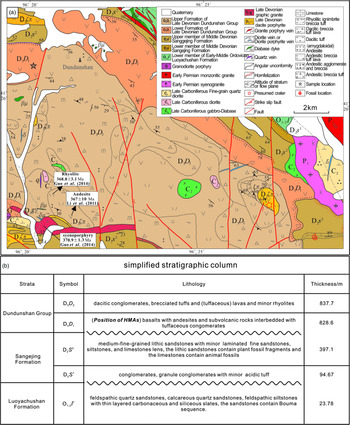
The E–W-trending Beishan orogen in the central-southern CAOB margin is situated between the North China and the Tarim Craton (Fig. 1a). The Palaeozoic Beishan orogen comprises several accreted arc terranes, including (from north to south) Quershan, Heiyingshan, Mazongshan, Shuangyingshan, Huaniushan and Shibanshan (Xiao et al. Reference Xiao, Mao, Windley, Han, Qu, Zhang, Ao, Guo, Cleven and Lin2010 b; Song et al. Reference Song, Xiao, Windley, Han and Tian2015; Ao et al. Reference Ao, Xiao, Windley, Mao, Han, Zhang, Yang and Geng2016; Fig. 1b), which are separated by the following fault or ophiolite mélanges: the Hongshishan ophiolite mélange, Jijitaizi-Xiaohuangshan ophiolite mélange, Hongliuhe–Niujuanzi–Xichangjing (HNX) ophiolite mélange and the Liuyuan Fault. In this study, we focus on the Dundunshan area in the Huaniushan arc, which contains the Middle–Lower Ordovician Luoyachushan Formation, the Middle Devonian Sangejing Formation and the Upper Devonian Dundunshan Group (Fig. 2a).

The Middle–Lower Ordovician Luoyachushan Formation mainly occurs in the north of Dundunshan (Fig. 2a). The rock assemblage includes medium- to fine-grained feldspathic quartz sandstone, calcareous quartz sandstone, feldspathic siltstone with thin carbonaceous/siliceous slate (JBGMRG, 1998). The sandstones belong to a typical Bouma sequence, suggesting a deep-pelagic reducing-deposition environment (Zuo & Li, Reference Zuo and Li1996).
Devonian sequences are mainly exposed in the southern Beishan orogen (including Dundunshan), and comprise the Sangejing Formation (D2 s) and Dundunshan Group (D3 D) (BGMRG, 1967). Later on, volcanic rock in the upper member of the original Sangejing Formation is reclassified as the lower Formation of the Dundunshan Group (JBGMRG, 1995, 1998). The revised Sangejing Formation mainly contains clastic rocks, while the Dundunshan Group mainly contains intermediate–felsic lavas and volcaniclastic rocks (Fig. 2b). This work uses the revised classification scheme of the Devonian sequences.
The Middle Devonian Sangejing Formation is distributed in the north of Dundunshan in an E–W or NW–SE orientation, and is divided into an upper and lower member (Fig. 2a, b). The lower member comprises greyish-green conglomerates with minor greyish-green felsic tuff, while the upper member consists of purplish-red, brown medium- to fine-grained lithic sandstone with minor greyish-green laminated fine sandstone–siltstone and limestone lenses. The lithic sandstone contains plant fossils and the limestone contains faunal fossils (JBGMRG, 1995).
The Devonian Dundunshan Group (D3 D) is distributed in central Dundunshan, and is divided into an Upper and Lower Formation. The contact between the Dundunshan Group and Sangejing Formation is unconformable (Fig. 2). The Lower Formation (the focus of this work) comprises black-green basalt with andesite and subvolcanic rocks interbedded with tuffaceous congomerate, while the Upper Formation comprises dacitic conglomerate, brecciated tuff and (tuffaceous) lava, and minor rhyolite (Fig. 2b) (JBGMRG, 1998). The Upper Formation andesite was zircon U–Pb dated to be c. 367 Ma (Li et al. Reference Li, Yu, Wang, Wu and Zhou2011 c), and subsequent work yielded very similar ages (369 Ma; Guo et al. Reference Guo, Xiao, Hou, Windley, Han, Tian and Song2014).
Intrusive/subvolcanic rocks at Dundunshan include mainly granite (-porphyry), diorite, gabbro, diabase and dacite porphyrite. Most of these intrusive rocks are Late Carboniferous and early Permian in age, with the exception of the Late Devonian dacite porhphyrite (Fig. 2a).
3. Petrography of high-Mg andesites
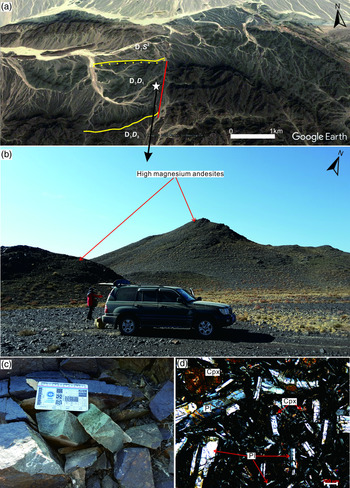
For the Lower Formation (> 829 m thick), vesicular and amygdaloidal structure is locally developed in the lavas (Fig. 2b) (JBGMRG, 1998). The Lower Formation andesites are exposed in the hills at Dundunshan with outcrop sizes of c. 500 × 500 m (Fig. 3a, b). The andesites are weakly chlorite- and carbonate-altered, and the least-altered rocks were sampled for the analyses (Fig. 3c). The andesties comprise phenocryts of short columnar plagioclase (c. 5%) and clinopyroxene (c. 10%), and groundmass of interlocking microcrystalline plagioclase and clinopyroxene laths. Plagioclase displays polysynthetic or simple twinning (Fig. 3c, d).
(a) Satellite image from Google Earth showing the schematic map of distribution location for the high-Mg andesites. (b) Photograph of the HMAs in the Devonian Dundunshan Group, Lower Formation. The car is included for scale. (c) Photomicrograph (crossed-polarized light) of andesite. The card is included for scale. (d) Photomicrograph (in crossed-polarized light) of andesite. Pl – plagioclase; Cpx – clinopyroxene.

4. Analytical methods
4.a. Whole-rock major- and trace-element analyses
Major and trace elements were analysed at the MNR Key Laboratory for the Study of Focused Magmatism and Giant Ore Deposits at the Xi’an Center of China Geological Survey. Fresh samples were powdered to 200 mesh using a tungsten carbide ball mill. Major and trace elements were analysed by X-ray fluorescence (XRF) (Panalytical Axios) and ICP-MS (Thermo X Series II), respectively. Analyses of the measured values from Chinese national rock standard (GBW07105) indicate that analytical accuracy for major elements is generally better than 5%. In addition, the FeO content was determined by wet chemistry according to the Chinese national standard GB/T14506. For chemical treatment of FeO, 0.1 g sample powders were placed in a 25 mL Teflon crucible, and 5 mL HF as well as 10 mL 1:1 H2SO4 were added. They were heated for 10 minutes at 100°C. After being removed from the high-temperature electric heating plate, they were put into a beaker with 25 mL saturated boric acid and 150 mL water. A further 10 mL of H2SO4–H3PO4 mixture and two drops of diphenylaminesulphonic acid sodium salt were added. Finally the solution was titrated with potassium dichromate standard solutions; the titration values were as for the calculation of FeO contents. For trace-element analyses, sample powders were digested using a mixture of 1.5 mL HF and 1.5 mL HNO3 in high-pressure Teflon containers at 190°C for 48 hours. Analytical accuracy was better than 10% for most trace elements.
4.b. Whole-rock Sr–Nd isotope analyses
Samples were processed with traditional cation exchange resin for Rb, Sr and light rare earth element (LREE) separation, and Nd was further separated from the REEs with di-(2-ethylhexyl)phosphoric acid (HDEHP) resin in HCl reagent. The processing was completed in the Guizhou Tongwei Analytical Technology Co. Ltd. Sr–Nd isotope analyses were carried out at the Radiogenic Isotope Laboratory at the University of Queensland. Sr and Nd chemical separation was performed with the modified procedure described by Pin & Zalduegui (Reference Pin and Zalduegui1997), Deniel & Pin (Reference Deniel and Pin2001) and Míková & Denková (Reference Míková and Denková2007). Strontium was loaded onto Ta filaments with TaF5 and analysed fully automatically on a VG Sector 54 thermal ionization mass spectrometer (TIMS) in a three-sequence dynamic procedure using 86Sr/88Sr ratio = 0.1194 for exponential mass fractionation corrections. The NBS-987 standard was used as a monitor of instrument status. It was repeatedly measured during the analysis of the samples (n = 45) and yielded an average of 0.710222 ± 20 (2σ). Deviation of this mean value from the laboratory’s previously obtained long-term average of 0.710249 ± 28 (2σ) was used to correct for all samples. Nd isotopes were analysed on a Nu Plasma HR MC-ICP-MS with a DSN-100 dissolvation nebulizing system, using a three-cycle dynamic procedure. Instrument bias and mass fractionation were corrected by normalizing the raw data to 146Nd/144Nd = 0.7219. Eleven measurements of JNdi-1 yielded an average of 143Nd/144Nd = 0.512113 ± 9, consistent with the recommended value of 0.512115 ± 7 (Tanaka et al. Reference Tanaka, Togashi, Kamioka, Amakawa, Kagami, Hamamoto, Yuhara, Orihashi, Yoneda and Shimizu2000). Lab standard, Ames Nd Metal was used as the routine instrumental drift monitor, correspondent with JNDi-1; 17 analyses yielded an average of 143Nd/144Nd = 0.511966 ± 16. This value was used to calibrate instrumental drift, which is usually less than 15 ppm.
5. Analytical results
5.a. Major- and trace-element compositions
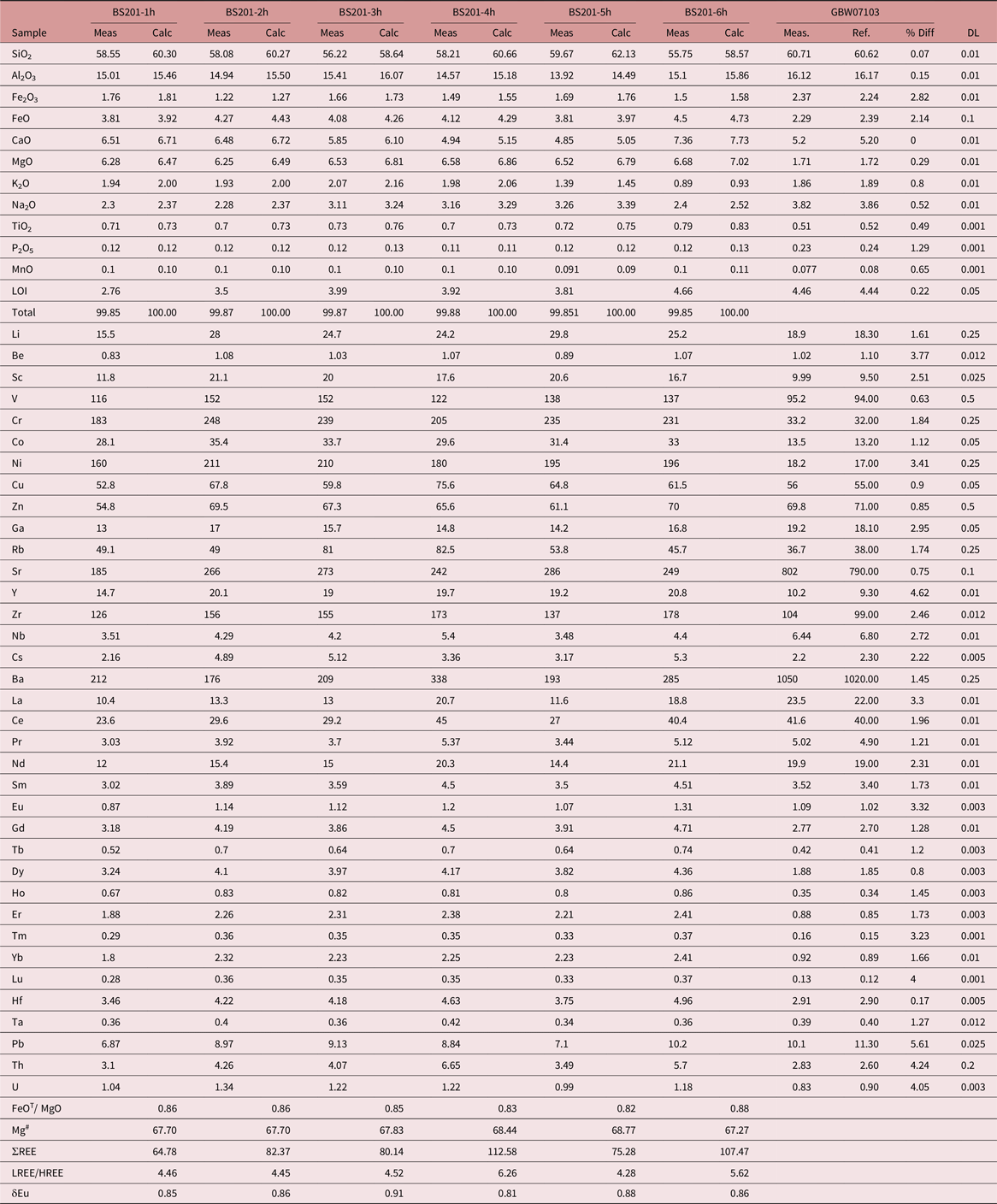
Major- and trace-element compositions of the Lower Dundunshan Group volcanic rocks are presented in Table 1. The rocks have 58.57–62.13 wt% SiO2, 14.49–16.07 wt% Al2O3, 5.05–6.24 wt% CaO and high MgO content (6.47–7.02 wt%). They have FeOt/MgO = 0.82–0.88, and higher Mg# (67.27–68.77) than typical volcanic rocks. These features are consistent with the HMAs defined by Kelemen (Reference Kelemen1995) and Tatsumi (Reference Tatsumi2001). Combined with published data (Guo et al. Reference Guo, Xiao, Hou, Windley, Han, Tian and Song2014, Reference Guo, Chung, Xiao, Hou and Li2017), the Dundunshan Group volcanic rocks comprise andesite, dacite, trachyte and rhyolite (Fig. 4a). The HMAs and other volcanic rocks mainly belong to the calc-alkalic or high-K-calc-alkalic series (Fig. 4b), respectively.
(a) Na2O + K2O versus SiO2 diagram (after Le Maitre et al. Reference Le Maitre, Bateman, Dudek, Keller, Lameyre, Le Bas, Sabine, Schmid, Sorensen, Streekeisen, Wolley and Zanettin1989) and (b) K2O versus SiO2 diagram (after Peccerillo & Taylor Reference Peccerillo and Taylor1976) for HMAs.

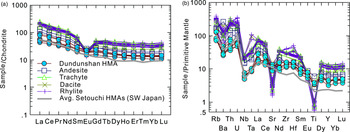
The Dundunshan HMAs have low total (Σ) REE contents (64.78–112.58 ppm). In the chondrite-normalized REE pattern (Fig. 5a), the HMAs are LREE enriched (LaN/YbN = 3.73–6.60) with a weakly negative Eu anomaly (δEu = 0.81–0.91). The other volcanic rocks (especially rhyolite) have higher ΣREE contents and significantly stronger negative Eu anomaly (δEu = 0.21–0.45) than those of HMAs. The HMAs are enriched in large-ion lithophile elements (LILEs; e.g. Cs, Rb, Ba and Pb), and depleted in high-field-strength elements (HFSEs; e.g. Nb, Ta and Ti) (Fig. 5b), displaying arc affinity. The other volcanic rocks show similar trace-element features to those of HMAs in the primitive-mantle-normalized spider diagram, except for the depletions in Sr and Ti (Fig. 5b).
(a) Chondrite-normalized REE distribution diagram for the volcanic rocks of Dundunshan Group. (b) Primitive-mantle-normalized incompatible trace-element spider diagram for the volcanic rocks of Dundunshan Group. Chondrite and primitive mantle values are from Sun & McDonough (Reference Sun and McDonough1989). The average composition of the HMAs in the Setouchi Volcanic Belt from SW Japan are from Tang et al. (Reference Tang, Wang, Wyman, Sun, Zhao and Jiang2013). Symbols as for Figure 4.

5.b. Sr-Nd isotope compositions
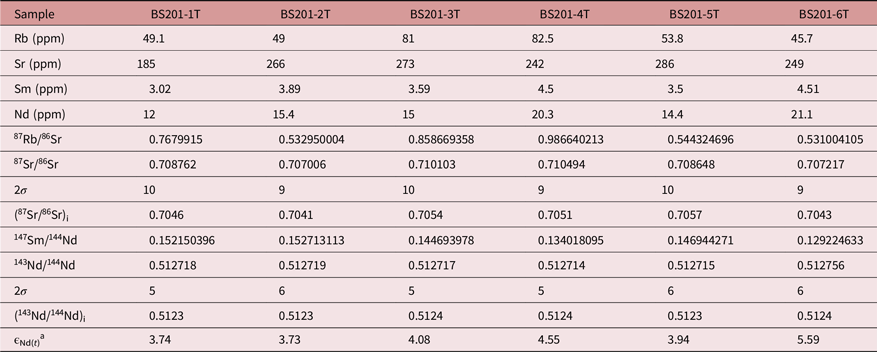
The measured initial isotope ratios were corrected to 382 Ma, based on the minimum age of the Dundunshan HMAs (Table 2). The Dundunshan HMAs have low and narrow (87Sr/86Sr)i (0.7041–0.7057) and (143Nd/144Nd)i (0.5123 –0.5124) ranges with positive ϵNd(t) (3.73–5.59). In the (87Sr/86Sr)i versus ϵNd(t) diagram, all HMA samples plot within the field close to mid-ocean-range basalt (MORB) and away from the enriched mantle (EM) I and II (Fig. 6). The Dundunshan HMAs are compared with the published Dundunshan Group rhyolite data (Fig. 6; Guo et al. Reference Guo, Chung, Xiao, Hou and Li2017) and the Late Devonian adakite-like dacitic porphyry (374 Ma) in northern Liuyuan (Fig. 6; Mao et al. Reference Mao, Xiao, Windley, Han, Qu, Ao, Zhang and Guo2011). The isotopic features of these Late Devonian volcanic ((87Sr/86Sr)i = 0.7036–0.7108; ϵNd(t) = −2.5 to −3.6) (Guo et al. Reference Guo, Chung, Xiao, Hou and Li2017) and subvolcanic rocks ((87Sr/86Sr)i = 0.7058–0.7065; ϵNd(t) = 0.6–3.8) (Mao et al. Reference Mao, Xiao, Windley, Han, Qu, Ao, Zhang and Guo2011) show the more evolved Sr isotopic compositions and more negative values of ϵNd(t) than Dundunshan HMAs.
Major-element and trace-element compositions of high-Mag andesites from the Lower Formation of Dundunshan Group in Dundunshan area, NW China

Recalculation of the percentage content after removing the loss on ignition (LOI) for the major elements. Major elements were analysed by the XRF (Panalytical Axios 440) using the measured values from Chinese national rock standard (GBW07103); analytical precision and accuracy were generally better than 5%. Trace elements were analysed by ICP-MS (Thermo X Series α); detection limits of trace elements are better than 5×10⁻⁹ and analytical precision is better than 10% for most. DL – detection limit.
Sr–Nd isotope compositions of high-Mg andesites from the Lower Formation of Dundunshan Group in Dundunshan area, NW China

a ϵNd is the derivation in parts per 10 000 of the initial ratio from that of a chondritic reservoir at the crystallization age of 382 Ma for high-magnesium andesites.
Plot of (87Sr/86Sr)i versus ϵNd(t) for the Upper Devonian volcanic rocks (after Zindler & Hart Reference Zindler and Hart1986).

5.c. Fossil chronology
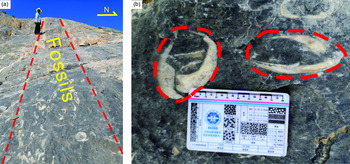
We collected abundant brachiopod fossils from the limestone lens in the upper member of Sangejing Formation (Figs 2a, 7a), and these perfectly preserved fossils (Fig. 7b) were identified to be typical brachiopod fossil Stringocephalus sp., a Middle Devonian (Givetian) index fossil. We therefore attribute the Sangejing Formation to the Middle Devonian strata, different from the Late Devonian deposition age as previously suggested (Guo et al. Reference Guo, Xiao, Hou, Windley, Han, Tian and Song2014).
(a) Photograph of fossil-bearing horizon in the upper section of the Sanggejing Formation. Person included for scale. (b) Circles for Stringocephalus sp.; the card is included for scale.

6. Discussion
6.a. Age of the Dundunshan high-Mg andesites
There are few geochronological constraints for the Devonian Sangejing Formation, except for its unconformable contact with the underlying Cambrian–Ordovician strata, and the two zircon U–Pb ages (c. 367 Ma, Li et al. Reference Li, Yu, Wang, Wu and Zhou2011 c; c. 368 Ma, Guo et al. Reference Guo, Xiao, Hou, Windley, Han, Tian and Song2014) for the overlying Dundunshan Group (Upper Formation) volcanic rocks. These geological facts have been used as the earliest evidence of the geochronology of Sangejing Formation. First, the Sangejing Formation are unconformable with the underlying Cambrian and Ordovician strata and overlying Upper Devonian Dundunshan Group. Second, the plant fossils of unknown species and brachiopod fossils were found in the Sangejing Formation (BGMRG, 1967); however, the identification of the brachiopod fossils was questioned by researchers (Liao, Reference Liao2001) because of their incomplete preservation. Third, the brachiopod fossils (Barrandeina sp.) and plant fossils (Lepielodendropsis sp.) were referred in the geological survey (JBGMRG, 1995), but there is no detailed description of preservation integrity about brachiopod fossils.
The age of the Middle Devonian (Givitian) fossils, 382–387 Ma in the upper member of the Sangejing Formation and 367–368 Ma (Li et al. Reference Li, Yu, Wang, Wu and Zhou2011 c; Guo et al. Reference Guo, Xiao, Hou, Windley, Han, Tian and Song2014) in the Upper Formation of Dundunshan Group, defines the age of the HMAs that were collected in the Lower Formation of Dundunshan Group; the HMAs were formed during early Late Devonian time (382–368 Ma).
6.b. Petrogenesis of Dundunshan high-Mg andesites
Three models have been proposed for the HMA formation: (1) melting of enriched mantle under hydrous conditions (Stern et al. Reference Stern, Hanson and Shirey1989; Stern & Hanson, Reference Stern and Hanson1991); (2) interaction between subduction slab-derived melts or oceanic sediments and mantle wedge peridotites (Kelemen, Reference Kelemen1995; Yogodzinski et al. Reference Yogodzinski, Kay, Volynets, Koloskov and Kay1995; Rapp et al. Reference Rapp, Shimizu, Norman and Applegate1999; Tatsumi, Reference Tatsumi2006, Reference Tatsumi2008); and (3) interaction between melts of the foundered lower crust and mantle-wedge peridotites (Kay et al. Reference Kay, Ramos and Marquez1993; Kelemen et al. Reference Kelemen, Hart and Bernstein1998; Xu et al. Reference Xu, Shinjo, Defant, Wang and Rapp2002; Gao et al. Reference Gao, Rudnick, Yuan, Liu, Liu, Xu, Ling, John, Wang and Wang2004; Wang et al. Reference Wang, Zhao, Xu, Wyman, Xiong, Zi and Bai2006). The results of the melting experiment show that the melt composition under the enriched mantle condition has higher Al2O3 (17.24–21.70 wt%) and CaO (8.53–9.99 wt%) contents (Hirose, Reference Hirose1997), but the Al2O3 (14.49–16.07 wt%) and CaO (5.05–7.73 wt%) contents in the Dundunshan HMAs are not consistent with the experimental results. Hydrous minerals, such as phlogopite and hornblende are not found in the Dundunshan HMAs. Further, the characteristics of Sr–Nd isotope (ϵNd(t)>0) of the Dundunshan HMAs are different from the enriched mantle. These signatures suggest that Model 1 can be ruled out.
For Model 3, when the mafic lower crust changes from granulite- to eclogite-facies, its density increased and the lower crust foundered due to gravity (Kay et al. Reference Kay, Mahlburgkay, Stoeckhert and Wedepohl1991; Gao et al. Reference Gao, Rudnick, Yuan, Liu, Liu, Xu, Ling, John, Wang and Wang2004), meaning that the HMAs formed by Model 3 are generally adakitic or adakite-like (Xu et al. Reference Xu, Shinjo, Defant, Wang and Rapp2002). Further, the melts formed by partial melting of eclogite-facies have commonly positive Eu anomolies (Stern & Hanson, Reference Stern and Hanson1991), which are not found in the Dundunshan HMAs. Model 3 can therefore be ruled out.
The Dundunshan HMA magma may therefore have originated from partial melting of subducted oceanic crust or sediments with subsequent interaction with mantle-wedge peridotites. Indeed, the HFSE features (Fig. 5b) and the Devonian subduction-related setting of the region (to be discussed later) all support Model 2. HMAs formed by Model 2 should have MORB-like Sr–Nd isotope compositions (ϵNd c. 10) (Defant & Drummond, Reference Defant and Drummond1990), but the Dundunshan HMAs have the relatively evolved isotopic compositions (Fig. 6), indicating the presence of crustal materials in the mantle source or crust contamination during the magmas ascent. However, there is no significant correlation (R 2 = 0.27) between the SiO2 contents and the (143Nd/144Nd)i ratios for the Dundunshan HMAs. This suggests that the Nd isotope compositions can approximate those of the source, and precludes major influence by crustal contamination. Moreover, crustal contamination would greatly increase the La/Sm ratios (mostly > 5; Lassiter & Depaolo, Reference Lassiter, Depaolo, Mahoney and Coffin1997), which are absent from the Dundunshan HMAs. In addition, the Dundunshan Group rhyolites have distinct crustal-like isotope charactersitics (Fig. 6). Consequently, the isotope characteristics of Dundunshan HMAs reflect a mantle source for the magma.
Previous studies were conducted on whether the HMA magmas were sourced from the subducted basaltic oceanic crust (Kay et al. Reference Kay, Ramos and Marquez1993; Yogodzinski & Kelemen, Reference Yogodzinski and Kelemen1998) or sediments (Shimoda et al. Reference Shimoda, Tatsumi, Nohda, Ishizaka and Jahn1998; Tatsumi, Reference Tatsumi2001; Hanyu et al. Reference Hanyu, Tatsumi and Nakai2002; Tatsumi et al. Reference Tatsumi, Shukuno, Sato, Shibata and Yoshikawa2003). The Dundunshan HMA parental melts are geochemically similar to those of Cenozoic sanukites in the Setouchi volcanic belt (SW Japan) (Fig. 5a, b), which are widely considered to be generated by the interaction between the subducting oceanic sediment-derived melts and mantle peridotites (Shimoda et al. Reference Shimoda, Tatsumi, Nohda, Ishizaka and Jahn1998; Tatsumi, Reference Tatsumi2001). As shown in the Sr/Y versus Y diagram (Fig. 8a), the Dundunshan HMAs samples are plotted close to the Setouchi sanukites, and close to the subducting oceanic sediment-derived melt end-member (Fig. 8b). This indicates that the mantle was most likely metasomatized by the melt derived from subducting oceanic sediments.
(a) Sr/Y versus Y diagram. Fields for adakite and island arc are from Defant & Drummond (Reference Defant and Drummond1990). The averages of the HMAs in the Setouchi Volcanic Belt from SW Japan are from Tang et al. (Reference Tang, Wang, Wyman, Sun, Zhao and Jiang2013). (b) Plot of Th versus Th/La. Subducted oceanic sediments are from Plank et al. (Reference Plank, Langmuir, Albarede, Blicherttoft, Staudigel and White1998).

We therefore suggest that the Dundunshan HMAs in the Beishan area were formed by the interaction between subducted oceanic sediment-derived melts and mantle peridotites.
6.c. Tectonic evolution of Devonian Beishan Orogen
The cessation time of Palaeozoic Beishan orogeny is still debated. The unconformity between the Dundunshan Group and Sangejing Formation suggests the termination of the Beishan orogeny (Zuo & Li, Reference Zuo and Li1996; He et al. Reference He, Zhou, Ren, Yao and Fu2005; Li et al. Reference Li, Wang, Tong, Hong and Ouyang2009; Li et al. Reference Li, Yu, Wang, Wu and Zhou2011 c; Yu et al. Reference Yu, Guo, Li, Li, Smithies, Wingate, Meng and Chen2016; Niu et al. Reference Niu, Liu, Shi, Lu, Xu and Shi2018), but Xiao et al. (Reference Xiao, Mao, Windley, Han, Qu, Zhang, Ao, Guo, Cleven and Lin2010 b) and Song et al. (Reference Song, Xiao, Windley, Han and Tian2015) considered that the region evolved through a complex series of oceanic subduction and terrane accretion events from Cambrian to Early Triassic time.
Previous studies have shown that the Early Palaeozoic S-dipping subduction of the HNX Ocean is now preserved by the HNX ophiolitic belt (Li et al. Reference Li, Wang, Li, Kang, Yu, Han and Ma2001; Zhao et al. Reference Zhao, Guo and Wang2007; Liu et al. Reference Liu, Chen, Jahn, Wu and Liu2011; Wang et al. Reference Wang, Zhang, Song, Li, Li and Zhou2018). However, the occurrence of Middle–Upper Silurian Gongpoquan Group arc-volcanic rocks (Dai et al. Reference Dai, Ren, Chen, Gao, Zhang and Wang2002, Reference Dai, Fang, Zhang, Wang, Ren, Gao, Lei and Cheng2003; Wang et al. Reference Wang, Li, Xu, Yu, Guo, Yan, Ji and Wu2016) and Silurian adakites (Yu et al. Reference Yu, Guo, Li, Li, Smithies, Wingate, Meng and Chen2016, Reference Yu, Ji and Guo2017) north of the HNX ophiolitic belt also indicates N-dipping subduction of the HNX Ocean. This implies bipolar subduction of the HNX Ocean, which may have begun during Late Ordovician time (Wang et al. Reference Wang, Zhang, Song, Li, Li and Zhou2018).
Based on the local 1:50 000 geological mapping (JBGMRG, 1995, 1998) and our field study, we systematically summarized the sedimentary sequence and characteristics of the Sangejing Formation (Fig. 9). The Sangejing Formation can be divided into the lower conglomerate member and the upper sandstone member, both showing normal bedding. There is minor greyish-green sandstone in the lower part of the upper member of the Sangejing Formation, but purplish-red and brown sandstones in the upper sandstone member are dominant and show reverse bedding and molassic features. The rocks of the Sangejing Formation change colour from greyish-green to purplish-red from the lower to the upper member, which may reflect a change from pelagic to oxidizing terrestrial deposition environment during late Middle Devonian time. In addition, Ordovician–Silurian radiolarian (He et al. Reference He, Zhou, Yao, Ren and Fu2004) that only exists in the HNX ophiolitic belt were found in the siliceous gravels of the Sangejing Formation conglomerates at Dundunshan (Zuo & Li, Reference Zuo and Li1996). The plant fossils (Barrandeina sp.) from the Sangejing Formation (upper member) (Fig. 9) at Dundunshan (JBGMRG, 1995) are a common genus in the Xichong Formation (eastern Yunnan), which represent the continental sequences of the upper Middle Devonian. We therefore suggest that the HNX Ocean in Beishan was closed during late Middle Devonian time, and the Sangejing Formation was deposited in a post-orogenic setting.
Schematic diagram of sequence characteristics of the Sangejing Formation.

Age dating results of cumulate gabbro or plagiogranite (Fig. 1b), Sinian and Cambrian stratigraphic studies (Yu et al. Reference Yu, Li, Wang, Wu and Yan2012) in the HNX ophiolite mélanges suggest that the HNX Ocean was formed during Early Cambrian time. Comparing the ages of the four ophiolitic belts (Fig. 1b), the HNX Ocean is the oldest ocean of the south branch of the Palaeo-Asian Ocean in the Beishan orogen. The Ordovician Nb-rich basalts in Liuyuan area (Mao et al. Reference Mao, Xiao, Windley, Han, Qu, Ao, Zhang and Guo2011), the Silurian Gongpoquan arc (Zuo & Li, Reference Zuo and Li1996; Dai et al. Reference Dai, Fang, Zhang, Wang, Ren, Gao, Lei and Cheng2003; Wang et al. Reference Wang, Li, Xu, Yu, Guo, Yan, Ji and Wu2016, Reference Wang, Zhang, Song, Li, Li and Zhou2018) and the Ordovician–Silurian Liuyuan-Yingzuihongshan arc (Dai et al. Reference Dai, Ren, Chen, Gao, Zhang and Wang2002; Xiao et al. Reference Xiao, Huang, Han, Sun and Li2010; Yang et al. Reference Yang, Zhao, Li, Yang, Li, Wang, Jiang and Tan2010; Song et al. Reference Song, Wang, Xu, Wang, Niu, Allen and Su2016) all suggest that Early Palaeozoic bipolar subduction of the HNX Ocean between the Dunhuang and Mingshui-Hanshan blocks existed and generated various magmatic suites (Fig. 10a).
(a) Simplified model for the tectonic setting during early Cambrian – Late Devonian time in the Dundunshan area and (b) the production of Late Devonian high-Mg andesitic magmas. HMA – high-Mg andesites; HNX – Hongliuhe–Niujuanzi–Xichangjing Ocean.

Many geodynamic evolution models such as subduction-related slab roll-back (Ao et al. Reference Ao, Xiao, Windley, Mao, Han, Zhang, Yang and Geng2016) in the north and lithospheric delamination (Xue et al. Reference Xue, Li, Qin and Tang2016), break-off (Xie et al. Reference Xie, Song, Deng, Wang, Ba, Zheng and Li2012), oceanic crust subduction (Mao et al. Reference Mao, Xiao, Windley, Han, Qu, Ao, Zhang and Guo2011) or super mantle plume presence (Su et al. Reference Su, Qin, Santosh, Sun and Tang2013) in the south were proposed for the generation of the Late Palaeozoic Beishan orogen. In the Beishan orogenic belt, however, the early Permian mafic–ultramafic complexes in the southern Beishan (Su et al. Reference Su, Qin, Santosh, Sun and Tang2013), Late Devonian mafic–ultramafic intrusions at western Dundunshan (Xie et al. Reference Xie, Song, Deng, Wang, Ba, Zheng and Li2012), and 368 Ma A-type rhyolite (Guo et al. Reference Guo, Chung, Xiao, Hou and Li2017) and 397–387 Ma A-type granites (Wang et al. Reference Wang, Yang, Xie, Lei, Wang, Cao, Yang, Qi and Jin2009; Li et al. Reference Li, Wang, Tong, Hong and Ouyang2009, Reference Li, Wang, Tong, Wang, Hong and Auyang2011 b) in the Dundunshan and its adjacent area led Yuan et al. (Reference Yuan, Zong, He, Klemd, Jiang, Zhang, Liu, Hu and Zhang2018) to suggest the magma source in the northern Beishan granitoids converted from the reworking of both juvenile and ancient crusts during a subduction-induced compressional setting to the remelting of juvenile crust during an intra-plate extensional setting during early–late Palaeozoic time based on zircon ϵHf(t) values, plagioclase Sr isotopic compositions and REE ratios. These evidences all suggest a Late Devonian post-collisional extensional setting at the Dundunshan area of the Beishan orogen. Moreover, the lower Palaeozoic igneous rocks of Beishan orogen are usually quartz-feldspathic granitoids that have undergone variable deformational and metamorphic overprints, but the intermediate–mafic plutons and mafic dykes of the upper Palaeozoic strata lack such geological features (e.g. Yu et al. Reference Yu, Li, Wang, Wu and Yan2012; Song et al. Reference Song, Xiao, Windley, Han and Tian2015; Zhang et al. Reference Zhang, Yuan, Sun, Long, Wang, Jiang and Lin2017). Consequently, on the basis of the above literatures and this study, we suggest that the late Middle Devonian is a transition period of Palaeozoic tectonic evolution and HNX Ocean was closed during late Middle Devonian time in the Dundunshan area.
Generally, the volcanic rocks formed in post-collisional intra-continental setting carry certain subduction-related geochemical signatures (Aldanmaz et al. Reference Aldanmaz, Pearce, Thirlwall and Mitchell2000; Wang et al. Reference Wang, Sun, O’Reilly, Sun, Ryuichi and Chen2004 a). The HMAs that have arc-like geochemical affinities in an intra-continental setting might be attributed to the inheritance of a previous subduction event in a metasomatized mantle source (Gao et al. Reference Gao, Rudnick, Yuan, Liu, Liu, Xu, Ling, John, Wang and Wang2004; Gan et al. Reference Gan, Wang, Barry, Zhang and Qian2020). Many similar cases can be found in a number of orogenic belts in western China, such as the upper Pliocene – upper Pleistocene volcanic rocks in Tengchong (Zhao & Chen, Reference Zhao and Chen1992), the Permian basalt in the Santanghu basin in Xinjiang (Zhou et al. Reference Zhou, Liu, Xing, Hao, Dong and Ouyang2006), the lower Permian volcanic rocks in the Western Junggar (Li et al. Reference Li, Xu, Yang, Zhao and Liu2016) and the Lower Carboniferous volcanic rocks in Inner Mongolia (Zhou et al. Reference Zhou, Zhao, Fu, Sun, Li, Huang, Mengchun and Santosh2018). Since the HNX Ocean in the Dundunshan area was likely closed during late Middle Devonian time, we suggest that the Dundunshan HMAs were formed in a post-collision extensional setting (Fig. 10b).
7. Conclusions
-
1. Andesites in the Dundunshan Group Lower Formation are geochemically comparable to typical high-Mg andesites. Trace-element and isotope compositions of HMAs indicate that they were formed by the interaction between subducted oceanic sediment-derived melts with the mantle peridotite in the mantle wedge.
-
2. Fossil chronology and radiometric dating constrain the age of the formation of the Dundunshan HMAs to early Late Devonian.
-
3. The HNX Ocean in the Dundunshan area was likely closed during late Middle Devonian time; the Dundunshan HMAs were formed in a post-collision extensional setting.
Acknowledgments
We sincerely thank Professors Xuan-Duo Cao and Ji-Wei Liang for reviewing this manuscript. We are grateful to Tao-Zhu for his assistance with field work. This study was financially supported by the National Natural Science Foundation for Youth of China (grant no. 41703038), the Natural Science Foundation of Shaanxi Province (grant no. 2015JM4144) and the China Geological Survey Project (grant no. DD20190812). We thank reviewer Shuguang Song, an anonymous reviewer, associate editor Xianhua Li and editor Dr Tim Johnson for their constructive comments and useful suggestions.
Declaration of interests
There are no conflicts of interests.