Exile
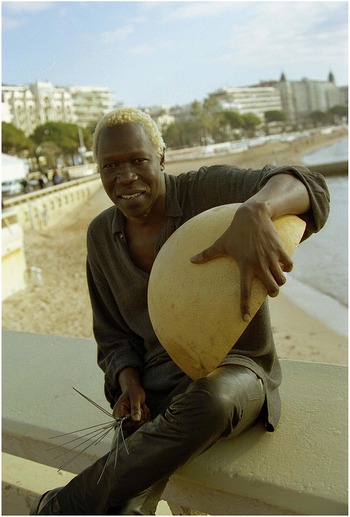
“Le Chanteur Geoffrey Oryema est mort.” So announced Le Parisien on June 23, 2018, of the death of world-music legend Geoffrey Oryema. (See Figure 1). A French Ugandan with Acholi roots he explored in dozens of songs, Oryema died of cancer in coastal Brittany at age sixty-five. Like the legacy of anyone, especially those of musicians, his remains an open question, but in this instance not just musically. For while Oryema—like many Africans in the diaspora who expect to die far from their birthplace—wanted his remains returned to his ancestral home (e.g., Mazzucato et al. Reference Mazzucato, Kabki and Smith2006; Mbiba Reference Mbiba, McGregor and Primorac2010), in contrast to many others, he wanted his body cremated and his remains brought back as ashes. What is more, he specified that his ashes should be divided and dispersed near Soroti, where he was born, and in Anaka, the savannah land of Acholi sub-region, northern Uganda. Anaka, his paternal ancestral home near the Nile River and a national park, is the region of his signature song “Land of Anaka,” a tribute to his late father. Anaka is, as he wrote on his Facebook page (January 4, 2017), where there is “red earth, black soil, green grass, and pale blue sky.”
Geoffrey Oryema in Cannes, France, in 2001 holding an awal, a traditional Acholi instrument. He played awal on “Spirits of My Father,” among other songs. Photo by Toni Anne Barson Archive/Getty Images; used with permission

“An’ my deepest roots.”
He left no will. The desire, expressed to those near him during his last moments, to become ashes and not be buried in red earth and black soil but released to the breeze, was met with alarm by Acholi cultural leaders and some of his own siblings. As Uganda Radio Network reported twelve days after his death, the Acholi council of chiefs was “afraid that the cremation and repatriation of the ashes will bring about ‘bad omen’ in Acholi land including unprecedented massive crop failures, lightning strikes, hailstorms or outbreak of strange diseases capable of wiping out a massive number of people”.Footnote 1
Two days before his June 30 funeral in Brittany, Acholi relatives petitioned the French High Court to block the cremation, but his body was nonetheless cremated. As an advisor to the Acholi paramount chief told reporters, there is one rule for Acholi last wishes: Do nothing to affect the people you leave behind.Footnote 2 However, Oryema broke this rule. His request was severely spiritually threatening because for many Acholi, bodily integrity after death and at burial means everything if the spirits of the bush are to be appeased. This bodily wholeness matters because families want the spirit of their loved one to be domesticated, not roaming in wild spaces. As much as families may try to influence the process, though, spirit forces are capricious. How spirits respond to the actions of the living is not entirely within family control (Victor Reference Victor, Stan and Nedelsky2021).
Oryema’s wish to be returned to northern Uganda, and the response, highlights “the bush” not as an abstraction but as a contestable concept in material human predicaments. Even though Oryema could have asked to be laid to rest near his home in Brittany or, like other foreign-born artists in France, in Paris’s Père Lachaise cemetery, it seems these were not options he considered. Instead, his desire for cremation and dispersal implied both a final, permanent return from exile and a controversial way of afterlife despite the fact that he, who sang internationally of Acholi culture, must have known the cosmological implications of improper burial in northern Uganda. To interpret Oryema’s life and death through the concept of the bush, and the bush concept through his life and death, is to confront such paradoxes. For in Acholi there is not one word for the bush but two, tim (pronounced teem) and lum (loom), with overlapping, divergent meanings, geographically as well as morally. And indeed, the bush recedes as a simple notion of vacant expanse or tangle of thorns, which is its usual English translation.
Even though it is conceivable that, in many years of exile, Oryema became less attuned to or concerned about rules and beliefs surrounding proper burial in Acholi sub-region, this seems unlikely. After all, many of his songs draw on Acholi ideas about spiritually active landscapes. “Lajok,” for example, describes the antics of a night dancer, and “Magical Stone” is based on an Acholi tale of an old woman with hidden powers summoning rocks to fall from the sky to form Mount Abaya. Northern Uganda’s twenty-year-long armed insurgency (1986–2006) and ongoing political violence still leave the spirits of many unquiet dead, about whom Oryema also sang. His album From the Heart includes songs such as “Tribal War” and “La Lettre,” the latter a demand to the Lord’s Resistance Army rebel Joseph Kony to release the children he abducted. Since the guns fell silent in 2006, displaced bodies which Acholi cosmology configures as coggo i ngom ma pe tye kakare (“bones in the wrong soil”) torment the spirits of the dead (Jahn & Wilhelm-Solomon Reference Jahn and Wilhelm-Solomon2015). Given Oryema’s life story, music, the history and landscape they probe, and Acholi ideas of proper burial, it seems unlikely that he did not know precisely what he was doing. The puzzle for the living, however, is what that was.
The Bush is Contested and Ambiguous
The bush is a keyword in African studies with a long, painful past. Beginning with B, it may be the first keyword to directly follow A, for Africa. In the first sentence of Critical Terms for the Study of Africa (Reference Desai and Masquelier2018), Gaurav Desai and Adeline Masquelier note, “Africa has long been represented as a featureless void—a mysterious place about which little is known but much is speculated.” Already the English word bush is conjured: as stereotype or distortion; as colonial imposition; and as pretext for grabbing land, dispossessing people, and worse. A veritable four-letter word, the bush is a term, if not the term of abuse, summoned either implicitly or explicitly to depict that supposed “featureless void” in misrepresentations of Africa.
With the bush as a suggested addition to the African Studies Review (ASR) Keyword series, I seek to demonstrate in this article, using a biography filled with music, that the bush may also play a productive role in African studies. Scholarship about the bush and its varied meanings in human life is already happening. In the Ugandan context, anti-colonial interpretations arguably have disrupted tropes of the bush since 1953, with poet, dramatist, and anthropologist Okot p’Bitek’s novel White Teeth. Here the author conceives of Kampala as a wild urban landscape his rural-raised hero must enter to earn money for bridewealth and so move his life forward (Reference p’Bitek1953).
To the extent that there are streams in recent literature about the bush, in a survey that is necessarily selective and incomplete, literature about and from the region of Acholi tends to offer up-close, localized reflections from Uganda, both historical and ethnographic. By contrast, the literature from elsewhere in Africa tends to focus transnationally on contexts of out-migration, with the bush usually considered to be outside Africa. Geoffrey Oryema’s story, as we will see, does not neatly track either of these streams, yet has many linkages. His story as an Acholi artist in France who wished to return to Uganda after his death adds a transnational intervention to a generally hyper-local literature. And for African studies more broadly, this article draws attention to the value of considering, in otherwise transnational perspectives, the nuances of a localized history of tensions related to displacement, generational flux, and political violence, and the suggestion of how understandings of the bush are perpetuated or inherited over time.
Bringing Oryema’s story forward, and simultaneously weaving in reflection on both research streams, is important because doing so helps reveal the stakes of bush concepts as more intimate and familial than might otherwise be possible, as more tied to the difficulties of a diaspora’s return from near or far, and as more suggestive of how ideas of the bush are carried through time. Simply put, in Acholi contexts the bush is entwined with histories of violence, and for some people it represents a reality—material, spiritual, and moral—that is inescapable. It encroaches on the home space not so much physically, as grass might, but in everyday relations, exposing the concept of home as fragile (Porter Reference Porter2020). As Stevens Aguto Odongoh described in a recent book chapter, comparing the experiences of Acholi who stayed during the insurgency to the experiences of those who either fled into exile or were abducted as bush combatants:
In this atmosphere, both the tormentors and the tormented have to share a neighborhood, a homestead and in some cases the same household. For example, those whose lips were cut, the maimed, those without nostrils, those whose ears were cut, those without legs and hands, the raped, those who were forced to kill their parents, close relatives, neighbors and friends—all these groups have to live together once again. (Odongoh Reference Odongoh, Casseus, Odongoh and Adrabo2021:79)
The purpose of this article, responding to the journal’s call to interpret keywords through “imaginative, speculative, and disruptive writing” (Lawrance & Desai Reference Lawrance and Desai2021:124), is to bring that importance forward. I invite scholars to engage with the bush’s discursive implications in order to grasp elusive nuances about identity, belonging, inclusion, and exclusion. At the same time, there are many dimensions to the bush, including those expressed in vocabulary such as poro, sande, and bundu (e.g., Keefer Reference Keefer2018; Anders Reference Anders2011), that are beyond the scope of this essay. In lieu of building an argument step by step, I attempt to encircle the larger question that rises through the long arc of war and postwar rural displacement that has occurred in northern Uganda (and other places, in Africa and elsewhere). And that question is: What is passed on—inherited—when everything else is laid to ruin? One inheritance is a discourse, a set of ideas, arguments, and unresolvable contradictions that travel from one generation to the next and that concern the act and meanings of going away and coming back. The bush discourse pivots around a shifting symbol for both home and the wild.
Concretely, this article explores the varied and contradictory meanings of the bush by tracing the life and death story of Geoffrey Oryema (1953–2018), a brilliant musical artist from Acholi, northern Uganda. His experiences suggest that the bush is about going somewhere different and strange, but potentially liberating, and returning after going. The border between safety and danger is blurred. The keyword’s role in inheritance is that it invites struggle over what is explicit and implicit, struggle between different kinds of authority, whether secular, spiritual, political, gendered, or intergenerational, and involving living and dead, insiders and outsiders.
To this end, I draw on the context of Oryema’s artistic upbringing and his ordeal at age twenty-three fleeing political violence in Uganda; the life’s work he created in France; permutations of his ancestral homeland of which he sang in love, anguish, and sometimes anger; and the meanings of the bush that these experiences illuminate, including within the context of literature of Acholi and Africa more broadly. For the bush is a capacious concept (Riesman Reference Riesman1998; Nyamnjoh Reference Nyamnjoh2011; Geschiere & Socpa Reference Geschiere, Socpa, Goldstone and Obarrio2017; Dubal Reference Dubal2018). It is a dangerous place, one to be avoided—a jungle, a tangle of grass, where visibility wavers—and it simultaneously lures warriors to prove themselves (Riesman Reference Riesman1998). “Oh, lights are dim,” Oryema sang of longing for life’s wonders and death’s release. “I wish heaven would knock on my door.” Life and death, in a region marked by political violence as well as buried landmines, are not simple binaries. Oryema’s wish to be cremated and dispersed on the wind—leaving people to wonder why—is, after all, an artist’s work. Perhaps it is his final performance.
In this effort, I never knew Geoffrey Oryema. I never requested nor received permission from anyone to write about his life and music. To the extent that details are in the public domain, scholars can learn from him, I think, about the constraints and freedoms found in exile, and the tensions between those in the diaspora and home people, especially at times of crisis, even death (e.g., Ndiaye, Reference Ndiayeforthcoming). As Julie Livingston conjectured with the ASR keyword “The Body,” “the bush” is simultaneously material, symbolic, metaphysically potent, and—especially in this case—politically fraught. A domain of thought, activity, and experience, the bush is a concept that should not be taken for granted (Livingston Reference Livingston2021). As a concept that is multivaried and sensitive—even painful—it demands an approach attentive to human vulnerability. Tracing a biography of connections between art, politics, and performance, and aiming for iconicity over representativity (Lawrence & Desai Reference Lawrance and Desai2021:118–19, 124), I try to express how the contradictory meanings of the bush create a space of struggle and engagement between diaspora and “home people” over how to respect spirits and ancestors yet at the same time cultivate individual freedom. This struggle is a form of inheritance between dead and living that carries forward.
In the following, I first explain what a keyword is, that its implicit and explicit meanings may be contradictory (Williams Reference Williams1983). Overlapping meanings and competing contradictions make any keyword such as the bush powerful and controversial. I then provide a brief overview of contributions from literature of Acholi, after which I draw attention to the vocabulary of tim and lum, two Acholi words commonly translated as “the bush” but with slightly different meanings and moral implications. After highlighting more scholarship from Acholi and other parts of Africa by African as well as non-African authors, I return to the life and music of Geoffrey Oryema, telling a story in reverse chronological order in the hopes that readers may be ever more invested in what I understand as his triumphs and dilemmas. The final setting is his funeral, gleaned from online sources, in lieu of a classic conclusion to a research article. Throughout, I try to emphasize the inheritance of the bush as a domain of thought, activity, and experience (Livingston Reference Livingston2021) that is carried and transported, inherited, and not without difficulty, from one generation to another.
As a multilingual American scholar, I am not fluent in Acholi, though I have discussed this term and many others in English with Acholi interlocutors, both during my research in Uganda (2014–2017) and online since then (2018–present). I do not imagine there is a singular understanding, nor that all Acholi would necessarily agree with my interpretations of the bush. However, exploring the bush through the (as best can be gleaned as an outsider) experience of one musical artist sheds light on a frequently invoked or implied term, one that can burrow “underground” when stigma prevails (Parkin Reference Parkin2015), as around the topic of death, and releases it from its English-language confines. With a throughline of Williams’ keyword formulation (Reference Williams1983) and an emphasis on inheritance, this interpretation builds on songs, social media posts, the Ugandan and French press, archives, published scholarship, and personal connections with (and Acholi translations by) many people in Uganda, who do not know one another and, to the best of my knowledge, are unbiased. Grammar in correspondence and social media posts is left intact for authenticity. French translations are mine. Geoffrey Oryema himself explained many of his songs on the Real World Records website.Footnote 3
The Bush as Keyword
A keyword unlocks no doors of definition. Rather, it encapsulates but cannot wholly contain a migration of meaning. As theorist Raymond Williams explained, a keyword is vocabulary with meanings both implicit and explicit (Reference Williams1983). It is not just any common word, but one that evokes strong feelings. For this reason, it risks becoming the province of “a temporarily dominant group” that tries to impose its definition on everyone else (Reference Williams1983:11–12). Using the word “culture,” for instance, Williams showed how culture as a keyword simultaneously communicates motion and stillness, conjuring ideas of cultivation as progress yet within a supposedly static and unchanging way of life: “a culture.” The social power of a keyword, then, comes from this roving uncontainability, the fact that its meaning cannot be pinned down by any one group because several meanings compete and overlap (e.g., Kuper Reference Kuper1999:245). Indeed, the gravity of a keyword, its ideological frequency, arises from these internal contradictions and this capacity to invite group tussles over whose meanings should prevail.
The bush is a keyword for these reasons. It is less a self-contained place than an example of “patterns that constitute places.” These patterns issue contradictory forces and imaginaries. So the bush makes for uncomfortable dialectical thinking, even feelings of vertigo (Gordillo Reference Gordillo2004:253). The bush summons negative connotations—think of “bush leagues,” with polar opposites about cities and sophistication—yet the bush resists binary thinking, too. Having no single meaning, blending implicit and explicit nuances, and stoking different feelings and reactions in different eras and circumstances, the bush is uncultivated theoretical space.Footnote 4 The friction of meanings that trespass and diverge opens up space for social and cultural meanings to emerge in relief form. What is at stake, ultimately, is not semantics but power dynamics (Williams Reference Williams1983:11–12) and social reality (MacGaffey & Bazenguissa-Ganga Reference MacGaffey and Bazenguissa-Ganga2000:2).
For the bush matters in Uganda. The country’s longtime president still derives his claims to legitimacy for having prevailed in a guerilla struggle known as the Bush War (1980–1986). In northern Uganda, former abductees of the 1986–2006 LRA conflagration have faced bigotry since they have come out of the bush and returned to Acholi civilian life (Oloya Reference Oloya2013; Odongoh Reference Odongoh, Casseus, Odongoh and Adrabo2021). In Uganda and elsewhere, the bush is both material space and the space of human and non-human agency. As Geoffrey Oryema’s own life story intimates, understanding the bush as a roving concept and social reality helps for discerning how histories of political violence get written into geographies. His story reminds us, too, that the bush has something to do with the lure of crossroads, which Acholi land has long been.
In recent literature of Acholi meanings of the bush, scholars both foreign and Acholi-born seek to understand and explain Acholi cosmology as well as how experiences in the bush impact the fates of former combatants and erect a barrier to belonging (Finnström Reference Finnström2008; Oloya Reference Oloya2013; Dubal Reference Dubal2018; Victor Reference Victor2018; Porter Reference Porter2020; Odongoh Reference Odongoh, Casseus, Odongoh and Adrabo2021). This literature shows ordinary people’s trauma due to the 1986–2006 armed insurgency. The bush as a symbol and reality of loss, pain, and blood is considered, both geographically and morally, to be either nearby or just over the border in southern Sudan. In contrast to literature from elsewhere, in which the bush is usually urban, in recent literature of Acholi it is often conceived of as a rural place without human habitation. It encroaches on home (Porter Reference Porter2020; Odongoh Reference Odongoh, Casseus, Odongoh and Adrabo2021) as a continual threat.
As we should expect with a keyword, there is no single definition, and the meanings are shaped by power dynamics (Williams Reference Williams1983:11–12). Stevens Aguto Odongoh (Reference Odongoh, Casseus, Odongoh and Adrabo2021), for example, reveals the daily debates about identity, belonging, and exclusion that arise when people with different wartime experiences interact, whether the people had stayed in northern Uganda during the insurgency, were abducted into the bush, or sought exile in the bush—that is, somewhere outside Acholi, such as in nearby southern Sudan. In one example, when former exilees and the author himself met an old man in Acholiland while watering their cattle, the old man never said the word bush, but implied it to criticize the group for, in his opinion, not knowing where their home is. He did this by first berating them for speaking a foreign language. Then he embarked on name-calling as an exclusionary tactic:
In this encounter, the old man used the term te-okono, literally “under the pumpkin,” to imply that the respondents were cowardly for having ever left Uganda to seek safety “outside.” Gi rwenyo: They are lost; they do not know where they are. In just a few sentences, the old man painted them as wanderers who are therefore no longer real Acholi.
Attention to language helps to show further subtleties of meaning. With tim and lum, Acholi language and thought intertwine expansive ideas of the bush. Tim, translated in the dictionary as bush and jungle, also means away from home, abroad, or overseas (Odonga Reference Odonga2012:469; Adong & Lakareber Reference Adong and Lakareber2009:110). As an Acholi friend explained, “The tim means a place out of your motherland or where you don’t belong.”Footnote 5 Tim implies the loneliness of being away, in exile forcibly or by choice, but also the freedom that accompanies escape and the chance to create new homes. As a verb form—obviously tone matters, too—tim means do. Tim oyot oyot (“Do it fast”) (Odonga Reference Odonga2012:470).
The related word lum literally means grass (Odonga Reference Odonga2012:290; Adong & Lakareber Reference Adong and Lakareber2009). More generally, lum concerns space “outside the moral world of humans […] governed by capricious and sometimes malevolent powers” (Porter Reference Porter2020:818). So lum is more about forces invisible to the eye but yet very material—savannah grass, jungle, wild spaces with roots—whereas tim can be those kinds of literal wild spaces but also anywhere. As the late anthropologist Sam Dubal noticed among former LRA child soldiers who survived their bush ordeals—many did not—they also interpreted lum in their counter-ontology as a space of unity, sobriety, learning, “meaningful work,” and “fierce, honorable” animals such as lions and gorillas (Reference Dubal2018:113; see also Mavhunga Reference Mavhunga2014). Furthermore, any grassy space that people might call lum was sometimes designated as tim.Footnote 6 “And if there are worries about entering lum or tim, so too are there worries about what may come out of it” (Dubal Reference Dubal2018:92). Tim and lum would seem to be separate: outside/away and grass. Yet they may be a conceptual crossbow.
Naming of children is one way in which some Acholi people express the connections and divergence of tim and lum. Male and female names about tim (Atim and Otim) and lum (Alum and Olum), respectively, share an undercurrent meaning of being away from home. However, while Atim and Otim are names of affection and incorporation for someone born outside Acholi land, Alum and Olum tend to be exclusionary, referring nowadays to individuals born in rebel captivity. What is more, during the LRA insurgency many abducted children and youth learned to adopt a “bush name”—a pseudonym, a nom de guerre—so they could avoid saying where they were from in order to protect their home communities from attacks (Victor Reference Victor2018:41). Adopting a bush name was a tactical move to protect themselves and their families, even though its use kept them apart. These examples of naming suggest the implicit tension between home and bush, the shared understandings of safety, danger, and stigma (Oloya Reference Oloya2013), and the bush as keyword or cultural concept that may be revitalized in times of human suffering.
What is also striking in Acholi materials is the evocation of children—not necessarily young, although they may be—as mediators of the bush’s contradictory dynamics. Dictionary examples about tim show these crisscrossings in a kind of poetry (Odonga Reference Odonga2012). Children play in the tim but it is not safe there; they go away but want to come back.
“They went to hunt in the jungle.”
“The children are still in the bush laying their traps to catch the birds.”
“Most of our children have gone away, abroad, or overseas; his child just came back yesterday from abroad; he does not want/like to stay away from home” (Odonga Reference Odonga2012:470).
These examples are about children going near or far away or coming back. Their being in the bush conceals them from the parents or guardians who love them. Acholi people in Gulu may say, even if they are just going to Kampala, “Aciero i tim” (I’m going to the bush).
In Acholi literature, the bush was first implied in a fresh way in Reference p’Bitek1953, by Okot p’Bitek in his novel Lak Tar Miyo Kinyero Wilobo (White Teeth Makes Us Laugh on Earth). A rural Acholi man sets out for Kampala and the plantations of “Bananaland” to earn bridewealth so he can return home to marry his beloved. Enduring mishaps and corruption, the character’s sparkling narration is full of citified hunting adventures. P’Bitek’s urban bush as a mix of moral and physical torment and frequent hilarity demonstrated the bush as a geography-bending concept, as echoed in scholarship more recently. Some Ghanaian migrants see Britain as a wild place, a “Babylon” (Akyeampong Reference Akyeampong2005). West African traders setting out from New York City anticipate the American hinterlands, namely Detroit, Kansas City, and Indianapolis, as the bush (Stoller Reference Stoller2002). And Paris, the City of Light, is experienced by some West African men as gunne, bush in Mande languages, a site of adventure (Kleinman Reference Kleinman2019).
The bush mediates time and geographies. Scholarship by and about Cameroonians, for example, shows individuals since the 1990s reconceiving the bush from a negative space to something hopeful, albeit full of risk. Hope + risk make for “bushfalling,” a uniquely Cameroonian term, it seems, which Francis Nyamnjoh theorizes as a Cameroonian form of questing (Reference Nyamnjoh2011:703). Bushfalling implies that someone can be both married and available, “subverting the boundaries within which one is confined” (Nyamnjoh:201, 707). Bushfallers propel themselves into new situations with faith in luck (Alpes Reference Alpes2014). Like the determined hero in Okot p’Bitek’s novel, bushfallers metaphorically hunt wild life or cultivate faraway fields (Feldman-Savelsburg Reference Feldman-Savelsberg2016) while envisioning the bush as “the richer parts of the world” (Geschiere & Socpa Reference Geschiere, Socpa, Goldstone and Obarrio2017).
Still, what is at stake is the ultimate gravity of home and what it represents for kinship and belonging (Geschiere & Socpa Reference Geschiere, Socpa, Goldstone and Obarrio2017:180). Unstable meanings of the bush may arise as the meaning of home changes from a place of refuge to something more ambiguous. Even if, as Paul Riesman observed more than twenty years ago, “the rest of the world is always bush compared to one’s own home” (Reference Riesman1998:31), anthropologist Holly Porter explains that for many Acholi in northern Uganda, “[t]wo decades in a state of disruption has profoundly seeped into the everyday.” Reclaiming home from the bush geographically and morally demands both imagination and persistence (Porter Reference Porter2020:829). Home and the bush are bound in a relationship, with ancestral spirits the mediators for moving in and through a forest (Mavhunga Reference Mavhunga2014:31). Even if someone ventures into the bush solo, even if the bush is a force “truly other than and independent from man as intelligent being” (Riesman Reference Riesman1998:257), he or she still carries an idea of home. Yet the distinction between home and bush can blur and, during times of political violence, shift into reverse. This reversal arguably happened to Geoffrey Oryema, and was one of his abiding dilemmas.
A Daring Man
In French, chanteur means singer, especially of ballads.Footnote 7 Ballads have simple words, tell stories, and leave a parting enigma. One of Oryema’s enigmas is leaving behind the song “No Ballads Ballad,” signaling his resistance to any one genre. His musical range, beginning with his debut album Exile, extends from lullabies such as “Solitude,” written for his mother after his father was assassinated, to laraka-raka club hits. His recorded voice, though always recognizably his own, swoops from falsetto to rich, bass tones that have been compared to smoke. As someone from landlocked Uganda, he felt at home by the Brittany sea, saying its “force de la nature de la terre” reminded him of northern Uganda, suggesting that home for him did not necessarily mean one place but a relationship with nature.Footnote 8 Fluent in four languages of diverse linguistic and cultural roots—Acholi Luo, Swahili, English, and French—he balked at classifications, even eschewing the category of “world music” through which his career was launched on the Real World Records label.Footnote 9 “You need to go further beyond expectation,” he once told fellow exilee Opiyo Oloya during an interview. “My idea of being an artist is first and foremost to explore the world between roots and modern music. It is a search for an identity, a musical identity.” “Talking to Oryema,” added interviewer Oloya, “one gets the impression that he is searching for more than just a musical identity, but the meaning of life itself.”Footnote 10
Another parting enigma nearly five years after his passing is the question of where or whether he rests. There is slippage between languages. In an article in English on the Acholi Times website, one of his sisters tried to settle the issue about ashes through terms of legal, familial, and linguistic legitimacy, with bush dangers implicit (Parkin Reference Parkin2015). Oryema and his French companion had never married and had no children together, his sister noted, implying that his companion had no right to speak for him. His sister also doubted the veracity of the five other French witnesses who testified in court to having heard her brother say he wished to be cremated. His firstborn, an adult daughter, was also not credible, in this perspective. What implicitly excluded them all was their language in court. The dispute about language echoes the old man’s assertion in Odongoh Reference Odongoh, Casseus, Odongoh and Adrabo2021, mentioned above, that Acholi language is a more authentic form of expression, a “true north” for orientation. However, as an online commenter on his sister’s article wrote about the witnesses—Oryema’s French companion, his firstborn, and the other French-speaking people—“I do not think they will go around lying about issue of this kind. What would they gain from it?”Footnote 11
The sense locally in Uganda was that Oryema’s Acholi relatives did not wish to elaborate. As one interlocutor relayed from the region, it seemed that “Oryema’s sisters, brothers and Elders in Acholi are not interested in bringing the ashes of Oryema to Anaka. Elders, in Gulu and in Anaka said, what happened to Oryema is going to kill Oryema’s children and his wife. This is not Acholi culture.” The person later added, “In Acholi when someone died we bury the body. If they burnt your death body to ashes, in the future it will bring death again. For Geoffrey Oryema his children and wife will die also. Burning death body is not in Acholi family.” A rumor was also brewing: “It was said that the late Oryema wrote in his will not to be brought back to Uganda but rather be buried in France.”Footnote 12 Were his ashes brought from France and divided and dispersed or not? If a ceremony with ashes followed in Uganda it might have been private, unlike many burials lasting for days and drawing hundreds of mourners.
Two significant stories about migration that may be found in human narration the world over suggest how the bush implies a relationship with travel and thus unpredictable tempos. In the first story, someone is flung from paradise and endures “the curse of wandering” in a place that is not their motherland and where they don’t belong. In the second, someone literally has to break out of “our suffocating places of origin” to create something new (Dorfman Reference Dorfman and Ahmad2020:49). With no way back, someone could be violently expelled from one place to another. But the bush can also be a creative zone worth questing for (Nyamnjoh Reference Nyamnjoh2011). That two significant migration stories could intersect in one person’s life is possible because the bush is a medium, and as a medium it only exists in the context of mobility, immobility, and the improvisation needed to cut a path between the two.
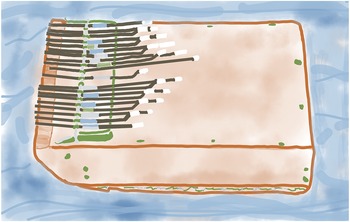
One thinks of this paradox seeing Geoffrey Oryema on stage on Youtube, at Woodstock ’94, armed with his acoustic guitar and a small but electrified lukeme thumb-piano, facing a sea of concertgoers and reeling them into his imaginative world. (See Figure 2).Footnote 13 Had he spent his whole life in Uganda, “fighting with the soil” as he exhorted other Acholi to do rather than succumb to apoka-poka me kaka, tribalism (“Exile,” 1990), would he have found new music within him? If he had stayed in Uganda, would he have been able to outlast the dictator Idi Amin, the Bush War, and the LRA insurgency, each with its own terrors and suffocations? As his sister Pamela once described his personality, “He is a daring man who will deliberately step out of line just for the sheer ecstasy of it.”Footnote 14 Oryema the artist understood the power of subverting boundaries (Nyamnjoh Reference Nyamnjoh2011:703). As he said two years before he died of cancer, “It’s true that people have always found my kind of style very difficult to classify. Very. From day one when the album Exile was released.”Footnote 15 For it was exile that delivered him to the bush. Exile has also brought him back to Acholi land, to its own bush in the form of tim, lum, and their troubled inheritance.
Acholi thumb piano known as lukeme. Drawing by the author

When a Pillar of the House Breaks
Geoffrey Oryema grew up in Anaka and Gulu town, both in Acholi land, and in the capital city Kampala, which many Acholi already consider the tim. His rural/urban upbringing was therefore neither localized, in line with the literature of Acholi, nor mainly urban, as reflective of the transnational literature, but a blend of both. From his early twenties he lived in France. What demarcated his life in Uganda from his life in France was his escape from Kampala to Nairobi in February 1977, crammed inside the trunk of a car. Soldiers had just murdered his father on the orders of President Idi Amin Dada. Reaching the Uganda/Kenya line, Geoffrey overheard the footsteps of border guards, who demanded of his driver in Swahili, “What’s in the trunk?”
“I was never so scared in my life,” Oryema later recalled. “In 15 seconds I will be dead. I prayed to all the gods: gods of the mountain, of the river. All the gods. Et même le destin. Il a parlé. Cette coffre reste fermer. Adieu, mon pays. Adieu, Maman. Adieu, Papa. Le destin en a décidé autrement.” The trunk stayed shut. Goodbye, my country. Goodbye, Mama. Goodbye, Papa. Fate has decided otherwise.Footnote 16
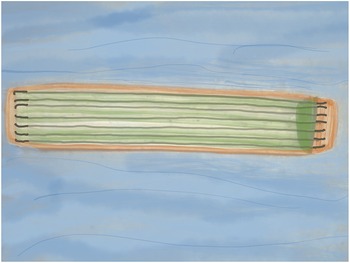
Prior to this escape, his family—“We do not choose our families,” he more than once reminded interviewers—was prominent in Uganda’s arts, security apparatus, and state administration.Footnote 17 Theirs was a trifecta of interpenetrating cultures and geographies, including of the family’s Acholi homebase in Anaka, northern Uganda, with the postcolonial nation’s tilt toward the wider world. Though Oryema would go on to guide music fans around the globe through Acholi ideas and beats—“U made us international as Acholi,” a mourner wrote on his Facebook funeral homepage—these were inroads his parents forged first.Footnote 18 Music is a language of communion and rebellion. As Uganda teetered toward authoritarianism in the 1960s and early 1970s, his mother, Janet Acoyo, coached Heartbeat of Africa, Uganda’s touring dance troupe. His father, Erinayo Wilson Oryema, who fought for the British empire in Burma during World War II (Lawoko Reference Lawoko2005:28), became the first African Inspector-General of Uganda’s police force after Independence. Geoffrey, the ninthborn of eleven children, grew up musically close to his father. As a boy, he sat at his father’s feet while Erinayo played nanga, a seven-string Acholi harp (See Figure 3) (Serumaga Reference Serumaga2018). During the 1960s, Erinayo often played Acholi instruments on Uganda Television’s Africana show (Lawoko Reference Lawoko2005:28, 189).
Nanga, the seven-string Acholi harp. Drawing by the author

Geoffrey Oryema reached early adulthood in this tim of Kampala, therefore making what many Acholi consider the bush into another setting of home that, through music playing, cultivated bonds with the heart of Acholiland. He did this as an actor as well, imbibing the naturalistic methods of Jerzy Grotowski and Konstantin Stanislavski, in which actors seek to fully understand and inhabit their characters. At age eighteen he had already toured Holland and Germany with the Abafumi (Storytellers) Theatre Company’s play Renga Moi. Footnote 19 Renga Moi—it means red warrior in Acholi—is an Odyssey tale about a soldier who comes home from a long war to find things upside down, but nobody will tell him why. “They just act like they don’t know, and his quest for answers tears the whole community apart” (Serumaga Reference Serumaga2018; Harding Reference Harding2002:108). As Robert Serumaga, Renga Moi’s playwright and director, once said, “We are posing a universal question about the choices an individual has to make, between himself and his social commitment” (Harding Reference Harding2002:109). This question reverberates in the wish of Oryema, both as a singer and the son of a police commander, to return to Uganda in the form of ashes.
The prominence of the Oryema family in the 1970s did not shield them from political violence. On the contrary, it made them more vulnerable. Idi Amin accused Erinayo of plotting to overthrow his regime. On February 17, 1977, the New York Times reported one day too late that Erinayo Oryema, along with Uganda’s archbishop and internal affairs minister, were arrested hours after a rally “where 3,000 troops shouted, ‘Kill them! Kill them today!’” (New York Times 1977:6; Omara-Otunnu Reference Omara-Otunnu1987:137). Soldiers handcuffed Erinayo, beat him, ripped his uniform, left him barefoot, then shot him dead along with the two other men (Lawoko Reference Lawoko2005:136, 140). Ugandans—especially other Acholi, many of whom were hurtling into exile after being purged from the military and police force—realized that no one was safe (Omara-Otunnu Reference Omara-Otunnu1987:104, 113, 138).
In Anaka, Erinayo Oryema’s blood-soaked remains were buried wrapped in a goatskin, in keeping with Acholi custom after a calamity “as a sign that the death had been in as yet to be explained circumstances” (Serumaga Reference Serumaga2018). Such an ignominious end, followed by Idi Amin’s hunt for his victims’ sons and relatives, who were considered to be threats to the regime (Omara-Otunnu Reference Omara-Otunnu1987:126), could only inflame the gods. “Il faut partir vite-vite-vite-vite-vite,” Geoffrey Oryema said. (I had to leave fast fast fast fast fast.)Footnote 20
In 2016, on his first trip in thirty-nine years back to Uganda, to play a concert and travel to Anaka region, Oryema sat in a Kampala hotel lobby and briefly revisited the crisis and its central betrayal. “My father saved Amin’s life many times. And he killed my father. So that is something I cannot—.” He did not finish the sentence. “People have been asking me whether I have forgiven. It’s very difficult for me to forgive. I think [the murder is] the most barbaric act in modern time. And I will never forget. But life goes on.”Footnote 21
As a result of this family tragedy in the public eye, and the human tendency to avoid painful history and to not appreciate homegrown talent, Geoffrey Oryema occupies the paradoxical position in Uganda of being a famous unknown. Famous, because it is fair to say most Acholi know about him, but unknown because northern Ugandan radio favors hip hop, dancehall, and American country music, styles that were not in his repertoire. Oryema is revered among male Acholi youth more for his tim/lum mastery than his music. He set out into the world’s wilds due to political violence they all endure to some extent and made a home in that bush, including falling in love and fathering three children. “Everyone wants to get that view,” an Acholi man once told me, about the vantage point of international air flights passing far overhead en route to and from Europe—“that view” from above, rather than from “our suffocating places of origin” (Dorfman Reference Dorfman and Ahmad2020).Footnote 22 Geoffrey Oryema in exile managed to slip certain bonds.
His biography shows that his life echoed but did not reproduce certain themes in the transnational literature of the bush. He left Uganda presumably with a desire for luck (Alpes Reference Alpes2014) and maybe “the richer parts of the world” (Geschiere & Socpa Reference Geschiere, Socpa, Goldstone and Obarrio2017), but first and foremost to save his own life. As in the transnational literature, the bush he went to after a short stay in Nairobi was another city, Paris. Coming from an upper-class background in Anglophone East Africa, he did not entirely fit into Paris’s Francophone West African community, with its working-class roots (e.g., Kleinman Reference Kleinman2019), yet, as he had done while growing up in Kampala, he cultivated bonds with Acholi through music playing, including with Acholi instruments. Most of all, he was a quester (Nyamnjoh Reference Nyamnjoh2011) in search of a unique musical identity.Footnote 23
His confrontation with death in France, then, stoked the crisis of history and geography implicating tim and lum. After some of his siblings appealed to the Acholi cultural chiefdom to intervene, the chief allegedly wrote a strong letter to Oryema’s French companion, informing her that cremation is an “unacceptable abomination with very serious consequences in the heritage of the Acholi people. … The greater family’s core interest is to return the late Geoffrey Oryema’s body home and give final resting according to the Acholi tradition and culture” (Labeja Reference Labeja2018).
The month after Geoffrey Oryema died, I asked different young people in Gulu what they thought. “It’s his right” to be cremated, one said. They agreed with his French companion’s effort to fulfill this wish. They assumed she would prevail, did not care whether there was a legal marriage between the couple, and did not worry (at least at that time) about domesticated or wild spirits.Footnote 24 Perhaps the bush is always an idiom for youth to distinguish themselves from elders, including through the language of personal rights and romantic love (Cole & Thomas Reference Cole and Thomas2009:15).
This implicit support was echoed in postings on Uganda’s Capital FM radio Facebook page:
“He’s a Ugandan. She has the right.”
“Please bring back home his ashes.”
“Its wat comes from God 4 wife respect a lates wish safe journey.” One fan simply wrote, “good wife.”Footnote 25
Maybe he has already come back. Geoffrey Oryema’s partner and children have once been seen in Anaka, according to a resident. This sighting offered a clue that romantic love may pose a counterweight to cultural authorities’ maintenance of traditional norms and values:
“He was cremated. And the ashes got spread just the way he wished, and I felt he was honored that way, Dr. Martha. Since he was married to a beautiful muzungu woman they became one no matter what people thought or said about them, not even the cultural leaders/cultural diehards from either sides. According to me, I think the Oryemas lived in their own bicultural world, which is much better than following or pleasing the traditional norms that our Acholi leaders expected.”Footnote 26
But it should also be observed that this may have been a rumor and not an eyewitness report. Was Oryema desiring to commune with his ancestors, especially his murdered father? He composed romantic love songs—“Mara,” “With You,” “The River”—but also love songs of another measure, especially his mournful ballad “Land of Anaka,” in which he recalled “that clear green land” of his paternal ancestral home, with the refrain “In place of the family house, dead sand, dead sand.” The song honors his father and grieves the memory of his assassination and all that came after. Obiga, he sang—clarifying on Facebook that “obiga” means the pillar of a house or the leader of a group, paradoxically both stability and forward motion—is no more.Footnote 27
“Obiga, lead me in this darkness Show me the way
Obiga, take me to a place Where I can see light.”
“When a pillar of the house breaks, the whole house just comes down,” he explained.Footnote 28 Breaking the pillar plunges a family into the tim. In forty-one years of exile, Geoffrey returned to Uganda only that one time, in December 2016, to play the concert in Kampala. Afterward, he made a road trip five hours north to Acholi sub-region, Gulu and Anaka, documenting the journey on Facebook.Footnote 29 “All these years, I kept saying, ‘Should I go, should I stay, should I go, should I stay, should I go?’—because I didn’t want to become a refugee for a second time.”Footnote 30 Having broken the ice and found that return was possible—Idi Amin died in exile in 2003, and the probable killers had long since vanished—it might be supposed that Oryema might come back again to Uganda to visit and perform. Through the years he had told French interviewers, “One day I’ll return there for a tour. I hope it will happen”—but also, when pressed if he missed Uganda, had replied, “Pas de tout” (“Not at all”) usually handling interviewers’ skepticism by saying Uganda was always in him. “I communicate with her through my music.”Footnote 31
As in the Renga Moi play, homecoming is often fraught. In the first migration story, somebody is thrust out into the bush. In the second, they willingly go to truly become themselves. Having been outside, though, how does the exilee get back in?
The Land of Anaka
Family is a keyword with meanings both implicit and explicit (Williams Reference Williams1983:131). With roots back to fourteenth-century Latin, “family” has evolved from implying ambiguous tensions within a household to tensions from without. These crosscurrents make any family its own arena of contestation. While the bush was not a keyword in Raymond Williams’ lexicon, and how tim and lum have migrated in their meanings over time is unclear, family and the bush necessarily have something in common, since no household exists in a vacuum. The sense of divisions that accompany belonging, and the tension between family ties and property claims co-create the sorts of inheritance that make the bush worth contending for.
And indeed, mixing ideas and words as containers of ideas in flux was one of Oryema’s specialties. He would string nouns and verbs in a sometimes deceptively soothing way as linked beads, exposing their inner fragility. In “Payira Wind,” for example, another song of exile, he began with a sturdy homestead and ended with the wind. “Visiting the family house/ visiting the family house/ I am putting dust in my eyes/ They are putting dust in their eyes/ Where have they all gone? Yamo me Payira.” “Payira Wind” evokes the forced dispersal of his Payira clan. Clan in both senses: an immediate family and their home and, more than a hundred years ago, Payira Acholi peoples expelled by British colonial forces from their land near the Nile River, the land of Anaka.
“Payira wind, carry the child away,” he sang. The physicality of land in Anaka subcounty, the red earth and black soil, has been long belied by its uneven terrain for family security. In 1910, colonial authorities deemed the area infested with tsetse flies and sleeping sickness. “Sentimentality can have no weight. … The only solution is to drive the people out,” wrote the Acting District Commissioner to his headquarters, calling for at least thirty police officers.Footnote 32 Over subsequent decades, Acholi communities would struggle in vain to return to lands from which they had been displaced. One subset of Payira who did return, in 1936, are the Payira Alokolum. Alokolum has slightly ambiguous pronunciation. It can be understood as present tense or past tense: “I change/d (aloko) the grass (lum).” In collective memory, changing the lum refers to bending the grass in one direction as the Payira were forced to leave Anaka in the early twentieth century, then bending it back as they made the return journey in 1936. While this etymology may not be historically accurate—the name may pre-date colonialism—it highlights the centrality of exile and return among Anaka and Acholi peoples over time.Footnote 33
More recently, property rights intersect with this history, leaving entanglements of family, spirits, land, and violence. At some point, perhaps when Erinayo was police commander after Independence in the 1960s, he had acquired three square miles (1,920 acres) of land in Tangi village, Anaka subcounty. The Tangi river feeds into the Nile a few miles away. Elephants roam in and outside Murchison Falls National Park. Erinayo built a farm, with agriculture, an orchard, and one hundred Friesien dairy cows. The family house, built to be protected by a metal gate with a sentry, was brick and mortar with running water. It was here that Erinayo’s body was brought after he was assassinated “and buried secretly by soldiers and his grave sealed with concrete” (Kagenda Reference Kagenda2014).
In 2014, thirty-seven years later, the government carried out an elaborate reburial in a new mausoleum in Anaka. Why it took decades for Uganda to lay Erinayo’s remains to rest may partially be explained by the fact that 2014 marked the centenary of the Uganda Police Force. Honoring Uganda’s first African police commander also serves to re-situate authority across an insecure nation. A formal reburial further implies that Erinayo’s restless spirit ever since his 1977 murder could finally be at peace, and could allow for societal regeneration among the living (e.g., Victor Reference Victor, Stan and Nedelsky2021; Jahn & Wilhelm-Solomon Reference Jahn and Wilhelm-Solomon2015:193). Attendees arriving to Anaka by convoy were estimated at 60,000 people, including the President of Uganda (Kagenda Reference Kagenda2014). Some of Geoffrey’s ten siblings attended, but he did not go to Uganda then.
Before this ceremony, the family had struggled with how to relate to the government about the reburial of their father. According to a Uganda Radio Network article that noted Geoffrey’s Acholi middle name, Ocheng, he and four sisters asked a lawyer to contact then-Inspector General of Police Kale Kayihura, expressing concern that even as they “appreciate and welcome the gesture of reburying their father during the centenary celebrations,” they believed the government was only communicating with their oldest sister. They had not been informed about the reburial, and they were seeking recompense for the houses destroyed and cattle and farm machinery looted from their Anaka property during the 1986–2006 LRA insurgency.Footnote 34 They wished “the Uganda Police Force [to] communicate officially to their attorney on intention to rebury the late IGP, and that the body of the late Oryema should not be reburied anywhere else but where it currently lies” (Otto Reference Otto2014; Serumaga Reference Serumaga2018). It is not clear if there was ever restitution.
This is the texture of Anaka. Crosscurrents of family, police, the military, the government, and Acholi have different forms of authority and persuasion. Allegedly, after the insurgency ended, a claim arose that one of Geoffrey’s siblings had exchanged 700 acres of family land with Major General Charles Otema-Awany in payment for a bill at a hotel the Major General was said to have owned (Malaba Reference Malaba2019). The Oryema family acreage at stake may number more than 10 square miles’ worth, since one of Erinayo’s granddaughters has been trying in court to have the exchange or sale revoked (Malaba Reference Malaba2019) and presumably protect the inheritance of the land for succeeding generations. Nearby, the Major General, who told a land inquiry that he owns 8,000 acres (Twaha Reference Twaha2017), has a “huge” home and commercial farm (Kagenda Reference Kagenda2014). He has been accused of using government soldiers for “illegal and forceful eviction” land grabs (Twaha Reference Twaha2017).
Having a land dispute with an army Major General in an authoritarian regime is obviously risky. In this sense, Geoffrey Oryema’s wish to be cremated and have his ashes dispersed could not have come at a worse time. Or a better one, if there is an asymmetric, cosmological challenge to worldly secular authority. Although the family and the Acholi Paramount Chief expressed concerns in cultural terms about unprecedented massive crop failures and lightning strikes, it might also be supposed that, after Erinayo’s 2014 burial with full honors, there was a delicate balance of forces to be maintained in Anaka.
Whether in life Geoffrey Oryema was aware of these alleged land grabs is not recorded in the Ugandan press. Even though, abroad, “Land of Anaka” is his best-known song, his name is absent in press articles about the Anaka land claims. Presumably he would have been aware of the gathering sense of threat. In May 2020, soldiers guarding Major General Otema-Awany’s property allegedly shot and killed four people and injured five others. The victims had been farming the land “for decades” (Daily Monitor 2020).
In other words: a place that was inhabited in pre-colonial times, with people living in proximity to wild animals and their spirit forces in savannah land near the Nile, was de-settled of families as an introduction to colonial rule, then partially re-settled later, then disrupted again through multiple iterations of war, including the LRA insurgency whose surviving victims have now come back from the bush. What is more, oil deposits have been discovered in the district, making the property even more valuable (Kagenda Reference Kagenda2014). On this porous border between human habitation and the colonial-created national park, herds of buffalo wander onto school grounds while pupils flee (Owiny Reference Owiny2020). This is Anaka, where Oryema wished his ashes to be dispersed. To the naked eye, the bush is a wilderness, ostensibly empty, but with ambiguity coursing through it. But the bush is also, paradoxically, a place of strict boundaries. Tim: the bush that is not your motherland or where you don’t belong. But re-entering the bush through lum, grass, means with limited visibility.
Indeed, the struggle is encoded in his very name, for in Acholi, Oryema means “I was cast out/ chased away/ expelled.”
Ocheng, today you leave
News of the singer’s passing in France in June 2018 was received with grief in Uganda, Europe, and the United Kingdom. Tributes and social media posts testified to Geoffrey Oryema’s magic on albums such as Exile (1990) and Beat the Border (1993); his last album, From Africa With Love, was still to be completed.
“Bon voyage GEOFFREY. Notre BRETAGNE pleure,” a mourner wrote in caps on Oryema’s official Facebook page. Safe journey, Geoffrey. Our Brittany weeps.
“R.I.P., Twon coo,” wrote another, using the Acholi for bull man, a term of respect.Footnote 35
The funeral was held two miles inland from the sea in an eleventh-century Romanesque church whose interior, depicting the ribs of a ship, evokes the journeys of seafarers who did and did not make it back to shore. The funeral was video-recorded and posted on Facebook and steeped in grief and symbolism. On that Saturday, June 30, Oryema’s French companion, Régine, his three children, members of his Acholi-born family including several sisters, and dozens of community members celebrated his life with songs from Exile, Beat the Border, and From the Heart such as “Land of Anaka,” “Nomad,” and “Lights are Dim.” His firstborn and lastborn children, respectively, performed “Makambo” (Problems) and “I’m Leaving Town.” These are all songs of restless motion. After reading from Revelations 21—“Then I saw a new heaven and a new earth, for the first heaven and the first earth had passed away, and there was no longer any sea”—the French priest explained, “Geoffrey’s songs were full of these references to spirits that somewhere travel over the seas, over the waters, and enter the hearts of men.”Footnote 36
On one level the funeral rites seemed a passage back to Anaka and the Acholi bush. Oryema’s casket, for example, was placed eastward in front of the altar while his guitar stood westward, perhaps a gesture to Acholi burial custom in rural homesteads.Footnote 37 In the era of today’s grandparents, for example, a deceased’s internment in the family homestead was often oriented so his or her head was toward the hut and the feet toward the tim—the wild or wilderness where spirits lived—so that a tipu (“soul” or spirit) from the bush could enter the home.Footnote 38 Oryema had once said of his guitar, “When I play the guitar I want the guitar to cry. It must cry. If it doesn’t cry then it doesn’t go straight to the heart.”Footnote 39 In the funeral, his guitar positioned opposite the altar was perhaps not incidental, but intentionally meant to mediate the tipu’s passage between realms of the bush and seaside Brittany.
The bush as distinct, physically and culturally, in Acholi sub-region, northern Uganda, thus encompassed France and the waters shaping it. One of Oryema’s lifelong friends from his time in the Abafumi Theatre Company addressed the congregation as if Oryema himself were listening. “Kampala in Uganda was a small city then. … You used to hold my hand every time we were crossing the street as if I were your little brother. I was 18, Geoffrey, you were 19. Protecting me—that’s how much you cared for me. To ashes you return, brother. But your soul and music is here for us forever.” Recalling the trip to Kampala and northward to Anaka in 2016 and early 2017, one of his nephews told the mourners, “If you were there you would have seen different emotions when he returned to his homeland. At the wang-o [fireside] where we sat all together, he re-lived the memories of growing up. That was probably the last time we were together.”Footnote 40
A line of mourners inched forward to pray at his coffin, comfort his weeping family, and contribute money into baskets for his journey back to Uganda. To the music of “Ye Ye Ye,” his song about a warrior whose killer is unknown, his sisters began to dance and ululate, tracing a protective shell around his companion, Régine, and the children while they quietly grieved, touching the coffin, heads bowed.Footnote 41
After the service, outdoors, pallbearers gently slid Oryema’s casket into the hearse as mourners and family members observed. Before the back door was lowered, a man shouted, “God bless you, my warrior! God bless you.” His sisters ululated, and in Acholi one cried out an Anaka mwoc. A mwoc is a praise name, a shout of joy by which someone of a certain group is recognized. Geoffrey Oryema’s name was now Ocheng, his middle name. In Acholi it means born on a sunny day. “Ocheng, today you leave to the road of Anaka. Anaka is a place of relaxation, stretching up the legs!” To encourage Ocheng, they ululated again. The sister again pierced the air, crying out once more in Acholi, “Anaka is a place of relaxation and stretching up the legs!”Footnote 42
Then the besuited driver pulled the hatch shut. A ripple of clapping followed from the crowd. “Yes, the sisters wanted his spirit to come back home here up to Anaka,” wrote an Acholi friend after watching the Facebook stream. “That’s why we heard them saying Anaka is a place of relaxation and stretching up the legs. And with all the love he had for Anaka, I strongly believe his spirit is here in Anaka no matter his ashes are brought or not.” In France around noon after the funeral, the hearse drove away, and everyone dispersed.Footnote 43
Acknowledgements
Thank you to Ugandan interlocutors. I also owe special thanks to three anonymous reviewers, to Daivi Rodima-Taylor, Annie Bunting, and Benjamin Lawrance, and to Henni Alava, Joanna Davidson, Geordie Haley, Patricia Keeney, Meridith Murray, Raymond Plourde, Holly Porter, Beth Restrick, Nancy Rydberg, Parker Shipton, Benjamin Twagira, Laura Ann Twagira, Letha Victor, Sara Weschler, and Jenny White. Writing workshops by Jaida Samudra and Kristen Vogt Veggeberg were very helpful. Thank you to the organizers of and participants in the African Studies Association’s 2021 “ASR Keywords” panel. The caveat applies: Any mistakes are my own. I have no competing interests to declare.