Introduction
Major depressive disorder (MDD) and anxiety disorders (ANX) are common and highly co-morbid disorders (e.g. Maser & Cloninger, Reference Maser and Cloninger1990; Lewinsohn et al. Reference Lewinsohn, Hops, Roberts, Seeley and Andrews1993; Merikangas et al. Reference Merikangas, Dierker and Szamari1998; Mineka et al. Reference Mineka, Watson and Clark1998; Angold et al. Reference Angold, Costello and Erklani1999; Kessler et al. Reference Kessler, Berglund, Demler, Jin, Koretz, Merikangas, Rush, Walters and Wang2003). Research data have indicated a lifetime prevalence rate of 16.2% for MDD (Kessler et al. Reference Kessler, Berglund, Demler, Jin, Koretz, Merikangas, Rush, Walters and Wang2003) and 28.8% for ANX (Kessler et al. Reference Kessler, Berglund, Demler, Jin, Merikangas and Waters2005). Fifty-nine percent of adults with lifetime MDD also met criteria for lifetime ANX (Kessler et al. Reference Kessler, Berglund, Demler, Jin, Koretz, Merikangas, Rush, Walters and Wang2003). Whereas MDD onset is spread across adolescence and early adulthood (interquartile range from ages 18–43; Kessler et al. Reference Kessler, Berglund, Demler, Jin, Merikangas and Waters2005), ANX onset tends to be concentrated in a narrow developmental span characterized by an interquartile range from ages 6–20 (Kessler et al. Reference Kessler, Berglund, Demler, Jin, Merikangas and Waters2005).
Several studies have called for greater specificity of the conceptualization of anxiety disorders (e.g. Widiger & Clark, Reference Widiger and Clark2000; Merikangas et al. Reference Merikangas, Zhang, Avenevoli, Acharyya, Neuenschwander and Angst2003). Empirical work supports the division of anxiety disorders into fear and distress conditions (Watson, Reference Watson2005). Although MDD has shown substantial co-morbidity with anxiety disorders in both conditions, this overlap is particularly noted with regard to the distress condition of generalized anxiety disorder (GAD; e.g. Moffitt et al. Reference Moffitt, Harrington, Caspi, Kim-Cohen, Goldberg, Gregory and Poulton2007; Kessler et al. Reference Kessler, Gruber, Hettema, Hwang, Sampson and Yonkers2008).
Compared to non-co-morbid presentations of the disorders, co-morbid MDD–ANX is associated with greater symptom severity (Coryell et al. Reference Coryell, Endicott, Andreasen, Keller, Clayton, Hirschfeld, Scheftner and Winokur1988; Mitchell et al. Reference Mitchell, McCauley, Burke and Moss1988; Bernstein, Reference Bernstein1991), higher rates of suicidal behavior (Reich et al. Reference Reich, Warshaw, Peterson, White, Keller, Lavori and Yonkers1993; Lewinsohn et al. Reference Lewinsohn, Rohde and Seeley1995; Rohde et al. Reference Rohde, Clarke, Lewinsohn, Seeley and Kaufman2001), higher rates of mental health treatment utilization but poorer treatment response (Lewinsohn et al. Reference Lewinsohn, Rohde and Seeley1995; Brent et al. Reference Brent, Kolko, Birmaher, Baugher, Bridge, Roth and Holder1998; Emslie et al. Reference Emslie, Weinberg and Mayes1998), higher medical costs (Marciniak et al. Reference Marciniak, Lage, Dunayevich, Russell, Bowman, Landbloom and Levine2005), and an increased risk of recurrence (Emslie et al. Reference Emslie, Weinberg and Mayes1998). Given the high level of overlap between MDD and ANX, and the severe impairment and cost incurred by their co-morbidity, understanding the development of co-morbid MDD–ANX represents a pressing need. The primary aim of the present study was to address that need by evaluating models of their co-morbidity among adolescents and young adults.
Theory-driven models of co-morbidity
Two theoretical models of co-morbidity between ANX and MDD that have received considerable research attention are direct causation and shared etiology. The direct causation model states that one disorder causes or lowers the threshold for the expression of the other disorder (Avenevoli et al. Reference Avenevoli, Stolar, Li, Dierker and Merikangas2001). To date, evidence indicates that ANX often temporally precedes MDD (Kovacs et al. Reference Kovacs, Gatsonis, Paulauskas and Richards1989; Alloy et al. Reference Alloy, Kelly, Mineka, Clements, Maser and Cloninger1990; Hagnell & Grasbeck, Reference Hagnell, Grasbeck, Maser and Cloninger1990; Regier et al. Reference Regier, Burke, Burke, Maser and Cloninger1990; Breslau et al. Reference Breslau, Schultz and Peterson1995; Wittchen, Reference Wittchen, Hand and Wittchen1998; Breslau et al. Reference Breslau, Chilcoat, Schultz, Peterson and Frank2000; Merikangas et al. Reference Merikangas, Zhang, Avenevoli, Acharyya, Neuenschwander and Angst2003) and predicts the course of MDD (Sanford et al. Reference Sanford, Szatmari, Spinner, Munroe-Blum, Jamieson, Walsh and Jones1995), leading some to suggest that ANX may play a causal role in the development of MDD (Brady & Kendall, Reference Brady and Kendall1992). However, it is not yet clear whether the relationship is causal or explained by other factors.
The shared etiology model, also referred to as the correlated liabilities model (Neale & Kendler, Reference Neale and Kendler1995), posits that a common set of risk factors leads to the development of both MDD and ANX. Research has shown that MDD and ANX share several putative risk factors, such as severely stressful life events (Finlay-Jones & Brown, Reference Finlay-Jones and Brown1981; Miller & Ingham, Reference Miller and Ingham1983; Brown, Reference Brown1993; Brown & Harris, Reference Brown and Harris1993; Cicchetti & Toth, Reference Cicchetti and Toth1998; D'Imperio et al. Reference D'Imperio, Dubow and Ippolito2000), socio-economic disadvantage, non-intact family structure, family dysfunction, and peer problems (see Shanahan et al. Reference Shanahan, Copeland, Costello and Angold2008 for review). Parental psychiatric disorders also have been implicated (e.g. Turner et al. Reference Turner, Beidel and Costello1987; Puig-Antich et al. Reference Puig-Antich, Goetz, Davies, Kaplan, Davies, Ostrow, Asnis, Twomey, Iyengar and Ryan1989; Last et al. Reference Last, Hersen, Kazdin, Orvaschel and Perrin1991; Harrington et al. Reference Harrington, Fudge, Rutter, Gredenkamp, Groothues and Pridham1993; Kovacs et al. Reference Kovacs, Devlin, Pollock, Richards and Mukerji1997; Klein et al. Reference Klein, Lewinsohn, Rohde, Seeley and Shankman2003). Thus, it is possible that common risk factors may account for a substantial proportion of the co-occurrence of MDD and ANX.
Risk factors for MDD
Numerous risk factors for MDD have been identified. Multiple indicators of poor interpersonal functioning have been linked to elevated risk of MDD, including low family social support (Lewinsohn et al. Reference Lewinsohn, Roberts, Seeley, Rohde, Gotlib and Hops1994, Reference Lewinsohn, Rohde and Seeley1998; Bond et al. Reference Bond, Carlin, Thomas, Rubin and Patton2001), loneliness (Joiner et al. Reference Joiner, Lewinsohn and Seeley2002), and emotional reliance or interpersonal dependence (Lewinsohn et al. Reference Lewinsohn, Rohde and Seeley1995). Certain cognitive variables have also been shown to enhance risk of MDD, such as low self-esteem (Brown et al. Reference Brown, Andrews, Harris, Adler and Bridge1986) and negative attributional style (Abramson et al. Reference Abramson, Metalsky and Alloy1989; Lewinsohn et al. Reference Lewinsohn, Roberts, Seeley, Rohde, Gotlib and Hops1994, Reference Lewinsohn, Rohde and Seeley1998). Additionally, the presence of other psychiatric conditions, such as subthreshold depressive symptoms (Judd et al. Reference Judd, Paulus, Wells and Rapaport1996, Reference Judd, Akiskal, Maser, Zeller, Endicott, Coryell, Paulus, Kunovac, Leon, Mueller, Rice and Keller1998; Lewinsohn et al. Reference Lewinsohn, Rohde and Seeley1998, Reference Lewinsohn, Klein, Durbin, Seeley and Rohde2003; Pine et al. Reference Pine, Cohen, Gurley, Brook and Ma1998), alcohol abuse (Kandel et al. Reference Kandel, Johnson, Bird, Canino, Goodman, Lahey, Regier and Schwab-Stone1997; Armstrong & Costello, Reference Armstrong and Costello2002) and drug use (Brook et al. Reference Brook, Brook, Zhang, Cohen and Whiteman2002), predicts MDD onset. Finally, status variables such as female gender and a single-parent home, in addition to stressful events and academic problems, represent risk factors for MDD (Andrews & Lewinsohn, Reference Andrews and Lewinsohn1992; Lewinsohn et al. Reference Lewinsohn, Hops, Roberts, Seeley and Andrews1993, Reference Lewinsohn, Rohde and Seeley1998).
Risk factors for ANX
Risk factors for ANX overlap considerably with those for MDD, and include female gender, stressful events and poor interpersonal functioning (Coie et al. Reference Coie, Lochman, Terry and Hyman1992; Panak & Garber, Reference Panak and Garber1992; Keiley et al. Reference Keiley, Lofthouse, Bates, Dodge and Pettit2003; Kessler et al. Reference Kessler, Berglund, Demler, Jin, Merikangas and Waters2005). Cigarette smoking and subthreshold symptoms of anxiety constitute additional risks (Lewinsohn et al. Reference Lewinsohn, Zinbarg, Seeley, Lewinsohn and Sack1997; Armstrong & Costello, Reference Armstrong and Costello2002; Klein et al. Reference Klein, Lewinsohn, Rohde, Seeley and Shankman2003). A cognitive factor that may predict the development of ANX is tendency to worry (Roemer & Borkovec, Reference Roemer, Borkovec, Wegner and Pennebaker1993).
Current study
In summary, there is preliminary support for both theoretical models of the co-morbidity between MDD and ANX. Nevertheless, prior work has often failed to consider a range of risk factors for MDD and ANX and to examine both models within the same study. The current study extends findings by Olino et al. (Reference Olino, Klein, Lewinsohn, Rohde and Seeley2010) on the longitudinal associations between anxiety and depressive disorders by examining theoretical models of co-morbidity in a large, non-clinical sample of adolescents who were tracked through age 30.
Method
Participants
Participants were drawn from the Oregon Adolescent Depression Project (OADP). OADP probands were randomly selected from nine high schools in western Oregon. A total of 1709 adolescents (ages 14–18 years, mean=16.6, s.d.=1.2) completed an initial (T1) assessment between 1987 and 1989. Approximately 1 year later, 1507 (88%) returned for a second evaluation (T2). Differences between the sample and the larger population from which it was selected, and between participants and those who declined to participate or dropped out of the study before T2, were small (Lewinsohn et al. Reference Lewinsohn, Hops, Roberts, Seeley and Andrews1993). At age 24, all probands with a history of psychopathology (n=644) by T2 and a random sample with no history of psychopathology (n=457) were invited to participate in a third (T3) evaluation. Of the 1101 T2 participants selected for a T3 interview, 941 (85%) completed the age 24 evaluation. The T2 diagnostic groups did not differ on the rate of participation at T3. Lastly, at age 30, all T3 participants were invited to participate in a T4 evaluation. Of the 941 T3 participants, 816 (87%) completed the T4 interview. The 816 T4 participants included 484 (59%) women. Among those invited to the T3 and T4 assessments, women were more likely than men to complete evaluations (χ2>5.99, p's<0.05). Participation did not differ as a function of other demographic variables or previous diagnoses.
The reference sample for the current investigation included the 1507 probands who completed T1 and at least one follow-up assessment.
Diagnostic interviews
Participants were interviewed with a version of the Schedule for Affective Disorders and Schizophrenia for School-Age Children (K-SADS) at T1, T2 and T3. The version of the K-SADS used combined features of the Present Episode and Epidemiologic versions (Orvaschel et al. Reference Orvaschel, Puig-Antich, Chambers, Tabrizi and Johnson1982; Chambers et al. Reference Chambers, Puig-Antich, Hirsch, Paez, Ambrosini, Tabrizi and Davies1985). In conjunction with the K-SADS, the Longitudinal Interval Follow-Up Evaluation (LIFE; Keller et al. Reference Keller, Lavori, Friedman and Nielsen1987) was used to evaluate the presence and course of disorders since participation in the previous diagnostic interview. T4 diagnostic assessments were based on the Structured Clinical Interview for Axis I DSM-IV Disorders – Non-Patient Edition (SCID-NP; First et al. Reference First, Spitzer, Gibbon and Williams1995), with the LIFE also used to evaluate disorder presence and course since T3. Symptom endorsements during these interviews were subsequently evaluated in conjunction with DSM-III-R criteria (APA, 1987) at T1 and T2 and DSM-IV criteria (APA, 1994) at T3 and T4. Interviews at T3 and T4 were conducted by telephone, which generally provides comparable validity to face-to-face interviews (Sobin et al. Reference Sobin, Weissman, Goldstein, Adams, Wickramaratne, Warner and Lish1993; Rohde et al. Reference Rohde, Lewinsohn and Seeley1997).
T1 diagnostic status
Two dichotomously coded variables were created to reflect lifetime ANX and lifetime MDD. In addition, two dichotomously coded variables were created to reflect lifetime alcohol use disorder and any lifetime substance use disorder (excluding alcohol).
T1 lifetime subthreshold depression and anxiety
Subthreshold diagnoses were coded dichotomously and assigned according to the definitions from Lewinsohn et al. (Reference Lewinsohn, Shankman, Gau and Klein2004) and Shankman et al. (Reference Shankman, Klein, Lewinsohn, Seeley and Small2008). Subthreshold depression was defined as an episode of depressed mood or loss of interest or pleasure lasting at least 1 week, plus at least two of the seven associated symptoms (yielding a total of at least three symptoms). Probands could not have subthreshold depression if they previously met criteria for dysthymic disorder or bipolar disorder. Subthreshold anxiety was defined as the presence of at least three anxiety symptoms across the following anxiety disorders: panic disorder, agoraphobia without a history of panic, social phobia, simple phobia, obsessive–compulsive disorder (OCD), separation anxiety (SA), overanxious disorder (OD), acute stress disorder, GAD and post-traumatic stress disorder (PTSD). Probands could not have subthreshold anxiety if they previously met criteria for any anxiety disorder.
T1 psychosocial measures
The following psychosocial measures were selected based on their theoretical relevance to ANX, MDD, or both.
Family social support
Eight continuously scored items were specified as loading on a latent Family Social Support construct. The model provided an acceptable to excellent fit on the basis of the model error index [root mean square error of approximation (RMSEA)=0.05] and fit indices [Comparative Fit Index (CFI)=0.99, Tucker–Lewis Index (TLI)=0.99]. Internal consistency was adequate (α=0.77).
Friend social support
Seven continuously scored items were specified as loading on a latent Friend Social Support construct. The model provided a good to excellent fit (RMSEA=0.04, CFI=0.98, TLI=0.96) and internal consistency was adequate (α=0.72).
Dysfunctional attitudes
Nine items from the Dysfunctional Attitudes Scale (DAS; Weissman & Beck, Reference Weissman and Beck1978) measured the tendency to generalize from specific bad outcomes to a sense of negative self-worth. The measure demonstrated acceptable internal consistency (α=0.74).
Worry
The tendency to worry was assessed with five items drawn from the Minnesota Multiphasic Personality Inventory (Hathaway & McKinley, Reference Hathaway and McKinley1943) and the Maudsley Obsessional Compulsive Inventory (Hodgson & Rachman, Reference Hodgson and Rachman1977). The measure demonstrated acceptable internal consistency (α=0.69).
Loneliness
Loneliness was assessed with an eight-item scale adapted from the UCLA Loneliness Scale (Roberts et al. Reference Roberts, Lewinsohn and Seeley1993), which measures feelings of solitude, disconnection and lack of closeness. Acceptable internal consistency (α=0.78) was demonstrated.
Emotional reliance
Excessive emotional reliance was assessed with 10 items of the extent to which the individual desires excessive support and approval from others, is anxious about being alone or abandoned, and is interpersonally sensitive (Emotional Reliance Scale; Hirschfeld et al. Reference Hirschfeld, Klerman, Chodoff, Korchin and Barrett1976). The measure demonstrated good internal consistency (α=0.83).
Self-esteem
Self-esteem was assessed with three items on satisfaction with specific body parts (Body Parts Satisfaction Scale; Berscheid et al. Reference Berscheid, Walster and Bohrnstedt1973), three items on general satisfaction with physical appearance (Physical Appearance Evaluation subscale; Winstead & Cash, Reference Winstead and Cash1984), and three items on self esteem (Self-Esteem Scale; Rosenberg, Reference Rosenberg1965). The measure demonstrated acceptable internal consistency (α=0.81).
Analytic strategy
Logistic regression was used to examine T1 cross-sectional associations between ANX and MDD, and also associations between theoretically derived risk factors and lifetime history of MDD or ANX. Each risk factor was significantly associated with MDD, ANX, or both at T1, and was therefore retained for prospective analyses (results available upon request to first author). In prospective analyses, we first examined the prospective relationships between the T1 risk factors and the subsequent onsets of MDD and ANX. Risk factors that predicted only MDD or ANX were considered ‘specific’, whereas those that predicted both conditions were considered ‘common’. Next, we examined the prospective predictive effect of a T1 lifetime history of one disorder (e.g. MDD) on the subsequent onset of the second disorder (e.g. ANX). This step was then repeated while controlling for common risk factors identified in step 1. Our rationale was that, if the predictive effect of one disorder on the other decreased to non-significance after controlling for common risk factors, then a shared etiology model would be supported (i.e. the relationship between MDD and ANX is explained by the presence of risk factors common to each disorder). If the predictive effect of one disorder on the other remained statistically significant after controlling for common risk factors, then a direct causation model would be supported (i.e. one disorder temporally precedes the other and the relationship is not spurious; Garber & Hollon, Reference Garber and Hollon1991). Based on prior research, we expected to find bidirectional predictive effects between MDD and ANX, and that these effects would decrease to non-significance after controlling for common risk factors.
Cox proportional hazards models were used to examine T1 predictors of subsequent disorder onset. Cox models take into account the onset of a disorder and the time to onset. Cox models appropriately handle information from censored cases, or those individuals who did not develop MDD or ANX over the course of the study. The probability of developing a disorder was expressed as a hazard ratio (HR) with a 95% confidence interval (CI). An interval variable representing time was created by computing (a) the number of months from the first assessment wave to disorder onset or (b) the number of months from the first assessment wave to the final assessment wave among those who did not develop a disorder. The diagnostic status for each disorder was coded dichotomously. All non-binary predictor variables were standardized prior to analysis so that HRs indicate the change in risk for one standard deviation of the predictor. The proportional hazards assumption was tested in each model by including a time×predictor interaction term. When the proportional hazards assumption was not met, the predictor, time variable, and the time×predictor interaction term were retained in the model (Tabachnick & Fidell, Reference Tabachnick and Fidell2001). As measures of standardized effect size, we used odds ratios (ORs) for logistic regression models and generalized R 2 for Cox proportional hazards models (O'Quigley et al. Reference O'Quigley, Xu and Stare2005). In addition to examining the statistical significance of predictors before and after controlling for common risk factors, we also calculated the percentage change in HR (Batty et al. Reference Batty, Der, Macintyre and Deary2006).
Given the stratified sampling procedure used at T3, weights reflecting the probability of selection for the T3 follow-up were used in analyses. Cox proportional hazards models including the weighting variable were run in Mplus, version 5 (Muthén & Muthén, Reference Muthén and Muthén1998–Reference Muthén and Muthén2007). Missing data were modeled using maximum likelihood estimation.
Results
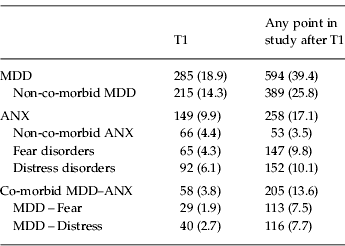
We first examined cross-sectional associations between the disorders at T1 in the entire sample (n=1507; Table 1). As expected, the association between MDD and ANX at T1 was statistically significant when examining lifetime diagnostic status (n=1507, OR 4.71, 95% CI 3.31–6.71) and current diagnostic status (n=1507, OR 7.94, 95% CI 3.11–20.24).
Prevalence of MDD and ANX by T1 and at any point in the study after T1

Values given as n (%).
Prospective predictors of disorder onset
MDD
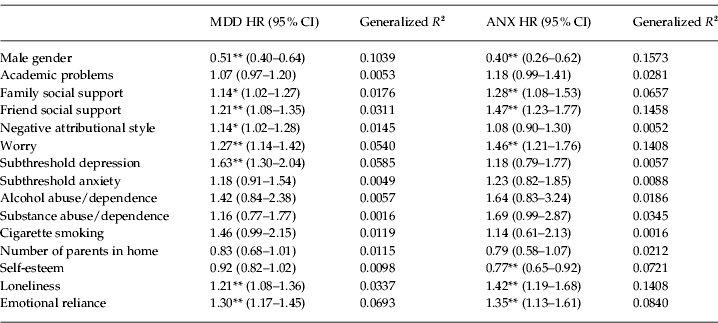
The reference sample for predicting MDD onset (co-morbid or non-co-morbid) included 1222 participants (602 women) with no lifetime history of MDD at T1. Of these, 309 (25.29%) developed MDD by the final assessment in which they participated. Significant univariate predictors of MDD were female gender, family social support, friend social support, negative attributional style, worry, subthreshold depression, loneliness, and emotional reliance (Table 2).
T1 bivariate predictors of MDD and ANX

HR, Hazard ratio; CI, confidence interval.
* p<0.05, ** p<0.01.
ANX
The reference sample for predicting ANX onset (co-morbid or non-co-morbid) included 1358 participants (700 women) with no lifetime history of ANX at T1. Of these, 109 (8.03%) developed ANX by the final assessment in which they participated. Significant univariate predictors of ANX were female gender, family social support, friend social support, worry, self-esteem, loneliness, and emotional reliance (Table 2).
From the preceding sets of analyses, common predictors of MDD and ANX were female gender, family social support, friend social support, worry, loneliness, and emotional reliance. Higher levels of negative attributional style and subthreshold depression were specific predictors of MDD whereas lower self-esteem was a specific predictor of ANX.
Dimensions of ANX
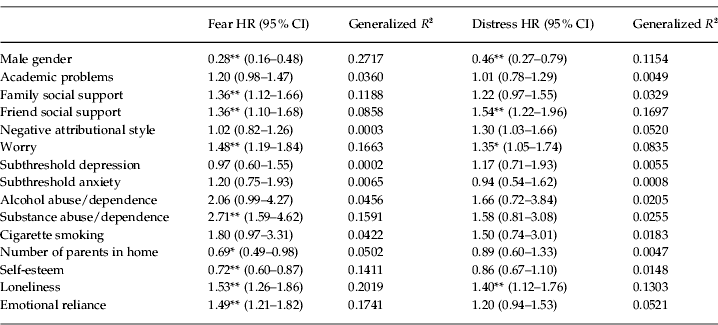
Secondary analyses were conducted with anxiety disorders divided into fear and distress disorders (Watson, Reference Watson2005). Fear disorders were defined as any form of lifetime panic disorder (with or without agoraphobia) or any form of lifetime phobia disorder (specific phobia, social phobia, or agoraphobia). Of the 1450 participants with no history of these conditions at T1 (767 women), 82 (4.99%) developed a fear disorder while in the study. Significant predictors of fear disorders were female gender, family social support, friend social support, worry, substance abuse/dependence, number of parents in the home, self-esteem, loneliness, and emotional reliance (Table 3).
T1 bivariate predictors of fear and distress disorders

HR, Hazard ratio; CI, confidence interval.
* p<0.05, ** p<0.01.
Models were then run for distress disorders. Distress disorders were defined as lifetime GAD, PTSD, OCD, OD or SAFootnote †. Of those 1426 participants (751 women) with no identified history of a distress disorder at T1, 60 (4.21%) developed a distress disorder while in the study. Significant predictors of distress disorders were female gender, friend social support, worry, and loneliness (Table 3).
Prospective relationships between MDD and ANX
In the total sample (n=1507), 207 participants met lifetime criteria for both MDD and ANX by the final assessment wave in which they participated. Of these, 125 (61.88%) developed ANX prior to MDD, with a mean time of 8.41 years from ANX onset to MDD onset. Seventy-four (36.63%) developed MDD prior to ANX, with a mean time of 6.04 years from MDD onset to ANX onset. Eight participants (3.96%) reported simultaneous MDD and ANX onsets.
T1 ANX predicting MDD onset
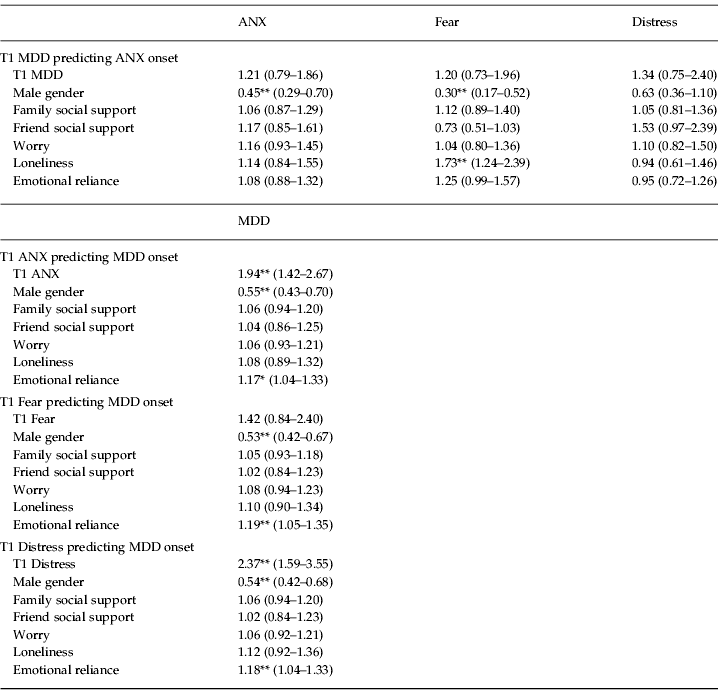
Lifetime ANX at T1 was examined as a prospective predictor of MDD onset by the final assessment. As expected, T1 ANX significantly predicted the onset of MDD in those with no history of MDD at T1 (n=1222, HR 2.32, 95% CI 1.70–3.16). When common predictors were added, T1 ANX (HR 1.94, 95% CI 1.42–2.67), gender (HR 0.55, 95% CI 0.43–0.70) and emotional reliance (HR 1.19, 95% CI 1.05–1.35) remained significant predictors of MDD onset. All other predictors decreased to non-significance. The addition of common predictors led to a 40.43% reduction in the T1 ANX HR for MDD.
Analyses were then run separately examining fear and distress disorders as predictors of MDD onset. Fear (n=1222, HR 1.76, 95% CI 1.05–2.97) and distress disorders (n=1222, HR 2.75, 95% CI 1.85–4.08) were each significant univariate predictors of MDD onset in those with no history of MDD at T1. When common predictors were included, fear disorders decreased to non-significance whereas female gender and emotional reliance remained significant predictors of MDD. Distress disorders remained significant, along with female gender and emotional reliance, as a multivariate predictor of MDD (Table 4).
Multivariate prospective associations between MDD and ANX

Vales given as hazard ratio (95% confidence interval).
* p<0.05, ** p<0.01.
T1 MDD predicting ANX onset
T1 MDD significantly predicted the onset of ANX in those with no history of ANX at T1 (n=1358, HR 1.81, 95% CI 1.21–2.70). When common predictors were added, female gender remained the only significant predictor of ANX onset whereas T1 MDD and all other predictors decreased to non-significance (Table 4). The addition of common predictors led to a 74.07% reduction in the T1 MDD HR for ANX.
Analyses were also run separately with MDD as a predictor of fear and distress disorders. T1 MDD was a significant predictor of fear disorder onset in those with no history of fear disorders at T1 (n=1428, HR 1.95, 95% CI 1.23–3.08). T1 MDD was also a significant predictor of distress disorder onset in those with no history of distress disorders at T1 (n=1408, HR 1.79, 95% CI 1.05–3.07). Each of these relationships decreased to non-significance when common predictors were added. Female gender and loneliness remained significant predictors of fear disorders and there were no significant multivariate predictors of distress disorders (Table 4).
Discussion
Consistent with expectations and prior research, significant cross-sectional and prospective associations were found between MDD and ANX. A combination of shared and distinct risk factors best explained the development of MDD and ANX over time. Attributional style and subthreshold MDD were identified as specific risk factors for MDD. Low self-esteem specifically predicted ANX. Finally, female gender, family social support, friend social support, worry, loneliness, and emotional reliance were identified as predictors common to MDD and ANX.
The results of the present study suggest that different etiological models may characterize the co-morbidity between MDD and ANX based upon the temporal order of onset. T1 ANX remained a significant predictor of subsequent MDD onset, even after controlling for common risk factors. This is consistent with previous research, which has generally supported the temporal precedence of and predictive relationship from ANX to MDD (Kendell, Reference Kendell1974; Reinherz et al. Reference Reinherz, Stewart-Berghauer, Pazik, Frost, Moeykens and Holmes1989; Angst et al. Reference Angst, Vollrath, Merikangas, Ernst, Maser and Cloninger1990; Orvaschel et al. Reference Orvaschel, Lewinsohn and Seeley1995; Pine et al. Reference Pine, Cohen, Gurley, Brook and Ma1998). Furthermore, it extends prior work by demonstrating that the predictive effect of ANX on later MDD was not spurious, or entirely accounted for by other variables in this study. It should be noted, however, that the addition of common risk factors did lead to a 40% reduction in the HR for MDD onset. By contrast, T1 MDD did not continue to significantly predict subsequent ANX onset when common predictors were included in analyses, and the addition of common risk factors led to a 74% reduction in the HR for ANX onset. Thus, temporal precedence and a significant association were found, but the association between MDD and later ANX was due to the presence of common risk factors. This is most consistent with a shared etiological path from MDD to the development of ANX.
Interesting findings emerged with regard to cognitive, interpersonal and psychopathological risk factors for disorder onset. First, although worry is commonly viewed as a risk factor for or a symptom of anxiety disorders, the present findings indicated that worry in adolescence conferred prospective risk for both ANX and MDD. This is consistent with a large body of work indicating substantial overlap between MDD and GAD (Kendler et al. Reference Kendler, Neale, Kessler, Heath and Eaves1992; Brawman-Mintzer et al. Reference Brawman-Mintzer, Lydiard, Emmanuel, Payeur, Johnson, Roberts, Jarrell and Ballenger1993; Wittchen et al. Reference Wittchen, Zhao, Kessler and Eaton1994; Carter et al. Reference Carter, Wittchen, Pfister and Kessler2001). Second, the cognitive factor of negative attributional style was shown to be a specific predictor of MDD. This finding is consistent with the reformulated model of learned helplessness (Abramson et al. Reference Abramson, Seligman and Teasdale1978), which hypothesizes negative attributional style to relate specifically to MDD and not to other emotional disorders. Third, poor interpersonal functioning in adolescence, including loneliness, emotional reliance and impaired relationships with family and peers, conferred risk for both MDD and ANX. This finding suggests that poor interpersonal functioning is not specifically associated with the development of MDD, but may reflect the joint presence of social anxiety and mood disturbance. Finally, prior work has found that subthreshold depressive symptoms increase the risk of MDD (Broadhead et al. Reference Broadhead, Blazer, George and Tse1990; Lewinsohn et al. Reference Lewinsohn, Solomon, Seeley and Zeiss2000; Fergusson et al. Reference Fergusson, Horwood, Ridder and Beautrais2005). The present findings were consistent with that research and further indicated that subthreshold depression was a specific risk for MDD.
Interesting findings also emerged with regard to the separate dimensions of ANX. Whereas risk factors for the distress disorders were common to MDD and ANX, two risk factors for fear disorder onset were specific. Consistent with research on the correlates of panic disorder (e.g. Zvolensky et al. Reference Zvolensky, Bernstein, Marshall and Feldner2006), substance use was found to specifically predict fear disorders. Additionally, a lower number of parents in the home also specifically predicted fear disorders.
The current study has several strengths. The use of a large non-clinical sample increases confidence in the external validity of the results. The study also incorporated reliable diagnostic procedures using criteria from DSM-III-R and DSM-IV and repeated assessments with a follow-up period of approximately 15 years, providing an opportunity to carefully document the onset and course of psychiatric conditions. Finally, the study assessed an array of psychosocial variables, which permitted analysis of common and specific risk factors for the disorders.
Limitations should also be noted. Despite the large sample, there were fewer cases of ANX than in other community samples, and therefore low statistical power to detect predictive effects for ANX. Although this is a limitation, it also suggests that new onset of ANX after mid-adolescence is rare. As a consequence of this limitation, we were unable to examine anxiety disorders by specific diagnoses, even though anxiety disorders may differ based on onset age. Our analyses of ANX by fear and distress conditions may also have been limited by the DSM-III-R criteria used in the T1 assessments. Although the diagnostic criteria for some anxiety disorders were modified in the DSM-IV, very high rates of agreement have been found between anxiety disorders diagnosed using the two sets of criteria (Kendall & Warman, Reference Kendall and Warman1996). An additional limitation is that temperament (e.g. neuroticism or negative affect; Mineka et al. Reference Mineka, Watson and Clark1998) was not examined as a common risk factor, although the psychosocial risk factors included in this study probably correlate meaningfully with temperament (e.g. Prenoveau et al. Reference Prenoveau, Zinbarg, Craske, Mineka, Griffith and Rose2009).
The age range of the sample was also limited in that it did not extend past 30 years and information for some participants may not be complete because of different follow-up periods. As new cases of psychiatric disorders, particularly MDD, may develop after early adulthood (Kessler et al. Reference Kessler, Berglund, Demler, Jin, Merikangas and Waters2005), it is recommended that prospective studies examine MDD and ANX into later development periods. A final limitation is that a relatively high number of analyses were run without correcting for inflated error rate. This analytic strategy was adopted to balance concerns of Type I and Type II errors, given the low statistical power to detect effects in some analyses.
Clinical implications of the present study are most relevant to prevention efforts. The support for a possible causal link from ANX to MDD suggests that successful prevention of and intervention for ANX in youth may prevent the development of MDD (see Kessler & Price, Reference Kessler and Price1993). These findings therefore underscore the importance of efficacious prevention and early intervention efforts for anxiety (see Rapee, Reference Rapee2002; Barrett & Farrell, Reference Barrett, Farrell, Antony and Stein2009). Furthermore, because the prospective predictive effect of MDD on later ANX decreased to non-significance after accounting for female gender, adolescent girls may represent a particularly at-risk population for intervention efforts.
In summary, the results of the present study supported different etiological models of MDD–ANX co-morbidity depending on which condition developed first. The path from ANX to later MDD is most consistent with a direct causation model, whereas the path from MDD to later ANX is most consistent with a shared etiology model. Future research is encouraged to cross-validate these findings in samples with greater economic and ethnic diversity, and also with a higher prevalence of ANX.
Acknowledgments
This research was supported by National Institutes of Health (NIH) awards MH40501, MH50522 and MH52858 to P. M. Lewinsohn and MH75744 to J. W. Pettit.
Declaration of Interest
None.