

This study employs mass spectrometry and an iconographic examination to identify Datura residues and Datura-specific imagery in late precolumbian shell-tempered vessels from Arkansas. This article goes beyond locating Datura residues in ceramic containers, however, because we have identified vessels that ritual practitioners used to produce hallucinogenic ceremonial beverages. To do so, we developed a low-cost, nondestructive residue extraction method for tall compound vessels that can be adapted to similarly shaped vessels from other archaeological contexts around the world. Overall, this new method will allow archaeologists to sample a whole new corpus of vessels that were previously inaccessible due to the destructive nature of organic residue sampling methods.
Datura (D. stramonium) is a member of a family of flowering plants that contain potent alkaloids, scopolamine, and atropine, which can induce powerful hallucinations (Rafferty Reference Rafferty and Fitzpatrick2018). Many Native American cultures have used Datura for various medicinal and hallucinogenic purposes (Rafferty Reference Rafferty, Barnard and Eerkens2007, Reference Rafferty and Fitzpatrick2018). Direct botanical evidence of Datura use in precolombian times in eastern North America is limited but recent applications of organic residue analyses on precolumbian materials in North America have shown promising results of widespread use and consumption of Datura (King et al. Reference King, Powis, Cheong, Deere, Pickering, Singleton and Gaikwad2018; Robinson et al. Reference Robinson, Brown, McMenemy, Dennany, Baker, Allan and Cartwright2020).
Research conducted by King and colleagues (Reference King, Powis, Cheong, Deere, Pickering, Singleton and Gaikwad2018) identified specific ceramic and marine shell vessels as containers from which Native people consumed a Datura hallucinogenic concoction. However, until now, archaeologists have not determined how Indigenous communities in the Southeast prepared Datura. We have identified a key Datura alkaloid (atropine) in residue samples collected from two unique polychrome-painted ceramic composite bottles with internal clay “filters” found in Late Mississippian contexts (AD 1400–1700) in the Central Arkansas River valley. We argue that ritual practitioners used the ceramic containers to produce and prepare Datura tea-like beverages and that they utilized the vessels’ Datura-specific imagery during production and consumption to interact with cosmological forces.
DATURA RESEARCH IN EASTERN NORTH AMERICA AND BEYOND
Throughout the Americas, it appears that an essential cultural practice was (and still is) the use of hallucinogenic plants that induce a variety of altered states of consciousness, each of which affects human physiology and cognition in specific ways (Benitez et al. Reference Benitez, March-Salas, Villa-Kamel, Chaves-Jimenez, Hernandez, Montes-Osuna, Moreno-Chocano and Carinanos2018; Litzinger Reference Litzinger1981). Through recent research, archaeologists have become more aware of the importance of hallucinogenic plants in a variety of social, communal, religious, and ritual practices by Native Americans in eastern North America (King et al. Reference King, Powis, Cheong, Deere, Pickering, Singleton and Gaikwad2018; Lankford Reference Lankford2014) as well as elsewhere in North America (Rafferty Reference Rafferty and Fitzpatrick2018:Figure 4.1). One of the most widely distributed of these plants used during the late precolumbian period in the Americas was the genus Datura (Geeta and Gharaibeh Reference Geeta and Gharaibeh2007). Datura is a member of the family Solanaceae, which includes plants such as nightshade (Atropa belladonna) and tobacco (Nicotiana tabacum). Datura is a flowering plant that contains intoxicant compounds known as alkaloids. The alkaloids that produce powerful hallucinogenic effects include atropine, scopolamine, and hyoscyamine, and an overdose of the alkaloids is potentially lethal (Lester et al. Reference Lester, Nee, Estrada and Hawkes1991). These alkaloids are also present in other genera of the Solanaceae family, including angel's trumpet (Brugmansia) and mandrake (Mandragora; Benitez et al. Reference Benitez, March-Salas, Villa-Kamel, Chaves-Jimenez, Hernandez, Montes-Osuna, Moreno-Chocano and Carinanos2018).
Datura is a common wild plant found throughout the world—from North and South America to Asia, Europe, and Africa (King et al. Reference King, Powis, Cheong, Deere, Pickering, Singleton and Gaikwad2018). Specifically, Datura occurred locally throughout the American Southwest and eastern North America during precolumbian times (Geeta and Gharaibeh Reference Geeta and Gharaibeh2007; Litzinger Reference Litzinger1981; Rafferty Reference Rafferty and Fitzpatrick2018). The preparation, use, and consumption of Datura are still poorly understood in eastern North America. Recent organic chemical, stylistic, and iconographic studies, however, are beginning to shed new light on the cultural significance of Datura before the appearance of Europeans (Baker Reference Baker1994; King et al. Reference King, Powis, Cheong, Deere, Pickering, Singleton and Gaikwad2018; Robinson et al. Reference Robinson, Brown, McMenemy, Dennany, Baker, Allan and Cartwright2020; Stahl Reference Stahl1985).
The presence of Datura has been confirmed at Mississippian period (AD 1000–1600) sites. One of the more significant discoveries of Datura was in the Central Mississippi Valley (CMV) at the BBB Motor site near Cahokia. There, archaeologists discovered carbonized Datura seeds in context with a ceremonial feature inside a special-purpose structure (Emerson Reference Emerson and Galloway1989; Emerson and Jackson Reference Emerson and Jackson1984; see also Parker and Simon [Reference Parker, Simon, Koldehoff and Pauketat2018:139–142] for other CMV sites with archaeobotanical evidence of Datura). The presence of carbonized Datura seeds in a ceremonial feature indicates that the plant was in some way associated with ritual practices in late precolumbian societies in eastern North America (Rafferty Reference Rafferty and Fitzpatrick2018; Wagner Reference Wagner and Winter2000). Brown (Reference Brown1997:474) discussed evidence that precolumbian ritual practitioners along the Atlantic coast used Datura to induce hallucinogenic experiences and that it was required during male initiation rites, which “has lent further support to the belief that hallucinogenic experience was once more commonplace in the Eastern Woodlands.”
The use and cultural significance of Datura have also been proposed based on specific ceramic design attributes whereby potters chose to decorate primarily simple bowls with spiked/noded exteriors. Lankford (Reference Lankford2012, Reference Lankford2014) studied 32 noded vessels from 21 late precolumbian sites in the CMV (Figure 1). He proposed that the form and arrangement of the nodes on these vessels represent the spikey fruit pod of the Datura plant. His findings were developed from previous research conducted by Litzinger (Reference Litzinger1981). He argued that there was a widespread Datura tradition from Mesoamerica through the Southwest. Litzinger also associated similar spiked/noded vessels with the use of Datura in the Southwest. In both cases, Litzinger and Lankford suggested that noded vessels were effigies of the Datura spiked fruit. Lankford argued that the Southwest Datura tradition and the use of noded ceramics passed from the Southwest to the CMV, symbolic of a broadly shared “prehistoric shamanic complex” (Lankford Reference Lankford2012:60). One way to associate the noded vessels with Datura use/consumption directly is to conduct organic residue analysis of this distinctive vessel form to detect alkaloids present in Datura. To our knowledge, archaeologists have not conducted this research.
Noded vessels from the Central Mississippi Valley (adapted from Lankford Reference Lankford2012).

In their significant contribution to Datura research in eastern North America, King and colleagues (Reference King, Powis, Cheong, Deere, Pickering, Singleton and Gaikwad2018) completed organic residue and iconographic analyses on several late precolumbian Mississippian/Caddo ceramic vessels and marine shell cups. This was the first time that archaeologists used organic residue analysis to locate Datura-specific alkaloids preserved in ceramic and shell vessels from Caddo and Mississippian contexts. The residue analysis detected Datura alkaloids in several ceramic vessels and engraved shell cups. Their iconographic analysis correlated the use of Datura and the Beneath World, one of the three layers to the world conceived by many Native Americans. This multifaceted study has provided a better understanding of the rituals that involved Datura use, consumption, and imagery in the precolumbian world.
Preparation and Use of Datura
To understand Datura preparations and its possible uses, it is important to look beyond the Eastern Woodlands where more research has been done. In many historical accounts, especially among the Chumash people, Datura preparation required specific people who possessed great knowledge of the plant, its hallucinogenic properties, and ways to control concentration levels for medicinal and hallucinogenic purposes (Applegate Reference Applegate1975). All parts of the plant (e.g., seeds, petals, leaves, roots, and stems) contain hallucinogenic alkaloids, but studies have shown that its seeds and roots contain the highest alkaloid concentrations (Benitez et al. Reference Benitez, March-Salas, Villa-Kamel, Chaves-Jimenez, Hernandez, Montes-Osuna, Moreno-Chocano and Carinanos2018). In several Hopi, Maya, and Aztec accounts of Datura preparation, seeds were commonly ground and added into liquid or animal fat mixtures for external and internal use (Litzinger Reference Litzinger1981; Robinson et al. Reference Robinson, Brown, McMenemy, Dennany, Baker, Allan and Cartwright2020; Vanpool Reference Vanpool2009). Datura producers also boiled leaves and seeds, sometimes by mixing Datura with tobacco or fermented liquids in special ceramic jars to produce a hallucination-inducing brew (Guerra-Doce Reference Guerra-Doce2015; Litzinger Reference Litzinger1981). Roots were commonly roasted and boiled before consumption (Robinson et al. Reference Robinson, Brown, McMenemy, Dennany, Baker, Allan and Cartwright2020). Recent studies have shown that Datura could be consumed by ingesting raw parts of the plant, chewing or sucking on plant parts, smoking leaves, or inhaling its vapors (Baker Reference Baker1994; Benitez et al. Reference Benitez, March-Salas, Villa-Kamel, Chaves-Jimenez, Hernandez, Montes-Osuna, Moreno-Chocano and Carinanos2018; Robinson et al. Reference Robinson, Brown, McMenemy, Dennany, Baker, Allan and Cartwright2020). Practitioners used Datura for a wide range of medicinal and psychoactive purposes, and the plant was used mainly in spiritual, ritual, and supernatural contexts (Robinson et al. Reference Robinson, Brown, McMenemy, Dennany, Baker, Allan and Cartwright2020).
There are several research questions that remain to be answered. Can we use stylistic and iconographic research to understand Datura use? Can finding Datura archaeobotanical evidence in ceremonial contexts and comparing archaeological evidence with early written texts help us determine its use in ritualized practices? Was Datura use and consumption available to all members of a society, or was its use restricted to ritual specialists? Is there any evidence of Datura use in domestic contexts? Can evidence be found of Datura use in earlier (pre–AD 1400) Caddo/Mississippian contexts? How was Datura prepared and ingested by precolumbian groups? By filtering it into a tea-like drink, smoking it, or both? The evidence we have obtained from the study of organic residues in unique composite Mississippian bottles from the CMV expands on King and colleagues’ (Reference King, Powis, Cheong, Deere, Pickering, Singleton and Gaikwad2018) research to answer these two questions: (1) How did precolumbian people prepare Datura using a unique set of ceramic vessels, and (2) What does the imagery on the vessels mean with respect to Datura production and consumption?
THE SAMPLE AND METHODS
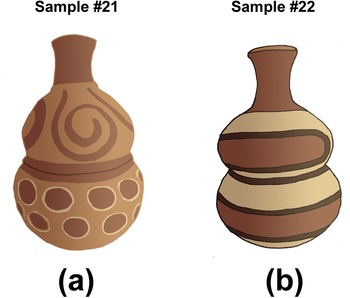
We performed absorbed residue analysis on two Late Mississippian composite bottles held in the Harry J. Lemley collections of the Gilcrease Museum at the Thomas Gilcrease Institute of American History and Art in Tulsa, Oklahoma (Figure 2). Lemley was a federal judge in Arkansas during the first half of the twentieth century, and during that time, he amassed a collection of over 3,500 Mississippian ceramic vessels primarily from Arkansas and Missouri. After Lemley's death, the collection was donated to the Gilcrease Museum. Unfortunately, these vessels, along with the rest of Lemley's collection, have limited, if any, provenience information due to the likely less-than-standard recovery methods employed by collectors who recovered these many vessels. The only contextual information for the two composite bottles are the counties in Arkansas in which they were discovered (Table 1).
Polychrome-painted bottles, Gilcrease Museum, Tulsa, Oklahoma (illustrations by Shawn P. Lambert).

Ceramic Vessels Sampled for This Study.

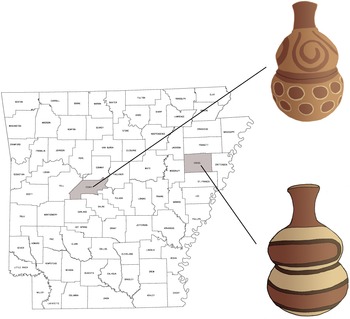
The two ceramic bottles sampled are from Mississippian sites in Arkansas (Figure 3). By studying the vessels’ forms and polychrome-painted decorations, both vessels are typed as Avenue Polychrome, dating between AD 1400 and 1700 (Phillips Reference Phillips1970). Avenue Polychrome painted vessels are usually well represented in Carden Bottoms phase (AD 1400–1600) assemblages in the Central Arkansas River valley (Jeter and Mintz Reference Jeter, Mintz, Jeter, Cande and Mintz1990; Wiewel Reference Wiewal2014). Avenue Polychrome bottles are primarily tempered with shell, and they have polished surfaces, outflaring rims, flattened or slightly rounded lips, and constricted necks that are usually painted red. Most potters painted these vessels with red, white, and black pigments in curvilinear and rectilinear designs (Phillip Reference Phillips1970:41).
Map of the locations where vessels may have been recovered.

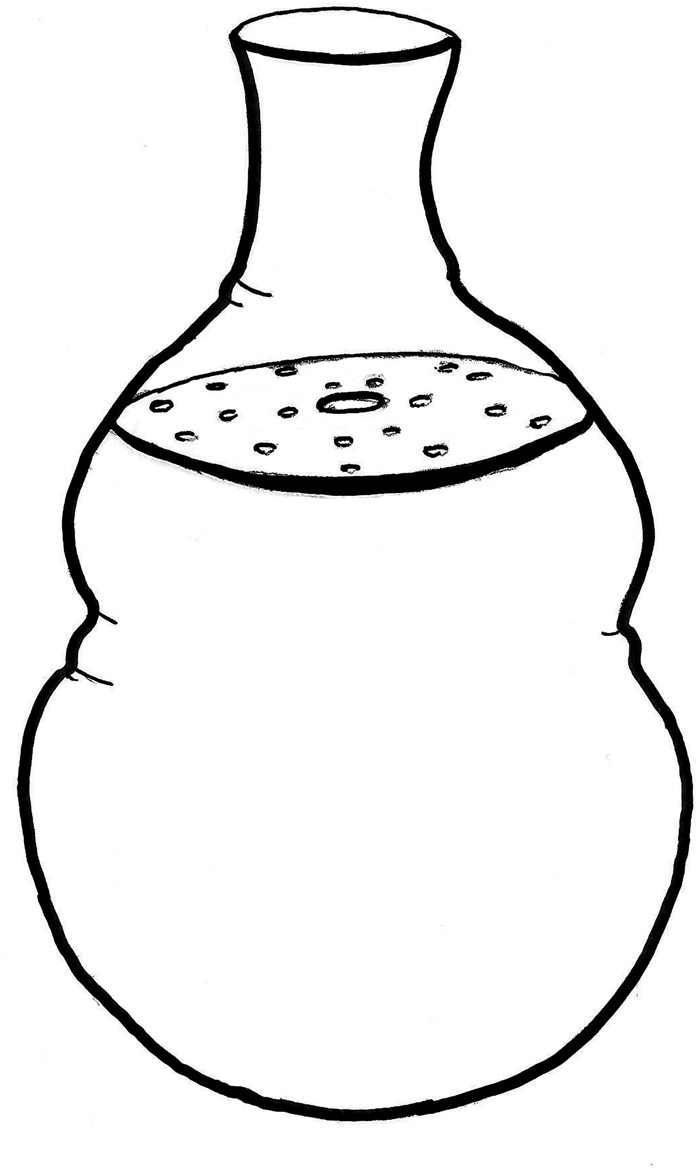
These two vessels were selected for organic residue analysis because of their internal construction. Inside each bottle is a very thin internal clay shelf with a series of concentric perforated holes that has been incorporated below the juncture of the bottle neck with the globular portion of the body (Figure 4). The only way potters could have placed the internal clay shelves or filters in the bottles was during their initial construction. Both filters were joined to the interior walls when the clay was still wet. We think these internal perforated disks may have served as a filter or strainer that allowed the vessels’ users to develop a concentrated brewed concoction from plant materials such as Datura. According to Bell (Reference Bell1980:95), the “presence of strainers in bottles is very rare and there are hundreds of bottles which do not have this device present.” Bell also proposed that these internal clay disks associated with the overall vessel form may have functioned as a complex filtering device. There are a total of only four vessels from the Lemley Collection at the Gilcrease Museum that have internal clay filters. We received permission from the Gilcrease Museum to sample only two of the vessels (#21 and #22). This is because parts of the internal clay filters on them were broken, which allowed access to the base of the bottle to obtain a residue sample without damaging the intact filters.
Drawing of vessel with the location and design of internal clay filter (illustration by Shawn P. Lambert).

Vessel #21
Vessel #21 is a shell-tempered composite bottle 25 cm in height with two globular sections, a constricted neck, and an outflaring rim (Figure 2). The globular area just below the bottle neck has a red-painted spiral motif repeated four times around the body. The scrolls are zoned with faint residues of black paint. The constricted area in the middle portion of the bottle has a red-painted band outlined with black paint. The lower globular section consists of two rows of red-painted circles outlined with white paint. The internal clay filter is below the juncture of the bottle neck and the upper globular portion. In this vessel, there are three concentric circles of perforations and a large purposeful perforation in the middle.
Vessel #22
Vessel #22 is a shell-tempered composite bottle that also has an upper and lower globular section. The vessel, 23 cm in height, has a red-painted constricted neck with an outflaring rim (Figure 2). The motif is a red and white interlocking scroll design outlined with black paint. This motif is repeated on the upper and lower globular sections. As is the case with Vessel #21, the internal clay filter is below the juncture of the bottle neck and the upper globular portion. The filter also has a series of three concentric perforations. Due to damage, however, it is difficult to say whether the filter also had a larger perforation in the center.
Extraction Protocol
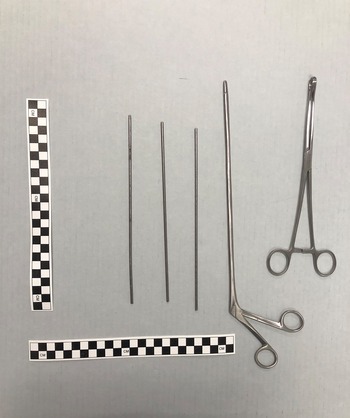
Due to the vessels’ unique structure, our primary goal was to extract visible intact organic residues without damaging interior surfaces. To do so, we developed a new extraction protocol. First, we used a wireless micro-endoscope camera to safely bypass the bottle neck and internal clay filter so as to visually locate the extraction area that contained the highest concentration of residue. Next, in order to reach and separate the residues from the base of each vessel, we made two Dremel rod attachments out of titanium by hand, approximately 2.6 mm in diameter and 32 cm in length (Figure 5). The length and the small diameter of the rods allowed us to reach each vessel's base without causing any damage to the clay filters. Finally, we used a portable handheld pump to extract the residues from each vessel.
Handmade tools used as Dremel attachments.

We specifically extracted residue samples in a manner similar to King and colleagues (Reference King, Powis, Cheong, Deere, Pickering, Singleton and Gaikwad2018) by removing a small residue area, approximately 1 cm2, without removing any of the clay surfaces. We set the Dremel to its lowest setting to control the amount of residue removed and to ensure that the interior clay surfaces were not damaged. The endoscope camera served to guide the Dremel and placement of the rods during the extraction process. We collected approximately 1 mg of residue from each vessel. Preserved residues are still present in the bottles for future analyses. Subsequent organic residue analyses could determine if other residues, such as tobacco or lipids, are also present in the bottles.
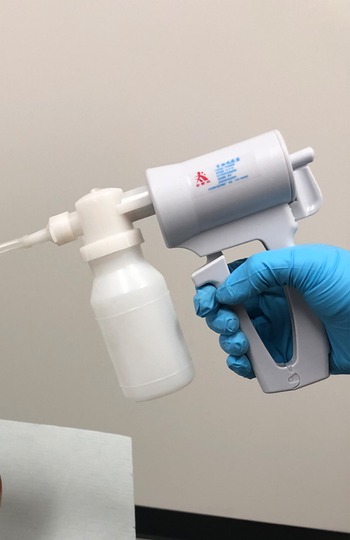
The multiglobular construction and the additional obstacle of the internal filters made it impossible to tip the vessel over to collect the sample. Instead, we used a manual, portable suction pump to remove the residues from each bottle safely (Figure 6). A small sterile rubber tube was attached to the pump and placed at the bottom of each vessel. Then, the residues were hand-pumped into individual sterile vials that were attached to the pump. Different tubes and vials were used for each vessel to decrease the chance of cross-contamination. This method permitted us to collect samples without removing any of the clay body, thereby preserving the vessel's structural integrity. The success of this sampling method shows that it can be readily employed and further modified for other vessels with similar forms.
Manual portable suction pump used to collect samples at the bottom of vessels.

Both samples were sent to the Gaikwad Steroidomics Laboratory in California, and they were analyzed by mass spectrometry to locate peaks in two alkaloids: atropine and scopolamine. The two alkaloids are found in Datura, and they give the plant its hallucinogenic effects.
When conducting organic residue analysis, contamination from modern sources is a point of concern because these contaminants can be absorbed into porous clay bodies or accumulate as surface dust, producing false positive samples that may not be directly related to precolumbian human behavior. As King and colleagues (Reference King, Powis, Cheong, Deere, Pickering, Singleton and Gaikwad2018) and Washburn and colleagues (Reference Washburn, Washburn and Shipkova2012) have shown, ceramic vessels and other materials can potentially be exposed to contaminants through air circulation systems and everyday mundane actions, such as drinking coffee or smoking tobacco. The two vessels that we sampled for this project are stored in acid-free boxes to protect them from such contamination, but we do not know how they were stored before they were donated to the Gilcrease Museum. Additionally, because we sampled preserved and visible burned residues and did not sample the clay bodies, we are confident that our results concerning the identified residues are directly related to the vessels’ use. Although dust can still accumulate while vessels are stored in boxes (in pre-donation times) and settle on top of the burned residue, it is unlikely the samples we obtained were even moderately contaminated given that they were taken from restricted orifice vessels whose necks were partially obscured by the strainers. According to Sean Rafferty (personal communication 2021), who has extensive experience in Datura research, these alkaloids are not present in other sources in eastern North America. Consequently, cross-contamination is highly unlikely.
LABORATORY METHODS
Atropine and scopolamine standards and formic acid were purchased from Sigma-Aldrich, a chemical company, in St. Louis, Missouri. All solvents were mass spectrometry grade, and all other chemicals used were of the highest available grade. The two samples were extracted using the reported procedure by King and colleagues (Reference King, Powis, Cheong, Deere, Pickering, Singleton and Gaikwad2018). Briefly, a 0.25 ml water:methanol (1:1) mixture was added to each sample. Then, samples were incubated at 80°C for 30 minutes. After incubation, samples were sonicated and vortexed for one minute. Next, the samples were centrifuged for three minutes, and the resulting supernatant was filtered with 5 kD membrane filters. Last, the filtrates were used for Ultra Performance Liquid Chromatography (UPLC)-MS/MS analysis.
A Waters Acuity UPLC system was used for analytical separations. Chromatography was conducted using a C18 1.7 μm column (1 × 150 mm) at a flow rate of 0.15 ml/min. The gradient started with 100% A (0.1% formic acid in H2O) and 0% B (0.1% formic acid in CH3CN), changed to 50% A over three minutes, followed by four minutes linear gradient to 10% A, resulting in a total separation time of seven minutes.
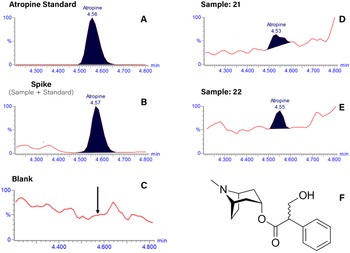
A triple quadruple mass spectrometer (Waters, Massachusetts) was used to record MS-MS spectra using electrospray ionization (ESI) in positive ion (PI) mode, capillary voltage of 3.0 kV, extractor cone voltage of 3 V, and a detector voltage of 650 V. The desolvation gas flow was maintained at 300 L/h. Source and desolvation temperatures were set at 150°C and 350°C, respectively. To optimize daughter ions, collision energy was varied. MassLynx 4.2 software was used to analyze and process data (Figure 7).
Ultra-performance liquid chromatography/tandem mass spectrometry chromatograms: (a) standard atropine; (b) spike; (c) blank; (d) sample 21, showing presence of atropine; (e) sample 22, showing presence of atropine; and (f) atropine chemical structure.

RESULTS
As Figure 7 shows, both Avenue Polychrome vessels were positive for atropine. Vessel #21 contained approximately 444 pg/gm of atropine, and vessel #22 contained approximately 212 pg/gm of atropine (Table 1). None of the samples, however, contained the alkaloid scopolamine. Robinson and colleagues (Reference Robinson, Brown, McMenemy, Dennany, Baker, Allan and Cartwright2020) identified atropine and scopolamine in at least four quid (small lumps of fibrous materials) samples in their analyses. We believe there is a reason for this discrepancy. The fibrous materials that Robinson and colleagues (Reference Robinson, Brown, McMenemy, Dennany, Baker, Allan and Cartwright2020) sampled were recovered from dry crevices inside a cave, whereas the two bottles in question were buried for at least 400 years. Perhaps scopolamine does not preserve well in buried low-fired clay ceramics and leaches out over time due to postdepositional processes and soil conditions. More work is needed to know if this is the case.
DISCUSSION
Both of the composite vessels with internal clay filters had organic residues that were positive for atropine, so they provide direct evidence for Datura use. Sean Rafferty (personal communication 2021) stated that although one can locate atropine and scopolamine in other Solanaceae species, such as henbane or nightshade, Datura is the only source of these alkaloids in the Americas. Until now, the tools related to the Datura preparation process have not been identified. Potters constructing unique containers such as these bottles and permanent clay filters for the processing and filtration of highly hallucinogenic substances into a concentrated consumable liquid appears to be an obvious solution. Both the vessel form and internal clay filters are not much different from modern-day teapots or even filtration devices used by chemists.
Potters across the Mississippian world, from Oklahoma to Florida, made a variety of composite bottles (Lambert Reference Lambert2018; Luer Reference Luer1996). Archaeologists have suggested, due to the fact that many are recovered from mound contexts and burned special-purpose structures, that ritual elites made and used composite bottles for specific ritual activities (Pauketat Reference Pauketat1987). For example, composite bottles recovered from the Banks Village site in Arkansas may have been used to heat a liquid concoction for ritual consumption (Luer Reference Luer1996). Prentice (Reference Prentice1986:112–113) argued that ritual practitioners used gourd-shaped composite bottles to make and serve hallucinogenic and medicinal beverages in several Southeast Native American groups. In Florida, during the contact period, gourd-shaped vessels with holes were used to produce the black drink (Andrews and Andrews Reference Andrews and Andrews1981:24–25; Fairbanks Reference Fairbanks and Hudson1979:131). One ethnohistorical account in the late eighteenth century documented an initiation ritual of a Creek war chief. During the initiation, a shaman and two warriors carried a red-painted gourd-shaped bottle that contained a brew made from a powerful plant (Milfort Reference Milfort and McCary1959:138–140). The Datura plant may have been what was used during this initiation ritual, and the gourd-shaped vessel described sounds remarkably similar to the vessels in this study.
If potters made the vessels as straining devices to produce a concentrated Datura compound, how did it operate? We propose that this involved a three-step process to produce a concentrated Datura concoction (Figure 8). The first step for Datura makers would have been to procure, dry, and grind the Datura flowers, leaves, roots, and/or seeds before putting them into the filtering vessels. We also need to determine how the practitioners inserted the Datura plant remains through the filter. One possible way is through the large central hole in the strainers. Datura producers could have used this opening to insert the larger elements, such as parts of the Datura flower, to rest at the bottom of the vessels. The next step may have been to add a liquid, such as water, or some other liquid mixture. At this point, the large dried elements and liquid would have been combined. Then, the mixture may have been put over a fire and heated. Lankford (Reference Lankford2012, Reference Lankford2014) suggested that the Datura plant parts needed to be heated to release the highest concentration of hallucinogenic alkaloids. This has been shown in recent research into the making of other precolumbian beverages, such as cacao and yaupon (King et al. Reference King, Powis, Cheong, Deere, Pickering, Singleton and Gaikwad2018). Therefore, the incorporation of dried Datura elements, liquids, and heat would have provided the required conditions to produce a concentrated Datura beverage. An experimental archaeology study could be conducted on vessel replicas to better understand the Datura drink-making process. Finally, to separate the hallucinogenic compound from the heavy organic materials, a simple tilt of the vessel would have allowed the liquid contents to escape, while the large materials would be unable to pass through the filter. These leftovers may have been used again or emptied by using a simple utensil.
Illustration of a hypothetical step-by-step process of Datura-making: (a) illustration of composite bottle with internal clay filter, (b) a possible way dried Datura leaves/seeds were inserted through the internal filter, (c) the addition of a liquid, and (d) dried Datura and liquid heated over fire (illustrations by Shawn P. Lambert).

Iconographic Evidence of Datura-Making
Iconographic representations are another source of evidence to understand the presence and use of Datura. Some of the most vivid depictions of Datura brewing and use associated with ritual practices are found in California and the American Southwest. For instance, Robinson and colleagues (Reference Robinson, Brown, McMenemy, Dennany, Baker, Allan and Cartwright2020) studied pinwheel pictographic imagery in a cave in California that they argue represents a blooming Datura flower. In context with the pinwheel imagery were several chewable quids that contained Datura prepared and chewed by shamans to enter altered states of consciousness. Likewise, in northeast Arizona, Malotki (Reference Malotki1999) researched rock art imagery that he argued to be motifs resembling Datura as well as several anthropomorphic “shaman” figures holding Datura. Vanpool (Reference Vanpool2009) employed a cross-cultural comparative approach that highlighted the importance of Datura use in shamanistic practices and emphasized the common co-occurrence of Datura and imagery as an important ritual process to contact other cosmological realms. In the Mimbres region of the American Southwest, potters embellished ceramic bowls with Datura imagery and various geometric shapes that may have been the result of hallucinogen-induced visions (Berlant et al. Reference Berlant, Maurer and Burtenshaw2018).
These examples show that it may have been a common ritual practice for Datura practitioners to combine the production and use of Datura concoctions with related imagery on different mediums to connect, manipulate, and record their cosmological journeys (Dye Reference Dye2012; Robinson et al. Reference Robinson, Brown, McMenemy, Dennany, Baker, Allan and Cartwright2020; Vanpool Reference Vanpool2009). It is reasonable to suggest that the ritual practitioners utilized the imagery of the bottles during Datura brew production to interact with their cosmological universe. Many southeastern Native American groups used special containers to produce and consume concentrated brewed beverages to induce altered states of consciousness as a way to connect with other cosmological realms (Brown Reference Brown1997; Loubser et al. Reference Loubser, Ashcraft, Wettstaed, Diaz-Granados, Simek, Sabo and Wagner2018; Luer Reference Luer1996).
The Mississippian cosmos is based on opposing layers or three linked cosmological levels. Several locatives, or visual keys, have been identified that are characteristic of each cosmological realm (Reilly Reference Reilly, Townsend and Sharp2004; Reilly and Garber Reference Reilly and Garber2007). The layers include (1) the Beneath World, which consists of water and underwater creatures; (2) the Above World of the sky, sun, and flying creatures; and (3) the Middle World of people, land, animals, and other natural elements (Dye Reference Dye2012; Lankford Reference Lankford, Lankford, Kent Reilly and Garber2011). People occupying the Middle World were in a constant battle to keep the two opposing worlds in balance. Religious practitioners wielded this sacred power to connect with, communicate with, and stabilize the cosmological realms through ritual propitiation and iconographic representation (Reilly Reference Reilly, Townsend and Sharp2004:126). Surmising that specific imagery and consumption of Datura was a common practice to help reach another realm, the imagery embellished on the two Arkansas stacked vessels with Datura may have been used to help stimulate similar otherworldly experiences.
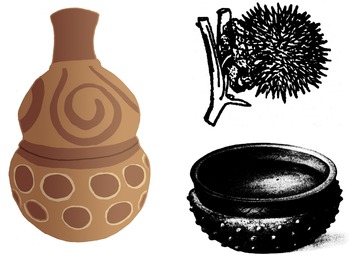
In our study, the vessels with internal clay filters also have configurations of motifs that may be cosmologically charged and associated with the four cardinal directions. In this study, the imagery on Vessel #21 was only analyzed because we believe it has complex representational imagery of Datura. The combination of motifs on Vessel #21 is particularly noteworthy because the bottom portion and imagery may represent Mississippian cosmological precepts and Datura seed pods. The iconography on the lower globular portion of this vessel—a series of red-painted circles outlined in white—is perhaps indicative of the spiked fruit of the Datura plant (Figure 9). This interpretation is similar to Lankford's (Reference Lankford2012, Reference Lankford2014) identification of a series of noded vessels from the CMV and Caddo areas as effigy pots that portray the Datura plant's spiky fruit. The bottom portion of composite bottle #21 has a similar form to Lankford's noded vessels, and the painted circles may be a two-dimensional representation of the circular Datura seed pods.
Vessel #21 iconography compared to the Datura seed pod and noded vessel from the Central Mississippi Valley (illustrations adapted from Lankford Reference Lankford2014).

Recent analyses suggest that Datura use and motifs can be directly associated with Mississippian cosmologies. For example, David Dye (Reference Dye2015) has suggested that a series of female effigy bottles may be associated with the use of Datura in the Lower Mississippi Valley. Specifically, Dye (Reference Dye2015:14) likened the posture and “vacant look about the face” as a stylized depiction of a trance-like state, perhaps during the ritualized use of Datura. King and colleagues (Reference King, Powis, Cheong, Deere, Pickering, Singleton and Gaikwad2018) also sampled one of these female effigy bottles, and the residue results were positive for Datura, supporting Dye's (Reference Dye2015) argument. Several Native American groups in eastern North America consider the female to represent the night sky, a known reference to the Beneath World (Duncan and Diaz-Granados Reference Duncan, Diaz-Granados, Diaz-Granados and Duncan2004). In this context, female effigy bottles of this type may represent the Beneath World and the powers that women brought to their communities (King et al. Reference King, Powis, Cheong, Deere, Pickering, Singleton and Gaikwad2018). Lankford (Reference Lankford2014) has suggested that the green pigments, such as glauconite, found on ceramic containers may have represented the blue/green spit of the nocturnal sphinx moth, which is known as the pollinator of the Datura flower. Spiral and winged motifs on Moundville bottles and the famous Moundville Willoughby disk have also been attributed as representations of the sphinx moth (Knight and Franke Reference Knight, Franke, Kent Reilly and Garber2007).
These interpretations could have implications for the interpretation of the four spiral motifs located on the upper globular portion of Vessel #21 under the bottle neck. An overhead view of the spirals in relation to the opening of the bottle shows that they are in quadripartite configuration (Figure 10), connected to the four cardinal directions in the Mississippian cosmos (Reilly Reference Reilly, Reilly and Garber2007). According to Lankford's (Reference Lankford, Kent Reilly and Garber2007) research on Cox Mound gorgets, the location of the spirals may specify a specific cosmological direction that reflects the directional powers of the Middle World. Thus, the spirals that make up the motif at the top portion of the bottle may represent the Middle World (or, This World). They could also, however, be indicative of the sphinx moth's proboscis (sensu Knight and Franke Reference Knight, Franke, Kent Reilly and Garber2007). If this is true, the vessel could also have Beneath World associations, similar to Lankford's (Reference Lankford2012, Reference Lankford2014) and King and colleagues’ (Reference King, Powis, Cheong, Deere, Pickering, Singleton and Gaikwad2018) research findings. Recent research of stacked bottles from Caddo ceremonial mound centers (e.g., King et al. Reference King, Powis, Cheong, Deere, Pickering, Singleton and Gaikwad2018; Lambert Reference Lambert2017) has shown that the vessel form is just as important as the motifs. The form of the bottles may represent layers of the cosmos, and by pouring the Datura tea from the bottom of the bottle, Datura makers and consumers were also taking powers from the Beneath World and bringing them into the Middle World (see also Reilly Reference Lankford, Lankford, Kent Reilly and Garber2011). Whatever the meanings were hundreds of years ago, the iconography, form, and construction of these bottles lead to a confident conclusion that they were associated with Datura-making, and also connected in some way to the broader Late Mississippian cosmological universe.
An overhead view of the spiral motifs in relation to the opening of the bottle (illustration by Shawn P. Lambert).

CONCLUSIONS
Mass spectrometry has been used in this study to identify Datura residues in two late precolumbian (ca. AD 1400–1700) composite bottles from sites in the Central Arkansas River valley. To our knowledge, this is the first direct evidence of ceramic vessels being used to process and prepare a Datura brew, most likely for ritual or religious activities. This discovery could not have been possible without the development of the nondestructive extraction method. This innovative method is applicable for a wide range of vessel types from any archaeological contexts, and it has the potential to advance our understandings of ritual production and consumption in past societies.
Ethnohistorical literature from South America and the Chumash people of southern California show that Datura took many days to prepare, and its creation and the creation of any related imagery were highly entangled in their cosmological belief systems (Baker Reference Baker1994). In this spirit, we argue that ritual practitioners used the two ceramic bottles with symbolic imagery to prepare Datura concoctions to establish contact or draw power from otherworldly cosmological forces.
Unlike the construction of most Mississippian bottles in the CMV and the Central Arkansas River valley, these potters intentionally constructed these polychrome-painted bottles with internal clay filters to assist in the production of a concentrated hallucinogenic liquid. The clay filters are ceramic disks with a series of concentric perforations that were incorporated in the bottles below the juncture of the bottle neck with the globular portion of the body. The internal clay disks would have served as strainers that allowed Datura producers to separate the hallucinogenic alkaloids from the Datura plant to produce a powerful liquid beverage.
We found charred Datura residues at the bottom of these vessels, which suggested that these distinctive vessels were used to pour a heated and filtered Datura beverage into ceramic and shell drinking containers during acts of ritual consumption and/or feasting. Although we do not have good contextual information on these vessels—other than that they are from late precolumbian sites in the CMV—the complexity of these bottle forms and their internal construction and stylistic motifs, combined with Datura residues, clearly suggests that these bottles comprise a distinctive set of specialized and ritualized vessels.
One aspect of this research that needs further attention is determining the exact process by which Datura beverages were made using these filtration ceramic devices. Based on the presence of the large perforations in the middle of the straining disks as well as the presence of intact residues, it seems to be the case that Datura makers likely inserted dried parts of the plant into the large opening, mixed them with a liquid, and then heated the mixture to make a tea. An experimental archaeology study using ceramic replicas would give valuable insight into determining the most likely Datura-making process and would help develop plausible interpretations of how Datura makers controlled the concentration levels of intoxicants.
Iconographic research on the meaning of the motifs should also be conducted on these vessels to answer the following questions:
(1) How do those motifs relate to the imagery and use of Datura?
(2) Do they have possible connections to a specific cosmological realm that King and colleagues (Reference King, Powis, Cheong, Deere, Pickering, Singleton and Gaikwad2018) highlighted in their research?
(3) Were they used by ritual specialists for shamanistic activities, as Lankford (Reference Lankford2012) proposed in his noded vessel research?
One way these questions could be answered is through a comparative stylistic and iconographic analysis with other vessels that have internal clay filters. As stated above, there are a few other examples of ceramic vessels with internal clay filters at the Gilcrease Museum, all of which not only belong to the Lemley collection but are also found on sites in the Central Arkansas River valley. A study of this corpus could give us more clues about who made Datura beverages using these unique filtration devices and why. It would also be beneficial to revisit past ceramic collections, especially bottles, and look inside—possibly with an endoscope camera for tall vessels—to see if there are other examples of internal strainers.
Archaeologists need to revisit past collections to see if objects that were inferred to be and labeled as spindle whorls could be portable strainers, perhaps made to be placed or fitted into the openings of bottles, jars, or bowls. These may have been reused over time for a spectrum of different concoctions. Organic residue analyses could be done on portable strainers to locate alkaloids found in Datura—or other alkaloids such as caffeine, theobromine, and theophylline, found in the holly plant (Ilex vomitoria) or tobacco. If some of these strainers are positive for one or more Datura alkaloid, and they have good contextual information, then it would be possible to temporally and spatially reconstruct the emergence and spread of precolumbian intoxicants among eastern Native American groups.
Last, it would be worthwhile to collaborate with Native American groups in a systematic study to understand the role that hallucinogens play in contemporary Indigenous societies. Many Indigenous groups still incorporate ancient iconography in their contemporary daily and ritual activities (Earles Reference Earles2015). To investigate and understand the historical and contemporary meanings of imagery related to the use of hallucinogens, and their associations with the Datura plant, can guide future collaborative work between Native American peoples and archaeologists.
Acknowledgments
We would like to convey our gratitude to the Collections Manager and curators at the Gilcrease Museum, who encouraged us to develop a non-destructive technique for residue extraction. We would also like to thank Gaikwad Steriodomics Laboratory for analyzing the residue samples as well as Mississippi State University and the Cobb Institute of Archaeology for funding this project. Finally, we would like to extend our appreciation to the reviewers, who gave us excellent comments on our manuscript.
Data Availability Statement
When conducting organic residue analysis, original data was gathered through sampling the two ceramic vessels using a mass spectrometer to locate possible Datura residues. At the moment, these raw data are housed at the Gaikwad Steroidomics Laboratory LLC in Davis, California. Once published, these data will be made available through the Digital Archaeological Record (tDAR).