INTRODUCTION
Disorders of self-awareness (SA) are very frequent in traumatic brain injury (TBI) patients (Ben-Yishay et al., Reference Ben-Yishay, Rattok, Lakin, Piasetsky, Ross and Silver1985; Bivona et al., Reference Bivona, Ciurli, Barba, Onder, Azicnuda and Silvestro2008; Prigatano, Fordyce, Zeiner, Roueche, Pepping, & Wood, Reference Prigatano, Fordyce, Zeiner, Roueche, Pepping and Wood1986; Sherer, Beargloff, Boake, High, & Levin, Reference Sherer, Bergloff, Boake, High and Levin1998). They can cause low motivation for rehabilitation (Malec & Moessner, Reference Malec and Moessner2001) and can interfere with safe and independent functioning (Flashman, Amador, & Mc Allister, Reference Flashman, Amador and McAllister1998). Furthermore, these disorders can lead to poor outcome and difficulty in community integration (Trudel, Tyron, & Purdum, Reference Trudel, Tyron and Purdum1998) and employability (Sherer, Hart, & Nick, et al., Reference Sherer, Hart, Nick, Whyte, Thompson and Yablon2003).
SA, which has been defined as the ability to recognize problems caused by damaged brain functions, has been divided into the following areas: intellectual awareness, which refers to patients’ ability to describe their deficits or impaired functioning; emergent awareness, which regards patients’ ability to recognize their difficulties as they are happening; and anticipatory awareness, which concerns patients’ ability to predict when difficulties will arise because of their deficits (Crosson et al., Reference Crosson, Barco, Velozo, Bolesta, Cooper and Werts1989). SA has also been differentiated into a) metacognitive knowledge (or declarative knowledge) about one’s abilities, which incorporates elements of intellectual awareness, and b) online monitoring of performance during tasks, which relates to emergent awareness and anticipatory awareness (O’Keeffe et al., Reference O’Keeffe, Dockree, Moloney, Carton and Robertson2007; Toglia & Kirk, Reference Toglia and Kirk2000).
A wide variety of methods have been adopted to assess the multi-faceted concept of SA of deficits and there is some controversy over the best approach to use (Fleming et al., Reference Fleming, Strong and Ashton1996; Hart & Sherer, Reference Hart and Sherer2005; O’Keeffe et al., Reference O’Keeffe, Dockree, Moloney, Carton and Robertson2007). For example, different methods have been used to assess metacognitive SA: structured or semi-structured interviews, self-report questionnaires, spontaneous verbal reports of difficulties, and patients’ judgment of their neuropsychological performance (Fischer, Gauggel, & Trexler, Reference Fischer, Gauggel and Trexler2004; Fleming et al., Reference Fleming, Strong and Ashton1996; Sbordone, Seyranian, & Ruff, Reference Sbordone, Seyranian and Ruff1998; Sohlberg, Mateer, Penkman, Glang, & Todis, Reference Sohlberg, Mateer, Penkman, Glang and Todis1998). The most commonly used method is to compare patients’ ratings of injury-related difficulties with those of a clinician or family member (Fleming et al., Reference Fleming, Strong and Ashton1996). This method is based on the assumption that the collateral reporter has a more accurate perception of the person’s current abilities. A discrepancy in the direction of the patient reporting fewer problems is interpreted as reduced self-awareness (Pagulayan et al., Reference Pagulayan, Temkin, Machamer and Dikmen2007).
The most widely used self-report scales for evaluating metacognitive SA are the Awareness Questionnaire (AQ) (Sherer et al., Reference Sherer, Bergloff, Boake, High and Levin1998) and the Patient Competency Rating Scale (PCRS) (Prigatano et al., Reference Prigatano, Fordyce, Zeiner, Roueche, Pepping and Wood1986). The AQ is comprised of 17 items that evaluate patients’ current functional abilities compared with their preinjury abilities. The items are rated on a Likert scale ranging from 1 (much worse) to 5 (much better). Scores vary from 17 to 85; a score of 51 indicates that the patient is functioning “about the same” as his/her preinjury level (Sherer, Hart, Nick, et al., Reference Sherer, Hart, Nick, Whyte, Thompson and Yablon2003). The AQ also includes forms for patient self-ratings as well as family/significant other and clinician ratings. Reliability studies of the AQ have revealed internal consistencies (Cronbach’s α = 0.88) for both patient and family ratings; however, test–retest reliability has not been reported (Sherer et al., Reference Sherer, Bergloff, Boake, High and Levin2003).
The PCRS is more widely used than the AQ because it is easily interpreted, quick to administer, has excellent test–retest reliability (.85–.97) (Fleming, Strong, & Ashton, Reference Fleming, Strong and Ashton1996; Prigatano and Altman, Reference Prigatano and Altman1990) and has been validated in some cross-cultural studies (Hoofien and Sharoni, Reference Hoofien and Sharoni2006; Prigatano, Bruna, Mataro, Munoz, Fernandez, & Junque, Reference Prigatano, Bruna, Mataro, Munoz, Fernandez and Junque1998; Watanabe, Shiel, Asami, Taki, & Tabuchi, Reference Watanabe, Shiel, Asami, Taki and Tabuchi2000). It is a 30-item self-report questionnaire that requires patients and their relatives or clinicians to make an independent judgment of perceived degree of competency demonstrated in several behavioral, cognitive and emotional situations. The subject is required to use a 5-point Likert scale (ranging from 1, “Can’t do”, to 5, “Can do with ease”). Total PCRS scores range from 30 to 150, with higher scores indicating higher levels of competency. Comparing the PCRS patient ratings with those of a family member or clinician shows how realistic a patient is in evaluating his/her limitations (Borgaro & Prigatano, Reference Borgaro and Prigatano2003).
The reliability figures reported by Prigatano and Altman (Reference Prigatano and Altman1990) for PCRS total scores were r = .97 for patients and r = .92 for relatives; significant (p < .05) test–retest correlations were reported for 27 (patient sample) and 28 (informants) of the 30 items (Leathem, Murphy, & Flett, Reference Leathem, Murphy and Flett1998). Fleming, Strong, and Ashton (Reference Fleming, Strong and Ashton1998) reported acceptable 1-week test–retest reliability for patients with TBI using intra-class correlations (ICC r = .85). In the same study, internal consistency was strong for both patient ratings (Cronbach’s α = .91, n = 55) and relative ratings of patients (Cronbach’s α = .93, n = 50). Although the validity of the PCRS is based on the assumption that the relative and the clinician ratings are a true measure of competency, this has not been validated (Prigatano, Reference Prigatano1996).
Three different approaches have been used to score the PCRS. The first approach (Prigatano & Altman, Reference Prigatano and Altman1990) is to compute three scores: a) the number of items in which the patient rating is higher than the relative rating (i.e., an index of the patient’s underestimation of his disorder); b) the number of items in which the patient rating is the same as the relative rating (i.e., an index of the patient’s good awareness of his disorder); and c) the number of items in which the patient rating is lower than the relative rating (i.e., an index of the patient’s overestimation of his disorder). This first method allows separating patients into three groups based on their highest score.
The second method (Prigatano et al., 1991) of scoring considers the difference between patient and relative ratings on specific items. If subtraction of the relative rating from the patient rating produces a positive number, the patient can be considered to overestimate his or her ability on that behavioral item. This method of scoring considers that patient and relative ratings may be at odds on the different items of the scale. For instance, Prigatano and Schacter (Reference Prigatano and Schacter1991) used this method to demonstrate that patients tended to overestimate their abilities on items related to emotional and social behavior but tended to agree with relative ratings on items related to activities of daily living (Fleming et al., Reference Fleming, Strong and Ashton1996).
Finally, in the third method (Fordyce et al., Reference Fordyce and Roueche1986; Prigatano et al., Reference Prigatano, Bruna, Mataro, Munoz, Fernandez and Junque1998; Roueche and Fordyce, Reference Roueche and Fordyce1987) the discrepancy between the total patient and relative rating scores is calculated to obtain an overall assessment of the patient’s self-awareness. While higher positive patient-relative discrepancy scores (DS) are associated with more severe SA deficits, negative scores may indicate a patient’s overestimation of his impairment (Cicerone, Reference Cicerone1991; Prigatano & Altman, Reference Prigatano and Altman1990).
This method has several advantages: a) it allows separating patients into different SA groups based on the cutoff chosen; b) it allows obtaining an overall measure of the patient’s SA; and c) it is easier to perform in a clinical rehabilitation setting than the other methods.
Regardless of which scales and scoring methods are used many issues about SA impairment in TBI patients are still unclear (Bivona et al., Reference Bivona, Ciurli, Barba, Onder, Azicnuda and Silvestro2008). For example, severity of acquired brain injury (ABI) correlated with measures of impaired self-awareness (ISA) in some studies (Leathem et al., Reference Leathem, Murphy and Flett1998; Prigatano and Altman, Reference Prigatano and Altman1990) but not in others (Anson & Ponsford, Reference Anson and Ponsford2006; Bach & David, Reference Bach and David2006; Bivona et al., Reference Bivona, Ciurli, Barba, Onder, Azicnuda and Silvestro2008; Carton, & Robertson, 2007; O’Keeffe, Dockree, Moloney, Port, Willmott, & Charlton, Reference Port, Willmott and Charlton2002). This was probably due to methodological differences such as sampling (chronicity and etiology), testing instrument or classification of TBI severity using different indexes (i.e., Glasgow Coma Scale, Time to Follow Commands, and Post-traumatic Amnesia [PTA]). In any case, there is still a debate over how chronicity and severity of injury are related to SA (Dirette & Plaiser, Reference Dirette and Plaisier2007). Although in some studies (Hart, Seignourel, & Sherer, Reference Hart, Seignourel and Sherer2009; Ownsworth & Clare, Reference Ownsworth and Clare2006; Vanderploeg, Belanger, Duchnick, & Curtiss, Reference Vanderploeg, Belanger, Duchnick and Curtiss2007) chronicity correlated with increased levels of SA, in one large longitudinal study (Pagulayan, Temkin, Machamer, & Dikmen, Reference Pagulayan, Temkin, Machamer and Dikmen2007) no change in SA was found in the acute and postacute phases.
Furthermore, the correlation between SA deficits and neuropsychological disorders is not clear (Allen & Ruff, Reference Allen and Ruff1990; Boake, Freeland, Ringholz, Nance, & Edwards, Reference Boake, Freeland, Ringholz, Nance and Edwards1995). It is believed that executive functions (EF) have the greatest effect on degree of SA following brain damage (Hart, Whyte, Kim, & Vaccaro, Reference Hart, Whyte, Kim and Vaccaro2005; Noè, Ferri, Caballero, Villadre, Sanchez, & Chirivella, Reference Noè, Ferri, Caballero, Villadre, Sanchez and Chirivella2005), and they are frequently impaired in TBI patients (Mattson & Levin, Reference Mattson and Levin1990; Stablum, Mogentale, & Umiltà, Reference Stablum, Mogentale and Umiltà1996). Nevertheless, even though many authors have tried to correlate executive dysfunction with ISA in TBI patients as yet no conclusive findings have been reported. Bach and David (Reference Bach and David2006), who investigated SA deficits with the PCRS, failed to demonstrate that EF disorders [explored by the Verbal Fluency (VF) Test and the Trail Making Test] are associated with reduced behavioral/social SA; however, their sample of ABI patients (TBI and stroke patients) was heterogeneous and they did not report severity and chronicity. More recently, Noè et al. (Reference Noè, Ferri, Caballero, Villadre, Sanchez and Chirivella2005) evaluated EF by means of the Wisconsin Card Sorting Test (WCST), the Trail Making Test, and the VF Test and demonstrated a significant correlation between poor WCST performance and low SA (assessed by the PCRS). However, the study by Noè et al. was also based on a heterogeneous ABI population, so the extent to which it characterized a specific TBI population is not clear. Furthermore, both professionals and family members were indiscriminately enrolled (together) as significant others. Finally, Bivona et al. (Reference Bivona, Ciurli, Barba, Onder, Azicnuda and Silvestro2008) found a significant correlation between some components of the executive system (measured by WCST) and metacognitive awareness (assessed by AQ).
Because EF are part of a very complex system, which includes behavioral, affective, motivational, and cognitive components (Apollonio et al., Reference Apollonio, Leone, Isella, Piamarta, Consoli and Villa2005), there is no comprehensive test for the executive system and many tools have been proposed to analyze its different aspects. However, it has been demonstrated that the WCST is an effective measure of multiple components such as abstract reasoning, problem solving, the ability to use response feedback information, cognitive flexibility, set-shifting and set-persistence capacity, concept identification, and hypothesis generation (Hanks, Rappaport, Millis, & Deshpande, Reference Hanks, Rappaport, Millis and Deshpande1999; Mukhopadhyay et al., Reference Mukhopadhyay, Dutt, Das, Basu, Hazra and Dhibar2008). In particular, it has been shown that perseverative responses on the WCST are an excellent measure of executive dysfunction (Johnstone, Hexum, & Ashkanazi, Reference Johnstone, Hexum and Ashkanazi1995) and that they correlate with SA impairment (Bivona et al., Reference Bivona, Ciurli, Barba, Onder, Azicnuda and Silvestro2008; Noè et al., Reference Noè, Ferri, Caballero, Villadre, Sanchez and Chirivella2005).
The aim of this study was to replicate previous work examining SA in TBI and to address previous methodological limitations. The study used the best measure available, that is, the PCRS, to examine SA in a relatively homogenous sample of adults with severe TBI, using only first-degree relatives as informants. Like other studies in this area, the aim was to evaluate clinical, neuropsychological, and functional correlates of impaired metacognitive SA in severe TBI out-patients.
METHODS
Participants
A total of 55 severe TBI outpatients were recruited from a consecutive series of 95 outpatients enrolled from May 2006 to October 2008 in the Post-Coma Unit of Santa Lucia Foundation, a neurorehabilitation hospital and research institute in Rome. The study was approved by the ethical committee of the Santa Lucia Foundation.
The study participants were recruited from the overall sample of 95 outpatients who were evaluated in the above-mentioned time period based on the following inclusion and exclusion criteria: inclusion criteria: 1) age ≥ 15 years; 2) diagnosis of severe TBI (GCS δ 8; Teasdale and Jennett, Reference Teasdale and Jennett1974); 3) availability of cerebral computed tomography or magnetic resonance imaging data; 4) PTA resolution [Levels of Cognitive Functioning Scale (LCF-S) score ≥ 7 (Hagen, Malkmus, & Durham, Reference Hagen, Malkmus and Durham1972)]; 5) availability of informed consent; exclusion criteria: 1) aphasia [Token Test (De Renzi & Vignolo, Reference De Renzi and Vignolo1962) score ≤ 29]; 2) inability to undergo formal psychometric evaluation because of cognitive [Raven’s Progressive Matrices (Basso, Capitani, & Laiacona, Reference Basso, Capitani and Laiacona1987) equivalent score < 1] and/or severe sensory-motor deficits; 3) previous history of drug and/or alcohol addiction, psychiatric disease and repeated TBI.
Three patients had to be excluded after enrollment because they refused to complete the test battery (two because they had low tolerance of frustration and one because of excessive and unexpected fatigability).
The final sample consisted of 52 patients, 44 males (85%) and 8 females (15%), with a mean age of 30.6 ± 11.1 years and a mean of 12.2 ± 2.9 years of education. The median interval in years from injury to date of assessment (chronicity) was .9 (Interquartile Range, IQR: .6/5.5). All patients had severe TBI with a median time to follow commands (TFC) of 20 days (IQR: 13/37) and a median PTA length of 60 days (IQR: 30/100). TFC was considered as the interval, in days, from coma onset until the patient was able to follow simple commands. PTA was calculated prospectively using the Galveston Orientation and Amnesia Test (GOAT) (Levin, O’Donnel, & Grossman, Reference Levin, O’Donnel and Grossman1979) for 38 patients previously hospitalized in our rehabilitation unit; it was calculated retrospectively (based on information given by patients and family members) for the other 14 patients who had already recovered from PTA at the time of admission to our rehabilitation hospital. Based on reports that retrospective analysis is correlated (r = .87) with prospective investigation of PTA (McMillan, Jongen, & Greenwood, Reference McMillan, Jongen and Greenwood1996), the retrospective and prospective evaluations of PTA were considered equivalent.
Assessment
A neuropsychologist (P.C., U.B., E.A., or D.S.) administered the following neuropsychological test battery to the patients in a quiet room in one or more sessions, depending on their fatigability: memory: Digit Span Test (forward and backward) (Orsini, Reference Orsini2003), Prose Memory Test (Novelli, Papagno, Capitani, Laiacona, Vallar, & Cappa, Reference Novelli, Papagno, Capitani, Laiacona, Vallar and Cappa1986); executive functioning: WCST (Heaton, Chelune, Talley, Kay, & Curtiss, Reference Heaton, Chelune, Talley, Kay and Curtiss1993, Reference Heaton, Chelune, Talley, Kay and Curtiss2000), Tower of London Test (ToL) (Krikorian, Bartok, & Gay, Reference Krikorian, Bartok and Gay1994), VF Test (Novelli et al., Reference Novelli, Papagno, Capitani, Laiacona, Vallar and Cappa1986); attention: Go-No Go Test of the Test for Attentional Performance (Zimmerman & Fimm, Reference Zimmerman and Fimm1992). Moreover, the Neuropsychiatric Inventory (NPI) was administered to a relative to assess the patient’s neuropsychiatric disorders.
A neurologist (C.B.) made the functional assessment using the following scales: the Disability Rating Scale (Rappaport, Hall, Hopkins, Belleza, & Cope, Reference Rappaport, Hall, Hopkins, Belleza and Cope1982), the Glasgow Outcome Scale Extended (Wilson, Pettigrew, & Teasdale, Reference Wilson, Pettigrew and Teasdale1998), and the LCF-S.
SA level was measured using the PCRS, which was translated into Italian by some researchers in our group (U.B., J.R., and R.F.). In line with a previous intercultural report (Prigatano et al., Reference Prigatano, Bruna, Mataro, Munoz, Fernandez and Junque1998), there were no specific difficulties regarding cultural adaptations.
The PCRS was completed by both the patient and a family member. The neuropsychologist was present and assisted the patient in filling out the questionnaire. Only first-degree relatives were enrolled: 40 parents (77%), 10 partners (19%), and 2 children (4%) living with the patients or at least in daily contact with them. In accordance with most previous studies, the presence of SA deficits was measured by using the discrepancy between the self-rating and the family-member rating (Ownsworth, Fleming, Strong, Radel, Chan, & Clare, Reference Ownsworth, Fleming, Strong, Radel, Chan and Clare2007; Pagulayan et al., Reference Pagulayan, Temkin, Machamer and Dikmen2007; Prigatano, Reference Prigatano1996; Sherer et al., Reference Sherer, Bergloff, Boake, High and Levin1998; Walker, Blankenship, Ditty, & Lynch, Reference Walker, Blankenship, Ditty and Lynch1987); a cutoff point was established for severity of SA deficits based on a discrepancy in the patient-relative cutoff score of ± 5 points (Prigatano et al., Reference Prigatano, Bruna, Mataro, Munoz, Fernandez and Junque1998). We chose close relatives rather than clinicians as raters because the former are in the best position to judge the patient’s functional ability in daily life.
Statistical Analysis
To assess unawareness, PCRS DS were computed by subtracting the relative rating from the patient self-rating. Pearson’s correlation coefficients were calculated to study the correlation between PCRS DS and single variables.
Depending on the cutoff chosen, PCRS DS were categorized as follows: PCRS DS ≥ 5 (index of poor SA) (Group A) and PCRS DS < 5 [index of good or (< −5) heightened SA (Group B)].
Differences between groups on the categorical parameters (based on the categorized PCRS DS) were tested using the Fisher exact test. Differences in continuous variables were assessed using analysis of variance comparisons for normally distributed parameters; alternatively, the Kruskal-Wallis test was adopted. Moreover, analysis of covariance was used to compare the adjusted means of the percentage of perseverative errors according to the PCRS DS groups by adjusting for TFC.
A p value below .05 (two-tailed) was considered statistically significant. All analyses were performed using SPSS for Windows, version 10.0.
RESULTS
When all patients were considered, the PCRS DS ranged from −50 to +48. Group A (PCRS DS ≥ 5) comprised 29 patients (56%) and Group B (PCRS DS < 5) 23 patients (44%). In particular, the latter group comprised 8 patients with good SA and 15 patients (DS < −5) with heightened SA. They were put into the same group because of potential limitations in power related to the small sample size.
Table 1 shows the distribution of demographic, clinical, functional, and neuropsychological data in terms of means, medians and IQR range for the entire sample.
Distribution of demographic, clinical, functional, and neuropsychological data

Note
TFC, Time to Follow Commands; PTA, Post-Traumatic Amnesia; DRS, Disability Rating Scale; LCF, Levels of Cognitive Functioning; GOS-E, Glasgow Outcome Scale Extended; WCST, Wisconsin Card Sorting Test; NPI: Neuropsychiatric Inventory.
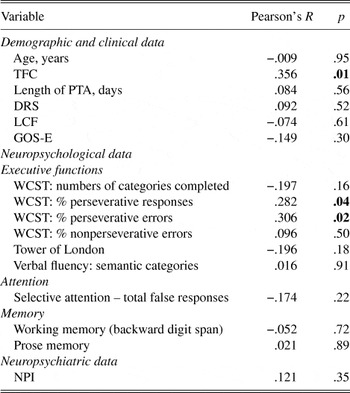
As shown in Table 2, significant correlations were found between PCRS patient-relative DS, analyzed as a continuous variable, and TFC duration, WCST percentage of perseverative responses, and WCST percentage of perseverative errors.
Correlations of clinical and neuropsychological data with PCRS DS

Note
TFC, Time to Follow Commands; PTA, Post-Traumatic Amnesia; DRS, Disability Rating Scale; LCF, Levels of Cognitive Functioning; GOS-E, Glasgow Outcome Scale Extended; WCST, Wisconsin Card Sorting Test; NPI: Neuropsychiatric Inventory.
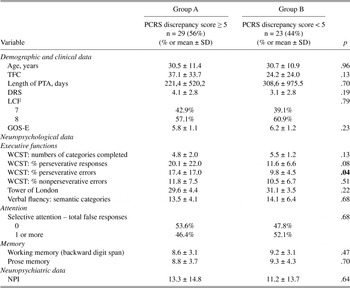
Table 3 shows the association between PCRS patient-relative DS subdivided into two groups based on a patient-relative DS cutoff of 5 and variables of interest. No statistically significant difference was found between groups for demographic, functional, or clinical variables. Regarding the neuropsychological variables, statistically significant differences were found between Group A (patients with poor SA) and Group B (patients with good or heightened SA) for the WCST percentage of perseverative errors (p = .04): Group A performed worse than Group B; a trend in the same direction was also found for the WCST percentage of perseverative responses (p = .08).
Association of demographic, clinical, and neuropsychological data with PCRS discrepancy score groups

Note
PTA, Post-Traumatic Amnesia; DRS, Disability Rating Scale; TFC, Time to Follow Commands; LCF, Levels of Cognitive Functioning; GOS-E, Glasgow Outcome Scale Extended; WCST, Wisconsin Card Sorting Test; NPI: Neuropsychiatric Inventory.
No significant difference was found between groups for any other neuropsychological variables or for any neuropsychiatric symptoms (assessed by the NPI).
To determine whether the relationship between unawareness and percentage of perseverative errors was due to the relationship both have with injury severity, adjusted means of percentage of perseverative errors, according to PCRS DS groups, were calculated by adjusting for TFC. In this analysis, participants in Group A had a borderline significantly higher percentage of perseverative errors than Group B (Group A mean 17.1, standard error 2.4 vs. Group B 10.2 standard error 2.7; p = .05).
DISCUSSION
The main finding of this study is that patients with poor metacognitive SA have more problems than patients with good and/or heightened metacognitive SA in some components of the executive system. These include flexibility and the ability to inhibit a response, the ability to benefit from feedback, shifting of set and problem solving, as indicated by the high WCST percentage of perseverative responses and the WCST percentage of perseverative errors made by the unaware group of patients. Moreover, a decrease in metacognitive self-awareness correlates significantly with TFC.
These results were obtained using raw scores as a continuous variable. Furthermore, unlike previous reports (Anson & Ponsford, Reference Anson and Ponsford2006; Bivona et al., Reference Bivona, Ciurli, Barba, Onder, Azicnuda and Silvestro2008; Dirette and Plaisier Reference Dirette and Plaisier2007; Hart et al., Reference Hart, Seignourel and Sherer2009; Leathem et al., Reference Leathem, Murphy and Flett1998), the correlation between the dysexecutive syndrome and ISA was confirmed also when patients were subdivided into different groups according to their level of SA (unaware vs. good-heightened SA).
As affirmed previously (Johnstone et al., Reference Johnstone, Hexum and Ashkanazi1995), the WCST perseverative errors and/or responses can be considered an excellent measure of executive dysfunction and are among the most common data emerging from a complete neuropsychological assessment of TBI patients. Inability to inhibit a response is generally associated with impulsivity and low self-monitoring capacity. In TBI patients, unawareness might impair the ability to monitor cognitive rigidity. Therefore, these patients may be unable to inhibit a response, that is, to avoid perseverative errors.
Considering the significant correlation between the above-mentioned WCST scores and low metacognitive SA levels, the lack of any relationship between the PCRS scores and the other measures of EF, such as the VF Test and the ToL scores, is worth noting. Perhaps it was due to the fact that the different tests used to assess EF measure different aspects of these functions (Bivona et al., Reference Bivona, Ciurli, Barba, Onder, Azicnuda and Silvestro2008).
Our data are consistent with the results of other studies (Bivona et al., Reference Bivona, Ciurli, Barba, Onder, Azicnuda and Silvestro2008; Noè et al., Reference Noè, Ferri, Caballero, Villadre, Sanchez and Chirivella2005) in which a significant correlation was found between these aspects of EF evaluated by the WCST and metacognitive SA. However, our study expands on the results of Noè et al. (Reference Noè, Ferri, Caballero, Villadre, Sanchez and Chirivella2005) regarding the correlation between pathological number of categories and low SA. In fact, in the present study a correlation was found between low SA levels and percentage of perseverative responses and WCST percentage of perseverative errors, which strongly suggests a relationship between ISA and cognitive inflexibility.
Some methodological issues can be raised with regard to the present study and the study by Noè et al. While we enrolled only relatives as significant others, in the study by Noè et al., both professionals and family members were enrolled. In this case, the indiscriminate enrollment of professionals and relatives could be considered a methodological bias because their judgments are based on different criteria.
Indeed, family member ratings might be unreliable because of caregivers’ high distress levels (Fleming et al., Reference Fleming, Strong and Ashton1996) due to their long-term efforts to cope with the patient’s post-trauma condition and the change in the quality of their relationship. Indeed, the latter tends to worsen over time due to the patient’s lack of improvement (Bivona et al., Reference Bivona, Ciurli, Barba, Onder, Azicnuda and Silvestro2008). Previous studies (Sherer, Hart, & Nick, Reference Sherer, Hart and Nick2003) have underlined that the patient-clinician discrepancy appears to be a more valid measure of SA impairment than the patient-family discrepancy. We do not agree with this. We believe that close relatives are in the best position to evaluate the outpatient’s functional ability in daily life, as required by the PCRS.
Furthermore, compared with the sample in the study by Noè et al. (Reference Noè, Ferri, Caballero, Villadre, Sanchez and Chirivella2005), our sample was quite homogeneous. All of our subjects had suffered a severe TBI, all were outpatients who had recovered from PTA and were able to answer the questionnaires reliably. By contrast, in the study by Noè et al., the patients had sustained different types of acquired brain injury, TBI was not severe in all cases, and some of the patients were still in PTA.
The present study confirms the finding of Bivona et al. (Reference Bivona, Ciurli, Barba, Onder, Azicnuda and Silvestro2008) of a correlation between ISA and executive dysfunction using a different tool, the PCRS, which is the most widely used scale to assess SA in TBI patients (Prigatano et al., Reference Prigatano, Bruna, Mataro, Munoz, Fernandez and Junque1998; Sherer et al., Reference Sherer, Hart and Nick2003). This tool is easily interpreted, quick to administer, and has excellent test–retest reliability (.85–.97) and internal consistency (Cronbach’s α = .91–.95) compared with other quantitative or qualitative methods of evaluating self-awareness of deficits (Fleming et al., Reference Fleming, Strong and Ashton1996; Prigatano & Altman, Reference Prigatano and Altman1990). Previously, other authors (Hoofien, Gilboa, Vaakil, & Barak, Reference Hoofien, Gilboa, Vakil and Barak2004; Noè et al., Reference Noè, Ferri, Caballero, Villadre, Sanchez and Chirivella2005; O’Keffee et al., 2007) investigated SA by subdividing patients into groups based on different levels of awareness. However, they used different methodologies. For example, O’Keeffe et al. (Reference O’Keeffe, Dockree, Moloney, Carton and Robertson2007) divided TBI patients into a high SA group and a low SA group based on a median split of a composite overall awareness score. This composite score included Z-scores from the metacognitive knowledge tests, online emergent awareness and online anticipatory awareness. Hoofien and coworkers (2004) also split TBI patients into three SA groups based on standard deviations of mean awareness scores. They calculated the difference between participants’ self-evaluation of their cognitive disabilities in attention, memory and comprehension and their actual neuropsychological test scores in the same domains. We preferred to use the DS score to subdivide our TBI patients into different SA groups based on a cutoff point. In fact, this is the most commonly used method (Fleming et al., Reference Fleming, Strong and Ashton1996; Fordyce & Roueche, Reference Fordyce and Roueche1986; Prigatano et al., Reference Prigatano, Bruna, Mataro, Munoz, Fernandez and Junque1998; Roueche and Fordyce, Reference Roueche and Fordyce1987) and is based on the assumption that the collateral reporter has the most accurate perception of the person’s current abilities.
A very interesting finding of our report is the fact that the percentage of aware patients (n = 8; 15%) was lower than the percentage of patients with heightened SA (n = 15; 29%), that is, than the patients with a DS score lower than −5 (who underestimated their competency). One reason for these findings could be the patients’ chronic condition of having to face daily living difficulties. Indeed, this could have clinical implications for emotional distress, such as depression or anxiety (Jorge & Robinson, Reference Jorge and Robinson2002; Kennedy, Livingston, Riddick, Marwitz, Kreutzer, & Zasler, Reference Kennedy, Livingston, Riddick, Marwitz, Kreutzer and Zasler2005; Kreutzer, Seel, & Gourley, Reference Kreutzer, Seel and Gourley2001; Rao & Lyketsos, Reference Rao and Lyketsos2000). It could be that neuropsychological factors contribute to unawareness and that heightened awareness is influenced by emotional factors. Nevertheless, we failed to find any correlation between neuropsychiatric symptoms (assessed by NPI) and self-awareness. It is also possible that in the heightened SA group relatives underestimated patients’ difficulties on both the PCRS and the NPI so that patients’ mood disorders were also neglected. In any case, further studies are needed to clarify this methodological issue.
In line with previous reports (Bach & David, Reference Bach and David2006; Bivona et al., Reference Bivona, Ciurli, Barba, Onder, Azicnuda and Silvestro2008; Noè et al., Reference Noè, Ferri, Caballero, Villadre, Sanchez and Chirivella2005; O’Keeffe et al., Reference O’Keeffe, Dockree, Moloney, Carton and Robertson2007), we failed to find any correlation between unawareness and the other neuropsychological variables examined. Using a different methodology to assess SA, Hoofien et al. (Reference Hoofien, Gilboa, Vakil and Barak2004) found a correlation between objective memory scores and subjective evaluations of that domain. However, these authors did not assess the executive system in their neuropsychological evaluation battery.
Regarding clinical features, we failed to find any correlation between metacognitive SA and clinical features, such as chronicity and length of PTA (Bach & David, Reference Bach and David2006; Bivona et al., Reference Bivona, Ciurli, Barba, Onder, Azicnuda and Silvestro2008; Borgaro & Prigatano, Reference Borgaro and Prigatano2002; Leathem et al., Reference Leathem, Murphy and Flett1998; Noè et al. Reference Noè, Ferri, Caballero, Villadre, Sanchez and Chirivella2005; O’Keeffe et al., Reference O’Keeffe, Dockree, Moloney, Carton and Robertson2007; Port et al., Reference Port, Willmott and Charlton2002; Prigatano & Altman, Reference Prigatano and Altman1990), except for TFC. This finding confirms that duration of unconsciousness (coma and/or vegetative state) may be an important prognostic factor in the neuropsychological outcome of patients with severe TBI (Formisano et al., Reference Formisano, Bivona, Penta, Giustini, Buzzi and Ciurli2005).
One limitation of this study is the small sample size. In fact, studies based on larger samples are needed to make a more thorough investigation of the neuropsychological and clinical variables correlated with SA deficits. A larger sample of subjects could also be divided into three different groups (ISA, good SA, and heightened SA) so that not only the specific features of the ISA group could be evaluated but also the differences between the good and heightened SA groups.
Further studies are also needed to make a better evaluation of the multidimensional system of SA (metacognitive and online monitoring of performance) according to the models outlined by various authors (Crosson et al., Reference Crosson, Barco, Velozo, Bolesta, Cooper and Werts1989; Toglia & Kirk, Reference Toglia and Kirk2000) and suggested by O’Keeffe et al. (Reference O’Keeffe, Dockree, Moloney, Carton and Robertson2007).
Nevertheless, considering the high percentage of self-awareness impairments (44%) found in our population of severe TBI patients, the significant correlation between some components of the executive system and metacognitive self-awareness strongly confirms the importance of integrating an overall assessment of cognitive functions with a specific evaluation of SA to treat self-awareness and executive functions together in the rehabilitation process.
ACKNOWLEDGMENTS
I have disclosed any and all financial or other relationships that could be interpreted as a conflict of interest affecting this manuscript. I confirm that we received no financial support to carry out this study.