1. Introduction
Human understanding of the Sun has always been a subject of study. Progress in this field has steadily advanced, including our knowledge of the star’s impacts on the planets within the Solar System. The solar wind, which originates from the Sun’s outermost atmospheric layer, the corona, directly affects the planets orbiting the Sun. This vast region possesses temperatures on the order of
 $10^6$
K.
The solar wind is generated by the immense pressure difference between the corona and interplanetary space. The thermal velocity of particles in the corona exceeds the Sun’s escape velocity, causing a stream of particles, primarily ionized helium nuclei, protons, and electrons, to escape. These particles are accelerated to high velocities, up to hundreds of kilometers per second, and disperse throughout the Solar System.
When these particles reach the planets, particularly the inner ones, they can cause atmospheric mass loss. Another mechanism for planetary atmospheric loss is photoevaporation. This phenomenon occurs when a planet’s atmospheric constituents absorb radiation from the star and dissociate into the interplanetary medium. Photoevaporation is most significant during the first few million years of a planetary system’s life, when the star is more active. During this early stage, planetary atmospheres are exposed to heightened ultraviolet radiation and are more susceptible to these impacts.
Mars is one of the planets affected by solar events. It also holds considerable interest for the scientific community because, like Earth, it is a telluric planet, meaning it is an inner rocky planet with a solid surface. Mars has been the target of numerous space missions, beginning in 1964 with the Mariner probe sent by the U.S. National Aeronautics and Space Administration (NASA). Missions are increasingly funded today to further our understanding of other planets and to seek life beyond Earth, a quest that has fascinated humanity since its origin.
Early Mars was a less hostile environment than it is today, resembling early Earth. Data from the Mariner 9 and Viking 1 probes suggest the planet was likely more humid and warmer, with a greater atmospheric pressure than at present. Today, however, Mars has a hostile climate characterized by aridity, as most of its
 $H_2O$
is frozen. It experiences dust storms with winds exceeding 50 to 100 m/s. Due to its thin atmosphere, its average temperature is 250 K (
 $-23^\circ C$
). The evolution of the Martian atmosphere, which may have once resembled Earth’s, is not well understood, and this remains the primary objective of this study.
This research was therefore developed to gain a better understanding of the evolution of the Martian atmosphere. It incorporates quantitative estimates of atmospheric mass loss through its interaction with the solar wind and through photoevaporation.
2. Methods
The methodology of this work is based on an investigation into the loss of the Martian atmosphere through photoevaporation and solar winds, starting from the premise that Mars was a less hostile planet in its past (Kasting & Catling Reference Kasting and Catling2003). Evidence suggests that Mars once had a denser, more humid atmosphere capable of supporting a milder climate similar to that of early Earth. During this period, the Sun was a younger and more active star compared to today, though it was 70% less luminous. This research utilizes equations that quantitatively describe the atmospheric losses of Mars through star-planet interactions, which may have contributed to the planet’s current thin atmosphere and hostile climate.
2.1. Photoevaporation
When radiation emitted by a star, primarily UV and X-rays, is absorbed by a planet’s atmosphere, it can ionize the atoms and molecules present, separating them into electrons and ions. This ionization of the outermost atmospheric layers can result in the loss of these charged particles to space. This process is known as photoevaporation. To estimate the atmospheric mass loss of a planet via photoevaporation, the following equation from Jackson et al. (Reference Jackson, Davis and Wheatley2012) is applied to planet Mars:
 \begin{equation} \dot{M} = \frac{\eta L_X R_p^3}{3 G M_p a^2}, \end{equation}
where
 $R_p$
and
 $M_p$
are the planet’s radius and mass, respectively, in this case, Mars. G is the gravitational constant (
 $6.67 \times 10^{-11} \text{ m}^3 \text{ kg}^{-1} \text{ s}^{-2}$
). a is the time-averaged orbital distance, which for eccentric orbits is given by
 $a = a_0 (1 + 0.5 e^2)$
. The efficiency factor,
 $\eta$
, varies from 0.25 to 1 (Jackson et al. Reference Jackson, Davis and Wheatley2012). Finally,
 $L_x$
is the star’s X-ray and EUV luminosity, which in this case is the Sun.
In Equation 1, the calculation for atmospheric mass loss due to photoevaporation is directly proportional to the star’s X-ray luminosity (
 $L_X$
). Thus, the Sun’s luminosity is calculated as a function of stellar radiation flux using the following equation:
 \begin{equation} L_X = 4\pi d^2 F \end{equation}
where d represents the distance of the planet from the star and F is the stellar radiation flux in W/m
 $^2$
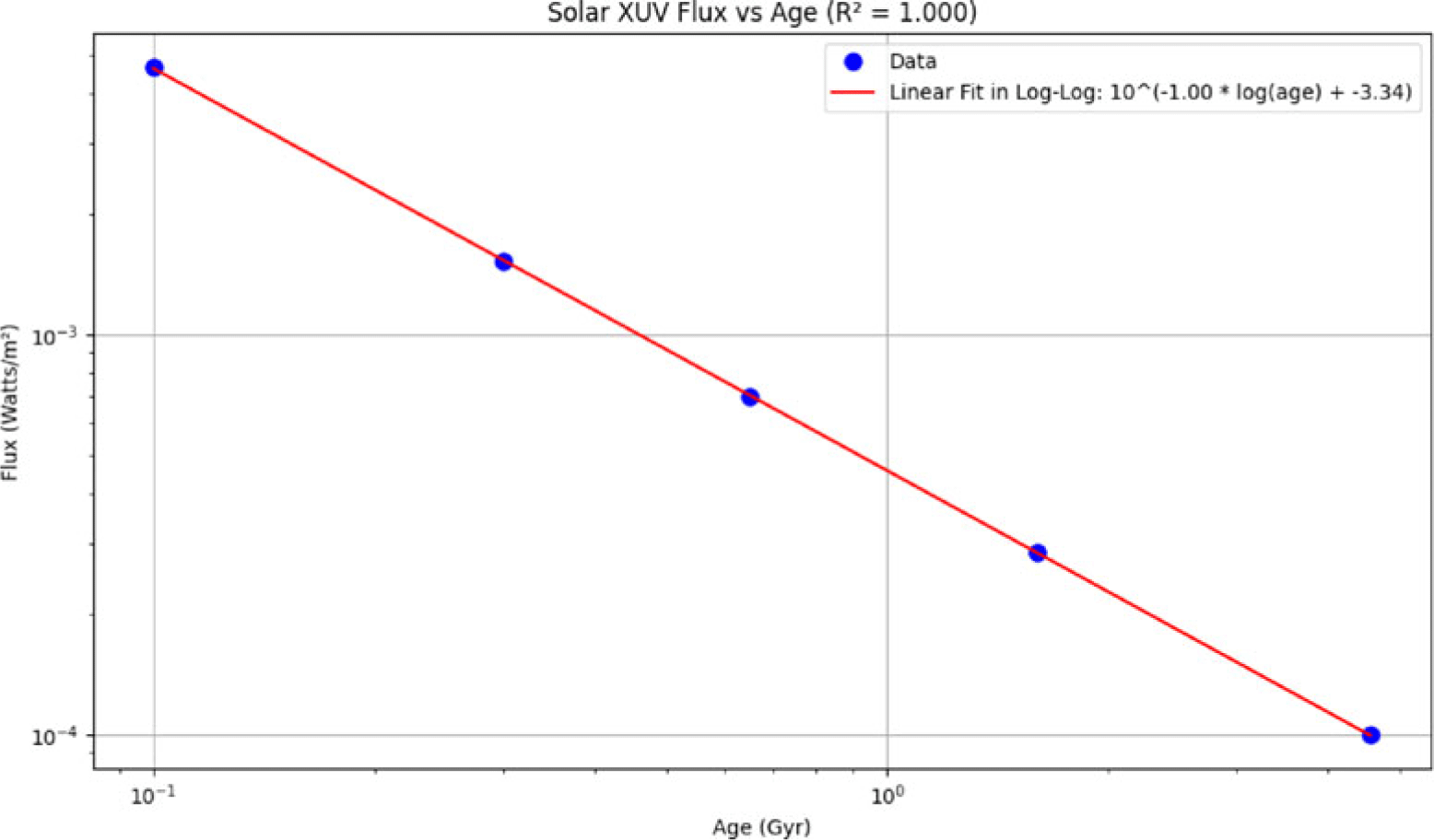
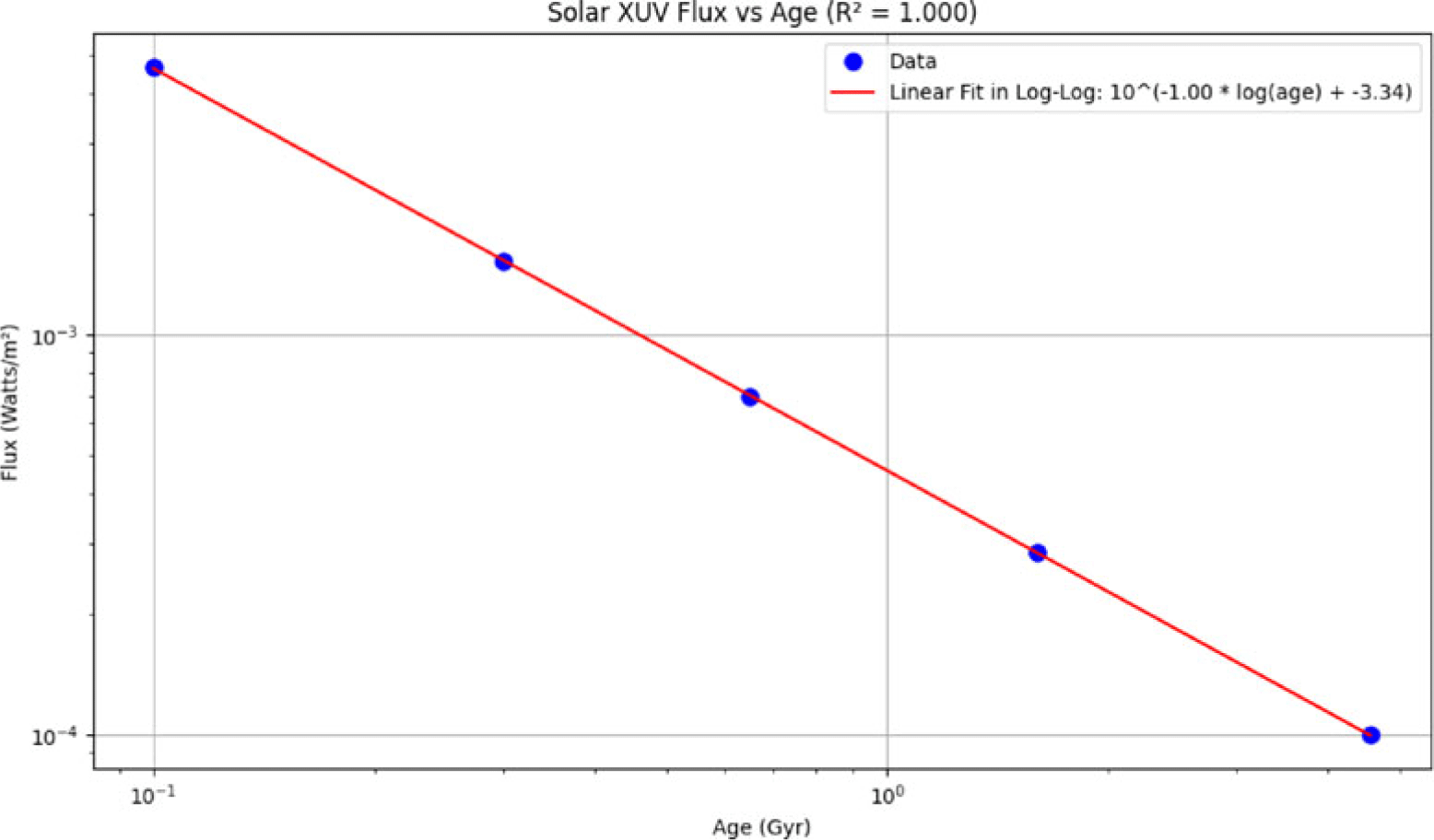
. The UV flux (F) varies over a star’s lifetime. To estimate this, we used the data from Ribas et al. (Reference Ribas2005), which describes the activity of Sun-like stars over time. Figure 1 shows the XUV flux of solar-like stars according to their age.
Data from Ribas et al. (Reference Ribas2005) showing the XUV Flux of Sun-like stars over their age.
2.2. Solar Wind
Atmospheric loss due to solar wind is a process that occurs when the solar wind, a stream of charged particles emitted by the Sun, interacts with a planet’s atmosphere. This process is particularly important for planets like Mars that lack a magnetic field strong enough to protect their atmosphere from solar wind interaction. When the solar wind reaches a planet’s atmosphere, the charged particles interact with the atoms and molecules present, potentially sweeping them away from the planet. The calculation of planetary atmospheric mass loss due to solar wind, as applied to Mars, was performed using the equation:
 \begin{equation} \dot{M} = 4 \pi R_p^2 \rho_{surf} u_{surf}. \end{equation}
Here,
 $R_p$
represents the planet’s radius, in this case, the Martian radius. The symbol
 $\rho_{surf}$
is the density of the solar wind at the planet’s surface, and
 $u_{surf}$
is the solar wind velocity at the planet’s surface, which must be calculated according to Parker (Reference Parker1958) before being inserted into Eq. 3:
 \begin{equation} u^2 - \frac{2kT}{m} - \frac{2kT}{m} \ln{\left(\frac{mu^2}{2kT}\right)} = \frac{8kT}{m} \ln{\left(\frac{r}{r_c}\right)} + 2GM \left(\frac{1}{r} - \frac{1}{r_c}\right) \end{equation}
and the critical radius is defined by the equation:
 \begin{equation} r_c = \frac{G M_s m_p}{4 k_b T} \end{equation}
where G is the gravitational constant,
 $M_s$
is the mass of the Sun,
 $m_p$
is the average mass of the wind particles,
 $k_b$
is the Boltzmann constant, and T is the temperature of the solar corona. Similarly, the solar wind density given by Leblanc et al. (Reference Leblanc, Dulk and Bougeret1998) is:
 \begin{equation} n(r) = 7 \times 10^4 r^{-1.67} + 4.1 \times 10^6 r^{-4} + N_s r^{-6} \quad (\text{cm}^{-3}) \end{equation}
where r is the radial distance from the Sun and
 $N_s$
is a constant,
 $N_s = 2.6 \times 10^7 \text{ cm}^{-3}$
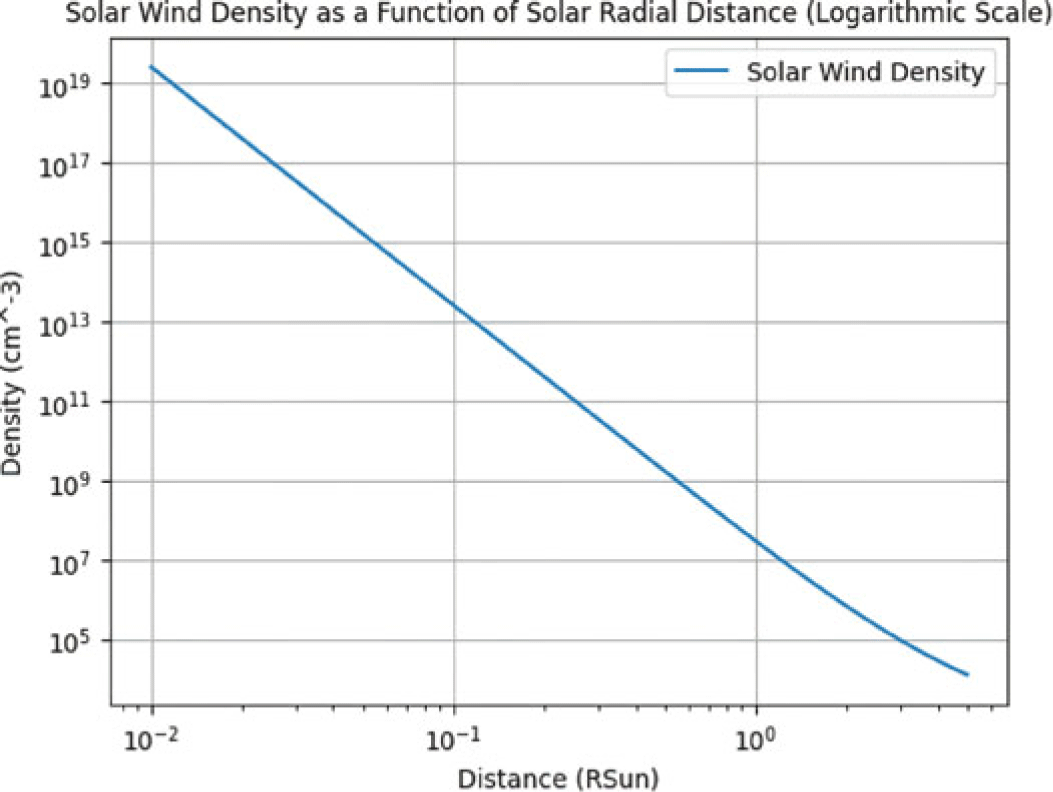
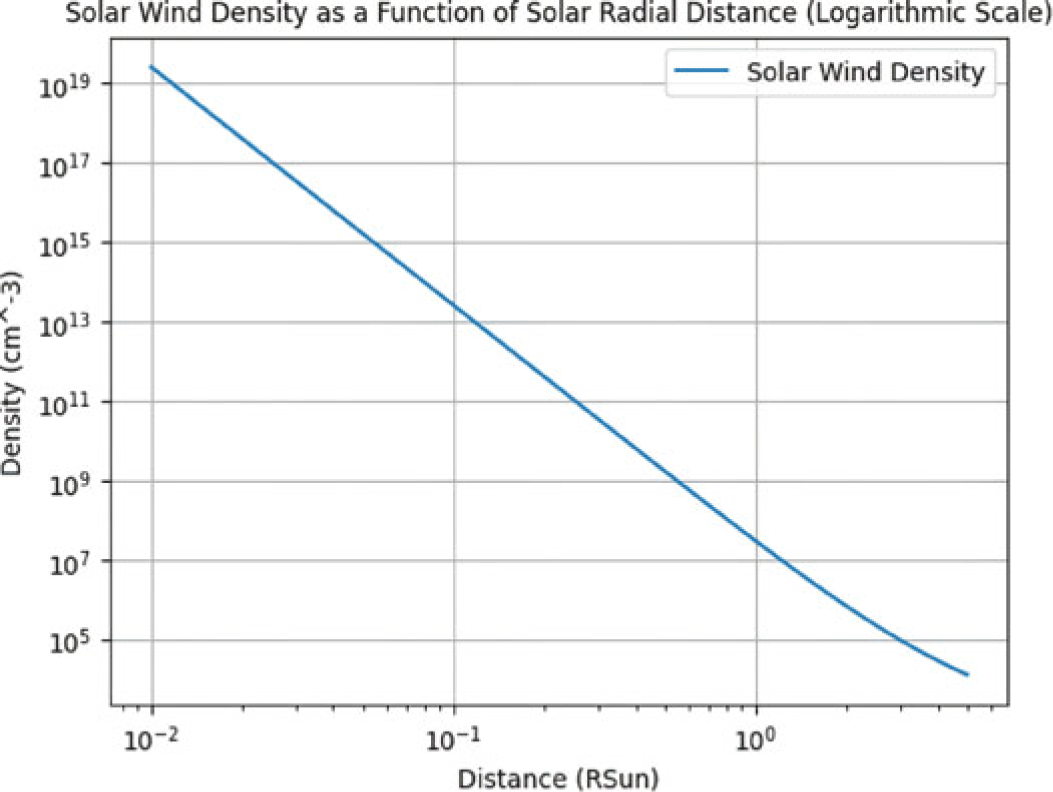
, obtained to fit the density of the solar corona. The solar wind density as a function of the radial distance from the Sun is plotted in Figure 2.
Solar wind density versus distance in solar radii.
2.3. Total Mass Loss
Considering the changes in the radius and mass of Mars caused by the loss of the planetary envelope, the calculations for both photoevaporation and solar winds must be performed by stepping backward in time. Thus, we have, following Modi et al. (Reference Modi, Estrela and Valio2023):
 \begin{equation} M_{before} = M_p + \dot{M} \end{equation}
where
 $M_p$
is the planet’s current mass. The
 $\dot{M}$
represents the total mass lost by the planet due to both photoevaporation and solar winds. This gives
 $M_{before}$
, the updated mass of the planet, which will be used in all subsequent calculations. For the updated radius, we calculate (Modi et al. Reference Modi, Estrela and Valio2023):
 \begin{equation} R_{before} = R_{core} + R_{envelope} \end{equation}
where
 $R_{core}$
is the radius of the planet’s core, the distance from the center of the planet to the edge of the rocky core for telluric planets like Mars.
 $R_{envelope}$
is the radius of the planetary envelope, which is the gaseous layer surrounding the core.
 $R_{before}$
represents the updated initial radius of the planet.
3. Results and Discussion
To perform all quantitative calculations related to the loss of the Martian atmosphere by photoevaporation and solar wind, a Python program was developed to facilitate the computations.
3.1. Photoevaporation
Photoevaporation is a star-planet phenomenon that can ionize atoms and molecules in a planetary atmosphere by absorbing UV and X-ray radiation from the star. Consequently, the planets most affected are those closest to the host star, as they are more exposed to this radiation.
Upon comparing the results of our initial calculated atmospheric mass loss for Mars due to photoevaporation with data from the MAVEN space mission (Vaisberg Reference Vaisberg2015), we observed an order of magnitude discrepancy. While analyzing all data points, we found them to be consistent. Therefore, we concluded that the efficiency factor (
 $\eta$
) proposed by Jackson et al. (Reference Jackson, Davis and Wheatley2012), which varies with planet size and atmospheric composition, is not applicable to Mars to obtain compatible results. We then used an efficiency factor of
 $\eta = 10^{-4}$
for the calculation of Mars’ atmospheric mass loss via photoevaporation and found results that were consistent with data collected by the MAVEN probe of 1-2 kg/s (Vaisberg Reference Vaisberg2015).
With the equations solved using the Python program and the newly proposed efficiency factor (
 $\eta = 10^{-4}$
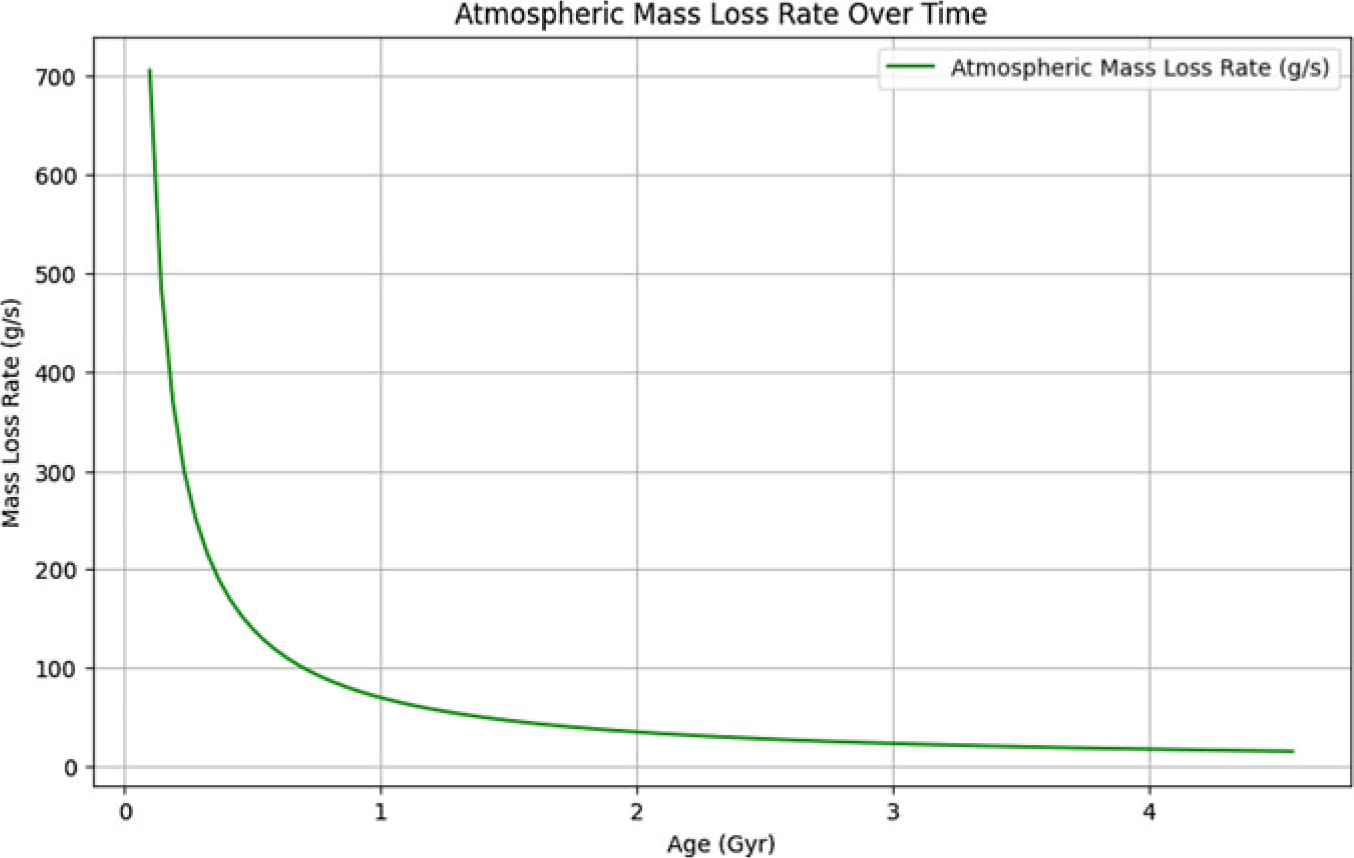
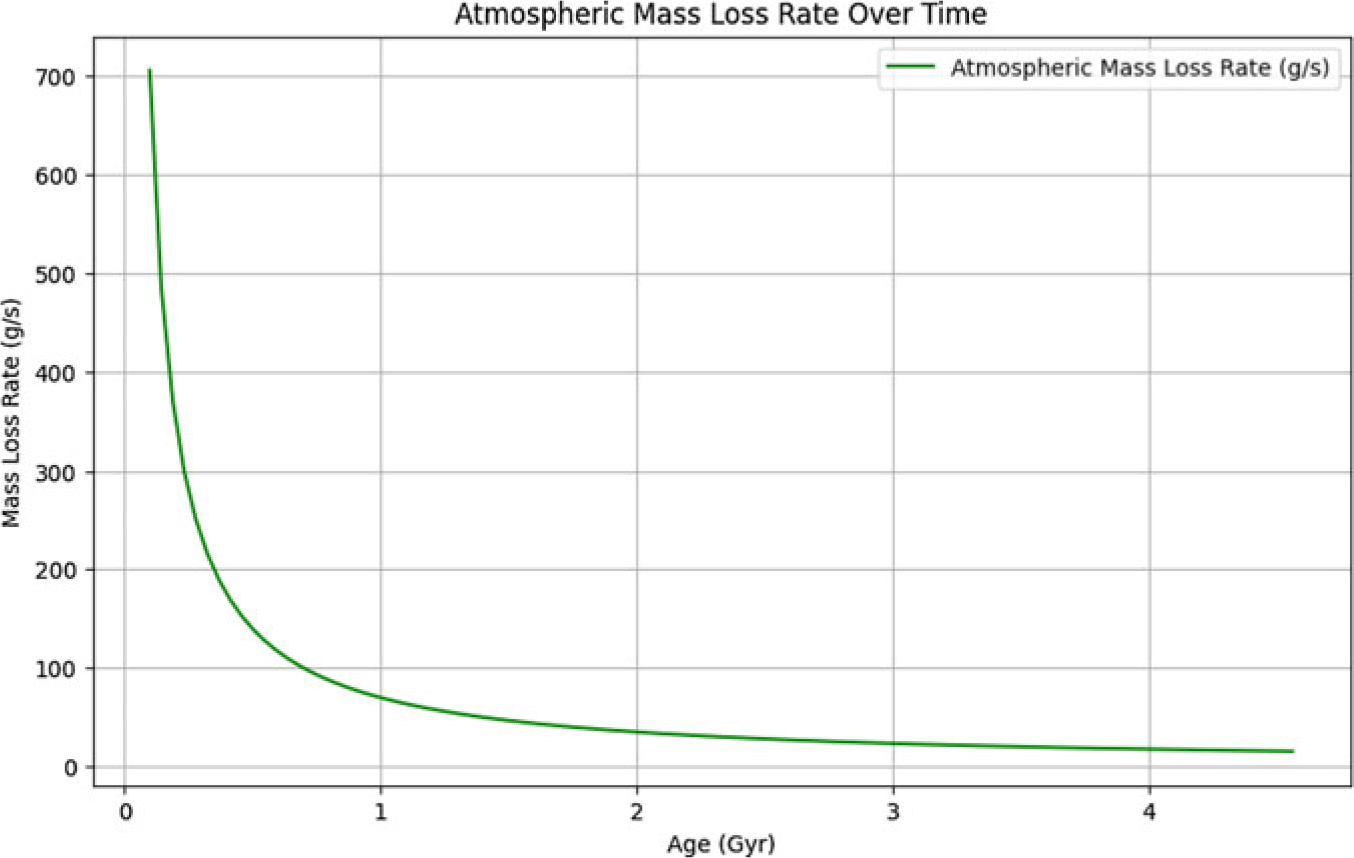
), we found that the atmospheric mass loss rate for Mars due to photoevaporation is 189.8 g/s. The total mass lost, estimated as explained in Section 2.3, over the period from 0.1 to 4.6 Gyr is
 $8.43 \times 10^{17}$
kg (Figure 3). These results are listed in Table 1.
Rate of Martian atmospheric mass loss due to photoevaporation over time in gigayears.
Estimated Martian atmospheric loss rates due to solar wind interaction and photoevaporation, compared to MAVEN probe observations (Jakosky et al. Reference Jakosky2018), and the total accumulated loss throughout the planet’s evolution.

Table 1 Long description
A table comparing Martian atmospheric loss rates and total accumulated loss over time. The table has three rows and three columns. Column headers are Rate (kg/s) and Total from 0.1 to 4.6 Gyr (kg). Row 1: MAVEN Observations, Rate 1-2, Total 2.9 x 10^17. Row 2: Photoevaporation, Rate 0.189, Total 8.43 x 10^17. Row 3: Solar Wind, Rate 0.840, Total 1.2 x 10^15.
3.2. Solar Wind
The solar wind is also effective in the loss of a planetary envelope for planets closer to the host star. However, for planets farther from the star, such as Mars, the solar wind is a more efficient process for atmospheric loss than photoevaporation.
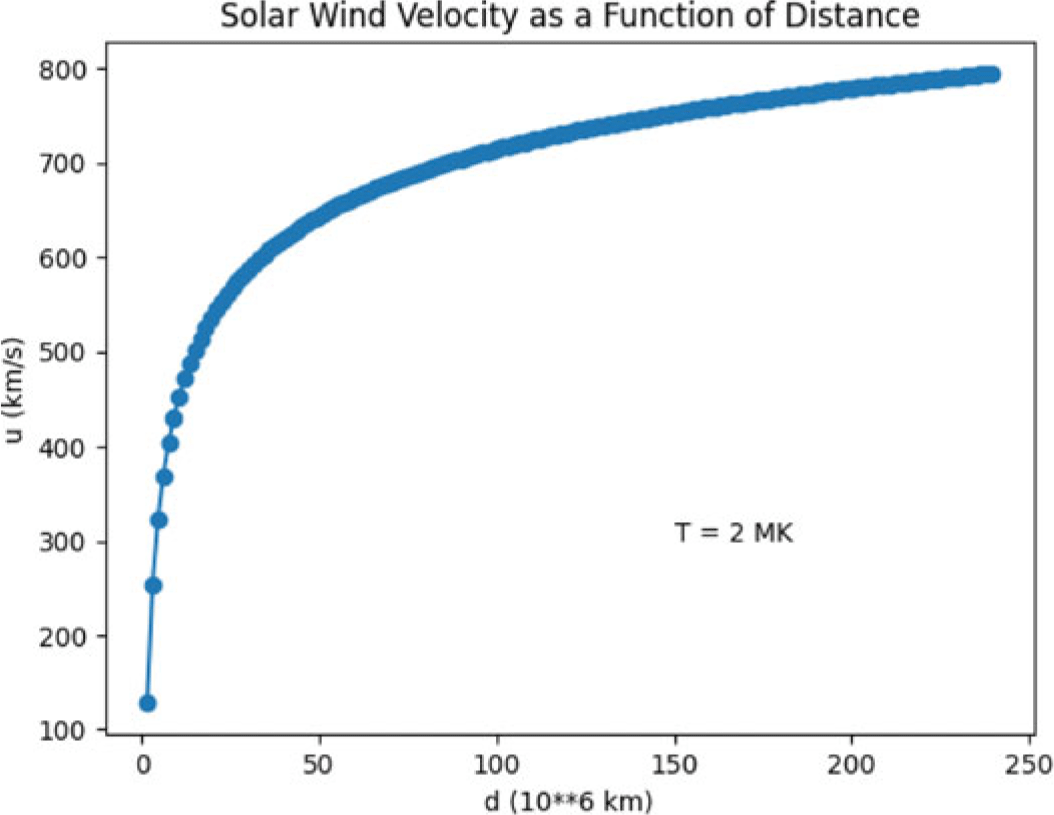
By solving the Parker equation (Eq. 4) for a coronal temperature of 2 MK using a Python program and adopting the solar wind density distribution shown in 2, we obtained the solar wind velocity as a function of the distance from the star, as shown in Figure 4.
Solar wind velocity as a function of distance for a constant coronal temperature of 2 MK.
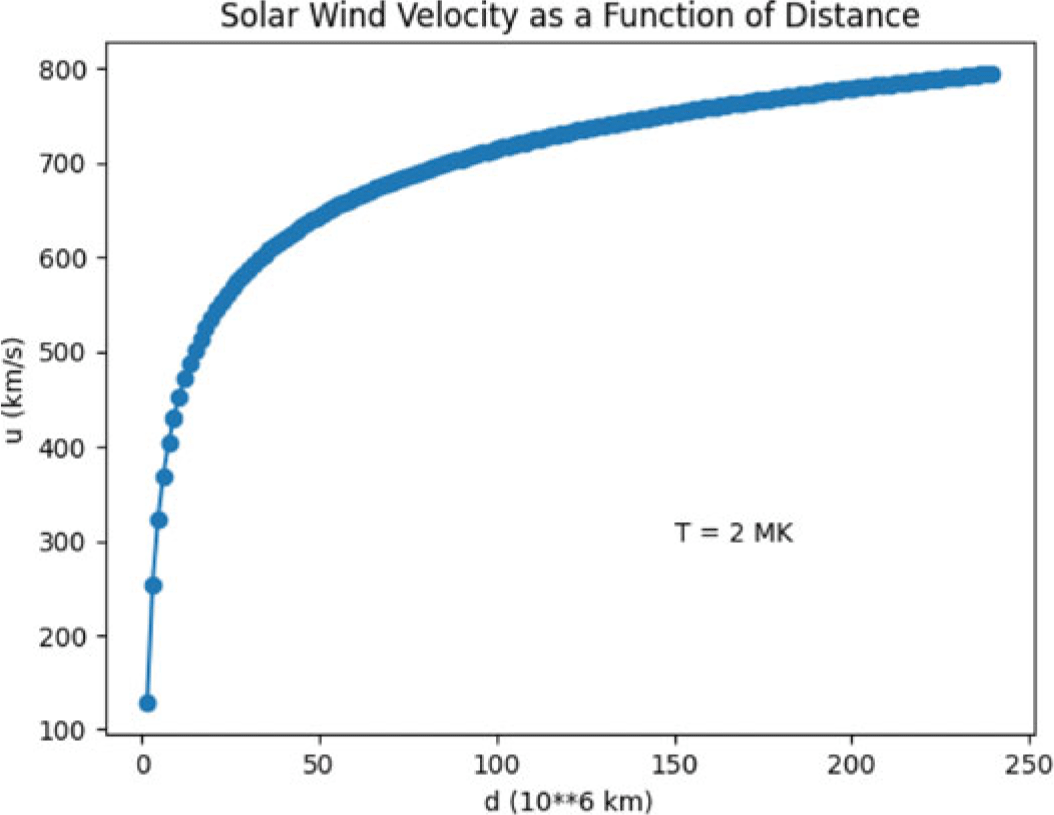
From the graph in Figure 4, we determined that the velocity at
 $227.94 \times 10^6$
km (the distance of Mars from the Sun) is 790.446 km/s, and the solar wind density at the same distance is 4.408 cm
 $^{-3}$
. By substituting the obtained solar wind velocity and density values into Equation 3, we estimated the current atmospheric mass loss rate for Mars to be 840.4 g/s, in agreement with the observations of MAVEN (1-2 kg/s). As explained in Section 2.3, integrating this rate from 0.1 to 4.6 Gyr (approximately the age of the Solar System), we found that the total atmospheric mass loss is
 $1.193 \times 10^{15}$
kg. Both results are listed in Table 1.
4. Conclusion
Planet Mars has undergone evolutionary processes that transformed its atmosphere from a past state that was denser and more humid into its current, highly rarefied state. There are several explanations for this shift from a milder climate to the present hostile one, which makes it uninhabitable for known life forms. One of these explanations is atmospheric loss resulting from interactions between Mars and the Sun, including the phenomena of photoevaporation and interactions with the solar wind.
It is well-established that the young Sun was more active and less luminous than it is today, and this significantly impacted the atmospheric evolution of its orbiting planets. Photoevaporation is directly linked to a planet’s exposure to the Sun’s radiation, making it particularly effective on planets closer to the star. The effects of the solar wind are closely tied to a planet’s magnetic field and its distance from the star. The density and velocity of the solar wind decrease with increasing distance, making it less efficient at stripping the planetary envelope. Thus, the combination of these factors led to the atmospheric loss of Mars, as quantitatively estimated in this research (Table 1).
Future work will require a more sophisticated approach to the calculations, as we did not account for the temporal evolution of the solar wind or Mars’s magnetic field during its early stages when magnetic activity was still present. However, the results of this study provide a quantitative estimate of the impact of Martian atmospheric mass loss and are consistent with observations made by the MAVEN probe.