Introduction
Early childhood adversities and recent negative life events have been shown to be robust predictors of major depression in adolescents and adults (Kessler & Magee, Reference Kessler and Magee1993; Kessler et al. Reference Kessler, Davis and Kendler1997; Mazure, Reference Mazure1998; Hammen, Reference Hammen2005; Garber, Reference Garber2006), but little research has examined how the two sources of stress might be associated in their link to depression. One approach hypothesizes that childhood adversity alters neurobiological and psychosocial processes whereby individuals may be sensitized to the effects of recent stressful events, responding with depression at lower levels of stress (Hammen et al. Reference Hammen, Henry and Daley2000) or with greater reactivity to the effects of adult severe events (Heim et al. Reference Heim, Newport, Heit, Graham, Wilcox, Bonsall, Miller and Nemeroff2000, Reference Heim, Newport, Wagner, Wilcox, Miller and Nemeroff2002; Kendler et al. Reference Kendler, Kuhn and Prescott2004). Another approach suggests that childhood stressors add to lifetime stress burden and independently predict depression along with recent stress (Turner & Lloyd, Reference Turner and Lloyd1995, Reference Turner and Lloyd2004). Other studies of the childhood adversity–adult depression link have simply ignored the role of current or recent stressful life events.
In the present article an additional mechanism of the effects of early adversity is hypothesized. Early adversity may be a marker of continuing exposure to negative stressors, such that those with exposure to childhood negative events and circumstances are more likely to continue to be exposed to stressful events and circumstances (Pearlin, Reference Pearlin1989), especially adolescents who are still living at home. Several investigators have demonstrated that the number of adversities and life events experienced in childhood and adolescence is associated with the number of life events and chronic stressors experienced even into adulthood (Turner et al. Reference Turner, Wheaton and Lloyd1995; Turner & Butler, Reference Turner and Butler2003; Turner & Turner, Reference Turner and Turner2005), and Cole et al. (Reference Cole, Nolen-Hoeksema, Girgus and Paul2006) demonstrated considerable continuity in burden and number of life events in middle and elementary school samples. Some of the effects of early adversity on adolescent depression may be due less to their special status as ‘early’ as to their continuity with later stressors. Thus, the association between early adversity and youth depression may be mediated by recent stressors. Examining the mediational role of recent life stress on depression is consistent with the stress-generation perspective (Kendler et al. Reference Kendler, Karkowski and Prescott1999; Hammen, Reference Hammen2006), in which vulnerable individuals may experience the occurrence of stressful life events at least in part because of their characteristics, behaviors and life circumstances. In turn, the experience of such events puts the person at further risk for depressive reactions.
Three studies found that recent negative life events mediated the relationship between adverse childhood experiences and depression, but each relied on college student samples, used retrospective reports of early stressors and maltreatment, and used depressive symptoms as the outcome variable (Turner & Butler, Reference Turner and Butler2003; Hankin, Reference Hankin2005; Uhrlass & Gibb, Reference Uhrlass and Gibb2007). Thus, while each study provides valuable information about the link between early stressors and depressive symptoms, it is unclear to what extent they are indicative of the prospective relationships between early adversity, proximal stressors, and syndromal depression. Previous assessments of adversity have also usually covered experiences through adolescence (e.g. age 16 years: Kessler & Magee, Reference Kessler and Magee1993; Kessler et al. Reference Kessler, Davis and Kendler1997; Hammen et al. Reference Hammen, Henry and Daley2000; age 14 years: Hankin, Reference Hankin2005; age 15 years: Uhrlass & Gibb, Reference Uhrlass and Gibb2007). Since many individuals experience a first onset of depression in adolescence (Kessler et al. Reference Kessler, Avenevoli and Merikangas2001; reviewed in Rudolph et al. Reference Rudolph, Hammen, Daley, Wolfe and Mash2006), the adversity may occur after the first depressive episode, which is itself a strong predictor of later depression. Even when steps are taken to account for prior depressive episodes in samples of young adults (Hammen et al. Reference Hammen, Henry and Daley2000; Harkness et al. Reference Harkness, Bruce and Lumley2006) or to ensure that traumas occur before first onset (Turner & Butler, Reference Turner and Butler2003), ‘early’ adversities may have occurred only a short time before onset of depression in adolescence, potentially blurring the distinction between early and recent stress. By assessing stressors in distinct periods in early childhood and mid-adolescence, the current study hopes to build on these previous studies by clarifying the respective contributions of distal and proximal stressors measured close to the time the stress occurred.
The present study attempted to address these gaps using a 20-year longitudinal study in which early adversities were operationalized as negative events and circumstances during the first 5 years of the child's life, as assessed from data collected contemporaneously during those years. The sample also included extensive interview-based diagnostic assessments covering the youths' first 15 years, and the period between ages 15 and 20 years. Additionally, stressful life events and chronic stress at age 15 years were assessed by interviews taking into account contextual information and dates of occurrence. The longitudinal design permitted tests of three hypotheses. First, adversities assessed in the first 5 years of life will predict diagnoses of depression in youth up to age 20 years. Second, adversities occurring by age 5 years will predict age 15 years stressful events and circumstances. Third, and most importantly, the association between early adversities and depressive disorders occurring between ages 15 and 20 years will be mediated by the recent stress occurring at age 15 years.
Method
Participants
Participants were recruited from a subsample of the Mater University Study of Pregnancy (MUSP), a community sample of 7223 children born in Brisbane, Australia. Mothers completed the Delusions-Symptoms-States Inventory (DSSI; Bedford & Foulds, Reference Bedford and Foulds1977) along with other measures during pregnancy, 3–4 days after the child's birth, 6 months after birth, and when the child was 5 years old. As described elsewhere (Hammen & Brennan, Reference Hammen and Brennan2001), when the youth were 15 years old mothers and their families were invited into the current study on the basis of the mothers' DSSI scores up to the age 5 years assessment. Mothers were chosen to capture wide variation in depressive symptom presence, severity and chronicity, including mothers who reported no significant depressive symptoms. Doing so created a high-risk sample in order to provide more depressed mothers and offspring for analysis than would be available in an unselected community sample.
At age 20 years attempts were made to contact each of the families that participated in the age 15 years data collection, and 705 youth (363 females) agreed to participate. The 705 youth did not differ from the 110 non-participating youth in their number of early adversities [t(813)=0.18, p=0.86], history of depression by age 15 years [χ2(1, n=815)=1.33, p=0.30] or in stress burden at age 15 years [t(134)=1.78, p=0.08], but participants did have higher family income at age 15 years [t(149)=2.38, p=0.02] and were more likely to be female [χ2(1, n=815)=8.71, p<0.01]. Subjects with missing data were excluded listwise within tests of each hypothesis, resulting in slightly varying sample sizes for each set of tests.
Measures
Youth diagnoses
The Schedule for Affective Disorders and Schizophrenia for School-age Children – Revised (Epidemiologic version) for the DSM-IV (K-SADS-E; Orvaschel, Reference Orvaschel1995) was administered to youth and their mothers at the age 15 years follow-up to determine the presence or absence of current or past depression. Youth were considered to be depressed if they had a diagnosis of major depressive disorder (MDD) or dysthymia (κ=0.82 for current diagnoses of depression, κ=0.73 for past diagnoses). Youth diagnoses of depression after the age 15 years interview were assessed using the Structured Clinical Interview for DSM-IV (SCID; First et al. Reference First, Spitzer, Gibbon and Williams1995) administered at age 20 years. A diagnostic reliability analysis of 10% of the interviews rated by independent judges yielded κ=0.83 for current diagnoses of depression and κ=0.89 for past depression. Of the 705 youth included in the present analyses, 237 (33.6%) had received a diagnosis of major depression or dysthymia by the age 20 years interview. Of those 237, 99 (41.8%) had been depressed prior to the age 15 years interview and 138 (58.2%) were first depressed between the age 15 and age 20 years assessments. These rates are higher than many population estimates (e.g. Kessler & Walters, Reference Kessler and Walters1998) due to the use of a high-risk sample, though other, unselected samples have also estimated high rates using the K-SADS-E (e.g. Lewinsohn et al. Reference Lewinsohn, Rohde and Seeley1998).
Early childhood adversities
Measures of early childhood adversities in the first 5 years of the child's life were derived from information provided by the mother at one or more of the pregnancy, birth, 6-month and 5-year assessments. In the case of maternal diagnosis, lifetime SCID interviews were administered when the child was age 15 years. Variables included as adversities were maternal Axis I diagnosis prior to age 5 years, financial hardship, child chronic illness, parental discord, maternal stressful life events and mothers' separation from partners.
Maternal Axis I diagnoses (omitting specific phobia) between the child's birth and age 5 years were assessed using the SCID for lifetime disorders administered at the age 15 years interview. In total, 282 diagnoses were attributed to 194 mothers. The most common diagnoses given were social phobia (n=34), MDD (n=78) and dysthymic disorder (n=68). The κ for depressive disorders within the child's first 5 years among those in the reliability sample was 0.81 (p<0.01).
Financial hardship was assessed by calculating the mean of maternal ratings of total family income at the prenatal, 6-month and 5-year data collections. Childhood illness was assessed at the age 5 years assessment by asking mothers to endorse whether the child had had any of 15 illnesses or injuries (e.g. asthma) lasting ⩾3 months that impaired the child's activities at least ‘some’. In total, 116 mothers reported that her child had had at least one chronic illness. Maternal life events were assessed using checklists of nine interpersonal, health or occupational problems that might have occurred in the last 6 months prior to the prenatal and post-natal data collections. The numbers of reported events at the two assessments were highly correlated (r=0.59) and were summed to reduce the checklists to a single measure of perinatal stressful life events. Maternal relationship satisfaction with her romantic partner was assessed using the mean of the eight-item satisfaction scale of the Dyadic Adjustment Scale (DAS; Spanier, Reference Spanier1976) collected during pregnancy and at birth, 6 months and 5 years (α ranged from 0.85 to 0.97). If on the age 5 years questionnaire a mother reported that she had been divorced or separated from a partner or that she had changed partners over the last 5 years the child was considered to have experienced a parental partner separation.
The continuous variables, income, DAS and maternal life events, were recoded as present/absent using the 33rd percentile as the cut-off point for each measure to identify the third of the sample experiencing the most adverse conditions. The specific cut-off was chosen as a consistent point across measures that would balance the need for sufficient numbers for meaningful analyses with selection of a moderately adverse level of each variable. A summary measure of early childhood adversity was formed by counting the number of adversities for each child, resulting in a range of 0–6 adversities experienced (median=1).
Age 15 years stressors
Participants completed the youth version of the University of California, Los Angeles (UCLA) Life Stress Interview at the age 15 years data collection. The interview has been used and validated in a variety of other youth and young adult samples (e.g. Adrian & Hammen, Reference Adrian and Hammen1993; Rao et al. Reference Rao, Hammen and Daley1999) and assesses both discrete stressful life events in the last 12 months and ongoing chronic stress. Similar to Brown's contextual threat interviews for adults (Brown & Harris, Reference Brown and Harris1978), interviewers used standard probes to elicit stressful events and probed for information related to the events' impact, as well as past familiarity with similar events, expectedness and available support. Teams of independent raters used this contextual information blind as to the person's own subjective reaction, to rate each event on a continuous, five-point objective threat scale with 5 indicating extremely severe negative impact and 1 indicating very little impact. A sum of the ratings of negative life event impact was used as a measure of the total impact of episodic stressors on the youth.
In addition, the interviewer probed and rated the youth's ongoing chronic stress over the past 6 months on five-point, behaviorally anchored scales in each of several domains: academic, social life, best friend, romantic, family, and school behavior domains. For example, on the close friend scale a 5 indicates ‘Absence of a close, confiding friendship where there is no one they feel close to or confide in’, while a 3 indicates ‘Presence of a close, confiding friendship, although may be unstable at times, some trouble with conflict resolution, or presence of only a moderate close friendship that is fairly stable and non-conflictual’. A total of the chronic stress ratings was used as a summary measure of chronic stress ranging from 6 to 30, with higher scores indicating greater total chronic stress. The measure is highly reliably scored and has demonstrated concurrent and predictive validity (e.g. Hammen & Brennan, Reference Hammen and Brennan2001).
Turner et al. (Reference Turner, Wheaton and Lloyd1995) have argued that a composite of recent episodic stressors and ongoing stressful circumstances provides a more comprehensive measure of the total stress burden on an individual at a given time. It also better represents the interdependence of the processes promoting and maintaining different types of stress within a given environment (Pearlin, Reference Pearlin1989). Such a measure captured stress at a global level consonant with both the broad assessment of early childhood adversity used and the lifespan approach to the stress–depression relationship being examined. Thus, following Turner & Turner (Reference Turner and Turner2005), total stress burden scores were formed by standardizing the episodic and chronic stress variables and summing them. The resulting variable ranged from −3.83 to 5.84 (mean=0.00, s.d.=1.53).
Additional indicators of environmental stress at age 15 years
Several variables generally corresponding to the content of measured early adversities were also assessed at the age 15 years data collection to permit assessment of stress continuity. Mothers rated family income at age 15 years on a nine-point ordinal scale. Mothers who were married or in relationships again completed the satisfaction subscale of the DAS. Maternal depressive symptoms at youth age 15 years were measured using the Beck Depression Inventory (Beck et al. Reference Beck, Ward, Mendelsohn, Mock and Erbaugh1961). Stressful maternal life events and chronic stresses over the past 6 months were assessed with the adult version of the UCLA Life Stress Interview (Hammen, Reference Hammen1991). Episodic life events and chronic stress ratings were determined in the same way as for the youth as described above, but using adult-appropriate probes and domains. The ratings for romantic relationship strain and financial circumstances were used to indicate maternal relationship quality and family financial status, respectively. Reliability and validity of the chronic stress scales for adults have been reported elsewhere (e.g. Hammen et al. Reference Hammen, Adrian, Gordon, Burge, Jaenicke and Hiroto1987).
Data analysis
The association between early adversity and the presence or absence of depression between ages 15 and 20 years was assessed using logistic regression. Stress continuity was assessed by calculating the correlations between the summary measure of early adversity and continuous measures of adolescent stress. t Tests were also used to test whether those who experienced specific early adversities had more adverse scores on indicators of similar constructs at age 15 years. The mediation analyses were performed using three regression equations as described by MacKinnon et al. (Reference MacKinnon, Lockwood, Hoffman, West and Sheets2002). These equations established the total effects of early adversity on depression (c) and youth stress burden at age 15 years (α), the effect of youth stress burden on depression controlling for early adversity (β) and the direct effect of early adversity on depression controlling for youth stress burden at age 15 years (c'). An estimate of the indirect, or mediated, effect, αβ, was calculated as the product of α and β. Because coefficients from ordinary least-squares and logistic regressions are on different scales and are thus non-comparable, each coefficient was rescaled by multiplying by the standard deviation of the predictor and dividing by the standard deviation of the criterion variable before calculating αβ (MacKinnon & Dwyer, Reference MacKinnon and Dwyer1993). The program of MacKinnon et al. (Reference MacKinnon, Fritz, Williams and Lockwood2007), prodclin, was used to calculate the 95% confidence interval (CI) of the indirect effect. It makes fewer distributional assumptions than the traditional Sobel method while providing greater power and tighter control over type I error. An interaction term was not included in the initial mediation analysis, but interaction terms were included in additional analyses to determine if the primary findings were moderated by youth or maternal histories of depression.
Results
Does early childhood adversity predict diagnoses of youth depression?
Three logistic regression analyses were used to test whether the sum of early childhood adversities was predictive of later onset of depression. The sum of the six possible early childhood adversities predicted depression diagnoses prior to age 15 years [b=0.17, Wald χ2(1)=5.05, odds ratio (OR) 1.18, 95% CI 1.02–1.36, p=0.03] and depression between age 15 and 20 years [b=0.13, Wald χ2(1)=4.90, OR 1.14, 95% CI 1.02–1.28, p=0.03].
Does early adversity predict age 15 years stressors?
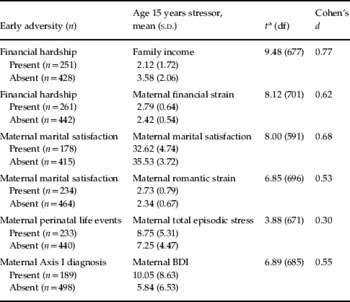
Table 1 displays the results of t tests comparing families that did and did not experience each of the early adversities on corresponding continuous measures at age 15 years. Each of the tests was statistically significant (p<0.001), indicating that experiencing an early adversity was associated with worse outcomes in the same domain at age 15 years relative to those who did not experience the adversity. The summary measure of early adversity was further correlated with ratings of total age 15 years youth episodic stress (r=0.10, p=0.01) and age 15 years chronic stress (r=0.21, p<0.001). Accordingly, early adversity also predicted total youth stress burden at age 15 years (r=0.22, p<0.001). Youth stress burden at age 15 years also had small but significant correlations with each of the indicators of ongoing adversity at 15 years: family income (r=−0.16), maternal financial strain (r=0.20), maternal DAS (r=−0.18), maternal relationship quality (r=0.18) and maternal life events (r=0.24) (all p<0.001). Thus, early adversities to age 5 years were significantly associated with family and youth stress at age 15 years.
Comparison of age 15 years stressors between youth who did and did not experience corresponding early adversities

s.d., Standard deviation; df, degrees of freedom; BDI, Beck Depression Inventory.
a t Tests compare each age 15 years stressor variable between youth who did and did not experience the listed early adversity. All p values <0.001.
Does stress burden at age 15 years mediate the association between early adversity and depression between ages 15 and 20 years?
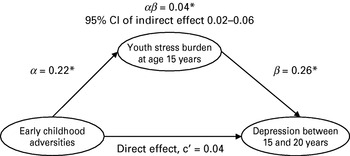
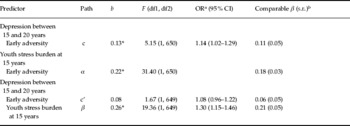
Fig. 1 illustrates the results of the mediation analyses evaluating whether stress burden at age 15 years accounted for the association between early adversity and depression between ages 15 and 20 yearsFootnote †. Regression results are displayed in Table 2. Among the 652 adolescents who had complete data for the mediation analyses, early adversity was predictive of depression between ages 15 and 20 years [b=0.13, Wald χ2(1)=5.16, OR 1.14, 95% CI 1.02–1.29, p=0.02] and of stress burden at age 15 years (b=0.22, p<0.001). Controlling for early adversity, stress burden at age 15 years was also predictive of depression between ages 15 and 20 years [b=0.26, Wald χ2(1)=19.36, OR 1.30, 95% CI 1.16–1.46, p<0.001]. However, controlling for stress burden at age 15 years, early adversity was no longer predictive of depression between 15 and 20 years [b=0.08, Wald χ2(1)=1.67, p=0.20]. The indirect effect was 0.04 (95% CI 0.02–0.06). Thus, the data are consistent with the hypothesis that the influence of early adversity on depression in late adolescence is mediated by adolescent stress burden proximal to depression onset.
Final mediational model. Before multiplication, α and β were standardized in order to allow for differences in scale (MacKinnon & Dwyer, Reference MacKinnon and Dwyer1993). CI, Confidence interval (* p<0.001).

Mediation analyses (n=652)

df, Degrees of freedom; OR, odds ratio; CI, confidence interval; s.e., standard error.
a Early adversity ranges from 0 to 6. Youth stress burden at 15 years ranges from 6 to 30.
b Because of scale differences between coefficients from ordinary least-squares regression and logistic regression (MacKinnon & Dwyer, Reference MacKinnon and Dwyer1993), comparable coefficients were calculated by multiplying each coefficient by the standard deviation of the predictor variable and dividing by the standard deviation of the criterion variable.
* p<0.05.
Additional analyses tested whether other factors moderated the observed relationships. The first analysis tested whether the relationship between adolescent stress burden and depression between 15 and 20 years may be affected by youth prior history of depression, consistent with the hypothesis that the link becomes weaker with successive episodes (the stress autonomy model; Monroe & Harkness, Reference Monroe and Harkness2005). Thus, presence or absence of depression prior to age 15 years was introduced as a moderator of the effects of adolescent stress burden on depression after age 15 years, but the interaction term was not significant (b=0.03, p=0.84). In a separate logistic regression, depression prior to age 15 years also did not moderate the association between early adversity and depression after age 15 years (b=0.17, p=0.26). Because the present families were selected from a larger community sample with oversampling for mothers with considerable depressive symptoms, maternal history of depression prior to age 5 years and prior to age 15 years were separately considered as moderators in separate sets of regressions. In no case did maternal depression moderate the association between early adversity and youth stress burden at age 15 years, or youth stress burden at age 15 years and depression between ages 15 and 20 years (all p>0.50). Thus, it does not appear that the mediation was moderated by depression prior to age 15 years or maternal history of depression during the adolescent's lifetime.
Discussion
As predicted, the total stress burden experienced in mid-adolescence mediated the association between early adversity and late-adolescent depression. Rather than being an independent risk factor for the occurrence of depression in late adolescence, early adversity plays a role in depression at least in part due to its association with adolescent stress burden, a well-established contributor to depressive onset. One potential mechanism by which this could occur is described by Rueter et al. (Reference Rueter, Scaramella, Wallace and Conger1999) who found that more stressful parent–child conflicts over multiple years in early- to mid-adolescence were predictive of increases in internalizing symptoms during that same time period. These symptoms in turn were predictive of the onset of anxiety and depressive disorders in late adolescence. Thus, continued exposure to stress during childhood and adolescence may increase or maintain symptom levels which eventually develop into full syndromal depression. Our findings are also broadly consistent with the stress-generation model in which the symptoms, personality traits and environmental circumstances of individuals with depression contribute to the occurrence of stress, which in turn acts as a risk factor for depression and its maintenance (Hammen, Reference Hammen2006).
In the course of testing the mediational hypothesis, the present study also provided additional data demonstrating the continuity of stressful conditions across childhood and adolescence. Previously Cole et al. (Reference Cole, Nolen-Hoeksema, Girgus and Paul2006) demonstrated that biannual reports of discrete life event occurrence and impact were correlated over a few years' time in both elementary and middle school samples. Harkness et al. (Reference Harkness, Bruce and Lumley2006) have also reported that retrospectively reported childhood abuse and neglect were associated with greater levels of chronic difficulties in adolescence. The current study complements these findings by demonstrating stress continuity prospectively over 15 years, using a wide range of non-traumatic early stressors and interviewer-based measures of chronic and episodic stress in adolescence. The current study design could not specify mechanisms of the continuity due to its circumscribed measurement periods, but it likely arises from reciprocal and cascading interactions between environmental factors, childhood symptoms and genetic factors that are the subject of increasing study (Jaffee & Price, Reference Jaffee and Price2007). Continued study of these processes incorporating more tightly spaced data collection times (see Cole et al. Reference Cole, Nolen-Hoeksema, Girgus and Paul2006) and genetic data will prove valuable for better understanding the processes by which stressful circumstances are propagated across childhood and adolescence.
Several issues must be noted regarding the operationalization of early adversity in the current investigation. Early adversity has been measured in different ways in the literature, ranging from the number of personal and family events endorsed on a checklist to the presence of physical or sexual abuse. The early adversities measured in the present investigation reflect a range of stressors and conditions, including indices of broad socio-economic disadvantage (family income), discord or dissolution in important parts of the family system (parental marital dissatisfaction, parental divorce) and direct physical stressors on the child (significant medical illness prior to age 5 years). Some degree of clustering of social, familial and personal adversities is likely typical and reflects the interdependence between the processes promoting each type of adversity. To the extent that the measure of early adversity used in the current study indexed the early social context, the current findings might also suggest that the risk for depression conferred by unfavorable social environments (Turner et al. Reference Turner, Wheaton and Lloyd1995) results from the likelihood of continued stress exposure for those raised in such environments.
The range of stressors assessed may also have affected the results of the current study. The decision to dichotomize continuous early adversity indicators at the 33rd percentile was made in order to provide consistency and sufficient samples for analysis, but it may have resulted in some children in only moderately stressful environments being listed as experiencing an adversity. In lieu of an empirically grounded reason for picking a more extreme value, it is important to note that even milder forms of childhood adversity have been previously credited with etiological significance in predicting later depression (e.g. Taylor et al. Reference Taylor, Way, Welch, Hilmert, Lehman and Eisenberger2006). Nonetheless, dichotomizing around different points may have yielded different patterns of results. Overt abuse and neglect also have clear etiological significance for the study of mood disorders (Brown & Harris, Reference Brown and Harris1993; Kendler et al. Reference Kendler, Kuhn and Prescott2004), and may have unique mechanisms by which they confer risk for depression, as might other traumatic experiences. The current mediation findings do not preclude the possibility that some specific traumatic childhood experiences may promote the development of depression by altering specific neurobiological or developmental processes related to stress responsivity and emotion regulation (Goodman, Reference Goodman, Gotlib and Hammen2002). Indeed, models that explicitly account for biological and contextual influences over time will be needed to capture the mechanisms by which traumatic stressors create a vulnerability to later depression.
Additional limitations of the current investigation are acknowledged. Notably, the present study only assessed depression by age 20 years. The results may not generalize to older samples, because childhood environments are more likely to resemble adolescent environments than adult environments. Indeed, the models of Cole et al. (Reference Cole, Nolen-Hoeksema, Girgus and Paul2006) suggest that the correlation between measures of life events degrades over time even within childhood. Thus, the redundancy of the effects of childhood adversity and proximal stress may become less pronounced at older ages. Moreover, the current sample was selected from a community sample in order to capture a wide range of depressive symptoms in mothers during the 5 years after the target child's birth. As a result, over half of the families in the study had a history of maternal depression and the sample showed a correspondingly high rate of youth depression. Although analyses suggested that maternal history of depression did not moderate the observed results, it is possible that somewhat different results might occur within non-selected community samples.
The current study holds considerable implications for intervention and public health. Many children are born into families with high levels of stress and adversity, and their exposure may overwhelm possibly limited capacities to cope effectively with adversities as they grow older. Efforts to reduce the amount of stress youth are exposed to may help to mitigate the risk of stress continuity using interventions aimed to either improve their contexts or their response to their contexts. Doing so may result in the alteration of stress transmission processes, reducing the likelihood that currently adverse conditions are conveyed into the future. Although developing such interventions presents considerable challenges, the current findings suggest that intervention even into mid-adolescence may be helpful for those exposed to early childhood adversity.
Acknowledgements
This study was supported by the National Health and Medical Research Council in Australia, the Mater Misericordiae Mothers' Hospital (Queensland, Australia) and the US National Institutes of Health grant R01 MH52239. We thank the project coordinators, Robin LeBrocque, Cheri Dalton Comber and Sascha Hardwicke, and the many dedicated interviewers. Thanks also to the MUSP principal investigators including J.N., William Bor, Michael O'Callaghan and Gail Williams for their contributions to the original MUSP birth cohort.
Declaration of Interest
None.