


Introduction
Many of the patients referred from primary care to secondary care medical services are judged by the specialist to have symptoms that are not adequately explained by organic disease; so-called medically unexplained symptoms (MUS) (Sharpe, Reference Sharpe2002; Burton, Reference Burton2003). MUS have been found to account for a third of new referrals to specialist medical clinics (Kroenke et al. Reference Kroenke, Arrington and Mangelsdorff1990; Carson et al. Reference Carson, Ringbauer, Stone, McKenzie, Warlow and Sharpe2000; Reid et al. Reference Reid, Wessely, Crayford and Hotopf2001). There is substantial evidence that MUS are associated with depressive, anxiety and panic disorders, the treatment of which would be an alternative to repeated medical referral (Katon et al. Reference Katon, von Korff, Lin, Lipscomb, Russo, Wagner and Polk1990; Henningsen et al. Reference Henningsen, Zimmermann and Sattel2003).
We have observed that not only are many patients referred to specialist medical clinics with MUS but also that some are repeatedly referred for assessment, despite having received previous specialist diagnoses of MUS. We will refer to these as repeatedly referred patients with MUS (RRMUS patients). We considered it important to learn more about this group of patients because: (a) they are unlikely to benefit from repeated referral for assessment to services that are designed to find or exclude disease, rather than to treat symptoms; (b) the repeated referral process generates substantial costs and consumes limited diagnostic resources (Barsky et al. Reference Barsky, Orav and Bates2005).
Our hypotheses for this study were that RRMUS patients would have a higher prevalence of depression, anxiety and panic than control groups and that, when present, these disorders would have been inadequately treated.
Methods
Design
The study used a case-control design: the cases were patients who had been repeatedly referred to hospital specialist out-patient clinics and had received multiple specialist opinions that their symptoms were not associated with organic disease (i.e. MUS) over a 5-year period. These will be referred to as RRMUS patients. We also chose two control groups. The first was of patients who had been infrequently referred to hospital for symptoms (IRS) to control for the prevalence of these disorders in a relatively healthy primary care population. The second was of patients who had been repeatedly referred for symptoms that specialists had diagnosed as being completely medically explained (RRMES) in order to control for being ill and for having repeated referrals to hospital. If the rate of depression, anxiety and panic was found to be higher in the cases, it would suggest a specific association with RRMUS.
The precise criteria used for categorization of cases and controls were as follows: RRMUS cases were patients who had three or more referrals in the 5-year study period, at least two of which had resulted in a diagnosis of MUS; IRS controls were patients who had been referred only once for symptoms in the 5 years (and this referral had been in the previous year), regardless of whether or not those symptoms were considered medically explained; RRMES controls were patients who had three or more referrals for symptoms, all of which had resulted in a specialist diagnosis of medically explained symptoms (MES) in the 5-year period.
Sample
A primary care population was studied. The initial study sample was of all patients registered with five primary care practices in Edinburgh, UK, which included 30 general practitioners and a total practice population of 39 562 patients. The practices were specifically chosen to represent areas of different degrees of social deprivation. The study data were collected between March 2003 and October 2005.
Procedure
Prior to commencing this study we had carried out a pilot study in a sixth practice to test the methods of patient identification and case note review (Smith et al. Reference Smith, McGorm, Weller, Burton and Sharpe2009).
Identifying patients with repeated and infrequent referrals
Patients with the specified referral rates were identified using information systems held by the Information Services Division (ISD) of the National Health Service (NHS) in Scotland (www.isdscotland.org). These systems record all out-patient activity and general practice registrations using a common patient identifier, which enables data linkage at the individual patient level with high levels of accuracy and completeness (Hole et al. Reference Hole, Clarke, Hawthorne and Murdoch1981). Patients registered with the general practices, who had been referred to hospital out-patient clinics within the previous 5 years, were identified through the ISD hospital out-patient activity database (SMR00). Referrals to the following clinical specialties were included in the search strategy: cardiology; dermatology; ear, nose and throat; endocrinology/metabolic; gastroenterology; general medicine; general surgery; gynaecology; neurology/neurosurgery; ophthalmology; orthopaedics; respiratory medicine; rheumatology; urology.
Identifying the outcome of referrals
The outcome of each referral was determined by review of the general practice case notes. A research nurse (K.M.) reviewed the correspondence filed in the general practice case notes from specialists for patients identified from the electronic records over the 5-year study period. The aim was to identify those with the required number of referral episodes, which were for symptoms, and to record the final specialist diagnosis in each case. A referral episode was defined as the initial and subsequent out-patient attendances resulting from a single referral for assessment of symptoms, until the patient was discharged, referred to another specialty or died. For each included referral episode the specialist's final diagnosis was classified using pre-specified criteria (Appendix 1) as either MES or MUS. The allocation was made by the research nurse following the specified criteria; where there was any uncertainty in allocation, the case was reviewed by two senior authors (M.S., D.W.) and categorized as MUS only if both agreed.
The number of referrals recorded on the ISD database was also checked against the practice's own referral records. Where necessary, the patient's referral status was corrected, for instance, if a patient referred through the NHS had also been referred to a private specialist or had not attended their appointment, the number of referrals was amended.
Questionnaire survey
All patients in the RRMUS, IRS and RRMES groups were sent a questionnaire pack by post. This included an invitation from the patient's own general practitioner to participate, a consent form, the study questionnaire and a £5 voucher to reimburse participants for time spent in order to promote completion.
Measures
Patient age, sex and number of referrals were obtained from the NHS database along with the DEPCAT measure of socio-economic deprivation (Carstairs & Morris, Reference Carstairs and Morris1990), which grades households from 1 (most affluent) to 7 (least affluent) based on postcode.
Depressive disorder was measured using the nine depression items from the Patient Health Questionnaire (PHQ; Spitzer et al. Reference Spitzer, Kroenke and Williams1999). This scale has been validated in both primary and secondary care populations (Wittkampf et al. Reference Wittkampf, Naeije, Schene, Huyser and van Weert2007). Each item is rated from ‘0’ (not at all) to ‘3’ (nearly every day) and a score of ⩾10 on the PHQ-9 has a sensitivity of 88% and a specificity of 88% in detecting interview diagnosed major depressive disorder. We judged a depressive disorder to be present when the score was ⩾10 and a moderate to severe depressive disorder when the score was ⩾15 (Spitzer et al Reference Spitzer, Kroenke and Williams1999). We also included a question on history of depressive disorder defined as symptoms of depression lasting >2 weeks at any time during the preceding 5 years.
Anxiety disorder was measured using questions from the GAD-7 scale of the PHQ, which has good validity (Lowe et al. Reference Lowe, Decker, Muller, Brahler, Schellberg, Herzog and Herzberg2008 a). We coded an anxiety disorder to be present if patients reported ‘feeling nervous, anxious, on edge or worrying a lot about different things’ and at least one of ‘feeling restless so that it is hard to sit still’ or ‘becoming easily annoyed or irritable’ on several days or more over the preceding 4 weeks. A history of anxiety was also elicited by asking participants whether they had had a period of increased anxiety lasting ⩾6 months at any time during the preceding 5 years.
Panic disorder was measured using the single question: ‘Have you had a sudden spell or attack (e.g. feeling frightened, anxious, uneasy, your heart race, faint or unable to catch your breath)?’ derived from the Autonomic Nervous System Questionnaire and relating to the preceding 4 weeks. Responses indicating a frequency of ‘several days’ or ‘more than half the days’ were taken as indicative of panic disorder. This question has been found to have good sensitivity and specificity for identifying panic disorder (Stein et al. Reference Stein, Roy-Byrne, McQuaid, Laffaye, Russo, McCahill, Katon, Craske, Bystritsky and Sherbourne1999).
We collected details of all treatment given for depression anxiety and panic from the general practice records for all RRMUS patients. This included antidepressant drug prescriptions and correspondence regarding contacts with mental health specialists; namely, psychiatrists, psychiatric nurses and psychologists. We did not review the mental health specialists' own records but were able to identify which patients had been seen for more than one encounter from the correspondence in the clinical records. We judged appropriate drug treatment to have been given if the patient received at least one prescription of a minimum effective dose of an antidepressant drug (as defined by the British National Formulary) (Joint Formulary Committee, 2006). Treatment was categorized as either current (prescribed within the last 60 days) or past (most recent prescription between 60 days and 5 years). Treatment with antidepressants within these timescales but at lower dose was also documented. We judged minimal psychological treatment to have been given if there was a record of at least two contacts with a mental health professional during the preceding year for recent treatment and during the preceding 5 years for past treatment. We applied the same treatment criteria to depression, anxiety and panic.
Statistical analysis
All data were manually entered into a database and analysed in R 2.9 (R Development Core Team, 2009). To investigate the prevalence of depression, anxiety and panic, we made separate comparisons between groups using logistic regression with the referral group as the dependent variable (RRMUS versus IRS and RRMUS versus RRMES). Results were expressed as odds ratios (OR) with 95% confidence intervals (CI). Because both depression and anxiety and hospital referral may be associated with sex, age and social deprivation and consequently be confounders, we repeated the analysis after including age, sex and deprivation category as covariates. In order to illustrate overlap between depression and anxiety we used a Venn diagram.
We assessed provision of treatment in patients in the RRMUS group, who met criteria for current depression, anxiety or panic. We analysed these together and also in two independent subgroups: those with moderate to severe depression (PHQ-9 ⩾15); those with milder depression (PHQ-9=10 to 14), anxiety or panic.
An initial power calculation based on pilot data suggested we would need 140 patients per group to detect a 20% difference in prevalence of depression between groups.
Ethical approval
Ethical approval was granted by the Local National Health Service Research Ethics Committee.
Results
Patient characteristics
In total, 14 034 patients (53% of the practices' population aged between 18 and 64 years) were identified in the hospital activity database as having at least one referral over the 5 years. From this we identified 718 patients belonging to the three study groups who could be invited to take part, of whom 507 (70.6%) completed and returned the questionnaire. The response rate was, however, similar for all three patient groups: RRMUS 72.2%; IRS 68.8%; RRMES 70.4%. The final sample comprised 193 patients with RRMUS, 152 with IRS and 162 with RRMES. The prevalence of RRMUS was 1.1% of the total practices' population aged 18–64 years. Table 1 shows the age band, sex and social deprivation category of the cases and controls. All subsequent analyses were conducted both before and after adjusting for the potential confounders of age, sex and social deprivation.
Comparison of demographic and social variables between cases and controls
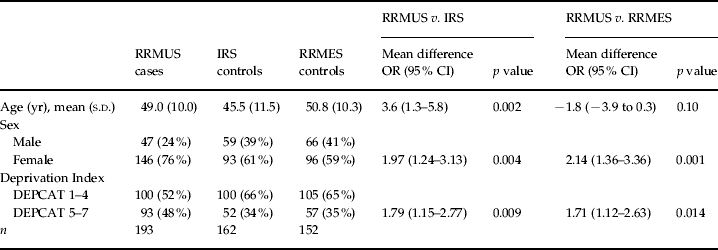
RRMUS, Repeatedly referred with medically unexplained symptoms; IRS, infrequently referred to hospital for symptoms; RRMES, repeatedly referred with medically explained symptoms; OR, odds ratio; CI, confidence intervals.
Ages by t test, other comparisons by logistic regression.
Depression anxiety and panic
Almost half (93; 48%) of the RRMUS cases met our criteria for one or more of depressive, anxiety and panic disorders. This compared with 38 (25%) of the IRS patients and 52 (35%) of the RRMES patients: OR (95% CI) 2.6 (1.6–4.1) and 1.6 (1.01–2.4), respectively. Current depression, anxiety and panic were all more common in the RRMUS cases than in the IRS controls with unadjusted OR ⩾3.0 (1.8–5.1). They were also more common in the RRMUS cases than the RRMES controls, although for depression of any severity the difference was non-significant (p=0.10). Adjustment for age, sex and deprivation made only minor changes to the OR of these associations. Tables 2 and 3 present these results in detail.
Comparison of depression, anxiety and panic between RRMUS cases and IRS controls
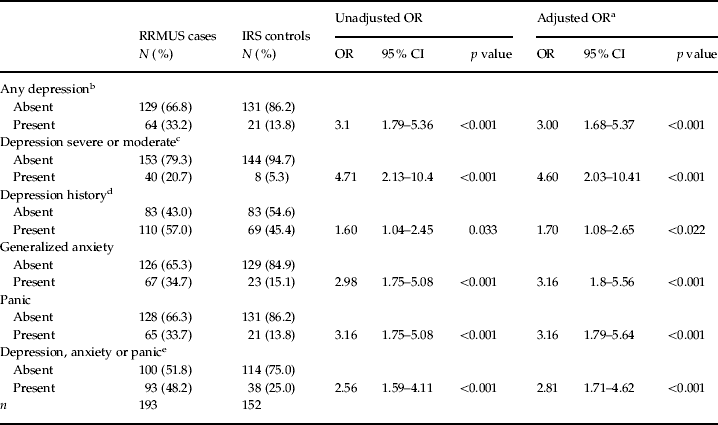
RRMUS, Repeatedly referred with medically unexplained symptoms; IRS, infrequently referred for symptoms; OR, odds ratio; CI, confidence intervals.
a Adjusted for age, sex and deprivation.
b Patient Health Questionnaire (PHQ)-9 score of ⩾10.
c PHQ-9 of ⩾15.
d Self reported depression for ⩾2 weeks in the last 5 years.
e At least one of current depression, anxiety or panic.
Comparison of depression, anxiety and panic between RRMUS cases and RRMES controls
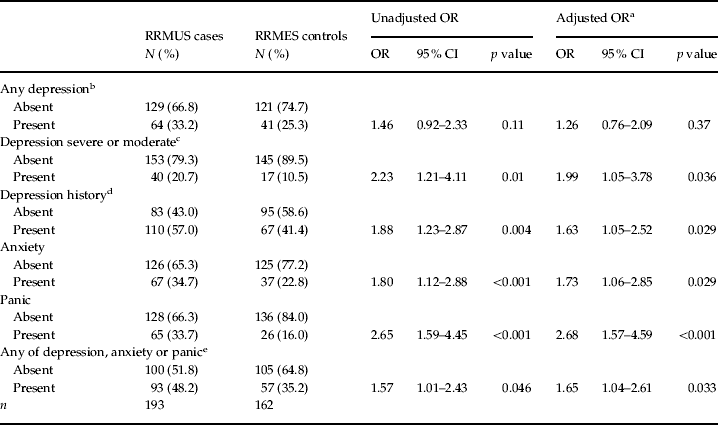
RRMUS, Repeatedly referred with medically unexplained symptoms; RRMES, repeatedly referred with medically explained symptoms; OR, odds ratio; CI, confidence intervals.
a Adjusted for age, sex and deprivation.
b Patient Health Questionnaire (PHQ)-9 score of ⩾10.
c PHQ-9 of ⩾15.
d Self reported depression for ⩾2 weeks in the last 5 years.
e At least one of current depression, anxiety or panic.
RRMUS cases were more likely than IR or RRMES controls to have two or more of depression, anxiety and panic disorders, as shown in Fig. 1. The OR (95% CI) were 3.74 (1.95–6.54), p<0.0001 and 1.95 (1.16–3.29) p=0.02, respectively.
Overlap of depression, anxiety and panic: (a) repeated referred patients with medically unexplained symptoms. A total of 93 patients met criteria for one or more condition and 100 patients met no criteria; (b) combined repeated referred patients with medically explained symptoms and patients infrequently referred to hospital for symptoms (IRS group). A total of 95 patients met criteria for one or more condition and 219 met no criteria. Groups are shown as combined because of the small numbers of patients in the IRS group meeting criteria for any of these disorders.

Adequacy of treatment
Only about half (52; 56%) of the 93 RRMUS patients identified as having depression, anxiety or panic had received at least a minimum effective recent intervention for this disorder. Of the 52 patients who had received such treatment, 50 had recent antidepressants and 11 had received two or more recent contacts with a mental health professional. An additional eight RRMUS cases had received an adequate dose of antidepressant at some time during the preceding 5 years and a further 14 had been prescribed an antidepressant at a dose below our adequate treatment threshold.
Among RRMUS cases with depression, anxiety or panic there was no association of adequate treatment with age, sex or social deprivation. However, patients with moderate to severe depression (PHQ-9 ⩾15) were more likely to have had adequate treatment than those with milder depression, anxiety or panic: 31/40 v. 21/53, OR 4.73 (1.8–12.3).
Discussion
We found that the prevalence of depression, anxiety and panic was high in patients with RRMUS. It was also higher than in either control group, supporting our initial hypothesis and suggesting a specific association. Furthermore, adjusting for the possible confounders of age, sex and social deprivation had little influence on these findings. This suggests that depression, anxiety and panic may be of importance in determining the phenomenon of repeated referrals to specialists with MUS.
The further observation that almost half the RRMUS patients with current depression, anxiety or panic had not received even minimal effective treatment with antidepressant drugs or minimal psychological treatment highlights the potential benefits of treating these disorders more effectively.
Strengths and weaknesses
This study had a number of strengths. It was based on samples relevant to primary care, which is where the problem of referral needs to be addressed, and it included a representative sample of primary care practices with a range of sociodemographic characteristics. Cases and controls were identified using similar methods based on computerized NHS activity data, which have been previously validated (Hole et al. Reference Hole, Clarke, Hawthorne and Murdoch1981). The diagnosis of MUS was likely to be valid as it had been made by specialists, often after investigation, and our categorization of referral episodes into medically unexplained and medically explained was done using explicit operational criteria. The response rate to the postal questionnaire was also adequate (approximately 70%) for the generation of valid findings.
There were also some weaknesses. The practices studied were inevitably those that were willing to participate, they lay within only one UK city and, consequently, may not be typical of all primary care. We had to use arbitrary criteria to define cases as there are no standardized definitions in widespread use. Other studies have used various different criteria to define high users of services (Katon et al. Reference Katon, von Korff, Lin, Lipscomb, Russo, Wagner and Polk1990; Reid et al. Reference Reid, Wessely, Crayford and Hotopf2001; Smith et al. Reference Smith, Korban, Kanj, Haddad, Lyles, Lein, Gardiner, Hodges, Dwamena, Coffey and Collins2004; Barsky et al. Reference Barsky, Orav and Bates2006). Our classification of referral episodes as medically unexplained or explained was based only on the information in the specialist letters to the general practitioners, which might not always include the results of all investigations.
As this was a study of referrals, even our most healthy control group (IRS) was not a healthy population sample, as evidenced by the prevalence of depression and anxiety. All IRS patients had been referred to a specialist once within the previous year and in approximately one third of cases that referral resulted in a diagnosis of MUS. We would therefore expect even bigger differences between RRMUS and a healthy population sample.
Case-control studies need to be treated with caution as uncontrolled biases and unknown confounders may lead to misleading findings. Neither can case-control studies demonstrate a causal relationship. We can at best conclude that there is an association between these psychiatric disorders and RRMUS. It is possible that this association is not relevant to either producing MUS or driving referral. It is even possible that reverse causation is operating, whereby repeated referrals and diagnoses of MUS lead to depression and anxiety. Whilst we believe that the available evidence makes it most likely that under-treated depression and anxiety do play a causal role in RRMUS, this hypothesis required further exploration, including studies that observe the effect of intervention.
In this study, depressive, anxiety and panic disorders were assessed using questionnaires rather than clinical interviews and our assessment may therefore not always have been valid. However, we are reassured by the fact that these measures, particularly the PHQ-9, have been extensively validated in primary care populations, including patients with chronic illness. Because of delays in the coding of activity data by ISD, we were only able to send questionnaires to patients ⩾1 year after the end of the period in which their referrals had taken place. It is therefore possible that the mental state of respondents at the time of referral may have been different from that at the time of the survey. Indeed, the higher rate of previous depression found suggests that in some cases these disorders may have been present at the time of referral but had subsequently resolved.
We set a very low threshold to determine adequacy of treatment for depression, anxiety and panic. We required only the minimum effective dose of each drug as that stated in the British National Formulary and were unable to accurately record the duration of treatment, which is also important to its efficacy (Hunot et al. Reference Hunot, Horne, Leese and Churchill2007). While antidepressant treatment is of greater value than usual care alone in the primary care treatment of depression, the benefits are modest (Kendrick et al. Reference Kendrick, Chatwin, Dowrick, Tylee, Morriss, Peveler, Leese, McCrone, Harris, Moore, Byng, Brown, Barthel, Mander, Ring, Kelly, Wallace, Gabbay, Craig and Mann2009) and it is currently not known whether more intensive primary care treatment would be effective in this group, either in improving depression and anxiety or in reducing referrals. Our requirement for a psychological intervention was also low and defined as two contacts with a mental health professional. Given that health anxiety is likely to increase the pressure on the general practitioner to refer for further opinions and tests, the small number of patients receiving an appropriate number of sessions of psychological treatment, such as cognitive behavioural therapy, is particularly striking. It could be argued that to be effective in treating the disorders identified, the interventions need to be far more intensive than these minimal requirements. However, the application of more stringent criteria for minimal treatment would greatly reduce the number of patients whom we judged to have had adequate treatment. It is also possible that general practitioners had recognized depressive and anxiety symptoms in these patients but chosen not to treat them – perhaps preferring to normalize them in order to avoid medicalization of distress. Further study of the detail of consultations and general practitioners' strategies of management might shed light on this question.
Relationship to other studies
While previous studies have found an increased prevalence of depression, anxiety and panic in patients with MUS (de Waal et al. Reference de Waal, Arnold, Eekhof and van Hemert2004; Lowe et al. Reference Lowe, Spitzer, Williams, Mussell, Schellberg and Kroenke2008 b), we are unaware of any that have studied depression, anxiety and panic in primary care patients who had been repeatedly referred to hospital for MUS. A hospital-based study of frequent attenders (Reid et al. Reference Reid, Crayford, Patel, Wessely and Hotopf2003) yielded findings consistent with ours. The investigators identified 73 patients who had repeated attendance at hospital clinics with MUS. A total of 45 of these patients completed a diagnostic interview and 33 (69%) were found to have depression or anxiety disorders. In the preceding 6 months only five of these patients (10%) had seen a practice-based counsellor and only eight (17%) a mental health professional; the authors did not report on antidepressant use.
Implications for practice and further research
Our findings suggest first that practitioners in both primary and secondary care should seek to identify those patients who have been repeatedly referred to specialists and who had received multiple diagnoses of MUS. Our experience in this study confirms that this does not currently happen; general practitioners were often unaware of the referral history of their RRMUS patients. Second, these patients should be specifically assessed for depression, anxiety and panic disorders and, if found, these disorders should be vigorously treated, either with existing treatments or through the development of new interventions to maximize access to and acceptability of psychological treatment.
Conclusions
Patients repeatedly referred to hospital with symptoms that specialists assess as medically unexplained have a high prevalence of depression, anxiety and panic disorders. They also have a higher prevalence of more severe depression and of panic than patients who have been referred as often, but for symptoms deemed to be medically explained. Furthermore, many of these patients do not receive minimum effective treatment from their general practitioners for these psychiatric disorders. We propose that there is now a need to develop and test approaches to improve both the recognition and treatment of depression, anxiety and panic in these patients. Such approaches to management have the potential to improve the outcome for these patients whilst also reducing unnecessary repeated medical assessment and reducing service costs.
Appendix 1. Operationalized criteria for medically unexplained symptoms (MUS)
Referrals for complaints fall into several categories and only referrals for symptoms are included.
The core of the operationalized criteria
(1) The patient is referred with a symptom, the cause of which is not known.
(2) How explained the symptom is, based on the specialist's opinion.
Determining MUS from case notes
The following criteria will be applied to each consultation episode:
(1) The patient presents with subjective physical symptoms.
(2) A history is taken.
(3) The specialist completes all planned investigations and sends a letter to the general practitioner.
MUS is the diagnosis when there is an absence of evidence that a defined organic disease caused the symptom. This is possible when:
(1) The final diagnosis suggests doubt surrounding the cause of the symptoms.
(2) The final diagnosis is a recognized medically unexplained (functional) syndrome.
(3) The investigations performed were normal or, if abnormal, were felt by the specialist to be an incidental finding or unlikely to account for the severity of the presenting symptom.
In all cases, the underlying opinion of the specialist should be interpreted from the case notes and we should not attempt to second-guess this opinion.
Acknowledgements
We wish to thank the staff of ISD for their collaboration and the practices and patients who took part in this study. This work was supported by the Chief Scientist Office of the Scottish Government Health Directorate (CZH/4/37); the funder had no involvement in the conduct or reporting of the study.
Declaration of Interest
None.



