INTRODUCTION
The degree to which courts protect constitutional rights in practice depends on the willingness of individuals to take action when their rights are threatened or violated. In these instances, we may expect citizens to be the first to act. Citizens might choose any number of venues and tactics to seek justice, including going to court. Much of the literature about rights litigation examines the conditions under which citizens bring grievances before the court (for example, Epp Reference Epp1998; Wilson and Rodriguez Cordero Reference Wilson and Cordero2006; Javeline and Baird Reference Javeline and Vanessa2007; Wilson Reference Wilson2009; Sanchez Urribarri et al. Reference Sanchez, Raul, Susanne, Randazzo and Songer2011). In Tanzania, however, citizens rarely raise constitutional rights claims in court. Although Tanzanians are not averse to litigating, they rarely make legal arguments that involve their constitutional rights, even when those rights might have been a valid basis for their case. In doing so, litigants reduce the number of potential pathways to winning their case and bypass a fundamental tool that exists to guarantee the most basic legal protections. Why do we observe this pattern of low rates of rights litigation in Tanzania?
While rights litigation occurs infrequently in many countries, the Tanzanian case presents an interesting opportunity for study due to historical developments that would seem to encourage a robust rights litigation practice. The period of this study (1994–2016) followed the proliferation of civil and human rights protection in Tanzania, both in law and in political discourse (Widner Reference Widner2001). Tanzania amended its constitution to include a Bill of Rights in 1984—which judges at the highest levels of the judiciary sought to institutionalize throughout the late 1980s and early 1990s (Ellett Reference Ellett2013)—and became a multi-party democracy in 1992. We might expect that these significant changes could have enabled and empowered citizens to use the courts to uphold their newly codified rights.
To explain why we observe such low rates of rights litigation despite these developments, the study first makes an important distinction about the actors to which we can attribute patterns in legal argumentation. Much of the literature about litigation views citizens as primary legal actors (Epp Reference Epp1998; Wilson and Rodriguez Cordero Reference Wilson and Cordero2006; Javeline and Baird Reference Javeline and Vanessa2007; Wilson Reference Wilson2009). Yet, as the same literature also tells us, such citizen-directed litigation and the conditions that allow it to occur do not always materialize. Even when they do, citizens in many countries must rely on lawyers if they are to litigate due to citizens’ lack of legal expertise and sufficiently accessible legal institutions, as I later show. It follows that, in contexts where lawyers serve as primary decision makers, one must examine the factors that affect lawyers’ choices about the cases that citizens bring to them. Importantly, this examination involves distinguishing between two separate decisions: the decision to litigate and the choice of the legal argument they will use to bring such litigation. The latter is often chosen by, or at least with the help of, a lawyer. This study thus examines the factors that affect lawyers’ decisions about the construction of their cases, which I argue ultimately determine the frequency of rights litigation in Tanzania.
I argue here that, to explain patterns in rights-based litigation, we must turn from traditional litigant-centered explanations of litigation to examine lawyers’ complex and dynamic role in legal proceedings. In Tanzania, lawyers’ attitudes and preferences determine the types of legal arguments advanced in court. Three factors shape lawyers’ disposition toward rights-based legal arguments and processes. First, the brevity of legal training leaves few lawyers equipped to use rights-based arguments in court. Second, the rules that govern the use of rights arguments cause lawyers to hesitate before using them. Third, a perceived lack of judicial receptivity to rights-based arguments leads lawyers to believe that such arguments are unreliable. Over time, lawyers’ behavior continues to be shaped by these institutions and reinforced by the habits and practice of other lawyers to generate and perpetuate low rates of rights-based litigation.
This study draws on, and seeks to contribute to, the growing literature on litigation. The majority of this scholarship presents litigants as primary determinants of legal mobilization (Galanter Reference Galanter1974; Felstiner, Abel, and Sarat Reference Felstiner, Abel and Austin1980; Javeline Reference Javeline2003; Brinks and Gauri Reference Brinks and Gauri2014), citing factors such as the perceived costs and benefits of litigating (Javeline and Baird Reference Javeline and Vanessa2007), the importance of “support structures” (Epp Reference Epp1998), the reduction of institutional barriers to going to court (Wilson and Rodriguez Cordero Reference Wilson and Cordero2006; Wilson Reference Wilson2009), and the presence of supportive judges (Sanchez Urribarri et al. Reference Sanchez, Raul, Susanne, Randazzo and Songer2011). However, in many countries, even those widely recognized as litigious—for example, the United States, Canada, and the United Kingdom (Epp Reference Epp1998)—we expect that most litigants require a lawyer to navigate legal systems’ complex processes. While scholars acknowledge that lawyers play this enabling role in litigation, litigants remain the central focus of these theories.
I also look to literature about lawyers, which I categorize into two types. The first set of literature focuses on factors that motivate lawyers, including what leads them to take on certain cases (Nelson Reference Nelson1988; Kritzer Reference Kritzer2004; Michelson Reference Michelson2006) and what affects their likelihood of success (Wheeler et al. Reference Wheeler, Bliss, Kagan and Friedman1987; Sheehan, Mishler, and Songer Reference Sheehan, William and Songer1992; McGuire Reference McGuire1995; Haire, Lindquist, and Hartley Reference Haire, Lindquist and Hartley1999). While theories about lawyer behavior and factors that determine lawyer success help us understand what motivates lawyers in their careers, they do not link these factors to lawyers’ decisions about particular cases and are thus too broad to explain the phenomenon in question here. Second, I examine literature on the lawyer-client relationship, including power dynamics within lawyer-client pairs (Cain Reference Cain, Dingwall and Lewis1983; Felstiner and Sarat Reference Felstiner and Sarat1992; Liu Reference Liu2006). Such theories bring us closer to understanding lawyers’ day-to-day interactions with clients, but again fail to give adequate attention to these interactions’ effects (if any) on decisions about how to argue legal cases.
This study bridges a gap between these two bodies of literature: scholarship that focuses on citizens as primary actors and studies of lawyers’ behavior that somewhat overlooks their role in argument formation. As I later show, to explain the low rights litigation rates in Tanzania, we must place lawyers’ strategic decisions at the center of our analysis. The new focus on lawyers that I suggest may also help to illuminate insights about litigation patterns in other jurisdictions, since a lack of legal knowledge is common among citizens in many countries. Separately, there is relatively little research on the role of courts and lawyers in African countries. This study thus helps us begin to understand the degree to which theories of litigation might be applicable outside of the geographic and cultural contexts in which they were developed. Further exploration of understudied legal settings may show additional limitations of existing theories and allow for the production of new theories.
I proceed first by offering background on the historical development of Tanzanian political and legal institutions. Second, I outline the most relevant theories and debates about the factors that influence patterns of litigation. Next, I use an original dataset of 252 Tanzanian Court of Appeal decisions between 1994 and 2016 to summarize trends in legal arguments used before the court. I then develop the study’s central argument using evidence from legal education curricula, relevant laws and regulations, and the views and experiences of twenty-one lawyers and legal experts whom I interviewed for the study. Last, I consider the significance of the research, which lies in its focus on the critical role that lawyers play in determining the degree to which citizens’ rights are recognized and protected by courts, and suggest further lines of inquiry.
LEGAL SYSTEM DEVELOPMENT: THE PARTY, THE LAW, AND THE COURTS
This article examines litigation in the period following several major changes in the Tanzanian government’s structure and legal framework. It is thus important to understand both the legal and political history that shaped the country’s modern institutions and the legal and institutional context during the years on which this study focuses.
Post-Independence
Tanzania gained independence from Great Britain in 1961 and adopted its first constitution the same year, which outlined a form of government based on the British parliamentary system. The Constitution, which did not have a bill of rights, was rewritten a year later to formally establish a one-party state and gave the president, Julius Nyerere, sweeping powers (ConstitutionNet 2020).Footnote 1 This government structure aligned with Nyerere’s vision for the country (Ellett Reference Ellett2013, 43); Nyerere pioneered an ideology known as ujamaa, a unique form of socialism rooted in the values of familyhood and developmentalism (Shivji Reference Shivji1995, 161). To develop economically and socially, Nyerere believed, features of democracy—such as individual rights, electoral competition, and the separation of powers—must be forgone (Widner Reference Widner2001; Ellett Reference Ellett2013). In his view, these institutions could lead to conflict among citizens and between citizens and the government and therefore were impediments to the unifying goal of accelerated development.
Within this one-party structure, the de facto role of the judiciary was to “actively support and uphold government policy” (Ellett Reference Ellett2013, 71). Nyerere maintained a skepticism of the courts as a potential obstacle to the implementation of ujamaa (79). These concerns were not unfounded; while many judges cooperated with Nyerere, others sought to assert the autonomy of the courts by challenging the government. For example, the Court of Appeal—the highest court in Tanzania—used the preamble of the Constitution to declare the 1962 Preventive Detention Act unconstitutional (71).Footnote 2 The court stated that the legislation, which authorized the president to unilaterally detain any person indefinitely and without trial, contravened commitments to international human rights and the principle of equality before the law stated in the preamble (71). To prevent further attempts by the court to assert independence, the executive branch exerted “moral and emotional pressure” on judges, characterizing decisions against the government as a “betrayal of the nation” (Yongolo Reference Yongolo2000, 106).
This type of rhetoric used to influence the courts also played a role in the construction of a national narrative that is still dominant today (Ellett Reference Ellett2013; Fouéré Reference Fouéré2014). Although Tanzania has since embraced a capitalist economy and a multiparty political system, the country maintains a political and moral value system derived from aspects of Nyerere’s ideology, including developmentalism, nationalism, and the precedence of the community over the individual (Ellett Reference Ellett2013, 72; Fouéré Reference Fouéré2014). This system has led to the widespread belief among Tanzanians that “to criticize the government is to be unpatriotic or disloyal” (Ellett Reference Ellett2013, 72). It is important to consider trends in litigation against this backdrop, especially since rights claims can constitute direct challenges to the government.
Liberalization
Following Nyerere’s departure from office in 1985, with the country’s dire economic state making it clear that his policies had failed to lift Tanzania out of poverty, ujamaa was abandoned in favor of liberal market structures. The perception among party leaders that the failure of the socialist economy weakened their political control afforded judges the opportunity to renegotiate the judiciary’s relationship to the other branches of government (Widner Reference Widner2001, 151). Judges, lawyers, and legal scholars advocated for the creation of a Bill of Rights, which was added to the constitution in 1984 and made justiciable in 1987 (Peter Reference Peter1990).Footnote 3 In 1991, the government determined that the addition of the Bill of Rights and the liberalization of the economy required a multiparty system, which it formalized in the 1992 Political Parties Act (ConstitutionNet 2020).Footnote 4 This shift furthered the courts’ transformation from a part of the ruling party apparatus to an arbiter of justice that could be relevant and useful to citizens (Widner Reference Widner2001).
Judges sought to uphold these formal changes in their practice as well. In several high-profile cases in the late 1980s and early 1990s, the High Court decided against the government, striking down multiple laws as unconstitutional on the grounds that they violated citizens’ fundamental rights (Ellett Reference Ellett2013, 90–93). The judiciary also sponsored initiatives to improve its accessibility and educate citizens about their rights (Widner Reference Widner2001). In doing so, judges sought to offer citizens recognizable means to enforce their rights in court for the first time. However, the ruling party attempted to thwart these judicial initiatives. Even in the multiparty era (and still to date), Nyerere’s party, Chama Cha Mapinduzi (CCM) retained control of the executive and legislature and routinely sidelined political opposition (Ellett Reference Ellett2013, 87). The government sought to weaken the judiciary by passing legislation that limited the courts’ powers (Widner Reference Widner2001, 173) and refusing to comply with court rulings (Ellett Reference Ellett2013, 95). Political leaders also continued to use the rhetoric of developmentalism from the one-party era to deter challenges from the judiciary by suggesting that, in decisions that did not favor the government, the courts acted as an obstacle to development and progress (135).
This study focuses on the period between 1994 and 2016. Thus, it examines litigation on the heels of two contrasting sets of developments. On the one hand, the democratization of the electoral system and addition of the justiciable Bill of Rights ushered in an era during which citizens had greater access than ever before to a system of laws that protected their rights and a court system that had shown some appetite to uphold them. On the other hand, CCM maintained political dominance through extralegal means and by portraying challenges to government power as unpatriotic. Lawyers who are considering pursuing rights litigation must confront these contradictory dynamics. In the section that follows, I consider relevant theories about the factors that might shape lawyers’ choices under such conditions and influence patterns of litigation more generally.
EXPLAINING CAUSES OF LITIGATION
This section examines theories that seek to explain patterns of litigation and the selection of legal arguments. It begins by discussing scholarship about factors that may encourage or discourage individuals from litigating. However, an individual’s decision to litigate may be distinct from decisions about the legal argument that they will use to argue their case; the latter is often chosen in consultation with, or entirely by, a lawyer. The second part of the section focuses on theories that seek to account for lawyers’ strategic choices and interactions with their clients.
Litigant-Centered Explanations
Scholars agree that accessible institutions alone are not enough to incentivize litigation, but emphasize the importance of different factors in shaping often-complex patterns of litigation. Charles Epp (Reference Epp1998) asserts that legal mobilization depends on the availability of various resources (“support structures”) such as rights-advocacy lawyers, organizations, sources of financing, and government rights-enforcement agencies. If such support structures are present, in conjunction with judicial receptivity, they can promote a cycle of rights-based litigation, which Epp calls a “rights revolution.” Raul Sanchez Urribarri and colleagues (Reference Sanchez, Raul, Susanne, Randazzo and Songer2011) find that the presence of institutional structures—such as docket control and constitutional or statutory rights protection clauses—and judicial ideology play a significant role in determining trends in rights litigation before high courts. Similarly, other scholars foreground the presence of legal opportunity structures: when the cost of accessing the court is sufficiently low, when standing is sufficiently broad, and when certain legal instruments that enable litigation are present (Hilson Reference Hilson2002; Stone Sweet 2002; Wilson and Rodriguez Cordero Reference Wilson and Cordero2006; Wilson Reference Wilson2009; Hilbink and Ingram Reference Hilbink and Ingram2019).
According to this view, structural judicial independence and the existence of justiciable constitutional rights allow and encourage citizens to interpret grievances as rights violations and bring them before a court that is free to hear such complaints. This literature is informative insofar as it suggests several factors that may or may not prove influential when applied to lawyers rather than litigants. While the literature falls short of exploring the potential causal connections between institutional structures and lawyers’ quotidian choices about their cases, we can imagine that such linkages exist. In the sections that follow, I argue that considerations related to institutional features, among other factors, weigh heavily on lawyers’ decisions about whether to adopt right arguments on behalf of their clients.
Other scholars emphasize that litigant preferences are a key factor in explaining litigation patterns. They consider how individuals weigh a variety of factors and potential outcomes, on the basis of which they choose whether to litigate. In this line of reasoning, litigation occurs when an individual or party ascribes a grievance to an entity and demands remedy (Felstiner, Abel, and Sarat Reference Felstiner, Abel and Austin1980; Javeline Reference Javeline2003). From this baseline, an individual weighs advantages and disadvantages of going to court in a complex cost-benefit analysis (Zemans Reference Zemans1982; Priest and Klein Reference Priest and Klein1984; Javeline and Baird Reference Javeline and Vanessa2007). Scholars point to a variety of factors that potential litigants may consider, including the benefits of a win in court vis-à-vis the costs of legal representation, getting to court, and potentially losing (Zemans Reference Zemans1982). Among these scholars, a notable subset posits that individuals’ likelihood of winning a potential court case is among the factors at the forefront of their calculation (Galanter Reference Galanter1974; Brinks and Gauri Reference Brinks and Gauri2014). Others focus on the importance of judicial receptivity to litigation on particular issues (Hilson Reference Hilson2002; Andersen Reference Andersen2005; Vanhala Reference Vanhala2012; Hilbink and Ingram Reference Hilbink and Ingram2019). Still other strands of the literature suggest that factors external to the case can play an important role in an individual’s decision to litigate, such as the perceived social consequences of litigation (Morgan Reference Morgan1999; West Reference West1999; Javeline and Baird Reference Javeline and Vanessa2007).
While it is helpful to understand individuals’ considerations around whether to litigate, the factors that lead an aggrieved person to litigate are not necessarily the same as the factors that influence what legal arguments they make when they do bring a case. While factors such as economic and social costs may weigh into individuals’ calculations about both decisions, the choice to litigate and the subsequent choice of legal argument may be two different decisions. Although an individual considering litigation necessarily conceives of their problem as a legal one, it does not necessarily follow that they have an idea of the law or laws that were violated in their case. Moreover, even if they have such an idea, these inclinations may not translate into the arguments they ultimately make in court. These distinctions are central to my study. As I later show, Tanzanian citizens tend to have little specific knowledge of their rights, the law, or the justice system and depend almost entirely on lawyers to construct their case. The next section considers the theories about lawyers’ motivation and the factors that affect their behavior.
Lawyer Motivation
While the theories in the previous section offer a variety of explanations for the initial choice to litigate, they do not account for the many decisions that happen after this point, often in consultation with a lawyer. Since most individuals lack the legal knowledge to navigate litigation, they often rely on a lawyer to guide and even direct them. Given lawyers’ expertise and experience, it stands to reason that lawyers have some degree of influence or—in some cases—are entirely responsible for decisions made in the course of a client’s case, including those concerning the argument they pursue. This section considers literature on lawyers, specifically factors that might influence their practices and motivate their choices.
Some studies investigate the factors that motivate lawyers’ decisions to accept or reject potential cases or clients. For example, survey research indicates that American lawyers are more likely to take on cases that fall within their area of expertise and present adequate fee potential (Kritzer Reference Kritzer2004, 84–85). Conversely, lawyers in a variety of contexts are likely to reject cases that lack legal merit (Kritzer Reference Kritzer2004; Michelson Reference Michelson2006) or that violate their personal values or professional ethics (Nelson Reference Nelson1988, 255–56). However, this literature tends to focus on the initial decision to work with a client and does not offer links between these influencing factors and lawyers’ choices about a case from that point forward.
Separately, a substantial body of literature seeks to explain lawyers’ success, which is defined as winning a particular case. Scholars posit various explanations for lawyers’ success, many of which focus exclusively on the American context. Among commonly cited factors to explain lawyers’ success are their level of experience (McGuire and Caldeira Reference McGuire and Caldeira1993; Flemming and Krutz Reference Flemming and Krutz2002; Szmer, Johnson, and Sarver Reference Szmer, Johnson and Sarver2007) and their capability, which is determined by their level of experience, their specializations in particular areas of the law, and the size of their legal team (Kritzer Reference Kritzer1998; Haire, Lindquist, and Hartley Reference Haire, Lindquist and Hartley1999). Judges are more likely to trust experienced lawyers and consequently are more likely to agree with their arguments. These theories are helpful in explaining judges’ behavior in response to certain lawyer characteristics. It also raises questions about whether and how factors related to lawyers’ success also affect lawyers’ choices. For example, we might hypothesize that experienced lawyers have gleaned from their previous successes and failures what behaviors, approaches, or legal arguments are more often successful.
The studies considered until this point suggest that the factors that motivate lawyers’ actions and judges’ responses to them do not appear to vary greatly over time or across legal issues. However, other literature suggests that lawyers’ strategy and orientation may shift over time in response to the characteristics or demands of their clients (Fu and Cullen Reference Fu and Richard2011; Gonzáles-Ocantos 2016). These findings may be particularly relevant in jurisdictions where the political and legal environment in which the lawyers operate is rapidly changing, as in several postcolonial African countries, including Tanzania. Scholarship about African countries suggests that lawyers’ choices about whether to litigate and on which legal issues to do so may be motivated by the executive’s—rather than judges’—reactions. For example, under Daniel Arap Moi’s regime, Kenyan lawyers faced severe consequences—including imprisonment—for opposing the government by agitating for civil rights (Ross Reference Ross1992). As Fauz Twaib (Reference Twaib1997, 95) implies, although not as drastic as the Kenyan case, Nyerere’s public skepticism of judges and the courts in Tanzania may have discouraged lawyers from acting, or appearing to act, in opposition to the government. These studies offer insights into the pressures that lawyers in the region have faced, at least during periods of autocracy in both countries. However, in the Tanzanian case, there is no evidence linking Nyerere’s views to lawyers’ decisions about what cases to take on or about the construction of legal argument in the cases they did take on.
A larger body of work examines the executive influence on judicial decision making. For example, Peter Vondoepp and Rachel Ellett (Reference Ellett2011) argue that, in many African countries, political leaders have strong incentives to manipulate and interfere with the courts. Likewise, Mariana Llanos and colleagues (Reference Llanos, Weber, Charlotte and Alexander2016) find that, in several African countries, interference occurs informally through bribes, threats of violence, or informal communication. These findings are thus relevant to the extent that lawyers’ perceptions of judicial characteristics affect the arguments they make before courts. We could infer from work on judicial decision making in Africa that lawyers might behave more cautiously for fear that retaliation against the courts in the form of executive interference or intimidation may extend to them. However, the work examined here does not make this causal link, and the respondents for this study did not either, as I explain in later sections.
In sum, extant research on lawyers suggest that a variety of factors may influence their work. However, no research specifically explains lawyers’ day-to-day choices about their cases, including their choice of legal argument. The next section thus considers literature on lawyer-client relationships and the effects of the dynamics in these relationships on their cases.
The Lawyer-Client Relationship
Do clients—their experiences, emotions, and desired outcomes—affect lawyers’ decision making? Some scholars suggest that clients have some degree of power to influence their lawyers. For example, in their examination of lawyer-client relationships in divorce cases, William Felstiner and Austin Sarat (Reference Felstiner and Sarat1992) find that power is fluid and that lawyers and clients each have some control. Even Maureen Cain (Reference Cain, Dingwall and Lewis1983), who asserts that lawyers retain the important power of translating their clients’ grievances into the language of law, still acknowledges that clients have some degree of control over the narrative presented to the court.
Other theories emphasize the power of lawyers relative to their clients, who lack lawyers’ skills and knowledge and are therefore subordinate. Scholars disagree on how and when lawyers assert their control over clients; some argue that the dominance is overt (Johnson Reference Johnson1972), while others maintain that it occurs more subtly (Bankowski and Mungham Reference Bankowski and Geoff1976; Scheingold Reference Scheingold2004). According to the latter theories, lawyers use “the language of the law … to coerce the experiences and life situations of their clients to fit” this language (Cain Reference Cain, Dingwall and Lewis1983, 85). Evidence from corporate law firms in China corroborates this theory in some contexts. Sida Liu (Reference Liu2006) finds that partners at corporate law firms almost never change their behavior in response to the varied demands of different types of clients, although less experienced lawyers sometimes do. This finding suggests that, at least in some cases, lawyers’ strategies are unaffected by their clients and their demands. Importantly, none of these theories, whether they affirm that clients can influence lawyer behavior or refute it, investigate if or how lawyers adjust their technical choices about cases—including their legal argument—based on the characteristics of their client. Thus, it remains unclear whether, and under what circumstances, clients play a role in the selection of a legal argument.
In short, scholars have developed a range of explanations to explain patterns of litigation. Some focus on factors that affect citizens’ choices and dispositions in relation to the law and legal system. Others evaluate factors that affect lawyers’ motivations and choices since lawyers often play a significant role in determining their clients’ course of action. However, as the following sections will highlight, none of these factors adequately explain rights-based litigation in Tanzania. In Tanzania, like in many places, lawyers act as the primary decision makers in their clients’ cases due to citizens’ common lack of legal knowledge. The literature discussed here offers explanations of several aspects of lawyers’ behavior, but it does not adequately address how lawyers make choices related to legal argumentation. I offer a theory of legal argumentation in which lawyers’ choices are shaped by their education, context, and perceived risks to their success.
TANZANIAN LEGAL FRAMEWORK AND STUDY DATASET
Before considering patterns in Tanzanian litigation and the theory that I argue explains them, it is important to understand the country’s legal and institutional framework during the years on which this study focuses. Next, I describe and draw insights from an original dataset to summarize trends in legal arguments used before the court.
The Constitution and Court System Structure
Tanzania adopted its current Constitution in 1977 to formally recognize the merger of mainland Tanzania’s ruling party, the Tanganyika African National Union, and its Zanzibari ideological counterpart, the Afro-Shirazi Party to form CCM. While it retains much of its original content, the Constitution has been amended several times, including with the addition of the Bill of Rights in 1984. The Constitution guarantees citizens the power to sue the government, commercial entities, and other citizens on the basis of constitutional rights.Footnote 5 This guarantee widens the range of situations in which rights-based arguments may be used—for example, in cases where both parties are citizens. As a result, constitutional rights are—at least, in theory—equally applicable in criminal and civil cases. For example, the lawyers that I interviewed explained that, depending on the facts of the case, petitioners in criminal appeals could argue that their right to life, personal freedom, or personal security had been violated and that such an argument would be viewed as legitimate among lawyers and legal experts.Footnote 6
The Constitution outlines a judicial hierarchy with the Court of Appeal at the apex. The high courts, district courts, resident magistrate courts, and primary courts occupy lower tiers of the judicial system. The Constitution gives the Court of Appeal the power to decide cases appealed from any of the country’s high courts, which have original jurisdiction over constitutional cases and electoral petitions. The high courts can also hear civil and criminal appeals from any of the country’s lower courts (Nyanduga and Manning Reference Nyanduga and Christabel2006). The country’s thirty regions are divided among fifteen High Court zones. In an effort to improve the Court of Appeal’s accessibility, the justices of the Court of Appeal move around the country throughout the year, holding sessions at eleven of the fifteen High Court facilities.
This study focuses on litigation at the Court of Appeal due to its position as the most powerful court in Tanzania and its ability to hear all rights cases. Moreover, the Court of Appeal’s decisions set precedent for all lower courts (Peter and Bisimba Reference Peter and Bisimba2007). Thus, litigation at the Court of Appeal is especially meaningful as it may affect patterns of litigation at the country’s high courts and trends in citizens’ interactions with the legal system more broadly. The Court of Appeal is required to hear all cases filed before it, and, therefore, we can expect that litigation at the Court of Appeal is to some extent representative of litigation across the judiciary.
Sample of Cases and Methodology
The study examines the period after Tanzania’s transition to multiparty democracy and relies on a sample of cases filed between 1994 and 2016, including cases from all eleven of the High Court facilities at which the Court of Appeal holds sessions. Here, I describe this sample and the dataset derived from it, and discuss the most prominent patterns in appellate litigation which I gleaned from this data. The dataset offers evidence that rights litigation is infrequent in Tanzania.
To observe patterns in litigation, the study draws on an original dataset constructed using a sample of Tanzanian Court of Appeal decisions on cases (both civil and criminal) lodged between 1994 and 2016 and obtained directly from the Court of Appeal in Dar es Salaam. The sample consists of a preexisting compilation of court decisions given to me by the Librarian of the Court of Appeal in Dar es Salaam.Footnote 7 The cases that comprise the sample were not preselected for this study and were assembled by the Court of Appeal prior to the initiation of this research. A constitutional law scholar at the University of Dar es Salaam verified the sample and did not identify any apparent systematic bias. While the study’s other respondents did not evaluate the sample specifically, many of their comments about trends in litigation at the Court of Appeal corroborate patterns in the sample. Although these testimonies do not guarantee the sample’s representativeness, they suggest that the cases capture several important trends in litigation at the Court of Appeal.
The dataset developed from this sample includes 252 cases, containing 504 total legal arguments in both criminal and civil cases. Since the study seeks to explain choices in legal arguments by citizens (or lawyers representing citizens), the dataset includes only cases in which the petitioner, the defendant, or both was a citizen or group of citizens. Of the 504 total arguments, 372 arguments were made by, or on behalf of, citizens. Cases are coded dichotomously according to whether the petitioner invoked a justiciable constitutional right included in the Bill of Rights of Tanzania. A case is classified as rights-based if either a citizen petitioner or a citizen defendant used a constitutional right in their argument before the Court of Appeal.
A comparison between the rates at which rights-based and non-rights-based arguments are used is only valid if the non-rights-based arguments could reasonably have been made using a rights-based argument instead. To make this determination, I consider the content of the original dispute and the circumstances in which the case had been decided at a lower court using the text of the opinion and the resulting decision. First, I evaluate whether the substance of the petitioner’s or the defendant’s grievance could be directly linked to a right. Second, in cases in which the petitioner’s or defendant’s grievance did not appear to constitute a rights violation, I evaluate whether the circumstances of the case as initially filed, or the proceedings at the lower court level, could constitute a violation of procedural rights and therefore suggests grounds for a rights-based argument. Cases in this category are those in which the litigant appealed their case over irregularities in their legal proceedings at a lower court. In these cases, the right to a fair trial or the right to equality before the law is reasonably applicable.Footnote 8 A case is categorized as having the possibility of a rights-based argument if either of these criteria is met. The following example of a case coded for the study illustrates this method of classification.
In Msambya v. Attorney General, the petitioner, a ruling party candidate in the 2000 parliamentary election, contested his defeat by an opposition candidate (one of the defendants).Footnote 9 He previously brought the same case to the High Court of Tabora, but having lost the case, he appealed to the Court of Appeal. In both the original case and this appeal, the petitioner argued that his opponent’s campaign tactics exploited tribal differences, including campaign speeches that insulted the petitioner’s tribal heritage. The petitioner argued that this violated the Elections Act.Footnote 10 However, the Court of Appeal found that the law to which the appellant refers does not have any provisions outlawing tribalism in elections. Furthermore, the court stated that no national laws outlaw tribalism in politics. No arguments were made concerning the relevant constitutional rights, which may have helped win the dispute. In particular, the right to equality before the law includes provisions about the illegality of discrimination on the basis of tribe, among other characteristics.Footnote 11 Instead, the case was argued on the basis of law that the court deems irrelevant. As such, this case was classified as one that had the possibility of a rights-based argument since the content of the dispute can be linked to a constitutional right.
Patterns in Rights-Based Arguments
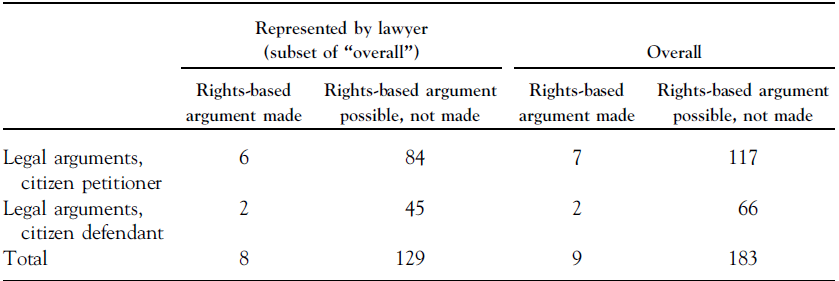
This section uses evidence from the dataset to describe the several prominent patterns in litigation. Summarizing cases in which a rights-based argument could have been made and cases in which a rights-based argument was made yields a total of 192 cases. Yet a rights-based argument was used in only nine cases (or less than 5 percent of those 192 cases) (see Table 1).
Rights-based litigation trends at Court of Appeal

Source: Court of Appeal of Tanzania, 1994–2016.
Two additional aspects of litigation in Tanzania reinforce the peculiarity of this small proportion of rights-based arguments. First, consider the comparison between the frequency with which rights-based arguments are made at the Court of Appeal and the frequency of litigation against the government at that same court. We might expect that litigation against the government would occur infrequently in Tanzania, given the dominance of the ruling party and the long-standing and widespread perception that those who oppose the government are acting as obstacles to development (Ellett Reference Ellett2013). Yet, according to the dataset from the Court of Appeal, litigation against the government occurs roughly six times more frequently than rights-based litigation. This comparison further illustrates the extent to which rights-based litigation is rare in Tanzania and, in turn, the puzzling nature of the phenomenon.
Second, the majority of litigants in the overall dataset (267 of 372 or 72 percent) were represented by lawyers. This finding indicates that even litigants with legal counsel were not necessarily inclined to make rights-based arguments. As I explain in the next sections, given that Tanzanian lawyers tend to manage most aspects of their clients’ cases, this finding suggests that it is lawyers, rather than litigants, who are averse to rights-based arguments. It also negates any suggestion that most litigants refrain from using rights-based arguments because they lack access to a lawyer who would be able to make such an argument more effectively. The rest of this article explains how, and the extent to which, choices made by lawyers contribute to low levels of rights-based litigation in Tanzania.
FOUNDATIONS FOR PATTERNS OF LITIGATION: LAWYERS AS LEGAL ARCHITECTS
Theories about litigation tend to identify litigants as the primary decision makers regarding legal cases and examine the factors that influence their answers to questions about litigation. However, in cases where a litigant chooses to hire a lawyer, this framework breaks down in relation to choices that follow the initial decision to litigate. As the literature on lawyer-client relationships points out, decision-making power varies and may be fluid but, in many cases, rests in large part with the lawyer. This is true in Tanzania where individuals facing a legal problem often defer to lawyers to interpret their grievance and determine a course of legal action (Interview R7). This section briefly explains why citizens cannot be viewed as the primary determinants of trends in legal argumentation, while the next explains why the lawyers to whom they defer avoid rights-based argumentation.
Litigant Knowledge: A Missing Link
For litigants to be a driving force behind trends in legal arguments, they would need to know and understand the laws that govern the legal issues at stake in their grievance. Yet Tanzanian citizens generally lack this expertise. Most of the experts interviewed as part of this project attribute this lack of knowledge, at least in part, to the weakness of the education system and civic education, in particular. In Tanzania, civic education is not offered in primary school, and many citizens lack access to secondary schooling, where students take civics for the first time. Those who attend secondary school learn from civics curricula, which place little emphasis on constitutional rights, although there is some emphasis on international human rights (Tanzania Institute of Education 1995, 2005). Lawyers and legal experts agreed that this results in a population that possesses a vague knowledge of customary and human rights but little understanding of their constitutional rights (Interviews R2, R7, R14, R15, R19, R20). Survey data from 2017 corroborates this assessment, finding that 65 percent of Tanzanians could not offer a simple description of their Constitution (Sauti za Wananchi 2017, 3). The same survey found that only 1 percent of citizens recognized that the Constitution contains a declaration of citizens’ rights. More broadly, the civics curriculum offers citizens few opportunities to learn about the court system or how to engage with it. Students discuss the judicial branch in only a few class periods and only during the second of four years of lower secondary school (Tanzania Institute of Education 2005).
Importantly, this specific lack of knowledge has not stopped Tanzanians from litigating: litigation rates remain steady on a number of issues. However, it does imply a reliance on lawyers to determine legal arguments for their clients and, specifically, to determine whether these arguments will include constitutional rights.
Institutional Complications to Litigant Agency
While citizens’ limited knowledge of the law is not unique to Tanzania, its effects on citizens’ inability to litigate on their own are amplified by the country’s lack of a widely recognized mechanism for rights protection (Interview R18). Elsewhere in the world, mechanisms allow citizens to take direct legal action in response to violations of certain fundamental constitutional rights (for example, the amparo, a type of legal action for the protection of constitutional rights that exists in many Latin American countries). In countries whose law includes such provisions, citizens require less legal knowledge to litigate without the assistance of a lawyer than they do in Tanzania. Without such a provision, Tanzanians require a much more expansive knowledge of the law to litigate successfully. To do so without assistance would require an understanding of the complicated array of laws and rules that govern rights-based litigation, in addition to knowledge of the right that they believe has been violated. Given that few citizens have such knowledge of the law, they require the expertise of a lawyer to navigate this comparatively complex process.
Lawyers as Agents of Litigation
For the reasons described above, lawyers, rather than litigants, determine the trends in rights litigation. In the following sections, I show that a combination of three factors discourages lawyers from using rights-based arguments: lawyers’ legal education does not adequately equip them to engage in rights-based litigation; lawyers see the institutional framework for making rights-based arguments as prohibitively challenging; and lawyers perceive judges’ as discouraging rights-based litigation. To make these arguments, I rely on evidence from in-depth interviews and email correspondence with twenty-one lawyers and legal experts based in Dar es Salaam and Dodoma, Tanzania, between June 2017 and April 2018 (see Appendix 1).Footnote 12 In approaching potential respondents, I benefited from previous experiences working with Tanzanian civil society organizations and my affiliation with Twaweza, a respected local research and advocacy organization for governance issues. I recruited initial interview respondents from Twaweza’s partner organizations that specialize in legal aid and rights advocacy. I recruited the rest of my respondents using chain-referral sampling from professional networks of the initial interviewees.
Legal Education
Historically and throughout the time period under study here, Tanzanian lawyers have received a fairly cursory, highly practical, legal education. The structure of legal education has remained relatively constant since independence, although its content has varied to account for changes to the law over several decades. The first law faculty in Tanzania was formed in 1961 at the University of East Africa in Dar es Salaam and served the entire region until 1970 when Kenyan and Ugandan universities launched their own programs (Twaib Reference Twaib1997, 162). The university offered (and continues to offer) a bachelor of laws (LLB) degree program modeled on the British system. Until 2007, the successful completion of a LLB degree was one of only two components required to become a candidate for the bar.Footnote 13 Second, students were required to complete an internship, which has varied in length between six and nine months (Twaib Reference Twaib1997). Beginning in 2007, an additional requirement was introduced: the completion of a one-year graduate program at the newly instituted Law School of Tanzania. Each of these three requirements will be examined in the order that students now complete them: the LLB degree program, the Law School of Tanzania, and, finally, the internship.
LLB Degree Program(s)
During the one-party era, the government instructed law faculty to align their teaching with its socialist policy (Mahalu Reference Mahalu1986). This insistence resulted in a system of legal training that did not present legal issues as “justiciable issues involving rights and freedoms of citizens” (Shivji Reference Shivji1985, 691) and, instead, at times “ignored the rule of law” (Ellett Reference Ellett2013, 66). After the transition to a multiparty system, faculty in LLB programs hesitated to embrace changes to the law, including the Bill of Rights, in their teaching (Shivji Reference Shivji1991; Twaib Reference Twaib1997). This hesitation afforded lawyers educated in the late 1980s and 1990s little opportunity to gain meaningful knowledge of rights and how the use of them in practice could affect the clients they serve (Shivji Reference Shivji1991, 119). Instead, the program continued to convey a positivist approach to the law that emphasized the protection of the “interests of society, which in practice means the interests of the state” (126). These deficiencies, Fauz Twaib (Reference Twaib1997, 48) argues, have resulted in a legal profession highly focused on adherence to procedural rules that, in some cases, “prevent the attainment of substantive justice.”
While the legal education system as a whole has retained this lack of emphasis on rights, LLB programs appear to have developed since the early days of the multiparty system. Today, LLB students in Tanzania are required to study the Constitution; however, the length and depth of the required courses on the topic vary. A survey of current, accredited LLB programs in Tanzania for which curricula are available indicates that students are typically required to take one or two courses in constitutional law during the first year of their three- to four-year undergraduate degree program.Footnote 14 However, this coursework appears insignificant in students’ calculations about their practice years later when they become lawyers. None of the respondents in this study cited their undergraduate coursework as influential in their subsequent decision about the area of the law in which they will specialize or their current choices about their cases as practicing lawyers.
The Law School of Tanzania
While candidates receive some foundation in constitutional law through their undergraduate coursework, they are likely to take cues for their future work from their professional training at law school. The single-year law school curriculum is divided into two semesters: twelve weeks of coursework followed by twenty-four weeks of practical learning, usually as an intern at a law firm. During their twelve weeks in the classroom, students take eleven required courses that cover topics such as criminal and civil procedure, commercial law, and legal drafting skills and techniques (Law School of Tanzania 2011, 105). As such, their introduction to these areas of law is relatively brief. Moreover, law school candidates are not required to take any courses on constitutional law and spend little time learning about constitutional and rights litigation in their required courses. While students take one course about legal aid and human rights advocacy, the syllabus focuses on international human rights law and does not mention the Constitution, constitutional rights, or their theoretical or practical applications (131). Information about rights-based litigation is only included in an elective course on constitutional law, but this course is unpopular among law students (Interviews R2, R13, R14).
Respondents confirmed that the single semester of training in the classroom did little to prepare them for their day-to-day work as practicing lawyers. Instead, it helped them determine which specialized area of the law to pursue through their internship (Interviews R2, R13, R14). Constitutional and human rights lawyers suggested that they represent a minority of law school students in their choice to undertake internships related to constitutional and rights law due to the minimal information students receive about this area of the law through their classroom education (Interviews R2, R13, R14, R18). Two respondents who practice commercial law confirmed this assertion, acknowledging their lack of knowledge on this topic and hesitating when speaking, even in basic terms, about constitutional law and litigation (Interviews R3, R11). Since both respondents chose to specialize in commercial law in their internships and in their careers beyond law school, their only knowledge of constitutional law and rights derives from the brief coursework they completed through their LLB and law school degrees. They attribute their lack of knowledge to the brevity of their legal education and the curriculum’s failure to emphasize constitutional litigation (Interviews R3, R11). These responses suggest that the structure and content of legal education contribute to lawyers’ reluctance to engage in rights litigation.
Internships
Until 2007, candidates were required to complete their six-month internships after earning their LLB degrees. Throughout the 1990s, the internship program was heavily influenced by the government: all internships were conducted through the Attorney General’s Chambers, with placements limited to one of several government legal offices (Twaib Reference Twaib1997, 168). Additionally, until 1993, law school graduates were required to serve in the government for at least five years before they became eligible to register as practicing lawyers (169). Evidence suggests that the influence of the state on the program in the early years of the multiparty system hampered the democratic transition and made it less likely that new lawyers would develop the expertise and willingness to challenge government policies (168). Given that litigation in defense of constitutional rights may be one tactic for challenging such policies, this appears to support the claim that law students in this era developed little ability to use rights in their arguments.
Since the opening of the law school in 2007, prospective lawyers have completed their internships following their single semester of professional education at the Law School of Tanzania. Considering the brevity of their coursework, prospective lawyers acquire most of their expertise through practice, during their internship and early years as practicing lawyers. Given their experience in the classroom and their learned perceptions of various legal specialties, the majority of law students intern in law firms that practice commercial or tax law (Interviews R2, R13, R14). According to lawyers, these areas of the law are most lucrative and are therefore viewed as being the most prestigious, while many view specialties like human rights and constitutional law as laborious, idealistic, and an impractical way to make a living (Interviews R13, R14). Lawyers who practice specialties like commercial and tax law are unlikely to employ rights-based arguments both because rights arguments are less likely to be relevant in these areas of the law and because, much like the students who intern for them, they were likely not trained to do so. As a result, students who intern at these firms remain unfamiliar with constitutional rights and are unlikely to employ them subsequently as practicing lawyers (Interviews R2, R3, R13, R14). One lawyer summarized: “If you [a law student] are doing your internship at a human right organization, it may make you very interested to go into that type of practice, but if you are doing your internship at a commercial law firm, it will lead you to want to practice commercial law” (Interview R13).
The Legal Education System’s Effects on the Practice of Law in Tanzania
The structure of legal education has led to the development of strong norms to which many lawyers adhere when making choices about their specializations after law school. Given that few lawyers study constitutional law, few law school graduates attempt to pursue a career in this specialty. The handful of new lawyers who do join offices that practice constitutional law have the opportunity to observe the strategy and procedures associated with rights-based legal arguments. As a result, the respondents agreed, these lawyers become well equipped to make rights-based arguments.Footnote 15 One human rights lawyer explained: “I worked at a human rights organization for three years after school which is where I developed the background to be able to argue these cases” (Interview R14). However, all of the respondents agreed that lawyers in Tanzania tend to be unfamiliar with constitutional rights law and litigation and claimed that the majority of recently registered lawyers enter specialties in which the more experienced lawyers whom they emulate rarely use rights-based arguments. For example, one lawyer stated: “For us who have been trained by human rights lawyers through practice, we can bring constitutional cases and argue them. Most lawyers, they don’t even know how to prepare the pleadings” (Interview R13). With few examples of rights-based arguments, new lawyers tend to view this type of litigation as an “abnormality” and may presume that the infrequency of these arguments can be attributed to their inherent inferiority or the naïveté of the lawyers who use them (Interview R13). As a result, there is a “small number of advocates that take up [constitutional] cases” (Interview R14).
The evidence presented here suggests a lack of depth in each of the components of Tanzanian legal education. It is important to note that many of these characteristics are not unique to Tanzania. For example, Kenya’s legal education system, which grew out of shared origins at the University of East Africa, follows a nearly identical structure to that of Tanzania and faces similar challenges (Ojienda and Juma Reference Ojienda and Juma2011; Kamau Reference Kamau, Richard, Hammerslev, Sommerlad and Schultz2020).Footnote 16 Still, the consequences of legal education in Tanzania are particularly stark: a generation of lawyers that has little knowledge of, or ability to use, the Constitution and Bill of Rights in their practice.
Legal Limitations for Lawyers
While lawyers who practice constitutional or human rights law stated that they know how to lodge rights cases before the court, the dataset shows that they do so infrequently. Additional factors explain why rights arguments are uncommon, even among lawyers who are familiar with the process. Certain procedural requirements, and the feedback that lawyers receive from legal institutions, also dissuade them from employing rights-based legal arguments. First, Tanzania’s lack of a widely recognizable or accessible mechanism for rights protection makes direct legal action in the face of rights violations more complicated than in democracies that have such a provision. The Constitution does provide that any citizen can institute proceedings to the High Court if any justiciable provision of the Bill of Rights “has been, is being, or is likely to be violated by any person.”Footnote 17 However, lawyers do not widely use or recognize this provision as a mechanism that affords citizens the opportunity to engage in rights-based litigation. When asked if Tanzania has a legal provision that enables or encourages rights-based litigation, none of the twenty-one lawyers and legal experts interviewed cited this provision.
Moreover, while the Bill of Rights includes civil, political, and socioeconomic rights, only the civil and political rights are justiciable, which limits lawyers’ options for rights-based arguments in cases where their clients allegedly experienced a violation of one of these non-justiciable rights. A researcher at an education rights advocacy organization explained that, since the constitutional right to education is not justiciable in Tanzania, his organization must use other arguments in cases where citizens’ right to education have been violated (Interview R1). They might instead draw on other justiciable constitutional rights or international human rights laws related to education to defend their clients. For example, in recent years, civil society organizations have advocated for a girl’s right to education in response to specific issues such as child marriage and early pregnancy, which limit a girl’s ability to attend school. The respondent recalled: “One organization addressed a case to the high court where they requested the court to declare some sections of the Law of Marriage Act unconstitutional. So, they successfully challenged the provision that gives parents the right to allow their sixteen-year-old girls to get married without the girl’s consent by arguing that it violates girls’ rights to personal freedom” (Interview R14).
Respondents agreed that the rules that regulate rights-based litigation also make that type of litigation procedurally difficult. According to the Basic Rights and Duties Enforcement Act, the High Court “shall not exercise its powers [to hear rights claims] if it is satisfied that adequate means for redress for the contravention alleged are or have been available to the person concerned under any other law.”Footnote 18 Several lawyers explained that this rule can cause them to “think twice about whether the client has other means of getting justice” (Interview R14). Often the provision dissuades them and other lawyers from making rights-based arguments because it makes rights litigation, in their view, unreasonably complicated (Interviews R6, R13, R14, R15). Even when a client has experienced a rights violation, their lawyer is likely to avoid using rights in their legal argument because it is often onerous to prove that their client has attempted to resolve their grievance through all other means: “The first thing they [judges] will ask is if they [the litigant] have an alternative remedy. If they are convinced you have another remedy, then they won’t entertain such a case” (Interview R14). The whole case may be thrown out if the court finds just one unmentioned legal mechanism or institution through which the client could have sought justice, considering this an error of procedure. Court decisions on rights-based cases, like the following example, offer justification for lawyers’ concerns.
Legal Deterrents in Practice: Ngonyani v. Attorney General
In Ngonyani v. Attorney General, the petitioner challenged the constitutionality of the 2015 Cyber Crimes Act, which criminalizes the publication of politically subversive material on the Internet.Footnote 19 Benedict Angelo Ngonyani had previously been arrested for violating this law by publishing “misleading” information online about a government official. Thus, at the time of this case, he was also a defendant in a criminal case at the local Magistrate Court where he was being tried for violating the Cyber Crimes Act. In the case at the High Court, the petitioner’s lawyer argued that the law violated several constitutional provisions, including the right to freedom of expression and the right to live as a free person. However, because his case at the lower court had not yet been concluded, the court rejected the petition, citing section 8 of the Basic Rights and Duties Enforcement Act. The petitioner could not yet claim that they had pursued all other remedies because the case at the lower court was ongoing and the outcome was unknown.
The petitioner’s lawyer, whom I interviewed, explained that, prior to this case, he had been aware of section 8 of the Basic Rights and Duties Enforcement Act and the ways in which it may constrain rights-based litigation. However, he did not predict that it would present any problems to his case, which he believed was strong, even irrefutable. In considering the court’s decision in this case, the respondent still believes that “the ruling was unfair.” Even so, he admitted that the decision “changed the way [he] thought on these [rights-based] cases,” explaining that he is now “very hesitant” to file cases using rights-based legal arguments (Interview R6).
Judicial Attitudes and Behaviors
Just as legal education and rules surrounding rights-based litigation dissuade lawyers from using rights arguments, they appear to cause judges to develop a similar aversion, further contributing to lawyers’ uneasiness about rights-based litigation. Appointees to the High Court and Court of Appeal must be “eligible for registration as advocates at the High Court … and have held these qualifications for at least five years.”Footnote 20 In other words, judges at the High Court and Court of Appeal must undergo the same legal education and training as lawyers and pass the bar exam, as these qualifications constitute eligibility for registration with the High Court. Lawyers that I interviewed believe that, as a result of their legal training, “a good number of judges are not very much aware of constitutional rights” (Interview R13). Lawyers and legal experts postulate that this lack of knowledge leads judges to be skeptical, or even suspicious, of rights-based legal arguments (Interviews R2, R6, R13, R14, R15, R18). For example, in Ngonyani, the lawyer for the petitioner was concerned that the judges hearing the case would not “understand this kind of [rights-based] argument,” although he was certain that his arguments were well constructed and had merit (Interview R6). He nonetheless hoped that his argument would “help to educate them.” When the court threw out his case, he concluded that the judges’ unfamiliarity with his argument led them to dismiss it altogether and that if the judge had tried to understand, “we would have succeeded” (Interview R6).
Lawyers sometimes suspect that judges’ lack of knowledge of rights-based arguments lead them to assume that lawyers use them to distract judges from legal issues or evidence that weakens their client’s case. One lawyer explained that he believes that, upon seeing a rights-based argument in a written petition, some judges “will not listen from the beginning. They will think that you are just trying to disturb the court” (Interview R14). Rather than consider the substance or validity of these arguments, judges often look for technical errors that provide justification to throw out the case. The vague provision in the Basic Rights and Duties Enforcement Act that requires litigants making rights-based arguments to prove that they have pursued all other means for redress before instituting their case offers judges a catch-all to avoid deciding rights-based cases.
In addition, the court often takes a formalist approach to requirements stipulated in the 2009 Court of Appeal Rules to dismiss rights-based cases without considering the case’s substantive issues. These rules serve to maintain the court’s practice, procedure, and efficiency in deciding cases and lay out a set of procedural guidelines that both the court and the litigants must follow.Footnote 21 For example, the court may throw out a case because the petitioner did not file their appeal in the given time frame or because the litigant did not submit the correct paperwork to the other party in the case, among other technical reasons. While these rules apply to all cases lodged at the Court of Appeal, respondents believe that judges enforce them more frequently in rights-based cases (Interviews R13, R14, R18): “You can make very good rights-based arguments but with a slight error of procedure you end up losing everything” (Interview R13).
Lawyers thus perceive judges’ attitudes and behavior in rights-based cases to indicate a degree of disapproval about rights-based arguments. This disapproval, along with constraining rules regarding litigation and the nature of Tanzanian legal education, produces lawyers who are averse to making rights-based arguments. As one lawyer explained, “a good number of judges do not very much appreciate constitutional rights so lawyers base their cases on other arguments” (Interview R2). When lawyers advise their clients on potential legal arguments, they consider each argument’s likelihood of success. Since lawyers believe that judges frequently dismiss rights cases without considering the merits or content of the argument, lawyers are inclined to make arguments that rely on laws that the court views less skeptically. Along with lawyers’ training and the law itself, a perception of skepticism of rights-based arguments by judges leads to the near absence of rights-based legal arguments in the cases we observed in Tanzania.
“THEY WILL NOT HEAR US”: A FUSION OF DETERRENTS DISCOURAGES LAWYERS
Each of the factors described in the previous section—legal education, limitations created by the legal framework, and perceived judicial attitudes and behaviors—independently restricts rights-based litigation in Tanzania. However, it is their combined effect that so powerfully deters lawyers from using rights-based arguments; each factor strengthens the effects of the others. In this section, I present an example of the way in which these factors reinforce each other as disincentives to lawyers who might pursue right-based litigation. In 2017, Tanzanian President John Magufuli announced a policy that would bar pregnant girls and teenage mothers from attending public school. This announcement was met with significant and sustained backlash from civil society groups who argued that this provision would violate girls’ constitutional protection against discrimination and the constitutional rights to equality before the law (Ratcliffe Reference Ratcliffe2017).Footnote 22 However, no group suggested fighting the policy in court.
When asked about the policy, all twelve lawyers who were interviewed for this study immediately discussed the issues in rights-based terms. Eleven believed that the implementation of the policy would constitute a violation of the justiciable right to non-discrimination and equality before the law (one of the commercial lawyers believed the policy was constitutional) (Interviews R2, R3, R5, R6, R7, R8, R9, R10, R12, R13, R14). Yet none said they would consider taking legal action to fight the policy. A commercial lawyer who believed the policy was unconstitutional said he would not personally be willing to challenge it in court because he lacked the training and expertise to make such an argument. The ten human rights and constitutional lawyers felt they had the expertise to challenge this policy in court using a rights-based argument, yet they agreed that the court would view even a strong or seemingly indisputable case with suspicion. Several of them predicted that judges would have a stark negative reaction to an argument about girls’ rights to equality and non-discrimination and believed attempting such an argument would be futile. The lawyers worried that judges’ desire to avoid the case might lead them to dismiss the case on a technicality (Interviews R2, R5, R6, R13). When pressed, even the lawyers trained in constitutional law admitted to thinking that such a case would be extremely complicated in terms of procedure, and they did not feel confident that they could craft the argument in a way that would give the court no opportunity to find a technical flaw. Knowing that the circumstances under which the court will allow rights-based arguments are constrained, lawyers viewed rights litigation as a last resort, even though they believed the policy would violate the Constitution. The perception that judges would view the case with an eye for technical violations makes this concern even more acute.
Furthermore, constitutional and human rights lawyers also raised concerns about the legal framework that governs rights-based litigation. Generally, they felt that if they were to initiate such a case, they could not do so right away (Interviews R2, R5, R6, R13). Several cited the provision requiring litigants to seek all other means for redress before filing a rights case. One lawyer reiterated: “If they [judges] see we have other remedies, they will not hear us” (Interview R14). Lawyers were adamant that, if they brought such a case right away, the court would use this law as grounds to dismiss it: “They will use that [rule] as a way of kicking you out” (Interview R14). If they did eventually choose to challenge the policy in court, they would not do so until they could be confident that doing so would not constitute a violation of the regulations surrounding rights-based litigation.
In the years since the president announced the policy, lawyers, researchers, and activists—several of whom I interviewed—have continued to challenge it through various forms of advocacy, including reports, formal statements, and events. In June 2019, the Legal and Human Rights Centre (a national advocacy and legal aid organization) lodged an official complaint against the policy with the African Committee of Experts on the Rights and Welfare of the Child (Martinez Reference Martinez2019). However, to date, no formal domestic legal action has been taken to challenge the policy. Rather, lawyers have chosen to pursue the issue by making their case before regional and international bodies, which suggests that Tanzanian lawyers are not averse to engaging in public activity in opposition to perceived rights violations but that they are averse to litigating such issues.
Due to judges’ reactions to rights-based legal arguments in conjunction with the effects of elements of their own legal education, the attitudes and practices of other lawyers, and the legal instruments governing rights-based litigation, Tanzanian lawyers tend to be reluctant to employ rights-based legal arguments. Consequently, they rarely suggest such an argument to their clients. Their discomfort motivates them to propose arguments with which they are more familiar and to which they believe the court will respond more favorably or to advocate for change outside of the courtroom.
CONCLUSION
Litigation patterns at the highest level of the Tanzanian judiciary suggest that lawyers rarely adopt rights-based legal arguments on behalf of their clients. This finding represents a significant breakdown in the provision of justice and a major barrier to citizens seeking to preserve and protect their constitutional rights. If lawyers cannot protect and defend their clients’ justiciable rights—fundamental parts of the Constitution and elements of the law that exist expressly for this purpose—citizens lose litigation as a mechanism by which to protect these rights. In this reality, the consequences for citizens are severe. This study has aimed to explain the problematic phenomenon by focusing on factors that influence lawyers’ decision making. I have suggested that three factors shape the way in which lawyers select legal arguments for potential rights grievances: the structure and content of legal education, the legal instruments that govern rights-based litigation, and judges’ reactions to rights-based legal arguments. The compounding effects of these factors on lawyers’ choices create a cycle that persists and reinforces itself over time, ultimately resulting in the consistently low rates of rights-based legal arguments at the Tanzanian Court of Appeal between 1994 and 2016.
These findings contribute to our knowledge of litigation in a few important ways. First, most of the literature about legal mobilization focuses on a citizen’s choice to litigate rather than on a lawyer’s role in argument formation. At the same time, literature about lawyers’ behavior and relationships with their clients overlooks lawyers’ role in legal argument and strategy selection. This research begins to the bridge the gap between the two literatures by exploring factors that affect lawyers as they make choices on behalf of their clients. Additionally, while the literature about litigation examines some cases from the developing world, the behavior of lawyers in low-income countries remains under-theorized. This study seeks to help turn the field’s attention to these cases and, in particular, to Africa, whose courts and legal systems are the subject of relatively few studies.
The argument advanced here—that lawyers’ behavior and preferences explains patterns of litigation—is likely to apply in countries where citizens depend on lawyers for access to the legal system and to make decisions about litigation on their behalf. This is the case in many countries—in Africa, elsewhere in the developing world, and parts of the global North—where citizens’ legal knowledge does not match the knowledge needed to litigate. In different contexts, this may be the result of an inadequate education system, a highly complex or inaccessible court system, or some combination of these and other factors. Of course, the factors to which I point to explain lawyers’ infrequent invocation of rights in legal arguments in Tanzania might manifest different results in other countries. However, it is conceivable that these factors are foundational to lawyers’ choices about their cases in many legal systems.
The findings presented here suggest a few areas for future research. First and most specifically, this study finds that legal training in Tanzania does not give lawyers and judges adequate knowledge and resources to habituate them to the use of constitutional rights in legal arguments. While some lawyers and judges who choose to focus their studies on constitutional and human rights law might be well prepared to construct and evaluate rights-based legal arguments, the majority do not have access to this information. This finding suggests a need to improve, or at least to more closely examine, the structure and content of legal education and its effect on the practice of law in Tanzania and beyond. More broadly, we know that legal representation is a prerequisite for litigation in many countries. Under these conditions, citizens will continue to depend heavily on lawyers to ensure that their rights are upheld. Consequently, it is important to identify and understand patterns in lawyer decision making and legal argumentation in different contexts. Currently, the field’s knowledge of lawyers focuses on factors that affect lawyers’ relationships with their clients or lead to their success. This study therefore begins to do the work of more specifically tracking lawyers’ choices and the factors that motivate them. Still, it suggests a need for a greater examination of lawyers’ technical choices about their cases. Moreover, much of the literature that informs this study examines lawyers’ work and relationships in Western countries. However, little research focuses on African lawyers, in particular, or on litigation in African countries in general.
Constitutional rights only reinforce democracy and protect citizens if citizens have the means to demand that they be respected. Here, I demonstrate that, in Tanzania, citizens’ ability to demand protection of their rights depends in large part on lawyers’ willingness to engage rights-based arguments. In Tanzania, as in much of the world, lawyers serve as vehicles for citizens to seek legal justice in a system that citizens would otherwise lack the expertise to navigate. If we are concerned about citizens’ ability to achieve their rights or attain other types of legal justice in developing and developed countries, we must begin to pay special attention to the role that lawyers play in formulating cases and legal arguments on behalf of their clients.
Appendix 1. Interviews