I told the audience to go home, I took my play, and ran.
—Julia BovassoFootnote 1The preview performance of Julie Bovasso’s Angelo's Wedding on 11 May 1985 imploded after an altercation between the playwright and the staff of Marshall Mason's Off-Broadway Circle Repertory. Bovasso, then almost fifty-five years old, attended the performance against the explicit wishes of the production team; the rehearsal period had been fraught. Suspecting unauthorized cuts, Bovasso took a seat in the audience, but then, midshow, confronted the backstage crew and demanded the chance to give the actors notes. The staff refused. At the start of the third act, Bovasso changed tactics: she alighted the stage and instructed the audience to leave the theatre. Members of the crew blocked her access to the actors, leading to a physical altercation, a 911 call, and, eventually, her forced eviction from the theatre.
The New York Times cast Bovasso as the villain in their coverage of the event: “The playwright attacked an intern and a house manager who had tried to evict her from the theatre for disturbing the cast.”Footnote 2 The production’s star actor, Scott Glenn, wasted no time in resigning from the show. Soon after, Mason made the (expensive) decision to cancel the entire production, and Bovasso defended herself against the theatre's attempts to caricature her as a volatile liability: “That makes it sound like I was going to take a sub-machine gun into the theater. I just wanted to see my play properly staged.”Footnote 3 Angelo's Wedding, a play about an Air Force veteran returning to his childhood home in Staten Island to investigate familial secrets, was to be the first installment in Bovasso's planned Lorenzo Trilogy. After the Circle Rep debacle, Angelo's Wedding was never produced.
“Unproduced” in this essay's title denotes the willful undoing of the labors invested in the mounting of Bovasso's play. It refers to the replacement of the play, particularly in the archive, with the divergent narratives surrounding its cancellation. The abrupt end to Mason's sustained relationship with Angelo's Wedding and its playwright underscores the political and personal conflict at the center of this undoing. It ended Bovasso's ten-year association with Circle Rep as a resident playwright, and marked her final effort as a dramatic writer. Circle Rep had described Angelo's Wedding in its season selling points as “a grand opus” with “some of the most electric comedy and character writing to grace the Circle Rep stage in years.”Footnote 4 Yet Mason's decision to override Bovasso's intentions seems to have overshadowed the entire production process. Some accounts suggest that Bovasso withdrew permission for the production, whereas others place the decision in Mason's hands. Immediately following the preview performance, Mason suspended the show for one week, and then the entire run, with Bovasso's agent telling the press, “Julie is very upset by the cancellation, but nobody can make somebody produce a play.”Footnote 5 The term “unproduced” therefore does not here describe a poetics of failure, or the possibility each production holds to be a critical, logistical, or financial disappointment. The ability for a reception—critical or otherwise—was foreclosed. The play reached its first preview, and Circle Rep's archives include detailed prop lists, program copies, and publicity stills. Yet the decisions of the theatre's creative team rendered Angelo's Wedding half-visible in the historical record.
The play can be discerned more clearly within the larger narrative of Bovasso's public acts of resistance against the ways in which her roles, both onstage and off, were legislated and defined across her career. Her physical eviction from the space of Circle Rep on the infamous preview night provides a metaphor to understand the politics of the production process, its institutional setting, and its broader cultural environment. The incident further cemented Bovasso's reputation as a temperamental collaborator, a demented caricature not unlike the feisty, yet ineffective, Italian American women she portrayed as an actor in Hollywood films. These types of film roles present loud-mouthed women who scream and curse but are ultimately helpless and inconsequential, within their families and the larger plot.Footnote 6 Bovasso was praised and punished for her performances (onstage and off) as a fiery ethnic female, and consistently defended herself against attempts to minimize her contributions within the creative process. As a playwright and director, she stood ready to “attack” over artistic differences, and she resisted exclusionary practices through varying strategies across her career. Angelo's Wedding signified her final refutation of the theatre industry's discrimination against female directors and playwrights. In this article, I explore the ways in which Bovasso's professional independence and her sexual and ethnic difference configured her as “subject to punishment,”Footnote 7 and uncannily mirrored her Hollywood screen roles.
Though Bovasso’s influential role in the Off-Off Broadway (OOB) movement has been variously acknowledged,Footnote 8 she remains a “minor” character. Like the works of Charles Dickens—one of the novelists at the center of Alex Woloch's book The One vs. the Many Footnote 9 —US theatre history of the mid to late twentieth century boasts an array of minor characters. These figures have the contradictory status of outsiders, suffering neglect while retaining the potential for oversignification. In Woloch's analysis, minor characters in the novel fall into two categories: the functional worker and the deviant eccentric. The representation of any character “emerges only in-and-through his marginalization.”Footnote 10 Although Woloch's site of analysis is the nineteenth-century novel, something similar is at play in historical narratives. In theatre historiography, our knowledge of these “characters” can both amend and contradict dominant narratives of the period. Bovasso's persona as a deviant eccentric emerges through conflicts, with her contributions frequently reduced to a series of characteristics and fragmented expressions of personality. But what of the larger social conditions that provoked Bovasso's at times “eccentric” responses?
An additional question frames any scholarly investigation of Bovasso’s compelling output of plays, produced and unproduced: What do unproduced works offer to the larger project of theatre historiography? Promising plays are left on the page for any number of reasons—self-sabotage or, worse, seemingly inexplicable turns of tragic bad luck. The unproduced play might tell us something about failure or talent or audiences, or inequality or discrimination. In the case of Julie Bovasso, the theatre-historical category of the “unproduced” informs a professional career in which femaleness and ethnicity influenced each conflict, which was often sanitized as “creative differences” in press reports. The consequences of this treatment persist: in the place of a published collection of works, we have anecdotes about Bovasso scattered across histories of the avant-garde; blog entries written by former students attesting to her sharp mind and merciless pedagogy; and gossipy memoirs attesting to her outrageous and maddening behavior.Footnote 11
Bovasso's contradictory “minorness” in theatre further informs her presence in some of the defining film representations of Italian Americans of the late twentieth-century. Here, the unproduced play functions as an affective gap. Tracy C. Davis argues that the encounter with “‘gaps’” is a major conundrum of theatre and performance history in part because “one scholar's criterion for gestalt may be another’s idea of irrelevance.”Footnote 12 Confronting the illusions of context and the trouble with criteria leads Davis to seek solutions to the “context problem,” in an effort to discover not “more complete” histories, but what “the unseekable might be.”Footnote 13 Woloch's imperative to “make more of minor characters”Footnote 14 applies: thematic recovery of “minor” characters does not imply a formal coherence to historiography—a grand drama comprised of small and big roles—but rather an interest in the revelations they facilitate about the “field.” This term encompasses the field of dramatic literature vis-à-vis theatrical production, as well as the “field” as understood in cultural sociology: Pierre Bourdieu's concept of an artistic field as “a field of forces,” and “a field of struggles tending to transform or conserve this field of forces.”Footnote 15 The reconstruction of what Bourdieu terms “these spaces of original possibles”Footnote 16 provides an opening for the analysis of unremarked instances of inclusion and exclusion.
Acting as Default
Acting as an artistic pursuit had long been a default for Bovasso. As a young woman from Bensonhurst, Brooklyn (b. 1930), the child of Sicilian and Albanian parents, Bovasso aspired to be in the theatre, and her Off-Broadway acting debut came when she was just twenty years old, at the Provincetown Playhouse. She embraced acting as the only creative activity women were encouraged to pursue at that time, and she quickly “got bored” with the vocation.Footnote 17
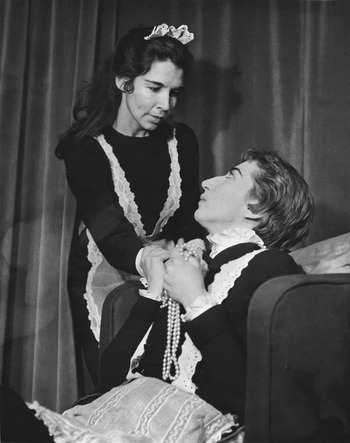
From her earliest work performing on New York's experimental stages, Bovasso challenged the expectations of the postwar avant-garde. It was her 1952 break from the ponderous early incarnation of The Living Theatre that positioned her at the vanguard: director Lawrence Kornfeld remembered, “when I began my theatrical apprenticeship in 1957 with The Living Theat[re] there was nothing that was ‘experimental’ in New York theatre except for Julie Bovasso.”Footnote 18 In the 1955–6 season, her theatre, the Tempo Playhouse, received a special citation from the Obie Awards for her groundbreaking productions of European absurdist playwrights.Footnote 19 That same year, Bovasso took home the first Obie Award for Best Actress, for her portrayal of Claire in Jean Genet's The Maids (Fig. 1). Village Voice theatre critic Jerry Tallmer credited her as one of the founders of the movement: “The history of Julie Bovasso is the first and most fundamental fact I know about Off-Broadway theatre.”Footnote 20 Her commanding performances in works by de Ghelderode, Genet, and Ionesco attracted the attention of critics. “A comedienne, a siren, a feminine goad of immense proportions,” raved Lewis Funke about Bovasso's turn in a 1960 production of Ionesco's Victims of Duty.Footnote 21
Phena Darner (left) and Julie Bovasso (right) in The Maids at the Tempo Playhouse, 1955. Billy Rose Theatre Division, New York Public Library for the Performing Arts.

Bovasso simultaneously fought to expand her acting career across the media of film and television. From 1958 to 1960, she played Rose Corelli Fraser on NBC's From These Roots, and claimed “the distinction of being the first ethnic heroine on a television soap opera.”Footnote 22 A dispute with the series director and producer Paul Lammers led her to walk off the set, and her daytime TV career was effectively over.Footnote 23 The world of 1950s network soap operas remained a conservative artistic environment for an experimental young artist. A romantic spread in a 1960 television magazine that featured Bovasso and her From These Roots costar, Len Wayland—she was divorced from her first husband, painter George Earl Ortman, with whom she'd cofounded the Tempo—captures the careful performance of bourgeois domesticity in which Bovasso participated. In their Greenwich Village duplex, the newly married couple sips tea from fine china, seated underneath a neosurrealist canvas painted by Bovasso. “I was always a rather flamboyant type,” Bovasso admits, before discussing their Corgi–dachshund mix and the secrets to Bovasso and Wayland's unlikely marriage. An anxiety circulates throughout the text as Bovasso reflects on the acceptable roles of women and men in relationships when both work and neither tend to the home; the reporter describes them as “blond and quiet-mannered” Wayland and “dark and volatile Bovasso.”Footnote 24 Shortly after this publication, Bovasso abandoned soap opera acting along with her life in the West Village duplex, a move that presaged a professional mutability that would define her career.
These shifts reflect her passionate auteurism: Bovasso always argued that her individual worldview should be the guide behind any project she directed, wrote, or performed. After the Tempo Playhouse and the NBC stint, it was in concert with Ellen Stewart on the Lower East Side of Manhattan that Bovasso fully staged this philosophy at Stewart's Café La Mama. Freed from the constraints of network television, Bovasso embraced and critiqued the excesses of the 1960s downtown bohemia. She lived on the east side of Tompkins Square Park, and wrote plays that tore up the conventions of the stage with “alternate gusts of inchoate bedlam and burning lucidity.”Footnote 25 She appeared in Sin of Jesus, photographer Robert Frank's follow-up to his avant-garde film classic, Pull My Daisy. Footnote 26 In a 10 December 1969 Wall Street Journal review of Bovasso's The Moon Dreamers at La Mama, John O'Connor marveled at the “complex, sprawling, hilarious, often brilliant and nearly as often puzzling” play.Footnote 27 Theatre Week dubbed Bovasso an “American Duse.” Dan Isaac admired her “ability to scramble traditional patterns, creating thereby new orders of sense and feeling.”Footnote 28 And with good friends Rosalyn Drexler, Maria Irene Fornés, and Megan Terry, she participated in the major playwright advocacy organizations of the period.
Throwing Chairs
Bovasso's work as a writer, director, and actor in Obie-winning shows at La Mama stood in contradistinction to a largely gendered trend of male directors leading companies (i.e., the Open Theatre and the Performance Group) and foregrounding their own definitions of experimental theatre. Fornés discerned this pattern of directors “taking over,” and quickly became a leading advocate for playwrights.Footnote 29 During the formation of the New York Theatre Strategy (NYTS), a playwrights coalition that existed between 1972 and 1979 (during which Fornés served as president), Bovasso joined these organizing efforts and railed against the marginal role of the playwright in the creative process.Footnote 30
Yet here Bovasso's biography departs sharply from Fornés's, in that Bovasso's attempts to continue working within theatre institutions frequently ended in conflict and came to cloud her legacy, whereas Fornés succeeded in achieving a relatively secure position within theatre institutions. Some of this, Fornés suggests, derived from Bovasso's inability to countenance directorial self-importance. She describes directing Bovasso in a New Dramatists workshop of Molly's Dream (1968) as “a bumpy ride. I didn't know her history of quitting and throwing chairs at directors. It worked because I didn't have a director's ego. I just wanted her to do my play. And she was wonderful.”Footnote 31 Bovasso shared Fornés's sense that the (often male) director's (or artistic director's) ego left little room for others in the rehearsal process. In the theatre, the cyclical reassertion of traditional values and the acute lack of sustainable economic models for the playwrights of her generation made it increasingly difficult for Bovasso's own playwriting to be produced at all.
Bovasso recognized that female playwrights remained particularly vulnerable to neglect within the landscape of new play production. When in 1972 members of the short-lived Women's Theatre Council (WTC) gathered at her garden apartment with Times critic Mel Gussow, Bovasso declared at the outset: “This is not a women's lib organization.”Footnote 32 She expressed ambivalence during discussions of gender and playwriting, and articulated concern about the ghettoization of female playwrights. From her earliest producing experiences, Bovasso sought center stage; her resistance to a reductive mission for the WTC likely reflected her prescient fear of moving from Obie wins to a women-only producing organization that would be pushed to the sidelines.
Notwithstanding this skepticism, Bovasso fundamentally distrusted the relationship between the patriarchal hierarchies of “institutional theatre” and the individual artist. In a 1987 oral history interview, writer Kenneth Turan asked Bovasso what she believed Public Theater director Joseph Papp sacrificed for success:
Bovasso: I think what's sacrificed, what's forfeited, is the intuitive side, which is in a sense the creative side. I think people like myself are threats to people like—people who have a lot of power. Because I don't have any power. At all.
[Laughs] The only power I have is when I am on the stage. … In other words, the creative process. And I think that people who are into power, they do the pragmatic thing, they do what's wanted by society, or what is needed by society, and I think the creative process has less to do with society than it has to do with the individual. So we're talking about the collective versus the individual, and I always have had trouble working in institutional theatre. I have fights with these people—Marshall Mason, Circle Rep—you read about it in the paper?
Turan: No.
Bovasso: I told the audience to go home, I took my play, and ran.
Turan: When was this?
Bovasso: About a year and half, two years ago.
Turan: Really?
Bovasso: Yeah. And La Mama, the same thing. These institutions, the individual gets lost. And when the individual gets lost, everything is in the service of the state, so to speak.
[Laughs] The Roman State—Joe [Papp] was like … was like [then–New York State governor] Mario Cuomo. In my mind, the two of them, they're good people. Very good people. And brilliant, brilliant men. But something of the individual gets lost and the whole paternalistic relationship to the artist is very bad, I think it stunts the growth.Footnote 33
Bovasso's comparison of Papp to Cuomo, New York's most prominent and powerful Italian American political figure of the 1980s, intentionally mixes the metaphors of government and family. The tyrannical leader of the Roman state becomes the patriarchal Italian American family head, with governance and domestic regimes indistinguishable. The notion that a play could be a threat to its producing institution would seem contradictory, but in fact this position informs the Angelo's Wedding preview debacle and her apparent disregard for the conventions of institutional theatre. She demanded the ability to speak directly to the audience as well as the actors, to have a voice onstage and backstage. She enacted her frustration with a paternalistic culture that demanded representations of retrograde, patriarchal family structures, and in so doing, furiously upended the hierarchies of the production.
Believable Rage
The hierarchical structure of the theatrical institutions within which Bovasso aged contributed to her unstable relationship with their norms of representation. Bovasso's explosive collaboration with Joseph Papp in 1974 offers another side of her resistance to the gendered dynamics of new play production, this time with Bovasso as a director. In 1974, Papp hired Bovasso to direct David Rabe's In the Boom Boom Room, Papp's first production at the helm of Lincoln Center's Beaumont Theater. This dark play revolves around Chrissy, a naive go-go dancer victimized by conniving men. Bovasso disagreed with Papp's decision to cast Madeline Kahn in the role of Chrissy, yet Kahn would later recall Bovasso as a guide: “She was a woman and she seemed to have a real ability to portray rage, while my fear would have been that I couldn't be really believable portraying rage. I hadn't come from a family background where everyone was really yelling at everyone else, and maybe she did, so I had courage with her leading me along a bit.”Footnote 34 As Chrissy, Kahn offered celebrity wattage, but had reservations about disrobing onstage. One of Bovasso's supposed missteps during the rehearsal process was requesting a rewrite from Rabe of a final scene in which Chrissy performs topless.
While Kahn credited Bovasso with emboldening her in her performance of Chrissy, Bovasso's own rage garnered criticism rather more often than that of Papp, who could also take a distinctly pugilistic stance toward collaborators. Both Papp and Bovasso hailed from blue-collar immigrant families in Brooklyn, and portrayed their own combative communication styles as a point of pride and ethnic inheritance. But as a female artist prepared to cross Papp as a director, their passionate artistic disagreements could not end any way other than in punishment for Bovasso. “Two pigs. Joe [Papp] and David [Rabe], are threatened by any woman who has strength and individuality,” Bovasso stated at the time, after an irate Papp banned Bovasso from the theatre just before previews.Footnote 35 Bovasso later concluded that the financial and professional pressures of Lincoln Center had exacerbated Papp's overbearing producing approach and sabotaged In the Boom Boom Room. Yet she never shied away from attributing the conflict to the discriminatory gender dynamic of the collaboration. Papp and Rabe, Bovasso explained, “are kind of old-fashioned, macho types. You know, ‘who is this little girl, what does she know?’”Footnote 36
The formal and philosophical distance between Papp and Bovasso became clear once Papp took over the production as director. Reviews of Papp's production largely support Bovasso's positions, especially her contention that miscasting Chrissy sank the play, as did a meandering script.Footnote 37 Bovasso recognized that Papp's institutional position would write the story in his favor. She tried to tell it otherwise in the limited opportunities she had to do so. In her oral history interview, conducted by Kenneth Turan during research for his book on Papp, Bovasso maintained that she was not fired from In the Boom Boom Room. She offers her own account of the failed production, explains her reasoning for erasing herself from the production materials, and translates the eruption of her storied temper as a mark of distinction:
He didn't fire me. Joe didn't fire me. Joe doesn't fire people, he just takes over, he tells you to go to the nearest newsstand and have an orange juice while he directs the play! … So what happens was, next day, Joe was there … there was like a plot going on, I think they all agreed, “this woman can't handle this.” And they're right, actually, I couldn't handle it, because I had really lost control … of those stars. … Anyway, so he said, “don't ask me what I'm doing, this is my theatre, go sit over there,” and then I got my Albanian up, which is wild, wild, a kind of eloquent anger that I am very noted for, I think, and I just walked out, and my agent sent him a telegram, telling him that I didn't want my name in the program because it was not my work. He didn't fire me.Footnote 38
Her adamant insistence that she was not fired also helps temper the burn of what was forfeited: a production in which she was to be a theatrical insider, working at one of the premiere arts institutions of New York for one of the most prominent producers in the city. As a woman within a profession that was still unequivocally dominated by men, Bovasso would have been the first female director at Lincoln Center, taking on Rabe's follow-up to his Tony Award–winning Sticks and Bones. All accounts of the In the Boom Boom Room process suggest that Papp and Bovasso's disagreements were wholly artistic, pertaining to script edits, casting, set, and costumes, and never a question of Bovasso's professionalism. Yet her very position of authority was nonetheless subject to punishment, and she was deprived of another stage opportunity as a penalty for her supposed wrongdoing. This had profound implications. Bovasso was forty-four when Papp hired her for Rabe's play. A successful stint directing uptown could have drastically altered her path as a director for decades to come.
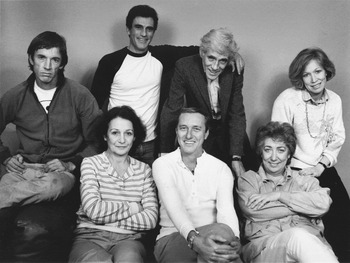
This offers a partial explanation for the intensity with which she experienced her betrayal at Circle Repertory in 1985. Bovasso's association with the company began in 1974, just as her relationship with Papp unraveled. The theatre, described by its Artistic Director Marshall Mason as “a haven for naturalism,”Footnote 39 was an unlikely pairing with Bovasso's prior work. Bovasso and Mason collaborated on Bovasso's Gothic absurdist melodrama, Down by the River Where the Water Lilies Are Disfigured Every Day (1974–5), and in 1976, she publicly praised Circle Rep's “creatively comfortable home,” where “you never get the feeling that you're a disposable item.”Footnote 40 During the rehearsal process of Angelo's Wedding, however, Mason and Bovasso held starkly differing opinions on two major elements of the production: casting and script edits. In rehearsals, the issue of actors dropping lines inflamed arguments regarding the length of the play, and less than a month before previews were to begin, more cuts were discussed, with Bovasso regularly delivering revisions to act II. Bovasso expressed continued frustration with the show's “star” actor, Scott Glenn, and an additional casting choice was of particular significance: Bovasso wrote the part of troubled matriarch Vera Perrone for herself, but Mason did not pursue this option (Fig. 2).Footnote 41
The cast of Angelo's Wedding, ca. 1984–5. Top row: Scott Glenn, Cliff Gorman, William Hickey, Mari Gorman. Bottom row: Lynn Cohen, Marshall Mason, Julie Bovasso. Photo: Gerry Goodstein. Billy Rose Theatre Division, New York Public Library for the Performing Arts, Astor, Lenox and Tilden Foundations.

Gendered assumptions about female power (particularly in the workplace) and characterizations of male subjectivity are decisively important to understand both the play and conflicts during its production. An analysis of the text itself will establish the ways in which Bovasso grappled with popular representations of Italian Americans in the play, and attempted to revise conventional understandings of the linkages between family and individual. The play also reveals a striking relationship between Bovasso's “role” in Angelo's Wedding and her own casting in Hollywood films of the period.
Appearances
The remarkable success of Francis Ford Coppola's The Godfather in 1972 led to a period of nearly three decades in which Italian Americans became “‘Hollywood's favorite ethnic group.’”Footnote 42 Box-office receipts attest to the increasing popularity of Italian Americans on film—Mean Streets (1973), Rocky (1976), Saturday Night Fever (1977), Raging Bull (1980). This history informs Angelo's Wedding in surprising ways. The drift toward Hollywood among Bovasso's generation of artists was highly individual, yet widespread—Bovasso directed Al Pacino in one of her plays at La Mama before he received his career-making role in The Godfather. In 1974, Bovasso expressed relief that “ethnic” actors of her generation finally enjoyed casting in significant dramas, an optimism directly related to expanded opportunities in Los Angeles as well as New York.Footnote 43 This optimism faded as her career as a theatre actor diminished, and her roles in film narrowed to matronly Italian characters. Bovasso returned to writing for the stage in an attempt to alter the terms of representation, and Angelo ’s Wedding was part of those efforts.
The first act of Angelo ’s Wedding presents a classical conflict between brothers. Benny inherited their father's milk delivery route in Staten Island and still works in the old neighborhood. His thirty-four-year-old brother Larry has recently returned from traveling through South America. Larry is an Air Force veteran, once considered MIA, who now wanders the globe and paints surrealist landscapes. Larry watches as Benny dresses for the wedding of Nunzio, their cousin Angelo's younger son. The first line of the play is Benny's: “Appearances… ! I'm talkin’ about appearances… !”Footnote 44 Benny reveals his life philosophy to Larry as he fastens his cuff links: appearances are the secret to upward mobility. Larry, however, maintains that appearances have sustained a lie of inheritance, and distances himself from the whole family: “Nincio [sic], Vincenzo, Angelo, these cousins don't mean anything to me.”Footnote 45 This prodigal son has returned home seeking a resolution to his unsettled memories.
While Larry broods about his parentage, Benny rages, angry at their sister, Gina, at his incompetent wife, Pigeon, and at Larry’s lack of concern for their childhood home, which Benny has recently purchased from their mother, Vera. As Benny prepares for the wedding, multiple concealments between the brothers come to light, and the house itself is revealed to be the site of a long history of betrayals. Their Staten Island accents tell another part of this story of misleading appearances; Larry lost (relinquished?) his, whereas Benny's is strong to the point of caricature:
Benny: Who's this, Aunt Theresa? Yeah, I'm gonna pick you up with the car an’ bring you here. … No, we'll pick up Annunziata an’ the twins an’ her husban’, Frank onna way back here. … Sure there's room, it's a big car. … Then Uncle Petie and Aunt Gracie are gonna meet up here with their car, an’ you and Annunziata an’ the twins an’ her husban’, Frank are gonna go with Petie an’ Gracie, an’ I got my mother, my brother, my wife, Uncle Salvatore. …
(He laughs) Hey, what milk truck? You want me to bring the milk truck? Whatta we gonna do, drive up to this weddin’ onna milk truck? Ma che pazza… !Footnote 46
Notwithstanding his kindly antics, Benny is a bigot. Perhaps as a consequence of Benny's boorish mentality, his unhappy wife, Pigeon, lusts after Larry. In a disturbing scene of foreplay between Larry and his brother's wife, he sketches Pigeon. At the end of act I, they sleep together, inflicting revenge on Benny for their shared suffering. Both Larry and Pigeon are starved for affection and sexual attention, with Larry's alienation from his family complete.
Larry has brought rum—very strong rum—from his travels, and what seemed in the first act to be a Greek-styled domestic drama opens out into a timeless expanse in an act II filled with delirious half-confessions. Under the influence, Larry and Benny are brothers again, the old chasms between them now filled with liquor. They finish each other's sentences, trade profane stories about their whoring and carousing, until Larry divulges a recent spiritual awakening. Drinking keeps him grounded, Larry maintains, and he believes he is pure in spirit. Benny, however, reveals that he no longer believes. Benny's act I posturing suddenly appears to veil deep spiritual doubt, while Larry's early confusion is transformed into a powerful certainty, drawn from his mystical experiences hallucinating on a volcano in Guatemala. Larry's exploits may be fictitious alcohol-induced delusions, or clues to a “real” Larry: the traumatized veteran, the surrealist painter, the son who left the neighborhood. Through act I, Benny performs the epitome of the stereotypical working-class Italian American male—brutal to his wife, blindly loyal to his philandering father, aggressive to everyone—yet in act II he is decimated. His macho expostulations now confirmed as mere “appearances,” yet still irrevocably destructive. Bovasso takes Benny, this severe Italian American clown in the milk truck, and renders him lost, while the thoughtful painter has found himself—yet both search vainly for a core identity that might finally ground them. The resonances with Bovasso's own identity are impossible to ignore; her father, Bernard M., was a teamster, and she had one brother, Bernard X. Julie Bovasso herself was a hard-drinking, neosurrealist painter who left the neighborhood behind, only to battle with the shallow stereotype of the angry primitive who operates according to brute force and the rules of the street.
Bovasso repeatedly clashed with Mason over cuts made to act II of the play, and it is the act most invested in the borderlands between consciousness and the unconscious. It is in this section of the play where Bovasso's own identity, and, crucially, her critical position on Italian American stereotypes in culture, drama, and movies, are most at stake, that the tensions with Mason over the script break out with the greatest intensity. An article in the Post covering the cancellation quoted a defiant Bovasso: “I just wanted to see my play properly staged. Mason actually put it on one night without the second act. Who does he think he is, the commissar of theatre?”Footnote 47 Mason's impatience with an overly long act II clashed with Bovasso's desire to shed the predictable stereotypes of the Italian American family, but also, of her identity. Her script, its production process, the institutional setting of Circle Rep, and its broader cultural environment could not be disentangled. Bovasso rewrites the familiar story of immigrant brothers, revises it with questions of spirituality and trauma, and intentionally breaks free of the psychological realism of the first act. In dismantling the stable caricatures of Larry and Benny, the play shifts to represent the outer limits of their experiences and potential, far from the realm of popular culture, and without resolutions to their struggles for belonging, direction, or artistic certitude.
The exploration of Larry's subconscious and Benny's existential confusions destroy the conventions within which the Italian American family drama had become calcified. For Hollywood, the stereotype of the Italian gangster continued to prove irresistible, particularly once the The Godfather cemented the Corleones as a seemingly definitive representation of Italian American cultural identity. In popular film culture of the 1970s, a new stereotype conjoined with the mafioso: an urban primitive, unintellectual and crude, vital but passionate. George De Stefano recognized him in Al Pacino's Serpico (1973) and Sylvester Stallone's Rocky. “[T]his type—as played by De Niro, Pacino, Travolta, Lo Bianco, Sorvino, Stallone, and Gere, who acted ‘Italian’— enjoyed tremendous cachet,”Footnote 48 and critics celebrated the dangerous, electric, swarthy characters. In Larry, Bovasso crafted a character in opposition to this: Larry is dangerous only to himself, and opts for oil paints, not boxing gloves.
Bovasso interpreted the powerful protagonists of Mafia dramas pragmatically, as a kind of functional cultural stereotype. These stories, she believed, tapped into the public's “yearning for autonomy and control over life's exigencies” within “highly technological and bureaucratized societies.”Footnote 49 Benny and Larry are losers in the societies she describes, with Benny performing the same social function as his father before him, and Larry opting out of society altogether, intent on blaming his mother for all the trouble. This is consistent with the Hollywood mafia genre Bovasso seems to be burlesquing, in which women characters seem superfluous to the narrative. “The absence or passivity of the criminal's mother is iconographic in the gangster genre,” argues Tricia Welsch, identifying the many films in which mothers are absent from strongly patriarchal Mafia families, and are instead used to call attention to the losses they suffer before their irrelevance is declared.Footnote 50 Vera, Benny and Larry's mother, appears at first to be crafted in this mold—the unnatural mother who fails to be maternal—and yet in act III, when she finally appears onstage, she aggressively defends herself, dominates the story, and ultimately remains a strong yet indeterminate figure in Larry's life. This final act unfolds as a grand confrontation between mother and son, with Vera and Larry locked in a heated argument about Larry's father's death. Has Vera spent decades protecting Larry, or herself? The truth falls in between, with Vera's actions revealed to be a direct consequence of the crimes of Larry's father. When Larry blames her for his rootlessness, Vera reveals that Larry's biological mother was a woman who lived in their attic, and who was his father's lover. Benny and Larry are not blood brothers. Family is confirmed to be a matter of appearances, and yet another woman is made available to blame. After the first act sets up a realistic family drama built on the pretense that a man can find himself if he finds his roots, Angelo's Wedding ends by dramatizing the limitless confusion of artifice and family relations.
Bovasso built Angelo's Wedding upon familiar stereotypes from theatrical and film language—the traditional ideas of brotherhood, family, gender relations, and the old neighborhood. This Italian culture is Roland Barthes's “Italianicity”—something that an audience can read and signify—rather than the presentation of a particular domestic arrangement or cultural paradigm.Footnote 51 Bovasso proceeds to trouble the notions of genetically determined ethnic culture, and the illusions of the nuclear family, while challenging the predictably normative social standards permeating dominant representations of men and women in Italian American families. Larry created a fiction of Vera's power, mirroring a paranoia frequently found in films of the period, “that women are unknowable, uncontrollable,” coexistent with an ambivalence about motherhood as well as women's ambitions.Footnote 52 This was a critique with which Bovasso also contended. Her uncontrollable—or, as she described it, eloquent—rage became her inheritance as well as her legacy.
Temperament
Eccentric artist or brutal urban ethnic? The question applied to Larry as much as it did to Bovasso. Stage manager Ginny Martino's account of the Angelo's Wedding disruption emphasizes the crew's fear (“Emily [Rymland, assistant stage manager] said on more than one occasion that Julie ‘scared’ her’”).Footnote 53 The language of the stage managers and news reports described Bovasso as another uncouth, violent Italian American, an image she countered with a vision closer to that of the wild, perfectionist artist. Where is Bovasso's accountability in this conflict? In interviews, Bovasso addressed the blurred boundaries between temperament and stereotype. She even invoked Italian hotheadedness as an explanation for her string of infamous collaborations:
I have a reputation for being … uh, wild. And so there's something that Joe [Papp] was afraid of. But you see, that's something that people don't understand: that's part of the creative process, as far as I'm concerned. And also I'm Italian, that might have something to do with it [laughter]—although I don't think so, I doubt it—I think that that's part of the temperament. That's part of the whole process. We have to almost go through in life, in the process of doing something, if we really, really are doing it, and not just going through the motions, it takes over.Footnote 54
Although Bovasso's reliance on the explanation of “temperament” is inadequate, this does not suffice to explain her consignment to the category of the unproduced. While she did acknowledge the role of gender in her work with Papp and Rabe, perhaps the most pertinent question—Would her volatility be diagnosed as a similar problem in a male artist?—goes unaddressed. As she defends her famed “wildness,” she omits the femaleness that rendered her as vulnerable to censure as the hysterical woman in the theatre.
Bovasso expounded upon the connections between creativity and ethnicity, but resisted explicit linkages between gender and creativity. She preferred a theory that combined an image of the artist as unfettered source of creativity with an essentialist conception of ethnic inheritance, be it Albanian or Sicilian. She also did not publicly discuss the ways in which this “wild” reputation, as a marker of her ethnicity, might have led to discriminatory or prejudicial practices, in a city where first- and second-generation Italian Americans still faced exclusionary policies and institutional barriers to professional attainment.Footnote 55 For Bovasso, “temperament” can be a theatrical language, communicating unconscious needs and desires. Yet while the tension between her proud ownership of the rage that Kahn so admired and her frustration with structural misogyny permeated her career in theatre, it took a different shape in film, where this blend translated into a highly desirable brand of ethnic authenticity.
Off-Broadway continued to confirm Bovasso's worst understanding of its limitations. Mel Gussow, tracing the history of women in New York theatre and lauding a “new chapter,” used the 1972 formation of the WTC as a “turning point”—with its failure becoming the narrative.Footnote 56 Every couple of years, Gussow rewrote his article about women playwrights taking the theatre by storm; but rarely did these articles confront the precarity that structured the lives of all of the playwrights involved in the coalition, or the economic imperatives that forced many into film roles, teaching, or other fields entirely.Footnote 57 During the comparatively lush days of grant funding in the 1960s and early 1970s, Bovasso received grants from the Guggenheim and Rockefeller Foundations and the New York State Council on the Arts, which gave her freedom as a playwright early in her development at a level not possible in the 1980s.Footnote 58 Unlike many of her contemporary playwrights, Bovasso could support herself with her private acting workshop in Manhattan, and her film acting roles.
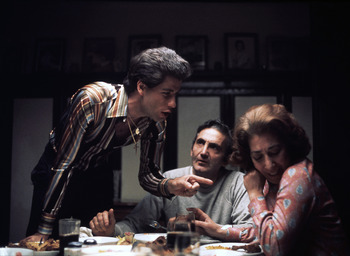
When Hollywood embraced Bovasso, it embraced her Italianicity most thoroughly of all. As she labored for ten years on Angelo's Wedding, a steady succession of films about Italian American family life met wild success. Angelo's Wedding offered an alternative aesthetic to these film performances, which articulate a particular gestalt—immigrant, white, working class, suffering, angry. In Saturday Night Fever (1977), Bovasso earned critical accolades as Florence Manero, John Travolta's anxious mother: her fearfulness and rage motivated the iconic scene in which she slaps Travolta at the dinner table, harshly, without remorse (Fig. 3). That role led to appearances in other films: not only Sidney Lumet's The Verdict (1982) and Daniel (1983), but also Stayin’ Alive (1983), Brian de Palma's mob film Wise Guys (1986), and Moonstruck (1987). In My Blue Heaven, Nora Ephron's 1990 comedy, Bovasso played “Vinnie's Mother,” the elderly, conniving mother of a mobster, weeping in garbled Italian as her son, played by Steve Martin, returns from a witness protection program. Angelo's Wedding cannot be understood without the knowledge that she was reliant upon popular cinema's version of Italian American culture in order to secure her livelihood.
John Travolta, Martin Shakar, and Julie Bovasso in Saturday Night Fever (1977). Paramount Pictures, mptvimages.com.

One of the most revealing credits of her film career, however, might be the one that she did not quite get. Bovasso fought for a part in the film adaptation of Richard Condon's book Prizzi's Honor (1985). Issues of ethnic identity and representation emerged during the casting process. Director John Huston had cast a number of Irish actors (Bill Hickey, John Randolph) in Italian American roles, and he was determined to cast his ex-secretary, Anne Selepegno, in the role that Bovasso so coveted, that of Aunt Amalia. This appeared to Angelica Huston, John Huston's daughter and an actress in the film, to be a disastrous choice:
[T]here was this quite extraordinary, very talented actress who was clamoring for the part, her name was Julie Bovasso. But Dad had this very clear idea that Anne was it, she was the part. Jack [Nicholson] and I were in Jack's suite in the Carlyle Hotel. Dad called and came over. He said, “I have found it! The voice of the movie.” And the voice of the movie was Julie Bovasso and, you have to understand, this was a good two years or so before Moonstruck, before The Sopranos, and he had actually fixated on the accent and that was the “voice of the film.” Poor Julie, I don't think she ever made it to screen but she was the voice of the film, she'd come in with her accent and after that we were all talking with her accent the entire time.Footnote 59
“Poor Julie” refers to the injustice of an accomplished stage and screen actor losing out to Huston's secretary, and being pushed into the nebulous role of an inspirational lodestar. Huston gives her father credit for discovering a kind of prototypical Italian American sound, suggesting that he anticipated later characterizations of urban, ethnic familial dynamics, all captured in the voice of Bovasso. Valued more for her background—seen as making her rage believable—than for her acting chops, Bovasso is unseen in the final product, even if she ultimately received credit as a dialect coach on the film.Footnote 60
Tricia Welsch argues that the narrative and mixed genres of Prizzi's Honor (gangster film, screwball comedy, film noir) reflect cultural anxiety regarding female power. Rebecca Bauman writes of the film as “a serio-comic vision of gender as locus of the battle between traditional and modern values in 1980s America.”Footnote 61 Certainly, the values of traditional filmmaking were also in play, including the director who casts his secretary, a film whose humor depends upon an exaggerated, citational image of Italian American identity. Bovasso became a clichéd casualty of the business, a victim of rotten luck and nepotism. The fact, however, that the cast and director acknowledged Bovasso's role in contributing the authenticity they wanted for the film subjected Bovasso to a peculiar punishment: relegated to the sidelines, she inhabited the role of the irreplaceably authentic ethnic figure, not to be seen, but only heard (through proxies).
The Effects of Absence
Why excavate the flashpoints in the career of a woman whose 1991 New York Times obituary included the subheading of “Turbulent Productions,” citing In the Boom Boom Room as well as Angelo's Wedding as examples?Footnote 62 Onstage and off, and onscreen and off, Bovasso's career demonstrates what Alice Rayner has called “the effects of absence.”Footnote 63 Like so many experimental works of the 1960s, Bovasso's early stage plays are largely relegated to out-of-print anthologies and photocopied Samuel French editions sold on eBay. For Angelo's Wedding, artifacts of the unproduced are left behind: an unorthodox stage manager's report, a sign posted on the door of Circle Rep announcing the cancellation of the 14 May performance, a playbill published but never distributed. At the time, the play rehearsed a confrontation between the artist and her collaborators. Absent critical response, Bovasso's unproduced script now lacks the luster commonly available to the theatre historian—but with plenty of Tracy Davis's context. It offers a unique perspective from which to observe the labors (and instability) of theatrical producing; in the case of Angelo's Wedding, the rehearsal notes exist, yet the planned production was eclipsed by constraints Bovasso faced within institutional theatre. These conflicts ensnared her in the irresolvable prejudices and stereotypes born of gender, race, and culture.
As an unproduced play, Angelo's Wedding offers reception in negative; this formulation draws from Elinor Fuchs's concept of “Aristotle in negative.” Fuchs's subject is “the persistence of the Aristotelian plot pattern even in its apparent absence,” and she writes:
The pattern persists somewhat in the uncanny, as the negative image represents the photograph, or as a cast survives lost wax, or even, perhaps, as a ghost haunts a house. Scenes of reversal and recognition may be missing, yet their very absence gives shape and meaning to the dramatic narrative; their absence becomes the story itself. … This new story does double duty as a link in the history of dramatic form.Footnote 64
The very absence of the play's planned performances give shape and meaning to the dramatic narrative of Bovasso's career. Although the lack of a successful run became the story itself, her theatre and film accomplishments persist, “as a ghost haunts a house.”Footnote 65 In Angelo's Wedding, a play about the ghosts of one family, the ghostly materiality of performance that Alice Rayner has described as “appearing not-to-be” in fact “gives appearances to the unseen.”Footnote 66 In this instance, we see previously unremarked dimensions of an artist's labors alongside and within the exclusionary practices that structured an industry.
Female playwrights and directors continue to beat against the doors of institutional theatre, as the sexism and inequity in theatre frequently covered in news outlets confirms. By every measure, current studies attest to persistent inequities: female writers and directors are starkly underrepresented on Broadway and Off-Broadway, as well as in Hollywood.Footnote 67 Julie Bovasso's Angelo's Wedding is a case study of the exchange between a playwright and the field, and the unproduced play, as an affective category, holds the place for unheard protests, unseen performances. This does not apply just to the theatre, but also to the unremarked exclusions that plague filmic representations, and, in the case of Bovasso, formed an uncanny double of her “role” as an artist in the field of theatre. While this correspondence is not always one-to-one, in Bovasso's case, these twinned predicaments position her within a history of two fields—theatre and film—that often supported and even coproduced each other's practices of exclusion.
Resolving some of the dilemmas of researching the minor, the forgotten, or the isolated work therefore facilitates interdisciplinary connections across mediums. As in the case of so many others in the category of the unproduced, Bovasso's opportunities were delimited by race and gender, and her career trajectory was subject to punishment within those same censuring frameworks. Through a focus on Bovasso's career and the canceled production of Angelo's Wedding, relations of power and privilege can be tracked not within the space of one theatre or even one theatre landscape, but rather between artistic fields and social spheres (in this case, film and theatre). Bovasso's ambivalent position between the margin and the mainstream confirms the extent to which the “unproduced” comes about through historical relations and the extent to which absences—such as a historical lack of female playwrights or directors on US stages—can in fact be seen.