Introduction
Over 380,000 children in the United States were impacted by newly diagnosed parental cancer in 2019, an estimated 20% of whom had parents diagnosed with the non-curable disease (Weaver et al., Reference Weaver, Rowland and Alfano2010; American Cancer Society, 2019). Parents with advanced cancer must deal with multiple issues, including coping with the illness and its side effects, treatment, and responding to both their child's and their own worries (Nilsson et al., Reference Nilsson, Maciejewski and Zhang2009; Bell and Ristovski-Slijepcevic, Reference Bell and Ristovski-Slijepcevic2011), even as they experience significantly higher levels of anxiety and depression than non-ill parents (Nilsson et al., Reference Nilsson, Maciejewski and Zhang2009). Parents describe difficulties with how to initiate a conversation with their child about their cancer, including what to tell their child or how often to raise the issue (Nelson and While, Reference Nelson and While2002). Although many parents request services to help them support their child with their illness, they seldom receive them (Ernst et al., Reference Ernst, Gotze and Krauel2013).
There is substantial documentation that both early and late-stage cancer in a parent affect the psycho-emotional adjustment of their children (Siegel et al., Reference Siegel, Mesagno and Karus1992; Stoppelbein et al., Reference Stoppelbein, Greening and Elkin2006; Rainville et al., Reference Rainville, Dumont and Simard2012; Bylund-Grenklo et al., Reference Bylund-Grenklo, Kreicbergs and Uggla2015; Phillips, Reference Phillips2015; Phillips and Lewis, Reference Phillips and Lewis2015; Sheehan et al., Reference Sheehan, Mayo and Christ2016; Beernaert et al., Reference Beernaert, Kreicbergs and Furst2017). Children of a parent with incurable cancer experience significantly higher levels of depression compared with the general population (Rainville et al., Reference Rainville, Dumont and Simard2012; Phillips and Lewis, Reference Phillips and Lewis2015) and frequently have adjustment problems on standardized measures of behavioral–emotional functioning (Siegel et al., Reference Siegel, Mesagno and Karus1992; Rainville et al., Reference Rainville, Dumont and Simard2012; Beernaert et al., Reference Beernaert, Kreicbergs and Furst2017). Although children may feel confused, sad, or angry as a result of the parent's cancer, children are hesitant to raise their concerns with their parent for fear of causing the parent more distress (Phillips and Lewis, Reference Phillips and Lewis2015).
Despite the documented distress of parents with advanced cancer and their children, few studies have been conducted to assist parents manage the toll of incurable parental cancer on the child. Of the known 10 intervention studies focused on supporting children facing parental cancer (Ellis et al., Reference Ellis, Wakefield and Antill2017), only two evaluated the impact of the intervention when a parent was diagnosed with incurable or stage IV cancer.
Bugge et al. (Reference Bugge, Helseth and Darbyshire2009) conducted a qualitative evaluation of the four-session Family Support Program with six patients. A health-care professional specializing in cancer care met with a family when a parent was diagnosed with incurable cancer. The program was guided by a manual which included information on the background of the program (including the theoretical basis), information on the goals for the families, family records of meetings, and strategies for dealing with specific problems. The primary aim of the parent–child communication aspect of the program was to support the parent in telling the child about their illness by having the facilitators model how to deal with difficult questions.
A second, small (n = 6) qualitative study gathered feedback from parents, children, and staff about a bereavement support program offered to families facing and following the death of a parent from cancer (Kennedy et al., Reference Kennedy, McIntyre and Worth2008). The program consisted of individualized family support by a family support worker (FSW) while the parent was ill and following the death of the parent. The families needed to be seen a minimum of five times to be eligible to be included in the study. Interventions by the FSW were tailored to the needs of the family, making the quality of the program dependent on the skills of the FSW.
Both Bugge's and Kennedy's studies relied on communication skills of professionals, rather than on teaching skills to parents to carry out illness-related discussions with their child. Further, their focus was largely on addressing a single event in the trajectory of the illness, rather than equipping the parent with communication skills for continued conversations with their child.
The purpose of the current study is to describe parents’ attributed gains in participating in a fully manualized psycho-educational program whose goals were to add to the parent's interactional skills, competencies, and confidence in ongoing communication with their child about the parent's incurable cancer (Lewis et al., Reference Lewis, Loggers and Phillips2020).
Methods
Study sample
After ethics committee approval by the study center's Human Subjects Committee, 61 parents with incurable cancer were recruited through a recruitment letter mailed from site intermediaries or provider referrals from a National Cancer Institute Comprehensive Cancer Center in the Pacific Northwest. Data analyzed for the current study were limited to parents’ responses about their attributed gains in participating in a five-session, fully manualized telephone-delivered counseling program for parents with incurable cancer. The data collected are a subset of a larger study (Lewis et al., Reference Lewis, Loggers and Phillips2020).
Study participants were eligible if they had a diagnosis of incurable cancer of any type, read and wrote English among their languages of choice, had an estimated life expectancy of at least 3 months, were not in a hospice program at time of enrollment, had a child 5–17 years of age living at home at least 50% of the time, and had been told their parent's cancer diagnosis. Forty-two of those recruited enrolled and 26 parents completed the study. The 16 parents who withdrew from the study cited the following reasons: too sick and not able or wanting to continue (6); experiencing too much stress, not able to complete the homework with the child, or feeling the program was not a good fit (5). Parents were withdrawn from the study due to: not being able to re-contact for subsequent sessions (3); parent dying (1); and parent entered hospice (1).
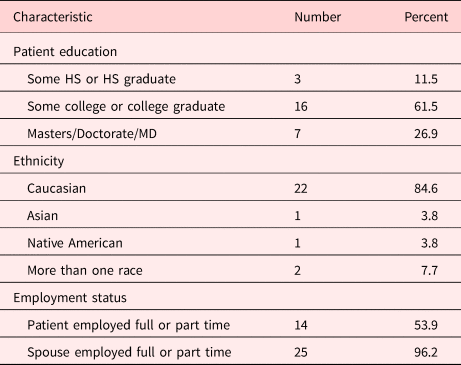
Of the 26 ill parents who completed the study, 5 (19.2%) were fathers and 21 (80.8%) were mothers who averaged 44.6 (SD 7.8) years of age and ranged from 25 to 58 years. All 26 of the parent participants were married and averaged 17.2 (SD 6.8) years in their relationship; range 3–29 years. Children averaged 11.4 (SD 3.3) years of age and ranged from 5 to 17 years: 15 were female and 11 were male children. Fourteen (53.8%) parents were diagnosed with breast cancer, 5 (19.2%) had colorectal cancer, 2 (7.7%) had sarcoma, 1 (3.8%) had head and neck cancer, and 4 (15%) were diagnosed with other types of cancer, including adenoid cystic carcinoma, neuroendocrine carcinoma, thymic neuroendocrine carcinoma, and pancreatic neuroendocrine cancer. The average time since diagnosis was 48.9 (SD 45) months, ranging from 1 to 206 months since diagnosis. Twenty-two of the parents (84.6%) had undergone surgery for their cancer, including 9 (40.9%) mastectomies, 2 (9.1%) lumpectomies, 2 (9.1%) wide excisions, 1 (4.5%) colon resection, and 8 (30.8%) had other types of surgery, including a sternotomy, removal of the rear hard pallet, oophorectomy, ileectomy, partial removal of the pancreas and spleen, surgical reconstruction to create a new esophageal opening, liver and gallbladder surgery, and one person had colon, lung, and liver surgeries. Fifteen of the 26 (68.2%) participants had undergone chemotherapy within the recent 6 months, 2 (9.1%) had received radiation, and 5 (22.7%) had received both chemotherapy and radiation.
Standardized measures on depressed mood and state anxiety at baseline revealed that 42% of parents (11) reached or exceeded clinical cutoff scores on depressed mood and 50% of the parents (n = 13) reached or exceeded clinical cutoff scores on anxiety. Twenty-four of the 26 (92%) parents reported symptoms or side effects and 79% of those reporting symptoms were taking medication to manage them. See Table 1 for additional characteristics of study participants.
Demographic characteristics of the sample (n = 26)

Study procedures
Prior to study participation, the consent form was mailed to potential subjects after which the patient educator phoned potential subjects to answer any questions about the study, consistent with the protocol. The signed consent was then returned by mail in a pre-stamped addressed envelope.
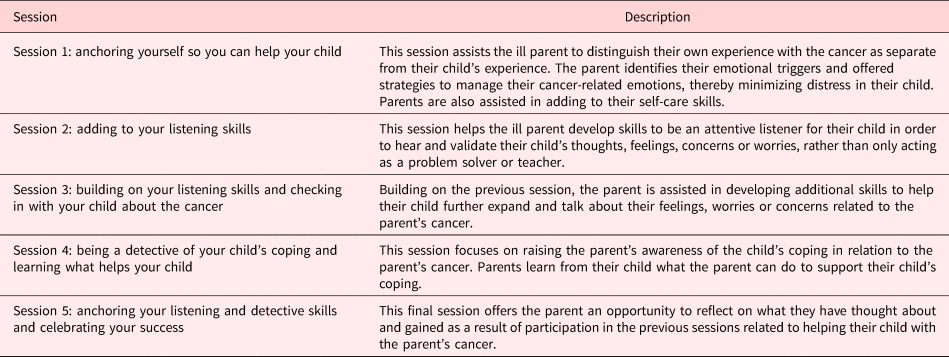
After consenting, eligible parents completed standardized measures of anxiety, depressed mood, and patient's reported symptoms along with demographic, treatment, and background information. After obtaining baseline measures, ill parents participated in five, 30–60 min manualized telephone intervention sessions scheduled at two-week intervals. Each session had an internal structure that included topic content, in-session skill-building exercises with debriefings by the patient educator. Sessions were digitally audio-recorded with subjects’ written consent, and monitored for dosage and fidelity. See Table 2 for descriptions of the interactive intervention sessions.
Enhancing connections palliative care: session descriptions

The primary goal of the question, what parents had gained from their participation in the program, was to give the parent an opportunity to self-reflect on what they had learned from completing the program. The patient educator was to only listen to their responses without comment beyond acknowledging the work the parent had done. All those who completed the five sessions responded to the question. Their descriptions provided the data that were analyzed for the current study.
Data analytic procedures
Digital audio recordings of the parents' responses were transcribed verbatim and verified for accuracy by comparing the transcript with the audio recording. Inductive coding methods based on grounded field theory (Krippendorff, Reference Krippendorff1980; Spradley, Reference Spradley1980) and extended by others (Lewis and Deal, Reference Lewis and Deal1995; Lewis et al., Reference Lewis, Zahlis and Shands1996; Zahlis and Lewis, Reference Zahlis and Lewis1998, Reference Zahlis and Lewis2010) were used to perform the inductive content analysis with each transcript. Units of analysis were the verbatim statements made by the parent. Statements were organized and grouped into categories according to their similarities, labeled, and defined. Definitions included rules of inclusion for that category in order to prevent overlap among categories. When possible, category labels were assigned using the words of the participants. Peer debriefing was carried out throughout coding and analysis (Krippendorff, Reference Krippendorff1980; Spradley, Reference Spradley1980). Two coders (MES and EZ) independently unitized the transcribed interview categories and their category definitions were created through consensual agreement. Coding disagreements were resolved by referring back to the original transcript or by refining the definition of the category. Constant comparative analysis was carried out throughout all phases of coding (FML), thereby protecting the uniqueness of each category.
Results
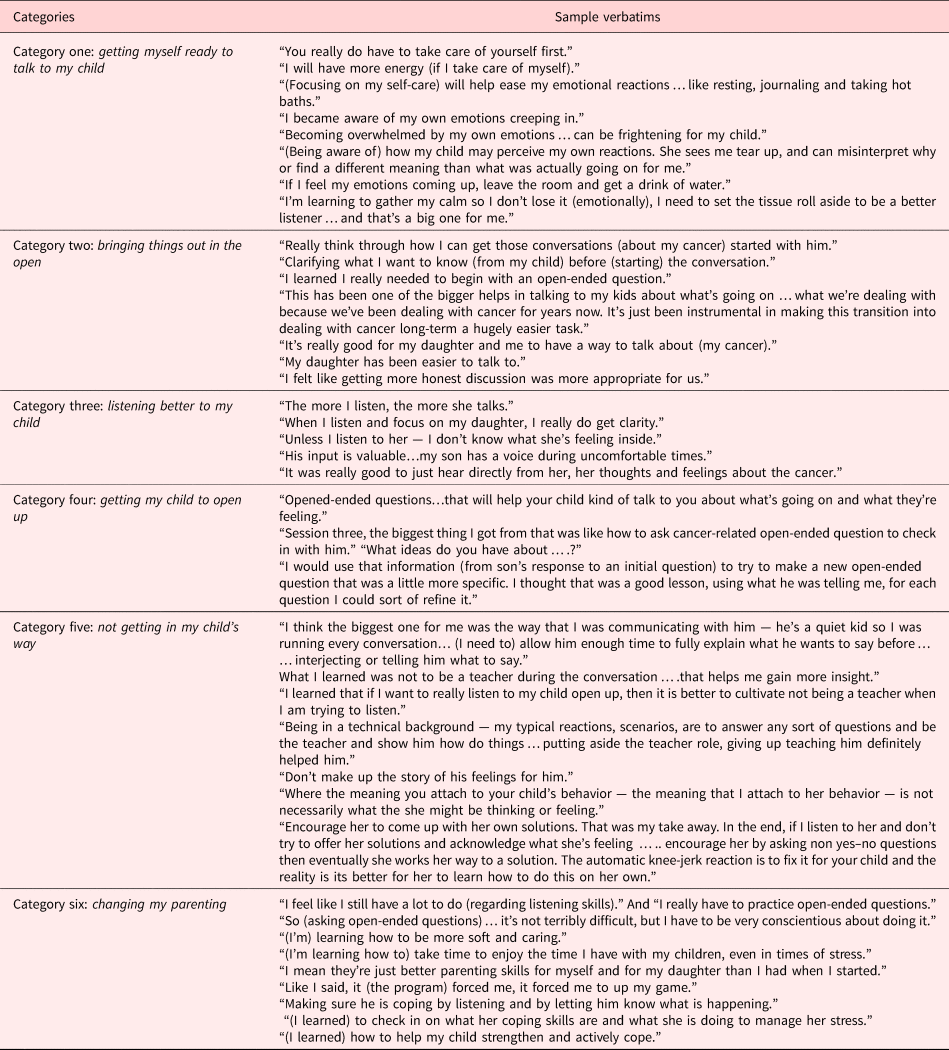
The data analysis yielded six categories of gains parents attributed to their participation in the program: being ready for a conversation about my cancer, bringing things out in the open, listening better to my child, getting my child to open up, not getting in my child's way, and changing my parenting. See Table 3 for additional examples of verbatim statements for each category.
Upping my game as a parent: categories with sample verbatims

Category one: being ready for a conversation about my cancer
Parents identified three strategies they gained from the program they could use before and during a conversation with their child about the cancer. Using these strategies assisted parents to have more satisfying and productive conversations with their child about the cancer. More specifically, these strategies helped parents understand they needed to: prepare themselves, even before starting a conversation; not overwhelm their child with their own emotions while talking to their child; and enact behaviors that contained their emotions if they surfaced during conversations with their child about the cancer.
Parents gained an awareness of the need to attend to their own self-care in order to put themselves in the best position to have a conversation. One parent puts it this way, “(focusing on my self-care) will help ease my emotional reactions … like resting, journaling and taking hot baths.” Parents also learned to notice when their own emotions would begin to surface during a conversation and gained an appreciation of how their emotions could affect their child. Parents felt the program helped them to learn ways to manage those emotions during a conversation. “I'm grateful for the fact that I am learning how to keep my fears under control … when I talk to my kids I need to be calm.”
Category two: bringing things out in the open
To be eligible for the study, the child had to have been told the parent's cancer diagnosis. However, even when the child knew the parent's diagnosis, it did not always mean that the parent had gone beyond disclosing the diagnosis. For some families, the diagnosis of cancer was not new, but the information that the cancer was now life-threatening had not been discussed with the child.
Parents reported that one of the skills they gained from the program was how to initiate a conversation about the cancer with their child, including how to invite their child to share their thoughts and feelings about the cancer. They often remarked that while initiating a conversation about the cancer with their child was not easy, it had some positive benefits. One parent said, “(I'm) feeling like he (my child) has a better understanding of where we are in the process (with my cancer). And that, you know, he knows death is a part of it. And that just hadn't been a conversation we've had. So challenging as that is, it was good to have that conversation as a part of the (session) practice.”
Category three: listening better to my child
A centerpiece of the intervention was engaging the parent in ways to fully attend to their child when their child was speaking and to lay aside anything that would distract them. The parents’ reality was often that of continuing responsibilities for childcare, family, and for some parents, their job while dealing with their own life-threatening illness. As a result, parents stated that they were “not always present” when their child was talking. Parents claimed the program helped them to focus on what their child was saying and to fully attend to their child's needs. They learned to stop what they were doing when their child was talking and to listen attentively. Parents said that they became more aware of the need to “give them (child) space and time to talk.” One parent stated that one of the “biggest” learnings from the program was “just slowing down, listening to them-having a little more patience.” Parents said that they benefitted by practicing listening skills with their patient educator to prepare them for listening to their child. “I thought it was really helpful for me because I hadn't really spent time thinking about how to be a good listener as it related to all this. I always put value on the importance of listening, but working on how to be a good listener (was helpful).”
Category four: getting my child to open up
The program offered parents strategies to encourage their child to fully elaborate their thoughts and feelings. The specific skills they attributed to the program included naming and acknowledging the child's feelings, reflecting back the child's words, giving the child's feelings a name, using neutral responses, and using open-ended questions. Using these skills helped to draw out their child's thoughts and feelings and give the parent a deeper understanding of their child's experience with the parent's cancer. Parents identified how these skills helped them to respond to their child's experience. “What helps me is to reflect back what my child is saying” and “I just acknowledge her feelings and what she is thinking.” Another parent spoke about the benefit of using open-ended questions to help their child further elaborate their thoughts and feelings this way, “opened-ended questions … help your child kind of talk to you about what's going on and what they're feeling.”
Category five: not getting in my child's way
Parents identified how their own behavior before participating in the program ran counter to the skills they were learning in the program. These prior behaviors included: reacting too quickly to what their child was saying; being the “teacher” or jumping in to try to fix or problem-solve; and making assumptions or judgments about their child's behavior. Instead, parent's described new behaviors they were learning: taking time to listen to their child; not interrupting their child when the child was trying to tell the parent a thought or feeling; remaining open to what their child was saying; and allowing the child to learn by solving their own problems. One parent spoke this way about what she had learned, “encourage her (daughter) to come up with her own solutions. That was my take away. In the end, if I listen to her and don't try to offer her solutions and acknowledge what she's feeling … encourage her by asking non yes–no questions, then eventually she works her way to a solution. The automatic knee-jerk reaction is to fix it for your child and the reality is its better for her to learn how to do this on her own.”
Category six: changing my parenting
As a result of going through the program, parents stated that while they felt they still needed more practice on the skills from the program, they felt better about themselves as parents and, in particular, about their ability to help their child cope with their cancer. They reported that the program improved their parenting by helping them learn from their child new ways to support and help their child cope with the cancer. “So, asking him what could I have done better — what could he do when he feels scared or he feels uncomfortable? I would never have come up with that one on my own.”
Two other parents spoke about the impact the program had on their parenting in this way, “You know I have guilt that he's 15 years old and I was doing it, I don't wanna say wrong because I was doing what I thought was ok. But, you know, I have an opportunity. I can correct that and be a really good listener for him” and “I feel like a better mom and you know, I think, before I leave this world, I always wanted to become a better mom.”
Discussion
A fully manualized, brief telephone-delivered educational counseling intervention on listening and support skills between the ill parent and affected child resulted in parent-reported skills and competencies. Parents reported that the program helped them prepare for difficult conversations and initiate and sustain those conversations to uncover their child's thoughts and feelings related to the parents life-threatening cancer diagnosis. Additionally, parents were able to learn valuable information from their child about what the child would find helpful and supportive during this time. No known prior intervention study focused on or achieved these parent-reported results.
Parents living with advanced cancer are living with symptoms from treatment and disease (Loveys and Klaich, Reference Loveys and Klaich1991; Saldinger et al., Reference Saldinger, Cain and Porterfield2004; Park et al., Reference Park, Check and Song2017) which often included very limited energy. Despite this symptom burden, parents were able to be on the telephone for 30–60 min for each of the five telephone sessions. Secondly, parents were willing and able to set aside time to learn new skills to assist them in talking with their child about the cancer. Finally, parents were able to use the skills that led them to uncover and listen to their child's concerns about the parent's cancer.
Symptom burden and incurable disease did not covary with parent-reported gains from participation in the program. Recall that 50% of the parents scored above the clinical cutoff score on depressed mood or anxiety. Ninety-two percent of parents reported symptoms or side effects and 79% were taking medication to manage the symptoms. Study results showed that even symptomatic parents were able to complete five, 30–60 min telephone-delivered intervention sessions, and found the telephone an acceptable channel for communication.
Given the challenge of learning new skills in the face of competing demands, it was unknown whether parents would be able to learn and apply the skills offered in the program and have the courage to listen to their child's worries and concerns about the parent's cancer, including answering questions about the cancer (Barnes et al., Reference Barnes, Kroll and Burke2000). Prior studies showed that some parents choose not to talk with their child about their illness hoping to minimize distress at home (Park et al., Reference Park, Check and Song2017). In one study (Hailey et al., Reference Hailey, Yopp and Deal2018), roughly a third of ill participants interviewed expressed that talking with their child about their illness was stressful. In another study by Turner's team of women with recurrent or metastatic breast cancer, over half the women interviewed (55.2%) described concerns about how to discuss the cancer with their children (Turner et al., Reference Turner, Kelly and Swanson2005). Of particular concern was talking with their child about the possibility of the parent dying from the cancer (Kennedy and Lloyd-Williams, Reference Kennedy and Lloyd-Williams2009; Hailey et al., Reference Hailey, Yopp and Deal2018). Contrary to prior studies by others (Barnes et al., Reference Barnes, Kroll and Burke2000; Park et al., Reference Park, Check and Song2017), parents with cancer in the current study engaged in the skill training sessions and did not hold back from talking with their child about the cancer. And, in their own words, parents offered explicit gains they attributed to the program that helped them to help their child.
The program helped parents cross a threshold they had never crossed before. Despite their advanced disease, some parents reported that they had never before had a conversation with their child about the seriousness of their cancer. Many parents reported that the program had changed their interactions with their child and improved their parenting. Parents, regardless of illness or symptom state, wanted to be the best parent they could be; they wanted to “up their game” as a parent.
The results of this pilot study suggest that the Enhancing Connections Palliative Care Program has the potential to assist many more parents living with incurable cancer help their children. There was no need for “tailoring” or relying on a therapist's astute observations to assist parents gain these competencies (Kennedy et al., Reference Kennedy, McIntyre and Worth2008; Bugge et al., Reference Bugge, Helseth and Darbyshire2009). Instead, the session-specific content focused material carried the program, not the “competencies” of a therapist (Kennedy et al., Reference Kennedy, McIntyre and Worth2008; Bugge et al., Reference Bugge, Helseth and Darbyshire2009). Given that the program is fully manualized and was delivered successfully by telephone, nurses, social workers, child life specialists, and volunteers could be trained to deliver this intervention in a cost-efficient manner. In addition, many cancer support organizations in local communities offer family-focused services that could be augmented and enriched by the Enhancing Connections Palliative Care Program.
Study limitations
There are study limitations. Parents’ responses may be affected by social desirability or self-enhancement bias. Because the patient educator who delivered the intervention also conducted the exit interview, it is always plausible that parents would have reported different or fewer gains to another person. Responses may be influenced by the recency with which parents completed the program. Recall that all data were obtained at the end of the fifth and final intervention sessions. Both the number and types of gains reported immediately at the exit from the program might be different than those reported later. Additionally, the positive orientation of the exit interview question likely skewed study results. Yet to be known are parents’ views of what the program failed to help them gain. Finally, the sample is likely biased toward high functioning parents whose symptom burden was tolerable. Unknown is the response of parents who declined participation. Recall that 16 parents who enrolled withdrew from the study for disease or symptom-related reasons.
Despite study limitations, results suggest that a manualized, brief, phone-delivered parenting intervention to parents with incurable cancer has the potential to positively affect parents’ self-reported competencies. Further testing is warranted with a more diverse study sample and data collection methods that are not confounded by bias.
Acknowledgments
The authors gratefully acknowledge the support of the physicians and staff at the Seattle Cancer Care Alliance who made this research possible by referring their most vulnerable patients and families to participate in the study, Kristin A. Griffith, statistician, and Zainab Alzawad, PhD. We also thank our fellow patient educator, Taryn Oestreich. Above all, we thank the families who participated in this research.
Funding
This research was supported by a grant from the Safeway Foundation, and by donations to the Thoracic, Head and Neck Oncology Research Program of the Seattle Cancer Care Alliance.
Conflict of interest
The content of the manuscript is solely the responsibility of the authors and does not represent the official views of the National Institutes of Health.