Introduction
Falls are a major threat to older people's health and independence, with a third of those aged 65+ residing in the community and half of those in institutions experiencing a fall annually (Kannus et al. Reference Kannus, Sievanen, Palvanen, Jarvinen and Parkkari2005; Rubenstein Reference Rubenstein2006; Skelton and Todd Reference Skelton and Todd2004). While interventions can reduce the rate and risk of falls in older people (Cameron et al. Reference Cameron, Murray, Gillespie, Robertson, Hill, Cumming and Kerse2010; Gillespie et al. Reference Gillespie, Robertson, Gillespie, Lamb, Gates, Cumming and Rowe2009), a zero falls rate is likely not only to be unattainable but also to impinge on human rights of older people in order to achieve it (Nyman and Oliver Reference Nyman, Oliver and Hughes2010; Oliver Reference Oliver2004). Therefore, when falls do occur they need to be effectively managed with one element of this being the prompt summonsing of assistance.
Assistive technology includes a range of interventions from simple aids such as walking sticks and frames to sophisticated home-based systems including telecare, which are used to home-manage various health conditions and facilitate the retention of independence (Audit Commission 2004; Brignell, Wootton and Gray Reference Brignell, Wootton and Gray2007; Brownsell, Aldred and Hawley Reference Brownsell, Aldred and Hawley2007). Personal call alarms are a form of assistive technology that has been developed to reduce long lies: an older person falling and then lying on the floor for an hour or longer. Long lies are estimated to occur in half of the falls experienced in the community (Tinetti, Liu and Claus Reference Tinetti, Liu and Claus1993), and are associated with serious injuries, admissions to hospitals and care homes (Fleming, Brayne and the Cambridge City Over-75s Cohort (CC75C) Study Collaboration Reference Fleming and Brayne2008), and an increased risk of mortality (Gurley et al. Reference Gurley, Lum, Sande, Lo and Katz1996; Wild, Nayak and Isaacs Reference Wild, Nayak and Isaacs1981). Personal call alarms are designed to prevent long lies by providing a faller with the facility to release a distress call when lying on the floor. By pressing a button on a device worn on the neck/wrist an emergency response can be solicited from a relative, service centre, or warden if the dwelling is in sheltered housing. Developments are also being made to automatically detect falls that would negate the need for the user to activate the alarm (e.g. Lee and Carlisle Reference Leone, Diraco and Siciliano2011; Leone, Diraco and Siciliano Reference Leone, Diraco and Siciliano2011); useful for when an older person is confused or left unconscious/disorientated (Brownsell and Hawley Reference Brownsell, Hawley, Wootton, Dimmick and Kvedar2006; Rajendran et al. Reference Rajendran, Corcoran, Kinosian, Alwan, Alwan and Felder2008). However, automatic fall detectors are rarely used at present and require further development because they are prone to false alarms (Brownsell and Hawley Reference Brownsell and Hawley2004; Noury et al. Reference Noury, Rumeau, Bourke, ÓLaighin and Lundy2008; Prado-Velasco et al. Reference Prado-Velasco, del Rio-Cidoncha and Ortiz-Martin2008).
As with the efficacy of assistive technology, information and communication technology (Blaschke, Freddolino and Mullen Reference Blaschke, Freddolino and Mullen2009), and home telecare in general (Martin et al. Reference Martin, Kelly, Kernohan, McCreight and Nugent2008; Takahashi et al. Reference Takahashi, Pecina, Upatising, Chaudhry, Shah, Van Houten, Cha, Croghan, Naessens and Hanson2012), the evidence-base is limited for the efficacy of personal call alarms to improve older people's health and social care (Barlow et al. Reference Barlow, Singh, Bayer and Curry2007). In addition, particularly in England as telecare has been incentivised (Department of Health 2009), research is required into the demand for personal call alarms by older people (and by those caring for them) to avoid investment in technology that older people do not find acceptable (Karafyllis Reference Karafyllis, Sollie and Düwell2009). For example, hip protectors appear not only to be ineffective in reducing fall-related fractures (Kiel et al. Reference Kiel, Magaziner, Zimmerman, Ball, Barton, Brown, Stone, Dewkett and Birge2007; Parker, Gillespie and Gillespie Reference Parker, Gillespie and Gillespie2006) but have low acceptability and usage amongst older people (Cameron and Quine Reference Cameron and Quine1994; Parker, Gillespie and Gillespie Reference Parker, Gillespie and Gillespie2005).
An early study suggested a reasonable uptake (65%) for personal call alarms among frail older Americans (age not reported) and that 88 per cent held positive attitudes toward them after use (Dibner, Lowy and Morris Reference Dibner, Lowy and Morris1982). Another American study suggested personal call alarms were used on average for 26 months, however, less than half of users (average age 83±9) always wore the device when alone in their home (Levine and Tideiksaar Reference Levine and Tideiksaar1995). More recent studies have suggested that usage rates of personal call alarms are low among Americans with disabilities aged 60+ (16%) (Mann et al. Reference Mann, Belchior, Tomita and Kemp2005), and community-dwelling people in Flanders aged 70–89 rarely possessed (3%) or used them (3%) (Roelands et al. Reference Roelands, Van Oost, Depoorter and Buysse2002b). While a Canadian study found high acceptability for personal call alarms (86–94%) and automatic fall detectors (65–79%) among baby-boomers and older adults (average ages of 45–49 and 70–74, respectively) (Mihailidis et al. Reference Mihailidis, Cockburn, Longley and Boger2008), a study in Hong Kong found that although adults aged 65+ generally perceived personal call alarms to be useful there was low interest in actually using one (Lai et al. Reference Lai, Chung, Leung, Wong and Mak2010).
For the current study we were interested in the use of personal call alarms in England. There is some evidence of demand amongst adults aged 72–82 in England for assistive devices in general (Pain et al. Reference Pain, Gale, Watson, Cox, Cooper and Sayer2007) and personal call alarms in particular: 136 out of 176 sheltered housing residents (mean age of 76) showed interest in using them (Brownsell et al. Reference Brownsell, Bradley, Bragg, Catlin and Carlier2000), and 31 out of 204 (mean age of 83) who had fallen and not bought assistive technology were paying for a weekly personal call alarm service (Logan et al. Reference Logan, Murphy, Drummond, Bailey, Radford, Gladman, Walker, Robertson, Edmans and Conroy2007). A population-based study in Cambridge (United Kingdom) also reported that 51 out of 81 nonagenarians in the community or sheltered housing owned a personal call alarm (Fleming, Brayne and the CC75C Study Collaboration Reference Fleming and Brayne2008). However, these previous studies are limited in that they recruited specific subgroups of the older population and did not recruit from the general population aged 65+ living in the community. In addition, previous studies have recruited small samples prohibiting subgroup analyses to explore the characteristics of users.
A characteristic of particular interest with the use of personal call alarms is household composition. While living alone may not be predictive of use of assistive technology in general (McCreadie and Tinker Reference McCreadie and Tinker2005), it has been suggested that those living alone are more likely to use a personal call alarm (De San Miguel and Lewin Reference De San Miguel and Lewin2008) and be more willing to consider using video monitoring for falls detection in the home (Londei et al. Reference Londei, Rousseau, Ducharme, St-Arnaud, Meunier, Saint-Arnaud and Giroux2009). Older people living alone make greater use of formal care services (Larsson and Thorslund Reference Larsson and Thorslund2002), and may well be under more pressure from health professionals and relatives to use a personal call alarm. Indeed, peace of mind for families has been cited as a reason for using a personal call alarm (Johnston, Grimmer-Somers and Sutherland Reference Johnston, Grimmer-Somers and Sutherland2010). Thus, the aim of this study was to investigate the proportion of users of personal call alarms in a large English sample and explore the characteristics of users. In particular, we wanted to explore whether the characteristics of adults aged 65+ that use personal call alarms differ between those living alone and those living others.
Method
We conducted a secondary cross-sectional analysis of data from the English Longitudinal Study of Ageing (ELSA) (Marmot et al. Reference Marmot, Nazroo, Banks, Blundell, Erens, Lessof and Huppert2008). The survey originally recruited participants from the annual government-funded Health Survey for England that used postal codes representative of the general English population (Taylor et al. Reference Taylor, Conway, Calderwood, Lessof, Marmot, Banks, Blundell, Lessof and Nazroo2003). While those dwelling in institutions were excluded from ELSA and loss of representativeness may have occurred when re-contacting adults (Vlachantoni Reference Vlachantoni2010), the ELSA dataset is widely used and regarded as broadly representative of adults aged 50+ living in private households in England (e.g. Gilleard, Hyde and Higgs Reference Gilleard, Hyde and Higgs2007; Lang et al. Reference Lang, Llewellyn, Alexander and Melzer2008; Stafford et al. Reference Stafford, McMunn and de Vogli2011; Stevens et al. Reference Stevens, Lang, Guralnik and Melzer2008).
We used the third wave (May 2006 to August 2007) of ELSA that recruited 9,771 adults (Taylor et al. Reference Taylor, Conway, Calderwood, Lessof, Marmot, Banks, Blundell, Lessof and Nazroo2003), which mainly comprised those aged 54+ who had participated in previous waves (N=8,038), with an individual response rate of 73 per cent (Marmot and Breeze Reference Marmot, Breeze, Banks, Breeze, Lessof and Nazroo2008; Scholes, Cox and Lessof Reference Scholes, Cox, Lessof, Banks, Breeze, Lessof and Nazroo2008). From the sample of 4,422 adults aged 65+, 3,091 (70%) reported difficulty with either mobility, activities of daily living (ADL, e.g. bathing), or instrumental activities of daily living (IADL, e.g. shopping and cooking), and were subsequently asked the question on personal call alarm use that was our dependent variable. In face-to-face structured interviews participants were asked to report if they used any of eight assistive devices, one of which was a personal alarm, ‘used to call for assistance after falls etc.’ (Nunn et al. Reference Nunn, Cox, Wood and Scholes2009: 173). The third wave of ELSA was granted ethical approval from the Multicentre Research and Ethics Committee (Nunn et al. Reference Nunn, Cox, Wood and Scholes2009: 4) and we registered our study (No. 39558) with the Economic and Social Data Service (www.esds.ac.uk) to obtain permission to access the data file.
Independent variables
Our main independent variable was household composition, which was dichotomised into living alone versus living with others (one or more other persons). We then selected 16 further independent variables from factors known to increase the risk of falls: socio-demographics, poor health and low psychological functioning (Lord et al. Reference Lord, Sherrington, Menz and Close2007; Todd, Ballinger and Whitehead Reference Todd, Ballinger and Whitehead2007). In addition, we selected variables pertaining to use of communications technology with the assumption that familiarity with this technology may in part predict use of assistive technology.
Socio-demographics
We included age, gender, ethnicity and socio-economic status. Because ELSA had collapsed the oldest participant ages into 90+, we categorised age into groups of 65–74, 75–84 and 85+. Ethnicity was already collapsed into two options – white and non-white – to ensure confidentiality and anonymity of the limited number of participants from minority groups. Wealth was used as a measure of socio-economic status as conducted with previous waves of ELSA (Stafford, McMunn and de Vogli Reference Stafford, McMunn, Zaninotto and Nazroo2011; Stafford et al. Reference Stafford, McMunn and de Vogli2011). Wealth has been found to be a more sensitive measure of socio-economic position in later life, perhaps because it is more accurate or mediates other indices such as education and occupational class (Marmot and Breeze Reference Marmot, Nazroo, Banks, Blundell, Erens, Lessof and Huppert2008; Tabassum et al. Reference Tabassum, Verropoulou, Tsimbos, Gjonca and Breeze2009). A previous measure of wealth was used that summed several items (Tabassum et al. Reference Tabassum, Verropoulou, Tsimbos, Gjonca and Breeze2009). Items to assess wealth included the value of properties, land, assets, business shares, life assurance, stocks and shares, bonds and gilts, unit and investment trusts, and the amounts held in current and savings accounts.
Health
We included four measures specific to falls and two measures of general health. For falls, participants were asked whether they had fallen down in the past two years, and if so, the number of times they had fallen, if any falls resulted in injury that required medical treatment, or if any falls resulted in hip fracture. To avoid small-sample subanalyses, those that reported no falls in the past two years were included in the subsequent variables, i.e. number of falls were ⩾0, and those that did not report a fall-related injury or hip fracture included those that had not fallen and those that had fallen but not experienced an injury or fracture. For general health, given that each participant had reported difficulty with either mobility or ADLs/IADLs, all of our sample would report some degree of health problem. We thus created two variables that measured the severity of difficulty with everyday tasks and summed the number of items participants reported difficulty with mobility (range 1–10) and ADL/IADL (range 1–13).
Psychological functioning
We included measures of depression, quality of life, social isolation and cognitive functioning. Depressive symptoms were measured using the eight-item version of the Center for Epidemiologic Studies Depression Scale (CES-D) (Radloff Reference Radloff1977). As defined previously (McMunn et al. Reference McMunn, Nazroo, Wahrendorf, Breeze and Zaninotto2009), presence of depression was defined as reporting four or more symptoms.
In addition to face-to-face interviews, ELSA participants were asked to self-complete a questionnaire that included the CASP-19 scale, a measure of quality of life derived from a needs satisfaction approach (Hyde et al. Reference Hyde, Wiggins, Higgs and Blane2003). Based on Abraham Maslow's hierarchy of needs, the 19-item measure comprises four subscales: Control, Autonomy, Self-realisation and Pleasure. Control is understood as the ability to influence one's environment; autonomy as freedom from unwanted interference, and self-realisation and pleasure as the active and reflective processes of being human (capturing satisfaction and enjoyment) (Hyde et al. Reference Hyde, Wiggins, Higgs and Blane2003). As intended by the authors, we used the sum score for the total and four subscales. The self-completion questionnaire also included a measure of perceived social isolation, which was measured with one item that asked whether participants felt isolated from others (hardly ever or never, some of the time, or often).
Cognitive functioning was assessed through five items pertaining to orientation, registration, fluency, prospective memory and speed. Orientation was scored on a four-point scale of whether the correct date was given (correct day of the week, day of the month, month and year). Registration was the number of words recalled from a list of ten. Fluency was the number of animals freely recalled. Prospective memory was assessed by whether the participant correctly remembered to write their initials at the top left-hand side of a piece of paper when handed to them, but instructed to do so at an earlier time in the assessment. Lastly, speed was the number of letters correctly marked in a letter cancellation task. A composite score for cognitive function was created by categorising participants into low/high functioning for each of the above five tests (1=incorrect/below median, 2=correct/above median), and with total possible sum scores of 5–10.
Use of communications technology
The self-completion questionnaire for ELSA contained two further items that we included; whether they currently used the internet and/or email and owned a mobile phone.
Analysis
Analyses were conducted using PASW Statistics 18. To check for sampling bias, four multivariate logistic regressions were conducted (enter method of variable entry) separately for socio-demographics, health, psychological functioning and use of communications technology to test whether there were significant differences between our sample and those that did not report difficulty with mobility or ADL/IADL. Separately for those that reported either living alone or with others, we then computed descriptive statistics on self-reported use of a personal call alarm as a function of the aforementioned 16 independent variables, and tested the significance of these variations with bivariate logistic regressions. The independent variables for which these bivariate regressions showed significant (at p<0.05) associations with personal call alarm use were then included in a multivariate logistic regression (enter method of variable entry) to calculate adjusted odds ratios, separately for those that reported living alone or with others.
Results
From 4,422 respondents aged 65+, 3,091 reported difficulty with mobility or ADL/IADL, and thus were invited to respond to the question for our dependent variable of use of a personal call alarm. In comparing our sample with the 1,331 that did not report difficulty with mobility or ADL/IADL, analyses indicated that our sample was biased on ten independent variables. Adults aged 65+ (N=4,422) were significantly less likely to report difficulty with mobility or ADL/IADL if they were: younger, male, more wealthy, had not fallen or sustained a fall-related injury in the past two years, did not report depressive symptoms, reported a relatively higher level of quality of life, a relatively higher level of cognitive functioning, used the internet and/or email, and owned a mobile phone. However, there was no significant difference between participants who did or did not report difficulty with mobility or ADL/IADL as a function of household composition, ethnicity, fall-related hip fracture or perceived social isolation (severity of difficulty with mobility and with ADL/IADL were not analysed given our sample comprised only those that reported problems with these).
Although participants in our sample were biased according to the aforementioned variables, and so were more likely to be fallers and more likely to report using a personal call alarm, our sample for analysis had an age and gender distribution similar to that expected from the national population. In particular, our sample bore a close resemblance to the expected percentage distribution for females, but under-represented males aged 65–74 by 7 per cent and over-represented males aged 75–84 and 85+ by 4 and 3 per cent, respectively (National Statistics 2010a, 2010b).
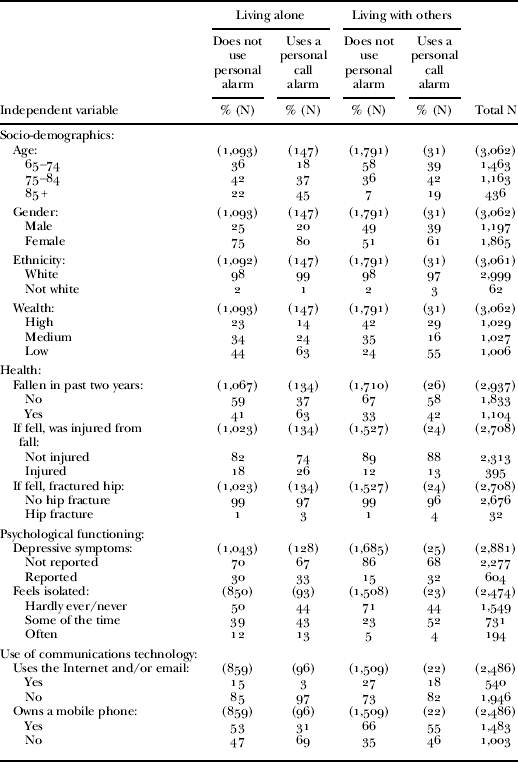
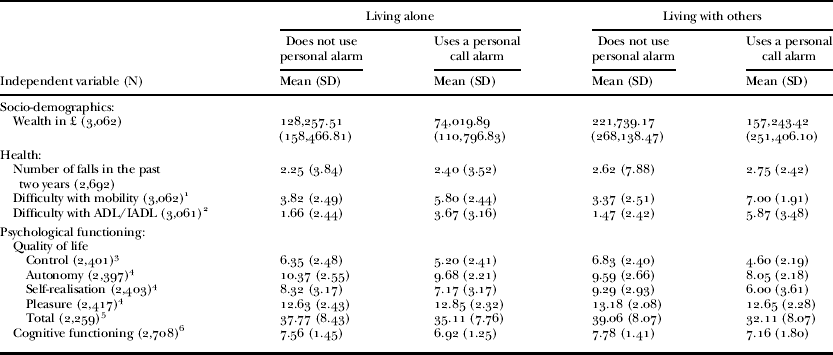
From our sample of 3,091 adults aged 65+, 180 (6%) self-reported use of a personal call alarm. In a logistic regression, those that reported living alone were significantly more likely to report using a personal call alarm (147 of 1,240, 12%) compared with those that reported living with others (31 of 1,822, 2%) (odds ratio (OR)=7.77, 95% confidence interval (CI)=5.24–11.53, p<0.001). The descriptive statistics of the sample as a function of self-reported use of a personal call alarm and household composition are presented in Tables 1 and 2 for the categorical and continuous variables, respectively. As there were missing data in 29 cases for household composition, the inferential statistics reported below were from a total sample of 3,062 adults aged 65+.
Percentages (within columns) of self-reported use of a personal call alarm as a function of household composition

Means and standard deviations (SD) of independent variables as a function of self-reported use of a personal call alarm and household composition
Notes:1. Possible scores range 1–10, with higher scores indicating greater difficulty with mobility.
2. Possible scores range 1–13, with higher scores indicating greater difficulty with activities of daily living (ADL) or instrumental activities of daily living (IADL).
3. CASP-19 subscale; possible scores range 0–12, with higher scores indicating better quality of life.
4. CASP-19 subscale; possible scores range 0–15, with higher scores indicating better quality of life.
5. CASP-19 summed total; possible scores range 0–57, with higher scores indicating better quality of life.
6. Possible scores range 5–10, with higher scores indicating better cognitive functioning.
Socio-demographics
Compared to those aged 65–74, adults aged 85+ were significantly more likely to report use of personal call alarms whether living alone or with others. However, only those aged 75–84 and living alone were also significantly more likely to use personal call alarms compared to respondents aged 65–74. There was no significant difference in self-reported use of personal call alarms as a function of gender. We had planned to conduct a bivariate regression of personal call alarm use as a function of ethnicity, however, only 63 participants represented non-white ethnic groups. Consequently, the expected frequency was too low for those that reported living with others and using a personal call alarm, which violated the assumption of logistic regression that no more than 20 per cent of cells have an expected frequency below 5 (Field Reference Field2009: 274). The comparable assumption was violated when we attempted to input wealth as a continuous variable due a highly non-normal distribution (leptokurtic) (Field Reference Field2009). However, wealth could be included in the model once collapsed into tertiles. Compared to those in the highest wealth tertile, those living alone and living with others in the lowest wealth tertile were significantly more likely to self-report use of a personal call alarm. There was no significant difference between the middle and highest wealth tertiles.
Health
Participants who reported experiencing a fall in the past two years were significantly more likely to self-report personal call alarm use, but only for those that were living alone. There was no significant difference according to the number of falls experienced. Unfortunately, the variables of fall-related injury and fall-related hip fracture could not be analysed because the expected frequencies were too low for those that reported living with others and using a personal call alarm (Field Reference Field2009: 274). Older people living alone and with others who reported greater difficulty with mobility were significantly more likely to self-report using a personal call alarm, as were those who reported greater difficulty with ADL/IADL.
Psychological functioning
Unfortunately, depressive symptoms could not be analysed because the expected frequency was too low for those that reported living with others and using a personal call alarm (Field Reference Field2009: 274). For both those living alone and with others, those that scored a lower level of cognitive function were significantly more likely to self-report using a personal call alarm, as were those that reported a lower level of quality of life. For the quality of life subscales, three out of four were significant for both those living alone and with others, in that personal call alarm users were more likely to report lower scores for control, autonomy and self-realisation (pleasure was not significant). For those living alone, there was no significant difference in self-reported use of a personal call alarm as a function of perceived isolation. However, for those living with others, compared to those that felt isolated hardly ever or never, those that reported feeling isolated some of the time were significantly more likely to self-report using a personal call alarm (but not those that reported feeling isolated often).
Use of communications technology
For those living alone, those who reported that they did not use the internet and/or email were significantly more likely to self-report using a personal call alarm, as were those that reported that they did not own a mobile phone. However, both variables were not significant for those living with others.
Multivariate analysis
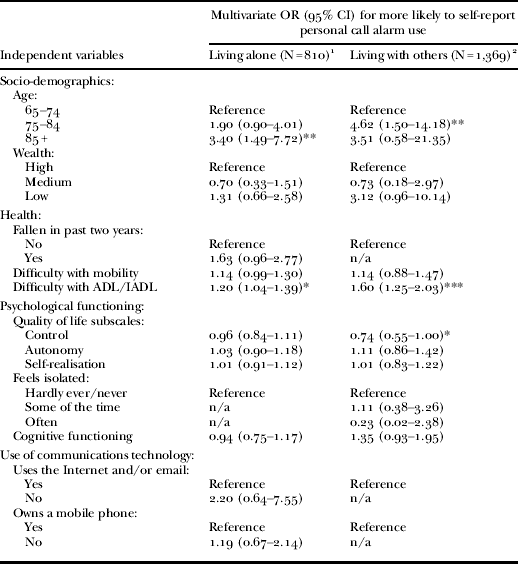
We entered the significant variables from the above bivariate tests into a multivariate logistic regression to predict self-reported use of a personal call alarm as a function of household composition (see Table 3). For both those living alone and with others, those that reported greater difficulty with ADL/IADL were significantly more likely to self-report using a personal call alarm. Another variable and one with the highest odds ratios was age, but the predictors differed according to household composition. For those living alone, aged 85+ (versus 65–74) was significantly predictive of self-reported personal call alarm use, whereas for those living with others, aged 75–84 (versus 65–74) was significantly predictive. An additional significant variable for those living with others was the quality of life subscale for control, in that those with lower levels of control were significantly more likely to self-report using a personal call alarm. For those living with others, those that reported low (versus high) wealth were marginally but not significantly more likely to self-report using a personal call alarm (p=0.058). When the multivariate logistic regressions were repeated using the total CASP-19 sum score in place of the three subscales, the total measure of quality of life was not significant.
Multivariate predictors of self-reported personal call alarm use as a function of household composition
Notes: Results from multivariate logistic regression with only the significant bivariate relationships entered. OR: odds ratio. CI: confidence interval. ADL: activities of daily living. IADL: instrumental activities of daily living. n/a: not applicable.
1. R 2=0.093 (Cox & Snell), 0.203 (Nagelkerke). Model χ 2(13)=79.00, p<0.001.
2. R 2=0.047 (Cox & Snell), 0.332 (Nagelkerke). Model χ 2(12)=65.90, p<0.001.
Significance levels:* p<0.05,
** p<0.01
*** p<0.001.
Discussion
Using cross-sectional data from ELSA, we investigated the proportion of users of personal call alarms and explored the characteristics of these users. Building on prior research that recruited small samples of subgroups of the older population, this study made use of a large English sample from the general population of adults aged 65+ living in the community. Given the more substantial sample size, our study adds to the literature by reporting that only 6 per cent of 3,091 adults aged 65+ self-reported using a personal call alarm, and that usage was much higher among those living alone than with others (12% versus 2%). Previous studies that solicited older people for their opinion on personal call alarms have found high rates for acceptance (65–94%) (Brownsell et al. Reference Brownsell, Bradley, Bragg, Catlin and Carlier2000; Dibner, Lowy and Morris Reference Dibner, Lowy and Morris1982; Mihailidis et al. Reference Mihailidis, Cockburn, Longley and Boger2008) and positive attitudes toward them after use (88%) (Dibner, Lowy and Morris Reference Dibner, Lowy and Morris1982). However, our results are similar to previous studies that recruited older people from the community and sheltered housing that reported low rates for use of personal call alarms in terms of possession (3–15%) (Logan et al. Reference Logan, Murphy, Drummond, Bailey, Radford, Gladman, Walker, Robertson, Edmans and Conroy2007; Roelands et al. Reference Roelands, Van Oost, Depoorter and Buysse2002b), and use (3%) (Roelands et al. Reference Roelands, Van Oost, Depoorter and Buysse2002b), including use among those with disabilities (16%) (Mann et al. Reference Mann, Belchior, Tomita and Kemp2005). Personal call alarms may be used to a much lesser extent than other assistive devices, as older people's adherence to prescribed assistive technology for mobility, bathing and dressing, etc. has been reported to lie in the range of 35–87 per cent (Steel and Gray Reference Steel and Gray2009).
Thus, it appears that personal call alarms are highly accepted but rarely used, which resonates with the results of a survey conducted in Hong Kong (Lai et al. Reference Lai, Chung, Leung, Wong and Mak2010), and an earlier finding that older people perceive falls prevention interventions to be helpful in general but not relevant for them personally due to a low perceived risk of falls (Braun Reference Braun1998; Yardley et al. Reference Yardley, Donovan-Hall, Francis and Todd2006). As our finding of low personal call alarm use relates to previous studies conducted in Flanders (Roelands et al. Reference Roelands, Van Oost, Depoorter and Buysse2002b), America (Levine and Tideiksaar Reference Levine and Tideiksaar1995; Mann et al. Reference Mann, Belchior, Tomita and Kemp2005) and Hong Kong (Lai et al. Reference Lai, Chung, Leung, Wong and Mak2010), we suggest that it may apply to community-dwelling older people in other countries. However, findings from a population-based sample of the ‘oldest old’ in Cambridge found the proportion of very old people with personal call alarms (63% of >90-year-olds not in long-term care) was much higher than we found in even our oldest age-band of 85+ (20%) (Fleming, Brayne and the CC75C Study Collaboration Reference Fleming and Brayne2008). Further research could explore this discrepancy in findings and investigate whether there are significant geographical differences in provision and uptake of personal call alarms.
Building on prior research that was prohibited in exploring subgroup analyses due to small sample sizes, this study explored the characteristics of users of personal call alarms who were either living alone or with others. Our study adds to the literature in finding that for those living alone, 12 of the 16 independent variables entered were significant at the bivariate level (five items were from the quality of life total and four subscales), and similarly for those living with others, 10 of the 16 independent variables entered were significant at the bivariate level. However, in the multivariate analyses, the adjusted odds ratios were all reduced and only two variables remained significant for those living alone and three for those living with others. This suggests that the independent variables were mediated by the variables found significant at the multivariate level. The predictor variables significant at the multivariate level for both those living alone and with others were severity of difficulty with ADL/IADL and age, and for those living with others only, the quality of life subscale for control.
For both those living at home and with others, severity of difficulty with ADL/IADL was the only health variable that remained significant at the multivariate level. Our finding that those who reported greater difficulty with ADL/IADL were more likely to self-report using a personal call alarm is consistent with prior studies that have found the presence of long-standing illnesses to increase the risk of falls (Tinetti, Williams and Mayewski Reference Tinetti, Williams and Mayewski1986); use of assistive mobility devices to predict use of personal call alarms (Levine and Tideiksaar Reference Levine and Tideiksaar1995); and lower body disability and obesity (Pressler and Ferraro Reference Pressler and Ferraro2010) and severity of disability (McCreadie and Tinker Reference McCreadie and Tinker2005) to predict use of assistive devices.
For both those living at home and with others, age was the only socio-demographic variable that remained significant at the multivariate level. For those living alone, those aged 85+ were more likely to self-report using a personal call alarm. Use of personal call alarms would be expected to be linked with older age – and more so among those aged 85+ – as falls are more frequent as age advances (Fleming et al. Reference Fleming, Matthews and Brayne2008; Skelton and Todd Reference Skelton and Todd2004). Personal call alarm use has previously been predicted by being aged 80+ (De San Miguel and Lewin Reference De San Miguel and Lewin2008), and use of assistive devices predicted by advanced age (McCreadie and Tinker Reference McCreadie and Tinker2005; Pressler and Ferraro Reference Pressler and Ferraro2010). However, for those living with others, those aged 75–84 were more likely to self-report using a personal call alarm. This result does not follow the expected trend of increasing frailty – and therefore need for a personal call alarm – with advancing age. Nor can it be explained by the other variables controlled for in this study such as wealth, cognitive functioning and difficulty with mobility. It is thus a finding that could be explored in future studies: it may be that older people living alone have care needs that go unnoticed for many years whereas those living with others have them identified much earlier. It may also represent a survival effect given that 70 per cent of our sample aged 85+ was living alone. Wealth was marginally not significant for those living with others and so would be a further variable to explore in future studies.
From the remaining variables pertaining to psychological functioning and use of communications technology, the only further variable that was significant at the multivariate level was the quality of life subscale for control for those living with others. Control refers to the ability to influence one's environment (Hyde et al. Reference Hyde, Wiggins, Higgs and Blane2003), and those with lower levels of control and living with others were significantly more likely to self-report using a personal call alarm. As control was significant in addition to severity of difficulty with ADL/IADL, this finding supports the notion that older people have a felt (subjective) need as well as assessed (objective) need for assistive technology (Tinker and Lansley Reference Tinker and Lansley2005; Wielandt and Strong Reference Wielandt and Strong2000). In the current study, control serves as a subjective need and difficulty with ADL/IADL an objective need for a personal call alarm. In the literature, quality of life has been used as an outcome rather than as a predictor variable, for example in showing lower levels of quality of life are reported by those with functional limitations (Blane, Netuveli and Montgomery Reference Blane, Netuveli and Montgomery2008) and higher levels are reported by those that use assistive technology (Matlabi, Parker and McKee Reference Matlabi, Parker and McKee2011). In relation to falls, lower levels of quality of life have been associated with both falls risk factors (balance, functional mobility, muscle strength and fear of falling) (Ozcan et al. Reference Ozcan, Donat, Gelecek, Ozdirenc and Karadibak2005) and experiencing a fall (Hartholt et al. Reference Hartholt, van Beeck, Polinder, van der Velde, van Lieshout, Panneman, van der Cammen and Patka2011). As noted above with age, control could be explored in depth in future research to examine why it was only significant for those living with others, and for example whether this reflects better identification of care needs or a survival effect.
Limitations and suggestions for future research
We report a study that has made effective use of existing data, though by design, our secondary data analysis was limited in that the data set used was not originally collected for the purpose of our study (Victor Reference Victor, Jamieson and Victor2002). The ELSA survey did not include further information that would have been of interest for our analysis, which further research could explore. Information on how often personal call alarms are worn or activated would be useful, which is unlikely to be often given the findings from previous studies (Fleming, Brayne and the CC75C Study Collaboration Reference Fleming and Brayne2008; Levine and Tideiksaar Reference Levine and Tideiksaar1995), though an Australian study reported high use around the home and in the garden (De San Miguel and Lewin Reference De San Miguel and Lewin2008). Fear of falling is another variable of interest, as concern with falling has been found to predict personal call alarm use (Mann et al. Reference Mann, Belchior, Tomita and Kemp2005). Though, while it has been reported that personal call alarm use can reduce fear of falls and increase perceived confidence and security (De San Miguel and Lewin Reference De San Miguel and Lewin2008; Mann et al. Reference Mann, Belchior, Tomita and Kemp2005), results from a randomised controlled trial do not support this conclusion (Lee et al. Reference Lee, Hurley, Carew, Fisher, Kiss and Drummond2007).
Further research could build on our findings and explore further why older people rarely use personal call alarms. Low usage of assistive technology may be because of either lack of awareness of such technology and training in its use among older people; lack of involvement of older people in its development (Selwyn Reference Selwyn2004; Selwyn et al. Reference Selwyn, Gorard, Furlong and Madden2003); or both (Charness and Czaja Reference Charness, Czaja, Johnson, Bengtson, Coleman and Kirkwood2005). In regard to awareness, a study in Belgium suggested that older people were more likely to choose not to use a personal alarm system than be unaware of them (60% versus 25%) (Roelands et al. Reference Roelands, Van Oost, Buysse and Depoorter2002a). In regard to involving older people in the design of personal call alarms, future research could determine whether low usage is more determined by (a) lack of felt need or (b) lack of acceptability of the device (McCreadie and Tinker Reference McCreadie and Tinker2005). Resistance to using personal call alarms has been reported in frail older women despite a perceived risk of long lies (Porter and Ganong Reference Porter and Ganong2002). Thus, low use may be due to older people protecting their self-identity (Johnston, Grimmer-Somers and Sutherland Reference Johnston, Grimmer-Somers and Sutherland2010), in that using a personal call alarm may be perceived as a symbol of frailty and dependency as noted with fall detectors, bed occupancy sensors and other assistive devices (Gitlin, Luborsky, and Schemm Reference Gitlin, Luborsky and Schemm1998; Horton Reference Horton2008). Control has also been noted as a barrier to using automatic falls detectors because of older people's fear of the device activating false alerts (Brownsell and Hawley Reference Brownsell and Hawley2004; Fleming, Brayne and the CC75C Study Collaboration Reference Fleming, Matthews and Brayne2008), and so the manual activation of alerts using personal call alarms were preferred (Horton Reference Horton2008).
Implications for policy and practice
From a large sample of community-dwelling adults aged 65+ in England, our study indicates that self-reported use of personal call alarms is rare. While such technology may not be appropriate for all older people dwelling in the community, it appears that among this group there is inadequate prevention of long lie-related serious injury and consequent hospital treatment, care home admission or fatality (Fleming, Brayne and the CC75C study collaboration 2008; Gurley et al. Reference Gurley, Lum, Sande, Lo and Katz1996; Wild, Nayak and Isaacs Reference Wild, Nayak and Isaacs1981). Our study found that while the experience of a fall in the past two years among those living alone significantly predicted use of personal call alarms at the bivariate level (but not for those living with others), it did not remain significant at the multivariate level. In addition, our study found that use of personal call alarms was not significantly predicted by the number of falls experienced in the past two years for either those living alone or with others at both the bivariate and multivariate levels. Perhaps this reflects both the high frequency of falls among older people and that they are often interpreted as mild accidents rather than indicating a reduction in physical functioning (Kingston Reference Kingston2000; McKee Reference McKee1998). Indeed, it may be that personal call alarms are only acquired after a fall has resulted in hip fracture or hospital admission, which occurs in approximately 5 and 10% of falls among those aged 65+ and 75+, respectively (Rubenstein Reference Rubenstein2006). Perhaps the decision to acquire a personal call alarm rests on an older person's assessment of whether they are able to function independently (or with their existing level of support), and that the predictors of personal call alarm use that remained significant at the multivariate level in our study are more informative for this assessment than fall history.
Of the myriad of possible factors that may predict use of personal call alarms (Charness and Boot Reference Charness and Boot2009; Fisk et al. Reference Fisk, Rogers, Charness, Czaja and Sharit2009; Rogers and Fisk Reference Rogers and Fisk2010), our study indicated that older people in the community most likely to accept a personal call alarm are those living alone, who require assistance with everyday activities, who are relatively older, and those living with others who feel relatively less able to influence their environment. However, practitioners should be reminded that advances in technology raise both new possibilities and concerns (Sollie and Düwell Reference Sollie, Düwell, Sollie and Düwell2009; Vedder and Custers Reference Vedder, Custers, Sollie and Düwell2009), and ethical concerns in particular (Bruce Reference Bruce2012; Ganyo, Dunn and Hope Reference Ganyo, Dunn and Hope2011; Punie Reference Punie and Silverstone2005; Remmers Reference Remmers2010; Rosenberg, Kottorp and Nygård Reference Rosenberg, Kottorp and Nygård2011). As our study underlines, assistive technology such as personal call alarms must be desirable as well as feasible (Karafyllis Reference Karafyllis, Sollie and Düwell2009). A novel approach that requires older people to self-report their daily activity and use of space shows promise as a way of collaboratively highlighting ways that homes can be made safer including the use of assistive technology (Bailey et al. Reference Bailey, Foran, Ní Scanaill and Dromey2011).
Despite the potential of personal call alarms to prevent serious injury, our findings suggest that they are very rarely used among community-dwelling older people. It remains to be seen whether initiatives to increase use of personal call alarms can be effective or whether such alarms constitute too great a compromise to most older people's self-identity as usage may be perceived as a symbol of frailty and dependency.
Acknowledgements
We thank Craig Catling for his assistance with some initial reviewing of the literature and preliminary descriptive statistics while acting as a temporary research assistant for the ENABLE project, when both authors were at the University of Reading. We also thank Finbarr Martin, Jane Fleming and Andy Mayers for their comments on an earlier version of this manuscript. The data were made available through the UK Data Archive. ELSA was developed by a team of researchers based at the National Centre for Social Research, University College London and the Institute for Fiscal Studies. The data were collected by the National Centre for Social Research. The funding is provided by the National Institute of Aging in the United States, and a consortium of UK government departments coordinated by the Office for National Statistics. The developers and funders of ELSA and the Archive do not bear any responsibility for the analyses or interpretations presented here.