INTRODUCTION
Barley (Hordeum vulgare L.) is one of most important cereal crops in the world as well as in the Czech Republic where spring barley is grown for domestic and international markets in malting and brewing and for animal feed. Powdery mildew caused by the airborne fungus Blumeria graminis f. sp. hordei (Bgh) is a worldwide disease with potential to cause frequent epidemics in Central and Northwestern Europe (Wolfe et al. Reference Wolfe, Brändle, Koller, Limpert, McDermott, Müller and Schaffner1992; Jørgensen Reference Jørgensen1994; Dreiseitl Reference Dreiseitl2011). Although it can be controlled by fungicides, host resistance is an efficient and more environmentally acceptable way of limiting its effect on yield and quality.
Psaknon was one of the first varieties in which resistance to powdery mildew was found and the corresponding gene was designated Mlp1 (Stanford & Briggs Reference Stanford and Briggs1940). Since then, Psaknon has been tested widely (Hiura Reference Hiura1960; Brückner Reference Brückner1964; Moseman Reference Moseman1968; Nover Reference Nover1972; Wiberg Reference Wiberg1974) and always showed resistance to all screened isolates except those from Israel (Koltin et al. Reference Koltin, Kenneth and Wahl1964; Eyal et al. Reference Eyal, Yurman, Moseman and Wahl1973; Dreiseitl et al. Reference Dreiseitl, Dinoor and Kosman2006). Psaknon was reported to originate from Australia (Moseman Reference Moseman1955), but this is questionable (G. Platz, personal communication). This doubt is supported by the fact that Mlp1 was not detected in any variety grown in Australia (Dreiseitl & Platz Reference Dreiseitl and Platz2012) and no corresponding virulence was found in any of 362 isolates originating from Australian barley production areas (Dreiseitl et al. Reference Dreiseitl, Fowler and Platz2013).
While studying the resistance of barley to powdery mildew (Dreiseitl Reference Dreiseitl2013a , Reference Dreiseitl b ), varieties with resistance other than that conferred by Mlo were identified with effective resistance to all known Bgh pathotypes. Fully effective resistance was also characteristic of Psaknon and a number of other varieties, including some with resistance derived from wild barley (H. vulgare ssp. spontaneum) (Jahoor & Fischbeck Reference Jahoor and Fischbeck1987).
In 2000–11, more than 800 isolates collected from aerial populations in the Czech Republic were tested using differentials carrying Mlp1 and no corresponding virulence was detected in any of them. The first virulent isolate among 144 isolates was found in 2012, the second among 107 isolates in 2013 and two more among 120 isolates in 2014 (Dreiseitl Reference Dreiseitl2015a ). The aim of the current research focused on new findings regarding the presence of Mlp1 in barley varieties and on the characterization of newly detected isolates virulent to this resistance. Three aspects were addressed: (i) to determine the pathogenicity of four new isolates virulent to Mlp1 for other resistance genes; (ii) to use a set of selected isolates, including those virulent to Mlp1, in testing varieties with fully effective resistance in order to identify genotypes with Mlp1; and (iii) to test the response of varieties with Mlp1 using a range of isolates to determine the presence of additional specific resistance genes.
MATERIALS AND METHODS
Pathogenicity and host response tests, pathogen isolates and plant material
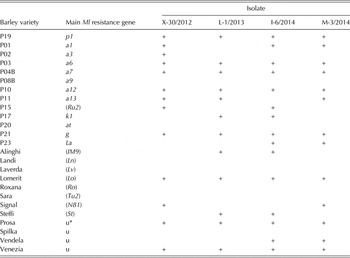
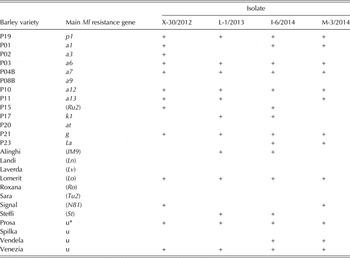
Three series of tests were performed, each in at least two replications. In the first series, all four Bgh isolates containing Vp1 were tested on 13 near-isogenic barley lines (Pallas) (Kølster et al. Reference Kølster, Munk, Stølen and Løhde1986) and 12 barley cultivars with different genes for powdery mildew resistance (Table 1).
Response of 25 standard varieties to four Blumeria graminis f. sp. hordei isolates containing rare virulence to the barley resistance gene Mlp1 found in Czech aerial populations
+ = Virulence.
* u = Unknown resistance gene(s).
In the second series, 48 barley genotypes with effective resistances to non-Israeli isolates were tested. They included selected resistance resources, commercial varieties and advanced breeding lines obtained from barley gene banks maintained by Agrotest Fyto Ltd., the National Spring Barley Gene Bank at the Agricultural Research Institute Kromeriz Ltd., and current registration trials in the Czech Republic. Tests were made with 20 Bgh reference isolates, the most critical of which were the four newly detected local Vp1 isolates, five Vp1 isolates originating from collections on wild barley in Israel, and 11 isolates avirulent to the gene Mlp1. Seed from three heterogeneous varieties were individually sown and five plants were harvested from each (see the Results section).
The third series included barley lines postulated to carry Mlp1 in the second series (Table 2). These were tested with 50 Bgh reference isolates from the pathogen gene bank at Agrotest Fyto Ltd., including 20 isolates used in the second series. Before inoculation, each pathogen isolate was purified, verified as the correct pathogenicity phenotype on standard barley lines and multiplied on leaf segments of the susceptible variety Stirling (Dreiseitl & Platz Reference Dreiseitl and Platz2012).
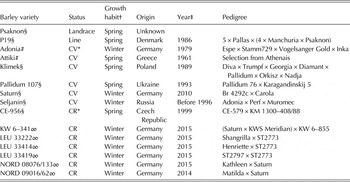
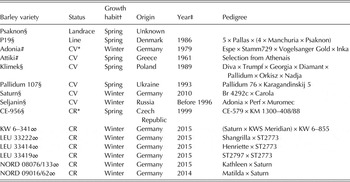
Fifteen barley varieties carrying the resistance gene Mlp1, their status, growth habit, origin and pedigree
* CV, Commercial variety; CR, Candidate for registration.
† The growth habit is not always clear; for instance, Adonia developed by crossing winter varieties is ranked among spring (as Seljanin) and conversely, Klimek, which was bred from spring varieties, often behaves as a winter variety.
‡ Year of first published information on P19 (Kølster et al. Reference Kølster, Munk, Stølen and Løhde1986); year of commercial registration and the first harvest year for registration in the Czech Republic.
Source of seed:
§ Agrotest Fyto Ltd., Kromeriz, Czech Republic.
# National Gene Bank of Spring Barley, Agricultural Research Institute Kromeriz Ltd., Czech Republic.
∞ Central Institute for Supervising and Testing for Agriculture, Brno, Czech Republic.
Testing procedure
About 40 seeds of each barley genotype were sown in two pots (80 mm diameter) filled with a gardening peat substrate and placed in a mildew-proof greenhouse under natural daylight. Leaf segments 20 mm long were cut from the central part of healthy fully expanded primary leaves when the second leaves were emerging. Three segments of each genotype were placed with adaxial surfaces upward in a 150 mm Petri dish on water agar (0·8%) containing benzimidazole (40 mg/l) – a leaf senescence inhibitor. For each isolate, a dish with leaf segments was placed at the bottom of a metal inoculation tower and inoculated at a concentration of c. 8 conidiospores/mm2. The dishes with inoculated leaf segments were incubated at 18 ± 2·0 °C under artificial light (cool-white fluorescent lamps providing 12 h light at 30 ± 5 µmol/m2/s).
Evaluations
Seven days after inoculation, reaction types (RT = phenotype of variety × isolate interaction) on the central part of the adaxial side of leaf segments were scored on a scale of 0–4, where 0 = no mycelium and no sporulation, and 4 = strong mycelium growth and strong sporulation of the pathogen on the leaf segment (Torp et al. Reference Torp, Jensen and Jørgensen1978) with an additional RT of 0(4) (Nover Reference Nover1972). A set of RTs provided a reaction type array (RTA) for each pathogen isolate or barley genotype. Based on the gene-for-gene model (Flor Reference Flor1971), virulence genes in each isolate and resistance genes in each host genotype were identified by comparing the RTA with previously determined RTAs of known pathogen isolates or standard barley genotypes.
RESULTS
The pathogenicities of four Vp1 isolates to 24 different resistances present in currently grown barley varieties were recorded (Table 1). In addition to Vp1 virulence, all isolates were virulent to Mla6, Mla7, Mla12, Mlg and Ml(Lo) and two others with the temporary designations Ml(Prosa) and Ml(Venezia). No isolate was virulent to Mla9, Mlat, Ml(Ln), Ml(Lv), Ml(Ro), Ml(Tu2) or Ml(Spilka).
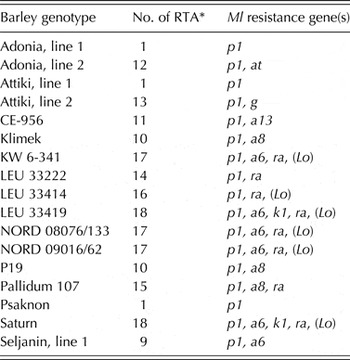
Forty-eight varieties with resistances fully effective against all previously used non-Israeli Bgh isolates were inoculated with 20 selected isolates, including nine virulent to Mlp1. Thirty-three varieties exhibited RTAs that did not indicate the presence of Mlp1 (data not shown). In addition to the standards Psaknon and P19 possessing Mlp1, 13 varieties most likely possessing Mlp1 were identified (Table 2). Six of them were cultivated spring and winter varieties and seven were candidates for registration. Adonia, Attiki and Seljanin showed heterogeneous reactions earlier and, therefore, five individually harvested plants were grown from each.
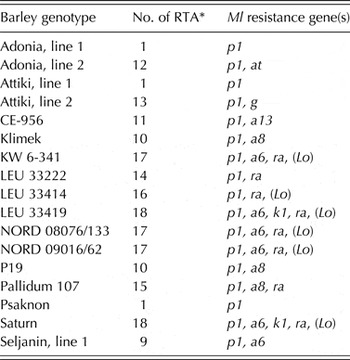
Twelve varieties and 15 progenies of Adonia, Attiki and Seljanin were inoculated with 50 reference isolates selected from Bgh collections representing worldwide diversity in the pathogen; Mlp1 was confirmed in all of them. In progenies of each of Adonia, Attiki and Seljanin three lines with different resistances were found; Adonia and Attiki had two genotypes carrying Mlp1. One selection of Adonia, one of Attiki and two of Seljanin did not contain Mlp1 and were not included here. In total, Mlp1 was detected in 17 genotypes of the 15 tested varieties.
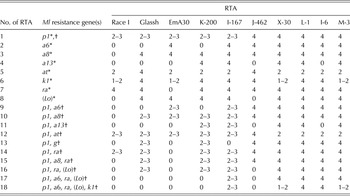
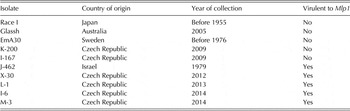
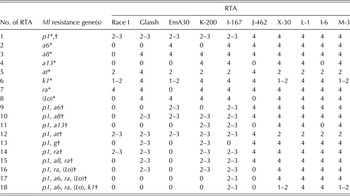
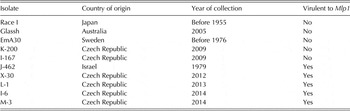
Ten of the 50 isolates were enough to characterize all 12 RTAs encompassing the resistance of 17 genotypes (Table 3). Information on the origin of these isolates is presented in Table 4. In addition to Mlp1, seven specific resistance genes were found; namely, Mlra, Mla6, Mla8, Ml(Lo), Mla13, Mlat and Mlk1. Mlra was identified in eight genotypes, Mla6, Mla8 and Ml(Lo) combined in six genotypes, Mla8 and Mlk1 combined in three and two genotypes respectively, and Mla13 and Mlat combined in one genotype. Mlp1 alone was found in Psaknon, one line of Adonia and one line of Attiki. A combination of five resistance genes was found in LEU 33419 and Saturn (Table 5).
Reaction type arrays (RTAs) for standard barley varieties and tested genotypes carrying Mlp1 and other resistance genes to powdery mildew after inoculating with 10 isolates of Blumeria graminis f. sp. hordei
* Standard varieties.
† Tested genotypes.
Ten Blumeria graminis f. sp. hordei isolates used to test barley genotypes, their country of origin, year of collection and pathogenicity to Mlp1
Seventeen barley genotypes, number of reaction type arrays (RTAs) and Ml resistance gene(s)
* See Table 3.
DISCUSSION
Brown & Jørgensen (Reference Brown, Jørgensen and Jørgensen1991) compiled a catalogue of mildew resistance genes in European barley germplasm summarizing data on the resistance genes in 699 barley accessions comprising mainly commercial varieties grown in Europe in the 20th century. Mlp1 was not found in any of them (except near-isogenic line P19) at that time, nor subsequently.
The oldest commercial variety found to possess Mlp1 in the present study was the Greek variety Attiki, which was registered in 1961. Attiki is a selection from Athenais, but seems to be a mixture of at least three genotypes. Two lines contained Mlp1 and differed by the presence or absence of Mlat. The third line did not contain Mlp1 and was possibly an admixture by a different variety. There is no further information about Athenais, but probably Mlp1 in this variety was not derived from Psaknon.
The second spring variety containing Mlp1 was a near-isogenic line P19 derived from Psaknon (Kølster et al. Reference Kølster, Munk, Stølen and Løhde1986). CE-956 originated from the same source as P19 because all pre-breeding lines with this gene produced in the former Czechoslovakia were derived from Psaknon (Brückner Reference Brückner1984). The third spring variety with Mlp1 is Klimek (from Poland) with Mlp1 derived from Pallidum (a Ukrainian landrace). Pallidum is probably the third source of Mlp1.
The first winter variety identified with Mlp1 was Adonia registered in Germany in 1979. It is a parent of Seljanin (from Russia), but the donor of the resistance is unclear. The most recently marketed variety with Mlp1 is Saturn (registered in Germany and the Czech Republic in 2010 and 2012, respectively) with resistance previously described as ‘unknown’ (Anonymous 2014). Saturn must derive Mlp1 from Br 4294c (Dreiseitl Reference Dreiseitl2007), but the original source is unknown. Saturn is a parent of three breeding stocks, which are now at the registration stage. Another three potential varieties derive Mlp1 from ST2773. The original sources of Mlp1 in Adonia, Saturn (and derivatives KW-6-341, NORD 08076/133 and NORD 09016/62) and ST2773 (a parent of LEU 33222, LEU 33414 and LEU 33419) are unknown. Hence, like Mla13 (Dreiseitl Reference Dreiseitl2007), there are probably more sources of Mlp1 that were used independently in breeding programmes.
New virulences arise by mutation and spread by airborne migration of the pathogen. Their frequencies increase mostly through selection on host lines possessing the corresponding resistance genes. Most of Europe can be considered a single epidemiological unit for powdery mildew (Müller et al. Reference Müller, McDermott, Wolfe and Limpert1996). In countries where varieties with Mlp1 were grown (Greece, Ukraine, and later in Germany, Poland and Russia) virulent pathotypes were surely present in the pathogen population. However, no information about the use of Psaknon resistance or about adaptation of the pathogen to it has been published.
Saturn was registered in the Czech Republic in 2012 and in the same year the first Vp1 isolate was detected. The corresponding virulence frequencies in the Czech aerial population were 0·7, 0·9 and 1·7% in 2012, 2013 and 2014, respectively (Dreiseitl Reference Dreiseitl2015a ). An aerial population represents pathogen conidiospores produced on all hosts in a particular area; in Europe this applies to fields planted with spring and winter barley. Saturn was grown in the Czech Republic on c. 1000 ha in 2013/14, or about 0·5% of the area of susceptible barley. Hence, the number of spores per hectare of Saturn must have been higher than, or at least equal to, the average production of spores originating from susceptible barleys grown in 2013/14. Since all spores produced on Saturn had the Vp1 virulence, fields planted with Saturn represented ‘hot-spots’ enabling the pathogen to adapt to the Psaknon resistance.
The four Vp1-virulent isolates belong to different pathotypes; they were also virulent on Venezia, which has only recently been exploited by breeders (Dreiseitl Reference Dreiseitl2015a ). Therefore, an increased frequency of Vp1 could also occur by association with selection of clonal populations on Venezia irrespective of whether or not the Psaknon resistance is used.
Compared with other pathogen populations the European population of Bgh is characterized by a high virulence complexity (i.e. average numbers of virulences per pathotype) as well as high pathotype diversity (Dreiseitl Reference Dreiseitl2014a ). Mlp1 has been detected in both spring and winter barley varieties as well as in many German candidates for registration. Therefore, the frequency of virulence to the Psaknon resistance will increase in the near future, but more gradually than the resistance in Roxana or Laverda, where frequencies of virulence increased from 0 to >20% within 3 years (Dreiseitl Reference Dreiseitl2015a , Reference Dreiseitl b ). However, Vp1 is undoubtedly becoming a major factor that will increase the virulence complexity and pathotype diversity in the Central European Bgh population.
Bgh is one of the most adaptable plant pathogens (McDonald & Linde Reference McDonald and Linde2002) and its variation is influenced by the same evolutionary forces as in other organisms (Flégr Reference Flégr2005; Brown & Tellier Reference Brown and Tellier2011). Specific genes confer resistance only to avirulent pathotypes and their effectiveness is rapidly overcome, thus limiting their life-span (Brown et al. Reference Brown, Foster, O'Hara, Crute, Holub and Burdon1997). However, specific resistance genes that are still used in breeding commercial barley varieties further influence the evolution of the pathogen population and highlight ‘the Red Queen’ dynamics (Jensen et al. Reference Jensen, Dreiseitl, Sadiki and Schoen2012). This is because many specific resistance genes were used in breeding mildew-resistant barley, but most varieties with such resistance remain susceptible.
The non-specific resistance Mlo is widely used in spring barley breeding and, because of its durability, will continue to be exploited. However, despite this durability it should not be used in breeding winter barley because this would extend the period under crop cultivation and allow the pathogen to adapt throughout the year, which could reduce effectiveness of this unique resistance. A possible way to prevent this happening is the pyramiding of quantitative resistance genes derived from cultivated varieties, landraces (Silvar et al. Reference Silvar, Casas, Igartua, Ponce-Molina, Gracia, Schweizer, Herz, Flath, Waugh, Kopahnke and Ordon2011) and wild barley (Dreiseitl Reference Dreiseitl2014b ). Using non-host resistance, such as that present in Hordeum bulbosum (Pickering et al. Reference Pickering, Hill, Michel and Timmerman-Vaughan1995), could also provide an alternative source for newly bred winter varieties.
The excellent technical assistance of Mrs. Dagmar Krejčířová, the support of Marta Zavřelová Ph.D. when searching for information on registered varieties is gratefully acknowledged. The article was generated within project no. RO02113021 supported by the Ministry of Agriculture of the Czech Republic.