





1. Introduction
This paper re-examines the structural integrity of the Homeric Hymn to Demeter. Footnote 1 The narrative of this text has often been found to be flawed and illogical, scrutiny especially falling on the actions of Demeter herself as unmotivated. By considering the poet’s use of various traditional story patterns, I will argue that the Hymn does in fact provide a logically coherent narrative, insofar as the in-world motivation for Demeter’s deeds, that is, her motivations as a character, are clearly discernible, as are the choices made by the poet in his employment of the traditional resources at his disposal, the creativity of which has not yet been fully appreciated.
A great deal is at stake when it comes to the question of the Hymn’s narrative integrity, because the supposed lack of motivation for Demeter’s actions as a character has been used to make a wide range of claims about the Hymn’s direct relationship to other early Greek poetry, or even mythology from other cultures, and about the prehistory of the myth of Persephone and Demeter’s disappearances. While the Homeric Hymn to Demeter provides one of the earliest accounts of the myth of the abduction of Persephone, Demeter’s withdrawal, the subsequent crisis, and its resolution, several archaic fragments of poetry pertaining to the same myth, attributed in antiquity to the legendary bard Orpheus, have been preserved.Footnote 2 We are thus in a fairly unique position because, unlike for many other texts of the early Greek hexameter corpus, we have roughly contemporary material which can be used for a direct comparison with the Homeric Hymn to Demeter. However, despite this good fortune, scholars have not reached a consensus about how the Hymn should be interpreted as a narrative and in terms of its relation to these other versions of the same myth. In fact, it has, to an extent, hampered the appreciation of the Hymn as a work of art, since many have argued that, in consciously diverging from other versions of the same myth, the poet of the Hymn has created a flawed narrative, lacking in motivation. We must therefore also consider the factors which led the poet to craft the narrative of the Hymn as it is, differing as it does from other early versions of the same myth. Thus, both the poet’s and Demeter’s motivations are highly relevant for understanding the poet’s skill in manipulating mythological material, as well as the relationship between the Hymn and the rest of the early Greek corpus.
The corpus of archaic Orphic hexameters contains fragments which are often held to be based on a version of the myth older than that of the Hymn,Footnote 3 and which some have argued offer a more logically coherent account of Persephone’s rape.Footnote 4 Central to the question has been the Berlin Papyrus, which contains a summary of a hymn attributed to Orpheus, interspersed with quotations, most of which are identical to lines from the Homeric Hymn to Demeter.Footnote 5 This narrative has Persephone abducted while picking flowers,Footnote 6 after which Demeter searches for her daughter, eventually arriving at Eleusis. There she nurses the child Demophoon, and her attempt to make him immortal is discovered and ended, resulting in the child’s death. According to other fragments, Demeter wandered around in grief for her daughter (380 T; 392 F III). She came to Eleusis and received hospitality there (394 F; 395; 515 I–II). Eubouleus and Triptolemos, the nephews of Keleos, the king of Eleusis, informed Demeter about Persephone’s abduction, and were rewarded by the goddess with the knowledge of agriculture (382 T/ Mus. Fr 60; 390 F; 391 F; 397 F I).Footnote 7 This was thus a traditional and logically coherent version of the myth in which Persephone was abducted by Hades,Footnote 8 prompting her mother to search for her. An important detail is that Demeter was informed about Persephone’s whereabouts for the first time at Eleusis, for which she rewarded the Eleusinians.
The Hymn instead has Demeter journeying to Earth and Eleusis after she has already found out from Helios what happened to Persephone (74–87). It is generally accepted that the poet is downplaying the Attic version of the myth represented by the Orphic fragments.Footnote 9 For some, therefore, the trip to Eleusis does not come about as a result of her search for Persephone, and so the Eleusis episode in the Hymn is often held to be unmotivated, especially when set against the Orphic versions of the same myth.Footnote 10 Likewise, the reason for the attempted immortalization of Demophoon and the bestowing of the mysteries on the Eleusinians (who in this version did not help Demeter find Persephone) has also been called into question.Footnote 11 These narrative incongruities have been used as evidence for a number of claims about the history of the Hymn as we have it. The older generation of analysts characteristically decided that the Eleusis episode was a later interpolation.Footnote 12 More recent interpretations have maintained that the Eleusis episode is authentic but still argue that it is out of place and thus needs to be explained. Some have argued that it represents an allusion to other early Greek poetry or a borrowing from Near-Eastern sources which has not been properly made to fit into the rest of the narrative.Footnote 13 Others, including those who believe the Eleusis episode does not make sense from Demeter’s perspective, have argued that the Eleusis episode is still motivated by the poet’s intentions (such as the desire to provide aetiologies) and the oral-traditional and structural elements which underly its narrative.Footnote 14
Broadly speaking, there are two levels of narrative motivation which have thus been investigated with regard to the Homeric Hymn to Demeter. I designate these as ‘internal motivation’ and ‘external motivation’, the former referring to the psychological reasons for a character’s actions within the fictional world, the latter being the reasons why the poet has created the narrative in a certain way. Arguments that Demeter’s actions in Eleusis are unmotivated thus pertain to the question of internal motivation, and the reasons suggested by neo-analysts, oral-traditionalists, and narratologists as to why the poet crafted the Eleusis episode as he did are questions of external motivation. It is important to consider to what extent these two kinds of motivation are really detectable in ancient poetry. Even though the analysis of poetic intentions is the prerogative of literary scholars, it is impossible truly to get into the head of the poet, even less so his fictional characters. Thus, we should be wary of seeing supposed internal inconsistencies as features which need to be explained externally. Recently, Grethlein has outlined why it is an anachronistic demand to expect ancient narratives to make logical sense at the internal, psychological level, arguing that considerations of the dynamics of plot were a much more important driving force for early poets and their audiences.Footnote 15 But as Grethlein points out, the internal motivation of characters is often stated explicitly,Footnote 16 and so the desire to create an internally logical plot is not mutually exclusive of other concerns which tend to guide the poet’s creation of a narrative. The following argument will try to demonstrate this, providing a new perspective on both the internal and external motivation lying behind the Eleusis episode in the Homeric Hymn to Demeter, and arguing that these events make sense both in terms of the internal psychological processes of Demeter and of the poet’s creative deployment of traditional themes.
2. The external motivation of the Eleusis episode
In this section, I highlight several aspects of the poet’s conscious decisions and artistry in crafting the narrative of the Homeric Hymn to Demeter. Modern scholars have put forth many varied (though not necessarily all incompatible) explanations as to why the poet constructed the narrative of the Eleusis episode in the way that he did, often in order to prove that it is sufficiently motivated. Whether or not the Hymn was composed orally,Footnote 17 the poet clearly employs oral-traditional story patterns, which has been a central focus of the question of the narrative’s external motivation. In particular, it is clear that Demeter’s withdrawal to Eleusis represents a key stage in the story pattern of a withdrawing angry god or hero, first outlined by Lord,Footnote 18 which many others have seen as a strong driving force for the development of the narrative.Footnote 19 The recurrent features of this pattern are as follows: the main character is bereaved of someone dear to them, often by a king; that individual becomes angry and withdraws from their usual sphere of operation; this withdrawal deprives the community of success and causes ruin; a reconciliation is eventually reached, and the withdrawn individual returns, though often at the cost of providing a substitute; the community’s good fortune and general wellbeing are restored. In the Hymn, Demeter is bereaved of Persephone, given away to Hades by the king of the gods; she becomes angry and withdraws first to Eleusis, and then, in anger at the Eleusinians, to her temple; this causes famine for humanity and thus a lack of offerings for the gods; finally a reconciliation is reached with the return of Persephone, and Demeter returns, along with the provision of agricultural growth, though with the compromise that Persephone must remain in the underworld for part of the year.
The deployment of the wrathful-withdrawal pattern was perhaps not a feature unique to the Homeric Hymn to Demeter. One Orphic fragment preserves the opening of a poem which closely resembles the opening of the Iliad, and clearly signals that the wrathful-withdrawal pattern which was also applied to Akhilleus is being applied to Demeter:
Μῆνιν ἄϵιδϵ, θϵά, Δημήτϵρος ἀγλαοκάρπου.
Sing, Goddess, of the wrath of Demeter, the bringer of splendid fruit.Footnote 20
(386 F)
Nickel points out that the employment of this pattern necessitates a configuration of the Eleusis episode which differs from that of other Orphic fragments, where Demeter comes to Eleusis during her search for Persephone, not as part of a wrathful withdrawal.Footnote 21 If this is correct, then perhaps fragment 386 F comes from a poem with a similar version of the Eleusis episode to that found in the Hymn.
I will outline here another traditional narrative pattern which is present in the Eleusis episode: the hospitality scene. The employment of this pattern in the Hymn has not been so thoroughly studied, nor how it has been made to overlap with the wrathful-withdrawal pattern outlined above. The seminal description of the hospitality type-scene is that of Reece,Footnote 22 who outlines no fewer than twenty-five typical elements in this pattern and shows compellingly how this pattern is realized in the Hymn to Demeter.Footnote 23 Most of the typical features occur in the standard order. The first element is the encountering of a maiden at a well or spring (I: 98–183), which occurs when Demeter meets the daughters of Keleos at a well called the Parthenion.Footnote 24 Next Demeter arrives at the destination (II: 184–5) of the palace of Keleos, following which we have a brief description of the residence and the activities of the people sought (III:185–7), after which Demeter waits at the threshold (V: 188–9). The seating of the guest (VIII: 191–201) is somewhat drawn out, with Metaneira first offering Demeter her own seat, which she refuses, before accepting a stool from Iambe.Footnote 25 The reception is completed when Metaneira, who noticed Demeter at the door (VIIa: 190) and stood up in surprise (VIIc: 191), bids Demeter welcome (VIIg: 212–15), before Demeter pronounces a blessing on her host (XIV: 224–5).
What has not yet been properly outlined or explained is how and why several other elements of the type-scene occur out of place in the Eleusis episode. It is of course no great surprise that such divergences occur, since the sequence outlined by Reece is attested mostly in the Iliad and Odyssey, and we should not necessarily expect non-epic texts such as hymnic narratives to follow an epic pattern so strictly. Firstly, the identification of the guest (XI) occurs much too early, when the daughters of Keleos question Demeter (XIa: 112–17) and she reveals her ‘identity’ (XI: 118–34) which takes the form of a false tale. As Reece points out, several examples of this pattern in the Odyssey make it very clear that a guest should not be questioned before they are adequately fed.Footnote 26 But the poem does not seem to suggest that this diversion from the norm by the young women is reprehensible, since they instead show the utmost respect to Demeter when questioning her, saying that she should come to the palace where she will be warmly welcomed (113–17).
Secondly, Demeter’s response includes a supplication (VI: 137–44) normally made to the royal host but here made to the daughters, in which she begs for pity and to be given work in someone’s house as a nurse.Footnote 27 The promotion of this element to earlier in the sequence reflects the fact that finding a child to nurse is a central part of Demeter’s plan, as I argue below. After a more extended invitation to Demeter to be welcomed in the palace, Keleos’ daughters return to the town and are instructed by their mother to escort Demeter to the palace (169–81). This resembles a similar sequence in the Odyssey, when a Spartan herald hesitates to escort Telemakhos and Peisistratos to the palace. Having been informed of their presence, Menelaus rebukes the herald and has his guests escorted to the palace at once (4.22–46).Footnote 28
The sequence of feasting (IX), drinking (X), and entertainment (XIII) also displays some variation. The feast is only briefly alluded to when Demeter does not take part in food and drink because of her grief (200–1).Footnote 29 Rather than having the after-dinner drink next as is usual, the Hymn describes the entertainment, in the form of Iambe making jokes to make Demeter laugh (202–5). The reason for this alteration seems clear: Demeter was refusing to eat and drink because of her emotional turmoil, and so before she can partake in the customary beverage, her mood must be improved. The first after-dinner drink is the wine offered by Metaneira to Demeter which is refused in favour of the kukeon. This part of the traditional pattern is thus altered in order to provide an aetiology for the drink used in the rites of the Eleusinian Mysteries.Footnote 30 Another element of the traditional hospitality pattern which one could argue is present in the Eleusis episode is the gifts offered by the host to the guest (XX: 167–8; 172–4). This is hinted at in advance with the promise of a generous payment to Demeter for nursing Demophoon. Because the breakdown in relations following the attempted immortalization of the child essentially brings about an early conclusion of the hospitality pattern, this payment is never made. However, one could argue that the temple built by the Eleusinians to appease Demeter fulfils this role instead (296–303). But here, too, as the temple was built out of the need to appease Demeter’s anger, this represents the failure of the Eleusinians to carry out correct and successful hospitality. Finally, Demeter’s promise of honour for Demophoon can be seen as a slightly ironic version of the farewell blessing (XXIII: 263–4), occurring as it does during Demeter’s angry tirade at Metaneira, and thus bestowed not on the host but on her son.
The poet of the Hymn thus skilfully deploys the hospitality type-scene in the description of Demeter’s stay at Eleusis, adapting it for his particular needs and engaging with the traditional significance of the different elements to shape his audience’s understanding of the narrative. The poet also combines this pattern with that of a theoxeny, including the final epiphany of the disguised god. Given the overlap between these themes, it is no surprise that this combination is not unique to the Hymn. It is also found twice in the Odyssey, when Athene visits Telemakhos disguised as Mentes to test his willpower, and when Odysseus returns to Ithaka disguised as a beggar.Footnote 31 In the Hymn, Demeter too comes in disguise and, like Odysseus and Athene, tells a false tale about how she came to be there.Footnote 32 Likewise, she comes to test the Eleusinians’ hospitality, particularly to see if they will accept her plea to hire her as a nurse.Footnote 33 At first, the Eleusinians are almost rewarded with the immortalization of Demophoon for their passing of the test as good hosts. But Metaneira puts an end to this, upsetting Demeter and ultimately failing the test.Footnote 34 Theoxenies usually conclude with an epiphany in which the god’s true identity is revealed.Footnote 35 In the Eleusis episode, we have two epiphanies. The first comes when Demeter, having arrived at the palace, stands in the doorway and stands as tall as the ceiling, filling the room with light. The significance of this early (semi-)epiphany is that it prompts Metaneira, filled with awe and respect, to offer Demeter her own seat (188–91). This shows that Metaneira at least partially recognizes the importance of her guest, suggesting perhaps in a deliberately misleading way to the audience that she will be a proper host and pass the test of the theoxeny. The second epiphany shatters this impression, with Demeter angrily rebuking Metaneira for her failure, because of which she cannot now bestow her planned reward of immortality on Demophoon, instead granting him honour in the form of the Eleusinian rituals. Her anger and the failure of the test is also signalled by the demand for a temple to be built immediately after she reveals her identity (256–81). The poet thus uses two epiphanies to bookend the testing of Metaneira.
In this way, the Hymn employs and combines the traditional themes of hospitality, theoxeny, and epiphany in the Eleusis episode, making subtle and significant adaptations to them. The application of these patterns to this myth is probably not unique to the Hymn within the early Greek corpus, because the basic elements of the story following Persephone’s abduction lend themselves naturally to these themes. The wandering of Demeter is attested as a theme in the Orphic fragments,Footnote 36 and such wandering is what leads guests to their hosts for hospitality.Footnote 37 These texts also mention the information given to Demeter by Keleos, Euboleus, and Triptolemos,Footnote 38 thus perhaps providing the exchange of information (XII) often found in hospitality scenes. This element is of course not found in the Homeric Hymn to Demeter, because Demeter has already been informed of Persephone’s whereabouts by Helios before coming to Eleusis. Likewise, the entertainment of the guest (XIII) is carried out in the Orphic texts by a woman named Baubo exposing herself to Demeter to make her laugh.Footnote 39
However, there are other ways in which the poet of the Hymn in particular demonstrates both his compositional skill and the flexibility of inherited traditional patterns with the use of the hospitality type-scene. Particularly noteworthy is the way in which the abduction of Persephone is also presented as a subverted hospitality type-scene which relates structurally to that of Demeter.Footnote 40 In this schema, Persephone becomes the ‘guest’ of Hades in the underworld. The poet is perhaps signalling the application of this pattern to the audience in that Hades is referred to as the ‘receiver of many’ (πολυδέκτης; πολυδέγμων) five times within the poem, always in the context of the description of Persephone’s abduction.Footnote 41 This epithet occurs three times within twenty-three lines at the beginning of the poem (9; 17; 31), and twice within twenty-seven lines when Demeter and Persephone discuss the abduction (404; 430). Several stages of the type-scene are also present. Firstly, the site of the abduction in a flowery meadow could be seen as a variation on the more usual encountering of a maiden at a well (I), replacing the locus amoenus of the spring with another similar one.Footnote 42 Here, though, there is a reversal in roles, since it is usually the guest who encounters and receives help from the maiden, but in this case, the guest is the maiden, thus depriving Persephone of the usual agency given to such characters in this type-scene and refiguring her as the helpless victim. The arrival in the underworld (II: arrival at the destination) is not narrated in the primary narrative, perhaps reflecting the fact that Demeter, through whom the subsequent narrative is focalized, is not aware of Persephone’s whereabouts. Instead, she has to be informed of this arrival by Helios and Persephone herself (79–80; 431). As with many other arrivals in hospitality scenes, the visitor arrives by chariot,Footnote 43 as does Persephone, though in this case it is not her own horses but those of Hades which pull the chariot (32; 80; 431), further highlighting her lack of agency. Just as the audience and Demeter do not at first see Persephone’s arrival in the underworld, the seating of Persephone (VIII) is not described until Hermes goes to Hades to instruct him to release her, when he finds the two of them sat together (343). The fact that Hermes is told to have Persephone released and that Hades abducted her against her will demonstrates that Hades, as Persephone’s ‘host’, is detaining his visitor (XIX). The detention of guests as a hindrance to their homecoming is a recurrent theme in the Odyssey, seen in the actions of Nestor, Menelaus, the Lotus-eaters, Circe, the Sirens, and Calypso.Footnote 44 Hades is the prime example of this type of over-zealous host, and the sending of Hermes to have her released closely parallels the sending of Hermes to have Odysseus released by Calypso.Footnote 45 As in this scene from the Odyssey, Hermes’ arrival in the underworld in the Hymn is also constructed as a miniature hospitality scene.Footnote 46 The features present include the guest’s arrival (II); a description of the surroundings at the destination where he finds Hades sat on a couch (IIIb) and Persephone grieving (IIIc); and the exchange of information (XII), in the form of Hermes relaying Zeus’ instructions to Hades and informing him of the disaster caused by Demeter’s wrath (340–56). Of course, unlike Calypso with Odysseus, Hades’ detention of Persephone continues even after her release, in that by feeding her the pomegranate, he ensures her eventual periodic return to him. Thus, the poet puts an ironic twist on the usual departure meal (XXI: 371–4).Footnote 47 The pattern of the ‘hospitality’ endured by Persephone concludes with the farewell blessing (XXIII: 363–9) given to her by Hades, who promises her honour and offerings as queen of the underworld,Footnote 48 and finally with the escort to her next destination (XXV: 375–85), when Hades has his horses harnessed and Hermes drives Persephone to be reunited with her mother.
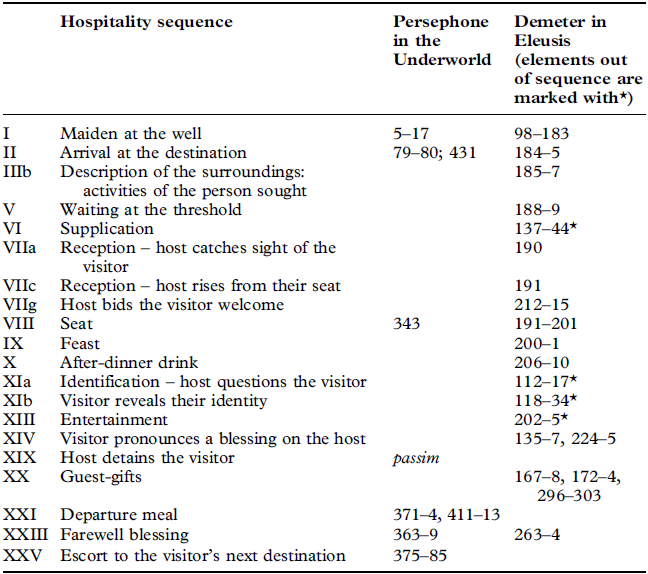
In this way, the poet of the Hymn constructs Persephone’s abduction and stay in the underworld as a hospitality scene, in which several of the typical elements are given ironic twists to highlight her lack of agency and her unwillingness to be Hades’ ‘guest’. Moreover, Persephone’s hospitality scene serves as a simultaneous parallel with that of Demeter in Eleusis (see Table 1). The narrative of the Hymn begins with the first few stages of the hospitality scene applied to Persephone. The sequence is then interrupted by Demeter’s reaction and her own hospitality scene in Eleusis. Just as Demeter’s reception cuts short the story of the disappearance of her daughter, it in turn is cut short by the failure of Demeter to obtain a substitute child by immortalizing Demophoon.Footnote 49 As we saw, this marks Metaneira’s failure of the theoxeny test and causes Demeter to withdraw to her new temple. It is at this point that Zeus has Persephone released from Hades, completing her hospitality scene while also providing the typical elements of the pattern which do not occur at the end of Demeter’s reception. This reflects the intertwining of Demeter’s disappearance with that of Persephone, since Demeter’s disappearance, following the wrathful-withdrawal pattern, is caused by that of Persephone, and the pattern is completed only when Demeter returns to Olympos together with Persephone.Footnote 50 Thus, not only is the poet playing off and subverting his audience’s expectations of this traditional pattern, but he also skilfully intertwines these two hospitality scenes in such a way that they complement each other and provide a complete sequence of the pattern with many of the standard features present.
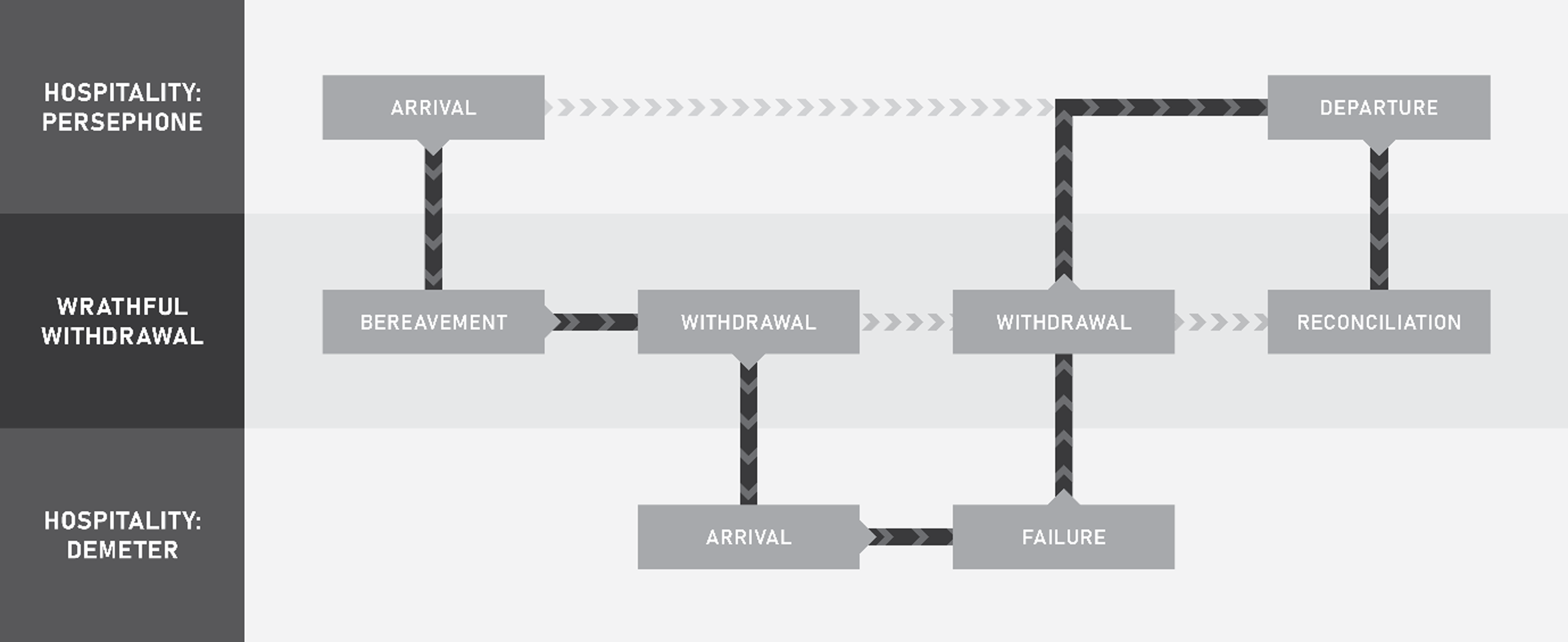
The wrathful-withdrawal and hospitality patterns in the Homeric Hymn to Demeter.

The hospitality pattern applied to Demeter and Persephone.

Finally, it should be noted how the narrative of the Homeric Hymn to Demeter combines the traditional pattern of hospitality with that of the wrathful withdrawal (see Figure 1). This is facilitated by the broad conceptual and thematic similarities of the two patterns: they both involve a character moving from one space or sphere to another and ideally returning home from the latter. In the Hymn, Demeter’s arrival at the start of the hospitality sequence is thus also her departure towards the start of the wrathful-withdrawal sequence. Moreover, when Metaneira prevents her from making Demophoon immortal,Footnote 51 this represents a failed hospitality sequence and prompts Demeter’s second wrathful withdrawal, just as the twisted ‘hospitality’ sequence applied to Persephone caused Demeter’s original withdrawal. Finally, it is the completion of Persephone’s hospitality sequence when she leaves the underworld (XXV) which allows for the reconciliation in the pattern of Demeter’s wrathful withdrawal and her eventual return to Olympos.Footnote 52
The poet has thus made skilful use of the inherent flexibility and adaptability of the traditional patterns to intertwine inextricably two iterations of the wrathful-withdrawal pattern and two of the hospitality type-scene. Returning to the question of the poet’s motivation, it is important that this combination can be achieved only by reconfiguring the Eleusis episode as the Hymn does and by having Demeter come to Eleusis not during her search for Persephone but out of anger at Zeus. As noted above, if Demeter’s journey to Eleusis is to be configured as a wrathful withdrawal, this requires a departure from the supposedly original ‘Attic’ version of the myth in which she receives hospitality in Eleusis during her search for information on Persephone’s whereabouts. These two scenarios are incompatible: Demeter would not be angry if she did not know what had happened to her daughter.Footnote 53 Thus, for the two patterns to be combined, Demeter’s motivation for going to Eleusis must be changed. Or rather, perhaps the employment of the alternative version in which Demeter is motivated by anger presents the poet with an opportunity to demonstrate his expertise by combining the two flexible traditional themes. This is maybe a preferable way to view the poet’s motivation, since we know little about what other versions of the myth existed prior to the Hymn’s composition, and so it is impossible to know for certain that the poet is consciously innovating by departing from the usual ‘Attic’ version of the myth, rather than simply using another version which already existed.
3. The internal motivation of the Eleusis episode
The previous section has built on the work of earlier scholars to demonstrate that the particular formulation of the Eleusis episode in the Homeric Hymn to Demeter is an essential part of the poet’s schematization and subtle combination of traditional story patterns. Thus, the shape of the narrative can be explained in terms of external motivation. For some, this is enough not to be concerned about the supposed lack of internal motivation on the part of Demeter, and this principle has motivated many studies of the poet’s intention in the Hymn.Footnote 54 For others, it is even natural that the intentions of deities should not be spelled out explicitly in poetic narratives:Footnote 55 ‘The attentive reader of a poem such as this quickly realizes that he is being led through a world of mysteries, because gods are gods, not men, because Olympus is hidden from mortal eyes. Demeter would cease to be Demeter if she had to explain herself to Wilamowitz’;Footnote 56 ‘equally [the poet] does not have to explain all of Demeter’s behaviour to his audience. Part of a god’s power lies precisely in the fact that their purposes are not always clear to men.’Footnote 57 This ‘God moves in mysterious ways reasoning is often used to explain the existence of evil and suffering in the Christian worldview and is a convenient workaround for the issue of Demeter’s motivation for going to Eleusis. However, putting aside the question at this point still leaves us with the impression that the narrative of the Hymn is flawed, and a closer reading will allow us to defend the notion that Demeter’s actions are motivated on the internal level. In this case, her actions at Eleusis demonstrate that she wishes to gain a substitute for Persephone, and it might be argued that she wishes thereby to regain the maternal honour lost when deprived of her daughter.
First, it is necessary to examine how the Hymn describes Demeter’s initial withdrawal and arrival at Eleusis:
τὴν δ’ ἄχος αἰνότϵρον καὶ κύντϵρον ἵκϵτο θυμόν.
χωσαμένη δἤπϵιτα κϵλαινϵφέϊ Κρονίωνι
νοσφισθϵῖσα θϵῶν ἀγορὴν καὶ μακρὸν Ὄλυμπον
ᾤχϵτ’ ἐπ’ ἀνθρώπων πόλιας καὶ πίονα ἔργα
ϵἶδος ἀμαλδύνουσα πολὺν χρόνον· οὐδέ τις ἀνδρῶν
ϵἰσορόων γίνωσκϵ βαθυζώνων τϵ γυναικῶν,
πρίν γ’ ὅτϵ δὴ Κϵλϵοῖο δαΐφρονος ἵκϵτο δῶμα,
ὃς τότ’ Ἑλϵυσῖνος θυοέσσης κοίρανος ἦϵν.
A more painful and more horrible grief came to her heart.
And then, having grown angry at the son of Kronos, the one of the dark clouds
She withdrew from the assembly of the gods and high Olympos
And went to the cities and fertile fields of men
Blotting out her beauty for a long time. No one of men
Nor of deep-girt women recognized her when they looked at her,
Until the very time when she reached the house of wise Keleos,
Who at that time was ruler of fragrant Eleusis.
(Homeric Hymn to Demeter, 90–7)
Firstly, it should be noted that the text clearly describes Demeter’s psychological state lying behind her journey. The participle χωσαμένη (‘having grown angry’), as well as establishing the key element of the wrathful-withdrawal pattern, states the reason for her departure from Olympos and consciously signals that it is different from the version of the myth which we know from the Orphic fragments. Her grief (ἄχος) is also stated to be the motivation for such wandering.Footnote 58 Secondly, what has often been overlooked is that Demeter did not go straight to Eleusis, which was therefore not her specific goal. The text states that she went to several cities (πόλιας), disguising herself in each one. The reference to her disguise also indicates that these visits to other cities all took the form of a theoxeny, just as the Eleusis episode does.Footnote 59 However, these theoxenies were perhaps defective or at least didn’t result in an epiphany, as implied by line 96, which suggests that Demeter’s quest in visiting the different cities was to be recognized in the form of an epiphany, which does not happen until she comes to Eleusis. Throughout the Hymn, the recognition of Demeter’s divinity is presented as necessary for showing her respect. For example, after Demeter asks Kallidike to be allowed to nurse a child, she responds by reassuring her that she will be welcomed in Eleusis and shown the utmost respect by the women there:
τάων οὐκ ἄν τίς σϵ κατὰ πρώτιστον ὀπωπὴν
ϵἶδος ἀτιμήσασα δόμων ἀπονοσφίσσϵιϵν,
ἀλλά σϵ δέξονται· δὴ γὰρ θϵοϵίκϵλός ἐσσι.
Not one of the women, when they first see you
Would dishonour your appearance and send you away from the house,
But they will welcome you. For indeed you are godlike.
(Homeric Hymn to Demeter, 157–9)
Here, the respect (οὐκ … ἀτιμήσασα, ‘not having dishonoured you…’) promised to Demeter is clearly linked with her quasi-divinity (θϵοϵίκϵλός, ‘godlike’),Footnote 60 for which reason she will also be given a proper reception (δέξονται ‘they will welcome you’), suggesting the fulfilment of the hospitality type-scene and a successful theoxeny. Kallidike then promises enviable rewards to Demeter if she should nurse Demophoon:
ϵἰ τόν γ’ ἐκθρέψαιο καὶ ἥβης μέτρον ἵκοιτο
ῥϵῖά κέ τίς σϵ ἰδοῦσα γυναικῶν θηλυτϵράων
ζηλώσαι· τόσα κέν τοι ἀπὸ θρϵπτήρια δοίη.
If you were to raise him and he should reach the measure of youth,
Any of the women who see you would easily
Be envious – such are the rewards for rearing him that she would give you
(Homeric Hymn to Demeter, 166–8)
These words are later repeated by Metaneira (221–3), and show that the respect which Demeter receives from the Eleusinians is in particular the result of her ability to act as a nurse for Demophoon.Footnote 61 This was also Demeter’s goal all along, it seems, given that, when the daughters of Keleos first treat her with respect, the nursing of a child is the first service offered by Demeter when she begs them to be given work in a household (137–44). Especially revealing in this respect is the fact that this appeal, which corresponds to the supplication part of the hospitality type-scene, is out of place, coming earlier than usual in the sequence,Footnote 62 as Demeter only comes to Eleusis once the object of her supplication has been promised to her.
Thus, it could be argued that Demeter’s arrival at Eleusis seems to be the result of her attempt to find somewhere where she is shown respect and can thus be employed as a nurse to a child. Once this occurs, she tries to immortalize the child, and this brings us to the question of the internal motivation for the Demophoon episode, which has also been criticized. For some scholars, Demeter has temporarily forgotten about her daughter at this point and the attempted immortalization of Demophoon has no relation to the search for Persephone.Footnote 63 But once again, a closer reading of the text makes clear Demeter’s intentions, and in particular the use of direct speech is an important tool by which the poet reveals this psychological motivation. When Metaneira asks Demeter to nurse Demophoon, she replies:
παῖδα δέ τοι πρόφρων ὑποδέξομαι, ὥς μϵ κϵλϵύϵις·
θρέψω, κοὔ μιν ἔολπα κακοφραδίῃσι τιθήνης
οὔτ’ ἄρ’ ἐπηλυσίη δηλήσϵται οὔθ’ ὑποταμνόν·
οἶδα γὰρ ἀντίτομον μέγα φέρτϵρον ὑλοτόμοιο,
οἶδα δ’ ἐπηλυσίης πολυπήμονος ἐσθλὸν ἐρυσμόν.
I will eagerly accept the child, as you tell me.
I will raise him and, I hope, neither any spell nor the Undercutter
Will harm him because of the foolishness of his nurse.
For I know a remedy which is stronger than the Woodcutter,
And I know a good safeguard against a baneful spell.
(Homeric Hymn to Demeter, 226–30)
It is possible that these lines refer euphemistically to Hades, or at least to Demeter’s ability to prevent the child from dying,Footnote 64 and thus creates a direct parallel between him and Persephone, who was not safe from Hades and was taken to the underworld before her time. It is important that, in planning to make Demophoon immortal, Demeter phrases this in terms of keeping him safe from Hades, as she is safeguarding him against the same misfortune which Persephone as an immortal should not have suffered, but did nonetheless. Demeter can thus be seen as trying to gain one immortal child as a substitute for her own child who fell victim to Hades despite being immortal.Footnote 65
A related explanation is offered by Clay, who argues that, in immortalising a human child, Demeter is trying to threaten the established order of Zeus.Footnote 66 That the immortalization of Demophoon is driven by the same motivation as Demeter’s withdrawal to her temple and withholding of fertility is suggested by the fact that the latter follows on directly from the failure of the former.Footnote 67 Demeter’s motivation is here clearly stated to be to have her daughter returned:
πόθῳ μινύθουσα βαθυζώνοιο θυγατρός.
Wasting away with desire for her deep-girdled daughter.
(Homeric Hymn to Demeter, 304)
Both courses of action are intended to bring Persephone back by putting pressure on Zeus to make amends for his wrongdoing, which is a key principle of the wrathful-withdrawal pattern. The Demophoon episode represents an affront to Zeus’ prerogative in controlling the male immortal offspring of deities, while the second withdrawal attacks his authority as the provider of timai (‘honours, prerogatives’) to the gods, which are withheld by Demeter (311).Footnote 68
When Demeter fails to immortalize Demophoon, this can be regarded as the result of or punishment for the failure of Metaneira to act properly as a host in the hospitality type-scene, thus failing the theoxeny test.Footnote 69 Scholars have wondered why Demeter still establishes the Eleusinian rites, despite her anger,Footnote 70 but her internal motivation is clearly stated by the poet by her direct speech:
ὄργια δ’ αὐτὴ ἐγὼν ὑποθήσομαι, ὡς ἂν ἔπϵιτα
ϵὐαγέως ἔρδοντϵς ἐμὸν νόον ἱλάσκοισθϵ.
I myself will establish the rites, so that thereafter
You might appease my mind by performing them in a holy manner.
(Homeric Hymn to Demeter, 273–4)
There is also a strong external motivation in the form of the traditional myth, inasmuch as it was presumably an unalterable element that the rites were established by Demeter at Eleusis. In the version of the myth preserved in the Orphic fragments, the internal motivation is different: the mysteries were bestowed upon the Eleusinians as a reward for information about Persephone’s whereabouts. This of course cannot be the reason in the Hymn, in which Demeter already knows about Persephone’s abduction, and the purpose of the establishment of the rites is therefore to propitiate Demeter’s anger, rather than reward the Eleusinians. Whether or not the formulation of the Eleusis episode in the Hymn is an innovation, the poet thus seems here to be making an active effort to provide a realistic internal motivation in order to make the narrative cohesive. In this way, it is clear that the poet of the Hymn was able to harmonize the internal and external motivations of the narrative, which should make us question whether the supposed narrative flaws of the Eleusis episode are the result of the poet’s failure to properly assimilate his altered features of the myth into the narrative.
4. Conclusion: the Homeric Hymn to Demeter and early Greek poetry
The preceding discussion has demonstrated that the version of the Eleusis episode in the Homeric Hymn to Demeter, despite its key differences from other versions of the same myth, is perfectly well motivated from the perspective of narrative logic. Though it is perhaps true that we should not expect an early Greek poet to create a narrative in which the characters’ actions make perfect sense at the internal psychological level, Demeter’s actions in the Hymn do seem to be coherently motivated in this way. Sometimes the impetus behind Demeter’s actions is spelled out clearly by the poet or by the words of the goddess herself, but even when they are not, they are still detectable. Moreover, the internal motivation of the Hymn’s narrative has been made to meet the demands and constraints of the poet’s structuring of the narrative as a skilful combination and intertwining of traditional story patterns. We should therefore reconsider the validity of the notion that there are flaws in the poem’s narrative which must be explained in terms of the poet’s inability to adapt earlier versions of the same myth to his particular needs.
For example, building on these sorts of arguments, Currie has proposed that the Hymn is engaging with and reworking material from an earlier poem represented in the second-century bce Berlin Papyrus. It is particularly difficult to determine the relationship between the Hymn and the text contained in that papyrus, and so we cannot be certain that the latter was known to the poet of the former. Contrary to recent conclusions on this question,Footnote 71 it seems highly unlikely that a commentary supposedly referencing a poem distinct from the Hymn would happen just by chance to quote almost exclusively lines which are identical to those in the Hymn. Moreover, it is suggested that the Hymn is engaging with a traditional version of the myth represented by the version in the Berlin Papyrus.Footnote 72 But if the latter is itself reflecting a traditional version, why does the poet of the Hymn need to be engaging with a specific poetic narrative of this myth rather than the broader body of tradition? That is, approaches to framing Demeter’s motivations are a matter of poetic choice rather than allusion to or variation from existing, fixed versions of her story. Furthermore, Currie argues that, since the author of the papyrus claims that the paraphrases and quotations recorded come from the same text, the suggestion that the quotations are in fact from the Homeric Hymn to Demeter would necessitate that the author of the papyrus is being deliberately deceitful.Footnote 73 However, it is possible that the text of the Berlin Papyrus represents an editorial combination of the Hymn with an Orphic version of the story, of which the papyrus author was unaware, and which took place at some point during the several centuries between these archaic narratives and the composition of the papyrus. It is therefore not necessary to explain the supposed narrative incongruities in the Hymn as evidence of allusion to other archaic poetry, represented by the Berlin Papyrus.
It is thus essential to remember that we are hampered by the limitations and fragmentary nature of our sources. A poet’s knowledge of the material would have been made up of all the versions of the same myth which they have heard, but most of which are lost to us.Footnote 74 It was questioned above whether the Hymn’s version of the Eleusis episode, motivated by Demeter’s wrath rather than her search for Persephone, was really an innovation of the Hymn and not a more established variant within the tradition.Footnote 75 We must always bear in mind that a mere fraction of early mythological narratives have actually survived, making it virtually impossible to prove direct relationships between the texts which we do have.Footnote 76 Moreover, it is possible that the surviving sources are skewed and not presentative of archaic Greek poetry as a whole, and that the ‘traditional’ Attic version from which the Hymn diverges might only seem to be the standard version of the myth because the cultural dominance of Athens in later periods means that this version was more frequently preserved in writing. Finally, the fragmentary nature of the Orphic texts could be misguiding our perspective on the Hymn. The Hymn is easier to scrutinize in terms of its narrative integrity simply because we have the entire text, whereas it is harder to pick apart the Orphic fragments because they are just fragments. Perhaps if the entire poems from which they are taken were preserved, these later attested narratives might be just as susceptible to accusations of lack of narrative motivation.
A lot depends on the question of the Hymn’s relationship with other early Greek poetry, and so it is important to remember that our evidence for this question therefore might not be accurate or representative. Methodological approaches such as Analysis and Neo-Analysis by their nature depend on finding flaws in the poet’s narrative creation, but thus necessarily overlook the extent to which the poet is engaging with and skilfully adapting traditional story patterns, creating meaning and depth within the narrative by playing on the audience’s familiarity with and expectations from such patterns.Footnote 77 And even others who acknowledge this traditional background use it almost as an excuse for the supposed flaws in the narrative, arguing that the oral poet does not need to produce an entirely internally logical story. And yet, this argument also depends on the notion that Demeter’s actions as a character do not make sense. In fact, I have sought to show that they do, and that the poet of the Hymn demonstrates clearly his ability to adapt and innovate with his employment and combination of traditional patterns to explain the motivation for certain fixed elements of the story of Persephone’s abduction and Demeter’s journey to Eleusis, whilst also maintaining the logical integrity of the characters of the narrative. This demonstrates the flexibility of the poet’s use of traditional material, which can be made to fit his specific needs, as well as his ability to bring the internal motivation of the characters in line with his own external motivation as a poet.

 Open access

