

1. INTRODUCTION
In the last three decades, microfinance has brought about outstanding achievements in most developing countries. Many specialists in economic development consider that microfinance has underpinned improvements in agriculture, encouraged the creation of smallholdings, and has, in general, improved well-being in developing countries.Footnote 1 However microfinance has also faced serious social and economic challenges in various parts of the world and, despite their achievements, today's microfinancial institutions tend to be less successful in rural areas than in urban ones.Footnote 2 Some experts have drawn parallels between current and historical institutions offering microfinance in Europe, pointing to similarities between the credit models they used. This provides a good example of the value that the study of a historical institution may offer to current practices.Footnote 3
Our main objective in this paper is to analyse how a publicly owned microcredit institution originating in the medieval period was able to adapt and transform itself over the first half of the twentieth century in order to meet the needs of Spain's small farmers as they became part of an increasingly commercialised agricultural economy. In this paper, we use the terms ‘peasant’ and ‘small farmer’ interchangeably to refer to those described in the sources as pequeños propietarios (small landowners). According to the Ministry of Agriculture, a ‘small farm’ on land that was not irrigated could extend from 1 to 10 hectares. In irrigated areas, a ‘small farm’ could be from 0.5 to 1.5 hectares in extent.Footnote 4 The granaries were local credit institutions, originally set up in the late middle ages, with the purpose of helping poorer peasants during subsistence crises, by loaning out grain for planting or consumption, to be repaid with interest after the next harvest.Footnote 5 They have been in continuous operation right up to the present day in Spain. The procedure for obtaining a loan from a granary was simple and carried very little expense. To qualify to apply for a loan one only had to appear on the register of peasants drawn up annually by the local town or village council and to have no outstanding debts. Whether or not a loan was approved depended on the amount and type of credit requested. Originally, these loans took the form of grain, but after 1906 they were exclusively monetary. Granaries were expected to convert existing stocks of grain into cash by selling the grain on local markets, but were allowed to continue loaning grain until this conversion was complete, a process which took until 1910. These loans, however, were only a small part of the pósitos’ operations.
Until the first half of the twentieth century Spain did not have a particularly good record in terms of financial inclusion, especially in the countryside, and compared with countries such as France and Italy.Footnote 6 Although granaries were not present in every part of Spain – they existed mainly in the cereal-producing regions – they were the only provider of financial services accessible to the peasants who made up the majority of the rural population and had no access to formal credit markets.
The granaries constitute a relatively successful model for rural finance. During the first half of the twentieth century, our study period, the granaries were able to meet the financial needs of poor peasants during a time of increasing commercialisation of agriculture. The granaries were able to survive the changes brought about in the agrarian sector of the economy by the liberal revolution of the 1830s to 1850s. From the late nineteenth century, and especially after legal changes in 1906 (Ley de pósitos or Granaries Act, 23 January 1906) granaries began their transformation into a centrally coordinated network of publicly owned financial institutions specialising in the provision of funding for small farmers.Footnote 7
It is also worth noting that institutions similar to the granaries were found in other Mediterranean countries. In Italy they were known as monti frumentarii, documented from 1492. They were a very important source of loans in kind until the late nineteenth century, but in 1924 the fascist government merged them with the Casse di Prestanza Agraria (Agricultural Lending Banks), which later became the Casse Comunali di Credito Agrario (Agrarian Credit Mutual Banks).Footnote 8 In Portugal, the celeiros comuns (communal grain stores) were also dedicated to providing loans in the form of grain for small farmers, but they failed to adapt to the liberal transformations of the nineteenth century. In both Italy and Portugal the changes in the administrative organisation of these credit-providing institutions, carried out during the second half of the nineteenth century, failed to restructure them, and mismanagement by the local authorities responsible for them ultimately caused their demise.Footnote 9 The few such institutions still in existence at the beginning of the twentieth century were unable to adapt to modern credit conditions. In Portugal, the Law of July 1898 sought to revive them, but they ended up becoming establishments for monetary speculation until eventually they disappeared after 1910.Footnote 10 In Spain, by contrast, the restructuring implemented in the first third of the twentieth century had the potential to keep the granaries functioning as a viable institution. Thanks to new legislation promoted by the government and relative improvements in their management and organisation, the network of granaries became the only public source of credit for the segment of the population that they served until 1925, when the National Agricultural Credit Service (which we will henceforth refer to by its Spanish acronym: SNCA) started to operate.Footnote 11 Between 1936 and 1939, however, the Civil War which shook Spain derailed the operation of all the granaries, and this was exacerbated by Franco's subsequent dictatorship. The coffers of many of the granaries were looted during the Civil War. Later, the Franco regime reduced the role of the SNCA by failing to give it any place at all in the large operation that was launched to provide credit to the agricultural sector. When the regime withdrew its support, it relegated the granaries to the margins of public finance. Nevertheless, in 1989 there were 6,791 granaries, 5,400 of them in regular operation with 6,637 million pesetas in capital with which to provide loans to farmers; the remaining granaries (1,391) were barely active, although they still had a legal existence.Footnote 12 Since 1990, the granaries have no longer been under the control of the state, thus making it impossible to obtain aggregate data after this date.
In this paper we focus on granaries in the first half of the twentieth century, the period when they represented a form of microcredit dedicated solely to peasants that was successful and became the most important state-run source of finance for this section of the national community. The paper is organised as follows: first, we analyse the legal reforms regulating the work of the granaries and the growing control exerted by the state to the detriment of more local authorities. We trace the development of the granaries over time in relation to the implementation of the reforms of the nineteenth and early twentieth centuries. In the following section, we analyse the financial evolution of the granaries over the course of the first half of the twentieth century, stressing the reasons for the decline in their importance after 1936. In the penultimate section, we study in detail the credit that the granaries offered to the small farmers throughout Spain. Finally, we present our conclusions.
2. THE GRANARIES: EXTENDING THE SUPPLY OF FINANCIAL SERVICES IN THE SPANISH COUNTRYSIDE
Up until the end of the nineteenth century the granaries were a form of welfare organisation, designed to respond to subsistence crises. In the middle of that century, however, the Spanish state began a profound transformation of the granaries, turning them into a network of publicly funded institutions which provided credit to the country's agricultural sector, adapting to the increasing demands for funds from small farmers. Between 1855 and 1930, a multitude of legislative bills concerning the granaries was drafted; some of the bills are discussed below. Most of those bills attempted to bring the individual granaries together to create a modern, national network of financial institutions, using the capital held by the granaries, in addition to contributions from both the state and private bodies (for instance, private banks), to facilitate the granting of loans to agricultural cooperatives and individual cultivators.Footnote 13 Thus, the granaries became local, council-run, autonomous institutions providing specialised credit. The role of the state was to ensure that the granaries functioned properly: it inspected their management, to ensure that granaries’ funds were mobilised and that the capital was not diverted away from aiding small farmers. Each individual granary had an administrative board. The main objective of the granaries was to provide loans, either in cash (or in kind before 1906), for the promotion and development of wealth through agriculture or the rearing of livestock.Footnote 14 However, they continued to provide a form of welfare by offering interest at a rate of 4 per cent, which was lower than the market rate, which potentially could amount to 12–13 per cent over the total lifetime of a loan.Footnote 15 In addition, before 1906, during times of plenty – such as just after the harvest when grain could be bought cheaply – the granaries would accumulate grain on behalf of their local municipal authority in order to loan it to peasants at a low interest rate. During the late nineteenth and the first half of the twentieth century, therefore, the Spanish state supervised a network of local granaries which had the primary purpose of providing finance for the activities of the rural poor at low interest rates.
With the late nineteenth-century crisis caused by worldwide agricultural depression, the loss of Spain's remaining colonies and continued political upheaval, financial support for Spain's agrarian sector became the central problem facing politicians in the country. The problems of a shortage of capital and high interest rates in all regions were compounded by the growth of informal credit markets and an absence of institutions specialising in the provision of credit for agricultural activities.
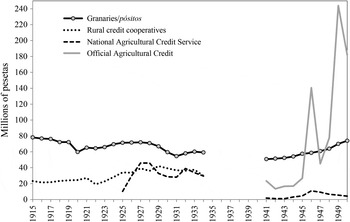
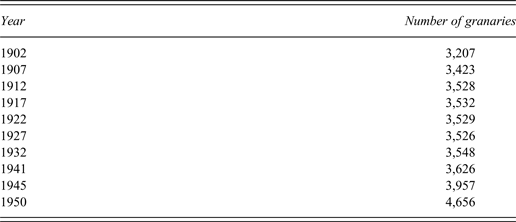
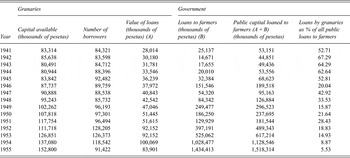
During the first half of the twentieth century, the most active agricultural credit institutions were the granaries network, the rural banks, the SNCA, and several institutions from the Agricultural Secretariat – a department of the Ministry of Agriculture, Industry and Commerce – which provided what we refer to as ‘official agriculture services’. However, the credit available from rural credit cooperatives, saving banks, and the SNCA was very limited (see Figure 1). (Rural credit cooperatives are associations that provided financial services in rural areas.)Footnote 16 The network of granaries was the main source of credit for small farmers. At this time, there were approximately four million people active in the agrarian workforce. According to the 1910 census, 3.5 million members of the agrarian workforce had access to the granaries. By 1930 the agrarian workforce had fallen to 2.9 million.Footnote 17 Furthermore, the number of granaries did not vary much between 1902 and 1932; just 341 new institutions were created in this period, that is, an increase of 10.63 per cent. Growth was greater between 1941 and 1950 when a total of 1,030 new granaries came into operation. By 1950, 4,659 towns had a granary (see Table 1) and in that year the Franco regime increased its funding for agriculture and transformed the SNCA into the Agricultural Credit Bank (Banco de Crédito Agrícola). The new bank used private banks, savings banks and rural credit cooperatives as its agents, rather than the granaries, and, as a consequence, the latter became marginal in the provision of public finance to agriculture: in 1949 the loans provided by the granaries accounted for 15.87 per cent of all loans from public entities, and in 1955 for just 5.53 per cent. With the regime's decision to reorient its agrarian policy towards a model of agricultural credit centred on the banks, the granaries came to occupy a definite second place. A similar situation evolved in Italy, but there the granaries disappeared completely.Footnote 18
Amount of capital loaned by the granaries, the rural credit cooperatives, the National Agricultural Credit Service (SNCA) and Official Agricultural Credit: Spain, 1915–1950 (in millions of current pesetas). Sources: Compiled from the Annual reports of the pósitos (Madrid, 1915–1928) and Statistical yearbook of Spain (Madrid, 1915–1950).

Evolution of the number of granaries in Spain, 1902–1950
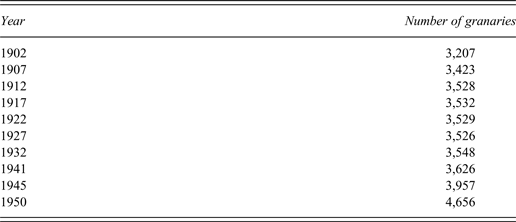
Sources: Annual report of pósitos (Madrid, 1902–1933); and Statistical yearbook of Spain (Madrid, 1941–1950).
In the early twentieth century, the most pressing problems facing the granaries were the corruption in their management, the debts owed by the state to the granaries on the national, provincial and local levels, and the continuing existence of old, uncollectible loans. Despotic ‘old boys’ networks’ often saw local councillors give their cronies loans from the funds held in the granaries. The paperwork for these loans would subsequently disappear and they would never be repaid. In other instances, town mayors and councillors granted themselves the funds and then loaned the capital out at higher rates of interest than those offered by the granary. The national government created a watchdog called the Royal Delegation to the Granaries (Delegación Regia de Pósitos, 1906) to reform the way in which the granaries operated so that they would not continue to be an instrument in the hands of local bosses.Footnote 19 The Royal Delegation was to assume all the powers in relation to the granaries that had previously been the responsibility of the town councils, but it was not provided with an adequate budget with which to undertake the inspections needed.
Another reform replaced the Board of Local Authorities (Junta de Notables, 1877) in each town council with a group of agronomic technicians (agricultural engineers and administrative officials). At the provincial level the granaries were also restructured creating a new administration named Provincial Granaries Section (Sección Provincial de Pósitos) (1907–1924) in each province. This latter measure lacked substance, because no organisation was put in place to connect the granaries ‘horizontally’ so that they could lend to each other in order to avoid idle funds or to raise capital from other banks, such as the Bank of Spain.
By remodelling the network of granaries, Spain's legislators aimed to fit the granaries’ credit services more closely to the financial needs of small farms, at a time when the latter were trying to survive and to adapt themselves to the requirements of the agrarian markets. The legislators were inspired by the agrarian credit cooperatives found in the rural areas of Germany and Italy, and they tried to bring the granaries’ economic functioning in line with that of the cooperatives. The Institute for Social Reform (Instituto de Reformas Sociales) developed by-laws for the granaries that practically converted them into rural credit cooperatives in line with the Raiffeisen system. This initiative was not successful due to the opposition of the Catholic church, as it created real competition for the new Catholic rural credit cooperatives that were being established in most of the country.
In 1906, a law was passed in Spain that allowed the granaries to form federations at both the provincial and regional levels.Footnote 20 This opened a pathway to the formation of credit networks of individual granaries, which was seen as key to the consolidation of the overall system, although, again, the actual achievements in this direction were limited.Footnote 21 Those behind the legislative reform of 1906 wanted the granaries to be in a position to help Spain's small farmers, not only by providing loans in money, but also by helping them to form cooperatives to promote saving, the use of machinery, the procurement of seed and the purchase of fertilisers and breeding animals. The changes in the legislation were intended to encourage the granaries to expand the financial services they offered, and to modernise their accounting practices. We will discuss the latter issue further below.
The new laws also gave permission to agricultural unions and to associations such as the cámaras agrícolas (chambers of agriculture – voluntary associations aimed at the protection and promotion of agricultural interests) to found new granaries, with a rather wider financial remit.Footnote 22 The granaries could accept deposits in grain from their clients and loan up to 50 per cent of the total value of these deposits, with the grain thus serving as collateral for the loan. It was also stipulated that only farmers could access this type of credit for agricultural purposes, and in each case they needed to provide a guarantor. Furthermore, rates of interest on loans in grain were not allowed to exceed 2 kilograms per 100 kilograms borrowed, and interest on monetary loans could not exceed 4 per cent, a reduction of 2 per cent compared with the Royal Order of 30 October 1861. Credit was only extended for a year, although it could be renewed for another year if the guarantee, or the security, on the loan was maintained. To reduce the number of defaults on loans, granary managers were given the subsidiary responsibility of reducing the excesses of the town councillors and their ‘political loans’.
The strategy for the reorganisation of the granaries’ accounts which followed the Law of 1906 and the creation of the Royal Delegation included three types of operation: an assessment of the granaries’ wealth and assets; the collection of any outstanding credit; and the transformation of their grain stocks into money. The improvments in management and accountability within the granaries was a key element contributing to their survival. Previously they had, for the most part, been managed by councillors with no specific training in finance or the management of accounts. This situation forced the Royal Delegation to devise a very simple system of accountability based on the monthly reports that were to be sent to the Section in each Province. The Provincial Sections’ control was further boosted by sending inspectors to examine the provincial accounts.
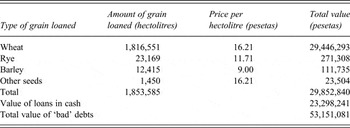
Another of the main objectives of the 1906 legislation was that any outstanding debts owed to the granaries should be settled. There were three kinds of defaults: debts that were over 40 years old which amounted to less than 1,000 pesetas or 100 bushels of grain; debts that were over 10 years old; and debts that were under 10 years old. Under the new organisation debts of the first type were to be forgiven; those of the second type were to be settled under favourable terms, and for those of the third type payment in full would be required. When, in 1911, under the new laws, the Royal Delegation demanded that loans (by granaries to peasants) of longer than 10 years’ standing should default to the debtors, this resulted in a multitude of legal actions lodged by those borrowers who had taken out a loan from a granary, or their heirs, as well as in actions lodged by the managers of granaries in an effort to elude any liability (having to use their own assets to pay the debts accrued by the granary during their period of management). To investigate the full extent of the granaries’ credit position, in 1906 the Royal Delegation also ordered each town council to provide exact information on the situation of their capital and their outstanding debts.Footnote 23 There were certain extreme instances where inspectors informed the Royal Delegation that the wealth of some granaries, and all the related documentation, had completely disappeared. The work of the inspectors from the Royal Delegation highlighted the important fact that out of the total capital held by the granaries (some 96.7 million pesetas at contemporary prices), 54.9 per cent was tied up in ‘bad’ debts (see Table 2).Footnote 24
Value of the granaries’ capital locked into ‘bad’ debts in 1906, by type of loan (valued in 1906 pesetas)

Source: J. M. Zorita, Los pósitos en España. Memoria de la Delegación Regia de Pósitos (Madrid, 1907), 51.
Mismanagement by public officials caused many of the defaults on the loans given out by the granaries.Footnote 25 These debts came from shares that the Royal Delegation had confiscated from an old state-run bank, the Banco de San Fernando. The inspectors from the Royal Delegation insisted that the Ministry of Revenue owed the granaries 14.4 million pesetas for loans made to the state. Between 1906 and 1907, the Royal Delegation set about recovering the outstanding debts and eventually managed to recover 26.9 million pesetas, although it was a slow process.Footnote 26 When, in 1920, the Royal Delegation decided to classify the granaries according to their unpaid debts, of the 3,532 granaries in existence at that point, 46 per cent had no debts pending from before 1915, 23 per cent had debts pending from the years 1906–1915, while 31 per cent still had debts pending from before 1906.Footnote 27 Of the Spanish regions, Andalucía had the greatest percentage of granaries without old debts (prior to 1906). This was mainly due to the fact that the inspections carried out on behalf of the Royal Delegation tended to focus on granaries situated in the large agro-towns, which dominated this region.Footnote 28 The regions of Castilla-León and Castilla-La Mancha had the second and third highest percentages of granaries without old debts. The Royal Delegation aimed to reactivate the granaries that had most of their capital in ‘bad’ debt, but it did not have sufficient capital to carry this out. In total, the Delegation restructured 83 granaries that were facing serious operational difficulties, and founded 98 new ones.Footnote 29
The non-repayment of debts of more than 10 years’ standing greatly hindered the work involved in restructuring the network of granaries. The lack of this capital restricted what the Royal Delegation could acheive. The Delegation also failed to adequately control the conversion of the granaries’ assets into cash. The methodology they applied allowed local administrators to sell farms, barns, silos, warehouses and other such buildings to individuals, and as a result many of the granaries’ assets ended up in the hands of the administrators’ political friends for greatly reduced prices.
A royal decree on 1 February 1924 replaced the Royal Delegation with the General Inspectorate of Granaries (Inspección General de Pósitos). Spain was now under the dictatorship of Primo de Rivera and the decree had two purposes: the integration of the network of granaries into the newly created Settlement Service (Servicio de Colonización) and further financial restructuring of the granaries in order to recoup old debts and to recover as much of their capital as possible. The Settlement Service was part of the Ministry of Development and its objective was to settle agrarian families on state-owned land to prevent emigration, populate the countryside and cultivate uncultivated or underexploited land.
A further reorganisation of the network took place under a Royal Decree of 26 July 1926. The government of Primo de Rivera abolished the Inspectorate General and replaced it with yet another new central agency: the General Directorate of Social Agrarian Action (Dirección General de Acción Social Agraria), this time based on the model of a corporation, with a manager, a general director, an administrative council and a central board. All the organisations related to agricultural policy were now grouped together under this single administrative centre. The new General Directorate of Social Agrarian Action also took over the duties of the (previous) Settlement Service. However, the General Directorate was unable to solve the network's main problems which remained the extent of bad debts, and the way in which the granaries’ executives set about liquifying the granaries’ assets. The General Directorate did introduce important financial innovations, for instance allowing mortgage loans to be secured on crops or livestock; and allowing personal loans with a single guarantor or where the collateral could be limited (to a specific amount of money) or unlimited (all the personal wealth of the guarantor). Furthermore, it extended the term of the aforementioned loans and allowed for the partial repayment of capital, as well as regulating the operations of the provincial sections, whose function was – as we have pointed out – to monitor the granaries’ accounts with a new and more effective loan control system.
To summarise, a broader coverage of the network of granaries was achieved through successive changes in their organisation, with new products, services and processes that emerged in response to the difficulties hindering credit transactions in rural areas.
3. THE FINANCIAL EVOLUTION OF THE NETWORK OF GRANARIES BETWEEN 1901 AND 1950
In 1901 Spain's Ministry of Development decided to use the granaries as a way of providing credit for the rural poor, because their idea of creating a strong agrarian bank providing credit to farmers had failed. This reasoning lay behind the financial auditing of the granaries in 1906 that has already been referred to above.
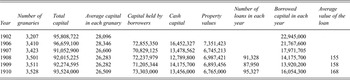
In 1906 the Royal Delegation of Granaries stated that in total the granaries held 96.7 million pesetas-worth of capital: 53 per cent in cash and 47 per cent in grains.Footnote 30 The value of rural and urban farms that belonged to the granaries (donated by the councils) amounted to 3.5 million pesetas. Between 1902 and 1910, the Royal Delegation managed to stabilise the granaries’ capital (see Table 3), which allowed them to continue their lending work, so that in 1910 they were able to grant more than 95,000 loans, totalling 16 million pesetas.
Evolution of the value of the granaries’ capital: 1902–1910 (in current pesetas)

Source: Annual report of pósitos (Madrid, 1907–1910).
3.1. The process of financial consolidation of the granaries, 1911–1935
From 1911 onwards the amount of capital available within the network of granaries had been established and the various aspects of the administration of the sytem continued to improve, placing the granaries in a much more sustainable position. On paper the amount of available capital continued to decrease after 1911, because of the sums still tied up in bad debts,Footnote 31 but these were gradually eliminated from the granaries’ books as the government forgave the debts, according to the provisions of the Law of 1906. The amount of capital available in cash to the granaries was generally stable after 1908.
To avoid the problems caused by the bad debts, the Regulation of 27 April 1923 for granaries stated that mortgage loans, and extensions to this type of loan, would not exceed three years.Footnote 32 It also allowed individual granaries to grant loans to other granaries or to agricultural credit institutions of ‘recognised solvency’, such as agrarian credit cooperatives or agricultural unions. By 1923, 2,000 granaries out of the existing 3,500 had been unencumbered of their bad debts, having recovered 42.7 million pesetas in capital between them. When the General Inspectorate took over in 1924 it continued collecting on the old debts owed, and adjusting the granaries’ nominal capital to their actual assets. Late in 1924, the Ministry of Labour, Commerce and Industry ordered that the granaries’ immobilised capital, which then stood at 12.1 million pesetas, be transferred to the General Inspectorate, which would, in turn, transfer it to other financial establishments (other granaries, agrarian credit cooperatives and other kinds of agrarian cooperatives) willing to lend to small farmers.
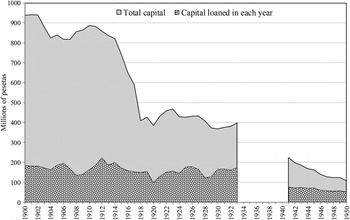
In the early 1920s, 57 per cent of all granaries were completely cleared and could operate with all of the capital at their disposal. Compared with the rest of the years in Figure 2, the amount of capital held by the granaries was highest between 1900 and 1917. Valued in 1950 pesetas, the sums ranged from 941 million pesetas in 1901 to 820 million pesetas in 1914. This capital was ‘fictitious’; it existed only in the accounts and included the large, longstanding debts on loans from the nineteenth century, which were, in practice, impossible to collect. In 1920, after the state ordered the granaries’ accounts to be restructured, the capital available was 384.6 million (in 1950 pesetas), which implied that there had been a 59 per cent decrease in the capital held by the granaries between 1900 and 1920. The restructuring, together with the improvements in local management (for example, contracting specialised personnel to do the accounts for the granaries) meant the capital available within the granaries remained fairly stable until 1934.
Total amount of capital held by the granaries and the total amount of that capital invested in loans in each year, 1900–1950 (in millions of 1950 pesetas). Source: Compiled from the Annual reports of the pósitos (Madrid, 1915–1928); and Statistical yearbook of Spain (Madrid, 1915–1950).

Throughout the 1930s, the granaries achieved financial stability and those responsible for them tried to coordinate them on the provincial level as well as on the state level. The efficiency of the granaries, in their role as institutions offering microcredit, was hampered by the lack of a financial instrument to allow idle capital from one granary, or a group of granaries, to be transferred to another granary. Despite these limitations, the network of granaries was the only publicly funded body that specialised in providing finance to small farmers. The total amount of capital loaned by the granaries was higher than that loaned by the agrarian credit cooperatives and even the embryonic state-run bank known as the SNCA. The latter institution served organisations, such as rural banks and agricultural unions, rather than individual farmers, and its capital endowment was small, so the loans it gave out did not amount to the capital lent by the granaries.
Institutions such as agricultural credit cooperatives appeared at the beginning of the twentieth century but failed to establish an intense nationwide presence during the first third of the century. They depended on the capital contributed by those doing business with them who were, for the most part, small-scale farmers. This meant that they were economically weak and had only a limited chance of acquiring funds in the formal credit markets. Only a small number of cooperatives, formed by medium and large landowners, operated in sufficiently good conditions to be able to offer financial services adequate to the demand of their members.Footnote 33
Legislation passed in 1906 and 1923 allowed some granaries to expand the range of financial services that they offered to their customers. They started to act like agricultural credit cooperatives in that they allowed their customers to make cash deposits into savings accounts, but also allowed them to make deposits in grain. The first federation of granaries, set up in the province of Salamanca in the Castilla-León region,Footnote 34 and the second federation, created in the region of Aragón in 1926,Footnote 35 both became central savings banks, making loans to affiliated granaries.
The new federations of granaries also purchased fertiliser, tools and machinery that could then be rented to local peasants for a reasonable fee. The Royal Delegation encouraged them to purchase machinery, highlighting the work done by those in Barcelona, Navarra and La Rioja, which had all acquired agricultural machinery. During 1919, 16 granaries in the province of Burgos (Castilla-León region) rented out simple machinery without any record of problems due to their collective use. This proved, according to the Royal Delegation, that a system offering shared machinery could be effective as long as the administration was straightforward and operating costs were kept low. Another important innovation for the granaries, established in the same year, was the ability to grant loans for mortgages that offered long-term credit of up to 10 years. Prior to that time, loans granted for mortgages had had shorter terms of three years.
The expanding line of services offered by the granaries included further innovations such as crop insurance, underwritten by the National Agricultural and Livestock Insurance Society (Mutualidad Nacional del Seguro Agropecuario), which was offered from 1926, and ‘granaries for fishermen’ which first opened in certain coastal regions in 1920 to provide monetary credit for the repair of vessels.Footnote 36
3.2. War, financial reorganisation and the granaries’ loss of significance, 1936–1950
The military uprising that occurred in Spain in July 1936 and the subsequent Civil War that lasted until 1939 interrupted the reforms modernising the granaries’ services. During the Civil War, two different organisations ran the granaries, one managed by Franco's rebel government in territory held by the Nationalist (Franco's) side and the other by the Republican government in the territory they retained. When the war ended, the victorious Franco imposed an exchange of currency upon the financial institutions in the territory held by the Republic at the moment of its defeat, whereby money issued by the former Republic was no longer legal tender and needed to be exchanged for Nationalist currency. The unfavourable exchange rate imposed led to a drastic reduction in the value of the capital held by the 581 granaries that had been situated in Republican territory. This capital amounted to 8,615,000 pesetas in July 1939, and, only a few months later, after the exchange in currency (January 1940) its value was reduced to 826,000 pesetas. The capital they held for their clients in deposit accounts, amounting to 2,553,763 pesetas, was also exchanged and lost considerable value. In total, the currency exchange lost the granaries 10,342,763 pesetas-worth of capital.Footnote 37
To remedy the loss of capital experienced by the network of granaries, Franco's regime established a new Granaries Service and passed a provision offering to invest in the granaries, pledging to match whatever funds could be collected by the town councils (Ordinance of 30 March 1944). This measure was effective. Between 1941 and 1950, there was an average annual investment of 150,000 pesetas (for all the granaries). By 1945, between them the 3,957 granaries had accumulated 83.8 million pesetas in capital, and by 1950, this figure had risen to 107.8 million pesetas (see Table 4). Despite the increase in the granaries’ capital, it was not until 1949 that the actual value of capital equalled that achieved in 1915 (see Figure 1). If measured in 1950 pesetas, the granaries saw a loss of total capital between 1933 – the last year with official figures before the Civil War – and 1949.
Amount of capital loaned to farmers by the granaries compared with the amount loaned by the Spanish government, 1941–1955 (in current pesetas)

Source: Statistical yearbook of Spain from 1943–1953 compilation.
By 1946 there was a sense that the Franco regime was no longer going to support the granaries. In the early 1950s, the state began to intervene in the agrarian sector, acting as a lender on a large scale, but did not use the granaries as lending agents. The new direction of Franco's agrarian policy saw the creation of agencies to control the market. Agencies such as the National Service for Wheat (Servicio Nacional del Trigo) had the autonomy to set up their own credit services for farmers. The Official Agricultural Credit (Crédito Agrícola Oficial), organised by the state, ignored the granaries as collaborating agents in the distribution of loans.
4. THE GEOGRAPHICAL DISTRIBUTION OF THE GRANARIES’ CAPITAL AND THEIR PERFORMANCE AS MICROFINANCIERS
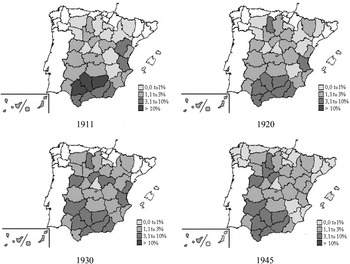
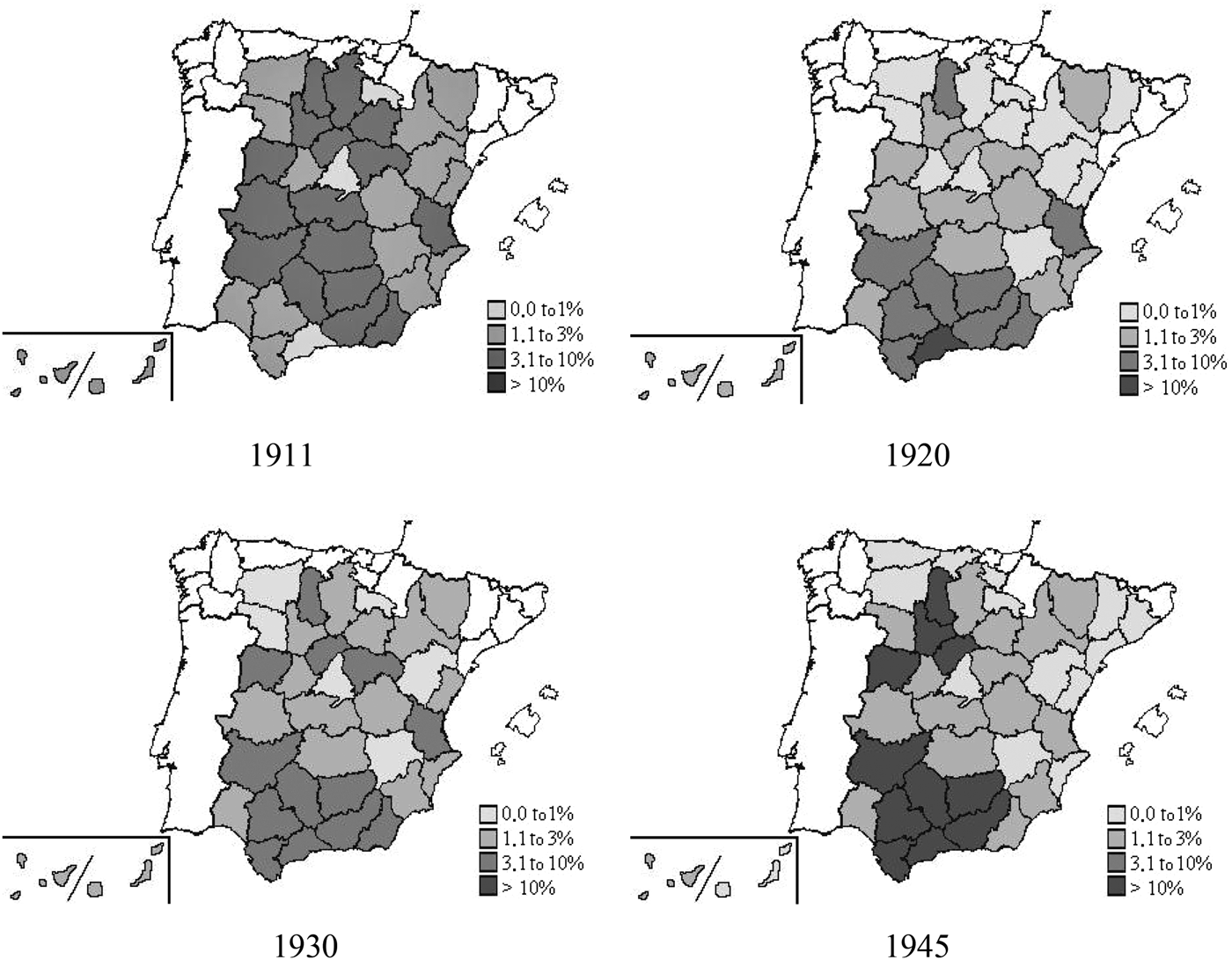
The capital held by the network of granaries was distributed unevenly throughout Spain (see Figure 3). The average value of the loans granted by the granaries grew from 179 (current) pesetas in 1910 to 341.3 (current) pesetas in 1930 (Figure 4).Footnote 38 Between 1911 and 1945, the granaries holding the most capital were in Andalucía, most of them situated in small towns of about 5,000 inhabitants. These granaries accounted for more than half of the network's total capital. The granaries of Castilla-León were the second most affluent, holding 23.3 per cent of the total capital.Footnote 39 Next came the granaries in the regions of Valencia and Castilla-La Mancha which each held 8–9 per cent of the total capital. Between them these four regions held more than 80 per cent of the capital in the granaries network (see Figure 3). Both Castile regions and Andalusia were predominantly cereal-producing regions. The remaining eight regions – Aragón, Extremadura, Murcia, La Rioja, Madrid, Canarias, Cantabria and Cataluña – held just 10.6 per cent of the total capital in 1911, but this had grown to a 16.0 per cent share by 1933.
Geographical distribution of the capital held by Spain's granaries in 1911, 1920, 1930 and 1945, by province (percentage of the total capital held by Spain's granaries). Sources: for 1911 and 1920, Annual report of pósitos (Madrid, 1913 and 1924); for 1930, Report of the General Inspectorate of Pósitos (Madrid, 1932); for 1945, Statistical yearbook of Spain (Madrid, 1946).

Geographical distribution of the capital loaned by Spain's granaries in 1911, 1920, 1930 and 1945, by province (percentage of the total capital loaned by Spain's granaries). Sources: for 1911 and 1920, Annual report of pósitos (Madrid, 1913 and 1924); for 1930, Report of the General Inspectorate of Pósitos (Madrid, 1932); for 1945, Statistical yearbook of Spain (Madrid, 1946).
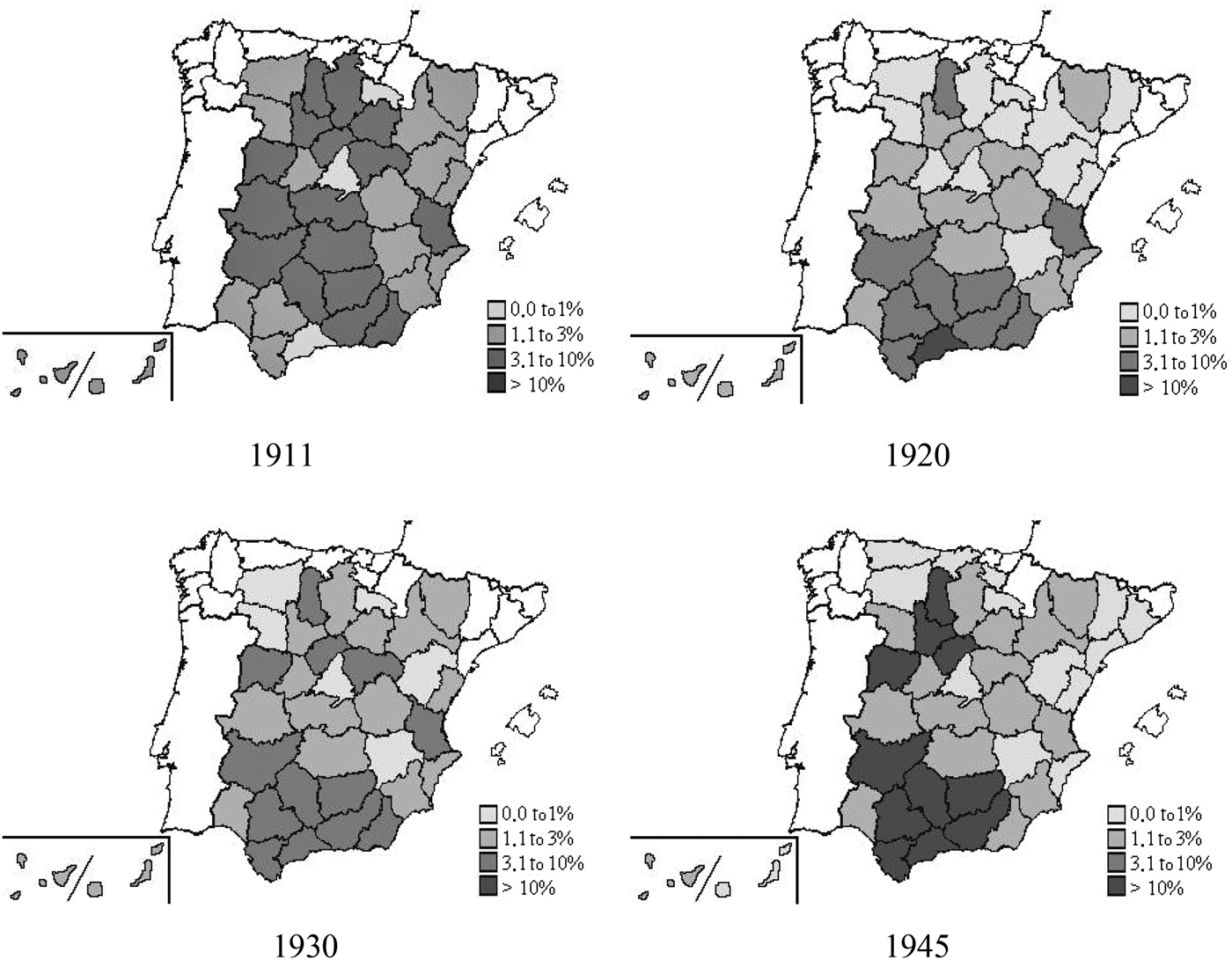
The distribution of the granaries’ loans in Figure 4 shows an asymmetry in favour of areas where properties were predominantly small. Those lending the most capital were located in the southern provinces of Andalucía, those in Córdoba, Jaen, Granada, Cadiz and Seville. Next were the granaries located in the central plateau, in Castilla-León (Salamanca, Segovia, Palencia and Valladolid), Castilla-La Mancha (Ciudad Real and Toledo) and Extremadura. Between 1920 and 1950, provinces in Andalucía and some in Castilla-León, such as Salamanca and Segovia, where the granaries had high amounts of capital and were largely unburdened by debt, were among the 10 provinces whose granaries gave the greatest number of loans.
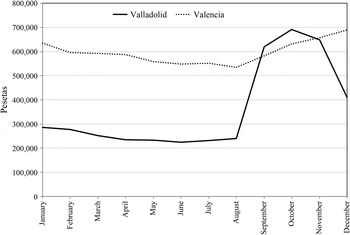
As we have already stressed, despite their problems, the network of granaries was the largest lender to the agrarian sector of the Spanish economy during the first half of the twentieth century, surpassing rural credit cooperatives, rural banks, and, after 1925, the SNCA. Particularly important in this regard was the diversification and extension of the range of financial services offered by the granaries, such as the purchase of tools and machinery which they later rented to farmers, the purchase of fertiliser which was delivered as a loan in kind and subsidies for the purchase of agrarian insurance. In this sense, the granaries evolved into what is known today as a provider of microfinance services.Footnote 40 The loans the granaries gave were adjusted to the needs of the farmers in each territory and to each type of agriculture so that their lending activity showed different patterns according to the agrarian characteristics of the different geographical areas. In the cereal-producing regions, the granaries maintained a more traditional mode of operation, only granting loans for the planting of grain, most of it wheat. Thus, in Castilla-León, Castilla-La Mancha, Andalucía and Aragón, which all specialised in cereal growing, farmers requested money loans during the planting season and paid them back at harvest time. In regions with a greater variety of crops, such as Valencia or Murcia, the needs of the farmers varied from one locality to the next, depending on the type of farming they practised. For instance, on irrigated land the demand for finance remained steady throughout the agricultural cycle, and the intensive citrus and vegetable farming in the eastern parts of the country also required the continuous purchase of inputs such as chemical fertilisers, pesticides, seeds and seedlings. The flow of capital in the granaries in these regions did not fluctuate greatly as in every season the repayment of loans compensated for the granting of new loans. Figure 5 shows how granaries acted in a non-irrigated economy, represented in the figure by the province of Valladolid, in the Castilla-León region, and in an irrigated economy, represented by the province of Valencia (within the region of the same name). During the time period shown in the figure, 1915–1920, Valencia was a modern irrigation economy, and demands for credit from the region's granaries were made throughout the year, as the agriculture was capital intensive. In Valladolid, on the other hand, demand for credit greatly increased in September, October and November, in preparation for the grain-planting season that fell mainly in October and November.
Distribution of credit provision by the granaries of the provinces of Valencia and Valladolid over the course of the year (showing the median amount of capital loaned each month between 1915 and 1920, in current pesetas). Source: Annual report of pósitos (Madrid, 1915–1920).

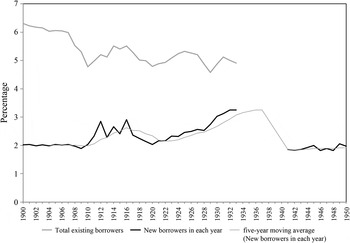
Loans from the granaries were very important for the poorest portion of the farmers, whether they were landowners or tenants. This microcredit, together with other microfinance services – such as rural credit cooperatives and saving banks – was instrumental in the survival of small farms as the agrarian market became increasingly competitive. Between 1900 and 1950, 3,736,706 farmers borrowed 6.165 million pesetas from the granaries.Footnote 41
Between 1907 and 1933 a total of 2,482,598 small farmers had loans from the network of granaries, representing an average of 5.2 per cent of the agrarian workforce in the countryFootnote 42 (see Figure 6). No other public or private institution reached this percentage during the period studied. In part this was because the conditions under which the granaries offered their financial services were very advantageous for the farmers, because the 4 per cent interest rate charged on their loans was fixed throughout the country. This rate was lower than the 5 to 6 per cent offered by the savings banks and agricultural credit cooperatives operating in rural areas.Footnote 43 Small farmers wishing to obtain finance had few options and the granaries were the most viable of these. Also, a loan from a granary did not exclude the farmer from other possible sources of finance, such as rural credit cooperatives and savings banks.
Annual percentage of the economically active population in Spain's rural areas formed by those borrowing from the granaries, 1900–1950. Sources: Annual report of pósitos (Madrid, 1900–1933); Statistical yearbook of Spain (Madrid, 1941–1950); Population Census Spain (Madrid, 1900–1950, selected years).

4.1. The financial problems of the network of granaries
Providing microcredit to small cereal farms was the main activity of the network of granaries, as the geographical distribution of loaned capital between 1907 and 1950 clearly shows (see Figures 4 and 5). As with microfinance institutions in agricultural areas today,Footnote 44 the first activity of a granary was to act as a lender, but a loan on its own was often insufficient to ensure that the small farm would modernise and become self-sustaining. The granaries, like other institutions offering microfinance, had to consolidate their position, and that of their customers, by extending the services they offered. Throughout the first third of the twentieth century the granaries extended their services into agricultural insurance, rental of small machinery and the purchase of chemical fertilisers. Despite these advances, areas were left unaddressed which could have transformed the granaries into more complete financial institutions, providing savings and credit. Savings were only offered in a very small number of granaries (mainly in the Castilian province of Salamanca). Most of the granaries could not offer this service because the town councils responsible for their operation refused to allow them to do so, arguing that the difficulties involved would be too great as the granaries lacked both the specialised personnel needed and the necessary funds.
Among the important factors that hindered the granaries’ operation were: deficient institutional organisation due to precarious government systems; the risky nature of many loans, since the guarantees required of borrowers were not very stringent; local managers without specific management qualifications (because they often became managers as a result of political decisions); and limited financial and commercial skills in the potential clientele. A final issue was the non-existent financial support from the state.
Another important problem for the network of granaries was its financial coordination. The central authorities improved the vertical organisation and administration of the network, and strengthened their own supervision and control over the accounting practices of the individual granaries. The granaries would have benefited from a central financial institution capable of redistributing the inactive capital from one granary to another, perhaps through a network of provincial agencies, but the various governments failed to put one in place, despite the attempts at reform by the government delegations within the network. The attempts to organise federations of granaries within provinces thus largely failed, due to a lack of financing.Footnote 45 Proposals for a Central Credit Bank (Caja Central de Crédito),Footnote 46 and, in 1920, for a King Alfonso XIII National Granary (Pósito Nacional Alfonso XIII) came to nothing. These failures were partly due to the fact that the Catholic Church actively financed rural credit cooperatives to avoid liberal and socialist ideas growing in influence in the rural areas. The Church set up several initiatives to support agriculture and provide credit to small farmers during the first third of the twentieth century. The most successful of these initiatives was the rural saving banks (the first was created in 1901). In some regions, such as Navarre, these were managed directly by the clergy. In a previous publication we have shown that rural saving banks and granaries tended to be located close together. There were approximately 500 rural savings banks in Spain during the first third of the twentieth century, although they were unevenly spread.Footnote 47 The greatest concentration at that time was in northern-central Spain, followed by the Mediterranean areas of Catalonia, Valencia, and Murcia with their highly market-oriented farming.
One of the most marked differences between the granaries and the rural saving banks was that the granaries were exempt from property tax (because in Spain all public entities were tax exempt) and could gain access to local farms seized by the Treasury for non-payment of taxes. However, granaries could not receive funds from other credit or financial institutions, whereas cooperatives could, and that allowed the cooperatives to increase the funds they had available. To compare the effectiveness of both institutions as lenders we have calculated the ratio between their available capital and their loaned capital. In relative terms, the rural saving banks loaned more capital than the granaries. Thus, between 1910 and 1930, the cooperatives loaned 69.4 per cent of their total capital, while granaries loaned 35.1 per cent.
The amounts of money immobilised were significant. In 1920 all the granaries across Spain had 35 million pesetas available, but only 19 million were available for lending. Although the General Inspectorate began in 1924 to grant extraordinary loans to local granaries with funds from idle resources in other granaries, it did not regulate the types of interest paid for these loans, nor did it set out the possible legal responsibilities, or duly guarantee the repayment of the loan to the lender-granary. This lack of precision created instability in the working of granaries as it opened the door to a number of poorly regulated operations. The General Inspectorate became an intermediary under the direction of the SNCA (1925), acquiring credit for the granaries. At other times, it cooperated with the SNCA to organise wheat collateral loans.
The first attempt to generate horizontal coordination was the establishment of the Granaries Federation of Salamanca in 1929, the Cuatro Sexmos de la Tierra Granary, bringing together nearly half the granaries in the province. This federation was one of the best functioning granaries in the entire network. This initiative sought to provide a model of horizontal integration for the rest of the network. The Granaries Federation of Salamanca was authorised to act as a savings bank; the capital deposited in the provincial granary could be invested in mortgage loans for up to 50 per cent of the property value of rural farms at a 5 per cent rate of interest. The profits made could then be used to pay the managers and to increase the capital available to the Provincial Granary.
5. CONCLUSIONS
In this paper, we have presented empirical evidence that supports the idea that granaries played a significant financial role during the first half of the twentieth century as lenders to the agricultural sector in Spain, in which small farmers lacked access to the formal credit market. In the early twentieth century, the network of granaries underwent a substantial reorganisation with the passing of the Law of 1906 and the creation of the Royal Delegation. From this date, the restructuring of accounts held by the granaries began. Between 1907 and 1920, the granaries underwent an increasing monetisation of their resources, and a significant number of ‘bad’ debts were eliminated, streamlining their accounting system. The inspections of the granaries’ accounts carried out under the auspices of Royal Delegation and better administration by their governing boards saw their performance improve notably and, consequently, enhanced their sustainability as agrarian microcredit institutions.
From 1900 to 1950, the granaries were the only public institutions in Spain specialising in agrarian microcredit. They carried out a significant role in the framework of the agrarian economy, loaning 6.166 million pesetas (1950 value) to poor farmers, a figure that no other institution, private or public, provided to the farming sector. Despite this, after 1950 the network had no role in the distribution of the agrarian credit provided by the state. Granaries continue to exist today but their activity is minimal.
As a network of publicly funded agrarian microcredit institutions, the granaries had significant deficiencies. These were not remedied by the state, which limited itself to centralised supervision of local management, funding some inadequate reorganisation of the granaries, and drafting new regulations concerning their organisation. Despite repeated attempts, the government failed to coordinate the financial operation of the individual granaries and this undermined their capacity to offer loans. Coordination within the provinces was not developed either; there was only one case, the Cuatro Sexmos de la Tierra Granary, which grouped all the granaries in Salamanca. By 1925, the state had decided to create a new centralised source of agrarian credit, the SNCA. However, they did so without either doing away with the network of granaries or incorporating it into the new agency as a network of offices. In the wake of the Spanish Civil War, the granaries’ capital was much depleted. The new regime attempted to reorganise them, but finally chose to create a new channel for the distribution of official agricultural credit using commercial banks and saving banks. The granaries thus became the marginal institutions they remain today.
ACKNOWLEDGEMENTS
The authors would like to thank M. A. Perceval for his comments as well as F. Munuera for excellent research assistance and comments. S. M. R. received financial support from Fundación Séneca (project 15147/PHCS/10), and the Spanish Ministry of Economy and Competitiveness (project HAR2013-42013-R).