

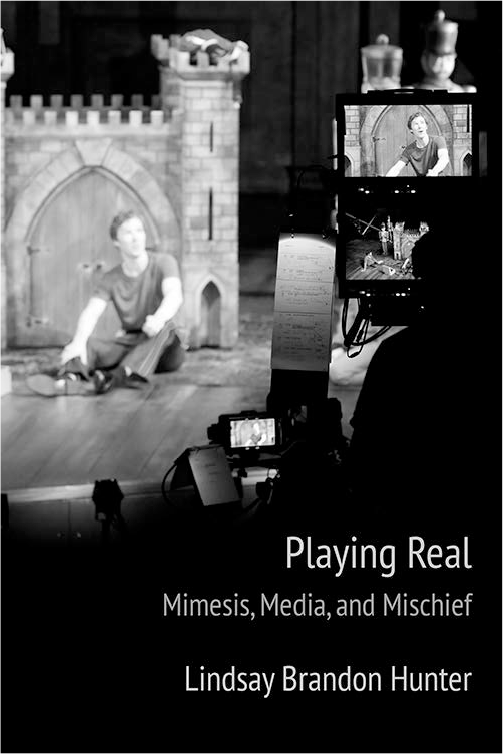
Lindsay Brandon Hunter’s Playing Real: Mimesis, Media, and Mischief is a wide‐ranging, thought‐provoking examination of the relationship between authenticity and artifice in the production and reception of mediatized performance in the 21st century. Specifically, Hunter analyzes live broadcast theatre, intermedial theatre, reality television, and alternative reality games, showing how each form, while relying upon a traditional “imaginary of the real” (xvii–xviii), exposes the notion of “realness” as slippery, subjective, and contestable. The book’s conceptual linchpin is Hunter’s “mischief,” understood throughout Playing Real as a potential for playful, pleasurably productive disruption or subversion.
Chapter 1 focuses on live broadcast theatre as exemplified by the (British) National Theatre’s NT Live and the Royal Shakespeare Company’s Live at Stratford‐upon‐Avon series. Hunter shows how these “digital translations of theater” (18) profess to grant audiences access to a specifically theatrical experience — excitingly ephemeral, passionately immediate — and, in the process, define the values and conventions that moviegoing publics associate with theatre (in the case of the NT and RSC, these values and conventions are, of course, institutional and relatively conservative). Chapter 2 centers on the Wooster Group’s 2007 production of Hamlet, which took as its source material the “Electronovision” film of a 1964 Broadway production of Hamlet starring Richard Burton, directed by John Gielgud, and screened at cinemas across the United States over a two‐day period. Hunter views the Electronovision experiment as an early precursor to NT Live and other live broadcast theatre. For Hunter, the Wooster Group Hamlet displays the core characteristic of intermedial theatre: an interactive use of media that provokes audiences to reflect upon the typical modus operandi of theatrical performance as well as that of the technological medium in question. Hunter argues that, while approaching the Burton/Gielgud Hamlet with an explicitly imitative methodology (enabled by onstage video monitors and earpieces carrying the film’s audio), the Wooster Group’s actors were able to summon successfully the kind of explosively auratic mode of presence for which Burton was famous. This playfully postmodern, mimetic approach calls into question the popular (and lingeringly Romantic) idea that inspired acting can only draw its power from the mysterious depths of a performer’s interior life.
Chapters 3 and 4 look at three reality television series: The Bachelor (2002–present), whose competitive format centers on the convincing performance of romantic love; True Tori (2014), which tracked the daily life and relationship dramas of actress Tori Spelling; and The Hills (2006–2010), a soap opera–style reality show following twenty‐somethings in Los Angeles. Hunter claims convincingly that, in each series, the tension between spontaneity and scriptedness is a key source of viewer fascination. Likewise, parsing the real from the fake, including the practice of “spoilering,” provides a chief pleasure of viewer engagement. In other words, an aesthetic of totally convincing “realness” would be undesirable for such shows; rather, Hunter argues, a “balance” or “alchemy” between contingency and contrivance is needed to achieve the texture of ambiguity (and, at times, indecipherability) that sustains the reality television genre (81).
Chapters 5 and 6 of Playing Real discuss alternative reality games (ARGs). Hunter defines ARGs as “immersive,” employing a “this is not a game” (TINAG) rhetoric, and “pervasive,” taking participants into real‐world environments and thus breaking the “magic circle” often theorized (by Johan Huizinga and others) as a precondition for ludic activity (85–92). Hunter examines three ARGs at length: The Beast (2001), initially developed to promote the Steven Spielberg film A.I. Artificial Intelligence; World Without Oil (2007), a “serious” game that challenged players to adapt their daily behavior to cope with an imagined global oil shock; and Conspiracy for Good (2010), a “participation drama” sponsored by Nokia that sent gamers armed with cell phones on missions to oppose the actions of a malevolent (fictive) corporation. For Hunter, ARGs provide powerful structures for integrating imagined and actual realities and potent prompts to their players’ “performing believing” and “performing realness” (103). Hunter sees positive, transformative potentials in ARG gaming, both in its capacity to provoke learning and shape player behavior after the conclusion of the game (as in the case of World Without Oil) and in the possibility that players might resist and critique the self‐serving motives of game designers and sponsors (as occurred in Conspiracy for Good).
I was largely unfamiliar with the ARG genre before reviewing Playing Real, and as I read Hunter’s description of the games’ entry points or “rabbit holes” — cryptic clues embedded in online content that draw potential participants into engagement with an expanding web of further clues placed in digital and analog media as well as real‐world environments — I found myself thinking: “This sounds an awful lot like QAnon.” Indeed, a cursory Google search yielded a number of recent articles in the mainstream press (some written by game designers themselves) comparing QAnon to ARGs. Hunter’s discussion of ARGs as offering “a fictional, optional circumstance superimposable on and integrated into players’ daily lives” (100) takes on ominous valences in our current moment of conspiracist thinking, mythologized politics, and misinformation run rampant.
Hunter herself notes in the conclusion to Playing Real that she began work on the book well before the ascendancy of Trump and the 2016 election, and that, given a climate of “alternative facts” and a growing anxiety over digital deceptions like ultrarealistic “deepfakes,” readers might now have greater difficulty accepting the idea of “mischief” being usefully provocative in its essence. (The faces of Roger Stone and Milo Yiannopoulos loom up in my mind’s eye as I write.) Media‐enabled manipulation and delusion are clearly on the rise, as is, perhaps, an antithetical tendency in the zeitgeist — a yearning for honesty and seriousness in discourse and action. These dynamics will surely continue to play out for years to come, and, given the breadth and sophistication of Playing Real (a debut monograph), scholars in the fields of theatre and performance studies ought to pay close attention to Hunter’s future research for a deep and lucid analysis of developments, potentials, and philosophical concerns related to the shifting interactions between media and performance in our existentially unsettled era.


