There is a consensus among researchers that better prepared civilian populations also cope better, are less vulnerable, and sustain fewer damages as a result of emergencies and disaster situations.Reference Peek and Mileti1, Reference Hémond and Robert2 Ample research has been conducted to understand the sociological and psychological elements governing preparedness behavior in attempt to influence it.Reference Norris3–Reference Roudini, Khankeh and Witruk8 In light of this, considerable efforts are made by civil defense authorities to promote readiness and increase public resilience to emergencies. This is true globally and specifically for the State of Israel. Yet, recent studies suggest that Israeli households’ preparedness to emergency remain insufficient.Reference Bodas, Siman-Tov, Kreitler and Peleg9–Reference Bodas, Siman-Tov, Kreitler and Peleg10
For example, in a study performed in Israel in 2013, a medium level of preparedness of Israeli households to a scenario of armed conflicts was observed.Reference Bodas, Siman-Tov, Kreitler and Peleg9 More interestingly, this study revealed that most of the variables reported in the literature as preparedness correlates were not associated with preparedness behavior in said context. In other words, classical threat perception components, such as perception of severity, likelihood, and personal responsibility, were inapt in predicting preparedness behavior to armed conflicts among Israelis.Reference Bodas, Siman-Tov, Kreitler and Peleg9–Reference Bodas, Siman-Tov, Kreitler and Peleg10
Indeed, the psychology behind preparedness behavior in Israel turned out to be highly complex. The findings of the studies performed by Bodas et al.,Reference Bodas, Siman-Tov, Kreitler and Peleg9–Reference Bodas, Siman-Tov, Peleg and Kreitler12 Kirschenbaum,Reference Kirschenbaum13 and Soffer et al.Reference Soffer, Goldberg and Adini14 provided important insights into the behavioral model of preparedness to emergencies in Israel. This behavioral model is qualitatively different from classical behavioral models such as the Health Belief Model,Reference Becker15 or even the preparedness model suggested by Paton et al.Reference Paton4 and Becker et al.Reference Becker, Paton, Johnston and Ronan7 While the latter are generally utilitarian models that propose that preparedness behavior is the product of a mostly rational process of the weighing of benefits and barriers, the former seem to disobey these classical associations between risk perception factors and behavior.Reference Bodas, Siman-Tov, Kreitler and Peleg11–Reference Bodas, Siman-Tov, Peleg and Kreitler12
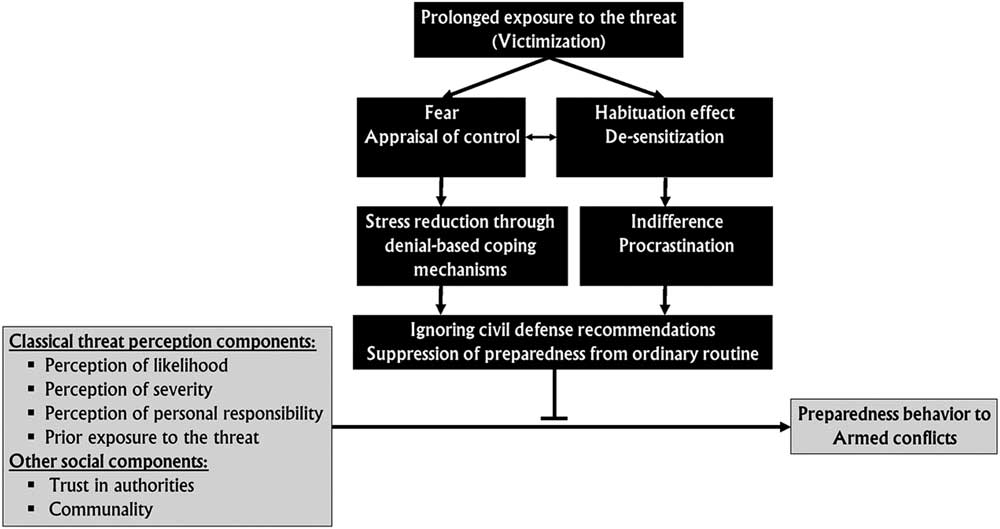
Being constantly exposed to the threat of armed conflicts has developed mechanisms that suppress preparedness behavior.Reference Bodas, Siman-Tov, Peleg and Kreitler12, Reference Bodas16 These mechanisms are adhering to the principles of victimization,Reference Rüstemli and Karanci17 that is, the behavior is governed mostly by fear and appraisal of control (Figure 1). Consequently, Israelis engage in preparedness behavior only when the threat becomes real and imminent, that is, when it is potentially too late. The findings suggest that this pattern of behavior is based on a conscious decision, rather than lack of awareness. In other words, Israelis actively and knowingly postpone their engagement in preparedness until they appraise the situation as one that requires immediate attention.Reference Bodas, Siman-Tov, Kreitler and Peleg11, Reference Bodas, Siman-Tov, Peleg and Kreitler12, Reference Bodas16
The Victimization Model and Its Effect on Suppression of Public Preparedness Behavior.

Support for this claim can be found in numerous emergency occasions in Israel. For instance, the phenomenon was demonstrated by the Israeli public in 2013. Following the use of chemical weapons by the Syrian regime in Syria, an inflammatory rhetoric sparked between the United States, Russian Federation, and Syria. The “beating drums of war” prompted Israelis to queue in line for many hours to obtain a gas mask kit distributed by the government. This is in spite of the fact that the media reported for months before that the stockpile of gas masks in Israel can cover only 60% of the population.18 This case study exemplifies the tendency of Israelis to delay emergency preparedness behavior to a time when they appraise the threat to be real and imminent. It is also demonstrating that they are willing to pay the price associated with this procrastination of behavior – in this case, long queuing for many hours.
The behavioral model of victimization suggests (Figure 1) that preparedness behavior is suppressed under conditions of frequent and repeated exposure to the threat due to the prevalence of denial-based coping mechanisms, desensitization, and habituation effect. The sociopsychological foundations of preparedness behavior under the setting of victimization pose many challenges to prompting the public to engage in preparedness. The psychological barriers that block and delay preparedness behavior under this setting are difficult to overcome. Adherence to typical public preparedness methods has not worked, suggesting that innovative thinking might be called-for to make a change.
The purpose of this study was to explore the efficacy of psychological intervention, proposed in light of accumulated data, to promote preparedness to armed conflicts in Israel. We hypothesized that, by applying scientifically crafted psychological interventions, we could overcome the cognitive barriers associated with the victimization modelReference Bodas16 and bring about a significant increase in reported preparedness behavior compared with control.
METHODS
This manuscript adheres to the CONSORT guidelines for randomized studies.
Study Design
A randomized controlled study was performed during December 2016 to evaluate the efficacy of psychological intervention on promotion of households’ preparedness to armed conflicts. The study was conducted in Israel. The interventions were administered via an Internet-based platform called iPanel. The choice of online platform was made in light of the type of interventions performed, which are easier to administer in a written format. The iPanel provided the best solution for this study given its pool of over 130,000 users and its ability to effectively provide a representative sample of the adult Jewish population of Israel. The iPanel began its activity in 2006 and has since provided an online platform for a wide variety of information collection services, polls, and public opinion surveys. The iPanel adheres to the stringent standards of the world association for market, social, and opinion researchers (ESOMAR). In addition, the iPanel was evaluated by the Applied Statistical Laboratory of the Hebrew University in Jerusalem and was found to be highly accurate in assessing Internet-based samples of the adult Jewish population in Israel.Reference Nirel19
Sample
Sample size was determined prior to conducting the study. The minimum sample size was calculated as 385 based on the size of the population of Israel (∼ 8,000,000), level of confidence (95%), and a 5% acceptable margin of error.20 Participants were included if they met the following inclusion criteria: greater than 18 years of age, Jewish, and a panelist on the iPanel. Non-Jewish individuals were not sampled due to the inability of the survey provider, at that time, to provide a representative sample of the Arab population in Israel. Overall, 502 individuals participated in the study.
Randomization
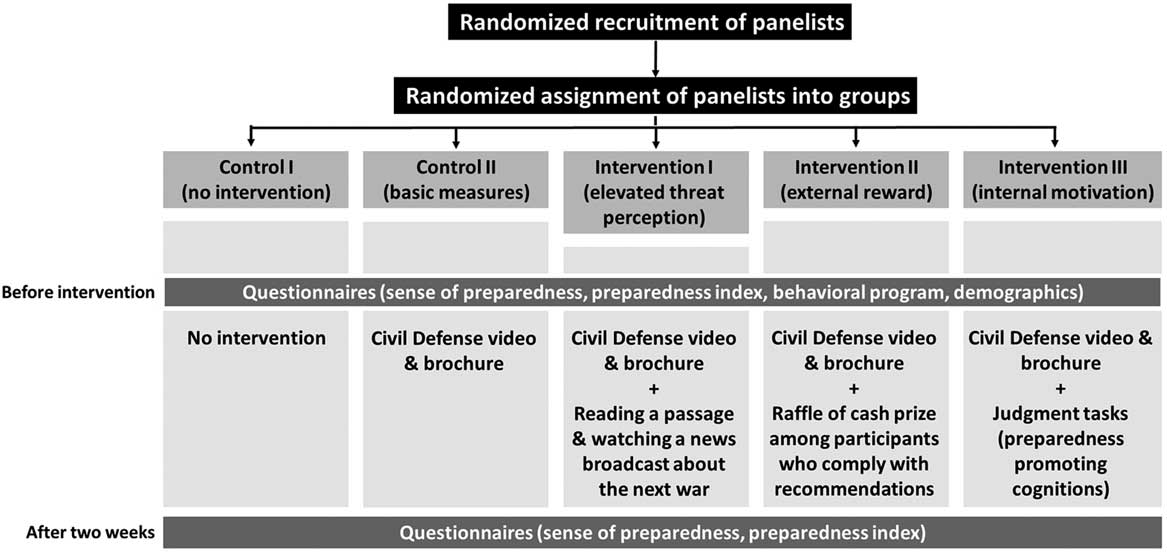
Participants were notified of their eligibility to enroll into the study through an online message sent by iPanel. The overall response rate was 26%, which is the common response rate in this type of survey. Of those opting-in to the study, 502 participants were randomly chosen according to preset quotas for gender, age, and geographical distribution. These quotas were predetermined to generate a representative sample of the Jewish population in Israel. Next, participants were randomly assigned by a computer to one of five groups: two control groups and three intervention groups. The intervention to control allocation ratio was predetermined as 3:1, respectively, with 105 intended participants in each intervention group and 35 in each control group. Participants and study flowchart are provided in Figure 2.
Participant and Study Flowchart.
1st control = no intervention, 2nd control = basic measures (civil defense video + brochure), 1st intervention = elevated threat perception, 2nd intervention = external reward, 3rd intervention = manipulation of a cognitive cluster.

Of the 502 participants, 381 participants (∼ 76% response rate) completed both rounds of questionnaires (see demographic distribution in Table 1). In the first control group, 35 participants completed both rounds out of a total of 46 who participated in the first round (76% response rate). In the second control group, 35 participants completed both rounds out of a total of 47 (75%). In the first intervention group (elevated threat perception), 110 participants completed both rounds out of a total of 137 (80%). In the second intervention group (external reward), 100 participants completed both rounds out of a total of 136 (74%). Finally, in the third intervention group (manipulation of a cognitive cluster), 101 participants completed both rounds out of a total of 137 (74%).
Sociodemographic Distribution of Studied Sample and Dropouts (N = 502)a

a A significant difference between the groups exists only for the age variable, according to Mann-Whitney test for difference of means (Z = -2.385, P = 0.017) and chi-square test for difference of proportions (χ2 (df = 2) = 6.393, P = 0.041)
b Compared to the average household income of US ∼ $3,800.
Despite randomization, the participants in the two control groups were statistically younger, secular (self-proclaimed non-religious), and comprised more females compared with the participants in the intervention groups. No differences were observed between remaining participants and dropouts other than age, with dropouts being statistically younger. Accordingly, controlling for these variables ensued in all analyses performed. Across the groups, the dropout of participants was completely random, with no statistical differences in the amount of dropouts or sociodemographic breakdown of dropouts between groups (data not shown).
Study Procedure
In all groups, participants were required to complete a set of questionnaires immediately before the intervention and 2 weeks following it. In the first control group, participants were asked to complete the questionnaire without going through any intervention. In the second, quasi-control group, participants were required to view a short animation video made by the civil defense authorities in Israel, prompting them to engage in preparedness behavior, and to download the civil defense brochure on households’ preparedness.Footnote 1 These basic measures were repeated for all three intervention groups, and, for this reason, were controlled in a separate quasi-control group.
In the first intervention group, participants were prompted to read a passage depicting the outlines of a future possible war with Hezbollah in Lebanon and to view a two-and-a-half minute video taken from a news broadcast that originally aired to commemorate 10 years since the Second Lebanon War (2006). This video also portrayed the intensity, challenges, and difficulties of the next war in the Northern border. Accordingly, this group was labeled “elevated threat perception.”
In the second intervention group, participants were offered a cash reward for completing as many household adjustment actions. Participants were told that a cash prize of 500 NIS (∼US $130) would be raffled among participants who completed as many of the civil defense recommendations for household preparedness to armed conflicts. Accordingly, this group was labeled “external reward.”
In the third intervention group, participants were asked to complete 24 judgment tasks. Each task included a primary statement, to which participants needed to match one of three other statements that they felt was most supportive. Participants could offer their own wording to each task if they preferred. The 24 primary statements were based on six themes previously identified to be associated with the cognitive orientation of preparedness behavior in accordance with the Theory of Cognitive Orientation (CO)Reference Kreitler and Kreitler21, Reference Lewinsohn, Mischel, Chaplin and Barton22: “being a survivalist,” “being in constant control,” “being self-sufficient, not relying on others,” “caring for one’s family,” “mistrust in authorities,” and “self-efficacy” (authors’ unpublished data). For each theme, there were four tasks phrased in accordance with one of the four belief types of the CO Theory (beliefs about self, reality, norms, and personal goals). For example, the primary statement pertaining to beliefs about self for the theme “being in constant control” was: “It is important for me to be in constant control all the time.” This primary statement was followed by the following three supportive statements: “I am a type of person who values control in my life,” “Controlling my fate is important to me,” and “When I am in control over my life, I am relaxed.” In fact, the specific choices made by participants were not considered. According to the CO theory, the mere engagement in the judgment process should be capable in priming participants for dispositional thinking that was found to be supportive of preparedness behavior (authors’ unpublished data). Accordingly, this group was labeled “internal motivation.”
Outcome Measures
Primary Outcome
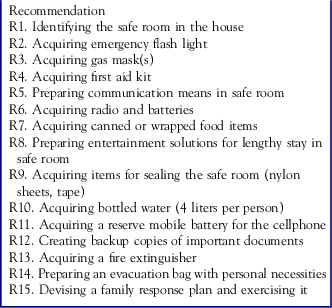
The primary outcome of this study was reported preparedness, as measured by the Preparedness Index (PI). This is a self-report measurement of households’ preparedness to armed conflict. The PI score was calculated as the number of action-items reported as complied-with out of a list of 15 recommendations by the civil defense authorities for households’ adjustment to armed conflicts (see Box 1). The questionnaire was validated and used in previous studies.Reference Bodas, Siman-Tov, Kreitler and Peleg9–Reference Bodas, Siman-Tov, Peleg and Kreitler12 In this study, the questionnaire scored a Cronbach alpha value of 0.777 and 0.756 before and after intervention, respectively.
List of Action-Items Recommended by the Israeli Civil Defense Authority for Household Adjustment to Armed Conflicts (in the Order of Appearance in the Questionnaire)

The primary outcome measurement was assessed in a two-time point: immediately before intervention and 2 weeks following the intervention. The choice of a 2 weeks period for reassessment was made to confine the duration of the research. This allowed avoiding possible fluctuation in threat perception caused by temporary changes in war posturing and regional inflammatory rhetoric, which are frequent in the Middle East region. In addition, it provided participants with a tangible deadline, hoping that this will maximize the effect of the interventions.
It is important to note that, in both points of assessment, the preparedness level was reported by the participants. Although this is common practice in similar studies, this kind of measurement is subject to reporting biases. Therefore, considerable efforts were made to reduce the potential for biases. For example, participants were informed that house visits would be performed to assess the accuracy of their reporting, and that monetary compensation would be denied from participants found to be overreporting or underreporting. In fact, no one was denied compensation nor any house visit was performed; rather, this was a deception approved by the ethics committee.
Secondary Outcomes
Sense of preparedness was assessed using a previously validated questionnaireReference Bodas, Siman-Tov, Kreitler and Peleg9–Reference Bodas, Siman-Tov, Peleg and Kreitler12 that included three items on a 5-point Likert scale: (1) “To what extent are you familiar with the Home Front Command’s recommendations for war preparedness?”; (2) “To what extent do you feel mentally and emotionally prepared for war?”; and (3) “To what extent do you feel physically prepared for war?” Subjects were asked to provide their evaluation of these items prior to reporting the PI. The sense of PI was calculated as the mean score of answers to the three items. The higher the score, the higher the sense of preparedness reported by the participant. The questionnaire scored a Cronbach alpha value of 0.773 and 0.784 before and after intervention, respectively.
A behavioral intent/plan, considered as a possible confounder, that is, the intent to engage in preparedness behavior in the 2 weeks following intervention, was assessed with a six-item questionnaire on a dichotomous scale (yes/no). Participants were asked to indicate whether or not they intend to engage in the following actions in the coming 2 weeks following intervention: (1) “Find or select the protected space”; (2) “Acquire food and bottled water for emergency”; (3) “Acquire emergency gear, such as a radio & batteries, flash light, reserve battery for a cell phone, etc.”; (4) “Prepare things that you will need during an emergency, such as an evacuation bag, copies of important documents, etc.”; (5) “Make a family response plan and exercise it”; and (6) “Devise alternative plan, such as leaving the country during the emergency.” The behavioral plan score was computed as the number of items answered “yes” and thus ranged from 0 to 6. The scale scored a Cronbach alpha value of 0.852.
Statistical Analysis
The statistical analysis of the results was performed using SPSS, Version 23 (IBM Corp, Armonk, NY). The analysis included both descriptive and analytical methods. Prior to analysis, indices were generated and their reliability was assessed using Cronbach alpha (with a minimal threshold of 0.700). The analysis of the primary outcome measurement (PI) was based on a residual (difference) score for the level of preparedness, which was calculated by subtracting the number of actions reported as complied-with before intervention from the number after intervention.
Statistical tests were chosen according to variable distribution. Non-parametric tests were mostly chosen for statistical analysis in accordance with the distribution of variables. The Spearman correlation test was used to examine correlations between continuous variables. Mann–Whitney or independent samples t-test were used to assess differences between means of two independent samples. Wilcoxon or paired-sample t-test was chosen for paired samples. The Kruskal–Wallis and analysis of variance (ANOVA) test was used for comparison of means of more than two groups. The chi-square test and relative risk (RR) were used to evaluate results associated with categorical variables. In addition, multi-variant analyses were performed. To assess differences in reported preparedness across groups, an analysis of covariance (ANCOVA) test with Bonferroni correction was used.
In addition, a linear regression analysis was used to predict change in reported preparedness. The regression was performed in enter mode with two blocks, the first including demographic variables found to associate with the dependent variable (age, gender, and having children [yes/no]) and the second including the type of intervention (excluding the first control group). Analysis was performed following negation of multiple co-linearity (maximum variance inflation factor value of 2.5). In all statistical analyses performed, a P-value of 0.05 or less was determined as statistically significant.
RESULTS
Primary Outcome
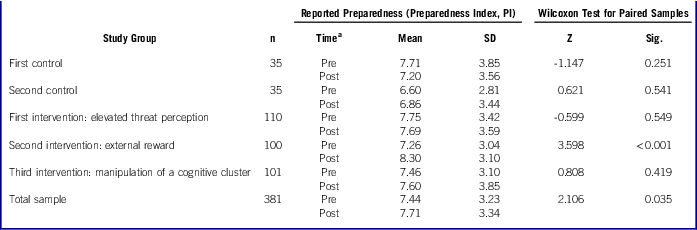
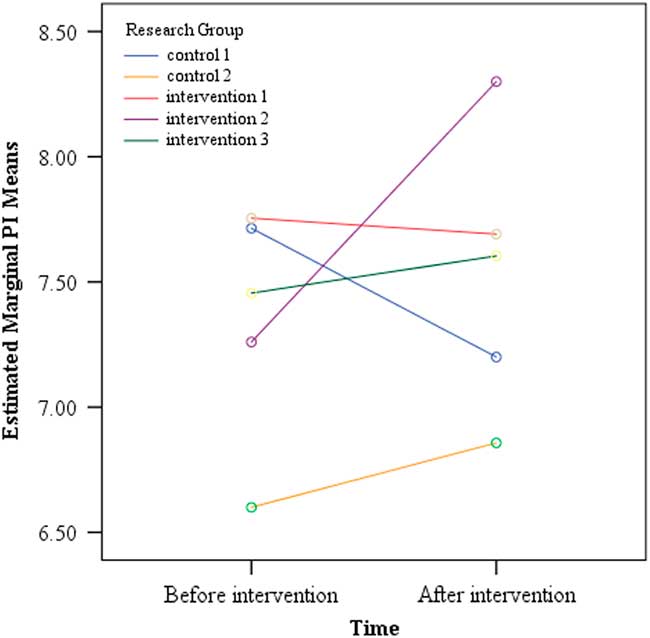
The main outcome of this study was the number of civil defense recommendations reported as complied-with by a participant (labeled: Preparedness Index, PI). Table 2 describes the levels of reported PI for each study group before and after intervention. Among the 381 participants who completed both rounds of the research, the reported PI increased significantly after the intervention (7.44 [± 3.23 SD] vs. 7.71 [± 3.34 SD]), respectively, according to Wilcoxon paired samples test (Z = 2.106, P = 0.035). A univariate analysis of difference between reported PI before and after intervention yielded significant result only for the second intervention group in which external reward was offered (Z = 3.598, P < 0.001). Figure 3 illustrates the change in reported PI for each study group.
Change in Levels of Reported Preparedness (PI) Across Study Groups (N = 381)

a Pre = before intervention; Post = 2 weeks following intervention.
Estimated marginal PI Means Before and After Intervention Across Study Groups (N = 381).
(A) Box-plot charts. (B) Pairwise comparison; 1st control = no intervention, 2nd control = basic measures (civil defense video + brochure), 1st intervention = elevated threat perception, 2nd intervention = external reward, 3rd intervention = manipulation of a cognitive cluster.

A multivariate analysis using an ANCOVA test was used to determine a statistically significant difference between study groups on reported PI after intervention. This analysis allowed for controlling for the reported PI before intervention as a covariate. All preconditions existing for this test were satisfied, including homogeneity of regression slopes and equality of variances. The results of the analysis suggest a significant effect of intervention on reported preparedness after controlling for the initial level of reported preparedness (F(4,375) = 4.511, P = 0.001). A post hoc analysis using the Bonferroni correction revealed that this effect is attributed to the difference between the second intervention group, in which external reward was offered, and the first control (MD = 1.460, SE = 0.420, P = 0.006), as well as the first intervention group (elevated threat perception) (MD = 1.001, SE = 0.296, P = 0.008).
The mean change in the second intervention group (external reward) was set at 1.04 (± 2.67 SE) preparedness actions more after intervention compared with before intervention (95% CI: 0.51,1.57). Participants in the second intervention group were almost twice more likely to increase their report of preparedness compared with the first control group (RR = 1.855; 95% CI: 1.065, 3.233). The improvement effect observed in the second intervention group is measured at Γ = 0.25, which is small to medium in size according to Cohen’s criteria (1988). The effect is statistically significant, according to the chi-square test (χ2 = 6.216, df = 1, P = 0.013).
To further test the effect of intervention on the change in reported preparedness, a residual measurement of the difference was calculated by subtracting the number of action complied-with before intervention from the number of action complied-with after intervention. A one-way ANOVA test yielded a significant difference between study groups for this residual measurement (F = 4.711, P = 0.001). A post hoc analysis using Bonferroni correction repeated the previously mentioned results and indicated that this difference is associated with the second intervention group (external reward) compared with the first control (MD = 1.554, SE = 0.440, P = 0.005) and the first intervention group (elevated threat perception) (MD = 1.103, SE = 0.309, P = 0.004). In addition, this post hoc analysis found a trend toward statistical significance between the second intervention group (external reward) and the third intervention group (manipulation of a cognitive cluster) (MD = 0.891, SE = 0.316, P = 0.050).
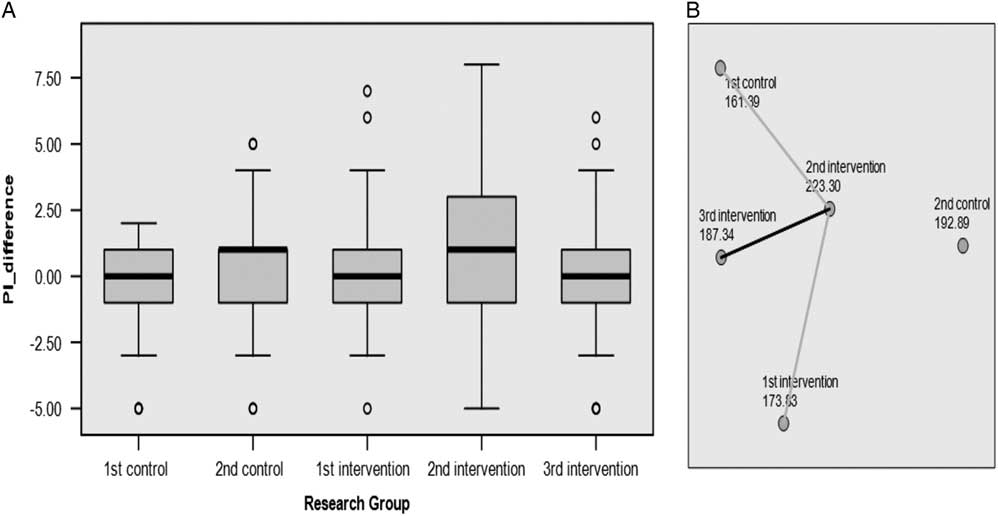
Given that the residual measurement is not normally distributed, a complementary analysis using a non-parametric analysis was used based on the Kruskal–Wallis test for independent samples. The results of this analysis yielded similar results (H = 14.235, df = 4, P = 0.007) (Figure 4).
Results of Kruskal-Wallis Test for Independent Samples Comparing Differences in the Preparedness Index (PI) Before and After Interventions Between Study Groups.
(A) Box-plot charts; (B) Pairwise comparison; 1st control = no intervention, 2nd control = basic measures (civil defense video + brochure), 1st intervention = elevated threat perception, 2nd intervention = external reward, 3rd intervention = manipulation of a cognitive cluster.

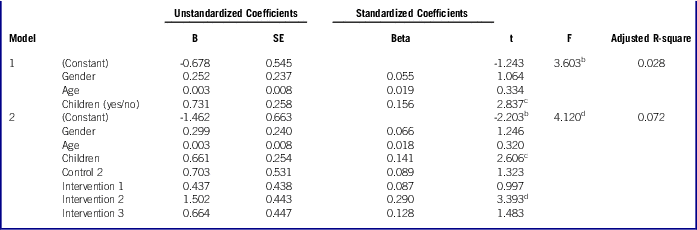
To assess the predictive power of the type of intervention on reported preparedness (as measured by the residual measurement), a multi-variant regression analysis was performed using a linear regression model. The results of this analysis are provided in Table 3. The regression analysis suggests that the studied model can account for 6.5% of the total variance of the dependent variable. The only variables that can predict an increase in reported preparedness are external reward (β = 0.193) and being a parent to children (β = 0.144).
Results of Linear Regression Analysis of Difference in Reported Preparedness According to Associated Demographic Variables and Type of Intervention (N = 381)a

a Regression performed in enter mode with two blocks. The first block included demographic variables, and the second block included the types of intervention (2nd control [basic measures], 1st intervention [elevated threat perception], 2nd intervention [external reward], and 3rd intervention [manipulation of a cognitive cluster]). The control variable was the first control group.
b Results are significant at the 0.05 level (two-tailed)
c significant at the 0.01 level (two-tailed)
d significant at the 0.001 level (two-tailed).
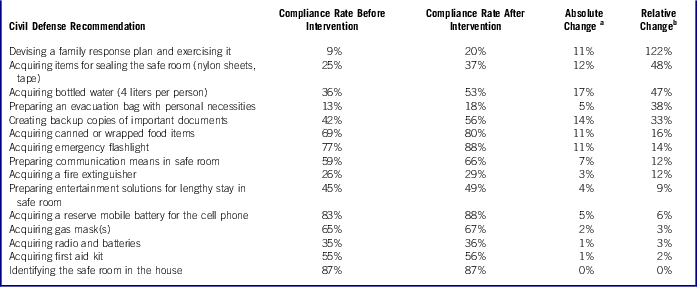
In an effort to better understand the absolute and relative improvement effects in reported preparedness among participants of the second intervention group, we explored the change for each preparedness recommendations (Table 4). According to the data, the highest absolute change (compliance rate before intervention subtracted from the compliance rate after intervention) was measured for the acquisition of bottled water (17% increase). The highest relative change (absolute change relative to the compliance rate before intervention) was measured for devising a family response plan (122% increase). Similar increase trends are exhibited for other recommendations, such as making copies of important documents and acquiring emergency supplies.
Change Rate in Preparedness Among Participants of the Second Intervention Group (External Reward) Across the Civil Defense Recommendations (n = 100)

a Absolute change is computed as the difference between compliance rate before and after intervention;
b Relative change is computed as the absolute change relative to the compliance rate before intervention.
Secondary Outcomes
Sense of Preparedness
The sense of PI is positively correlated with reported preparedness. This is true for both rounds of the study, that is, before intervention (r = 0.433, P < 0.001) and after intervention (r = 0.428, P < 0.001). The mean score of sense of preparedness for the entire sample (N = 381) was 3.06 (± 0.87 SD) and 3.02 (± 0.83 SD) before and after intervention, respectively. The two means are not statistically different, according to Wilcoxon paired-samples test (Z = -1.166, P = 0.244). Similarly, no statistical differences in mean sense of preparedness were measured across study groups (data not shown). Nevertheless, although all groups registered a reduction in this scale between time points, the participants in the second intervention group (external reward) are the only to report a slight increase in their sense of preparedness (data not shown).
The data show that a reduction in the preparedness level was observed between time points for some of the participants. Because the interventions were not expected to create a negative effect on preparedness, the results were cross-tabulated with the data concerning the sense of preparedness. The analysis indicates that there was a significant increase in sense of preparedness among participants who reported an increase in their preparedness level (2.92 ± 0.88 before the intervention compared with 3.04 ± 0.79 after the intervention), according to the paired samples t-test (t = 2.303, df = 163, P = 0.023). In contrast, there was a significant reduction in sense of preparedness among participants who reported a decrease in their preparedness level (3.24 ± 0.81 before compared with 2.95 ± 0.84 after), according to the paired samples t-test (t = 4.933, df = 136, P < 0.001). No significant change in sense of preparedness between time points was observed for participants reporting no change to their preparedness level.
Behavioral Plan
Participant were asked to indicate their intent to engage in preparedness behavior prior to intervention. This scale, measured as the number of items indicate as “yes” by a participant ranged from 0 to 6. In the total sample (N = 381), the mean for this measurement was 1.79 (± 1.91 SD), indicating an overall very low level of intent to engage in preparedness behavior. No statistically significant difference in this measurement was observed between the groups, according to a Kruskal–Wallis test (H = 4.573, df = 4, P = 0.334). Moreover, the scale is not correlated with the reported PI according to Spearman correlation (r[369] = 0.021, P = 0.685).
The item most endorsed with a “yes” answer was “Find or select the protected space” (53.3% responses), followed by “Acquire emergency gear, such as a radio & batteries, flash light, reserve battery for a cell phone, etc.” (40.1%), “Acquire food and bottled water for emergency” (33.4%), “Prepare things that you will need during an emergency, such as an evacuation bag, copies of important documents, etc.” (32.7%), “Make a family response plan and exercise it” (21.3%), and “Devise an alternative plan, such as leaving the country during the emergency” (12.2%).
DISCUSSION
The hypothesis is partially supported by the results of this study. We could identify a significant effect of intervention on reporting preparedness, but only for one type of intervention, that is, the external reward. The third intervention group, in which a cognitive cluster was manipulated to support preparedness-promoting thinking, showed a trend toward a beneficial effect, albeit not statistically significant.
Although the change effect among participants of the second intervention group (external reward) is small to medium in size, it is a meaningful one. The results suggest that the main relative change was observed for the recommendation of devising a family response plan. Similarly, other recommendations, such as preparing an evacuation bag or acquiring emergency supplies, were also encouraged in this group. These are actions highly oriented toward emergency preparedness. Previous studies proved that these actions were among the least complied-with by the Israeli public.Reference Bodas, Siman-Tov, Kreitler and Peleg9, Reference Bodas, Siman-Tov, Kreitler and Peleg10 Therefore, this study was able to demonstrate that meaningful preparedness behavior can be prompted through carefully crafted psychological interventions.
The ability to overcome the suppressive nature of the victimization modelReference Bodas16 on preparedness behavior by offering an external incentive is an important finding. Israelis use denial as an adaptive coping mechanism to manage excess stress associated with the frequent exposure to the threat.Reference Bodas, Siman-Tov, Kreitler and Peleg11, Reference Bodas, Siman-Tov, Peleg and Kreitler12, Reference Bodas16 This phenomenon is well described and studied in the field of health behavior.Reference Lewinsohn, Mischel, Chaplin and Barton22–Reference Kamen, Taniguchi and Student26 It was also described specifically in the context of emergency preparedness.Reference Bodas16 Yet, the dominance of denial in the behavioral model of preparedness in Israel makes it very difficult to engage Israelis in protective behavior, precisely because they avoid the negative meaning associated with it. This study demonstrates that it is possible to overcome denial suppression of preparedness behavior through external reward. Arguably, the mechanism allowing this to happen was a detour of the negative cognitions associated with preparedness behavior and threat perception, and focusing instead on cost-benefit cognitions. In other words, we allowed participants to avoid engaging with the threat directly, retain the benefits of denial on their well-being, and still get them engaged in preparedness behavior.
We were unable to demonstrate a similar promoting effect on preparedness with the other psychological interventions examined in this study. The first intervention that failed to significantly promote preparedness behavior is elevation of threat perception. In a previous study, it was reported that Israelis postpone preparedness behavior until the threat materializes into a tangible and imminent one.Reference Bodas, Siman-Tov, Peleg and Kreitler12 The intervention performed in the first intervention group was aimed at increasing the attention of participants to the threat by making it more concrete and tangible. However, the results of this study suggest that this sort of intervention is not enough to generate the dispositional motivation required to promote preparedness behavior. In hindsight, the findings here are not surprising. Israelis are used to news reports depicting the next war at the northern border or Gaza, such as the ones used in the intervention. If Israelis were able to develop indifference to the threat itself,Reference Bodas, Siman-Tov, Kreitler and Peleg11, Reference Bodas, Siman-Tov, Peleg and Kreitler12 it is likely they were able to develop a similar habituation effect to the news broadcasts reporting the threat. This finding serves to illustrate the limitation of current approaches to promoting preparedness. Risk communication campaigns and repeated news reporting of the threat are inapt in generating the dispositional motivation needed to lead to substantial change in preparedness behavior. In fact, one can argue that the ongoing news coverage of the threat serves only to deepen the denial-based coping mechanism used by Israelis to relieve the excess of stress.
The other type of intervention that was unable to provide effective change in preparedness behavior is that based on internal motivation. This intervention was examined in light of the literature supporting the benefits of promoting behavior through internal locus of control.Reference Ryan and Deci27 The participants in the third intervention group underwent a process in which a cluster of preparedness-promoting motifs was manipulated. These motifs were identified in preliminary studies (unpublished data) as relevant themes that support and promote preparedness behavior, according to the Theory of CO.Reference Kreitler and Kreitler21–Reference Kreitler and Kreitler28 Accordingly, it was presumed that priming participants with preparedness-promoting thinking could jumpstart the dispositional motivation required for the behavior to materialize. Although a positive trend in change to the reported preparedness level in this group was observed, it was not statistically significant. This finding suggests that there might be merits in promoting preparedness behavior through cognitive manipulation; however, this would require some adaptations of the applied intervention. In line with the CO approach, it would be necessary to expand systematically the meanings of the involved major constructs (e.g., self-efficacy, survival) so that the desired behavioral direction is supported.
Although not statistically significant, the proposal to focus risk communication campaigns on messages of empowerment and optimism, stemming from the third intervention group, seem to have merit.Reference Carbone and Echols29 Our study suggests a possible trend toward the effectiveness of such intervention, yet calls for further studies to substantiate the capacity of such intervention in promoting public readiness.
Limitations
This study has several limitations. First, the dependent variable is a self-report measurement of the studied behavior, and, as such, it is subject to reporting-biases. While self-reporting is a common practice in studies of preparedness behavior, we made considerable efforts to reduce the potential for biases. For example, participants were informed that house visits would be performed to assess the accuracy of their reporting, and that monetary compensation would be denied from participants found to be overreporting or underreporting. Of course, no one was denied compensation nor any house visit was performed. This was a deception approved by the ethics committee. Support of the viewing that we were able to sustain lower levels of reporting bias can be observed in the data. In particular, the nonrandom change in reported preparedness is an important indicator. Had the participants falsely reported higher levels of preparedness simply for the cash reward, we would expect to see a random and somewhat equal rise on all PI items. In contrast, we observed that items changed nonrandomly with some items reported as complied-with in greater numbers.
Second, the study was performed solely online. While this method allowed us to get rapid access to many participants on a wide geographical distribution, it is limiting the generalization of the findings to people with good computer skills and Internet access. We find this reasonable, given that most Israelis are connected to the Internet. In addition, the iPanel pool of participants was assessed by the Hebrew University of Jerusalem and was found to be representative of the Jewish population of Israel.
Third, this study is limited in the capacity to control for various plausible confounder variables. For example, we did not assess in this study levels of prior exposure to the threat or other psychological or cognitive measurements that could be applicable. For instance, one can assume that cognitive constructs, such as self-efficacy, could play a role in the studied behavior.
There are additional limitations to this study, such as sampling of the Jewish population only and using monetary incentives to recruit subjects. These limitations resulted from technical consideration in performing this study. Because we cannot avoid them, we would limit our conclusions to the specific population studied without further generalizing them.
CONCLUSIONS
Promoting preparedness behavior is difficult, especially among victimized populations, that is, those who are being frequently exposed to a threat. The findings of this study suggest that current approaches for promoting preparedness behavior in Israel are inapt in achieving this goal. The risk communication campaigns use messages that are counterproductive to overcoming the challenges posed by victimization. In particular, repeating the severity of the threat or appealing to fear is expected to be suppressive of preparedness behavior due to reinforcement of denial-based coping mechanisms.
The results of this study suggest that innovative thinking is required to overcome the psychological barriers associated with the victimization model. The findings of this study support the claim that preparedness behavior can be promoted through offering an external reward. Presumably, external rewards can encourage preparedness because of its ability to deflect negative cognitions associated with the threat and allowing subjects to retain their denial as an adaptive coping mechanism. In light of this, policy-makers might wish to consider offering incentive in the form of tax relief for households engaging in preparedness behavior. This call requires an in depth analysis of the costs and benefits of such a policy. It also requires additional research to evaluate the efficacy of this specific incentive on preparedness behavior.
The results of this study are also indicative that a similar beneficial effect of promoting preparedness might be achieved through tapping into motifs that are supportive of preparedness behavior, such as messages of empowerment and optimism. To solidify this conclusion, future research should focus on the efficacy of optimism-manipulating interventions.
Acknowledgments
This work was performed in partial fulfillment of the requirements for a PhD degree by MB at the Sackler Faculty of Medicine, Tel Aviv University, Israel. This study was supported by the Department of Disaster Medicine at the School of Public Health, Sackler Faculty of Medicine, Tel Aviv University, and reviewed and approved by the university’s ethical committee on September 25, 2016.
Conflict of Interest Statement
The authors declare no competing interests.