INTRODUCTION
Mangroves are productive coastal ecosystems that form an ideal habitat for a variety of animals, including many fishery species (Barbier, Reference Barbier2000; Nagelkerken et al., Reference Nagelkerken, Blaber, Bouillon, Green, Haywood, Kirton, Meynecke, Pawlik, Penrose, Sasekumar and Somerfield2008; Pinheiro et al., Reference Pinheiro, Costa, Gadig, Buchmann, Fontes, Oliveira and Pinheiro2008). A relevant species in this coastal environment is the mangrove crab Ucides cordatus (Linnaeus, 1763), an endemic crab with a semi-terrestrial life that digs burrows in the sediment up to 2 m deep and shows nocturnal habits (Alcantara-Filho, Reference Alcantara-Filho1978; Costa, Reference Costa1979; Pinheiro & Fiscarelli, Reference Pinheiro and Fiscarelli2001; Schmidt et al., Reference Schmidt, Oliveira, Souza, May and Araújo2008a). This crab is distributed along the tropical and sub-tropical mangrove coasts of the eastern Americas from southern Florida to southern Brazil, in the Santa Catarina State (Bright & Hogue, Reference Bright and Hogue1972; Melo, Reference Melo1996).
Ucides cordatus is considered a key species of mangrove ecosystems for its high biomass, its role in nutrient cycling and in the trophic structure of these ecosystems (Wolff et al., Reference Wolff, Koch and Isaac2000; Koch & Wolff, Reference Koch and Wolff2002; Schories et al., Reference Schories, Barletta-Bergan, Barletta, Krumme, Mehlig and Rademaker2003; Nordhaus et al., Reference Nordhaus, Wolff and Diele2006; Christofoletti et al., Reference Christofoletti, Hattori and Pinheiro2013). In Brazil, due to its large size and tasty meat, U. cordatus has been extensively exploited (Rodrigues et al., Reference Rodrigues, Branco, Saccardo and Blankensteyn2000; Brasil, 2011) and holds a major socio-economic importance for artisanal fishery, constituting the economic base of many human coastal populations (e.g. Alves & Nishida, Reference Alves and Nishida2003; Glaser & Diele, Reference Glaser and Diele2004; Alves et al., Reference Alves, Nishida and Hernandez2005; Passos & Di Beneditto, Reference Passos and Di Beneditto2005; Souto, Reference Souto2007; Firmo et al., Reference Firmo, Tognella, Walter, Barboza and Alves2011; Santos et al., Reference Santos, Dahdouh-Guebas and Bitencourt2013). Since 2000 a great number of studies have been executed, revealing aspects about the population status and ecology of this crab (e.g. Schories et al., Reference Schories, Barletta-Bergan, Barletta, Krumme, Mehlig and Rademaker2003; Alves & Nishida Reference Alves and Nishida2004; Glaser & Diele, Reference Glaser and Diele2004; Diele et al., Reference Diele, Koch and Saint-Paul2005; Pinheiro et al., Reference Pinheiro, Fiscarelli and Hattori2005; Hattori, Reference Hattori2006; Nordhaus et al., Reference Nordhaus, Wolff and Diele2006; Schmidt et al., Reference Schmidt, Oliveira, Souza, May and Araújo2008a, Reference Schmidt, Theil and Gallib; Wunderlich et al., Reference Wunderlich, Pinheiro and Rodrigues2008; Piou et al., Reference Piou, Berger and Feller2009; Conti & Nalesso, Reference Conti and Nalesso2010; Diele & Koch, Reference Diele and Koch2010; Góes et al., Reference Góes, Branco, Pinheiro, Barbieri, Costa and Fernandes2010; Sandrini-Neto & Lana, Reference Sandrini-Neto and Lana2011; Leite et al., Reference Leite, Rezende and Silva2012; Christofoletti et al., Reference Christofoletti, Hattori and Pinheiro2013; Amaral et al., Reference Amaral, Vieira, Osório, Rocha and Lima2014) and providing better conditions to develop an effective management strategy of this fishery resource (Diele et al., Reference Diele, Koch and Saint-Paul2005; Duarte et al., Reference Duarte, Duran, Mendonça and Pinheiro2014). The large size of Ucides cordatus suggests that this species has a high vulnerability to exploitation as it is generally correlated with slow growth, high age at maturity, long-lived (>10 years), low reproductive output and low natural mortality (Jennings et al., Reference Jennings, Reynolds and Mills1998; Pauly, Reference Pauly1998; Pinheiro et al., Reference Pinheiro, Fiscarelli and Hattori2005; Diele & Koch, Reference Diele and Koch2010). Declines of U. cordatus have been reported from many coastal regions of Brazil and were related to mangrove habitat destruction, diseases and overfishing (Maneschy, Reference Maneschy, Furtado, Leitão and de Mello1993; Boeger et al., Reference Boeger, Pie, Ostrensky and Patella2005; Diele et al., Reference Diele, Koch and Saint-Paul2005). Massive mortalities of U. cordatus have been reported by crab harvesters and biologists since 1997 throughout North-eastern Brazil, from Ceará to Espírito Santo State (Boeger et al., Reference Boeger, Pie, Ostrensky and Patella2005, Reference Boeger, Pie, Vicente, Ostrensky, Hungria and Castilho2007) that have decimated local stocks (Alves & Nishida, Reference Alves and Nishida2003; Schmidt et al., Reference Schmidt, Theil and Galli2008b; Firmo et al., Reference Firmo, Tognella, Walter, Barboza and Alves2011). This mortality has generated considerable concern among specialists in regards to resulting environmental and socioeconomic impacts (Alves & Nishida, Reference Alves and Nishida2003; Firmo et al., Reference Firmo, Tognella, Walter, Barboza and Alves2011).
This context has led to the creation of many legal guidelines by the National Environment Ministry, in order to assure strategies for the conservation and sustainable fishery of U. cordatus on the Brazilian coast. For example, in 2004, U. cordatus was included in the list of overfished or endangered species of overexploitation (Brasil, 2004). In 2011, the Brazilian Institute of Environment and Renewable Natural Resources (IBAMA) published a Proposal of a National Management Plan for the Sustainable Use of this species, which aims to contribute to the maintenance and/or restoration of natural stocks of U. cordatus, as well as for the sustainable use of this resource, according to biological, fishery, ecological, social, economic and legal parameters (Brasil, 2011; Pinheiro & Rodrigues, 2011). This proposal is an important guideline framework for crab management, but it stills lacks regional and local studies in order to raise these parameters and to apply them to the management practices, which will be the base to build the management at the National level. Furthermore, in the end of 2014, U. cordatus was listed in the ‘near threatened’ (NT) category (Brasil, 2014) and in 2015, it has been included in the National Conservation Action Plan of Endangered Species and of Socioeconomic Importance in Mangrove Ecosystems (Brasil, 2015) as one of the nine species in the regional list of endangered species.
Considering this scenario, studies on the population status of Ucides cordatus on the coast of Brazil, such as population density and size of crabs, are extremely important for stock evaluation, estimation of population recovery and assessment of fishery potential (e.g. Hattori, Reference Hattori2006; Wunderlich et al., Reference Wunderlich, Pinheiro and Rodrigues2008), and fundamental to achieve the objectives and to raise the parameters indicated by the Proposal of a National Management Plan for the Sustainable Use of this species (Brasil, 2011). Despite the existence of studies about U. cordatus population structure, these data are not still applied to management fishery and conservation strategies. In the present study we investigated the potential of these data to base the elaboration and suggestion of management measures, for the identification of extractive and fishery exclusion areas, an important management strategy stated by the Proposal of a National Management Plan for the species (Brasil, 2011).
In the São Francisco River Estuary (North-eastern Brazil, 10°30′27″S 36°23′45″W) Ucides cordatus occurs along 30 km2 of mangrove forests and is the second most exploited mangrove fishery resource, constituting the major economic base for deprived human populations of eight coastal villages (Santos et al., Reference Santos, Dahdouh-Guebas and Bitencourt2013, Reference Santos, Matos, Schaeffer-Novelli, Cunha-Lignon, Bitencourt, Koedam and Dahdouh-Guebas2014). Despite its importance, decreases in this species’ stock have been reported since 2000, both by local populations and research institutes (e.g. CEPENE, 2003; Santos et al., Reference Santos, Dahdouh-Guebas and Bitencourt2013). Therefore, the aim of this study is to assess the population status (population density and size of crabs) and the fishery potential of Ucides cordatus in the mangroves of this estuary, and based on these data suggest strategies for sustainable use and conservation of this important mangrove fishery resource, according to the guidelines of the Proposal of a National Management Plan for the Sustainable Use of this species (Brasil, 2011).
MATERIALS AND METHODS
Study area
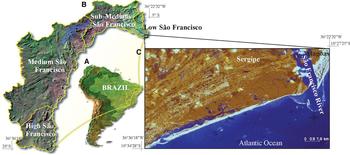
The São Francisco River is one of the most important Brazilian water resources and is considered the River of National Integration, draining seven states along its 2863 km. The river basin (636,919 km2) is divided in four sub-regions from its nascent to its estuary: high, medium, sub-medium and low São Francisco (ANA, 2005). The estuary of this river is located in the low sub-region, on the boundary of Sergipe and Alagoas States (10°30′27″S 36°23′45″W) (Figure 1), in the North-east of Brazil.
(A) Map of South America and Brazil indicating the location of the São Francisco River basin (adapted from ANA, 2005). (B) The São Francisco River basin with its four divisions (adapted from ANA, 2005). (C) A close-up of the São Francisco River Estuary, the study area (tones of red are vegetation, blue is water and white is sand or clouds). (Adapted from Santos et al., Reference Santos, Matos, Schaeffer-Novelli, Cunha-Lignon, Bitencourt, Koedam and Dahdouh-Guebas2014.)

The study area corresponds to the southern part of the São Francisco River Estuary (State of Sergipe) (Figure 1C) and covers ~192.35 km2 and is part of the municipalities of ‘Brejo Grande’ and ‘Pacatuba’. This estuary shows a mangrove extent of 30.1 km2, which corresponds to about 16% of the study area (Santos et al., Reference Santos, Matos, Schaeffer-Novelli, Cunha-Lignon, Bitencourt, Koedam and Dahdouh-Guebas2014). The climate in this region is tropical semi-humid with a mean annual temperature of 25°C, showing two outstanding seasons: one rainy, between April and August, and another dry, between September and March (Medeiros, Reference Medeiros2003). This is included in the Tropical Wet & Dry (Aw) Climate, according to the Köppen Climate Classification System. The area is subject to a mid tide amplitude (between 2 and 4 m) with semi-diurnal tides (two high tides and two low tides) (Semensatto, Reference Semensatto2004).
The study area is characterized by a remarkable lack of infrastructure, such as paved roads, hospitals, health centres, schools and commercial stores. The inhabitants are a deprived population composed of native residents whose income and subsistence depends on agricultural activities, aquaculture and mainly fishery, highlighting the fishery of the mangrove crab (Santos et al., Reference Santos, Matos, Schaeffer-Novelli, Cunha-Lignon, Bitencourt, Koedam and Dahdouh-Guebas2014). A total of eight fishery villages are distributed in this area, characterized by artisanal fishery practices, using canoes and fishing methods such as line, net and gathering of crabs and shellfishes (CEPENE, 2003). This area is part of a State Environmental Protected Area (APA ‘Litoral Norte’), a Conservation Unit of sustainable use whose objectives include the promotion of the socio-economic and sustainable development by activities that protect and conserve the ecosystems and the improvement of the life quality of the local population (Sergipe, Reference Sergipe2004).
Sample of Ucides cordatus burrows and population estimations
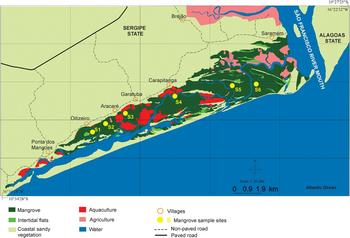
Six different sites of mangrove forests were sampled (Figure 2), from 9–11 February 2013. At each site two transects of 50 m from the channel edge towards the interior of the mangrove forest were delimited. The transects were arranged parallel to each other and separated by a distance of 5 m. Within the area bounded by transects, three quadrats of 5 × 5 m (25 m2) were delimited (e.g. Schmidt et al., Reference Schmidt, Oliveira, Souza, May and Araújo2008a; Amaral et al., Reference Amaral, Vieira, Osório, Rocha and Lima2014; Pinheiro & Almeida, Reference Pinheiro, Almeida, Turra and Denadai2015). The first quadrant was at 5 m from the edge, the second at 25 m and the third at 45 m. In each quadrat the geographic coordinates were recorded on a GPS (Global Positioning System, Garmin eTrex Venture HC) and qualitative information about the mangrove vegetation was recorded, such as species composition, dominant arboreal mangrove species, stand stature (height) estimated as short (tree height ≤7 m), medium (height 7–15 m) and tall (height≥15 m) (e.g. Santos et al., Reference Santos, Matos, Schaeffer-Novelli, Cunha-Lignon, Bitencourt, Koedam and Dahdouh-Guebas2014), in order to provide additional qualitative information on the structural heterogeneity of the sampled mangroves (e.g. Sandrini-Neto & Lana, Reference Sandrini-Neto and Lana2011). A total of 18 quadrants were sampled.
Land use and cover map of study area (São Francisco River Estuary), indicating the six mangrove sample sites (S1–6).

Within each quadrant the diameter of burrow entrances of U. cordatus was measured in parallel with the sediment using a digital caliper (0.05 mm). Only active galleries, identified by the presence of fluid mud, faeces, and/or animal traces close to the opening, were considered (e.g. Sandrini-Neto & Lana, Reference Sandrini-Neto and Lana2011; Pinheiro & Almeida, Reference Pinheiro, Almeida, Turra and Denadai2015). Ucides cordatus burrows are easily recognized in the field (Santos et al., Reference Santos, Pinheiro and Hattori2009) and broadly used as a proxy of crab density and size (Piou et al., Reference Piou, Berger and Feller2009; Sandrini-Neto & Lana, Reference Sandrini-Neto and Lana2011; Pinheiro & Almeida, Reference Pinheiro, Almeida, Turra and Denadai2015). The galleries of U. cordatus were differentiated from other crab species by inspection of the duct and opening morphology, and its position in relation to the surface of the sediment, as described by Santos et al. (Reference Santos, Pinheiro and Hattori2009). Besides this, we are aware of the possibility that juvenile, smaller crabs can inhabit burrows that were abandoned by larger crabs, thus we only considered in our sample active galleries.
Population estimations from burrow numbers and size have been used widely for mangrove crab species (e.g. Macintosh, Reference Macintosh, Fincham and Rainbow1988; Warren, Reference Warren1990; Skov et al., Reference Skov, Vaninni, Shunula, Hartnoll and Cannicci2002; Salgado Kent & McGuinness, Reference Salgado Kent and McGuinness2006), including U. cordatus (e.g. Alcantra-Filho, Reference Alcantara-Filho1978; Alves & Nishida, Reference Alves and Nishida2003; Alves et al., Reference Alves, Nishida and Hernandez2005; Hattori, Reference Hattori2006; Schmidt et al., Reference Schmidt, Oliveira, Souza, May and Araújo2008a; Wunderlich et al., Reference Wunderlich, Pinheiro and Rodrigues2008, Piou et al., Reference Piou, Berger and Feller2009; Sandrini-Neto & Lana, Reference Sandrini-Neto and Lana2011). Advantages of this methodology include: speed and consequent increase in sample size; conducting non-destructive sampling, which is important when work involves endangered species; and the possibility of obtaining measures of all individuals within sampling units (Schmidt et al., Reference Schmidt, Oliveira, Souza, May and Araújo2008a).
Considering that each burrow of U. cordatus is inhabited by a single crab (Costa, Reference Costa1979; Alves et al., Reference Alves, Nishida and Hernandez2005), the number of burrows within the quadrats in each mangrove site was used to estimate the crab density (number of burrow m−2), and the diameter of the burrow entrance was used as a proxy crab size (e.g. Alcantara-Filho, Reference Alcantara-Filho1978; Alves & Nishida, Reference Alves and Nishida2004; Alves et al., Reference Alves, Nishida and Hernandez2005; Hattori, Reference Hattori2006; Schmidt et al., Reference Schmidt, Oliveira, Souza, May and Araújo2008a; Wunderlich et al., Reference Wunderlich, Pinheiro and Rodrigues2008; Piou et al., Reference Piou, Berger and Feller2009; Sandrini-Neto & Lana, Reference Sandrini-Neto and Lana2011; Pinheiro & Almeida, Reference Pinheiro, Almeida, Turra and Denadai2015). The data of crab burrow size was classified in eight size classes of 10 mm, from 20–30 to 90–100 mm; and histograms of the class size-frequency distribution were produced.
The burrow diameter (BD) is a measure similar to the crab carapace length (CL) which is correlated with the body size of U. cordatus, measured as the carapace width (CW) (Pinheiro & Almeida, Reference Pinheiro, Almeida, Turra and Denadai2015). In Brazil, the legal minimum market size of U. cordatus is 60 mm carapace width (IBAMA, 2003a). Schmidt et al. (Reference Schmidt, Oliveira, Souza, May and Araújo2008a) determined that the legal market size of 60 mm carapace width (CW) corresponds to a carapace length (CL) of 46 mm which, in turn, corresponds to a burrow diameter (BD) of 51 mm. The relationship and conversion among these variables (BD to CL and then to CW) is described by Schmidt et al. (Reference Schmidt, Oliveira, Souza, May and Araújo2008a) and Pinheiro & Almeida (Reference Pinheiro, Almeida, Turra and Denadai2015).
Therefore, the frequency and density of crabs of commercial and non-commercial size were determined by the frequency (%) and density (number of burrow m−2) of burrows with diameter size ≥51 mm and <51 mm, respectively. The Immediate Extractive Potential (IEP) was considered as the percentage of burrows above (or equal to) the size at first maturity, which corresponds to the frequency of crabs of commercial size, while the Future Extractive Potential (FEP) is the percentage of burrows below the size at first maturity, which corresponds to the frequency of crabs of non-commercial size (e.g. Wunderlich et al., Reference Wunderlich, Pinheiro and Rodrigues2008).
The total commercial and non-commercial stocks of U. cordatus were estimated based on the total commercial and non-commercial densities, respectively, and the total extent of mangrove forests, calculated in our previous study (e.g. Santos et al., Reference Santos, Matos, Schaeffer-Novelli, Cunha-Lignon, Bitencourt, Koedam and Dahdouh-Guebas2014). For stock estimation, we obtained the product between the density (number of burrow m−2) and the areal extension of mangroves (in m2).
Statistical analysis
The data were tabulated and analysed in GraphPad Prism and Excel software. The analysis was carried out considering the entire mangrove forest of the São Francisco River Estuary (all sampled sites) and in relation to each mangrove site, which were compared by statistical tests. Descriptive statistics such as mean, standard deviation (SD) and frequency were calculated for crab burrow size and density. The normality of the data and homogeneity of variances were assessed by Kolmogorov–Smirnov and Bartlett tests, respectively, in order to apply parametric tests. The statistical analyses ANOVA and Tukey's Multiple Comparison test were carried out in order to compare the mean burrow diameter among the six sites of mangrove. The Kruskal–Wallis test (non-parametric ANOVA) and Dunn's Multiple Comparison Test were used to compare median crab density among the six sites of mangroves, because of the small size of this sample data. The t-test was used to verify if there was a difference in the density of the commercial and non-commercial crab burrow sizes. The χ2 test was used to compare the frequencies of IEP and FEP between mangrove sites.
RESULTS
A total of 541 burrows of Ucides cordatus were measured and counted along the six sampled sites in the São Francisco River Estuary, corresponding to a total of 450 m2 of sampled mangrove area. All sampled sites were mostly made up by Rhizophora mangle L. and some sites also showed the occurrence of Avicennia schaueriana Stapf and Leechman ex Moldenke, Laguncularia racemosa (L.) Gaertn.f., or both (sites 2, 3, 4 and 6). Site 6 was unique with occurrence of the mangrove-associated species Acrostichum aureum and dead L. racemosa trees infested by termites, while site 5 showed a remarkably high density of rhizophores. Mangrove stands of short stature (height <7 m) were recorded in sites 2, 3 and 6, while medium mangrove stand stature (height between 7 and 15 m) was recorded in sites 1, 4 and 5.
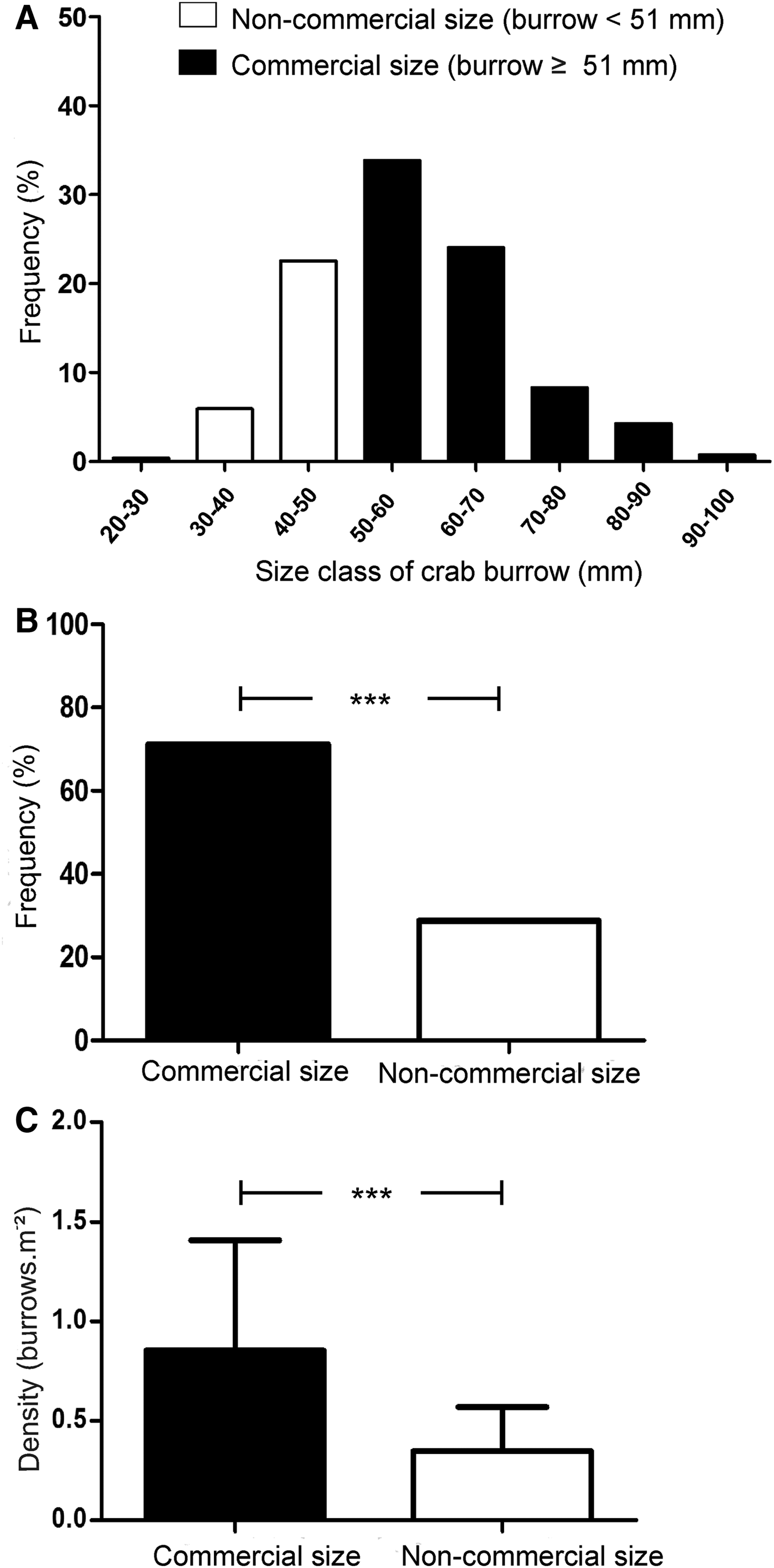
Considering all the six sampled sites, the overall mean burrow size of Ucides cordatus in the mangroves of the São Francisco River was 56.8 (±12.2) mm. Most of the crab burrows are in the class size of 50–60 mm (33.8%), followed by 60–70 mm (24%) and 40–50 mm (22.6%) (Figure 3A). Thus, medium-sized crabs (40–70 mm) are the most frequent in the mangroves of the São Francisco River Estuary. Burrows from large-sized crabs (70–80 mm: 8.3%; 80–90 mm: 4.3%; and 90–100 mm: 0.3%) and small-sized ones (20–30 mm: 0.3%; and 30–40 mm: 5.5%) are less frequent in these mangroves, but the larger are more frequent than smaller (Figure 3A).
Population parameters of Ucides cordatus based on measurement of their burrows in the mangroves of the São Francisco River Estuary. (A) Size-frequency distribution of Ucides cordatus by burrow's classes. (B) Frequency of the crab's burrows in commercial and non-commercial sizes. (C) Density of the crab's burrows in commercial and non-commercial sizes. (***P < 0.001).

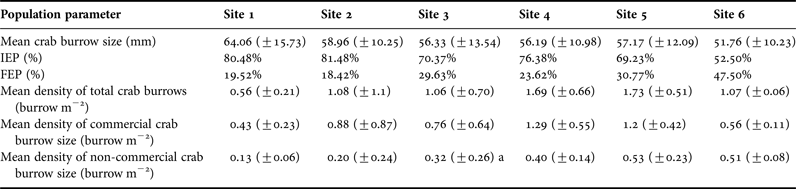
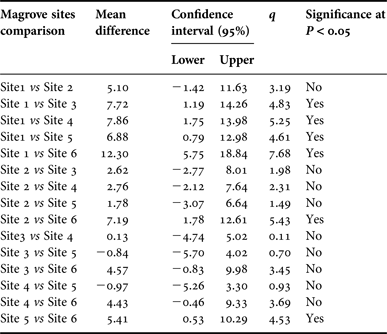
The comparison of the six mangrove sites indicated that mean crab burrow size significantly differed among some sites (F = 6.66, P < 0.0001, Tables 1 and 2). Site 1 showed the highest mean burrow size, which significantly differed from all the other sites, apart from site 2. On the other hand, site 6 showed the lowest mean burrow size, differing from sites 1, 2 and 5. The others sites (2, 3, 4 and 5) did not differ in mean burrow size (Tables 1 and 2).
Population parameters of Ucides cordatus based on measurement of their burrows in the six sampled sites mangroves in the São Francisco River Estuary.

IEP, Immediate Extractive Potential; FEP, Future Extractive Potential (FEP).
Mean ± standard deviation.
Differences in crab burrow size (mm) among mangrove sites, using information of Tukey's Multiple Comparison Test.

(q, studentized range q).
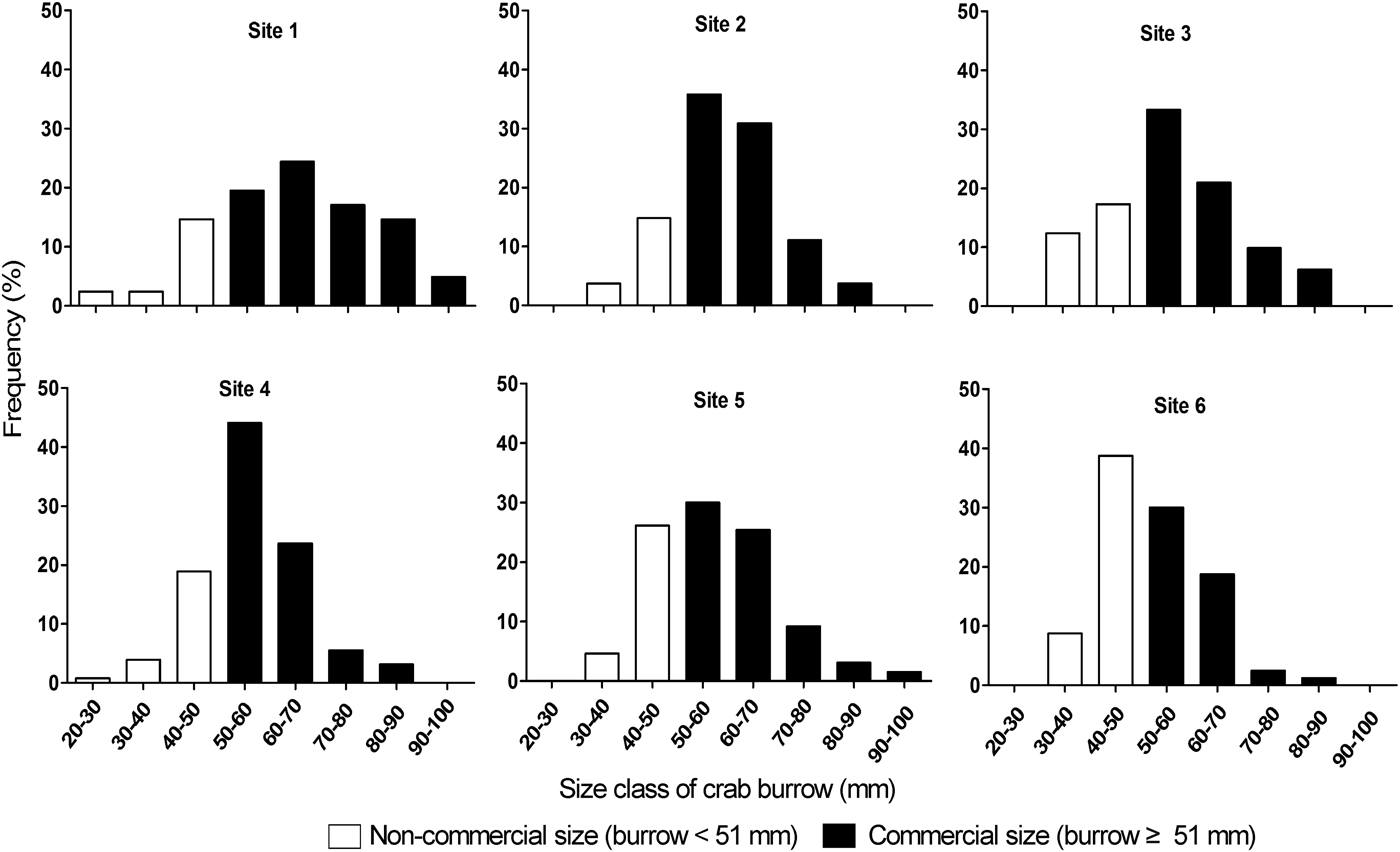
In regard to size-frequency distribution in the six mangrove sites (Figure 4), site 1, which recorded the highest mean burrow size (Table 1), also showed highest frequency of large crab burrows (70–80 mm: 17.1%; 80–90 mm: 14.6%; and 90–100 mm: 4.9%) and the lowest frequency of small crab burrows (20–30 mm: 2.4%; 30–40 mm: 2.4%). Moreover, this was the unique site that recorded all the classes of crab burrow size. Sites 2, 3, 4 and 5 showed similar size-frequency distribution, with predominance of medium-size crab burrows (40–50 to 60–70 mm), but site 4 recorded the highest frequency of burrows between 50–60 mm (44.1%). Site 6, although showing predominance of medium-size crab burrows, had a most frequent size class of 40–50 mm (31%), differing from all the other sites (Figure 4).
Size-frequency distribution of Ucides cordatus based on measurement of their burrows in the six mangrove sampled sites of the São Francisco River Estuary.

In general, about 71.2% of the total sampled burrows were from crabs which are of commercial size (burrow size ≥51 mm), while 28.8% are from crabs that did not reach commercial sizes (burrow size <51 mm) (Figure 3B). Therefore, in the mangroves of the study area the IEP (71.2%) of U. cordatus was significantly higher than the FEP (28.8%) (χ2 = 21.5, P = 0.0006). Sites 1 and 2 recorded the highest values of IEP (>80%) and the lowest FEP (<20%), while site 6 showed an opposite pattern (Table 1). Site 6 showed a remarkably low IEP and high FEP and it was the sole area in which IEP and FEP significantly differed from all the other areas (sites 1, 2, 3, 4 and 5) (χ2 = 9, P = 0.0027; χ2 = 15.31, P < 0.0001; χ2 = 4.9, P = 0.028; χ2 = 12.7, P = 0.0004; and χ2 = 5.93, P = 0.015, respectively). Sites 3, 4 and 5 showed intermediate high values of IEP (69–77%) and intermediate low values of FEP (29–31%) (Table 1), which did not statistically differ among them and among sites 1 and 2, with the exception of site 5 which showed lower IEP and higher FEP than site 2 (χ2 = 3.8, P = 0.04).
The overall mean crab density in the mangrove forests of the São Francisco River Estuary was 1.2 (±0.68) burrows m−2. From this, the density of burrows from crabs in commercial size (0.85 ± 0.55 burrows m−2) was significantly higher than the density of crabs in non-commercial size (0.35 ± 0.21 burrows m−2) (t = 3.59, P < 0.0005) (Figure 3C). Considering the total mangrove extent (30 km2), the study area showed, in February 2013, a mean total crab stock of about 3.6 × 10⁷ individuals, from which 2.55 × 10⁷ individuals are crabs in commercial size, and 1.05 × 10⁷ individuals are crabs in non- commercial size. Thus, the proportion of commercial size crab stock:non-commercial size crab stock in the mangrove of the São Francisco River Estuary is 1:0.4.
The mean density of total, commercial and non-commercial crab burrows did not statistically differ among the six sites (H = 6.68, P = 0.25; H = 6.4, P = 0.27; H = 7.52, P = 0.18, respectively). However, sites 4 and 5 showed higher values of total and commercial mean densities than sites 1, 2, 3 and 4. The lowest value of mean density was recorded in site 1 (Table 1). Site 4 was unique in that it showed similar values of commercial and non-commercial crab burrow density (Table 1), recording a proportion of ~ 1:1.
DISCUSSION
Population structure
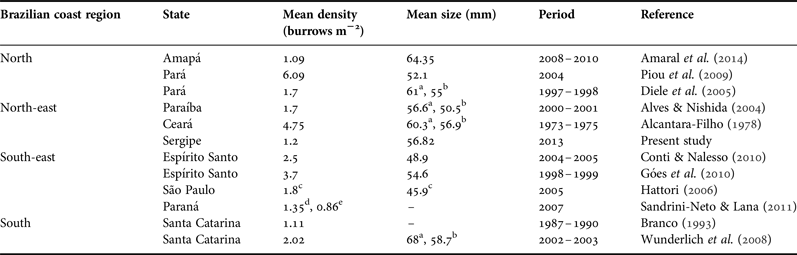
The value of mean Ucides cordatus density (1.2 burrows m−2) recorded in this study was similar or lower than those recorded in other mangroves along the Brazilian coast (Table 3). The most similar values were recorded in mangroves located on the north coast, in Amapá (e.g. Amaral et al., Reference Amaral, Vieira, Osório, Rocha and Lima2014) and in the south coast in Santa Catarina (e.g. Branco, Reference Branco1993). It is interesting to note that we registered lower values than those found in mangroves on the north-east coast, the region where the study area is located. The low values of mean crab density recorded in the mangroves of the São Francisco River Estuary can be attributed to a high mortality of the crab in this area, which started in 2000, as reported by local fishermen (e.g. Santos et al., Reference Santos, Dahdouh-Guebas and Bitencourt2013), probably due to the lethargic crab disease that spread along the Brazilian North-east coast between 1997 to 2010 causing massive mortalities of U. cordatus (e.g. Boeger et al., Reference Boeger, Pie, Ostrensky and Patella2005, Reference Boeger, Pie, Vicente, Ostrensky, Hungria and Castilho2007; Firmo et al., Reference Firmo, Tognella, Walter, Barboza and Alves2011). This high mortality of Ucides cordatus in the study area is also supported by the data of crab production which showed a large decrease since 1999 (e.g. CEPENE, 1999, 2000, 2001, 2002, 2003). The same evidence of low crab density related to crab mortality was also observed by Alves & Nishida (Reference Alves and Nishida2004) in other mangroves on the Brazilian North-east coast. Additionally, it is remarkable that the U. cordatus density can vary between different mangrove areas as a result of their degradation (Pinheiro et al., Reference Pinheiro, Duarte, Toledo, Adams and Torres2013; Duarte et al., Reference Duarte, Duran, Mendonça and Pinheiro2014), higher incidence of this extractive feature (Pinheiro & Fiscarelli, Reference Pinheiro and Fiscarelli2001), as well as due to intrinsic factors of a particular mangrove forest (primary productivity and patterns of larval recruitment, among others) (Conti & Nalesso, Reference Conti and Nalesso2010). Since shrimp farming is the main impact causing deforestation of mangroves in the study area (Santos et al., Reference Santos, Matos, Schaeffer-Novelli, Cunha-Lignon, Bitencourt, Koedam and Dahdouh-Guebas2014), and the fishery of U. cordatus by the local communities is very high (Santos et al., Reference Santos, Dahdouh-Guebas and Bitencourt2013), these two factors may also contribute to the lower densities recorded in the present study. In general, recent papers have registered smaller crab densities than the older studies, revealing that the crab population has been overfished, mainly due to unsustainable practices (Conti & Nalesso, Reference Conti and Nalesso2010) without respect to their biological limitations such as slow growth (see Pinheiro et al., Reference Pinheiro, Fiscarelli and Hattori2005). The reduction of the crab size, weight and abundance in various mangrove areas in Brazil reveals the great pressure to which the U. cordatus crab population has been subject (Góes et al., Reference Góes, Branco, Pinheiro, Barbieri, Costa and Fernandes2010; Brasil, 2011).
Density and mean size of Ucides cordatus recorded by the literature and in the study area, in mangrove forests along the Brazilian coast.

a Male.
b Female.
c Sampled in Rhizophora mangle forests.
d Commercial size.
e Non-commercial size.
The mean size of U. cordatus recorded in this study (56.82 ± 12.2 mm) was overall similar to those recorded on the north-east coast, lower than the north and higher than the south-east and south coast (Table 3). Here we found a dominance of adult medium-size crabs (40–70 mm), mainly from the class of 50–60 mm. This pattern was also recorded in other studies about U. cordatus in Brazilian mangroves (e.g. Passos & Di Beneditto, Reference Passos and Di Beneditto2005; Diele et al., Reference Diele, Koch and Saint-Paul2005; Brasil, 2011) and is in accordance with the survival curve for the species, which is characterized by high survival in intermediate age classes/sizes, followed by a decrease when close to longevity/maximum size (Leite et al., Reference Leite, Rezende and Silva2012). Additionally, we found more frequency of larger crabs than smaller ones (Figure 3A). High frequency of large crabs is frequently found in large, long-living species, such as U. cordatus, where crabs accumulate in larger size classes as growth decreases with age (Hartnoll, Reference Hartnoll and Abele1982; Hartnoll & Bryant, Reference Hartnoll and Bryant1990).
Differences in mean crab burrow size and in the size frequency were detected among the mangrove sites. The highest and statistically significant difference in crab size was found between site 1 (the farthest mangrove area from the estuary mouth – Figure 2), which showed the largest crabs (Figure 4, Table 1) and site 6 (the nearest from the estuary mouth – Figure 2), which showed the smallest crabs (Figure 4, Table 1). These sites have different vegetation composition, as a mono-specific mangrove forest of Rhizophora mangle (site 1) and a mangrove area with occurrence of R. mangle and Laguncularia racemosa, associated with Acrostichum aureum L. and dead L. racemosa trees infested by termites (site 6). Therefore, differences in crab size and size frequency between these sites can be attributed to differences in vegetation composition, a fact also verified in sex ratio of U. cordatus by Wunderlich et al. (Reference Wunderlich, Pinheiro and Rodrigues2008). According to Gomes et al. (Reference Gomes, Abrunhosa, Simith and Asp2013) some mangrove crab characteristics, such as abundance and weight/size, can be significantly correlated with vegetation type. Moreover, differences in food availability (leaf litter) and/or quality could cause differential growth rates and thus crab sizes (Diele et al., Reference Diele, Koch and Saint-Paul2005) among mangrove areas with different vegetation structure and productivity. Ucides cordatus preferentially created their burrow entrances closed to R. mangle prop roots (Piou et al., Reference Piou, Berger and Feller2009). Presence of Avicennia germinans (L.) Stearn and L. racemosa in the neighbourhood was not found to favour big sizes and large numbers of crab burrows (Piou et al., Reference Piou, Berger and Feller2009). Thus, since U. cordatus mainly feeds on mangrove vegetation litter, a reduction of food availability (leaf litter) and quality in site 6 (due to the presence of L. racemosa associated with Acrostichum aureum and dead trees) could have caused the high frequency of smaller crabs. The other mangrove sites (2, 3, 4 and 5) did not differ in mean burrow size (Tables 1 and 2) and showed very similar vegetation composition, with Rhizophora mangle as the dominating species. These results suggest the influence of the vegetation composition on the U. cordatus population structure, as stated by Gomes et al. (Reference Gomes, Abrunhosa, Simith and Asp2013).
We did not record significant differences in crab density among the mangrove sites. Nevertheless, it is important to highlight that the mangrove site 1, which recorded the largest crab sizes, also recorded the lowest density (Table 1). This low density with dominance of large crabs could be attributed to the occurrence of monospecific mangrove forest of R. mangle, the vegetation composition found in the preferred habitat of U. cordatus (e.g. Diele et al., Reference Diele, Koch and Saint-Paul2005; Hattori, Reference Hattori2006; Piou et al., Reference Piou, Berger and Feller2009). Data from previous studies (Oliveira, Reference Oliveira2005; Wunderlich & Pinheiro, Reference Wunderlich and Pinheiro2013) suggest that monospecific mangrove forests of R. mangle are those with higher levels (higher water column) or frequency of flooding during neap and spring tide and muddy, almost fluid sediment. Thus, in these areas, larger crabs are more able to rebuild their galleries after the flooding by tides. To save energy, these animals build their galleries close to the areal roots of these trees, which guarantee more stability of the adjacent sediment and therefore favour the stability of the galleries of this species.
Fishery potential and management
The study area largely shows a high potential for the fishery of U. cordatus, since most of the crabs are of commercial size, thus showing a high Immediate Extractive Potential (IEP – 72.1%, Figure 3B) and higher density of commercial-sized crabs (Figure 3C). Additionally, this area shows a large stock of commercial crabs (2.55 × 10⁷ individuals) which sustains the immediate extractive potential, in addition to a stock of non commercial-size crabs (1.05 × 10⁷ individuals), which sustains the Future Extractive Potential (FEP – 27.9%). Wunderlich et al. (Reference Wunderlich, Pinheiro and Rodrigues2008) also found a similar result in mangroves of Santa Catarina State (south Brazil), recording higher IEP than FEP, which was considered of high fishery potential for U. cordatus.
Despite these results, U. cordatus is the second more explored fishery resource in the study area, and the main base of the local subsistence economy (Santos et al., Reference Santos, Dahdouh-Guebas and Bitencourt2013). Thus, the fishery pressure and extractive rates of this resource are very high, requiring adequate management strategies for their sustainable use. Another important point to be highlighted is about a lower overall crab density recorded in the study area when compared with other Brazilian mangroves (Table 3). This difference could be explained by the high crab mortality that occurred in the study area and to overfishing. Considering these features, it is important to establish management strategies for conservation and a sustainable fishery of U. cordatus in the São Francisco River Estuary. The high exploitation and mortality of U. cordatus is a scenario also verified in almost the entire Brazilian coast, which highlights the importance of local and regional studies in order to apply structural population data to guide the elaboration of management strategies, in order to meet the objectives of the National Management Plan and Sustainable Use for this species (Brasil, 2011).
Due to the reduced growth rate of U. cordatus and intense extraction of this resource, it is necessary to foresee the laws of closure (e.g. IBAMA, 2003a, b), an intensified supervision and proper management of its natural population to provide an efficient conservation process of this species, ensuring the continuity of the extraction (Pinheiro & Fiscarelli, Reference Pinheiro and Fiscarelli2001). As a management suggestion, fishery management strategies could be considered that apply a fixed exploitation rate, in which the same percentage of stock is caught and the rest is left to reproduce and spawn. This can be calculated based on the assessment of the crab stock size and IEP which was estimated in this study for the São Francisco River Estuary. Another strategy is a fixed escapement rule which leaves the same number of crabs to spawn each year. A fixed escapement rule is a fishery management measure which aims to establish a stock after harvest. The advantage of this is to guarantee enough animals to assure the next generation and to assure the FEP. Both strategies could be considered in the study area and in other areas in Brazil showing similar population structure of U. cordatus. This would reinforce the importance of population structural data being applied to crab fishery management.
The Proposal of a National Management Plan for U. cordatus highlights the delineation of extractive and fishery exclusion areas of this resource (Brasil, 2011; Pinheiro & Rodrigues, Reference Pinheiro and Rodrigues2011). In this view it is crucial to identify mangrove areas more suitable for fishery in which a fixed exploitation rate and/or a fixed escapement rule should be considered and other mangrove areas more suitable for conservation wherein the fishery should be prohibited in order to allow the conservation of adults crabs for reproduction, enabling the juvenile crabs to grow and reach the commercial sizes. In the present study we identified these mangrove areas, based on the crab population structure. For example, sites 1 and 2 recorded the highest IEP while sites 3, 4 and 5 recorded intermediate IEP (Table 1), indicating their high potential for crab fishery. From these, sites 4 and 5 were the most important areas for fishery due to a combined higher mean of density from commercial crabs and greater crab size. On the other hand, site 6 showed the lowest IEP and the highest FEP and thus is a more appropriate mangrove area for conservation of the U. cordatus.
Corroborating our finds we can mention another study (Santos et al., Reference Santos, Dahdouh-Guebas and Bitencourt2013), that reveals the mangrove sites 1, 2, 3 and 4 as the most productive areas for extraction of U. cordatus. According to these authors, the village considered the primary crab producer (Carapitanga, Figure 2) uses mainly mangroves of site 4, where there is a remarkably high frequency of crabs in the class size of 50–60 mm, and the highest density of commercial crabs. The second most productive village (Oitizeiro, Figure 2), mainly uses mangroves of sites 1 and 2; and the third most productive village (Aracaré, Figure 2) exploits U. cordatus on mangroves of sites 2 and 3. Nevertheless, most attention should be direct to site 1, because although it showed the highest mean crab size, it also records the lowest density. Thus from the sites that showed potential for fishery, site 1 should be the least exploited. An alternative for this is the use of the mangrove site 5, a mixed area that combined high crab size and density, instead of the exploitation of the crab in site 1.
CONCLUSION
We concluded that the composition of mangrove vegetation can promote changes in U. cordatus population structure. We found larger crabs in lower density mangrove areas of monospecific mangrove forest of Rhizophora mangle, or dominated by this mangrove species. Moreover, mangroves associated with Acrostichum aureum and dead trees were linked with the occurrence of smaller crabs in high densities. These patterns show a spatial distribution wherein the density and size of crabs tend to increase in the direction to the river mouth.
Overall the São Francisco River Estuary mangroves show a high potential for the fishery of U. cordatus, showing a high IEP and stock in commercial size. Nevertheless, this study area showed lower densities of U. cordatus than other Brazilian mangrove areas. We argued that this lower density is mainly caused by a high mortality of the crab that occurred in 2000, mangrove deforestation due to shrimp farming and also to a high fishery pressure on U. cordatus by the local populations. This scenario reveals the need for new strategies directed for the conservation and sustainable management of U. cordatus. Therefore, we conclude that the mangrove areas more appropriate for U. cordatus fishery (extractive areas) are those that combined higher means of crab size associated with the greater densities of commercial crabs and rates of IEP. On the other hand, mangrove areas more appropriate for the conservation of U. cordatus (fishery exclusion areas where fishing should be prohibited) are those with smaller mean crab size combined with a higher density of non-commercial crabs and FEP.
These important management strategies were delineated based on the population structure of U. cordatus assessed in this study. Therefore our study and conclusions reinforce the importance of this type of data being applied to achieve the objectives of the National Management Plan and Sustainable Use for this species. These strategies (identification of extractive areas and fishery exclusion areas, fixed exploitation rate based on IEP and fixed escapement rule based on FEP) should be considered in our study area as well as in other Brazilian mangrove areas showing similar U. cordatus population parameters to those assessed in the present study.
ACKNOWLEDGEMENTS
We are grateful to ICMBio/Projeto Tamar (Pirambu/SE, Brazil), Prof. Dr Humberto Reis Matos (Universidade Federal de Sergipe), Rafael dos Santos (Projeto Tamar – Ponta dos Mangues/SE, Brazil) and Givaldo de Jesus (native of Ponta dos Mangues) for their logistical support in the fieldwork. We would like to thank the anonymous reviewers and Dr Tom Moens, Editor of this journal, for their important suggestions and comments in the review process of this manuscript.
FINANCIAL SUPPORT
This study was undertaken with the financial support of FAPESP – Fundação de Amparo à Pesquisa do Estado de São Paulo (Process # 2010/20028–9) to LCMS with reference of her doctoral scholarship.