MGM's science-fiction offering Forbidden Planet (1956) stands as one of the strangest concoctions of atavism and the avant-garde of its time. Its depiction of a wondrous technological future—supported by a combination of the latest special effects, the pop modernism of its visual style, and an all-electronic underscore (Hollywood's first)—suggests a forward looking, optimistic stance. Nevertheless, an overtly conventional and backward-looking sexual politics underpins and animates its boy-meets-girl narrative. The fact that the girl—Altaira, daughter of the scientist Morbius—is a mouthy know-it-all who eventually learns her place by succumbing to love (and, in the final scene, is reduced to silence) pointedly reinforces the film's gender agenda. At the same time, though, the victimization of the film's men by a fiend materially projected from the mind of the film's mad scientist, the so-called “Monster from the Id,” appears to undermine a 1950s ideology of patriarchy, even if the final resolution in the narrative serves to dramatize its restoration and legitimacy.
This process from destabilization to restoration of gender and social norms in the plot mirrors a complex anxiety centered on technology's allure versus its destructive potential. In itself this anxiety is not surprising, since many of the sci-fi films of this era have come to be read as multi-layered metaphors expressing Cold War fears about the hazards of technological progress (i.e., atomic warfare).Footnote 1 Like those films, Forbidden Planet voices the era's fear that technology might outpace the moral and political maturity of its creators and culminate in global annihilation; thus, Forbidden Planet overtly celebrates technology while simultaneously warning of its dangers. Underneath that surface message, however, the film expresses this tension in gendered terms as a drama of male conflict and control: Morbius wants complete control over the technology of the original but now extinct inhabitants of the planet, the Krell, which ultimately destroys him (just as it had earlier destroyed the Krell), while the ship's crew becomes subject to internal strife and death in its encounters with the film's “Others,” both human and non-human. While these anxieties may be obvious in the film's narrative and visual construction, what has yet to be explored is how these anxieties shaped Louis and Bebe Barron's sonic response to the film, and in turn how that response shaped audiences’ experiences of those anxieties. In many respects Forbidden Planet's farrago of futurism and conformity offered the Barrons the perfect opportunity to exploit the unique qualities of their electronic sounds to underpin and unveil these anxieties, shaping avant-garde musical techniques to serve, paradoxically, the film's conservative cultural messages. Indeed, marrying electro-acoustic music to Forbidden Planet's conventional underlying narrative exposed hidden fault lines in the ideology of musical modernism at midcentury and foregrounds the complex practical, semiotic, and ideological questions the Barrons had to confront in scoring a Hollywood film.
Forbidden Planet, of course, was not the first science fiction film to feature the novelty of electronically generated sounds in its underscore. Throughout the 1950s, a number of science fiction films employed electronic instruments—particularly the theremin—as elements within more conventional orchestral settings; such as, for example, Bernard Herrmann's trend-setting score for Robert Wise's 1951 film The Day The Earth Stood Still. Forbidden Planet, however, was the first film to jettison completely the conventional orchestral underscore, replacing it with the most up-to-date sonic technology and avant-garde approach to composition. Of course, as many have noted, the very novelty of an all-electronic score has a historical significance of its own.Footnote 2 But the Barrons’ electronic applications within the context of Hollywood cinema forced them to confront certain stylistic and ideological tensions out of which that medium grew.
Emerging in the wake of World War Two, electronic and tape music, facilitated by rapid changes in sound and recording technologies, was firmly committed to high musical modernism's ideology of autonomy.Footnote 3 Spurred by the medium's capacity for abstracting sound from the world of natural production and interaction, and thus in a metaphorical sense allowing an escape from the realities of the recent war and its consequences, these practitioners were ready to abandon subjective expression in music in order to explore high modernism's ideology of musical autonomy and abstraction.Footnote 4 The ideal of musical autonomy (as first articulated in 1854 by music critic Eduard Hanslick in Vom Musikalisch-Schönen [The Beautiful in Music]) resonated with early modernist composers like Schoenberg, who could raise it as a shield for his music from a hostile public.Footnote 5 Although the ideal of musical autonomy came to be even more forcefully asserted by other artists, including modernist writers and poets like T. S. Eliot and Ezra Pound, this ideology of musical autonomy within capitalist society was not without its contradictions. Writing during the war, Theodor Adorno and Max Horkheimer exposed the impossibility of a purely autonomous art in what would later prove to be an influential chapter: “The Culture Industry: Enlightenment as Mass Deception” from their book Dialectic of Enlightenment.Footnote 6 While Adorno was devoted to the ideal of artistic autonomy, he was nevertheless cognizant of the futility of its realization within commodity culture and the contradictions inherent in the attempt: “Pure works of art which deny the commodity society by the very fact that they obey their own law were always wares all the same.”Footnote 7 But Adorno was not broadly influential in the United States during the postwar era and so his assessments of modernism's dilemmas were not widespread. More vocal and influential proponents of modernism like Milton Babbitt were more representative. Babbitt's 1958 essay, “Who Cares If You Listen” (published only two years after Forbidden Planet’s premiere) was a forceful apologia for the ideology of high modernism, glossing over its contradictions in order to demand publicly funded support for the unimpeded autonomy due both art and artist (that is, comparable to that afforded by universities and government agencies to the sciences).Footnote 8 In contradistinction to Adorno, Babbitt seemed to believe that if the composer could just be freed from the demands of the audience (i.e., the consumer within commodity culture), true musical autonomy could be achieved.Footnote 9
The narrative and the functional ambiguity of Forbidden Planet's soundtrack, along with the Barrons’ employment of the newest musical materials and technologies of the mid-1950s, allowed them to explore explicitly, though perhaps unconsciously, these ambivalences between the ideal of an autonomous artwork and the insistent demands on the functionality of art within capitalist commodity culture.Footnote 10 Indeed, by linking their sounds to both literal and symbolic (i.e., “subjective” or affective) representation, the Barrons towed synthetic sound out of the electronic music labs of the 1950s—out of the “semiotic limbo” of disembodied musical autonomyFootnote 11—in order to investigate the latent potential of this particular music's strange voice for cultural meaning and significance. In the process they created a musical discourse that mirrors mid-century modernism's ideological ambivalence between the illusion of autonomy and the functional, if covert, terms in which it always operated.
Because of the particular nature of its sonic material, the Barrons’ soundscape for Forbidden Planet highlights the way in which film music must be understood and analyzed as a complex element within the full panoply of cinema's representational strategies and means: sonic, visual and discursive. Indeed, traditional methods of musical analysis, which are still available and useful for the film music analyst dealing with more conventional orchestral scores, are not much use in this context. Any approach to this film's music, therefore, requires an overtly multi-faceted approach to analyzing musical meaning as a complex intersection of historical, technical, aesthetic, and cultural phenomena, all in conjunction with readings of the film's narrative and visuals. In the first half of this article I lay out technical, practical and aesthetic issues such as the ambiguous ontology of the film's soundscape vis-à-vis the film's diegesis, conceptions of embodiment in the Barrons’ practice, and the impact of modernist musical ideology on that practice within the film itself. In the second part of the article I turn to a more critical reading of how these technical, practical, and aesthetic issues work in relation to the film's visual and narrative fields to underpin notions of the exotic other and of gender, especially masculinity, across the film as a whole.
The Sound of Music / The Music of Sound
An understanding of the deep ambiguity of this sonic landscape rests, in the first instance, on understanding how and why the radical nature of the sounds the Barrons produced eventually came to fulfill a novel double function in Forbidden Planet.Footnote 12 On one hand, their sonic creations directly represent the diegetic sounds of the futuristic technology the film depicts, a function no conventional underscore had previously exploited to the same extent. On the other, the Barrons’ sounds also had to perform the conventional symbolic and subjective functions of “movie music.” Moreover, the ambiguous nature of these sounds, divorced from familiar sources, made it possible for the Barrons to exploit the soundtrack both diegetically (sounds within the fictional film world), nondiegetically (music/sound emanating from outside the fictional world), and, more fantastically, simultaneously as music and sound, in and out of the diegesis, as if in a sonic quantum state.Footnote 13
Although music in conventional Hollywood cinema often moves easily across diegetic boundaries, filmmakers rarely conflate nondiegetic music with non-musical diegetic sound.Footnote 14 In even the most extreme cases of “Mickey Mousing”—in which music mimics action on the screen—music is rarely understood as a stand-in for diegetic sound itself. In these cases music takes on a hyper-explicative function, augmenting action or sound on screen rather than replacing it. Indeed, collapsing the boundaries between diegetic sound and nondiegetic music in traditional narrative cinema almost always consciously foregrounds the collapse itself, creating a startling effect. The opening of Rouben Mamoulian's 1932 film Love Me Tonight, for example, in which the director gradually choreographs everyday sounds into a kind of musique concrète, is arresting precisely because it is not “natural.” In spite of Mamoulian's stylization of rhythm in this scene, the actual sounds of things seen on screen remain true to their sources and easily identifiable: a pickaxe, a man snoring, a broom, an alarm clock, a cobbler's hammer. It is not the sounds of the things themselves that catch our attention—rather, it is their fantastic organization.
Forbidden Planet transmutes this same approach into a stylization of sound that becomes normative within the diegesis and, therefore, easy to ignore. Whereas the sounds of more prosaic objects in the film seem clearly within the diegesis—such as the sounds of water, hydraulic lifts, motor vehicles, and sounds of human activities—when more fanciful objects or impossible beings appear, the distinctions between music and sound begin to blur. This blurring occurs partially in response to the problem of representing objects that in 1956 had no literal reality in the natural world: a flying saucer, an extraterrestrial landscape, a fantastical robot, alien technology, Monsters from the Id. Without referents in everyday experience, audiences had no clear cues as to the diegetic source of the Barrons’ “electronic tonalities.” In other words, it is not always obvious whether sounds are meant to be emanating from objects or musically interpreting them.Footnote 15 The sound editors’ inconsistent approach to sound perspective across the film further complicates this ambiguity.Footnote 16
To the extent that music in Forbidden Planet constantly strives to represent the diegetic sounds of strange or alien objects within the film and evoke nondiegetic affects, it departs significantly from the conventional scoring practice of the time.Footnote 17 Although music in Forbidden Planet does create effective atmospheres and helps to define the unique qualities of characters, throughout the film there is a curious disconnect between nondiegetic music and subjective interiority. With the significant exception of what Leydon has termed Alta's “love music” (to which I will return later), the traditional role music had played in voicing the inner, emotional lives of its characters in cinema up to this period appears, for the most part, curiously absent from Forbidden Planet.Footnote 18
Indeed, since the nondiegetic “electronic tonalities” in this film are ever on the verge of becoming diegetic, they tend not to function as indices of subjective states but instead become preoccupied with stylized representations of the physical world in general, as well as particular inhabitants of that world. More specifically, these stylizations become increasingly bound up with representations of the body. Claudia Gorbman has suggested that in silent films, in the absence of synchronized sound and speech, music helped establish a three-dimensional, “spatial presence”—a “liveness”—to compensate for the flatness of the visual image and the uncanny muteness of the ghostly characters on screen.Footnote 19 Michel Chion describes sounds that aurally “render” the physical materiality of diegetic objects in terms of “materializing sound indices”; that is, as sounds that help create the illusion of material weight and substance for the screen's insubstantial images.Footnote 20 Forbidden Planet partakes fully of these effects, as the Barrons tie their sonic representations more clearly and insistently to bodily representation, determining who or what is capable of being musically represented. Since the film can easily be understood as a projection of Western Orientalist discourse onto an Americanized colonial fantasy of space exploration, its stylized sonic representations thus become specifically preoccupied with a politics of representation that expands on, and provides a sonic commentary parallel to, the film's general ideology of its Others: aliens, futuristic technologies, Robby the Robot, Alta as “Woman”—practically everyone and everything in the film except for the crew manning the spaceship C57-D.Footnote 21 Indeed, very quickly, the Barrons’ “electronic tonalities” become obsessed not only with setting the stage for masculine discovery and action, but also with articulating the embodiment of Others both visible and invisible.
Body and Soul
Forbidden Planet is at root a film obsessed with the body: vulnerable male bodies; sexualized female bodies; mechanical bodies; alien bodies destroyed by their own technology; invisible, impossible, monstrous bodies projected from mind into matter. The film's thematization of the body, in fact, resonates strongly with Louis and Bebe Barron's own philosophy and practice of electronic music composition: an idiosyncratic approach that they explicitly articulate in terms of the strange body. The Barrons drew inspiration from Norbert Wiener's work in the field of cybernetics, introduced in his popular book Cybernetics: or, Control and Communication in the Animal and the Machine.Footnote 22 Wiener proposed a theory to explain the common behavioral tendencies underlying complex biological and mechanical systems. As the principal creator of the circuits producing the sonic raw materials that Bebe shaped into compositions, Louis sought to apply Wiener's principles, conceiving his circuits as living bodies: what he called “little primitive organisms”Footnote 23 with “built in behavior patterns resembling emotional personality types.”Footnote 24 According to the Barrons, “[w]hen these circuits are properly designed, controlled, and stimulated, they react emotionally with strange and meaningful sounds.”Footnote 25 These circuits had a kind of life cycle that usually ended in an electrical Liebestod: as Louis said, “When our circuits reached the end of their existence (an overload point), they would climax in an orgasm of power and die. In the film, many of the sounds seem like the last paroxysm of a living creature.”Footnote 26 This allusion to sexual violence and death in organic circuitry was perfectly suited to the representation of sexual violence and death in the film. These circuits, moreover, seemed to possess a kind of volition. In a 1989 interview with Bebe Barron, Andrea Juno remarked that Bebe's descriptions of the original electronic circuits implied that the machines themselves had a creative soul. Bebe responded, “We explored the idea that we didn't want to control the circuits. Whereas everyone nowadays is obsessed with control—just the opposite of our approach.”Footnote 27
Further contradicting the modernist mainstream, the Barrons also stressed the affective, emotional qualities of the sounds that emanated from their circuits. As they wrote in a 1956 issue of Film Music:
The most remarkable aspect of this whole phenomenon is that the sounds which result from these electronic nervous systems convey distinct emotional meaning to listeners. The design and dramatic control of synthetic nervous systems which care nothing about symbols, but which seem to feel, and seem to express audibly the emotions which the artist intends, and which the audience unconsciously experiences, is the essence of what we do.Footnote 28
Tellingly, this anti-modernist notion of the artist who expresses emotions for an audience to experience seems to have arisen, at least in part, from the Barrons’ own stereotypically gendered division of labor. More captivated by physical technology, Louis designed and built the circuits to produce emotionally resonant sounds, while Bebe functioned as the “emotional yardstick” for their music.Footnote 29 Emerging as the creative force behind the compositions themselves, Bebe determined the compositional possibilities of the affective, emotional sounds Louis coaxed—sometimes tortured—from his circuits. Working incessantly (often while Louis slept), Bebe sifted through miles of reel-to-reel tape, listened to the results, and probed for those sounds that might be musically effective.Footnote 30 Consequently, she distinguished herself as not only one of the earliest female composers of electronic music but also one of the first female film composers.Footnote 31
Although the Barrons’ attitudes towards affect, representation, and subjectivity seem to position them as uniquely qualified to wed this strange new music to Hollywood's conventional musical functions,Footnote 32 this potential marriage had to overcome certain practical problems. I have already explained how the uncanny ambiguity of the Barrons’ creations enabled those sounds to fulfill the double-duty of both sound and music, and therefore lacked the conventional sonic indices that not only distinguished sound from music in cinema but diegetic from nondiegetic.Footnote 33 Even more important, though, the disruption of these categories meant the Barrons had to rethink the conventional underscore's musical codes, which had been so well established by the mid-1950s. Not only had the diegetic/nondiegetic distinction been commonly employed to create diverse effects, but particular timbres, instrumental combinations, and musical genres had evolved to effect reflexive responses to particular situations and characters in film; in addition, most orchestral underscores of this period also used leitmotifs, music associated with people, places, or things, to create narrative commentary and structural unity.Footnote 34 Because of the nature of the Barrons’ sound world, however, all these strategies had to be wholly reimagined. The alien nature of the Barrons’ “electronic tonalities” eroded the ability of audiences to read their soundscape according to the conventional codes of contemporary orchestral underscoring because it tended both to suppress affective association and render important motivic repetitions harder to establish for the listener. These conditions thus compelled the Barrons to find new ways to restructure musico-cinematic strategies of signification in this film.
What The Sine Wave Said
In one important respect, the film's musical surface is immediately readable in itself: as a signifier for the strange, the uncanny, the alien—a property the Barrons exploit to significant effect. In one of the film's most exceptional scenes Morbius addresses Commander Adams and Dr. Ostrow to evoke a sense of the Krell, the original alien inhabitants of Altair 4 (49:55). He explains that “No record of their physical nature has survived.” Consequently, their corporeal form is unknowable. Then, with no explanation at all, Morbius activates a playback device. Suddenly, the disembodied music of the Krell—2,000 centuries dead—issues forth (51:37).Footnote 35 Although the contrapuntal and lyrical, even strangely vocal, sighing gestures, composed of descending glissando figures, mark this moment as an overtly musical one, its overall sonic palette, structure and affect still carries the accumulated associations with the strange Other. At the same time, this scene, as it begins, appears to provide the singular unambiguous instance of diegetic music in the film. And yet as the scene continues to unfold, even the Krell music cannot evade the tendency to drift back into that nebulous state between diegetic and nondiegetic that pervades the film. This scene provides the clearest distillation in the entire film of that tendency, and the meaning of this moment is crucial to understanding the complexity of the Barrons’ relationship both to modernist music and its ideologies and to film music in general.
In its initial diegetic manifestation, not only is this sonic moment the clearest statement of music-as-music, it is presented here as an object of musical contemplation: the men stand and stare at nothing, simply listening. This strange voice, though intended by Morbius to represent the Krell, actually conveys nothing about the materiality, psychology, or subjectivity of the extinct beings who composed it. Appropriately enough, the Krell also happen to be composers of electronic music, and by placing the Krell music in this medium the Barrons explicitly set up a complex play on the disembodiment and unknowability of both the Krell, and of certain stereotypes adhering to the most ultra-modernist idiom of the mid-50s.Footnote 36 Whereas acoustic music is bound by physical limits and can thus imply the presence of the body, the disembodied nature of acousmatic music allows physicality itself to vanish behind a screen of technological production.Footnote 37 Thus, the music in this scene is one of the purest representations of the fulfillment of music both absolute and autonomous: a sonic object emanating from disembodied, super-intellectual, metaphysical mind, expressing nothing and divorced from any social context—all the things that would link the Krell music not just with common assumptions about modernist and electronic music in the nineteen-fifties, but with the more general ideology of modernist music pervading all “serious” music at this period, as so clearly expressed, for instance, in Babbitt's famous declaration of 1958.
The autonomy of the Krell music from physical constraint and subjective expression becomes startlingly reified as the scene advances. As Morbius leads the men toward the entrance to the subterranean remains of the Krell civilization, the diegetic music he activated in his study seems to float out of the diegesis as it follows them down the tunnel with no gradation in volume, thus gradually appearing to assume the function of nondiegetic accompaniment. But this accompaniment has no actual purpose, either subjective or representational. It is now simply there. Released not just from physical constraint, but also from subjective association, the music in this scene explicitly sets up the modernist ideal of a transcendent musical autonomy that expresses only itself.Footnote 38 As the narrative later discloses, this release from physical limitation represented the Krell's greatest scientific achievement (and ironically mirrors exactly what Babbitt would soon argue for: the possibility of recognizing music composition as a form of scientific or mathematical achievement). The paradox of this achievement within the film, however, as we eventually learn, is that it was also the source of the Krell's extinction: the creation of a computer that freed them from the necessity of “physical instrumentalities” gave them absolute power to project instantly into physical existence whatever their minds could conceive, loosing the monstrous impulses of the subconscious that allowed them to wipe each other out.Footnote 39 The fact that the film's moral is also a truism (“absolute power corrupts absolutely”), or that it has nothing directly to do with music but rather the general dangers of technology, should not distract us from the complexity of what the Barrons are evoking in this scene, and the critique they subsequently enact.
The Barrons’ critique of musical modernism, however, was also played out with and dependent on a parallel critique of film music's conventional practices, especially Hollywood's wholesale absorption of the Romantic sensibility with its reliance on music as subjective expression. The central conflict the Barrons confronted in Forbidden Planet thus revolved around the antithetical functional demands of Hollywood and those of modernism's ideological preoccupations. On one hand, a central antagonism of musical modernism sprang out of its recoil from the excesses of Romantic expression, the foundations on which the Hollywood underscore had unselfconsciously been erected and from which it had assumed the affective and subjective qualities that had proved so effective in narrative cinema. On the other hand, the materials and the medium the Barrons were appropriating to serve in a cinematic context had been specifically designed to eliminate, or at least suppress, affect and subjective representation. In arriving at their particular compromise, the Barrons effectively called the ideologies and practices of both musical modernism and film music into question.
Without doubt, the Barrons make the most of the latent representational associations of sound, music, and image in the film.Footnote 40 By choosing to focus their music on representations of the physical world, though, they challenged the primary association of the conventional underscore in this period with emotional affect and subjective interiority and used modernist musical materials to evade and undermine those traditional functions. At the same time, by aligning electronic music with the Krell, they implicitly reprove musical modernism's ideological conceits. That reproach evolves stealthily across the film and flows specifically out of the Krell music. Playing on popular assumptions about modern music's incomprehensibility and retreat into a rarified intellectual realm, while simultaneously representing the benign objectivity and subjective distance of the Krell music, the Barrons set the audience up for a shocking reversal of both its musical and narrative assumptions and associations. As we eventually learn, the Monster from the Id is the impossible re-embodiment of an interior savage subjectivity, made possible by the rediscovery of the Krell technology—that is, by the retreat from the body and the abdication of the subject—and invariably articulated in the film through the Barrons’ electronic tonalities. At the film's denouement, when the intertwined issues of disembodiment, the hazards of unfettered intellect, and musical representation all collide, we can see that the Barrons have grounded within the drama a double-edged musical critique: one that abjures both the sterility of a subjectively empty “intellectual” music and, as Adorno had already articulated, the untenable solipsism of musical autonomy in commodity culture, but that simultaneously also offers an alternative to film music's unself-conscious appropriations of an unproblematic reliance on music as the direct expression of an individual (or collective) subjectivity.
Bait and Switch
In addition to being bound up with a complex critique of the musical ideologies and practices concerning subjectivity, the introduction of the Monster from the Id also marks a turning point in the narrative function of the Barrons’ electronic tonalities. Mostly associated with diegetic representation at the beginning of the film, the appearance of the Monster motivates a change in the film's musical focus from a fascination with the novelty of strange, new worlds to the more subjective drama of human conflict. The essence of that conflict centers both on an overt and a liminal obsession with female sexuality. The Barrons respond to this focal change by gradually structuring their “electronic tonalities” more insistently around and in parallel with the drama of gender, implicitly indexing the interconnected binaries of the diegetic/nondiegetic/object/subject to the more rigid female/male boundaries of gender in the 1950s.
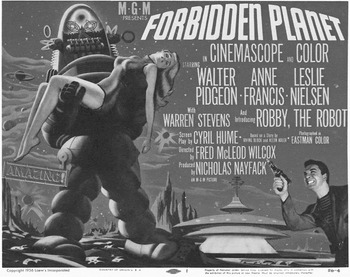
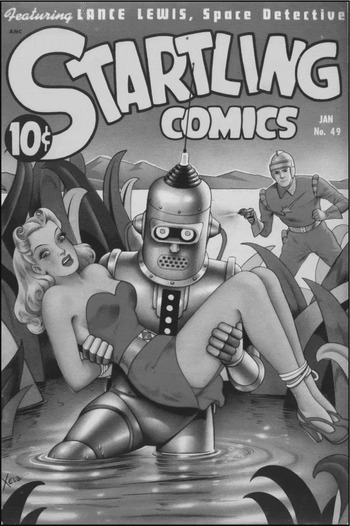
The drama of gender in Forbidden Planet, however, stands out from other contemporary films: by projecting and then defusing a disturbing threat to masculinity and the patriarchal order through its portrayal of men as helpless victims—a threat that resonated with growing anxieties about gender in a society on the brink of Second-Wave Feminism. The reassertion of conventional gender attitudes is illustrated visually by a gap—an equivocation—between the film's most iconic image (a poster used in the film's original advertising campaign) and the film itself, which points toward unacknowledged aspects of the film's sexual politics and latent anxieties. The poster presents a mise-en-scène typical of the genre: a damsel-in-distress in need of rescue from the clutches of an evil monster (or robot) by a dashing young hero (Figure 1). In spite of its sci-fi garb, this image draws on a staple narrative of American cinema going back at least as far as the classic 1914 silent serial The Perils of Pauline. Even in these early serials, the image of a helpless Pauline sadistically bound hand and foot to railroad tracks, train approaching, mustachioed villain in topcoat and hat towering over her (now a cliché of camp and comedy), carries an inherent sexual component. The sexual element in images of the damsel-in-distress becomes more explicit in the cover art of pulp fiction magazines of the 1930s and 40s like Spicy Adventure Stories or Uncanny Tales, or the more specifically sci-fi offerings such as Captain Future, Astounding Science Fiction, and Weird Science (among numerous others), with their menacing aliens, mad scientists, handsome heroes, and scantily clad women so clearly exemplified by artists like the ubiquitous Alex Schomburg (Figure 2).
Lobby card reproduction. Forbidden Planet (1956). Used by permission of Warner Bros.

Alex Schomburg, airbrush. Cover Startling Comics, January 1948, No. 49. Copyright, Estate of Alex Schomburg. Used by permission.

These pulp magazine covers sexualize the vulnerability of the female body to technology and alien forces, in order to lure the predominantly adolescent and young adult male purveyors of these genres into buying the comics or, in the case of Forbidden Planet, a ticket to see the film. More importantly, though, this projection of sex and violence into the realm of fantasy occurs because the culture at large most readily projects a capacity for physical violation onto the female vulnerability to rape (which these images with their “sexless” robots bizarrely suggest). Taken together, then, these narratives with their fetishistic images of helpless females, ever susceptible to physical violation, would seem to displace male anxieties about the dangers of technology specifically onto the sexualized female body.
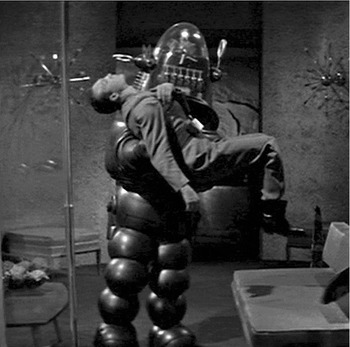
And yet the posters and other advertising materials on which Forbidden Planet's iconic image appears do not depict what happens in the film.Footnote 41 Alta, the film's only female character, is never threatened in the fashion portrayed in the promotional material, either by Robby the robot or the film's Monster. Certainly the film does deliver individual elements of the poster: the attractive, sexually alluring young woman; the robot with its superhuman abilities; exotic locales; the handsome, brave astronaut with blaster blazing. But in a startling reversal of this image, the film offers instead a scene in which Robby (incapable of threatening or harming humans) carries the mortally injured science officer, Dr. Ostrow, back from the Krell laboratory so Ostrow can tell Commander Adams how to prevail over the film's Monster(s) (Figure 3).
Robby carries Dr. Ostrow, Forbidden Planet, DVD, dir. Fred Wilcox (1956; Burbank, CA: Warner Bros. Entertainment Co., 2006).

Although the poster may lure one into the theatre with the promise of an erotic thrill centered around conventional gender relationships, this scene and its echo of the poster suggests a covert ambivalence about the interplay of gender and technology that hangs over the film. On the one hand, the interchangeability of genders between the poster and the actual scene in the film seems to transcend gender and point toward a more overarching theme: the relationship of technology to the human body in general. And yet, the curious slippage between the iconic image of the vulnerable, sexualized female body and the actual scene replacing the image of the woman in the robot's arms with the body of the male, victim of an overwhelming alien technology, implies that the narrative of Forbidden Planet hinges on a particular problem of masculinity in the film: the vulnerability of the male body to sadistic violence born out of a sexually motivated, technologically enabled rage against which there is no material defense.
Look Like A Man
Before masculinity can be destabilized, however, its privileges and authenticity needs to be established. In Forbidden Planet the filmmakers delineate the prerogatives of patriarchy visually throughout the film as an object/subject distinction in which the film's various Others become feminized as objects of the male gaze.Footnote 42 The Barrons support these binary distinctions in the film's opening scenes by underscoring everything visually fantastic around the gaze of the spacemen on the ship, thus pointing away from the men and toward the object(s) being viewed. Here, the vocal primacy of the ship's officers always requires music and sound to be subordinated to the voices of men and rational discourse.Footnote 43 Because the beginning of the film unfolds entirely within the homosocial world of the spaceship, the filmmakers risk aligning the “electronic tonalities” in these opening scenes with the ship's crewmen. That would be a muddled message, since these men clearly represent the epitome of masculine “normalcy.” In his 1956 New Yorker Magazine review, John McCarten recognized them as familiar American contemporaries:
[. . .] with their striped sweaters and snappy, close-fitting gray uniforms, the boys look as if they’d just stepped out of a musical comedy of our day. Except that they refer now and then to mysterious gyroscopic gadgets that apparently keep their saucer from spilling all over the Milky Way, they’re just a gang of regular American fellows, anxious to complete their mission and get back to places like Kansas City.Footnote 44
Danny Peary also states: “[. . .] the men of the C-57D [represent] the norm for the Eisenhower era—white, WASPish, and, even after a year in space, even-tempered, unquestionably loyal and obedient to their captain.”Footnote 45 In short, the crew are just regular “Joes” carrying out their duties in a familiar context overlaid with the exotic gloss of a star-spangled futurism representing the ideal of Euro-American patriarchy, racial homogeneity, and military discipline.
Throughout these opening scenes, then, the Barrons use music to structure all the strange or alien visual objects around the politics of masculine subjectivity and the male gaze: the infinity of space filled with stars, the saucer ship, the futuristic gadgetry, planets and suns. Here the Barrons’ “electronic tonalities” collude with strategies that convey the wonder and strangeness of the visuals to an audience who experiences them from the crew's perspective, and thus from the point of view of an explicitly male subject. The necessity of foregrounding male subjectivity is so strong that when the visuals switch to the ship's interior—the women mentioned in the film's opening narration as having pioneered with men the conquest of space—are completely effaced from the crew. Of course, the introduction of women into the crew would have weakened not just certain aspects of the narrative itself, but the gender division on which the film's sexual politics depend. Less obviously, but perhaps more importantly, women in the crew would also have confused the clear distancing of masculinity from “musicality,” especially a musicality so explicitly Othered.Footnote 46
Within these opening scenes, the alignment of “electronic tonalities” with the diegetic exotic and the distancing of music from representations of male bodies becomes strikingly apparent as the ship decelerates from hyper drive (2:55). Here, the “electronic tonalities” fulfill the double functions of music as stylized sound. In this moment of high sonic energy, the men's bodies are obscured, erased from the film's visual surface as the deceleration field enfolds them, shielding them from the terrific energies at work—energies projected through musicalized sound. While forestalling a musical representation of the men themselves, the intersection of music and body in this moment emphasizes and foreshadows the vulnerability of the male body to powerful, life-threatening forces articulated in high-energy sound. As the film progresses this vulnerability will be marked by a particularly unnerving vocalization: the male scream. As I will demonstrate, the film's resolution revolves around the recuperation of that scream and the restitution of the dominant, authoritative male vocality it has subverted.
From the outset, the film assumes male vocal dominance (the male voice-over, the utterances of the all-male crew) by subordinating music dynamically under the male voice, ensuring that the dialogue can always predominate. When the film focuses on the astronauts, music is silenced, and typically coincides with the captain's authoritative, often electronically amplified, vocalizations. At one point, Morbius comments to Adams, who is barely able to register his IQ on the Krell brain booster, “A commanding officer doesn't need brains. Just a good loud voice, huh?” Throughout the film, music either disappears in response to Adams's “good loud voice,” or it colludes with his voice to focus our gaze on the objects of scrutiny. At least with respect to Adams, the separation of music from male representation grows more pronounced as the film progresses, especially after he and his men land on the planet and the focus shifts more explicitly to the Others populating it. This state of equilibrium between music and the rational male voice, however, begins to break down with the introduction of the Monster from the Id and the threat it poses to the regime of masculinity. That destabilization becomes most sonically clear as music and voice begin to collide in the screams of the ships all-male crew, the Monster from the Id, and, finally, the silent scream of Dr. Morbius himself.
Voices of Extremity
While the Krell remain the tragic ghost in the subterranean machine, another more palpable ghost materializes as the film progresses: the Monster from the Id. Unlike the Krell, whose former existence is evoked by means of a fixed musical recording, the “Monster from the Id” becomes embodied and envoiced through the evolving musical representations that accompany its ever more substantial and violent materializations. At the Monster's second manifestation the Barrons’ “electronic tonalities” again imply diegetic ambiguity (1:06:15). Is the rhythm here a stylized evocation of the Monster's footsteps seen within the frame of the film, giving physical materiality and weight to Chion's acousmêtre (an invisible being, sometimes—as in this case—actually within the frame of the film, whose presence is articulated in sound)?Footnote 47 Or does it connote more subjectively its pulsing bloodlust, its murderous intent portrayed musically? However one might interpret music's diegetic ambiguity in this scene, the ambiguity itself parallels the Monster's impossible ontology (and the impossibility of musical modernism's ideologies of autonomous, absolute music): both materially present but, simultaneously, only a projection of the human mind—an emanation hovering over and between diegetic boundaries.
Early in the film, music tended to fall away at Commander Adams vocalizations, implying music's distance from the realm of patriarchal language and rationality. At the Monster's climactic attack on the ship, however, the Barrons’ “electronic tonalities” not only create an aural analogue to its body, but they invest that (eventually semi-visible) body with an uncanny voice (1:16:24)—a voice, moreover, that almost drowns out the voices of the captain and his crew. The sense of voice the Barrons created in their music for the Monster here (and in the climactic scene leading up to Morbius's death) was so powerful, that contemporary critics focused their attention on the score's perceived vocal qualities, both real and abstract. In his May 1956 review of the film for The New York Times, Bosley Crowther stated: “[. . .] Louis and Bebe Barron [. . .] developed the ‘tonalities’—the accompaniment of interstellar gulps and burbles—that take the place of a musical score.”Footnote 48 Even more evocative is John McCarten's review: “The picture is crowded with the lunatic mechanisms so common to celluloid views of the future, but their air of portentousness is ruined by the sound track, which equips them with drowned grunts, whimpers, bleats, and whoops.”Footnote 49 In a more positive account of the film's sound track, Arthur Knight, states: “Best of all, M-G-M has dispensed with a musical score and accompanies the doings with [. . .] ectoplasmic moans [. . .].”Footnote 50 One anonymous reviewer described the score as “an ingeniously sustained accompaniment of electronic shrieks.”Footnote 51 More recently, James Wierzbicki also continually draws attention to the vocality of the Barrons’ soundtrack: “tone-colors that suggest the timbre of a human voice”; “akin in timbre to an animal's howl”; “a low-pitched and vibrant ‘hum,’ comparable in timbre to the sound of multiple male voices”; “animalistic screeches.”Footnote 52 The persistent reference to the score as a projection of vocal utterances conveys the visceral impact the Barrons’ soundscape communicated in the theatre. More importantly, it underlines the significance of a perceived vocality in the film's sonic construction.
This intersection of music and voice becomes critically central to the film's narrative trajectory and resolution, and is a key element of the score's entanglement not just with issues of gender, body, and sexuality but also with modernism's ideologies of gender and patriarchy.Footnote 53 As the film unfolds and the Barrons more insistently locate the vocal qualities of their score in the Monster, they not only reinforce music's connection to materiality, but also widen the gap between authentic masculine vocality (language, dialogue, and rationality)—and modernism's focus on the role of intellect in pursuing the mirage of musical autonomy—and music's association with all things irrational and perverse the Monster represents (i.e., its impossible physical constitution, its sexually-motivated rage, the warped masculinity represented by its emanation from the de-humanized mind of the Mad Scientist, who lacks both wisdom and compassion). The film thus offers up an extreme expression of technologically enabled patriarchal masculinity gone awry, vested in the shrieks of the Monster—drunk with power, jealousy, and rage.
A similarly extreme vocalization is expressed by the screams of the crew as the Monster kills them. Unlike the Monster's howls, which are a literal realization of what Chion has termed “the identification of the male with the totemic animal,” the screams from crew members Quinn and then Farman (along with others of the crew) are more disruptive to the hierarchy of gender in that they articulate the vulnerability of the male body to sadistic violence (with its unsettling connection to the idea of male rape).Footnote 54 The collapse of gender categories, which sets up certain men as potential feminized victims, is unnervingly highlighted by their screams, because it relocates in their bodies the extremity of the “cry” almost invariable reserved for “Woman” in a genre especially marked by the screams of women.Footnote 55
The proliferation of screams and howls associated with male characters—the murderous howling of the Monster, the death screams of the crew—marks an acute crisis of masculinity in the film that requires a conventional narrative resolution. It is not surprising then that as the crisis has unfolded in the soundscape, the recuperation of masculinity and conventional gender categories depends primarily on a sonic resolution. The film's denouement occurs when Morbius, finally recognizing and accepting the truth, renounces the Monster in himself. That renunciation, though, is effected in a silent, inverted scream: a self-annihilating scream which in swallowing itself, also swallows the Monster's howls and its power to harm (1:35:05) (Figure 4).Footnote 56 The music first associated with the Monster thus finally disappears when Morbius dies. The actual sound of the male scream is recuperated more conventionally earlier when Alta, her dreams invaded by visions of the Monster's horrific attack on the ship, wakes screaming herself (1:17:45). Her double scream, the second of which finally wakes her father and silences the screaming of the Monster, is recuperative, and not simply because it is the last human scream we hear in the film. It marks a critical turning point: the moment when Alta realizes her love for Adams, thus becoming the potential victim of her father's murderous, subconscious rage. Finally, Alta devolves into the female figure on which the genre conventionally relies: the screaming woman whose life depends on the protective male hero who will rescue her.
Dr. Morbius's Silent Scream, Forbidden Planet, DVD, dir. Fred Wilcox (1956; Burbank, CA: Warner Bros. Entertainment Co., 2006).

In a film of this period and genre, feminist psychoanalytic film theory might argue that masculinity can only be recuperated by projecting back onto “Woman” that which must be disavowed, and by restoring to her the role to which she is “naturally” fitted. Indeed, Alta plays a crucial part in righting the vocal inversions the film has projected (including her perceived right of vocal equality with men). Here, the Barrons’ musical depiction of her motivates the recontextualization of Forbidden Planet's soundscape within the conventions of Hollywood cinema. The Barrons effect this recontextualization by linking the sonic qualities associated with Alta to feminine musical affect and through a type of quasi-leitmotivic approach that relies more on timbral affect than melody or harmony to make the index between music and gender more explicit for their audience. If, as I have argued, the film's soundscape has uniquely marked the vulnerability of male bodies to violence and undermined conventional masculinity, nevertheless the nuanced links between music and gender eventually aid masculinity's recuperation. Through a focus on Alta's “love music” the restoration of contemporary notions of gender at the film's conclusion is ultimately grounded in the “naturalization” of music's alignment with the feminine.
“Natural” Woman
At her first appearances, the film sets Alta up as a double Other: woman and cultural exotic. Having been raised by her father alone, she is not aware of, and thus does not fulfill, established gender roles. Her ignorance of social norms and her self-assertion pose direct challenges to patriarchy. Moreover, never having seen a young man before, she is a sexual naïf who, in the first part of the film, is open to experimentation with members of the crew and quickly becomes the cause of intramasculine conflict. On the most prosaic level, Alta's entry into the homosocial world of the ship's crew initiates rivalries that disrupt its stability and discipline.Footnote 57 More threateningly, the Monster, as we eventually learn, is a projection of Morbius's subconscious “Id,” enraged by Alta's growing attraction to Commander Adams, bent on destroying that relationship at any cost—even, finally, if it means Alta's death. Music, working with other cinematic strategies, helps foreground Alta as body, at first highlighting the threat her sexuality poses within the narrative, then eventually becoming a primary focus for resolving the intersecting dramas of body, sexuality, voice and gender in the film.
The filmmakers establish the intersection of music, sexuality, and Alta's body at her first appearance. Not long after she arrives on the scene, Alta, a curious but sexual innocent, receives warnings from Lt. Farman about the captain's reputed predatory nature. Although the undertone of the conversation is ostensibly humorous, these initial references to sexual violence and Alta herself as a potential motivator for that violence are crucial elements of the narrative, and help establish the connection of this theme to Alta from the moment she first appears. At first glance, the entry of music at this moment of sexual innuendo after a lengthy musical silence might seem incongruous. Dubbing the cue “flirtation music,” James Wierzbicki, for example, finds it perplexing: “inane,” “dramatically pointless,” and “serv[ing] no purpose other than to add coloration to the final segment of a lengthy scene that is essentially devoid of action.”Footnote 58 However, in moments like these where there seems to be no immediate diegetic motivation, Forbidden Planet's music functions as something like the film's unconscious, obsessively (even, perhaps, from a narrative point of view, irrationally) marking, intertwining, and conflating the darker themes on which the film itself fixates. Indeed, invoking references to both the purity of Christian Saints like Francis of Assisi and the myth of the virgin and the unicorn, the scene continues to emphasize Alta's sexual innocence in her symbolic relationship to the planet's wild animals, in particular the tiger that, as her father notes, when outside the range of her taming influence remains a “deadly, wild beast” (26:55). Significantly, the music accompanying this scene recurs in altered form as Alta's theme music, soon to become (as both Wierzbicki and Leydon point out) Alta's “love” music. Rather than simply responding to local diegetic action, then, the music in Alta's first scene performs a more subtle, unifying function, tying together the constellation of signs referencing male sexual predation and violence, and female virginity and innocence, which will ultimately be resolved through Alta's integration into a “properly” constituted heterosexual partnership.
Throughout Alta's introductory scene, rather than being distanced from music as Commander Adams is, Alta becomes the object of erotic musical construction. While Forbidden Planet's opening scenes function as props for the male gaze, as the film progresses, music's function as a corollary of the male gaze becomes more specifically centered on Alta and her subordination to that gaze—most vividly illustrated in the scene where Morbius uses Krell technology to create a “living” projection of his daughter from pure thought while Adams and Ostrow look on in amazement (55:10). Though the “electronic tonalities” seem to begin diegetically as the literal sound of the mind booster, as the image of Alta congeals the music slips into that ambiguous space between diegetic and nondiegetic, striving both to articulate her physical invocation as well as the emotional excitement of this act of mental creation (Figure 5).Footnote 59
“Visualizing” Alta, Forbidden Planet, DVD, dir. Fred Wilcox (1956; Burbank, CA: Warner Bros. Entertainment Co., 2006).

Over the past thirty years feminist and psychoanalytic film critics have addressed Hollywood's iconic sexualized visualizations of the female body. In Forbidden Planet, this iconography is explored through Alta, whose body becomes the contested, constitutive site of legitimate sexuality. On the one hand, we have the guttural, animalistic vocalizations of the Monster from the Id or the feminized, cross-gendered Robby, whose mechanical body is constantly evoked both sonically and physically (the whirring and clattering of his gears and circuits; his flat, emotionless—yet often strangely ominous—mechanical voice; his incongruous burps after ingesting some bourbon for chemical analysis) or through his lack of physical functions (Farman's oblique reference to Robby's lack of sexual organs). Alta's physicality, on the other hand, is never literally evoked sonically. While the visual images of Alta emphasize her body in erotic terms, such as in the bathing scene, the music accompanying the scene is conveyed as an “aura” that refers to more conventional musical codes suggesting female desirability, romance, and fantasies of “Woman” (44:27). The musical emblems of that aura include not just softer dynamics but a general musical diffusion in which shimmering sustained harmonies evolve gradually over time. The diffuseness of Alta's music, especially in the crucial bathing scene, suggests the soft fluidity of femininity and female sexuality, a sexuality that negates clear surface demarcation of musical elements to suggest rather than assert.Footnote 60
The idea of a musicalized fantasy body structured around the male gaze and masculine agency is precisely what allows music finally to shed its too-close-connection with the non-human Other and to settle not just in the realm of the human represented by Alta, but the realm of humanity represented by her ultimate heterosexual union with Commander Adams in the final scene.Footnote 61 The sonic metamorphosis from electronic sounds associated with the Other to nondiegetic music as purely human affect culminates in this final scene with the reappearance of Alta's bathing music. Though Alta has lost the power of speech here, as soon as the ship reaches its safe distance from the planet—which then explodes—her music begins, underscoring Adams's eulogy of her father (1:36:11).Footnote 62 As I noted earlier, rather than employing electronic sound to depict Alta in literal, bodily terms (as they did for both Robby and the Monster from the Id), the Barrons sublimate her sexuality in romantic musical affect. It is precisely because her sexuality has been reduced to nondiegetic affect that her “Otherness” can be symbolically resolved at the film's conclusion, the sexualized female body and the danger it poses “naturalized” and properly subordinated within patriarchy and heterosexual union. By “naturalizing” female sexuality, aligning it with more conventional notions of musical romance and subordinating it to the male voice at the film's end, the Barrons have also finally neutralized the ambiguous functions of electronic music in Forbidden Planet, “naturalizing” it as pure Hollywood convention.Footnote 63
Pay No Attention To The Woman Behind The Curtain
As the first science-fiction film to employ an all-electronic score, Forbidden Planet helped reify the potential representational functions of electronic music in film not just in 1956 but also for the sci-fi films that followed it. By exploiting overtly the inherent tensions within musical modernism and its dialectical relationship with popular, commodity culture, the Barrons helped articulate a particular position for modernist idioms in Hollywood cinema.Footnote 64 Their oblique critique of musical modernism in Forbidden Planet, revealing the conundrum of the unavoidable links to materiality and subjectivity of even the most “intellectual” and abstract of musical sounds, might also be understood as a defense of their own turn away from the ideology of purely autonomous music. Although Forbidden Planet may only ever achieve the status of a cult classic, traces of its musical attitudes and functions reverberate in more critically acclaimed films such as Stanley Kubrick's 2001: A Space Odyssey with its celebrated use of Ligeti's music. Like the Barrons’ music for the Krell, the strangeness of Ligeti's music in the popular imagination becomes associated with the monolith in Kubrick's film, metonymically standing in for the unknowable, unrepresentable Other. As in Forbidden Planet, the ambiguous relationship of Ligeti's music to the diegesis articulates the contradictory nature of the Other: abstracted yet simultaneously embodied and envoiced.Footnote 65
Forbidden Planet unveils one of the often unarticulated motivations of modernist music's retreat into abstraction and autonomy: a reaction to (and occasionally an expression of) the terrifying, potentially uncontrollable nature of technological “progress” that either promises to redeem humanity or threatens to overwhelm it with annihilation. Though naively atavistic in its attitudes toward gender, Forbidden Planet mirrors in the realm of popular culture the generally pessimistic view of twentieth-century modernism (a pessimism that is more overtly articulated in Adorno's writings). That pessimism springs, in part, from an anxiety in the face of overwhelming technological advances without regard for the humanity that might keep them in check: the scientific mind unfettered by bodily, hence human, restraint. Forbidden Planet, like modernism itself, seems caught between the material conditions of existence and, like the human characters in the film, an impulse to escape into a utopian world. And yet the modernist impulse to escape from commodity culture into a realm beyond utility or signification is revealed in the Barrons’ music to be a vain, even destructive, pursuit.
As I noted previously, the ideology of postwar modernism impinged powerfully on gendered notions of music and music-making. In tracing the roots and social determinants of Charles Ives's gendered attacks on the effeminacy and emasculation of Classical music in commodity culture, Judith Tick expertly narrates the history of musical modernism's internalization of a masculine gender bias.Footnote 66 Given both the articulated as well as the unspoken pressures of that bias, I wonder to what extent Bebe Barron's approach to composition was dictated by something more than temperament or an uncritical desire to communicate affectively. As a woman composer in a dauntingly male profession motivated, moreover, by an ideology of often openly transparent gender bias, Bebe Barron never occupied the typical subject position of the modernist composer, and, in a sense, was forced to swim against the tide: she taught no students who could propagate her views, had no position within academia, had her most important work disseminated primarily though popular media, had access to technology mainly through her husband, and worked collaboratively rather than autonomously. In light of these impediments, I would suggest that Forbidden Planet was not just a reflection of modernism's aesthetic preoccupations and denials but of Bebe Barron's own professional dilemmas as a woman composer in the era of modernism's high ascendancy.Footnote 67 Barron, therefore, was not just a pioneer and, in practice, a critic of a new medium, but a visionary who gestured toward what might someday be possible for women in a profession whose ideologies of musical autonomy and gender bias barred them and the importance of their work from acknowledgement.Footnote 68 Like Alta, the woman in the film who is both Other and Silent Partner, Bebe Barron and her work in the field of electronic music in the 1950s appear incongruous. Perhaps the ambiguous nature of Forbidden Planet's “electronic tonalities” and the musical aesthetic of embodied Otherness they represent are thus as much a reflection of Bebe Barron's own subjective position as a woman composer of electronic (film) music in 1956: the human voice of modernism's unsettled dilemmas.