Although the origins of childhood behavior problems are undoubtedly multiply determined, a burgeoning interest over the last decade has been directed toward examining the molecular genetic basis of complex traits and psychopathology in humans (see Benjamin, Ebstein, & Belmaker, Reference Benjamin, Ebstein and Belmaker2002; Cloninger, Adolfsson, & Svrakic, Reference Cloninger, Adolfsson and Svrakic1996; Hamer & Copeland, Reference Hamer and Copeland1998; Rutter, Moffitt, & Caspi, Reference Rutter, Moffitt and Caspi2006; Schmidt & Fox, Reference Schmidt, Fox, Benjamin, Ebstein and Belmaker2002, for reviews). However, the majority of the studies in this area of inquiry have focused exclusively on examining single genes or only reporting associations of single genes with behavior despite the multiple determinants and complexities of human behavior. Recently, researchers have begun to embrace these complexities by moving beyond single gene hypotheses and examining gene–environment interactions (G × E) and gene–gene interactions and, in some instances, gene–gene–environment interactions, which may confer risk for human psychopathology (see Caspi & Moffitt, Reference Caspi and Moffitt2006, for a review). Much of this work has been guided by existing G × E models that are known to underlie other types of human diseases (e.g., Hunter, Reference Hunter2005).
The recent work of Caspi and colleagues (Reference Caspi, McClay, Moffitt, Mill, Martin and Craig2002, Reference Caspi, Sugden, Moffitt, Taylor, Craig and Harrington2003) provides a cogent example of the G × E interplay in understanding human psychopathology. Caspi et al. (Reference Caspi, McClay, Moffitt, Mill, Martin and Craig2002) noted that maltreated children with a genotype that conferred high levels of the neurotransmitter-metabolizing enzyme monoamine oxidase A (MAOA) were less likely to develop antisocial behavior, suggesting that some genotypes may moderate a child's sensitivity to some environmental insults. Caspi's group also noted in another study that individuals with one or two copies of the short allele of the serotonin transporter (5-HTT) gene exhibited more depressive symptoms, diagnosable depression, and suicidal ideation in relation to stressful life events compared with individuals homozygous for the long allele (Caspi et al., Reference Caspi, Sugden, Moffitt, Taylor, Craig and Harrington2003). These basic findings have been independently replicated in studies of children (Kaufman et al., Reference Kaufman, Yang, Douglas-Palumberi, Houshyar, Lipschitz and Krystal2004), adolescents (Eley et al., Reference Eley, Sugden, Corsico, Gregory, Sham and McGuffin2004), and young adults (Kendler, Kuhn, Vittum, Prescott, & Riley, Reference Kendler, Kuhn, Vittum, Prescott and Riley2005).
Other examples of G × E involved in children's internalizing and externalizing-related behaviors have been recently published as well. For example, Fox and colleagues (Reference Fox, Nichols, Henderson, Rubin, Schmidt and Hamer2005) found that preschoolers with one or two copies of the short allele of the 5-HTT gene and who had mothers who perceived themselves low in social support were more likely to be shy and behaviorally inhibited at age 7 than children homozygous for the long allele of the 5-HTT gene and/or whose mothers were high in perceived social support. Bakerman-Kranenburg and van IJzendoorn (Reference Bakerman-Kranenburg and van IJzendoorn2006) noted that children with the long dopamine receptor D4 (DRD4) genotype and who had mothers who provided insensitive care exhibited more externalizing behaviors than children with the short DRD4 genotype and/or had mothers who were sensitive to their child's needs.
In addition to G × E, there are several reports of gene–gene interactions underlying complex traits in humans (see Lesch, Greenberg, Higley, Bennett, & Murphy, Reference Lesch, Greenberg, Higley, Bennett, Murphy, Benjamin, Ebstein and Belmaker2002). Gene–gene interactions have been traditionally examined in relation to a wide range of human diseases, including asthma (Howard et al., Reference Howard, Koppelman, Xu, Zheng, Postma and Meyers2002), hypertension (Moore & Williams, Reference Moore and Williams2002), risk of thrombosis (Van Boven, Vandenbroucke, Briet, & Rosendaal, Reference Van Boven, Vandenbroucke, Briet and Rosendaal1999), Crohn disease (Negoro et al., Reference Negoro, McGovern, Kinouchi, Takahashi, Lench and Shimosegawa2003), etiology of neural tube deficits (Botto & Mastroiacovo, Reference Botto and Mastroiacovo1998), and renal impairment after unilateral nephrectomy (Shiozawa, Provoost, Van Dokkum, Majewski, & Jacob, Reference Shiozawa, Provoost, Van Dokkum, Majewski and Jacob2000). Recently, researchers have examined gene–gene statistical interactions in relation to complex traits in human infants and adults.
In a series of studies, Ebstein and colleagues (Reference Ebstein, Levine, Geller, Auerbach, Gritsenko and Belmaker1998) examined gene–gene interactions in relation to neonatal temperament, infant attention (Auerbach, Benjamin, Faroy, Geller, & Ebstein, Reference Auerbach, Benjamin, Faroy, Geller and Ebstein2001), and the adult personality trait of reward dependence (Ebstein, Segman, et al., Reference Ebstein, Segman, Benjamin, Osher, Nemanov and Belmaker1997). Ebstein et al. (Reference Ebstein, Levine, Geller, Auerbach, Gritsenko and Belmaker1998) investigated the interaction of 5-HTT and DRD4 genes in 81 healthy 2-week-old neonates in relation to temperament that was indexed by the Brazelton Neonatal Assessment Scale (NBAS). Neonates with the homozygous short 5-HTT genotype (s/s), but lacking the longer allele form of the DRD4 gene, scored lower on the NBAS orientation score compared with other neonates. In another study by Ebstein's group (Auerbach et al., Reference Auerbach, Benjamin, Faroy, Geller and Ebstein2001), these researchers noted a significant interaction between the 5-HTT gene and the DRD4 gene on a measure of sustained attention in a group of 61 healthy 1-year-old infants. Infants with the homozygous short allele of the 5-HTT gene and the long allele of the DRD4 had the lowest scores of duration of looking while involved in an information processing task. Ebstein, Segman, and colleagues (Reference Ebstein, Segman, Benjamin, Osher, Nemanov and Belmaker1997) also examined the interaction of the serotonin 2C receptor gene (5-HT2C; Lappalainen et al., Reference Lappalainen, Zhang, Dean, Oz, Ozaki and Yu1995) and DRD4 gene in relation to adult personality. They found an association between a cysteine to serine coding sequence polymorphism in the 5-HT2C gene and the personality trait of reward dependence, especially in individuals with the DRD4 long genotype. This latter finding of a gene–gene interaction in relation to the personality trait of reward dependence has been independently replicated (e.g., Kuhn et al., Reference Kuhn, Meyer, Nothen, Gansicke, Papassotiropoulos and Maier1999).
Most recently, independent groups of investigators have examined Gene × Gene × Environment interactions. Kaufman and colleagues (Reference Kaufman, Yang, Douglas-Palumberi, Grasso, Lipschitz and Houshyar2006) found a significant three-way interaction between the brain-derived neurotrophic factor (BDNF) gene, the 5-HTT linked promoter region (5-HTTLPR) gene, and maltreatment history in predicting depression. Children with the methionine (Met) allele of the BDNF gene and two short alleles of the 5-HTTLPR gene had the highest depression scores; however, the vulnerability linked to these two genotypes was only evidenced in the maltreated group. In addition, they noted that a significant four-way interaction revealed that social supports moderated the risk for depression. Mandelli and colleagues (Reference Mandelli, Serretti, Marion, Pirovano, Calati and Colombo2007) examined the interactions among the 5-HTT, DRD4, and catechol-O-methyltransferase (COMT) genes, and stressful life events in mood disorders. A significant interaction between the 5-HTT and COMT genes was found such that individuals with the 5-HTT short allele and COMT Met alleles showed the highest occurrences of stressors at the first lifetime mood-disorder episode. Taken together, the findings from the disparate studies reviewed above suggest that particular combinations of genotypes may confer risk for psychopathology. Overall, the presence of one or two copies of the short allele of the 5-HTT gene and the presence of the long allele version of the DRD4 gene may confer a risk for internalizing- and externalizing-related behaviors, respectively, but particular environments may moderate the outcome.
In a group of typically developing children, we examined whether the presence of the 5-HTT short and DRD4 long genotypes in the same individual would confer risk for more internalizing and externalizing behaviors than children with other combinations of the 5-HTT and DRD4 short and long genotypes. We collected buccal cells from 108 typically developing children who had been followed longitudinally since infancy (see Calkins, Fox, & Marshall, Reference Calkins, Fox and Marshall1996; Fox, Calkins, & Bell, Reference Fox, Calkins and Bell1994; Fox et al., Reference Fox, Rubin, Calkins, Marshall, Coplan and Porges1995, Reference Fox, Henderson, Rubin, Calkins and Schmidt2001, Reference Fox, Nichols, Henderson, Rubin, Schmidt and Hamer2005; Fox, Schmidt, Calkins, Rubin, & Coplan, Reference Fox, Schmidt, Calkins, Rubin and Coplan1996), and their mothers completed the Child Behavior Checklist (CBCL) when the child turned 7 years old. The DNA was extracted from the buccal cells and genotyped for the presence of short (s/s, s/l) and long alleles (l/l) of the 5-HTT gene and the short (2–5 repeats) versus long (6–8 repeats) alleles of the DRD4 gene. We next stratified the 5-HTT and DRD4 genotypes. We created a 2 (5-HTT: short vs. long alleles) × 2 (DRD4: short vs. long alleles) design, resulting in four groups of children: 5-HTT short/DRD4 long, 5-HTT short/DRD4 short, 5-HTT long/DRD4 short, and 5-HTT long/DRD4 long. We then examined whether the four groups were distinguishable on the maternal report of CBCL for internalizing and externalizing behavior at age 7. To our knowledge, there are no published studies examining gene–gene interactions in typically developing children's behavior problems.
We examined the serotonin transporter gene because of its well-documented role in anxiety-related problems in humans. Lesch et al. (Reference Lesch, Bengel, Heils, Sabol, Greenberg and Petri1996) reported that adults carrying one or two copies of a short allele of the regulatory DNA sequence polymorphism in the 5-HTTLPR gene self-reported higher levels of neuroticism, anxiety, and depression compared with individuals homozygous for the long allele of this polymorphism. In addition, euthymic adults with the short allele of the 5-HTT gene are known to be low on novelty seeking (Serretti et al., Reference Serretti, Mandelli, Lorenzi, Landoni, Calati and Insacco2006). In vitro and in vivo expression studies have shown that the short allele leads to less gene transcription and protein production than does the long allele (Greenberg et al., Reference Greenberg, Tolliver, Huang, Li, Bengel and Murphy1999; Heils et al., Reference Heils, Teufel, Petri, Stöber, Riederer and Bengel1996; Lesch et al., Reference Lesch, Bengel, Heils, Sabol, Greenberg and Petri1996; Little et al., Reference Little, McLaughlin, Zhang, Livermore, Dalack and McFinton1998). Serotonin has been also implicated as a major neurotransmitter of anxiety and withdrawal behaviors because of its effects on regulating mood and emotional states (see Westernberg, Murphy, & Den Boer, Reference Westernberg, Murphy and Den Boer1996, for a review). The association between the serotonin transporter gene and anxiety-related symptoms has been replicated in culturally diverse populations, including the United States, Europe, Israel, and Japan (e.g., see Greenberg et al., Reference Greenberg, Tolliver, Huang, Li, Bengel and Murphy1999, for a review), although it is important to point out that some studies have failed to find any association of the 5-HTT gene with anxiety (Ball et al., Reference Ball, Hill, Freeman, Eley, Strelau and Riemann1997; Deary et al., Reference Deary, Battersby, Whiteman, Connor, Fowkes and Harmar1999; Kumakiri et al., Reference Kumakiri, Kodama, Shimizu, Yamanouchi, Okada and Noda1999; Schmidt, Fox, Rubin, Hu, & Hamer, Reference Schmidt, Fox, Rubin, Hu and Hamer2002).
The second gene of interest to us was the DRD4 gene. This gene contains a functional repeated sequence polymorphism within its coding sequences and was originally studied for its role in personality traits related to novelty seeking. The initial two studies (Benjamin et al., Reference Benjamin, Li, Patterson, Greenberg, Murphy and Hamer1996; Ebstein et al., Reference Ebstein, Novick, Umansky, Priel, Osher and Blaine1996) found that adults with longer versions (6–8 repeats) of the DRD4 gene self-reported higher novelty seeking scores than adults with shorter versions (2–5 repeats) of the coding sequence polymorphism. Dopamine has been implicated as a major neuromodulator of novelty seeking because of its well-documented role in inducing euphoria in humans and approach behavior in animals (Cloninger, Reference Cloninger1987). The shorter alleles code for a receptor that is apparently more efficient in binding dopamine compared with the larger alleles (see Plomin & Rutter, Reference Plomin and Rutter1998, for a review). The association of the long allele of the DRD4 gene with novelty seeking in young adults has been independently replicated in some populations (Ebstein, Nemanov, Klotz, Gritsenko, & Belmaker, Reference Ebstein, Nemanov, Klotz, Gritsenko and Belmaker1997; Noble et al., Reference Noble, Ozkaragoz, Ritchie, Zhang, Belin and Sparkes1998; Ono et al., Reference Ono, Manki, Yoshimura, Muramatsu, Mizushima and Higuchi1997; Strobel, Wehr, Michel, & Brocke, Reference Strobel, Wehr, Michel and Brocke1999; Tomitaka et al., Reference Tomitaka, Tomitaka, Otuka, Kim, Matuki and Sakamoto1999). However, several studies have found either no association (Gelernter et al., Reference Gelernter, Kranzler, Coccaro, Siever, New and Mulgrew1997; Goldman et al., Reference Goldman, Malhotra, Urbanek, Guenther, Robin and Virkkunen1996; Jonsson et al., Reference Jonsson, Nothen, Gustavsson, Neidt, Brene and Tylec1997; Pogue-Geile, Ferrell, Deka, Debski, & Manuck, Reference Pogue-Geile, Ferrell, Deka, Debski and Manuck1998; Sander et al., Reference Sander, Harms, Dufeu, Kuhn, Rommelspacher and Schmidt1997; Sullivan et al., Reference Sullivan, Fifield, Kennedy, Mulder, Sellman and Joyce1998; Vandenbergh, Zonderman, Wang, Uhl, & Costa, Reference Vandenbergh, Zonderman, Wang, Uhl and Costa1997) or associations in the “opposite” direction relative to the initial reports (Malhotra, et al., Reference Malhotra, Virkkunen, Rooney, Eggert, Linnoilia and Goldman1996). The DRD4 long genotype has also been linked to attention-related problems in human infants (Auerbach et al., Reference Auerbach, Benjamin, Faroy, Geller and Ebstein2001) and problems with attention (Schmidt, Fox, Perez-Edgar, Hu, & Hamer, Reference Schmidt, Fox, Perez-Edgar, Hu and Hamer2001) and aggression (Schmidt et al., Reference Schmidt, Fox, Rubin, Hu and Hamer2002) in children, and more recently, externalizing behaviors in children with low IQ (DeYoung et al., Reference DeYoung, Peterson, Seguin, Mejia, Pihl and Beitchman2006) and low harm avoidance in euthymic adults (Serretti et al., Reference Serretti, Mandelli, Lorenzi, Landoni, Calati and Insacco2006).
If the 5-HTT short genotype is related to withdrawal behaviors, anxiety, and internalizing-related problems, and the DRD4 long genotype is related to approach behaviors, novelty-seeking, and externalizing-related problems, then it is possible that individuals with the presence of this combination of genotypes would evidence more behavior problems because of the “double hit” than other individuals who possess different combinations of the 5-HTT and DRD4 genotypes. Accordingly, we predicted that children with one or two copies of the short allele of the 5-HTT and the long allele of the DRD4 gene would exhibit more internalizing and externalizing behaviors at age 7 than children with other combinations of the 5-HTT and DRD4 short and long allele genotypes.
Method
Participants
The participants in this study were 108 typically developing children who had complete gene and behavioral data. These children have been followed longitudinally since infancy as part of a larger study examining the psychology and psychophysiology of socioemotional development (see Calkins et al., Reference Calkins, Fox and Marshall1996; Fox et al., Reference Fox, Calkins and Bell1994, Reference Fox, Rubin, Calkins, Marshall, Coplan and Porges1995, Reference Fox, Schmidt, Calkins, Rubin and Coplan1996, Reference Fox, Henderson, Rubin, Calkins and Schmidt2001, Reference Fox, Nichols, Henderson, Rubin, Schmidt and Hamer2005). The children were primarily Caucasian and of middle-class background. All of the parents had completed high school, and a majority of the mothers and fathers were college graduates. The children were mostly living with their families in or near College Park, Maryland. Original exclusion criteria were that the child had no peri- or postnatal complications and no known neurological problems.
Maternal report of childhood behavior problems
The parent (primarily mothers) completed the CBCL (Achenbach, Reference Achenbach1991; Achenbach & Edelbrock, Reference Achenbach and Edelbrock1981) on the child at age 7. The CBCL is a widely used questionnaire completed by parents of children aged 4–18 years to assess child behavioral problems. The CBCL contains eight narrowband, less general syndromes: aggression, delinquency (externalizing), withdrawal, anxiety/depression and somatic complaints (internalizing), thought problems, task persistence, and social problems (neither clearly internalizing nor externalizing). Each item is scored on a 3-point scale, ranging from 0 = not true to 2 = very true. Two broadband clusters of internalizing and externalizing behaviors are derived. Achenbach (Reference Achenbach1991) reported mean α coefficients of .89 and .93 for the internalizing and externalizing scales, respectively. Of particular interest to the present study were the internalizing and externalizing broadband factors.
DNA preparation and genotyping
Genomic DNA was prepared from buccal swabs (Epicentre Technologies, Madison, WI). Children were instructed by an investigator or parent to collect cheek cells by rolling a buccal brush firmly on the inside of the cheek, approximately 20 times on each side. The brushes were air dried for 10–20 min then sent to the laboratory at the National Institutes of Health for extraction within 3 days. DNA was prepared by absorption to a bead matrix and heat elution according to the manufacturer's instructions.
5-HTT
5-HTTLPR was analyzed by polymerase chain reaction (PCR) amplification followed by agarose gel electrophoresis as described by Lesch et al. (Reference Lesch, Bengel, Heils, Sabol, Greenberg and Petri1996). Allele frequencies were 59.0% for the s allele and 41.0% for the l allele; no extralong alleles were observed in this population. Based on previous results (Lesch et al., Reference Lesch, Bengel, Heils, Sabol, Greenberg and Petri1996), genotypes were dichotomized as short (S) for s/s and s/l and long (L) for l/l.
DRD4
The DRD4 gene exon III polymorphism was assayed by PCR using the primers and reaction conditions described by Lichter et al. (Reference Lichter, Barr, Kennedy, Van Tol, Kidd and Livak1993) combined with a “hot start.” The number of repeats was determined by electrophoresis through a 3.5% agarose gel and ethidium bromide staining. Allele frequencies were 6.2% for allele 2, 1.9% for allele 3, 68.3% for allele 4, 1.6% for allele 5, 0.3% for allele 6, 21.4% for allele 7, and 0.3% for allele 8. Based on previous results (Benjamin et al., Reference Benjamin, Li, Patterson, Greenberg, Murphy and Hamer1996), genotypes were classified into two groups: S for s/s and L for s/l and l/l, where S indicates alleles with 2–5 repeats and L indicates alleles with 6–8 repeats. Indistinguishable results were obtained when genotypes were coded according to the presence or absence of the 7-repeat allele (Ebstein et al., Reference Ebstein, Novick, Umansky, Priel, Osher and Blaine1996) or as the sum of allele lengths.
Results
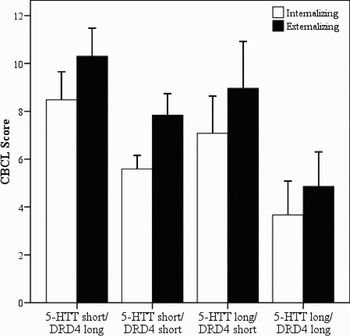
Figure 1 presents the differences among the 5-HTT (short, long) and DRD4 (short, long) genotype groups on CBCL internalizing and externalizing behaviors at age 7.
Mean (standard error bars) number of internalizing and externalizing behaviors, stratified for serotonin transporter (5-HTT) and dopamine receptor D4 (DRD4) genotypes in typically developing children at age 7. The 5-HTT short/DRD4 long genotype group is significantly different from the 5-HTT long/DRD4 long genotype group on internalizing and externalizing behaviors at age 7. The 5-HTT short/DRD4 short genotype group and 5-HTT long/DRD4 short genotype group were not statistically reliably different from one another on CBCL internalizing and externalizing behaviors at age 7.

CBCL internalizing behaviors
An analysis of variance (ANOVA) with 5-HTT (short, long) and DRD4 (short, long) as the between-subjects factor was performed on CBCL internalizing scores. The analysis revealed a significant 5-HTT (short, long) × DRD4 (short, long) interaction, F (1, 104) = 6.10, p < .015. As predicted, children in the 5-HTT short/DRD4 long (n = 32, M = 8.48, SE = 1.18) group exhibited significantly more internalizing behaviors at age 7 than children in the 5-HTT short/DRD4 short (n = 55, M = 5.59, SE = 0.56), t (85) = 2.49, p = .015, and in the 5-HTT long/DRD4 long (n = 9, M = 3.67, SE = 1.42), t (39) = 2.04, p = .049, groups, but not the 5-HTT long/DRD4 short (n = 12, M = 7.08, SE = 1.55), t (42) < 1, group. The 5-HTT short/DRD4 short and 5-HTT long/DRD4 short genotype groups were not statistically reliably different from one another on CBCL internalizing behaviors at age 7. The separate main effects for 5-HTT and DRD4 groups were also not significant.
CBCL externalizing behaviors
An ANOVA with the 5-HTT (short, long) and DRD4 (short, long) group as the between-subjects factor was performed on the CBCL externalizing scores. The analysis revealed a significant 5-HTT (short, long) × DRD4 (short, long) interaction, F (1, 98) = 4.06, p < .047. As predicted, children in the 5-HTT short/DRD4 long group (n = 29, M = 10.30, SE = 1.18) exhibited significantly more externalizing behaviors at age 7 compared with children in the 5-HTT long/DRD4 long (n = 8, M = 4.88, SE = 1.41), t (35) = 2.29, p = .028, group and tended to exhibit more externalizing behaviors than children in the 5-HTT short/DRD4 short (n = 53, M = 7.84, SE = 0.90) group. However, this difference was only a trend, t (80) = 1.65, p = .10, and did not differ from those in the 5-HTT long/DRD4 short (n = 12, M = 8.96, SE = 1.96), t (39) < 1, group. The 5-HTT short/DRD4 short and 5-HTT long/DRD4 short genotype groups were not statistically reliably different from one another on CBCL externalizing behaviors at age 7. The separate main effects for 5-HTT and DRD4 groups were also not significant.
Discussion
We found a significant interaction of the 5-HTT and DRD4 genes in relation to internalizing and externalizing behaviors in typically developing children at age 7. As predicted, children with one or two copies of the short allele of the 5-HTT gene and the long allele of the DRD4 gene exhibited significantly more internalizing behaviors at age 7 than children in the 5-HTT short/DRD4 short and in the 5-HTT long/DRD4 long groups and children in the 5-HTT long/DRD4 short group, although this difference was not statistically significant. We also found that, as predicted, children in the 5-HTT short/DRD4 long group exhibited significantly more externalizing behaviors at age 7 than children in the 5-HTT long/DRD4 long group, and they exhibited more externalizing behaviors than children in the 5-HTT short/DRD4 short and in the 5-HTT long/DRD4 short groups. However, these latter group differences were not statistically significant, although they were in the predicted direction. It is also important to point out that children with the 5-HTT short/DRD4 short and 5-HTT long/DRD4 short genotype groups were not statistically reliably different from one another on CBCL internalizing and externalizing behaviors (see Figure 1).
Disparate studies examining the 5-HTT and DRD4 genes have traditionally focused on associations of single genes with behavior. These studies have noted that individuals with one or two copies of the short allele of the 5-HTT versus those homozygous for the long allele are more likely to be depressed (Caspi et al., Reference Caspi, Sugden, Moffitt, Taylor, Craig and Harrington2003), anxious (Lesch et al., Reference Lesch, Bengel, Heils, Sabol, Greenberg and Petri1996), or shy and behaviorally inhibited (Fox et al., Reference Fox, Nichols, Henderson, Rubin, Schmidt and Hamer2005). As well, individuals with longer versus shorter allele repeats of the DRD4 gene are more likely to be high in novelty seeking (Benjamin et al., Reference Benjamin, Li, Patterson, Greenberg, Murphy and Hamer1996; Ebstein et al., Reference Ebstein, Novick, Umansky, Priel, Osher and Blaine1996; Noble et al., Reference Noble, Ozkaragoz, Ritchie, Zhang, Belin and Sparkes1998; Ono et al., Reference Ono, Manki, Yoshimura, Muramatsu, Mizushima and Higuchi1997; Strobel et al., Reference Strobel, Wehr, Michel and Brocke1999; Tomitaka et al., Reference Tomitaka, Tomitaka, Otuka, Kim, Matuki and Sakamoto1999), substance using behaviors (Gelernter et al., Reference Gelernter, Kranzler, Coccaro, Siever, New and Mulgrew1997) and aggression (Schmidt et al., Reference Schmidt, Fox, Rubin, Hu and Hamer2002), and attention-related problems (Schmidt et al., Reference Schmidt, Fox, Perez-Edgar, Hu and Hamer2001) and attention deficit and hyperactivity disorders (LaHoste et al., Reference LaHoste, Swanson, Wigal, Glabe, Wigal and King1996; Swanson et al., Reference Swanson, Sunohara, Kennedy, Regino, Fineberg and Wigal1998). Overall, the results of the present study are consistent with these earlier studies.
However, few studies have examined gene–gene interactions in relation to complex human traits in typical development, with the exception of the work by Ebstein and colleagues. Ebstein and his group have examined the interaction of 5-HTT and DRD4 genes in neonatal temperament (Ebstein et al., Reference Ebstein, Levine, Geller, Auerbach, Gritsenko and Belmaker1998) and infant attention (Auerbach et al., Reference Auerbach, Benjamin, Faroy, Geller and Ebstein2001). Neonates with the homozygous short 5-HTT genotype (i.e., s/s), but lacking the longer allele form of the DRD4 gene, scored lower on temperament measures of orientation compared with other neonates. Ebstein's group (Auerbach et al., Reference Auerbach, Benjamin, Faroy, Geller and Ebstein2001) also found that infants with the homozygous short allele of the 5-HTT gene and the longer allelic repeats of the DRD4 had the lowest scores of duration of looking during an information processing task. More recently, Kaufman et al. (Reference Kaufman, Yang, Douglas-Palumberi, Grasso, Lipschitz and Houshyar2006) noted a significant gene–gene–environment interaction. Children with the Met allele of the BDNF and two copies of the short allele of the 5-HTT gene exhibited more depression, but only if they had experienced child maltreatment. The results of the present study are based on sample sizes larger than those reported by Ebstein and colleagues, and are largely consistent with their findings and the findings by Kaufman's group. Although multiple genes may have been collected in these earlier studies, limited sample sizes often restrict the testing of gene-gene interactions (see Gauderman, Reference Gauderman2002).
What role do the 5-HTT and DRD4 receptor genes play in children's behavioral problems? Serotonin is known to play a key role in avoidance-related behaviors. Serotonin has been implicated as a major neurotransmitter of anxiety and withdrawal because of its influences on mood and emotional states (see Westernberg et al., Reference Westernberg, Murphy and Den Boer1996, for a review). In vitro and in vivo expression studies have demonstrated that the 5-HTT short genotype leads to less gene transcription and protein production than does the long allele (Greenberg et al., Reference Greenberg, Tolliver, Huang, Li, Bengel and Murphy1999; Heils et al., Reference Heils, Teufel, Petri, Stöber, Riederer and Bengel1996; Lesch et al., Reference Lesch, Bengel, Heils, Sabol, Greenberg and Petri1996; Little et al., Reference Little, McLaughlin, Zhang, Livermore, Dalack and McFinton1998). Children who are anxious, depressed, and shy withdraw from situations. It seems plausible then to argue that the short allele of the 5-HTT may be a possible locus for internalizing-related behaviors in children.
In contrast, dopamine has been implicated as a major neurotransmitter involved in approach and reward-seeking behaviors (Cloninger, Reference Cloninger1987). The shorter alleles code for a receptor that is apparently more efficient in binding dopamine compared with the larger alleles (see Plomin & Rutter, Reference Plomin and Rutter1998, for a review). The DRD4 gene appears to play some role in the cognitive and motivational aspects of behavioral regulation, as well as the inhibition of behavioral responses to stimulation. Children who are aggressive and engage in disruptive behaviors have problems with attending, staying on task, and actively seeking out stimulation. It is reasonable to argue then that the DRD4 long genotype may be a possible locus for externalizing-related behaviors in children.
The present results have implications for understanding cumulative biological risk and protective factors in children's psychopathology. We found that children with one or two copies of the short allele of the 5-HTT gene and the DRD4 long genotype exhibited the highest amounts of internalizing and externalizing behaviors. These findings raise the possibility of a “double hit” model or cumulative biological risk hypothesis for some children with both of these genotypes. In addition, children who were homozygous for the long allele of the 5-HTT gene and who had the DRD4 long genotype exhibited the lowest amount of internalizing and externalizing behaviors. Given that the longer allele of the DRD4 by itself has been linked to externalizing-related behaviors (LaHoste et al., Reference LaHoste, Swanson, Wigal, Glabe, Wigal and King1996; Schmidt et al., Reference Schmidt, Fox, Perez-Edgar, Hu and Hamer2001; Swanson et al., Reference Swanson, Sunohara, Kennedy, Regino, Fineberg and Wigal1998), this finding raises the possibility that the presence of the long allele of the 5-HTT gene may serve as a protective factor against behavior problems in some children with the DRD4 long genotype.
The idea that genes and G × E serve as protective factors is not new (e.g., Cicchetti & Blender, Reference Cicchetti and Blender2004, Reference Cicchetti and Blender2006; Kaufman et al., Reference Kaufman, Yang, Douglas-Palumberi, Grasso, Lipschitz and Houshyar2006). Cicchetti and colleagues have suggested that, until recently, most studies examining the notion of resiliency have focused largely on psychosocial determinants of the phenomenon. They further argue the importance of considering genes and G × E for conferring resiliency and how the approaches that involve multiple levels of analysis (i.e., psychological, biological, and environment–contextual processes) are critical to fully understanding resiliency. This multilevel approach is evidenced in a recent study by Curtis and Cicchetti (Reference Curtis and Cicchetti2007), in which they found that a behavioral measure of both emotion regulation and left resting frontal EEG asymmetry contributed to the development of resiliency in maltreated children. In contrast, the only predictor of resilience in nonmaltreated children from similar social class backgrounds was the behavioral measure of emotion regulation.
The present findings have theoretical implications for understanding individual differences in temperament in normal development. The neurochemical substrates underlying approach–withdrawal motivational and behavioral responses are thought to be subserved by dopamine and serotonin, respectively (Gray, Reference Gray, Ekman and Davidson1994). We have previously used an approach–withdrawal motivational heuristic to account for individual differences in temperament in children (Fox, Reference Fox1991, Reference Fox1994) and personality in adults (Schmidt, Reference Schmidt1999; Schmidt & Fox, Reference Schmidt, Fox, Schmidt and Schulkin1999). We have found that there are distinct behavioral and psychophysiological correlates associated with approach–withdrawal responses (see Fox, Reference Fox1991, Reference Fox1994; Schmidt, Reference Schmidt1999; Schmidt & Fox, Reference Schmidt, Fox, Schmidt and Schulkin1999, for reviews). Adults and children who are high on approach-related behaviors have been characterized as social and outgoing. These individuals exhibit greater relative left frontal EEG activity at rest. Adults and children who are high on withdrawal responses have been characterized as shy and anxious. These individuals display greater relative right frontal EEG activity at rest. Because approach–withdrawal motivational tendencies are conceptually and empirically orthogonal dimensions (Asendorpf & Meier, Reference Asendorpf and Meier1993; Cheek & Buss, Reference Cheek and Buss1981; Schmidt & Fox, Reference Schmidt, Fox, Schmidt and Schulkin1999), each of which has distinct behavioral and psychophysiological correlates, it is possible to examine the interaction of the two dimensions in relation to individual differences in temperament. For example, we have termed individuals who are both high on social approach (i.e., social and outgoing) and high on social withdrawal (i.e., shy and anxious) tendencies as “socially conflicted.” Socially conflicted individuals are known to exhibit a distinct pattern of greater relative right frontal EEG activity, high overall frontal EEG activity at rest (Schmidt, Reference Schmidt1999), and more behavioral problems (e.g., substance use and abuse) in adolescence (Page, Reference Page1990) and as young adults (Santesso, Schmidt, & Fox, Reference Santesso, Schmidt and Fox2004) compared to individuals with other high and low combinations of social approach and social withdrawal.
We have argued that competing motivational tendencies in socially conflicted individuals, as evidenced in the endophenotypic (e.g., Segalowitz & Schmidt, in press) expression of distinct psychophysiological correlates and the phenotypic expression of behavioral responses, lead to behavioral problems (Santesso et al., Reference Santesso, Schmidt and Fox2004; Schmidt, Reference Schmidt2003). Although the exact causal mechanism underlying and maintaining socially conflicted behavior and temperamental style remains unknown, the results of the present study suggest a combination of the 5-HTT short and DRD4 long genotypes as possible loci and one causal mechanism. Genes (e.g., the 5-HTT short allele and DRD4 long allele combination) may influence endophenotypes (e.g., resting right frontal brain activity asymmetry and high overall frontal activity), which in turn may influence behavior (e.g., social conflicted responses) (see Caspi & Moffitt, Reference Caspi and Moffitt2006, for a discussion of gene–endophenotype–behavior hypotheses).
The origins of children's behavioral problems are undoubtedly multiply determined. However, the last decade has witnessed a search for the molecular genetics of complex traits in humans, including human psychopathology. Published work in this area has traditionally examined associations of single genes with behavior, often yielding mixed and inconsistent findings. More recently, researchers have begun to examine G × E to account for the complexities underlying human behavior. Such studies have been particularly important for informing theory and issues related to risk and protective factors. Here we extended this line of research by examining gene–gene interactions in relation to behavioral problems in typically developing children.
The present study appears to be the first documented evidence of a gene–gene interaction in relation to internalizing and externalizing behaviors in typically developing children. However, the results of the present study need to be interpreted with caution because they are based on a relatively small sample size and are in need of replication with a larger sample than reported herein. The typically developing children with the short 5-HTT and long DRD4 genotypes in the present study may be at risk for behavior problems, but it is important to note that their CBCL scores were not at clinical levels. It might be that particular environmental influences are needed for this vulnerability to manifest into clinical levels of behavioral problems. Given the multiple determinants of behavior problems in children, future studies should consider examining the interactions of multiple genetic and environmental influences (e.g., Kaufman et al., Reference Kaufman, Yang, Douglas-Palumberi, Grasso, Lipschitz and Houshyar2006; Mandelli et al., Reference Mandelli, Serretti, Marion, Pirovano, Calati and Colombo2007) in typical and atypical human development.