Introduction
The way in which male and female whiteflies interact with one another in nature is still unclear, mainly because it is so difficult to track and observe such tiny insects in the field. Experiments are necessarily conducted under laboratory conditions, and reciprocal cross-mating experiments are often used to test the species status of different populations of these insects. Surprisingly, perhaps, the interpretation of results from such cross-mating tests can be ambiguous. We believe that the ambiguity relates to the need for several issues to be considered in the design of such tests, as detailed below. Omissions at this level are not uncommon and are likely to obscure what has actually been assessed in cross-mating tests. The central issue is whether the males and females that are exposed to one another actually recognize one another as potential mating partners. This requires an experimental design that is appropriate for this purpose, as demonstrated in some of the cross-mating tests that have been conducted on tiny parasitic Hymenoptera and thrips (Fernando and Walter, Reference Fernando and Walter1997; Rafter and Walter, Reference Rafter and Walter2013). These latter tests were designed with appropriate control crosses to ensure that it is the recognition process that is being scrutinized (Walter, Reference Walter2003). The crucial aspect with respect to their behaviour, in other words, is to understand what is functional with respect to that behaviour (in this case, the recognition process), rather than investigating the consequence of that behaviour (in this case reproductive isolation between populations) (Paterson, Reference Paterson and Vrba1985). More accurate interpretation will follow the appropriate design of such tests.
Bemisia tabaci (Gennadius) (Hemiptera: Aleyrodidae) represents the synonymy of over 20 previously recognized species (Mound and Halsey, Reference Mound and Halsey1978). Since then, the species status of the group has been the subject of much debate and confusion. This is the case despite early progress in accurately recognising cryptic species in this taxon a quarter of a century ago (Perring et al., Reference Perring, Cooper, Rodriquez, Farrar and Bellows1993), with the convincing demonstration that New World B. tabaci (commonly known as the A biotype; hereafter New World) did not mate with Middle East-Asia Minor 1 B. tabaci (identified as B. argentifolii Bellows & Perring (Bellows et al., Reference Bellows, Perring, Gill and Headrick1994), but still referred to B biotype; hereafter MEAM1). More recently, data have accumulated supporting the potential presence of many cryptic species within the complex. These data have come from genetic studies (Dinsdale et al., Reference Dinsdale, Cook, Riginos, Buckley and De Barro2010; De Barro et al., Reference De Barro, Liu, Boykin and Dinsdale2011; De Barro, Reference De Barro2012; Liu et al., Reference Liu, Colvin and De Barro2012; Firdaus et al., Reference Firdaus, Vosman, Hidayati, Jaya Supena, Visser and van Heusden2013; Lee et al., Reference Lee, Park, Lee, Lee and Akimoto2013; Hu et al., Reference Hu, Chen, Jiang, Nardi, Yang, Jin and Zhang2015) as well as ecological and virus transmission data (see table 7.1 of Walter (Reference Walter2003)). Dinsdale et al. (Reference Dinsdale, Cook, Riginos, Buckley and De Barro2010) delineated B. tabaci into 11–12 ‘high-level’ genetic groups (at 11% genetic difference), containing 24 ‘lower level’ phylogenetic groups (at 3.5% genetic difference). Hu et al. (Reference Hu, De Barro, Zhao, Wang, Nardi and Liu2011) added four more mitochondrial lineages, increasing the total to 28. The number of mitochondrial lineages in this complex is still likely to increase further because surveying and sequencing are ongoing around the world. Most recently, Kanakala and Ghanim (Reference Kanakala and Ghanim2019) reanalysed mtCOI sequences from B. tabaci collected globally and, based on the criteria of 3.5 and 4% genetic divergence, suggested there are 44 distinct genetic groups.
Gene-sequence data alone are not sufficient to test species limits, however, especially when only a mitochondrial gene is considered. Even a single species may contain highly different mitochondrial lineages. For example, in Cryptolestes ferrugineus (Stephens), divergent lineages (8 ± 2% mtCOI difference) have come into contact in Australia, where nuclear gene flow demonstrates that they are clearly one species (Toon et al., Reference Toon, Daglish, Ridley, Emery, Holloway and Walter2016). Conversely, two different species can have the same mitochondrial sequence due to ‘mitochondrial capture’ from rare introgression (Marková et al., Reference Marková, Dufresne, Manca and Kotlík2013; Perea et al., Reference Perea, Vukić, Šanda and Doadrio2016). Considerable effort has therefore been conducted to assess the species status of these lineages through mating studies (e.g., De Barro and Hart, Reference De Barro and Hart2000; Maruthi et al., Reference Maruthi, Colvin and Seal2001; Maruthi et al., Reference Maruthi, Colvin, Thwaites, Banks, Gibson and Seal2004; Omondi et al., Reference Omondi, Sseruwagi, Obeng-Ofori, Danquah and Kyerematen2005; Zang and Liu, Reference Zang and Liu2007; Elbaz et al., Reference Elbaz, Lahav and Morin2010; Xu et al., Reference Xu, De Barro and Liu2010; Sun et al., Reference Sun, Xu, Luan and Liu2011; Li et al., Reference Li, Li, Xue, Ahmed, Ren, Cuthbertson and Qiu2012; Qin et al., Reference Qin, Pan and Liu2016; Vyskočilová et al., Reference Vyskočilová, Tay, van Brunschot, Seal and Colvin2018).
Many of these tests have been conducted at the population level (more than one male or one female) in a cage, with them mostly left for protracted periods, sometimes even days, without this exposure period having been justified. The design of these tests evidently stems from the species concept that forms the basis of the specific investigation, with most being guided by the concept of reproductive isolation. Under the recognition concept (Paterson, Reference Paterson and Vrba1985), tests are designed to determine whether two individuals would recognize each other as potential mating partners and mate under natural conditions (Walter, Reference Walter2003). The period of exposure should therefore be appropriate to the assessment of whether the males and females recognize one another as potential mating partners. Longer exposures are likely to distort results because mating may occur in confinement that would not otherwise take place. Significantly, the behaviour of B. tabaci individuals in cross-mating tests has seldom been followed (but see Zang and Liu (Reference Zang and Liu2007) and Sun et al. (Reference Sun, Xu, Luan and Liu2011) for notable exceptions). These points mean that the results of most cross-mating tests are likely to be ambiguous when mating is detected.
In Australia, two native B. tabaci populations are known, AUSI and AUSII. These were originally found on different host plants and in different locations. AUSI was originally characterized as the ‘Eastern’ population (De Barro and Hart, Reference De Barro and Hart2000) and has been recorded in Queensland (Biloela, Capella, Cleremont, Dalby, Emerald, Gindie, Oakey, St George, Warra) and New South Wales (Narrabri, Moree). AUSII was originally designated the ‘Western’ population (De Barro and Hart, Reference De Barro and Hart2000), and has been found in Kununurra (northern Western Australia) and Darwin (Northern Territory). More recently, B. tabaci AUSI has been recorded from Verbesina encelioides (Golden crownbeard) from Emerald, Queensland, and B. tabaci AUSII has been recorded from several host plants such as Salvia hispanica (Chia), Solanum lycopersicum (Tomato), Solanum melongena (Eggplant) in Kununurra, Western Australia, and Abelmoschus esculentus (Okra), S. melongena (Eggplant) and Cucurbita pepo (Pumpkin) in Darwin, Northern Territory (unpublished data). The allopatric distributions of AUSI and AUSII mean that it is not possible to undertake a direct assessment of gene flow between these two populations under natural conditions.
Comparison of mitochondrial DNA reveals 3.82–4.20% genetic difference between individuals across the two lineages. This would indicate that they are separate species using the divergence threshold of 3.5% recommended by Dinsdale et al. (Reference Dinsdale, Cook, Riginos, Buckley and De Barro2010). However, the divergence of mitochondrial genes among populations is not a robust test of species limits. De Barro and Hart (Reference De Barro and Hart2000) conducted reciprocal cross-mating experiments between the AUSI and AUSII populations and found that hybrids were produced from crosses (although only at low frequencies). However, that study was not designed to investigate the mating behaviour of the two populations. Given the close phylogenetic relationship of these two lineages, and the results from these initial crossing studies, further testing designed on the basis of the recognition concept is warranted.
We address the question of whether the AUSI and AUSII B. tabaci populations are distinct species by assessing the way in which males and females from these two B. tabaci populations interact with one another. These tests are designed to determine if the males and females from these populations recognize one another as potential mating partners, and mate with one another. The results from control crosses are crucial to designing such crossing tests, especially with respect to duration, because the exposure time should not be longer than the time to successful mating in the control crosses (Fernando and Walter, Reference Fernando and Walter1997; Walter, Reference Walter2003; Rafter and Walter, Reference Rafter and Walter2013).
Bemisia tabaci reproduces by arrhenotoky. That is, unmated females produce only haploid eggs and these develop invariably into adult males. By contrast, mated females produce both female and male progeny, with the females developing sexually from fertilized eggs (Byrne and Bellows, Reference Byrne and Bellows1991). We therefore used this phenomenon to assess mating success in the cross-mating tests. Microsatellite markers were used to confirm that any hybrids produced in the cross-mating tests were indeed hybrids (to control for possible unintended matings from insects other than the selected partners). Because we recorded all of the overt behaviours during the interactions between the insects we also quantified the details of the mating behaviour of whiteflies from each population (and in each cross-mating test) in ethograms. We can thus resolve the species status of these two populations and also contribute to an understanding of the mate recognition systems of populations in the B. tabaci species complex more generally. Understanding the cryptic species status of different lineages (and populations) in the B. tabaci complex is crucial to understanding whitefly ecology for the improved development of integrated pest management strategies against these pests, as well as maintaining appropriate biosecurity.
Materials and methods
Whitefly cultures and experimental insects
Bemisia tabaci AUSI was collected on Euphorbia cyathophora (Painted spurge) from Bundaberg (coastal Queensland). Bemisia tabaci AUSII was collected on Emilia sonchifolia (Lilac tasselflower) from Kununurra. Each population was maintained on E. cyathophora (which is a suitable host for both B. tabaci AUSI and AUSII – they have both been reared on this host for a long time and their development is the same) in a separate room from one another at 25.5 ± 0.5°C, a 14 h:10 h photoperiod (the photoperiod started at 0600 h), and 60 ± 4% relative humidity. To obtain virgin adults, the whiteflies used in the experiment were collected from the culture at the fourth instar (red eyes, raised body) by removing a leaf with the insects on it and then cutting sections so that each held a single pupa. Each was placed in its own stoppered vial. After adult emergence, each insect was sexed under the microscope without narcosis. The purity of the cultures was checked by mtCOI sequencing of four randomly sampled adult female whiteflies from each colony before commencement of the cross-mating experiment to confirm that there was no contamination across the two populations (see below).
Cross-mating tests
Previous experiments have shown that B. tabaci MEAM1 and B. tabaci AsiaII3 (commonly referred to as ZHJ1) can mate relatively early after emergence, from 2 to 6 h (Zang and Liu, Reference Zang and Liu2007; Luan et al., Reference Luan, Ruan, Zhang and Liu2008), but at low frequency. Frequencies increased significantly at 12 h (56% in AsiaII3 and 73% in MEAM1). By 36 h, 92% of AsiaII3 and 100% of MEAM1 would mate. Preliminary testing on AUSI indicated that mating could be initiated at 3 h after emergence, but was much more likely after 12 h. Because our study was designed (from the basis of the recognition concept) to control the amount of time that males and females had access to each other, we wanted to remove this pre-mating phase from the experiments and therefore started the test with adults that were 24 h old.
Six treatments (table 1) of 24 h old virgin adults were prepared. Two of these treatments comprised only unmated females, as extra controls, to make sure that the unmated females in each treatment produced only male progeny. This was to test that the quarantine procedures followed, and the clip cages used, excluded all whiteflies besides the test pairs. Each replicate in each cross-mating treatment contained one male and one female, introduced into a clip cage made, with minor modification, according to the description of Muñiz and Nombela (Reference Muñiz and Nombela2001). The insects were thus held on the underside of a painted spurge leaf still attached to the plant. The mating behaviour of whiteflies in each replicate was recorded for 9 h following their introduction to the cage in the morning (at 1000 h) under the same conditions as colony maintenance, and using a Panasonic HD Camcorder HC-V380 (Osaka, Japan) with continuous function (Ruan et al., Reference Ruan, Luan, Zang and Liu2007). We recorded each pair for 9 h (from 1000 to 1900 h) because initial tests showed that much less mating took place at night. On each day, five replicates were run from the same population to avoid contamination across the cultures. To maintain the purity of cultures, reciprocal crosses were carried out in a separate room from the culture rooms. The specific methods used for controls and reciprocal crosses are expanded below. After all tests had been completed, the videos were replayed and behaviours were defined and timed. The mating phases were defined using the guidelines of Li et al. (Reference Li, Vinson and Gerling1989), Kanmiya (Reference Kanmiya, Drosopoulos and Claridge2006), Perring and Symmes (Reference Perring and Symmes2006) and Zang and Liu (Reference Zang and Liu2007).
Number of pairs that mated in each control cross and reciprocal cross involving Bemisia tabaci AUSI and AUSII

Those insects that did not mate, but which were ‘Involved in sexual interaction’, did interact with one another to some extent (see text).
When recording had been completed for a pair, the male was removed from the clip cage using an aspirator. The female was left in the cage for a further 5 days to oviposit, and was then removed using an aspirator. Eggs were allowed to hatch and the nymphs were allowed to complete their life cycle in the clip cage. Once the F1 generation insects had completed their life cycle, the clip cages that contained whiteflies were removed and the leaf was detached and held at 4°C for 10 min so that the new adults could be counted and sexed under a stereomicroscope to determine the mating success of the parent insects and also to calculate the offspring sex ratio. The identities of the parents and F1 progeny from all experiments that produced progeny were confirmed by mtCOI sequencing, and then hybrids were tested with microsatellite markers to confirm their status as hybrids (see below).
DNA extraction and gene sequencing
DNA was extracted from B. tabaci specimens using a modified Chelex extraction, adapted from White et al. (Reference White, Kelly, Perlman and Hunter2009). Single whiteflies were homogenized using zirconium beads in 1.5 ml tubes containing 6 µl of 10 mg ml−1 Proteinase K and 50 µl of Chelex solution (10% Chelex in 10 mM Tris H-Cl and 1 mM EDTA pH 8.0), then incubated at 37°C for 1 h, followed by incubation at 96°C to inactivate the Proteinase K.
PCR amplification of an 819 bp region of the mtCOI gene was achieved using the primers C1-J-2195 (5′-TTGATTTTTTGGTCATCCAGAAGT-3′) and L2-N-3014 (5′-TCCAATGCACTAATCTGCCATATTA-3′) (Simon et al., Reference Simon, Frati, Beckenbach, Crespi, Liu and Flook1994). Each 30 µl reaction contained 2 µl DNA template, 1U MyTaq Polymerase (Bioline, Australia), 0.2 µM of each PCR primer and 1x buffer. PCR reaction conditions consisted of an initial denaturation at 95°C for 3 min, followed by 10 cycles of 30 s at 95°C, annealing at 45°C for 30 s, and 1 min extension at 72°C, then 30 cycles of 30 s at 95°C, annealing at 50°C for 30 s, and 1 min extension at 72°C, and the final extension was at 72°C for 10 min. PCR products were verified by agarose gel electrophoresis and cleaned using 1 U of Exonuclease I and Antarctic Phosphatase (New England Biolabs, Ipswich, Mass., USA) by incubating at 37°C for 20 min followed by 10 min enzyme denaturation at 80°C. The clean products were sequenced using the same forward and reverse primers used for PCR, by Macrogen Inc. (Seoul, Republic of Korea). Sequences were aligned with representative B. tabaci mtCOI haplotypes (from the National Center for Biotechnology Information (NCBI)) plus some unpublished sequences of Australian B. tabaci (S.L. van Brunschot, unpublished), using MUSCLE, and checked for premature stop codons, indels and frameshift mutations (indicators of pseudogenes) by manually checking all nucleotide sequences, including the translation of each sequence, in Geneious version 9.1.8 (http://www.geneious.com). The alignment was trimmed to 655 bp and a Bayesian tree was constructed with MrBayes (using the GTR + I + G model after checking for the best model with jmodeltest (Guindon and Gascuel, Reference Guindon and Gascuel2003; Darriba et al., Reference Darriba, Taboada, Doallo and Posada2012)) in Geneious version 9.1.8 using 100,000 iterations for the burn-in followed by 1,000,000 iterations. The sequence data have been submitted to GenBank (Accession numbers MN273694–MN273714).
The Pre-mRNA processing factor 8 (Prp8) protocols followed those of Hsieh et al. (Reference Hsieh, Ko, Chung and Wang2014) with minor modification. The forward and reverse PCR primers were Prp8F (5′-GCCTTGGGAGGTGTTGAAG-3′) and Prp8R (5′-GGCTTGCATCCAGGGTACC-3′). The 30 µl PCR reactions comprised 2 µl DNA template, 1U MyTaq Polymerase (Bioline, Australia), 0.2 µM forward primer, 0.2 µM reverse primer and 1x buffer. PCR conditions consisted of initial denaturation at 95°C for 3 min followed by 30 cycles of 30 s at 95°C, annealing at 55°C for 30 s, and extension at 72°C for 1 min, and the final extension was at 72°C for 3 min. PCR products were visualized and cleaned (as above). The clean products were then sequenced using the forward primer Prp8F and the internal sequencing primer Prp8seqMF (5′-CTGGAGTTCTCATTGCGATC-3′) (Hsieh et al., Reference Hsieh, Ko, Chung and Wang2014) by Macrogen Inc. The sequences were edited and aligned as above with additional sequences downloaded from GenBank. Jmodeltest (Guindon and Gascuel, Reference Guindon and Gascuel2003; Darriba et al., Reference Darriba, Taboada, Doallo and Posada2012) also indicated that GTR + I + G was the most suitable model for Prp8, and the phylogenetic tree was therefore constructed with the same parameters as the mtCOI tree. The sequence data have been submitted to GenBank (Accession numbers MN273715–MN273737).
Microsatellite development and genotyping
Microsatellite loci were developed from next generation sequencing of B. tabaci AUSI and AUSII (125 bp paired end Illumina sequencing). Data for AUSI were de novo assembled using the short oligonucleotide analysis package (SOAP) (Luo et al., Reference Luo, Liu, Xie, Li, Huang, Yuan, He, Chen, Pan, Liu, Tang, Wu, Zhang, Shi, Liu, Yu, Wang, Lu, Han, Cheung, Yiu, Peng, Xiaoqian, Liu, Liao, Li, Yang, Wang, Lam and Wang2012) and microsatellites were identified using the QDD program (Version 3) (Meglécz et al., Reference Meglécz, Costedoat, Dubut, Gilles, Malausa, Pech and Martin2010, Reference Meglécz, Pech, Gilles, Dubut, Hingamp, Trilles, Grenier and Martin2014), which uses primer3 to design primers (Untergasser et al., Reference Untergasser, Cutcutache, Koressaar, Ye, Faircloth, Remm and Rozen2012). The suitability of a subset of the markers (the ones with the most repeats excluding dinucleotides) was checked by mapping of AUSII data to the AUSI-designed loci. Markers were selected that would have good primer binding across the two populations. Forty-eight primer pairs were screened across AUSI and AUSII populations (including microsatellite loci from De Barro et al. (Reference De Barro, Scott, Graham, Lange and Schutze2003) and Hadjistylli et al. (Reference Hadjistylli, Schwartz, Brown and Roderick2014)). Then, 14 primers that had good amplification for both populations were selected to further screen across 15 individuals (14 females and one male) each of AUSI and AUSII. Females were screened to test for null alleles and males were used to test for the specificity of microsatellite amplification (because males are haploid and should only ever yield one allele). Only 11 primers were used to screen the putative hybrids produced in the reciprocal cross-mating experiment and their parents (for primer sequences and characteristics see table 2). An M13 tail (GTAAAACGACGGCCAG) was attached to each primer at the 5′ end of the forward primer to allow PCR incorporation of fluorescent labels (Schuelke, Reference Schuelke2000). A PIG tail (GTTTCTT) was also added to the 5′ end of the reverse primers to reduce stutter (Brownstein et al., Reference Brownstein, Carpten and Smith1996). The 12 µl PCR reactions were composed of 2 µl DNA template, 0.5 U MyTaq Polymerase (Bioline, Australia), 0.1 µM of forward primer, 0.2 µM of reverse primer, 0.2 µM M13 labelled primer with different fluorescent dyes: 6-FAM, VIC, PET or NED and 1x buffer. PCRs were performed under the following conditions: initial denaturation at 95°C for 2 min; 35 cycles of 15 s at 95°C, annealing at 57°C for 25 s, extension at 72°C for 30 s; followed by 10 cycles of 15 s at 95°C, annealing at 54°C for 25 s, extension at 72°C for 30 s; the final extension was 10 min at 72°C. Before genotyping (by Macrogen Inc.) the quality of the PCR products was checked on a microchip electrophoresis machine, MultiNA™ (Shimadzu Corporation, Kyoto, Japan) and then cleaned using 1 U of Exonuclease I and 1 U of Antarctic Phosphatase.
Primer sequences and characteristics of 11 microsatellite loci used for testing the parentage of offspring produced in a cross-mating experiment with Bemisia tabaci AUSI and AUSII

Imp, imperfect; N a, number of different alleles; H O, observed heterozygosity; H E, expected heterozygosity; PHW, Hardy–Weinberg probability test.
a Microsatellite loci from Hadjistylli et al. (Reference Hadjistylli, Schwartz, Brown and Roderick2014).
b Microsatellite loci from De Barro et al. (Reference De Barro, Scott, Graham, Lange and Schutze2003).
Microsatellite analysis
The peaks were analysed using the microsatellite plugin of Geneious version 9.1.8 (http://www.geneious.com). The basic population genetic statistics, including Hardy–Weinberg equilibrium, were calculated using Genepop version 4.6 (Rousset, Reference Rousset2008). Null allele frequencies were estimated with the EM algorithm (Dempster et al., Reference Dempster, Laird and Rubin1977) implemented in FreeNA (Chapuis and Estoup, Reference Chapuis and Estoup2007). The locus-specific statistics (number of different alleles (N a), the observed heterozygosity (H O) and expected heterozygosity (H E)) were calculated using GenAlEx 6.5 (Peakall and Smouse, Reference Peakall and Smouse2006, Reference Peakall and Smouse2012).
The population assignment of the parents and progeny produced in the cross-mating experiment was conducted with Structure version 2.3.4 (Pritchard et al., Reference Pritchard, Stephens and Donnelly2000; Falush et al., Reference Falush, Stephens and Pritchard2003, Reference Falush, Stephens and Pritchard2007; Hubisz et al., Reference Hubisz, Falush, Stephens and Pritchard2009). Only one individual progeny from each cross was used in this analysis because Structure is designed to assign natural populations rather than full-sib cohorts. Structure runs were performed using the admixture model with a burn-in of 50,000 iterations followed by 500,000 iterations. Five runs were conducted with K = 2, and these were permuted and plotted using Clumpak server (Kopelman et al., Reference Kopelman, Mayzel, Jakobsson, Rosenberg and Mayrose2015). A principal Component Analysis (PCA) was performed using the dudi.pca function from the adegenet package (Jombart, Reference Jombart2008; Jombart and Ahmed, Reference Jombart and Ahmed2011) in R version 3.0.2 (R core team, 2013).
Data analyses
The durations of each phase in the mating sequence, the numbers of male and female progeny produced in each treatment and the proportion of female progeny were analysed by one-way ANOVA, and the specific differences across the treatments were analysed with the least significant difference test at P = 0.05. Those data that did not meet the requirements of normality and homogeneity of variance were square root transformed before analysis. For numbers of female progeny and proportion of female progeny, only those mated whiteflies that produced female progeny were included in the analysis. The data from the AUSI-M and AUSII-F crossing test could not be analysed statistically because the sample size was too low, so only descriptive statistics were used. All data were analysed using R version 3.0.2 (R core team, 2013).
Results
Behavioural phases in the mating sequence
From 261 h of recording, with 29 pairs of AUSI whiteflies, there were 18 copulations. However, one pair did mate twice, so only the mating behaviour from the first successful mating was analysed (i.e., n = 17 copulations). For B. tabaci AUSII, 35 pairs were filmed. From 315 h of recording, there were only ten copulations. Twenty replications of each reciprocal cross-mating treatment (AUSI-M × AUSII-F and AUSII-M × AUSI-F) were filmed. There were only three matings, all of which involved AUSI-M × AUSII-F, while no mating occurred with AUSII-M × AUSI-F (table 1).
When the whiteflies were initially introduced into the clip cages both males and females remained stationary, usually apart from one another, and fed on the leaf. They sometimes moved around, but to a limited extent, and the female moved less than the male. Once the male started to walk randomly around the leaf, he was clearly searching for the female. This was confirmed by his eventually approaching to within 2–3 mm, close enough to contact the female. This was the first phase in the sequence of mating behaviours in the B. tabaci AUSI and AUSII populations, in which four phases can be defined (fig. 1a, b). If the male did not approach the female in the way defined for phase one, mating was never initiated.
Principal stages in the mating sequences observed in the control crosses and cross-mating tests between Bemisia tabaci AUSI and AUSII. (a) AUSI population (n = 29), (b) AUSII population (n = 35), (c) AUSI-M crossed with AUSII-F (n = 20), (d) AUSII-M crossed with AUSI-F (n = 20).

The second stage is the ‘contact’ phase, when the males make contact with the female with his antennae or tarsi. Initial contact was made on different parts of the female's body (categorized as: posterior (abdomen area), middle (thorax region) and anterior (head region)) and insects in all crosses (AUSI, AUSII and AUSI-M × AUSII-F) showed a similar pattern with initial contact mostly being made at the anterior region, followed in frequency by the posterior end, and then the middle of the female's body (table 3). Once the male had made contact with the female in the control crosses (AUSI and AUSII), that pair completed the mating sequence in all cases (fig. 1).
The point at which male Bemisia tabaci made initial contact with the female, and the movement of the male before assuming the parallel position alongside the female and facing forward

a AUSI, 17 mating events from 29 replications; AUSII, ten from 35; AUSI-M × AUSII-F, three from 20; AUSII-M × AUSI-F, no mating.
Details from crosses made within two populations (AUSI and AUSII) and cross-mating tests between them (see text for details).
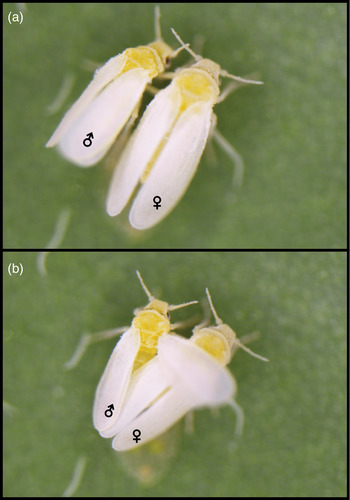
After first contact, the male positioned himself parallel to the female and faced in the same direction as her; we call this ‘parallel orientation’ (fig. 2a). Mostly, males assumed a parallel position to the female on the same side as that on which they had made initial contact (70.6% (n = 12) in AUSI and 100% in the other crosses) (table 3). Most of the males in the AUSI control cross assumed the parallel orientation on the right-hand side of the female (64.7% (n = 11)), whereas most males in the AUSII control cross were on the left-hand side (70% (n = 10)) (table 3).
Mating positions observed in Bemisia tabaci AUSI and AUSII populations. (a) In ‘Parallel orientation’, the male stands alongside the female, facing in the same direction. (b) In ‘Male positioning and copulation’, the nearside wings of the male cover the female's thorax and anterior abdomen, and the farther ones covered the hind abdomen.

The last phase in the sequence of mating behaviour is ‘male positioning and copulation’. Before copulation, the male raised his two wings on the side of his body nearest to that of the female and covered her thorax and anterior abdomen with them. He also moved his far wings across to cover the posterior part of the abdomen of the female (fig. 2b). During this ‘wing hanging’ (Kanmiya, Reference Kanmiya, Drosopoulos and Claridge2006), the male made sporadic flicking movements with all four of his wings, and this persisted for a short time (see below). After that, the male shuffled sideways to position his abdomen below that of the female. Copulation began when the tip of the male abdomen made contact with the tip of the female abdomen.
Mating success in B. tabaci AUSI (n = 29) was 58.6% (n = 17). In 94.1% (n = 16) of those events (i.e., n = 17), the couple went directly from the first phase ‘searching and approaching’ to the last phase ‘male positioning and copulation’ in a single attempt, whereas 5.9% (n = 1) had to attempt courtship five times before they could achieve parallel orientation (and so completed successful mating on the sixth attempt). For B. tabaci AUSII (n = 35), mating success was 28.6% (n = 10) and all of these completed successful mating in a single attempt. Insects that did not mate successfully sometimes performed certain of the stages in the mating sequence and not others. In the AUSI (n = 29) and AUSII (n = 35) control crosses, most of the pairs that did not mate showed no sign at all of any sexual communication (41.4%, n = 12) and (71.4%, n = 25), respectively (fig. 1a, b). These insects fed, rested or groomed, or moved around the observation arena, but did not show any behaviours associated with searching or approaching. Results from the test crosses were very different from those of the control crosses. For AUSI-M × AUSII-F (n = 20), mating success was only 15% (n = 3), and one of the three pairs had to attempt courtship twice before they could achieve parallel orientation (and so completed successful mating only at the third attempt). There was no successful mating in the AUSII-M × AUSI-F crosses (n = 20). In these test crosses, a much greater proportion of pairs that did not mate did not show any sexual communication and this was mainly shown by the males not searching for the females as observed in the control crosses. For those insects that did interact sexually, the results are presented in table 1 and fig. 1c, d.
Timing of the stages in the mating sequence
The two control crosses (AUSI and AUSII) were mostly similar to one another in the durations for which the different behaviours lasted in the mating sequence, but the males took a significantly different amount of time to begin searching for the females (table 4). Too few pairs in the reciprocal cross (AUSI-M × AUSII-F) mated, so only mean and range were given. The durations in each phase from these mating crosses were much the same as in the control crosses. The difference was in the much longer time that these insects spent in the parallel orientation phase (table 4).
Mean (±1 SE) time (all in seconds) that pairs took to complete the different behavioural phases in courtship and copulation

a Summary of statistical test results (only for AUSI and AUSII comparison): time to begin searching (F = 14.56, df = 1, P = 0.000793), time until first contact (F = 1.88, df = 1, P = 0.182), first contact to parallel orientation (F = 0.15, df = 1, P = 0.704), parallel orientation duration (F = 0.436, df = 1, P = 0.515), duration of intromission (F = 0.848, df = 1, P = 0.366), total time (which was from the start of searching to the end of copulation) (F = 0.033, df = 1, P = 0.856).
b Only mean and range are given because of small sample size.
c,dMeans within a column followed by the same letters do not differ from one another significantly (P > 0.05).
Data are given for Bemisia tabaci AUSI and AUSII control crosses and the cross-mating populations that did mate successfully.
Assessment of mating success
All pairs that mated in both control crosses produced both male and female progeny and no significant difference was detected in the number of female progeny produced across them (table 5). Even though three pairs in the AUSI-M × AUSII-F crosses did mate, only two pairs produced female progeny and the total number of female progeny was only 16 individuals. All individuals (parents and progeny) related to the AUSI-M × AUSII-F crossing tests (21 individuals in total, four of them being parents) were checked for identity using mtCOI sequencing. The phylogenetic tree based on mtCOI (655 bp) showed that the parents in each cross were grouped in a different clade, with the fathers and mothers grouped within the B. tabaci AUSI and AUSII clade, respectively. This indicates that there was no contamination of the parental insects used in the cross-mating experiments. Moreover, all progeny were grouped within the B. tabaci AUSII clade, as were the female parents (Supplementary fig. S1), which is consistent with the usual maternal inheritance of the mitochondrial genome. Comparison of mtCOI shows a 3.82–4.20% genetic difference across individuals from the different populations (the father from each cross was AUSI and the mother was AUSII). The results from nuclear Pre-mRNA processing factor 8 showed that the sequence of all female progeny was heterozygous (after discarding two low-quality sequences) where the AUSI and AUSII sequence differed (nine SNPs across the 957 bp sequence), indicating that both crosses were successful.
The average number of male and female progeny of Bemisia tabaci in cross-mating tests involving AUSI and AUSII insects

a Summary of statistical test results (only AUSI and AUSII): mean no. of male progeny (F = 6.231, df = 1, P = 0.0152); mean no. of female progeny (F = 2.842, df = 1, P = 0.104).
b These data not analysed statistically because of small sample size.
c,dMeans within a column followed by the same letters do not differ from one another significantly (P > 0.05).
The parent males and females that produced female progeny in the reciprocal cross-mating test involving AUSI-M × AUSII-F and all of their progeny (21 individuals in total) were tested for their genetic relationship using 11 microsatellite markers (table 2). In the Structure analysis, the B. tabaci AUSI and AUSII colonies were clearly separated into two clusters. The males and females from each cross were correctly assigned to the cluster that represented their origin (AUSI or AUSII). Both offspring used in this analysis were assigned a 50% posterior probability to each of these clusters indicating that they were true hybrids (fig. 3). In the principal component analysis, most of the variance (33%) was explained by the first axis, and this axis separated the AUSI and AUSII cultures (fig. 3). The parents used in this cross were assigned to the cultures from which they derived, further confirming that there was no contamination. The female progeny produced in the two crosses fell between the AUSI and AUSII clusters, indicating they were true hybrids and had inherited half of their alleles from each parent. In the second cross-mating, there was one male progeny and this individual clustered with the B. tabaci AUSII genotype. This indicates that this haploid male had inherited all alleles from the female parent. Together, the microsatellite data confirm that the crosses were successful in that hybrid offspring were produced.
Microsatellite testing of parents in cross-mating tests between Bemisia tabaci AUSI and AUSII and offspring derived from the crosses. (Top) A Principal Coordinates Analysis of data from 11 microsatellite loci from 49 individuals. The first axis (33% of variance) separates B. tabaci AUSI and AUSII, and the progeny fall between these two clusters, indicating that they are hybrids. (Bottom) Bayesian clustering analysis performed in Structure on representatives from the AUSI and AUSII populations and on parents and progeny from crosses between two pairs of AUSI-M and AUSII-F (only one individual progeny from each cross was used in this analysis). The Structure analysis also indicates that the progeny from these cross-mating tests were true hybrids.

Microsatellite characteristics
The microsatellite markers were polymorphic in both populations (mean number of alleles 1.5–8 per locus, table 2). The frequency of null alleles was generally low, with the exception of WFAUS39 which had 23% null alleles in the B. tabaci AUSII population but not in AUSI, and WFAUS40 which had an 18% inferred null frequency in the AUSII population but not in AUSI. These null allele frequencies were based on 14 individuals from a laboratory culture and would likely be lower in wild populations.
Discussion
The two native Australian populations of B. tabaci (sensu lato) have a mating sequence comprised of several stages, including searching and approaching, contact, parallel orientation and male positioning, and copulation. In general, their mating sequence is similar to that of the other B. tabaci populations studied, namely B. tabaci New World (Li et al., Reference Li, Vinson and Gerling1989) and B. tabaci MEAM1 (Perring and Symmes, Reference Perring and Symmes2006). The mating sequence is also similar to that of the more distantly related whitefly Trialeurodes vaporariorum (see Las, Reference Las1980; Ahman and Ekbom, Reference Ahman and Ekbom1981). A lot of variation in terminology is evident in the literature on whitefly mating, so the terms used here are those ones that are closest to what the insects are seen to be doing.
Reports show that differences in behavioural details occur within some of the major steps in the mating sequence across whitefly species. For example, New World B. tabaci sometimes express a behaviour called ‘body pushing’ but this occurred in only about 15% of the observed pairs (see Li et al., Reference Li, Vinson and Gerling1989). By contrast, MEAM1, AUSI and AUSII have not shown this behaviour (see Perring and Symmes (Reference Perring and Symmes2006), and results from this study). Also, male T. vaporariorum showed a behaviour called ‘blocks’ (called ‘stage three’ by Ahman and Ekbom (Reference Ahman and Ekbom1981)) and these are always accompanied by a high frequency of wing flicks, followed by a periodic temporary stop in wing flicks. Such behaviour has not been observed in B. tabaci MEAM1 (Perring and Symmes, Reference Perring and Symmes2006), AUSI or AUSII (this study).
Not all pairs in the AUSI and AUSII control crosses mated, and the frequency of mating differed across the two control crosses (more AUSI pairs mated than AUSII pairs did) (table 1), which complicates interpretation of the results from the cross-mating tests (see Rafter and Walter, Reference Rafter and Walter2013). No successful mating took place in the AUSII-M × AUSI-F (n = 20) crosses even though some of the males (25%, n = 5) searched for females. These latter males proceeded through all of the mating phases up to the parallel orientation position, when the interaction broke down in all crosses, at the point when the male tried to position himself for copulation (fig. 1d). This implies that the female did not recognize the male as a potential mating partner. Some males in the AUSI-M × AUSII-F (n = 20) crosses did search for females (35%, n = 7), but relatively few of them actually mated (15%, n = 3). The three pairs that mated did produce female progeny, but the crucial point is that the frequency of mating was extremely low relative to that in both control crosses.
These results demonstrate the critical role of assessing whether mate recognition actually takes place in cross-mating tests that are conducted to understand the species status of sexual organisms. Tests that run too long are liable to have a higher rate of mating simply because males are persistent and such results are misleading (Fernando and Walter, Reference Fernando and Walter1997). Clearly, from this perspective, the B. tabaci AUSI and AUSII populations are distinct species. Although some AUSI males were recognized by the AUSII females as potential mating partners, the rate of this recognition was extremely low compared with the AUSI and AUSII control crosses. Most of the males did not recognize the female's signal or the females did not recognize the males as potential mating partners, especially at the point when the males assumed the parallel position. All of this implies that there was a failure of mate recognition between individuals of these two populations, and so the laboratory results demonstrate that insects from these two populations are extremely unlikely to cross-mate in nature.
In nature they may, in any case and for various reasons, seldom find themselves in close proximity to one another. For example, they would have to share the same host plant and stay on the same host for a certain time. Clearly, males in the AUSI and AUSII control crosses showed significant differences in the time it took for them to begin searching for females (table 4), which indicates that these two whitefly populations might not begin to mate within the same time interval and this again might make it more unlikely that they would mate in nature even if they were on the same host plant. A further point to consider in this regard is the distance for sending and receiving signals between the male and female. It seems that the individuals have to be very close to communicate with each other effectively as seen when they are in contact and the parallel position.
Three females in the AUSI-M × AUSII-F cross produced female progeny, but the number produced was low relative to that produced by control females (table 5). This result was similar to that of De Barro and Hart (Reference De Barro and Hart2000) who conducted cross-mating tests on the same Australian whitefly populations as investigated here. They found that female progeny were produced from the crosses between AUSI and AUSII and that the proportion of offspring that was female was 0.30 in both directions. Based on the size and shape of the abdomen, most F1 females were presumed to be sterile, with only a few appearing fertile (De Barro and Hart, Reference De Barro and Hart2000).
Some whitefly studies have interpreted the ability to produce some female offspring as evidence that the populations are conspecific. However, this might well be the consequence of the insects being left together in a confined space for too long. For example, B. tabaci cryptic species ASIAII 9 and ASIAII 3 (mtCOI shows 4.47% genetic difference) were kept together in a confined space for 3 days. The females subsequently produced female progeny in relatively low proportions to intra-species mating crosses, at 47.6% in ASIAII 9-F × ASIAII 3-M cross, and 17.1% in the ASIAII 3-F × ASIAII 9-M cross (Qin et al., Reference Qin, Pan and Liu2016). According to the recognition concept of species, each sexual species has a diversity of characters to achieve fertilization, and this involves sending and receiving signals between mating partners in a particular sequence and within a particular context. In the case of B. tabaci AUSI and AUSII, we can infer that these two native populations do not share in a common fertilization system and therefore represent two distinct species.
An important question, now, is how exactly whiteflies communicate with one another. Do they use vibrations through the host leaf as reported by Kanmiya (Reference Kanmiya, Drosopoulos and Claridge2006), or do they use pheromones, as suggested by Li et al. (Reference Li, Vinson and Gerling1989), or do they perhaps use both modes of communication? Future research should, therefore, examine AUSI and AUSII from these perspectives. Moreover, observations on how males behave when they are kept in isolation of other whiteflies should be conducted to determine whether they search for a mating partner in the way reported above, or whether they need a signal from a female before they start searching. Finally, the other ecological characteristics of the AUSI and AUSII whiteflies should be investigated, including their host plant relationships and virus transmission abilities.
Supplementary material
The supplementary material for this article can be found at https://doi.org/10.1017/S0007485319000683
Acknowledgements
This research was funded by the Cotton Research and Development Corporation (CRDC), Australia. We are grateful to Lynita Howie and Xiaobei Wang from Commonwealth Scientific and Industrial Research Organisation (CSIRO), Australia for guidance in rearing Bemisia tabaci AUSI and AUSII. Our sincere thanks also go to Michelle Rafter (CSIRO) whose advice has been of great assistance in designing the cross-mating experiments and statistical analysis.