Introduction
The sequence of the chicken genome is composed of one billion base pairs (bp), with an estimated 21,000-23,000 genes. Sequencing the DNA provides a new inside into vertebrate genome evolution, both non-coding and coding. Many of the aligned human-chicken non-coding sequences occur far from genes, frequently in clusters which seem to be under selection for functions that are not yet understood. It is very likely that some as yet unknown processes exist in the cells (Blankenship, Reference BLANKENSHIP2001). This theory is based on the fact that the roles of approximately one third of gene sequenced to data are unknown. Modern molecular biology techniques should be able to help revealing these processes. Among them, the most interesting are the application of transposons, viral integrase, zinc-finger nuclease, and site-specific recombinase.
Transposons
A transposon is a DNA section which is capable of integrating itself into host DNA. Class I transposons ‘multiply and paste’ themselves, while Class II ‘cut and paste’. Four well known transposons are used: FLP-FRT from two Saccharomyces cerevisiae microplasmids (O'Gorman et al., Reference O'GORMAN, FOX and WAHL1991), Cre-lox from bacteriophage P1 (Sauer and Henderson, Reference SAUER and HENDERSON1998), phiC31 from Streptomyces (Thorpe and Smith, Reference THORPE and SMITH1998), and piggyBac from Baculovirus mutant (Fraser et al., Reference FRASER, CLSZCZON, ELICK and BAUSER1996). ‘Sleeping beauty’ is a synthetic DNA transposon designed to introduce precisely defined DNA sequences into the genome (Ivics et al., Reference IVICS, HACKETT, PLASTERK and IZSVÁK1997). In the integration process, the TA sequence is duplicated, with the duplication being a hallmark of transposition. None of the transposons in the genome are autonomous, since they are neither functional or can move by themselves. Therefore, host cells possess the mechanism(s) for regulation of transposon activity.
Efficient genetic modification and germ-line transmission of chicken PGCs using piggyBac and Tol2 transposons has been observed (MacDonald et al., Reference MAcDONALD, TAYLOR, SHERMAN, KAWAKAMI, TAKAHACHI, SANG and McGREW2012). They found that the Tol2 transposon was five-fold more efficient than the piggyBac. In the same experiment they showed that insulator element DNA sequences, that shield regions of DNA from epigenetic silencing, were not required in the integrated transposon for transgenic expression. PGCs containing integrated transposons were able to colonise the gonad of host embryos and form functional gametes that produced transgenic offspring. After piggyBac-mediated green fluorescent protein (GFP) gene transfer into chicken PGCs, chicken expressed GFP constantly without transgene silencing (Park and Han, Reference PARK and HAN2012).
Viral integrase
Retroviruses are the only animal viruses that can integrate themselves into the host genome during the normal cell cycle with the help of the enzyme integrase, which is coded by the Pol gene. Integrase connects the ends of viral cDNA with genomic DNA at defined locations. Retroviruses are subject to epigenetic modification, and consequently, their expression is switched off during embryogenesis (Jaenisch, Reference JAENISCH1976), or after birth (Chan et al., Reference CHAN, HOMAN, BALLOU, BURNS and BREMEL1998). Research has shown that viral DNA in the epigenetic state can be transcribed (Wu and Marsh, Reference WU and MARSH2003; Brussel and Sonigo, Reference BRUSSEL and SONIGO2004). For this reason, several different types of viruses with defective integrase have been developed (Vargas et al., Reference VARGAS, GUSELLA, NAJFELD, KLOTMAN and CARA2004).
Embryo injection was used to generate transgenic birds by replication-competent vectors derived from avian leucosis virus (ALV) (Salter et al., Reference SALTER, PAYNE, CRITTENDEN, FEDERSPIEL, PETROPOULOS, BRADAC and HUGHES1993.). Replication defective vectors from reticuloendotheliosis virus (REV) and ALV were developed and have been used to produce transgenic birds (Bosselman et al., Reference BOSSELMAN, HSU, BOGGS, HU, BRUSZEWSKI, OU, KOZAR, MARIN, GREEN and JACOBSON1989). Transgenic chickens expressing GFP are generated and consist of the CAGGS enhancer-promoter which contains the chicken beta-actin promoter (Niwa et al., Reference NIWA, YAMAMURA and MIYAZAKI1991).
In recent years, the application of the lentiviral system has gained importance in gene therapy, as well as for stable transfer of interfering RNA. The main reasons for this is in the advantages that lentiviruses possess: efficient transduction of non-dividing cells, independence from replication, transfer of large DNA molecules, and maintenance of long-term transgene expression. A novel group of vectors was derived from the lentivirus class of retroviruses (Naldini et al., Reference NALDINI, BLOMER, GALLAY, ORY, MULLIGAN, GAGE, VERMA and TRONO1996). The expression pattern of reporter transgenes was maintained in next generation suggesting non-silencing of transgene expression. Transgenic hens were produced by the injection of lentivirus carrying a recombinant human interferon gene into the blastoderm (Lillico et al., Reference LILLICO, SHERMAN, MCGREW, ROBERTSON, SMITH, HASLAM, BARNARD, RADCLIFFE, MITROPHANOUS, ELLIOT and SANG2007).
Zinc-finger nuclease (ZFN)
ZFN is an artificially created restriction enzyme, a compound of proteins which bind to DNA (Cis2His2) and endonuclease Fok I (Kim et al., Reference KIM, CHA and CHANDRASEGARAN1996). The principle is the following: ZFN causes a double break of the DNA strands (dsb) at a precise location. This disruption can be corrected with the ‘error-prone’ merger of non-homologous regions (NHEJ), or by homologous recombination (Lombardo et al., Reference LOMBARDO, GENOVESE, BEAUSEJOUR, COLLEONI, LEE, KIM, ANDO, URNOV, GALLI, GREGORY, HOLMES and NALDINI2007). Challenging the dsb in the eukaryotic genome stimulates a mechanism for recovery of the DNA. NHEJ may cause deleting or insertion of short DNA sequences at dsb site. Fok I restriction endonuclease, from Flavobacterium okeanokoides, the N-terminus of the which binds to the DNA (5, -GGATG: 3, -CATCC), and the C-terminus which cuts the first DNA strand nine nucleotides downstream, and cuts the second strand 13 nucleotides upstream from the first nucleotide in the sequence which the enzyme recognises (G or C) (Aggarwal et al., Reference AGGARWAL, WAH, HIRSH, DORNER and SCHILDKRAUT1997). The whole binding complex is 18 bp long, which is long enough for the recognition sequences to be unique for each animal genome (Bibikova et al., Reference BIBIKOVA, GOLIC, GOLIC and CAROLL2002).
Transcription activator-like effector nuclease (TALEN) represents a new generation model for studying functional genomics. Non-transgenic chicken are genetically modified without integration of any exogenous DNA, by mutation of ORF shifts (Park et al., Reference PARK, LEE, KIM, KIM and HAN2014). ZFN and TALEN both contain DNA binding domain and Fok I restriction nuclease, suitable to targeted deleting and alteration to analysed gene function.
Site-specific recombinase
Since the discovery showed that recombinase can be used to alter genomes (Sauer and Henderson, Reference SAUER and HENDERSON1998), recombinase-mediated cassette exchange (RMCE), one of the techniques in the field of reverse genetics, has been of increased interest (Tasić et al., Reference TASIĆ, HIPPENMEYER, WANG, GAMBOA, ZONG, CHEN-TSAI and LUO2011). The Cre-lox recombination is an important tool for genetic manipulation. Cre recombinase catalyses reciprocal site-specific recombination between two loxP sites. The loxP sequence is composed of an asymmetric 8 bp spacer flanked by 13 bp inverted repeats, and Cre protein binds to the 13 bp repeat mediating the recombination within 8 bp spacer.
Successful results with Cre/loxP-mediated conditional excision system were obtained with monoclonal antibodies driven by an ovalbumin promoter in chicken oviduct cells (Oichi et al., Reference OICHI, KIM, YOSHII, ESTEBAN and BELMONTE2011). Another site-specific recombinase, phiC31 integrase, was used to efficiently modify chicken PGCs (Leighton et al., Reference LEIGHTON, VAN DE LAVOIR and DIAMOND2008). phiC31 integrase catalyses site-specific recombination between an attB and attP sites. Increased frequencies of transgene integration into attP sites in the chicken PGCs genome have been reported when phiC31 integrase was co-introduced, (Leighton et al., Reference LEIGHTON, VAN DE LAVOIR and DIAMOND2008).
In vivo studies
For in vivo study of gene expression and function in developmental biology, non-coding RNA (ncRNA) functions, virus-virus recombination, silencing with epigenetic modification, using the transgenic chicken has advantages over other organisms. The key advantage of the chicken embryo is easy access to all stage of development by new techniques. Further possibility which makes chicken suitable as a model for scientific investigation is that it can be performed in vivo, while the embryo is still in the egg. For genetic manipulation of the avian embryo three developmental stages can be used: 1) the newly fertilised egg, 2) the embryo in newly laid eggs, and 3) embryos that have reached app. two days of incubation.
Developmental biology
The sequence of the chicken genome is now available which gives promising prospects for the future of investigations into developmental biology. Molecular study can be used to understand the evolution of vertebrates. Testing vertebrate gene functions, the origin of birds and mammals can be traced back to a common ancestral species 300-350 million years ago. The use of transgenic chickens makes possible to examine the evolution of biochemical pathways, their genes and gene families. The chicken model can be used to elucidate cell differentiation, embryonic development, metamorphosis, regeneration, apoptosis, sex determination and so on. Although the avian model is well characterised and utilised for the developmental biology, with the genome sequence at hand it will be an excellent tool for future studies.
ncRNA function
Development of chickens cannot be explained only by the number of genes. However, a significant number of long non-coding RNAs (lncRNAs) are regulated during the development (Dinger et al., Reference DINGER, AMARAL, MERCER, PANG, BRUCE, GARDINER, ASKARIAN-AMIRI, RU, SOLDA and SIMONS2008.) by the influence of RNA polymerase II, or inducing chromatin remodelling and plasticity, histone methyltransferase and acetyltransferase. Hybridisation of the sense and antisense transcripts can allow Dicer machinery to generate siRNA, i.e. lncRNA can be processed to yield small interfering RNA (siRNA). Transcription of ncRNA can induce histone modification, another important factor in epigenetic silencing (Yu et al., Reference YU, GIUS, ONYANGO, MULDOON-JACOBS, KARP, FEINBERG and CUI2008; Cambiong et al., Reference CAMBIONG, IGLESIAS, FICKENTSCHER, DIEPPOIS and STUTZ2007). The silencing of some genes can be prevented by Polycomb proteins (Schmitt et al., Reference SCHMITT, PRESTEL and PARO2005).
With chicken transgenesis it is possible to study in vivo these processes and elucidate whether chromatin plasticity occurs due to the act of ncRNA transcription, or whether the ncRNA actively plays a role by recruiting chromatin remodelling and histone modifying enzymes, or that ncRNA may play unknown role(s). It is possible to induce chromatin opening, but via delivery of different types of DNA transcription factors. There is potential to study chromatin opening/silencing of the genes including ncRNA.
Potential applications for transgenic chicken embryos is the expression of small interfering RNA (siRNA) for gene knockdown study. As they lack ORFs longer than 50-100 AA, many were generally eliminated from gene annotation in the Human Genome Project. However, several 33-nt ORFs within the Drosophila tag gene are translated into 11-aa long peptides controlling morphogenesis during fly development (Pueyo and Couso, Reference PUEYO and COUSO2008.). This may be the case with the chicken genome also. The modified chicken can be used as a model for generation of knockout long ncRNA to show that they are not transcriptional ‘noise’, but are required for normal development.
Chicken embryos have been modified by pEGFP-shRNA vector co-expressing enhanced green fluorescent protein and short hairpin RNA (shRNA) to analyse gene silencing in vivo (Dai et al., Reference DAI, YUSUF, FARJAH and BRAND-SABERI2005). This dual expression system (EGFP-shRNA) opens a new possibility for the study of gene regulation and function. The dsRNA Dicer enzymes are found to produce siRNA that induce sequence of specific gene silencing. The short hairpin RNA (termed as micro RNA or siRNA) links the RNAi machinery to developmental gene regulatory mechanisms (Ambros, Reference AMBROS2004). The synthetic siRNA can be designed, based on target gene sequence, with hairpins ranging from 19 to 29 bp in length to induce sequence of specific gene silencing and is utilised in the chicken embryo. In this way, the chicken embryo may become a model for functional genomics in vivo.
The number of ncRNA is unknown. Recent transcriptional studies suggests the existence of thousands of ncRNA. It seems that all DNA is transcribed, although the more conserved ncRNA are thought to be molecular fossils or relics from the L.U.C.A genome and the RNA world, especially those with the unknown functions. Currently, nobody has made all four of the nucleotides from one pool of simple starting materials. The ribose is difficult to form under prebiotic conditions, but rather than rely on free ribose and ribonucleobases, it is derived from complete ribonucleotides from glyceraldehydes and glycoaldehyde, which are the smallest molecules considered as a sugars (Powner et al., Reference POWNER, GERLAND and SUTHERLAND2009). Scientists have yet to produce the purine nucleotides (A and G) under similar prebiotic conditions. Short oligomers of RNA can recombine, bringing together different RNA units building up a repertoire of catalysts, and these RNA fragments can be recycled to generate a supply (pool) of nucleotides for replication and exponential growth of genetic elements (Hayden et al., Reference HAYDEN, RILEY, BURTON and LEHMAN2005).
RNA/DNA hybrid viruses
Viruses with RNA genomes that do not go through a DNA stage in their reproduction are the simplest genetic elements, probably reminiscent of the putative primordial RNA world. Their hallmark genes are RNA-dependent RNA polymerase (RdRp) which are genes for capsid proteins containing the S7-RNA-binding domain proteins. Viruses evolved via re-assortment of genomic segments and genome shuffling and RdRp was derived from reverse transcriptase. In a recent study, Bolduc et al. (Reference BOLDUC, SHAUGHNESSY, WOLF, KOONIN, ROBERTO and YOUNG2012) suggested that positive-strand RNA viruses might have pre-existed in an archaic ancestor of eukaryotes which corresponded to the Stupar and Vidović (Reference STUPAR and VIDOVIĆ2013) model for viruses to arise. This putative archaic RNA virus has been isolated from near-boiling, archaea-dominated geothermal springs. Other interesting viral development suggestions come from the work of Diemer and Stedman (Reference DIEMER and STEDMAN2012). They discovered that the viral genome resulted from recombination between unrelated groups of RNA and DNA viruses (Diemer and Stedman, Reference DIEMER and STEDMAN2012). In this RNA-DNA hybrid virus (RDHV) the genome is in the DNA form as is the replication machinery, whereas the capsid is of RNA viral origin. Together with the unexpected discoveries of the first putative, archaic RNA viruses and the RNA-DNA hybrid virus, we can expect other interesting findings from the RNA viral world.
When avian H5N1 virus crosses species barriers it infects humans, i.e. there is a chance of re-assortment between H5N1 and related human viruses. In this case, re-assortment between avian H5N1 and human influenza virus seems mainly restricted to the matrix gene (Stupar, Reference STUPAR1981) and neuraminidase gene segments (Schrauwen et al., Reference SCHRAUWEN, BESTEBROER, RIMMELTZWAAN, OSTERHAUS, FOUCHIER and HERFST2013). This system offers a way to study virus and/or host properties required for adaptation or re-assortment of viruses. To study these processes in transgenic chickens it is important to develop a modified chicken which is genetically resistant to the infection. Transgenic chicken expressing a short-hairpin RNA designed to inhibit and block influenza viral polymerase has been developed (Lyali et al., Reference LYALI, IRVINE, SHERMAN, MCKINLEY, NÚÑEZ, PURDIE, OUTTRIM, BROWN, ROLLESTON-SMITH, SANG and TILEY2011).
Reverse genetics can be used to produce viruses with different gene composition to study new processes in the cells. For this purpose, transgenic chicken with capabilities to suppress viral transmission is the model of choice. Recently, GMC expressing a short hairpin RNA designed to suppress A/V transmission was generated. These shRNA function as a decoy that inhibits viral polymerase (Lyali et al., Reference LYALI, IRVINE, SHERMAN, MCKINLEY, NÚÑEZ, PURDIE, OUTTRIM, BROWN, ROLLESTON-SMITH, SANG and TILEY2011). All this, together with low complexity of the egg whiteness, need further investigation.
Silencing with epigenetic modification
In general, four types of epigenetic pathways have been identified: DNA methylation, histone modification, nucleosome remodelling, and non-coding RNA-mediated pathways. It is important to dissect epigenetic regulation during the differentiation by rearrangement of DNA sequences in transgenic chickens to access the epigenetic memory and mechanisms for silencing. The role of CpG-methylation, cytosine methylation in the absence of RNA-directed DNA methylation can be investigated by modified chicken. Pathways connect target mRNA into dsRNA by siRNA-primed RNA-dependent RNA polymerase (Yamasaki et al., Reference YAMASAKI, MIYASAKA and OHAMA2008). The transcriptionally silenced chromatin and underlying DNA in heterochromatin is often methylated, but the histones located in euchromatin regions are modified by acetylation. With targeted transgenesis in chicken it is possible to elucidate DNA methylation, histone modification and heterochromatin formation pathways.
It is believed that the entire human genome, including all non-coding (nc) DNA, which comprises more than 99% of the genome, is transcribed into RNA. This entire ‘transcriptome’ consists of many short RNAs, the transcription levels of which are very low. Some ncRNA, obtained after treatment with Dicer and Drosha RNAses, possess about 21 to 27 nucleotides. The DNA defensive response (DDR) is activated at the site of the induced DNA double break. To correct this type of error, Dicer and Drosha-dependent small ncRNA (DDRNA) signal a change in DNA. Without DDRNA, the cell is not alerted to the break in the DNA chain, so any response to the induced change is silenced. It is assumed that most of these small ncRNA regulate functional organisation and gene expression, as in the case of DDRNA and genome integrity. For ncRNA, a low expression level does not equate to lack of function. The length of ncRNA at 21 to 27 nucleotides, corresponds to seven to nine amino acids, which would be the normal length of a primordial, progenitor protein. It can be assumed that some of these families of small ncRNA can be copied into protein. Systematic research in this direction (ejection of parts of ncDNA sequences corresponding to large families of small RNA, i.e. ncDNA knockout) should enable us to reach a ‘restored’ RNA world. Thus, a simplistic scheme could look like this: ncDNA → short RNA → protein. A question to be answered is whether a mechanism for the synthesis of proteins on the basis of RNA without DNA coding exists. It evidently did exist, as synthesis of proteins without ribosomes exists, i.e. the amino acid ligase encoded with cofF, mptN genes and non-ribosomal peptide synthetase. This would be a good starting point in the construction of livesome and investigating the role of ncDNA.
Double stranded RNAs (dsRNA) and their ‘dicer’ small RNA products can direct changes in the chromatin structure of DNA regions with sequence identity. Having in mind that the whole DNA is transcribed, all their regions are overlapping with small RNK, i.e. all DNA submit to RNA control, thus providing transcriptional heterochromatin silencing. Triggers for RNA-directed DNA methylation may come from transposons, transgenes and viruses. The mechanism of this processes can be investigated by corresponding genetically modified chickens (Mathieu and Bender, Reference MATHIEU and BENDER2004).
Conclusions
The success of generating chicken transgenic models for in vivo investigation of genetics and genomes depends on the method-vector used to deliver new sequences or change existing ones. All the techniques mentioned above are expensive, time consuming, tedious and inefficient. To develop radically new approaches to influence the avian genome, the most interesting technology, which might detect the role of DNA, in vivo, would be synthetic biology, and nanotechnology with DNA-metal hybrids (DNA ‘microchipping’).
Construction of DNA vectors originated from the genome of targeted organisms, and non-transgenic sequence rearrangement with different intragenic regions, which is a model of choice for future challenges. The transposon-helitron vector based system can act in harmony with corresponding purpose. It could be accessed to controlled prediction of genome rearrangement by artificial domain duplication, shuffling of existing regions, blocking small RNA coding sequences in non-coding DNA or influencing epigenetic silencing machinery. To overcome random insertion of the intergenic regions, both the transposon vector and chromosome has to be chipped. This is one way to control DNA re-arrangement, so it is possible to guide and mimic evolutionary changes in the genome.
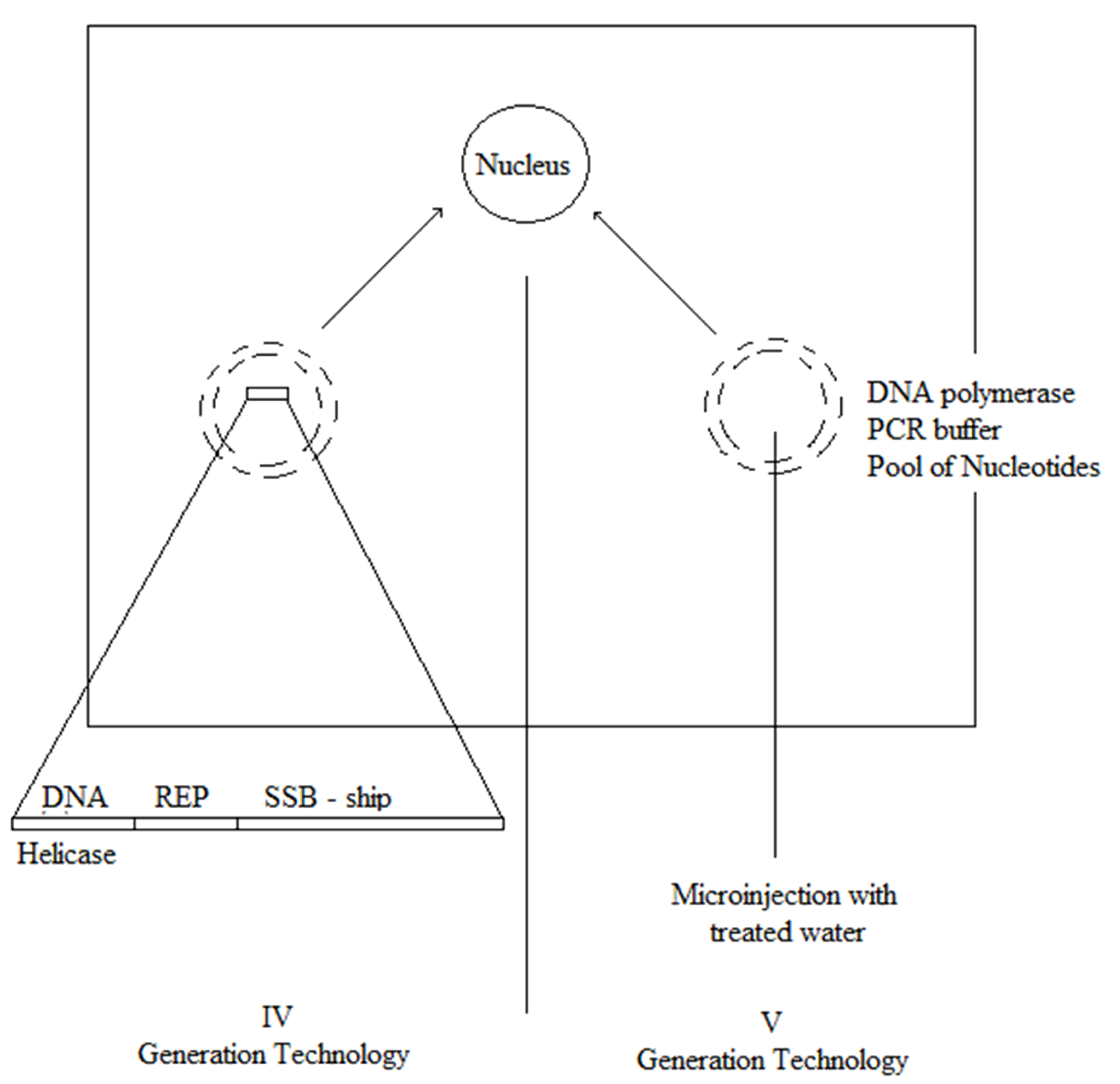
It might be possible to synthesise sequences with certain desirable functions using livesomes. A suitable example would be as we have already seen, reconstructing the ‘Sleeping Beauty’ transposase gene. With the necessary instructions, the ‘chipped’ helitron RTM2 could, by scanning and palpitation through the genome, choose and pick desired intragenic sequences. Livesomes are hypothetical artificially synthesised organelles that are housed in the cytoplasm of the cells or in the nucleus. ‘Leading office’ genes which conduct modification of the genome are located within these organelles. The helitron RTM2 could be placed into vacuoles or semi-permeable alginate capsule (Figure 1).
The leader DNA would be set within those artificial organelles, as needed. How this circuit will function is yet to be assessed, but assuming that the problem is solved with the hybrid DNA-Si/C-metal, i.e DNA has chipped, it is possible to guide rearrangement of the bio-sequences by remote control. Now it can be accessed to controlled prediction of gene sequence selection by artificial domain duplication or shuffling, resembling a controlled sexual PCR in vivo. Genome evolution involves rearrangement of existing genes to improve its function or produce new ones. The point is that the cell itself reconstructs gene whose properties are predicted, by using newly synthesised organelles.
Genome modeling using next generation methodology. Livesome I (at the left side), and Livesome II (at the right side). Construction of the L.I are based on the Helitrom RTM 2. In the vector there are rolling-circle replication origin (Rep), DNA helicase domain, ssb-DNA binding region, and chipped DNA with designed nucleotide sequences. Construction of L.II understand PC reaction inside membrane-bound vacuoles, like separate organelle within the cell nucleus. In this case PCR primers are chipped.

Constructing the livesome can be done using either of two models: Model I: remote control of DNA mixing, and Model II: PCR-mislion influence. Model I would be based on gene shuffling mechanisms, helitron model RTM2. Livesome DNA should contain rolling-circle replication origins (Rep) which cleaves, transfers and ligates DNA of interest. When the linker DNA molecule is added to a specific mixture of other DNA, it creates a network of associated DNA with complementary sequences. This ability of DNA and inorganic structures would be a good contribution to the development of molecular nanotechnology. The most suitable moment for livesomes to work would be during replication, when the DNA is single-stranded. With the necessary instructions, the chipped helitron RTM2 could be walked through the DNA sequence of the genome already prepared (something similar to att sites with phiC 31 integrase) and marked on the ends of each chromosome, in search of a given sequence. The second part involves the DNA helicase domain. Modelling of the DNA binding part of Rep is the key to success of all operations. For this purpose, the chicken microchromosomes can be of importance as a transfer vector.
Electromagnetic chips can be guided by bio-remote control and monitored with a scanning electron microscope. Using energy-dispersive X-ray analysis, nanoparticles can be identified in vivo by an electron microscope with high spatial resolution (Lim et al., Reference LIM, RIEHN, RYU, KHANARIAN, TUNG, TANK and AUSTIN2006). Using chipped livesome across marked chromosomes, with the help of added linkers, could result in the discovery and isolation of complementary sequences. If livesomes reside inside vacuoles, their lysis can be timed spreading out across their genome in searching for complementary sequences and arrange them in a desired order with the help of helitrone and helicase.
All of this looks like ‘deja vue’, but is there anything fascinating or exotic? The answer is the Livesome model II. Part of the model has been described (Stupar and Vidović, Reference STUPAR and VIDOVIĆ2013) and preliminary experiments have been successfully started at the Vinča Institute. Investigation in vivo with chicken embryos can provide a suitable basis for future scientific purposes.