INTRODUCTION
In 2008, Barack Obama faced a barrage of criticism for his associations with Rev. Jeremiah Wright, a man who, by all account, is an intensely devout Christian. Religion was part of Obama's political persona at that time, as he frequently laced his speeches with religious language (Sheets, Domke, and Greenwald Reference Sheets, Domke and Greenwald2011), and took measures to reach out to Christian communities (Wald and Calhoun-Brown Reference Wald and Calhoun-Brown2011). Obama's religious ties did not lead conservative Christians to mistake him as one of their own; instead his ties produced a deep suspicion about who Obama really was and what he would actually do as president. Whites and Blacks reacted very differently to Rev. Wright's sermons (McKenzie Reference McKenzie2011), reflecting the truism that 11:00 am Sunday is the most segregated hour in America (Emerson and Smith Reference Emerson and Smith2000). Indeed, Obama's religious discourse had little chance of winning over conservative Christians.
Yet, scholars and media pundits have largely argued that in the United States religion and the Republican Party go hand in hand (Layman Reference Layman2001; Putnam and Campbell Reference Putnam and Campbell2010; Olson and Warber Reference Olson and Warber2008), and that religious cues can secure favorable evaluations among those who are religious (Domke and Coe Reference Domke and Coe2008). Most American citizens share this perception, typically assuming that Christian fundamentalism equates with political conservativism (Bolce and De Maio Reference Bolce and De Maio2008; McDermott Reference McDermott2009).
Obama's case highlights an important stipulation to these assumptions: religion's influence on politics is conditioned by race (Wald and Calhoun-Brown Reference Wald and Calhoun-Brown2011). While it is becoming increasingly clear that a politician can use religious cues to influence voters’ evaluations (Albertson Reference Albertson2011; Calfano and Djupe Reference Calfano and Djupe2009; Weber and Thornton Reference Weber and Thornton2012), work examining religious cues has largely overlooked the role of race (for notable exceptions, see Calfano and Djupe Reference Calfano and Djupe2009; Calfano and Paolino Reference Calfano and Paolino2010).
Race plays a central, but often understated, role in determining how Christian beliefs influence vote choice in America (Brady, Verba, and Schlozman Reference Brady, Verba and Schlozman1995; Wald and Calhoun-Brown Reference Wald and Calhoun-Brown2011). For example, African-Americans are more religious and more likely to be Democrat than any other ethnic or racial group in the United States (McDaniel and Ellison Reference McDaniel and Ellison2008). While White evangelicals are known for trumpeting socially conservative positions, religious Blacks represent a stark counterpoint. Notable politicians such as Jesse Jackson and Al Sharpton embody the image of religious Democrats championing Black rights (McKenzie Reference McKenzie2011; Sinclair-Chapman and Price Reference Sinclair-Chapman and Price2008). Thus, generalized statements about the relationship between religion and politics are largely about White Christianity (McDaniel and Ellison Reference McDaniel and Ellison2008).
In this study, we examine how race and religion intersect to affect voter evaluations. A politician's identity cues should affect voter inferences, but a citizen's racial and religious identity should also affect how they perceive and react to these identity cues. To test how these factors interact, we employ an online experiment with a national sample, where participants are exposed to a homepage for a fictitious congressional candidate. The candidate is either Black or White and the homepage either includes religious cues or no religious cues. We first consider how these identity cues affect voter perceptions of candidate ideology. Then, we examine how a citizen's own identity interacts with these cues to affect how favorably they feel towards the candidate.
USING IDENTITY TO ASSESS IDEOLOGY
American voters typically know relatively little about politicians’ policy positions and voting records. Instead, voters often rely on informational shortcuts when making voting decisions (Popkin Reference Popkin1991). To this end, a politician's social identity cues can help voters make rapid assumptions about a candidate's ideology, likely policy positions, and personality traits (Huddy and Terkildsen Reference Huddy and Terkildsen1993). Identity markers such as race (Mendelberg Reference Mendelberg2001) and religious affiliation (McDermott Reference McDermott2009) serve as heuristics that allow voters to make inferences about which politician will best represent their own ideological positions (Jacobsmeier Reference Jacobsmeier2013; Reference Jacobsmeier2014).
Religious Cues
In recent years, scholars have begun to focus on the significant impact religious cues have on voter evaluation in the United States (Albertson Reference Albertson2011; Calfano and Djupe Reference Calfano and Djupe2011; Domke and Coe Reference Domke and Coe2008; Weber and Thornton Reference Weber and Thornton2012). A growing body of experimental research has found that religious affiliation activates stereotypes and affects evaluations (Berinsky and Mendelberg Reference Berinsky and Mendelberg2005; Braman and Sinno Reference Braman and Sinno2009; Campbell, Green, and Layman Reference Campbell, Green and Layman2011; McDermott Reference McDermott2007; Reference McDermott2009). But politicians are becoming less and less likely to openly tout their specific religious affiliation (Lambert Reference Lambert2008; McDermott Reference McDermott2009). Instead, politicians typically discuss their faith and/or use religious language in broad, generic terms (Coe and Chenoweth Reference Coe and Chenoweth2013; Domke and Coe Reference Domke and Coe2008; Green Reference Green2010). It is not the type of religious affiliation that matters most to voters, but how strong a politician's religious commitments appear to be (Braman and Sinno Reference Braman and Sinno2009; McDermott Reference McDermott2007).
The general assumption is that the more religious a candidate, the more politically conservative they are. These assumptions are not unfounded — Republicans are generally more religious than Democrats (Putnam and Campbell Reference Putnam and Campbell2010), and Republican politicians tend to more fervently court Christian voters (Coe and Domke Reference Coe and Domke2006). Additionally, the media has focused heavily on the relation between Republicans and evangelical Christians (Bolce and De Maio Reference Bolce and De Maio2008; Green Reference Green2010). As a result, evangelical candidates are perceived to be more conservative than mainline Protestant candidates, even when they are ideologically similar in reality (Jacobsmeier Reference Jacobsmeier2013). We therefore expect that when a candidate uses religious cues, they will be seen as more conservative.
H1:
When candidates use religious cues, citizens will perceive them to be more conservative than when they do not use religious cues.
Racial Cues
Race is a notoriously divisive political topic (Mendelberg Reference Mendelberg2001). In the 1960s, the Democratic and Republican parties realigned around race, with Democrats taking ownership of civil rights issues (Karol Reference Karol2009). These divisions remain entrenched, as the Democratic Party endorses more liberal racial policies, has a higher percentage of Black politicians, and holds a stronger grip on the Black vote, than their Republican counterparts (Hajnal and Lee Reference Hajnal and Lee2011). As a result, a Black candidate's race may evoke racialized thinking and make racial policies salient (Petrow Reference Petrow2010).
Race continues to play a prominent role in politics, as voting during the 2008 presidential election was “more polarized by racial attitudes than any other time on record” (Tesler and Sears Reference Tesler and Sears2010, 5). The color of Obama's skin was enough for race to be salient in the minds of voters (Tesler and Sears Reference Tesler and Sears2010). Thus, a politician's race still acts as a powerful heuristic for voters. There is a strong tendency for voters to assume Black candidates are liberal (Huddy and Terkildsen Reference Huddy and Terkildsen1993; Lerman and Sadin Reference Lerman and Sadin2014), in part because Black candidates are perceived to be more likely to be Democrats (Jacobsmeier, Reference Jacobsmeier2014). We therefore predict:
H2:
Black political candidates will be perceived as more liberal than white candidates.
Divided by Faith
Citizens are unlikely to evaluate religious cues and racial cues independently, but relatively little work has considered how these cues interact. Scholars examining the effects of religious cues have typically either used White candidates (Albertson Reference Albertson2011; McDermott Reference McDermott2009; Weber and Thorton Reference Weber and Thornton2012), or not mentioned a candidate's race at all (Berinsky and Mendelberg Reference Berinsky and Mendelberg2005; Braman and Sinno Reference Braman and Sinno2009; Calfano and Djupe Reference Calfano and Djupe2011; Campbell, Green and Layman Reference Campbell, Green and Layman2011; Djupe and Gwiasda Reference Djupe and Gwiasda2010).
Calfano and Djupe (Reference Calfano and Djupe2009) and Calfano and Paolino (Reference Calfano and Paolino2010) provide notable exceptions. Calfano and Djupe (Reference Calfano and Djupe2009) presented participants with either a White or a Black candidate and varied whether or not the candidate used covert evangelical cues. The authors, however, actually found that the Black candidate benefited more from the religious cues than the white candidate. In a follow up study, Calfano and Paolino (Reference Calfano and Paolino2010) found similar results — White evangelicals had a stronger preference for a Black candidate who used covert evangelical cues. They further provided evidence that White evangelicals’ favorable attitudes are influenced by both perceived in-group commonality and general ideological agreement with the candidate. The authors suggest that this boost for the Black candidate might be the result of an “Alan Keyes effect,” where the Black candidate is seen as an exception to the Black stereotype (Calfano and Paolino Reference Calfano and Paolino2010).
These studies provide important information about how religious and racial cues might interact, but they focus solely on evangelical Christianity. Perhaps the results may have been different if the Black candidate used more general religious cues, which would be more likely to be interpreted as reflective of a commitment to the Black church rather than evangelical Christianity. Further, questions remain about how non-evangelical and non-white citizens react to a Black candidate using general religious cues.
The findings of Calfano and Djupe (Reference Calfano and Djupe2009) and Calfano and Paolino (Reference Calfano and Paolino2010) are somewhat unexpected given the long history of American religious institutions reinforcing racial divisions (Emerson and Smith Reference Emerson and Smith2000; Tranby and Hartmann Reference Tranby and Hartmann2008). Religion in America is often referred to as a “marketplace,” where individuals are free to pick the church of their preference (Warner Reference Warner2005). Unsurprisingly, Whites typically feel more comfortable in a church of likeminded Whites than a Black church, and vice versa (Emerson and Smith Reference Emerson and Smith2000). Thus, churches tend to reinforce racial divides rather than attenuating them (Edgell and Tranby Reference Edgell and Tranby2007; Tranby and Hartmann Reference Tranby and Hartmann2008).
When it comes to politics, White evangelicals are largely associated with the Republican Party, while the Black church is largely associated with the Democratic Party. Given this, and the long history of religion being divided along racial lines, religious cues should activate different cognitive associations depending upon whether they are delivered by a White or Black candidate. When a Black politician uses a religious cue, it may actually serve to reinforce racial assumptions. We therefore predict:
H3:
There will be an interaction between religious and racial cues, such that (a) White candidates will be seen as more conservative when they use religious cues, and (b) Black candidates will be seen as more liberal when they use religious cues.
Given the long-standing historical connections between race, religion, and politics, it seems plausible that religious and racial cues will lead to relatively uniform assumptions about a politician's ideology. At the same time, the associations a person has will often depend upon their cultural experiences and the racial/ethnic framework through which they process the social world (Dawson Reference Dawson2003; McDaniel and Ellison Reference McDaniel and Ellison2008). Thus, it may be that White and Black citizens make different assumptions about racial and religious cues. We therefore ask:
RQ1:
Does the interaction between religious and racial cues affect the perceived ideology of a candidate differently depending upon whether the citizen is White or Black?
IDENTITY MATCHING AND CANDIDATE PREFERENCE
Social identity cues are important because citizens often use them to make inferences about whether a politician is likely to represent their best interest. Voters can use identity cues to assess whether a candidate is likely to share their political orientation (Jacobsmeier Reference Jacobsmeier2014). Citizens make inferences about a candidate's ideology and generally prefer candidates who they perceive to hold similar ideological positions to themselves (Jacobsmeier Reference Jacobsmeier2013; Reference Jacobsmeier2014). Thus, we predict:
H4:
The more a voter perceives a candidate's ideology to be similar to theirs, the more favorably they will feel about the candidate.
Assumptions and stereotypes about social groups will vary depending on whether or not a person is a member of that group (Jenkins Reference Jenkins2008). Individuals are psychologically predisposed to vote for those who are similar to themselves (Schultz and Pancer Reference Schultz and Pancer1997). When a particular social identity category is salient, people think of their identity in terms of representation of that in-group category (Turner Reference Turner, Ellemers, Spears and Doosje1999). The effect of religious and racial cues on voter evaluations should, therefore, depend upon a voter's identity.
Religiosity
Religious cues can lead to more favorable evaluations among those who are religious (Albertson Reference Albertson2011; Domke and Coe Reference Domke and Coe2008), but religious messages run the risk of alienating less religious voters (Calfano and Djupe Reference Calfano and Djupe2011; Lambert Reference Lambert2008). The impact of religious cues is, therefore, dependent on the religiosity of a potential voter (McLaughlin and Wise Reference McLaughlin and Wise2014). The more religious a citizen is, the more effective religious cues should be in garnering support. We therefore predict:
H5:
The effect of religious cues will be contingent on a citizen's religiosity, with religious cues leading to higher levels of favorability among those who are more religious.
Race
Despite the substantial racial progress in America since the 1960s, levels of racial resentment and stereotyping remain high (Redlawsk, Toblert, and Franko Reference Redlawsk, Tolbert and Franko2010; Tesler and Sears Reference Tesler and Sears2010). Most Whites are genuinely unaware that they harbor racial resentment, but these implicit attitudes can, nevertheless, encourage White voters to support White candidates (Petrow Reference Petrow2010). For African-Americans, having a political official who shares their race is highly motivating (Herron and Sekhon Reference Herron and Sekhon2005; Lerman and Sadin Reference Lerman and Sadin2014). This can, in part, be explained by the concept of linked fate. Linked fate is the belief that an individual's fortunes are tied to what happens to African-Americans as a whole (Dawson Reference Dawson1994; Tate Reference Tate1994). Thus, Black voters are likely to support Black politicians not just because they expect to share a similar ideology, but because of a sense of commitment to African-Americans. Additionally, Black citizens should expect a Black politician to represent them on racial issues, while distrusting a White politician to care about their interests (Lerman and Sadin Reference Lerman and Sadin2014).
H6:
The impact of racial cues will be contingent on the race of a citizen, with (a) White citizens viewing White candidates more favorably, and (b) Black candidates viewing Black candidates more favorably.
Divided by Race
Because White and Black citizens have different experiences and cultural references associated with religion (Dawson Reference Dawson2003; Edgell and Tranby Reference Edgell and Tranby2007; Tranby and Hartmann Reference Tranby and Hartmann2008), they should come to different conclusions about what religious cues mean to them depending upon a candidate's race.
For Blacks, religion is strongly correlated with positive Black identification (Allen, Dawson, and Brown Reference Allen, Dawson and Brown1989). Thus, religious cues are likely to reinforce their racial solidarity and make them feel more favorably toward a Black politician. Conversely, White evangelicals have historically been associated with conservative racial policy positions that are unfavorable to African-Americans (Calfano and Paolino Reference Calfano and Paolino2010). As a result, religious cues should make Blacks feel less favorably toward a White politician.
For Whites, on the other hand, their attitudes about the White candidate should primarily be driven by the degree to which their religiosity matches up with the religious cues. When exposed to the Black politician, however, religious cues may activate racial stereotypes (McKenzie Reference McKenzie2011) and serve to reinforce their racial differences with the candidate, regardless of how religious they are. Thus, we hypothesize:
H7:
There will be an interaction between racial and religious cues, with Blacks feeling more favorably, and Whites feeling less favorably, towards the Black candidate when he employs religious cues.
METHOD
Participants
A total of 425 participants were recruited through Survey Sampling International (SSI). SSI provides samples that are “diverse and as representative as possible of the target population.” SSI continuously monitors and calibrates their sampling techniques and their recruiting method includes multiple levels of randomization. SSI also uses quality controls to ensure that all sample populations are consistent and high quality.
Due to our theoretical framework, we specifically targeted White and Black participants. Our sample was 56.4% White and 43.6% Black. Among the White participants 46% were male, 54% female; 29% were Democrat, 53% Republican, and 16% independent; 18% were high school graduates, 30% had some college, and 50% were college graduates; 31% were Mainline Protestant, 12% were evangelical Protestant, 23% were Catholic, and 22% had no affiliation. Among Black participants 53% were male, 47% female; 73% were Democrat, 8% Republican, and 17% independent; 16% were high school graduates, 43% some college, and 40% were college graduates; 44% were Mainline Protestant, 11% Black Protestant, 8% Catholic, and 19% had no affiliation.
Experimental Procedure
This study employed a 2 × 2 between-subject factorial design (religious cues vs. no religious cues) × (White candidate vs. Black candidate). Data were collected using a web-based experiment in the Spring of 2015. After providing informed consent, participants completed some brief introductory questions then were randomly assigned to one of the four profiles for a fictitious political candidate's online webpage.Footnote 1 After viewing the experimental stimulus, participants were asked to evaluate the congressional candidate. Finally, participants were asked to fill out demographic questions and provide information about their political and religious beliefs and practices.
Stimulus Material
Participants were randomly assigned to view one of four versions of the “About” page for a fictitious 2016 congressional candidate, Jonathan Hughes, and told that all links had been deactivated. Aside from the changes to religious language and the politician's profile picture, the profiles were identical. The layout of the website was designed to mimic a real congressional candidate's homepage. The page provided details about Hughes’ approach to governing, upbringing, and professional and political achievements. Additionally, there was a brief discussion of his emphasis on education and fiscal responsibility. These two issues were used to provide stances on one issue typically owned by Democrats and one owned by Republicans without either stance being incompatible with being a Republican or Democrat, respectively. The page contained no mention of Hughes’ political affiliation.
In the religious conditions, religious cues were inserted throughout the page without otherwise changing the content. For example, in the non-religious condition, “After careful consideration, Jonathan Hughes will be running for Congress in Pennsylvania's 6th Congressional District,” while in the religious condition it states, “After prayerful consideration, Jonathan Hughes will be running for Congress in Pennsylvania's 6th Congressional District.” Similar language signifying Hughes’ religiosity was inserted judiciously throughout the text.
The only change between the different racial conditions was whether the profile page had a picture of a White or Black politician. Great care was taken to ensure the candidates appeared as similar as possible outside of race. In both pictures, the candidates look professional, wearing a suit and tie and displaying serious facial expressions. The candidates are also very similar in terms of age and physical fitness/attractiveness (see Online Appendix to view the manipulations).
MEASURES
Religiosity
Religiosity was a composite measure designed to capture Christian religiosity. Participants were first asked on seven-point scales (-3 thru 3) to what extent they agreed with the following statements: “I believe there is a Heaven,” “I believe there is a God,” “I believe Jesus walked on water,” and “I believe Jesus was born of a virgin.” Next, participants were asked on seven-point scales (-3 thru 3): “how frequently in the past 12 months have you attended religious services (apart from weddings, funerals, and christenings),” “how frequently in the past 12 month have you prayed to God outside of religious services,” and “how frequently in the past 12 months have you read the Bible outside of religious services.” Due to a very high correlation between these seven measures a religiosity index was created (Cronbach's α = 0.92, M = 1.30, SD = 1.65).
Ideology
Participants were asked on a seven-point scale (-3 thru 3), “In terms of social issues” and “In terms of economic issues,” “would you say you are:” (very liberal — very conservative). These two items were then merged (r = 0.86, M = 0.13, SD = 1.83).
Perceived Ideology
Participants were asked on a seven-point scale (-3 thru 3), “How liberal or conservative would you say Jonathan Hughes is?” (M = 0.48, SD = 1.54).
Ideological Similarity
Ideological distance was measured by taking the absolute value of participant ideology minus the perceived ideology of the candidate. This score was then reverse coded so that a higher score meant greater perceived ideological similarity with the candidate (M = 1.52, SD = 1.36).
Favorability
The post-test questionnaire measured favorability toward the candidate using a 100-point feeling thermometer adapted from the American National Election Study, with 0 representing a “cold” or unfavorable feeling and 100 representing a “warm” or favorable feeling (M = 65.25, SD = 20.97).
QUALITY CONTROL MEASURES AND MANIPULATION CHECKS
First, in order to help ensure the quality of the data, three measures were included to identify participants who were not sufficiently attentive to the questionnaire. These questions were placed at different points in the survey, asking participants to fill out specific answers (i.e., “To show that you are paying attention, please select strongly agree”). If a participant failed two of these questions they were redirected out of the study.
Next, we checked whether participants were sufficiently attentive to the manipulations. First, we examined whether participants could correctly identify Jonathan's race. When asked, “what is Jonathan's race,” 27 people misidentified whether he was White or Black in their condition. All of these participants were removed from analysis. This left us with a total of 397 participants.
Second, we checked whether participants could correctly identify whether they saw a manipulation with religious cues or not. Results of a Chi-square test show that there was a significant relationship between experimental condition and perception of religious cues, χ2 (2) = 188.08, p = 0.000. Participants correctly identified the presence of religious cues 73.3% of the time, and incorrectly thought there were religious cues 6.2% of the time. It is not surprising that not all participants were able to correctly identify the manipulation. General religious cues are so common in political discourse that some participants might not have consciously processed them. On this note, further analysis showed that white participants correctly identified religious cues 81.9% of the time, while black participants only identified religious cues 61.6% of the time. This is likely a result of race being more salient for black participants than religion, but religion being particularly salient for white voters (see Discussion). We decided not to exclude any additional participants because religious cues should be more apparent to some people than others (Calfano and Djupe Reference Calfano and Djupe2009; Domke and Coe Reference Domke and Coe2008).
RESULTS
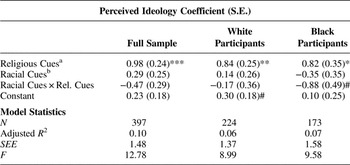
Table 1 presents the ordinary least squares (OLS) regression results of perceived candidate ideology, broken down by full sample, White participants, and Black participants. Our first hypothesis predicted that participants would perceive the religious candidate to be more conservative. Consistent with these expectations, there effect of religious cues in the full sample is significant and positive β = 0.98(0.24), t(397) = 4.09, p = 0.000. We therefore found evidence that when a candidate uses religious cues they are perceived to be significantly more conservative. H1 was therefore supported.
Predictors of perceived candidate ideology

***p < 0.001, **p < 0.01, *p < 0.05, #p < .10 (two-tailed tests).
a1 = Religious cues, 0 = No religious cues.
b1 = Black candidate, 0 = White candidate.
Our second hypothesis predicted that the Black candidate would be perceived as more liberal than the White candidate. Contrary to our expectations, there was not a significant effect of racial cues in the full sample, β = 0.29(0.25), t(397) = 1.20, p = 0.23. We therefore failed to find support for H2.
Hypothesis Three predicted a significant interaction between religious and racial cues on perceived candidate ideology. Contrary to expectations, there was not a significant interaction in the full sample, β = −0.47(0.29), t(397) = −1.60, p = 0.11. Thus, we failed to find support for H3.
Our research question asked whether religious and racial cues affected perceived ideology differently depending upon participant race. To examine this question, we added a three-way interaction term for religious cues, racial cues, and participant race to the regression model. Results of the three-way interaction were significant, β = −1.07(0.29), t(397) = −3.66, p = 0.000, suggesting that religious and racial cues affected perceived ideology differently among White and Black participants. We therefore used a split-file to examine how the estimates differ among White and Black participants.
Looking at Table 1, both White and Black participants perceive the candidate using religious cues to be more conservative. Additionally, neither White nor Black participants are significantly affected by candidate race; it is worth noting, however, that the coefficient is positive among White participants and negative among Black participants. Supplementary analysis was performed with an independent samples t-test, which showed Black participants viewed the Black candidate as significantly more liberal (M = −0.28, SD = 1.69) than White participants did (M = 0.79, SD = 1.43), t(194) = −4.77, p = 0.000. A similar difference was not found when considering perceived ideology of the White candidate, t(197) = −0.91, p = 0.36.
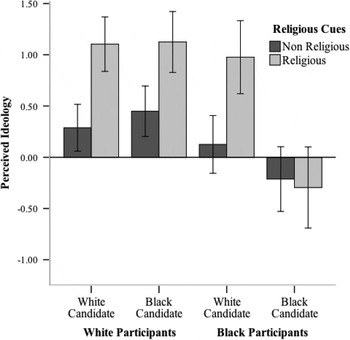
Perhaps most notably, we find a marginally significant interaction for religious and racial cues among Black participants, β = −0.88(0.49), t(173) = −.79, p = 0.08, while the interaction is non-significant among White participants β = −0.17(0.36), t(224) = −0.48, p = 0.63. As seen in Figure 1, White participants saw the religious candidate as more conservative than the non-religious, regardless of whether he was White or Black. Conversely, among Black participants, the White religious candidate was seen as significantly more conservative, but there was no difference in perceived ideology between the religious and non-religious Black candidates. Thus, we find that the effects of religious cues on perceived ideology are contingent upon candidate race, but it is only among Black participants that this is the case.
Interaction of racial and religious cues among White and Black participants with 84% confidence intervals.

FAVORABILITY
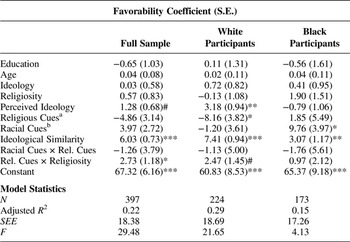
Table 2 presents the OLS regression results for candidate favorability. The models show the effects on favorability of the control variables (participant education, participant age, participant ideology, and participant religiosity), perceived ideology, the racial cue manipulation, the religious cue manipulation, ideological similarity, the interaction between the racial and religious cues, and the interaction between religiosity and religious cues.
Predictors of candidate favorability

***p < 0.001, **p < 0.01, *p < 0.05, #p < .10 (two-tailed tests).
a1 = Religious cues, 0 = No religious cues.
b1 = Black candidate, 0 = White candidate.
Hypothesis 4 predicted that the more participants perceived the candidate to be ideologically similar to themselves, the more favorable they would feel toward the candidate. As Table 2 displays, the more participants perceive that the politician is aligned with their political ideology, the more likely they are to feel favorably toward the politician. H4 was therefore supported.
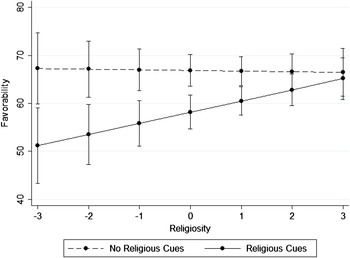
Hypothesis 5 predicted that religious cues would be more effective among those who are religious. Across the full sample, we see that there is not a significant effect of religious cues. When accounting for participant religiosity, however, we see a positive interaction, such that the effect of religious cues is dependent upon a citizen's religiosity. Thus, H5 was supported. Figure 2 shows that this interaction is primarily driven by a negative reaction among those who have low to moderate levels of religiosity. The less religious a participant, the less favorably they feel about the candidate who uses religious cues. Conversely, there is no evidence that the religious cues garner support among those who are religious.
Predicted values for the effects of candidate religious cue use and citizen religiosity on candidate favorability with 90% CIs.

Hypothesis 6 predicted that participants would feel more favorably about politicians of the same race. Among White participants, we do not see a significant main effect of candidate race. We therefore failed to find support for H6a. Among Black participants, however, there is a significant effect of candidate race, such that they are more likely to feel favorably about a Black candidate than a White candidate. We therefore found support for H6b.
Finally, Hypothesis 7 expected that religious and racial cues would interact differently among White and Black participants. We first added a three-way interaction term for religious cues, racial cues, and participant race to the regression model. Results of the three-way interaction were significant, β = 12.46 (3.91), t(397) = 3.19, p = 0.002. We therefore used a split-file to examine the regression models among White and Black participants.
Looking at Table 2, we notice some interesting trends. Among White participants, there is still a moderately significant positive interaction between religious cues and participant religiosity. As noted above, however, there is no unconditional effect of candidate race nor is there an interaction between religious and racial cues.
Looking at Black participants, on the other hand, there is not a significant interaction between religiosity and religious cues. In fact, there is no evidence of an effect of religious cues at all. As noted above, there is a significant effect of candidate race, but there is not a significant interaction between religious and racial cues. Thus, we find evidence that for Whites, religious cues are more salient than racial cues, while for Blacks, racial cues appear to trump religious cues. These results are corroborated by the much larger degree to which white participants correctly identified the religious cues.
DISCUSSION
Although the relationship between religion and politics is conditioned by race (Brady, Verba, and Schlozman Reference Brady, Verba and Schlozman1995; McDaniel and Ellison Reference McDaniel and Ellison2008; Wald and Calhoun-Brown Reference Wald and Calhoun-Brown2011), work examining the effect of religious cues on political outcomes has primarily focused on White politicians. This study sought to help fill this gap by employing an experimental design where a national sample of White and Black participants was exposed to the homepage of a fictitious congressional candidate. By manipulating the race of the politician and whether or not they used religious cues, this study furthers our understanding of how race and religion interact to affect political processes. The results of our study demonstrate that religious and racial cues do interact, but a citizen's racial identity plays a central role in determining how these cues affect the perceived ideology of, and favorable feelings towards, a political candidate.
First, religious cues did have a clear effect on the perceived ideology of the candidate, but in different ways for White and Black participants. For both White and Black participants, the White religious candidate was seen as more conservative than the non-religious White candidate. More significantly, White participants saw the Black religious candidate as more conservative than the non-religious Black candidate, while Black participants did not perceive a difference in ideology between the religious and non-religious Black candidates. These findings suggest that, absent other contextual cues, Whites will tend to assume that religious politicians are more likely to be politically conservative, regardless of race. Black participants, on the other hand, do not appear to make any assumptions that a religious Black politician will be conservative.
Given the overwhelming emphasis on the connection between Republicans and those who are highly religious in the mainstream media (Bolce and De Maio Reference Bolce and De Maio2008; Green Reference Green2010), the cognitive associations between religion and the Republican Party might be more salient among White citizens than the connection between religious Black politicians and the Democratic Party. This could reflect a lack of exposure to, and understanding of, the cultural differences embedded in Black religious culture (McKenzie Reference McKenzie2011). It seems plausible that White Americans reactions to the Rev. Wright controversy were primarily driven by racial associations, while the issue of religion never became particularly salient in their minds. If this interpretation is correct, then the Rev. Wright could be viewed as an exception, not a challenge, to the presumed associations between religion and the Republican Party.
For Black participants, on the other hand, the cognitive associations between religion and the Republican Party are likely isolated to their conceptions of White Americans. Because most African-Americans are both highly religious and likely to vote Democrat, seeing a religious Black politician should not activate any assumptions about political conservatism. Thus, our findings suggest that there are some important differences in the associations racial and religious cues activate among most White and Black citizens. These findings are consistent with literature that argues that a person's cultural experiences and racial/ethnic framework will affect how they process the social world around them (Dawson Reference Dawson2003; McDaniel and Ellison Reference McDaniel and Ellison2008).
Along those lines, we also found important racial differences when it came to candidate preferences. For White participants, religious cues had a more pronounced effect than the racial cues. Among White participants, there was a significant negative effect of the religious cues, but these cues were dependent upon citizen religiosity. As displayed in Figure 3, the less religious a participant, the greater their aversion to the religious candidate. Previous work has suggested that religious messages may alienate less religious voters (Domke and Coe Reference Domke and Coe2008; McLaughlin and Wise Reference McLaughlin and Wise2014; Wald and Calhoun-Brown Reference Wald and Calhoun-Brown2011), but it is somewhat surprising that there was not a boost among those who are religious. This lack of positive effects of religious cues may have been partially an artifact of our experimental context.
Given the strong negative reaction many Whites had to Obama's association with Rev. Wright (McKenzie Reference McKenzie2011), and the historical association between the Black church and political and social activism (Allen, Dawson, and Brown Reference Allen, Dawson and Brown1989) we expected that religion would serve to stir racial resentment among Whites. This clearly was not the case in our study. At the same time, these results are consistent with the findings of Calfano and Djupe (Reference Calfano and Djupe2009) and Calfano and Paolino (Reference Calfano and Paolino2010). Calfano and Paolino's (Reference Calfano and Paolino2010) findings provide evidence that it is not just perception of a shared religious worldview that leads White evangelicals to think positively of a Black evangelical politician, but also belief in a shared conservative ideology can provide a candidate boost. In these instances, White voters can hold favorable opinions toward the Black candidate, who they view as an exception to the Black stereotype, without challenging their general racial schemas.
There is reason to believe that White participants may have viewed the candidate in our study as an exception to the Black stereotype, as White participants perceived the Black candidates to be significantly more conservative than Black participants did. This is at odds with the general tendency to assume Black politicians are liberal. There is, however, evidence that Black politicians are sometimes viewed as an “unique subtype of Blacks” (Schneider and Bos Reference Schneider and Bos2011). Indeed, there have also been several high profile conservative Black politicians in recent years (e.g., Alan Keyes, Condoleezza Rice, Michael Steele, Herman Cain). Thus, conservative Black politicians likely activate different cognitive associations than do liberal Black politicians. In this case, there may be a couple factors of our survey that allowed for the politician to be evaluated as a unique subtype (see below).
Among Black participants, on the other hand, the religious cues did not have clear effects on candidate preference, while the racial cue had a significant effect. This is consistent with the idea that Blacks are particularly motivated to support Black candidates (Dawson Reference Dawson1994). Race is a particularly salient social identity category for most African-Americans. It is, therefore, not surprising that it would play a particularly large role in influence the inferences and conclusion they make about a political candidate.
Finally, we found that there was a significant effect of the perceived ideological similarity between the candidate and participant. This finding is not particularly noteworthy, in and of itself, but it does demonstrate the importance of the ideological inferences that are made about religious and racial cues. If a candidate's social identity affects a voter's perception of the type of policy positions they are likely to hold, then that information should play an important role in determining whether or not they support that candidate.
LIMITATIONS
There are several limitations to our study that are important to acknowledge. First, it was surprising that White participants did not view the Black candidate as liberal. These results could have resulted from idiosyncratic aspects of our experimental stimuli. One possibility is that the profile picture we used fit well with a conservative Black subtype. Perhaps we would have seen different reactions among Whites with a different profile picture. This explanation seems plausible given that we did not include any information about political affiliation, but it is likely that party affiliation would have played an important interactive role. To be sure, all things being equal, a Black politician should be assumed to be Democrat. But there may have been aspects of our stimuli that lead participants to believe the candidate was Republican. It is likely that White citizens make very different assumptions about Black Republicans and Black Democrats. It may be only when voters know a Black politician is Democrat that the more common ideology stereotypes kick into high gear. Alternatively, when a Black Republican is evaluated as an exception to the racial category, it likely deactivates these traditional racial stereotypes. This raises interesting and important questions about how White citizens react to Black politicians that would benefit from more research.
Along those lines, we also might have seen different results if we had used different types of religious cues. In line with the approach most politicians take (Domke and Coe Reference Domke and Coe2008), we used generalist religious cues. Things might have played out differently if there were more clear indications that Black religious politician was tied to a Black church or if the religious cues were ramped up. Indeed, there are a wide range of religious cues a politician can use, from covert (Calfano and Djupe Reference Calfano and Djupe2009) to explicit and specific (Domke and Coe Reference Domke and Coe2008). It would be helpful if future research examined how a full range of religious cues interacts with a candidate's race.
This leads to another limitation of our study — our perceived ideology measure did not give participants the opportunity to distinguish on which ideological dimensions they expected the politician to be liberal or conservative. In this article, we have treated ideology as a relatively homogeneous concept. In reality, ideology is a multi-dimensional construct that is often organized by two distinct dimensions: economic and social (Carmines, Ensley, and Wagner Reference Carmines, Ensley and Wagner2012). But even within the social ideology dimension there are important distinctions between racial and social welfare issues and religious and family value issues. Even though Blacks are widely perceived to be politically liberal, their political attitudes are more nuanced than widely assumed. For example, most Blacks hold conservative positions on issues such as gay rights and abortion (Kidd et al. Reference Kidd, Diggs, Farooq and Murray2007). African-Americans do, however, tend to be particularly liberal on racial and social welfare issues. In particular, Blacks’ voting decisions are strongly influenced by their perception of whether a candidate is likely to hold political positions that are sympathetic toward minority groups (Jacobsmeier Reference Jacobsmeier2014). It may be that the Blacks participants in our study were largely influenced by their assumption that the Black candidate would hold more liberal racial policies. Unfortunately, our measures only asked participants how liberal or conservative they believed the candidate was without giving them an opportunity to distinguish between these different types of ideology. It would be beneficial for future research to disentangle these nuanced multi-dimensional layers of ideology to provide a more fully developed understanding of ideology.
CONCLUSION
These limitations reflect a typical limitation of experimental research, which is a lack of real world context. That being said, we are confident in the overall finding that Black and White citizens respond differently to racial and religious cues. While we are cautious in assuming that things would always play out in this manner, there are several conclusions that we do feel comfortable extrapolating from. First, religious and racial cues appear to activate different cognitive associations for White and Black citizens. It may be that the associations between religion and the Republican Party are more salient among White citizens than the connection between religious Black politicians and the Democratic Party. Conversely, for Black citizens, the cognitive associations between religion and the Republican Party may be isolated to their conceptions of White Americans.
Second, when it comes to candidate preference, we can assume that there is something to the relative differences in importance placed on race and religion by White and Black participants. It is clear that racial cues are particularly important for Black voters, while religious cues are particularly important for White voters. Religion has become a salient, and contentious, political topic in the last several decades. It is therefore not surprising that religious cues had a significant effect and significantly interacted with participant religiosity.
Religion and race promise to be important political factors for the foreseeable future. While there has been increasing scholarly emphasis on understanding how, when, and why religious cues affect voter evaluations, this work has largely ignored questions of race — a typical problem in the religion and politics subfield. This study provides some important insights into how race and religion interact to affect voter evaluations of religious cues, but it also opens up some interesting questions that remain to be resolved. Future work may consider how factors such as political affiliation, type of religious cue, and gender all interact to effect results. Indeed, the relationship between religion, race, and politics is much more complicated than is typically portrayed in the media. This study takes one-step in the larger process of unpacking this relationship.
Supplementary materials and methods
To view supplementary material for this article, please visit http://dx.doi.org/10.1017/S1755048316000213