Introduction
The importance of women’s empowerment has been broadly accepted across the globe as a means of achieving development goals: the eradication of poverty, attaining universal primary education, achieving sustainable development and enabling universal access to health care (World Bank, 2012). Furthermore, women’s empowerment is strongly associated with better reproductive health service utilization (Basu, Reference Basu1992; Bhatia & Cleland, Reference Bhatia and Cleland1995; Upadhyay & Karasek, Reference Upadhyay and Karasek2010). It works through lowering fertility, unintended pregnancy and extending birth intervals (Jejeebhoy, Reference Jejeebhoy1984, Reference Jejeebhoy1991; Visaria, Reference Visaria1993; Upadhyay et al., Reference Upadhyay, Gipson, Withers, Lewis, Ciaraldi and Fraser2014). An empowered woman who has the ability to control resources and take decisions in her own favour is more likely to limit her family size by using contraceptives (Mason, Reference Mason1987; Mason & Smith, Reference Mason and Smith2000; Roy & Saggurti, Reference Roy and Saggurti2004; Patrikar et al., Reference Patrikar, Basannar and Sharma2014).
In parallel, there is a general belief that the use of contraceptives empowers women by ensuring aspects of women’s reproductive rights (Alano & Hanson, Reference Alano and Hanson2018). Specifically, woman’s control over unwanted pregnancies, birth intervals and number of children a couple have are thought to be important pathways to enhanced women’s empowerment (Cleland et al., Reference Cleland, Bernstein, Ezeh, Faundes, Glasier and Innis2006). Furthermore, greater educational attainment and engagement in productive activities have been documented as links between contraceptive use and women’s empowerment (Cleland et al., Reference Cleland, Bernstein, Ezeh, Faundes, Glasier and Innis2006; Alano & Hanson, Reference Alano and Hanson2018). Labour force participation enhances women’s empowerment through economic independence, exposure to the outside world and expanding social networks (Dixon, Reference Dixon1993; Gupta & Yesudian, Reference Gupta and Yesudian2006). It is evident that women who participate in the workforce and contribute to family income are more empowered than those who do not participate in the labour force (Sen, Reference Sen and Tinker1990; Mahmud & Johnson, Reference Mahmud, Johnson, Gita, Germain and Chen1994).
Nevertheless, when it comes to the systematic assessment of the direct impact of contraceptive use on women’s empowerment, studies are very limited (Lee-Rife SM, 2010; Upadhyay et al., Reference Upadhyay, Gipson, Withers, Lewis, Ciaraldi and Fraser2014). In particular, to the authors’ knowledge, no study has been conducted on this issue in India.
Empowerment is a complex concept and does not have a particular definition that cuts across disciplines. Over the years, the definition of women’s empowerment has evolved from ‘the degree of women’s control over material and social resources within the family, community or society’ (Dixon-Mueller, Reference Dixon-Mueller1978); ‘the respect accorded to an individual and personal power available to women’ (Mason, Reference Mason, Federici, Mason and Sogner1993); and ‘the ability to manipulate one’s personal environment through obtaining information and controlling resources in order to take decisions for own concern and other family members’ (Dyson & Moore, Reference Dyson and Moore1983; Basu, Reference Basu1992). The World Bank defines empowerment as the expansion of freedom of choice and action to shape one’s life (Narayan, Reference Narayan2002). Sen (Reference Sen1985) defined agency as what a person is free to do and achieve in pursuit of whatever goals or values he or she regards as important and prerequisite to empowerment. Following Kabeer (Reference Kabeer1999), women’s empowerment is a ‘process by which those who have been denied the ability to make strategic life choices acquire such ability’. Kabeer (Reference Kabeer2008) stated that women’s agency leads to empowerment when it questions, challenges or changes regressive norms and institutions that perpetuate the subordination of women. In this context, education and economic independence (gainful employment) play key roles.
The measurement of women’s empowerment is equally complex. Various indicators are used as proxies for empowerment. Education, workforce participation, media exposure, women’s decision-making capacity, access to assets such as ownership of land and a house, and freedom in their daily life, have remained common choices of researchers. Higher level of educational attainment not only increases employment opportunity, but also leads to better reproductive health behaviours such as increased use of contraception (Jejeebhoy, Reference Jejeebhoy1995; Stephenson & Tsui, Reference Stephenson and Tsui2002).
Methods
Data
The study used data from the fourth round of the National family Health Survey (NFHS-4), collected during the years 2015–16 with the administrative and financial support of the Ministry of Health and Family Welfare (MoHFW), Government of India. International Institute of Population Sciences (IIPS), Mumbai, was the nodal agency for conducting the survey. The primary objective of the 2015–16 NFHS was to provide essential data on health and family welfare and their determinants. The survey was conducted in all 29 states and seven union territories of India. The total samples of households and eligible women interviewed (currently married women aged 15–49 currently using any contraceptive method) were 601,509 and 699,686 respectively. The present study used information from 499,627 currently married women aged 15–49 years, interviewed as part of the overall sample of eligible women.
The NFHS-4 adopted a two-stage stratified sampling methodology. The data from the 2011 census served as the sampling frame for the selection of Primary Sampling Units (PSUs). The PSUs were villages in rural areas and Census Enumeration Blocks (CEBs) in urban areas. In rural areas, villages were selected at the first stage using the Probability Proportional to Size (PPS) random sampling method after stratification by population size and percentage of SC/ST population. In urban areas, CEBs were again stratified according to the percentage of SC/ST population in each CEB, and sample CEBs were selected with PPS sampling method. In the second stage, in each selected rural and urban cluster, 22 households were randomly selected with systematic sampling method. The details of survey design and other information are given in the NFHS 2015–16 report (Ram, Reference Ram2014; IIPS & ICF 2017).
Variables
The study used two sets of indicators as dependent variables – mobility and decision-making – to represent women’s empowerment. Each set was comprised of three indicators. Therefore, altogether six indicators were selected that reflected the process of change and ability to make choices in a woman’s life. Indicators included various aspects of mobility and decision-making power. The indicators for women’s mobility were: (i) percentage of women who were allowed to go to the market alone; (ii) percentage of women who were allowed to go to the health centre alone; and (iii) percentage of women who were allowed to go out of the village in which they lived alone. The indicators for women’s decision-making power included: (iv) percentage of women who took decisions in health care related issues; (v) percentage of women who took decisions on large household item purchases; and (vi) percentage of women who took decisions on visiting family or relatives.
Explanatory variables were age cohort (15–24, 25–34, 35–44, and 45 and above), place of residence (rural and urban), educational level of women and husband (illiterate, primary, secondary, higher secondary and above), household wealth (estimated using household’s assets; categorized into poorest, poorer, middle, richer and richest), mass media exposure (watched TV regularly or not), working status of women and husband (currently working or not), religion, caste, types of contraceptive used (no use, sterilization, modern spacing method and traditional method) and rate of women using any method of contraceptives in a community.
Analysis
First, the Contraceptive Prevalence Rates (CPRs), choice of contraceptive methods and level of women’s empowerment indicators of the sample women were described by socioeconomic and demographic characteristics. The associations of women’s empowerment status with type of contraceptive method used (no use, sterilization, modern spacing method, traditional method), and also by mobility and decision-making variables, were also assessed.
Second, multivariate modelling was used to estimate impact of contraceptive use on women’s empowerment. Logit regression models were applied to indices of women’s empowerment (separately for six dichotomous variables). The model specification was as follows:
 $${\rm{Logit}}\;\left( {{W_i}} \right){\rm{ = }}{\beta _{\rm{0}}}{\rm{ + }}{\beta _{\rm{1}}}{C_{\rm{i}}}{\rm{ + }}{\beta _{\rm{2}}}{X_{\rm{i}}}{\rm{ + }}{{\rm{e}}_i}$$(1)
where W i refers to the chance of a woman i going alone to the market/health centre/outside village and having a say in taking decision on health care/purchasing of household major items/visiting relatives; C i indicates the contraceptive use of woman i; X i refers to other variables that influence women’s empowerment.
The Logit regression model shows the association between women’s empowerment and contraceptive use. However, reverse causation remains a matter of concern. The pathway that was the main focus of the paper was that reduced fertility as a result of contraceptive use might in turn result in women’s empowerment by expanding their horizon of life choices or changing gender norms in a patriarchal setting. Another direction, which is well established in the literature, is that women who are already empowered are more likely to use contraceptives to limit their fertility (reverse causation). Therefore, the Logit model needed to be corrected for endogeneity to gauge the true effect of contraceptive use on women’s empowerment. In order to overcome the issue of endogeneity two-stage least squares (2SLS) regression models were used. Contraceptive use at the community level, i.e. rate of women using any method of contraceptives in a community, was used as the instrument to identify the effect of contraceptive use at the individual level on women’s empowerment. The PSU – a village in rural area and a ward in urban area – represented a community in the analysis. Community-level contraceptive use was taken as an instrumental variable considering its strong association with individual-level contraceptive use (Thang et al. Reference Thang, Swenson, Man and Trinh1992).
Following the instrumental variable approach, community-level contraceptive prevalence was used as an instrument (IVCi) to identify the effect of contraceptive use in equation (2), and then the predicted value of contraceptive use from equation (2) was used to estimate the effect of contraceptive use on women’s empowerment represented by indices, as specified in equation (3).
 $${C_i} = {\alpha _0} + {\alpha _1}{\rm{I}}{{\rm{V}}_{Ci}}{\rm{ + }}\alpha {X_{\rm{i}}}{\rm{ + }}{\mu _{\rm{i}}}$$(2)
 $${\rm Logit}\,{\rm{ }}\left( {{W_i}} \right) = {\beta _0} + {\beta _1}\left( {{C_i}} \right){\rm{ }} + {\beta _2}{X_i} + {{\rm{e}}_i}$$(3)
Results
Descriptive statistics
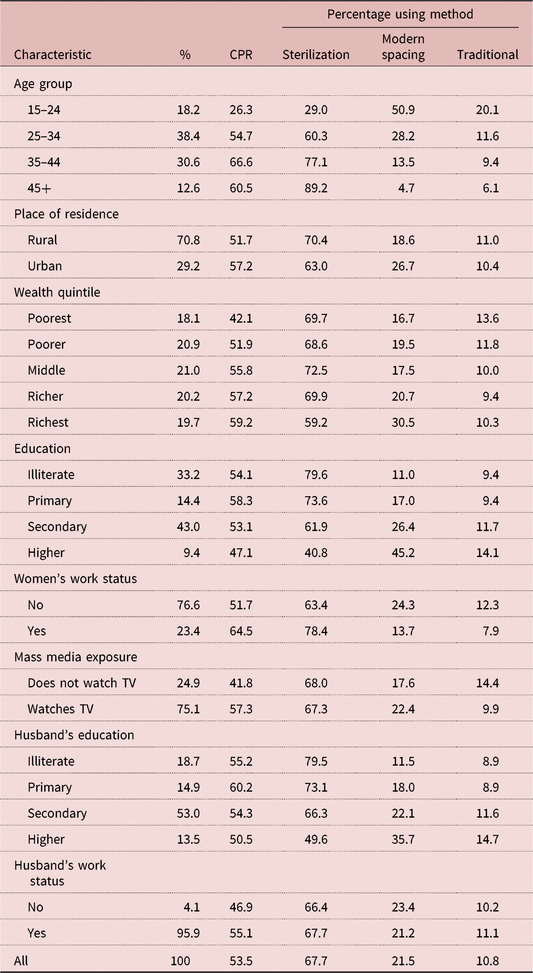
The distribution of the sample by CPR and use of contraceptive methods and by socioeconomic characteristics is presented in Table 1. Broadly, CPR was higher among women of higher socioeconomic status and among older women. The CPR increased with women’s age (up to age 45), and was greater in higher wealth quintile households and among urban women. Additionally, women’s workforce participation and mass media exposure were positively related to CPR. Thus, CPR displayed associations with wealth, age and area of residence, as documented in previous literature. Education remained the only exception, showing lower CPR among women with higher level of education. A similar picture was observed for husband’s education. This may be due to the higher concentration of educated women, as well as their educated husbands, in the lower age group. This was further clarified by the multivariate analysis.
Use of contraceptives and Contraceptive Prevalence Rates (CPRs) for women by socio-demographic characteristics, India 2015–16

Overall, sterilization was the most popular choice of contraceptive method, followed by other modern contraceptive methods. Two-thirds (67.7%) of all contraceptive users adopted sterilization, 21.5% another modern spacing method and 10.8% traditional methods. Choice of method was also associated with women’s socioeconomic status. Women of higher socioeconomic status were more likely to adopt modern spacing methods and the relatively lower socioeconomic group preferred sterilization. The proportion of modern spacing method usage increased from 16.7% of the poorest quintile to 30.5% of the richest quintile. On the other hand, choice of sterilization declined from 69.7% of the poorest quintile to 59.2% of the richest quintile. A similar picture was observed for the educational levels of women and their husbands.
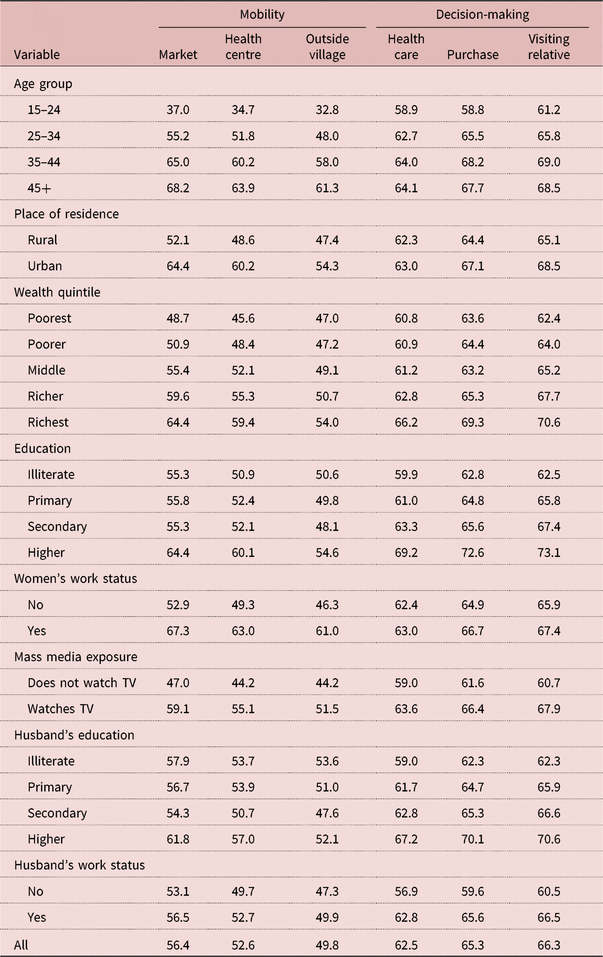
Like CPR, women’s empowerment was positively associated with women’s socioeconomic status (Table 2). Women’s empowerment, as measured by the three mobility and three decision-making indicators, increased: (i) on moving from the poorest wealth quintile to richest quintile, (ii) with higher level of education (of both women and their husbands) and (iii) among women living in urban areas, those in the workforce and those exposed to mass media. However, the overall status of women’s empowerment in India as indicated by the NFHS-4 was poor. Around half of currently married women were not allowed to go alone to market/health centre/outside village. Correspondingly, 56.4%, 52.6% and 49.8 of women were only allowed going alone to the market, health centre or outside of their living village, respectively. Similarly, for women’s decision-making, around 35–40% of women reported that they were not part of decision-making on issues within a household. The percentages of women who had a say in taking decision for health care, purchasing of household major items and in visiting relatives were 62.8%, 65.6% and 66.5% correspondingly.
Level of empowerment of women by socio-demographic characteristics, India 2015–16

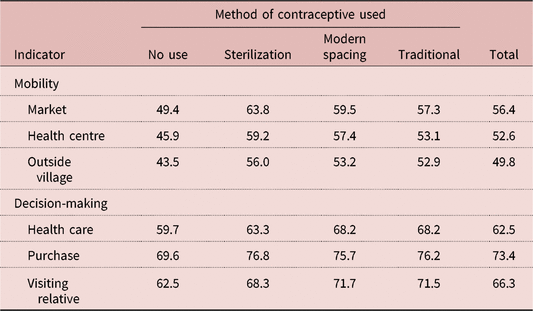
Women’s empowerment, as represented by the six indicators, by contraceptive method use is shown in Table 3. The findings indicate that women who used contraceptives were more empowered. Among contraceptive users, sterilized women (prevalence of sterilization was higher among women from poorer socioeconomic background) enjoyed greater mobility, followed by those who used modern spacing and traditional methods. For example, 63.8% of sterilized women could go to the market alone compared with 59.5% and 57.5% of those who used modern spacing and traditional methods, respectively. As far as decision-making power is concerned, modern spacing and traditional method users were more empowered than sterilized women. For example, 68.2% of modern and traditional method users reported that they jointly took decisions in the matter of health care compared with 63.3% of sterilized women.
Level of empowerment of women by contraceptive method use, India 2015–16

Multivariate analysis
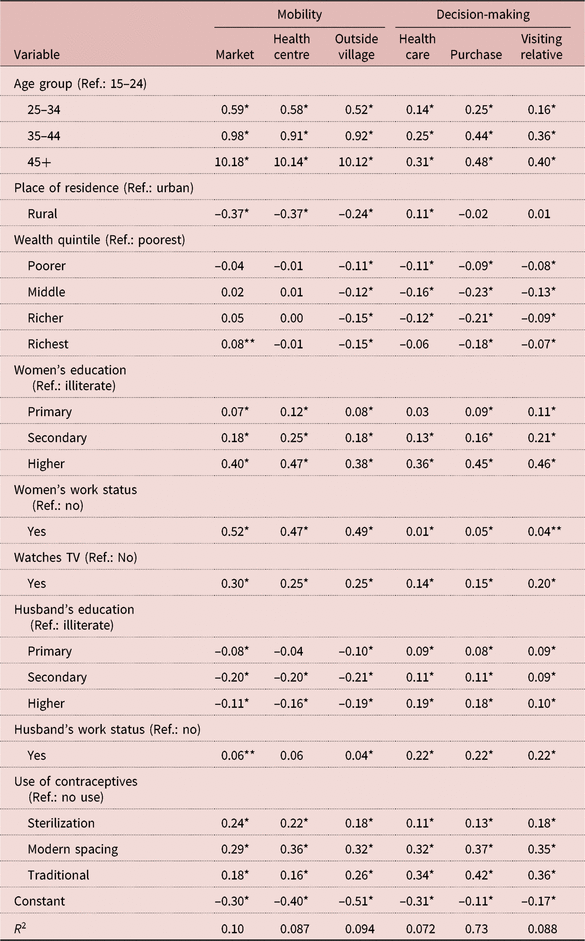
The results of the logit models are presented in Table 4. Age, education, workforce participation and mass media exposure remained consistent, showing a positive association with all six indicators of women’s empowerment. Husband’s education showed a negative association with indicators of mobility, i.e. women were less likely to enjoy the freedom of mobility with an increase in the education level of their husband. However, this result reversed when it came to decision-making. Women were more likely to be part of decision-making if their husband was educated (unlike the findings from the bivariate analysis). Husband’s workforce participation also showed a positive association. There was a significant positive association between contraceptive use and women’s empowerment. Women who used contraceptives were more likely to enjoy mobility as well as decision-making power. For example, the coefficient for sterilized women who were allowed going alone to market was higher by 0.24 units compared with that for women who did not use any contraceptives. In general, modern spacing and traditional method users had a marginal edge over sterilization as far as empowerment was concerned.
Logit model of women’s empowerment by socio-demographic characteristics, India 2015–16

Caste and religion were controlled for.
*p<0.01; **p<0.05.
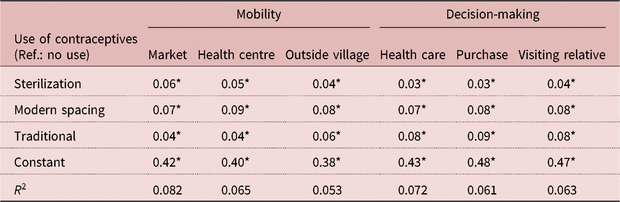
Estimation of the impact of contraceptive use on women’s empowerment after considering the issue of endogeneity using the 2SLS model is presented in Table 5. The positive impact of contraceptive use on women’s empowerment continued to persist, as observed both in the bivariate and logit regression models. However, there was a difference in the magnitude of the coefficient. The coefficients for all methods of contraception were found to have reduced drastically in the 2SLS model compared with the logit model. For example, the coefficient for sterilization was 0.06 in the 2SLS model compared with 0.24 in the logit model. Therefore, in sum, the 2SLS model established a true positive impact of contraceptive use upon women’s empowerment after correcting for the issue of endogeneity.
Impact of contraceptive use on women’s empowerment after considering endogeneity using the 2SLS model, India 2015–16

Age, place of residence, household wealth, educational level of women and husbands, working status of women and husbands, caste and religion were all controlled for.
*p < 0.01.
Discussion
The findings of this study highlight that contraceptive use has a positive impact on women’s empowerment in terms of their mobility and decision-making capability. The finding has been discerned using a 2SLS model, which examines reverse causality, and therefore established that women’s empowerment leads to higher use of contraceptives, by factoring in the issue of endogeneity. This was confirmed by the observed greater mobility and decision-making power among women who were sterilized, despite their lower socioeconomic status. The impact of contraceptive use on empowerment was also pronounced among women who were using other modern methods rather than traditional ones.
The findings of this study suggest that investment in family planning in India will not only reduce fertility and improve reproductive health, but also directly empower women. Use of contraceptives also has other benefits, particularly for women’s health and family planning. It prevents pregnancy-related health risks in women, reduces maternal and child mortality by preventing closely spaced and ill-timed pregnancies and births, and offers protection against unintended pregnancies and sexually transmitted diseases (STIs) by enabling people to make informed choices about family planning and reproductive health (WHO, 1995).
The pathways to greater women’s empowerment by the use of contraceptives are presumed to be through nurturing spheres of women’s life by changing their perception of their domestic role, sense of control over their own body and control over family size and birth intervals, thereby weakening the patriarchal norms (Alano & Hanson, Reference Alano and Hanson2018). Also, a smaller number of children can empower women through women’s greater involvement in non-domestic spheres such as workforce participation, higher education and mass media exposure (Carr et al., Reference Carr, Gates, Mitchell and Shah2012; Upadhyay et al., Reference Upadhyay, Gipson, Withers, Lewis, Ciaraldi and Fraser2014). Economic independence, the ability to contribute to family income and social networks generated through workforce participation seem to be important pathways towards greater empowerment. Furthermore, greater mass media exposure presumably enhances women’s empowerment by expanding their horizon of knowledge, to enhance self-esteem, identity and perception of control over resources (Ting et al., Reference Ting, Chon and Ming2014).
Although the findings of this study offer important insights, the results should be interpreted with caution in light of certain limitations. The study used cross-sectional data to examine the causal relationship between contraceptive use and women’s empowerment. While the methodology addresses the limitation to an extent, the direct causal relationship between these two variables requires further longitudinal research. The reliance on self-reported responses on empowerment and contraceptive use may have some social desirability bias, particularly within selected population sub-groups (illiterate, non-working and lower social class women). The availability of data from longitudinal surveys may address the social desirability bias as well and strengthen findings of this paper.
In conclusion, the presented results show that the use of contraceptives could result in greater empowerment for women, particularly for women from low economic households. This findings highlight the important implications of women’s control over family size and birth intervals through use of contraception in their pathway to empowerment. Family planning investment in general largely argues for preventing unwanted pregnancies and maternal and child deaths, but this evidence from India suggests that it helps women achieve greater mobility and decision-making powers within a household.
Acknowledgments
This study was conducted as part of a mentorship programme under the RASTA initiative of the Evidence Project of the Population Council. The Evidence Project is made possible by the generous support of the American people through the United States Agency for International Development (USAID) under the terms of co-operative agreement No. AID-OAA-A-13-00087. The contents of this paper are the sole responsibility of the authors and do not necessarily reflect the views of USAID, the United States Government or the Population Council. The authors wish to acknowledge Prof. K. S. Srinivasan, Dr Abhishek Singh and Prof. Arvind Pandey for their insightful comments on earlier versions of the manuscript.
Funding
This research received no specific grant from any funding agency, commercial entity or not-for-profit organization.
Conflicts of Interest
The authors have no conflicts of interest to declare.
Ethical Approval
The DHS data can be downloaded from the website and are free to use by researchers for further analysis. In order to access the data from DHS MEASURE a written request was submitted to the DHS MACRO and permission was granted to use the data for this survey.