Human papillomavirus (HPV) types 6, 11, 16, and 18 are responsible for 90 percent of cases of genital warts (GW), 50–70 percent of all cases of cervical intraepithelial neoplasia (CIN1–3), and 70 percent of cervical cancer cases (Reference Clifford, Rana and Franceschi4;Reference Lacey, Lowndes and Shah12;Reference Smith, Lindsay and Hoots22). Despite the presence of screening programs, cervical cancer is still a leading cause of cancer death worldwide (Reference Parkin, Bray, Ferlay and Pisani21). Denmark was one of the first countries to introduce cervical cancer screening, but the incidence and mortality rates from cervical cancer are among the highest in the European Union (18). The incidence of cervical cancer in Denmark is approximately 11 cases per 100,000 women and 130–140 Danish women die of cervical cancer every year (19). The prevalence of GW is estimated to be 32,000 persons (8 cases per 100,000 adult persons) (Reference Kjaer, Tran and Sparen11). A total of approximately 4,000 CIN1, 1,100 CIN2, and 1,700 CIN3 cases are found every year [appendix 2.3.2 in National Board of Health (17)].
Two HPV vaccines are available: a vaccine against HPV types 6, 11, 16, and 18 (Gardasil®) and a vaccine against HPV types 16 and 18 (Cervarix®). The quadrivalent vaccine can prevent GW, CIN1–3, and cervical cancer and in the long run this effect might be substantial. The long-term effect of a vaccination program will depend on many factors, however, including the efficacy of the vaccine and the vaccination uptake rate.
The effect of vaccination is expected to be improved quality of life due to avoided cases of GW, CIN1–3, and cervical cancer, and improved survival due to fewer deaths from cervical cancer. The introduction of a vaccination program would incur extra costs, but would also save treatment costs due to a decrease in the incidence of GW, CIN1–3, and cervical cancer.
As of 2009, all 12-year-old girls in Denmark are offered HPV vaccination (15). To describe and analyze the epidemiological and economic impact of HPV vaccination, a dynamic transmission model that includes herd immunity has been developed. The model is an updated and further developed version of the models used in a recent Danish health technology assessment (18).
The objective of this study was to simulate HPV infection in a heterosexual population and subsequently analyze the incremental costs and effects of introducing a vaccination program against HPV 6/11/16/18 in Denmark compared with the current strategy. The analytic approach comprised both cost-effectiveness and cost-utility analysis. The cost-effectiveness of the bivalent HPV vaccination has already been analyzed in a Danish setting (18). The present analysis was performed to demonstrate the additional consequences in terms of costs and effects of including protection against HPV 6 and 11.
METHODS
The study compared quadrivalent HPV vaccination with the current Danish strategy, which includes a cervical cancer screening program for women aged 23–59 years who are offered screening every 3 years. The average participation rate in the screening program is 70 percent (18). It is assumed that this screening program would continue despite the introduction of HPV vaccination.
The analysis was performed in two phases. First, using the software NetLogo (version 4.0.2) (http://ccl.northwestern.edu/netlogo), a transmission model was developed that describes the HPV transmission dynamics before and after introduction of HPV vaccination. Second, an analysis of the incremental costs and effects was performed using Microsoft® Excel.
The Transmission Model
The dynamic transmission model is an agent-based simulation model consisting of 25,000 individuals who collectively comprise a closed “mini-society.” Agent-based modeling is not widespread within the area of economic evaluation of vaccine interventions, but is a very flexible modeling technique (Reference Kim and Goldie10).
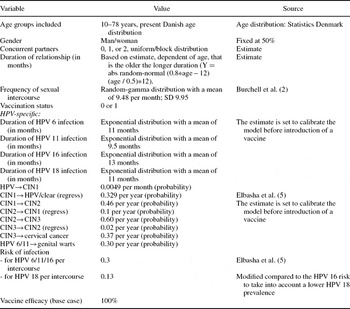
The model simulates a population of 25,000 individuals and their relations as a heterosexual network, where individuals/agents constitute the network nodes and relationships are represented as network links. The agents’ sexual behaviors are based on logical if/then rules that take the properties of the individual agent into account. There are thus no equations defining agent interactions, but some equations are used for setting model variables (Table 1). See also Supplementary Figure 1 for model structure (available at www.journals.cambridge.org/thc2010016).
Parameters Applied in the HPV Transmission Model

HPV, human papilloma virus; CIN, cervical intraepithelial neoplasia.
Agent-based models are well suited for modeling sexually transmitted diseases because each individual of the population is directly represented in the model, thus allowing the model to capture individual heterogeneity in sexual behavior and the herd-immunity effect of vaccinations.
The model operates with several variables, some of which relate to the entire population (global variables, e.g., CIN progression and regression probabilities, risk of HPV infection per sexual act), and some of which are agent-specific (agent variables, e.g., age, sex, duration of relationship, frequency of sexual intercourse), see Table 1. The model is assumed to be a small-scale version of sexual networks in Denmark. The age distribution of the 25,000 agents mimics that of the general Danish population aged 10–78 years, and the HPV prevalence rates at model initialization are similar to those found in Denmark.
When the model was initialized, it was assumed that every individual over 14 years would seek a partner of the opposite sex aged ± 10 years of their own age (with a minimum age of 13 years). The model time step was 1 month (i.e., discrete time intervals). The model took into account that the risk of HPV infection will change over time with the introduction of vaccination, which will reduce the prevalence of HPV in a given population over time due to herd immunity.
In the base model, HPV 6/11/16/18 were allocated to several individuals in each age group, based on the prevalence in the Danish population (Kjaer SK, personal communication, 2008) [Figure 3.2 in National Board of Health (18)]. If an individual is infected with HPV, there is a risk of the development of CIN or GW. We assume no natural immunity following infection, suggesting that an individual infected by one type of HPV has the same risk of being re-infected by the same type. The model worked with a range of probabilities regarding the move from one CIN stage to another, or to cervical cancer (Table 1). The model also included simulation of the screening program for cervical cancer, as 70 percent of all Danish women aged 23 to 59 years are screened every third year. Any women with CIN2 and CIN3 underwent tumor excision with conisation, after which the model deemed them to be healthy.
The model estimated the incidence and prevalence of HPV 6/11/16/18, GW (in men and women) and CIN1. The annual incidence of CIN2–3 and cervical cancer was subsequently estimated in Microsoft Excel.
Initial simulations for 30 years without vaccination were performed to calibrate the model (and to reach a steady state), that is, to make the necessary adjustments to approximate the present Danish incidence and prevalence of HPV 6/11/16/18, GW, CIN1–3, and cervical cancer.
Estimation of Cost and Effects
The estimated incidence and prevalence of HPV 6/11/16/18, GW and CIN1–3, and cervical cancer were extrapolated to the Danish population level, and the incremental effects (in terms of a decrease in the incidence of GW, CIN1–3, and cervical cancer) and incremental costs of the vaccination program compared with current strategy were subsequently estimated.
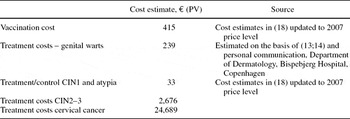
From the year the HPV vaccination is introduced, there will be extra costs related to cost of vaccination. These were represented by the costs for three injections plus the general practitioner's fee. The vaccination program will lead to future savings in treatment cost due to reduced incidence of GW, CIN1–3, and cervical cancer. DRG-charges (Diagnosis-Related Group charges) and outpatient charges (secondary care sector), fees (primary care sector), and market prices without value-added tax (HPV vaccination) were used as cost estimates (see Table 3). The perspective of the analysis was the healthcare payer perspective (third party payer perspective).
Future effects of the vaccination are expected to be fewer men and women contracting GW and fewer women developing cell changes (CIN1–3) and cervical cancer, thus suggesting gains in both life-years and health-related quality of life. However, the future effect will depend on several parameters, including the vaccine efficacy and duration of protection.
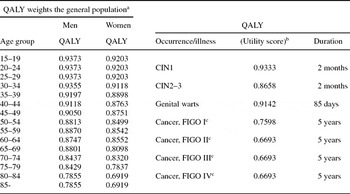
Given the age distribution for cervical cancer deaths and that for the general female population, it was possible to estimate the life-years gained (LYG) due to a lower incidence of cervical cancer. Similarly, given the modeled decrease in GW, CIN1–3, and cervical cancer and given the quality-adjusted life-year (QALY) weights for the general population and the specific occurrences/illnesses (Table 2), the gain in QALYs was estimated. Future costs and effects were discounted at a rate of 3 percent. The base–case assumed a vaccination rate of 70 percent and a 62-year time horizon for the vaccination program.
QALY Weights Applied

aUnpublished data from survey performed by National Institute of Public Health, University of Southern Denmark (personal communication).
bSource: Elbasha et al. (Reference Elbasha, Dasbach and Insinga5).
cBased on Jakobsen et al. (Reference Jakobsen, Engelholm and Knudsen8), it was assumed that 50% of the cervical cancer incidence was FIGO I and 50% was FIGO I–III.
QALY, Quality-Adjusted Life-Year; CIN, cervical intraepithelial neoplasia; FIGO, International Federation of Gynecologists & Obstetricians.
Sensitivity Analysis
Univariate sensitivity analysis was performed, in which different parameters were varied one at a time. Scenario analyses were also performed, in which different vaccination scenarios (e.g., inclusion of catch-up programs) were analyzed.
RESULTS
HPV Transmission
Simulations before the introduction of vaccination showed that the estimated HPV prevalence was stable (reached a steady state), indicating that the model was well calibrated, and the estimated prevalence replicated the present Danish HPV prevalence (data not shown) fairly precisely. The present Danish HPV prevalence for types 6, 11, 16, and 18 was estimated on the basis of Figure 3.2 in National Board of Health (18) and Kjaer (Kjaer SK, personal communication, 2008). Initially, the model was also calibrated to simulate the present Danish GW prevalence in men and women and the present incidence of CIN1–3 and cervical cancer. The present GW prevalence was estimated on the basis of Kjaer et al. (Reference Kjaer, Tran and Sparen11), assuming equal prevalence in men and women (i.e., assuming the same levels of sexual activity) and assuming a linear reduction in GW prevalence for men and women aged over 44 years (i.e., prevalence was 0.50 percent in the age group 40–44 years and decreased linearly to 0.0 percent for the age group 74–79 years). The present incidence of CIN1–3 and cervical cancer was estimated on the basis of the National Patient Registry (2003–2005), Appendix 2.3.2 in National Board of Health (17) and the National Cancer Registry (2000–2001). The model was thus calibrated to give a close replication of the incidences in Denmark of cervical cancer (400 new cases per year) and cervical intraepithelial neoplasia (approximately 4,000 cases of CIN1, 1,100 cases of CIN2, and 1,700 cases of CIN3) and the prevalence of GW (32,000 cases).
When vaccination was introduced, the prevalence of HPV 6/11/16/18 decreased and these HPV types were estimated to be eliminated after approximately 50 years of vaccination (after 49 years of vaccination the HPV prevalence reached 0 percent for all 4 types; data not shown). The herd-immunity effect contributed to the elimination even with a vaccination rate of 70 percent. These reductions in HPV prevalence led to a decrease in the number of cases of GW, CIN1–3, and cervical cancer (data not shown).
Cost Estimates and Effects
The estimated costs are shown in Table 3. Except from the treatment costs of GW, the applied cost estimates were an updated version of the cost estimates used in a recent Danish health technology assessment (18). Regarding the treatment costs of GW, it was assumed that 65 percent of the patients were treated by their general practitioner, 25 percent by a specialist in dermatology and 10 percent at a hospital. The cost estimate was thus a weighted average.
Cost Estimatesa

a2007 price level. Applied discount rate, 3%.
PV, present value; CIN1, cervical intraepithelial neoplasia 1.
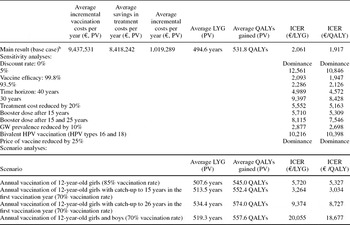
Given a 62-year time horizon, the result of the simulations showed the annual average extra cost to be €9.4 million and the average annual cost saved to be €8.4 million. This resulted in an average incremental cost per year of €1.0 million (Table 4). The average effect per year was estimated to be 494.6 LYG (due to fewer deaths from cervical cancer) and 531.8 QALYs gained (Table 4). Based on these results, the incremental cost-effectiveness ratios were estimated to be €2,061/LYG and €1,917/QALY (Table 4). The vaccination program thus led, on average, to approximately 210 avoided cases of cervical cancer per year, approximately 2,600 cases of avoided CIN1 per year, approximately 1,600 cases of avoided CIN2–3 per year, and approximately 26,000 cases of avoided GW per year—given a 62-year time horizon.
Main Result (Base–Case): Average Incremental Costs per Year (€, PV), Sensitivity and Scenario Analyses for Vaccination Over 62 Yearsa

a2007 price level. Vaccination over 62 years suggests that the incremental costs and effects are calculated as an average over the 62 years, assuming vaccination from the first year and onward.
bVaccination over 62 years (first – 62nd year) of 12-year-old girls, 70% vaccination rate, discount rate 3%, 100% vaccine efficacy.
PV, present value; QALY, quality-adjusted life-year; ICER, incremental cost-effectiveness ratio; LYG, life-year gained; GW, genital warts; HPV, human papilloma virus.
Table 4 also shows the results of the sensitivity and scenario analyses. Given an increased discount rate (5 percent) or a shorter time horizon (30 years), the cost-effectiveness ratios increase to €12,561/LYG and €9,397/LYG, respectively. In contrast, the incremental cost-effectiveness ratios were only marginally increased by assumptions of lower initial GW prevalence (due to reduced saved GW treatment costs) and reduced vaccine efficacy [efficacy estimates based on Table 1 in European Medicines Agency (6)]. The incremental cost-effectiveness ratios were increased markedly with a higher discount rate, a shorter time horizon, inclusion of a booster dose and reduced treatment costs (in view of the recent introduction of the HPV vaccine, the advantages of a booster dose are not yet known). If a 25 percent reduction in vaccine price is assumed, then the average annual savings in treatment costs outweigh the average incremental vaccination costs per year, that is, the vaccination program is dominant compared with current strategy, given a 62-year time horizon.
Table 4 also shows the results of four scenario analyses, which assume different vaccination rates and inclusion of either catch-up programs or additional vaccination of boys. It is seen that especially inclusion of boys in the vaccination program—but also increased vaccination rate or inclusion of a catch-up program to 26 years of age—increases the cost-effectiveness ratios markedly.
DISCUSSION
Agent-based modeling within the area of economic evaluation of infectious diseases and vaccine interventions is fairly novel (Reference Kim and Goldie10). The analysis presented in this study was based on a Danish model that contributes new information on dynamic modeling within the area of HPV transmission and vaccination. The study investigates the long-term effects of HPV vaccination and estimates the incremental cost and effects of the subsequent decrease in the incidence of genital warts, cervical cancer, and related pathologies.
The validity of predictions about future trends in HPV prevalence is difficult to assess. This model was calibrated to simulate the present Danish HPV prevalence, that is, the situation without HPV vaccination. The introduction of vaccination against HPV 6/11/16/18 (among 12-year-old girls) led to a decrease in the prevalence of these viruses. The subsequent reduction in the number of cases of genital warts, CIN1–3, and cervical cancer leads to an estimated average gain of 531.8 QALYs, 494.6 life-years, and estimated average incremental costs per year of €1.0 million, corresponding to incremental cost-effectiveness ratios of €2,061/LYG and €1,917/QALY. (The assumption of a 5 percent discount rate leads to estimated incremental cost-effectiveness ratios of €12,561/LYG and €10,846/QALY.) The result lies within the same range/level as in some studies [e.g., Elbasha et al. (Reference Elbasha, Dasbach and Insinga5)], whereas the cost-effectiveness ratios are higher in other studies [e.g., Bergeron et al. and Jit et al. (Reference Bergeron, Largeron, McAllister, Mathevet and Remy1;Reference Jit, Choi and Edmunds9)]. Apart from the choice of modeling approach (e.g., dynamic/agent-based versus cohort models) the results of the analyses are dependent on a range of parameters, including vaccination rate, applied unit cost estimates, applied discount rate, choice of QALY weights, and initial burden of disease in the form of incidence of genital warts and cervical cancer.
The discrepancy between the present results and those from other studies is partly due to the high Danish incidence of and mortality from cervical cancer, which are among the highest in Europe [Figure 3.3 and 3.4, page 33 in National Board of Health (18)]. The incidence of genital warts is also relatively high in Denmark (and the Nordic countries) compared with other European countries (Reference Kjaer, Tran and Sparen11)—see for example Monsonego et al. and The UK Collaborative Group for HIV and STI Surveillance (Reference Monsonego, Breugelmans and Bouee16;23)—resulting in a relatively large savings potential when a quadrivalent HPV vaccination program is introduced.
Bergeron et al. (Reference Bergeron, Largeron, McAllister, Mathevet and Remy1) found an estimated incremental cost-effectiveness ratio of €8.408/QALY using a third party payer perspective to investigate the effects of vaccinating 14-year-old girls. They used a Markov model with parameters including 80 percent vaccine coverage, 100 percent vaccine efficacy and 3 percent discount rate [Table 7 in Bergeron et al. (Reference Bergeron, Largeron, McAllister, Mathevet and Remy1)]. In our study using the same assumptions (i.e., 80 percent vaccine coverage, 100 percent vaccine efficacy, and 3 percent discount rate) we estimated a cost-effectiveness ratio of €4,145/QALY (data not shown in Table 4). This difference can be explained by the higher Danish incidence of cervical cancer and genital warts and the higher mortality from cervical cancer compared with France and also the fact that our model includes herd immunity whereas the French model is a cohort model (Markov model) that ignores the effect of herd immunity. Finally, we have applied a higher unit cost for treatment of CIN2–3, that is, €2,676 versus €759 [Table 3 versus Table 4 in Bergeron et al. (Reference Bergeron, Largeron, McAllister, Mathevet and Remy1)].
The scenario that was presented as the main result in the earlier Danish health technology assessment report was retained here as the main result to make comparisons between the earlier report and the present analysis. This scenario was also the one that resulted in the lowest cost-effectiveness ratio (Table 4), that is, 70 percent vaccination rate, vaccination of 12-year-old girls only, no catch-up program and no booster dose. The HTA report considered that a relatively low vaccination rate (70 percent) was the most realistic scenario in the Danish context in view of the Danish uptake of MMR-II vaccination [page 83 in National Board of Health (18)].
HPV 6/11/16/18 vaccination (i.e., inclusion of genital warts and 6/11-related CIN1) altered the cost-effectiveness result markedly compared with HPV 16/18 vaccination alone (Table 4). Data from other countries indirectly support this result, as it is estimated that the costs associated with treating HPV 6/11-related diseases amount to millions each year (Reference Hu and Goldie7).
The time horizon of the modeled intervention is long, and the results are sensitive to the choice of discount rate and the choice of time horizon. However, an analysis of HPV vaccination must necessarily be based on a long time horizon to capture all relevant differences in future costs and effects. Indeed, guidelines for economic evaluations recommend a lifetime horizon as the reference case where relevant [e.g., see Canadian Agency for Drugs and Technologies in Health (3)]. It is also important to emphasize that HPV vaccination is a long-term investment, although in the case of the quadrivalent vaccine it is worth noting that the protection against genital warts will contribute to earlier benefits from the vaccine.
The vaccine efficacy is, in principle, unknown but is presumably close to 100 percent [see, e.g., (Reference Olsson, Villa and Costa20)]. However, we performed sensitivity analysis assuming vaccine efficacy of 93.5 percent and 99.8 percent (6).
Two different sources were used for the applied QALY weights for the general population and for the specific occurrences/illnesses (Table 2). Furthermore, the QALY weights for the general population were distributed according to age group. This can lead to discrepancies. It appears from Table 2, for example, that the utility score for CIN1 was higher than any of the utility scores for the general female population, suggesting that the occurrence of CIN1 will not lead to any QALY loss. This is a limitation of the analysis that is primarily caused by the use of two different sources for QALY weights. It is thus possible that the total gain in QALYs is underestimated in the present results.
The results indicate that a catch-up program for 13- to 15-year-olds gives higher gains in terms of life-years and QALYs, yet the cost-effectiveness ratio increases only from approximately €2,050/LYG to approximately €3,250/LYG. Inclusion of 12-year-old boys in the vaccination program would double the annual vaccination costs but, given the high vaccination rate assumed in the female cohort, the extra effect on LYG and QALYs related to female cervical disease and to genital warts in both genders is relatively moderate. This calculation would need to be revised should more information become available on the vaccine's impact on other gender-neutral diseases related to HPV 6/11/16/18.
Study Limitations and Strengths
This health economic analysis used a modeling approach and thus was a simplified representation of real life that involved several assumptions, although sensitivity and scenario analyses were performed. Given the long-term public health impact of vaccination against HPV 6/11/16/18, analyses based on modeling are the only option if future effects (beyond the next few years) are to be estimated.
The model focused on heterosexual transmission of HPV and did not include transmission between homosexual and heterosexual persons; it also assumed that individuals had fewer sexual contacts as they aged. Furthermore, while new individuals were added to the model, HPV was not re-introduced at any time, for example by means of partners from other countries (while this might result in an over-optimistic estimation of the effects of vaccination, the herd-immunity effect was found to be very strong, and it would possibly offset re-introductions of HPV).
The results depend on a range of assumptions, including vaccine efficacy of 100 percent, reflecting assumed stability of the HPV viruses. Should the viruses drift, and the vaccine efficacy thereby drop, the impact of a vaccination scheme would also (but not necessarily proportionally) decrease. There are also other assumptions that affect the reliability of the results, for example, the applied cost estimates, as well as changes in clinical practice (e.g., future changes in treatment regimes for CIN2–3 or cervical cancer) that would presumably alter the cost levels. It was assumed in the current model that the participation rate in the cervical cancer screening program would be maintained in the future. However, if women are less likely to adhere to cervical cancer screening once they are vaccinated against HPV, then gains from the vaccination program would be partly offset by this decreased adherence to screening. An information campaign that emphasizes the need for continued screening would be very important.
It is a weakness of the present study that only univariate sensitivity analysis has been performed, as probabilistic sensitivity analysis would have allowed more detailed examination of the impact of input parameter uncertainty. However, it is a limitation of agent-based modeling—which does not comprise a set of linked (differential) equations that can readily be solved for different parameter settings—that such an analysis would be require a lengthy computer processing time. The model has previously been applied in an Irish setting, where a probabilistic sensitivity analysis was performed using combinations of costs per LYG that were estimated by reference to the outputs from the agent-based model. Thus, the robustness of the model has been tested; for details, see Usher et al. (Reference Usher, Tilson and Olsen24).
The present model only includes cervical cancer and not other HPV 16/18-related cancer such as anal, vulva, vaginal, oral and penile cancer. Inclusion of these would alter the results.
CONCLUSIONS
This study analyzed the prevention of cervical cancer, CIN1–3, and genital warts through HPV vaccination. A vaccination program as an “add-on” to the current cervical cancer screening strategy would lead to extra vaccination costs, but would also save treatment costs and improve both quality of life and survival. The cost-effectiveness ratios for vaccination program for 12-year-old girls were estimated to be €1,917/QALY (3 percent discount rate), €10,846/QALY (5 percent discount rate), and €7,546/QALY (3 percent discount rate and inclusion of two booster doses).
CONTACT INFORMATION
Jens Olsen, MSc (Econ.) (jeo@cast.sdu.dk), Head of Centre, Centre for Applied Health Services Research and Technology Assessment, University of Southern Denmark, J. B. Winslöws Vej 9B, DK-5000 Odense C, Denmark
Martin Rudbeck Jepsen, MSc, PhD (mrj@dmu.dk), Post.Doc, Department of Policy Analysis, National Environmental Research Institute, University of Aarhus, Frederiksborgvej 399, DK-4000 Roskilde, Denmark