Healthcare-associated infections (HAIs) and infections due to antibiotic-resistant organisms are leading causes of morbidity and mortality in the United States and worldwide. 1 , Reference Magill, Edwards and Bamberg 2 Prevention of these infections requires a multifaceted approach, collaboratively led by infection prevention and control (IPC) and antimicrobial stewardship programs (ASPs). In 2013, the Society for Healthcare Epidemiology of America (SHEA) Research Network (SRN) performed a survey evaluating IPC and ASP practices among SRN-affiliated facilities.Reference Morgan, Deloney and Bartlett 3 The 2018 survey expanded upon these data by characterizing current IPC and ASP practices among SRN facilities and highlighting projected future needs.
Methods
The SRN is a consortium of hospitals conducting collaborative research projects in healthcare epidemiology and antibiotic stewardship. All 132 facilities were invited to participate in this web-based Research Electronic Database Capture (REDCap) survey between July 12, 2018, and August 10, 2018. Surveys were completed by the SRN site principal investigator with input from individuals most familiar with institutional IPC and ASP practices. Survey responses were primarily categorical and 5-point Likert scale responses. All analyses were performed using Stata version 14 software (StataCorp, College Station, TX). This survey was deemed exempt from approval by the University of Pennsylvania Institutional Review Board.
Results
Overall, 64 surveys were completed (response rate, 48%) from a geographically representative sample of hospitals including 47 from the United States and 17 from international facilities representing 11 countries. Most facilities (62 of 64, 97%) were acute-care hospitals, 2 were long-term acute-care hospitals (LTACHs), and 45 hospitals provided care to children (Supplemental Table 1 online). Approximately one-third (19 of 64, 30%) of facilities completed both the 2013 and 2018 surveys.
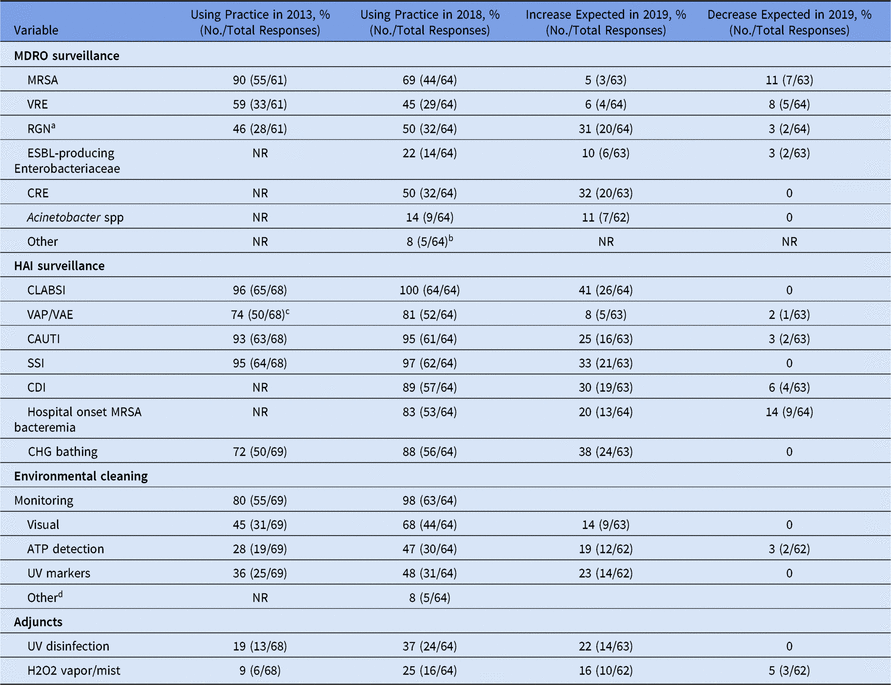
Active surveillance for multidrug-resistant organisms (MDROs) was frequently reported during both study periods; methicillin-resistant Staphylococcus aureus (MRSA) was the most common organism for which surveillance was performed in 2013 (55 of 61, 90%) and 2018 (44 of 64, 69%) (Table 1). Surveillance for multidrug-resistant gram-negative (MDR-GN) organisms, which had been anticipated to increase in 2014, was performed in a similar number of facilities in both 2013 and 2018 (28 of 61 [46%] vs 32 of 64 [50%], respectively). Although surveillance for specific MDR-GN organisms was not measured in 2013, 50% of hospitals performed active surveillance for carbapenem-resistant Enterobacteriaceae (CRE) in 2018.
Healthcare-Associated Infection and Multidrug-Resistant Organism Surveillance and Infection Prevention Practices

Note. MDRO, multidrug-resistant organism; MRSA, methicillin-resistant Staphylococcus aureus; VRE, vancomycin-resistant Enterococcus; RGN, resistant gram-negative; ESBL, extended-spectrum β-lactamase; CRE, carbapenem-resistant Enterobacteriaceae; NR, not reported; HAI, healthcare-associated infection; CLABSI, central-line–associated bloodstream infection; VAP, ventilator-associated pneumonia; VAE, ventilator-associated event; CAUTI, catheter-associated urinary tract infection; SSI, surgical site infection; CDI, Clostridioides difficile infection; CHG, chlorhexidine gluconate; ATP, adenosine triphosphate; UV, ultraviolet; H2O2, hydrogen peroxide.
a The total for RGN for 2018 is the sum of ESBL, CRE, Acinetobacter spp, and carbapenem-resistant (CR) P. aeruginosa.
b CR-P. aeruginosa (2 facilities) and Candida auris (1 facility).
c VAE surveillance was measured independently in 2013 and reported in 53 facilities (36/68).
d Culture swabs of surfaces (4 facilities); C. difficile spore detection kit (1 facility).
Similar to 2013, formal surveillance for HAIs was common in 2018, including central-line–associated bloodstream infection (CLABSI) in 64 of 64 hospitals (100%); ventilator-associated pneumonia (VAP)/ventilator-associated events (VAE) in 52 of 64 hospitals (81%); catheter-associated urinary tract infection (CAUTI) in 61 of 64 hospitals (95%); and surgical site infections (SSI) in 62 of 64 hospitals (97%) (Table 1). Most hospitals publicly reported CLABSI (50 of 64, 78%), CAUTI (48 of 64, 75%), SSIs (49 of 64, 77%), hospital-onset Clostridioides difficile (47 of 64, 73%), and hospital-onset MRSA bacteremia (53 of 64, 69%); fewer reported VAP/VAE (17 of 64, 27%). Monitoring of environmental cleaning effectiveness was more frequent in 2018, when it was performed in 98% of facilities compared to 80% in 2013. Similar trends were noted in the use of ultraviolet light and hydrogen peroxide mist/vapor modalities, which were used in 24 of 64 facilities (37%) and 16 of 64 facilities(25%), respectively, in 2018, respectively.
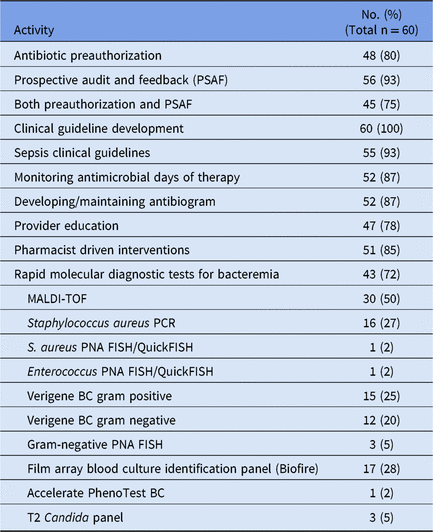
Antimicrobial stewardship programs were present in 95% of facilities (60 of 63) in 2018, an increase from 85% in 2013. Compared to 2013, the proportion of facilities providing financial support for physician stewardship medical directors increased (78% vs 52%), as did support for stewardship pharmacists (85% vs 54%). In 2018, 75% of ASPs utilized a combination of preauthorization and prospective audit and feedback. ASP activities in 2018 included guideline development (60 of 60, 100%), monitoring antibiotic days of therapy (52 of 60, 87%), development and maintenance of an antibiogram (52 of 60, 87%), provider education (47 of 60, 78%), and pharmacist-driven interventions (51 of 60, 85%). Of 60 facilities with ASPs, 43 (72%) used at least 1 rapid molecular diagnostic test for positive blood cultures, and within these facilities, the ASP discussed results directly with the primary team at 61% of hospitals. The most commonly used technologies were matrix-assisted laser desorption/ionization time-of-flight (MALDI-TOF; 30 of 60, 50%), Film Array (Biofire; 17 of 60, 28%), and Staphylococcus aureus polymerase chain reaction (PCR) tests (16 of 60, 27%) (Table 2).
Antibiotic Stewardship Program Activities and Use of Molecular Diagnostics

Note. PSAF, prospective audit and feedback; MALDI-TOF, matrix assisted laser desorption/ionization time of flight; PCR, polymerase chain reaction; FISH, fluorescent in situ hybridization; BC, blood culture.
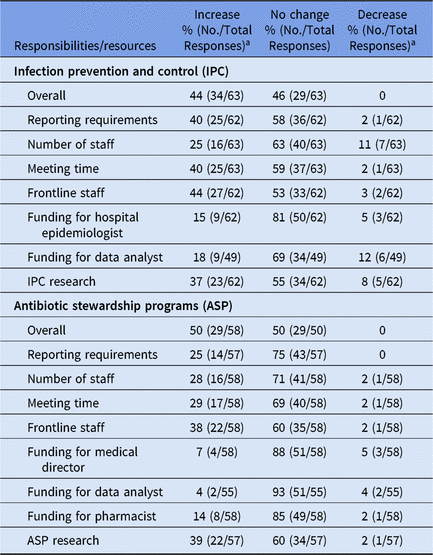
When surveyed in 2018, 44% of IPC programs and 50% of ASPs expected overall increases in responsibilities for 2019, including increased reporting requirements, time in meetings, and time with frontline care providers (Table 3). When asked to highlight challenges, ~50% of facilities cited lack of IPC and ASP funding and staff, and 54% of IPC programs and 60% of ASPs cited insufficient information technology and/or data analyst support. A minority of respondents indicated that they expected funding for ASP and IPC physician leadership and data analyst support to increase, whereas some facilities projected decreases (Table 3).
Projected Infection Prevention and Control and Antibiotic Stewardship Responsibilities and Resources, 2019

Note. IPC, infection prevention and control; ASP, antibiotic stewardship program.
a Survey responses for projected responsibilities were on a 5-point Likert scale. “Increase” includes survey responses “much more” and “somewhat more” and “decrease” includes “somewhat less” and “much less.”
Discussion
This survey characterized contemporary IPC and ASP practices for a large consortium of geographically diverse hospitals, and we used it to identify expected areas of growth as well as current and future challenges for effective infection prevention and antibiotic stewardship. These findings update those presented in a 2013 SRN survey, highlighting the ongoing core IPC focus on MDRO and HAI surveillance, increased focus on hospital environmental cleaning and monitoring, and the growth of financially supported ASPs over the last 5 years.Reference Morgan, Deloney and Bartlett 3 , Reference Yokoe, Anderson and Berenholtz 4 Finally, and similar to the 2013 sample, although responsibilities for both IPC and ASP are expected to continue growing, most facilities anticipate no increase in resources to support these demands. A lack of funding, staff, and data analyst support were cited as key barriers to effective IPC and ASP.
A limitation of this study was that only 30% of facilities answered both the 2013 and 2018 surveys; however, because both surveys reflect a diverse and geographically representative sample, several relevant comparisons can be made. First, the 2018 survey reflects a shift in focus toward active surveillance for MDR-GN organisms, including CRE, with fewer facilities reporting active MRSA surveillance. This finding may reflect a response to surveillance recommendations made in the 2015 Centers for Disease Control and Prevention (CDC) CRE toolkit, coupled with data demonstrating no significant reduction in MRSA transmission with active surveillance and use of contact precautions. 5 , 6 Second, respondents reported an increase in the use of automated technologies for environmental disinfection, which may reflect the growing body of literature demonstrating efficacy of these devices.Reference Weber, Rutala, Anderson, Chen, Sickbert-Bennett and Boyce 7 Third, the frequency of US hospitals with an ASP increased to 100%, with almost 80% reporting financial support for a physician medical director, likely reflecting the 2017 Joint Commission Antimicrobial Stewardship Standard mandating implementation of ASPs in all acute-care hospitals. Finally, consistent with prior studies demonstrating increases in adherence to the CDC’s Core Elements of Hospital Antibiotic Stewardship over time, guideline development, monitoring of antibiotic days of therapy, and pharmacist-driven interventions were frequently reported ASP activities.Reference O’Leary, van Santen, Webb, Pollock, Edwards and Srinivasan 8 , 9 Data demonstrating the positive impact of ASPs on relevant healthcare quality measures, including lowering antimicrobial costs, decreasing gram-negative resistance, and reducing the frequency of C. difficile infections are highlighted in the 2016 SHEA/Infectious Diseases Society of America (IDSA) guidelines and underscore the importance of universal ASP implementation for hospital systems.Reference Barlam, Cosgrove and Abbo 10
Overall, our survey demonstrates the increasingly complex role of the healthcare epidemiologist and ASP, including growing regulatory demands, burgeoning antibiotic resistance threats, and integration of emerging technologies into existing workflows; however, most facilities do not anticipate receiving additional resources to meet these demands. Funding to support healthcare epidemiology research from all governmental levels, as well as hospital-level support of IPC programs and ASPs should be prioritized.
Author ORCIDs
Kathleen Chiotos, 0000-0002-0204-8708
Acknowledgements
The authors thank the SRN participant institutions for taking part in this survey.
Financial support
K.C. received support from the Agency for Healthcare Research and Quality (grant no. 1K12HS026393-01). D.J.M. received support from the Veterans Affairs Merit Review Award (grant no. HSR&D CRE 12-307) and National Institutes of Health National Library of Medicine (grant no. DP2LM012890).
Conflicts of interest
Dr Morgan received honoraria from Springer Nature for textbook and journal editing. All other authors report no conflicts of interest relevant to this article.
Supplementary Material
To view supplementary material for this article, please visit https://doi.org/10.1017/ice.2019.172.