1. Introduction
The rise of technology-facilitated interaction has become increasingly normalized in day-to-day life—both in personal and professional settings (Kessler, Reference Kessler2017; Otto, Reference Otto, Chapelle and Sauro2017), so it is not surprising that it is also quite prevalent in educational arenas. The evolution of the technological landscape in language learning has continued to expand rapidly as well. The path of computer-assisted language learning (CALLFootnote 1) has been characterized by hostility (Dunkel, Reference Dunkel1987), threat (Clifford, Reference Clifford1986), apprehension (Dunkel, Reference Dunkel1987), enthusiasm (Golonka, Bowles, Frank, Richardson, & Freynik, Reference Golonka, Bowles, Frank, Richardson and Freynik2014; Salaberry, Reference Salaberry2001), fear (Blake, Reference Blake2001; Reference Blake2013; Clifford, Reference Clifford1986), utility (Chapelle, Reference Chapelle2007), skepticism (Salaberry, Reference Salaberry2001), and frustration (Hubbard, Reference Hubbard2009; van Lier, Reference van Lier2004), among other states. As technology gains in maturity, it is more widely accepted and used, and preconceived notions about technology evolve as well.
At times, technological change is so rapid that educators may have a hard time finding both the support and the time needed to keep abreast of such growth. Each new development, which can also be a disruption to the existing way of doing things, tends to incite a shift in medium/tools, which then is often associated with a paradigm swing and a new wave of research. With technology, this process can take place very quickly at times, and can become problematic when educators are not ready or able to embrace change. According to Golonka et al. (Reference Golonka, Bowles, Frank, Richardson and Freynik2014), changes in technology in language learning can help learners to increase their interest and motivation, which is critical to success (Dörnyei, Reference Dörnyei2001), provide access to target language input, engage learners with native speakers, and offer immediate feedback opportunities. However, they noted that the use of new technologies can also result in “inappropriate input, shallow interaction, and inaccurate feedback; student frustration with software and hardware; distraction from the learning task; and a general over-emphasis on delivery modality over learning objectives” (p. 71), and so its effective implementation is crucial. Other scholars have echoed these concerns. Clifford (Reference Clifford1986) noted that the progress in CALL implementation has not been “uniform” (p. 9), while Golonka et al. (Reference Golonka, Bowles, Frank, Richardson and Freynik2014), after examining over 350 studies of technologies and their effectiveness, found that while outcomes are often promising, sometimes evidence of efficacy is limited. Although we can be confident that technology use will continue to expand in all arenas, including education, CALL's somewhat conflicted history of promises and realities makes ascertaining its future challenging.
Against this backdrop of ever-changing technologies and tools, we must also consider changes in and around the broader profession of language teaching and learning, as these external forces have shaped where we are today. Nowhere is this external influence more evident than in the work undertaken by the Modern Language Association (MLA) in recent years. In 2007 the MLA explored the state of language teaching and learning in the United States (Modern Language Association Ad Hoc Committee on Foreign Languages, 2007), and shortly afterward it released another report addressing the role of languages in a “liberal” education (MLA, 2009). Of particular interest is its assessment of the foundational nature of literacy, broadly speaking, in all its many facets, including “to work with new forms of media through technological literacy, … and to analyze, organize, and make sense of the information through information literacy” (MLA, 2009, p. 2). The report goes on to clearly assert the role that new technologies play, and will continue to play, in education: “The rise of digital media has ushered in new paths to the pursuit and attainment of knowledge, which requires universities and colleges to adapt to the challenges and opportunities presented by this technological revolution” (p. 6). While the profession at large must concern itself with the multiple issues addressed by the MLA, in this article we explore the changing dynamics of our field with respect to the trajectory of CALL over the past decades and seek directions for the future. The next section begins with a retrospective look at CALL's past, focusing on how key articles have helped to shape the field.
2. Reflecting on the Past, Considering the Future
Earlier review articles in the Annual Review of Applied Linguistics (ARAL) have contemplated the roles of technology in language learning (Blake, Reference Blake2007; Reference Blake2011; Chapelle, Reference Chapelle2007; Otto, Reference Otto1980; Purcell, Reference Purcell1984). Depending on the context and situation, technology has been referred to as something that can potentially support, enhance, assist, aid, replace, or motivate learning. Whether technology serves as a tutor, tool, or medium (Kern, Reference Kern2006), it has played a pervasive role in language learning. In fact, Chun, Kern, and Smith (Reference Chun, Kern and Smith2016) suggested that “is that it is not possible to ‘opt out’ of using technology: It is so pervasive and so interwoven with human activity that to teach language without some form of technology would create a very limited and artificial learning environment” (p. 65). Otto (Reference Otto, Chapelle and Sauro2017) examined the varied roles of technology in her historical overview and found that many of the issues related to the use of technology that were raised in the early 1900s (see Clark, Reference Clark1918) remain today: material quality, engagement, support, and training of teachers, as well as sound objectives and pedagogy. Fischer (Reference Fischer1999) reminded us that “sound theory leads to good CALL products, and good CALL products contribute to theory building” (p. 564).
As documented by Otto (Reference Otto, Chapelle and Sauro2017), a number of publications have explored the history of CALL, including Sanders (Reference Sanders1995), Levy (Reference Levy1997), Davies (Reference Davies2008), Delcloque (Reference Delcloque2000), Jung (Reference Jung2005), Butler-Pascoe (Reference Butler-Pascoe2011), Davies, Otto, & Ruhoff (Reference Davies, Otto, Ruhoff, Thomas, Reinders and Warschauer2012), Thomas, Reinders, & Warschauer (Reference Thomas, Reinders and Warschauer2013), and Fischer (Reference Fischer2013). Each of these articles offers a unique lens to explore a different time period in the history of CALL. Additionally, a number of organizations and conferences are devoted to language teaching and technology, including The Computer-Assisted Language Instruction Consortium (CALICO), The European Association for Computer Assisted Language Learning (EUROCALL), International Association for Language Learning Technology (IALLT), Pan-Pacific Technology-Enhanced Language Learning (PPTELL), as well as journals like Language Learning & Technology, ReCALL (The Journal of the European Association for Computer Assisted Language Learning), CALL (Computer Assisted Language Learning journal), System (a journal covering the applications of educational technology and applied linguistics to problems of foreign language teaching and learning), Journal of Computer-Mediated Communication, and the CALICO Journal (Computer-Assisted Language Instruction Consortium).
The origins of CALL date to the 1960s, after the emergence of computer-assisted instruction (CAI) and computer-assisted learning. Levy (Reference Levy1997) originally offered as a definition of CALL “the search for and study of applications of the computer in language teaching and learning” (p. 1), and Egbert (Reference Egbert, Egbert and Petrie2005) later expanded the definition to include “learners learning language in any context with, through, and around computer technologies” (p. 4). While Levy's definition focuses on applications or tools, the later definition implies a more active process of engagement and interaction with the learner. This shift reflects how computers were used in the earlier stages of CALL as tools that provided assistance and guidance; it was not until later on that they offered more integrated role in learning.
What we know and refer to as CALL has been around since the 1960s and ’70s, yet research agendas are still emerging (Chapelle, Reference Chapelle1997; Felix, Reference Felix2005; Warschauer & Healey, Reference Warschauer and Healey1998), the conclusiveness of many studies is not solid, and there remains much work to be done. CALL is a relatively young field, and as such, Fischer (Reference Fischer2013) rightly pointed out that many came to the field of CALL not as trained practitioners, but as academics from other fields with little or no formal training in CALL or second language acquisition (SLA). Fischer also asserted that starting in the year 2000, those working in CALL were more closely aligned and trained in CALL and SLA, leading to a new period of research in CALL that would move the field forward and increase the related literature on language learning. Those working in the fields of CALL and SLA have “a long tradition of interrogating each other about best ways to engage in fruitful dialogue” (Ortega, Reference Ortega2017, p. 285).
More recently, Otto (Reference Otto, Chapelle and Sauro2017) situated 100 years of CALL into defined periods of time, including:
1. Early 20th century characterized by progressive eclecticism
2. Mid-century characterized by repetition
3. 1960s–80s characterized by interactivity and authenticity
4. 1980s characterized by compelling new contexts
5. 1990s characterized by new competencies
6. 21st century characterized by the social turn
While each of these periods helped to shape the next, the “basic media used in language instruction—written texts, drawings, photos, audio and video—have remained constant over time,” stated Otto (Reference Otto, Chapelle and Sauro2017) who recognized that corresponding technology tools and their role in language learning have changed radically (p. 21). In the next section, we look briefly at Otto's three most recent periods, identifying in each seminal articles in the field that shed light on language learning and technology (e.g., Blake, Reference Blake2007; Reference Blake2011; Chapelle, Reference Chapelle1997; Chun, Kern, & Smith, Reference Chun, Kern and Smith2016; Clifford, Reference Clifford1986; Dunkel, Reference Dunkel1987; Fischer, Reference Fischer2013; Garrett, Reference Garrett1991; Salaberry, Reference Salaberry2001; Warschauer, Reference Warschauer2000; Warschauer & Healey, Reference Warschauer and Healey1998; Ziegler, Reference Ziegler2016).
2.1. 1980s: (E)Merging Media
The developments surrounding the 1980s focused on merging media with language learning in various formats, including video, audio, images, and text. The innovation of this period offered an integration and merge of digital media in what Davies (Reference Davies2008) referred to as “multimedia CALL.” The emergence of video laser discs and video discs, CD-ROMs and included simulations, interactivity, and authenticity contributed to the novelty of this phase. Characterized by myriad changes, the 1980s brought an emergence of technology that seemed to come to fruition before language educators were ready to embrace all it could offer. One example of a lost technology is the laser disc. The laser disc, which was ahead of its time, offered remarkable picture quality and surround sound, but cost and training were prohibitive to many educators. As Dunkel (Reference Dunkel1987) warned, it would “take time for teachers in the humanities and foreign languages to become familiar with the potential of computers and to tap that potential for L2 learning and instruction” (p. 258). Often technology did not realize its potential as a tool until much later. Many articles from this period suggested that educators be open to change and try new tools. For example, Clifford (Reference Clifford1986) encouraged educators to shape the direction of the field by offering six challenges, including the need for higher-level activities in courseware, improvements in feedback capabilities and student input capabilities, progress in artificial intelligence, and involvement of educators in courseware development and matching the learning environment rather than the bells and whistles of the technology. These repeated exhortations to be open to technology reveal to us that during this time, there was a sustained unfamiliarity toward CALL, which was likely a result of the rapidity with which tools were emerging.
2.2. 1990s: Mediating Technology
In the 1990s, there was again a sudden technological development, including the explosion of computer-mediated communication (CMC, e.g., chat, email) and the distinction between synchronous and asynchronous communication. The focus on CMC, interaction, tasks, and authenticity mirrored trends in SLA at that time and allowed for the blurring of temporal and spatial constraints, as learners explored new spaces and means to communicate in different countries or settings. Still, technology continued to move at a faster pace than educators could consume. Garrett (Reference Garrett1991) asserted again that “technology that can be taken for granted today is already light-years ahead of the profession's ability to integrate a principled use of it into the classroom and the curriculum” (p. 74; see also Dunkel, Reference Dunkel1987). Moreover, Garrett (Reference Garrett1991) attempted to clarify that the computer was not, in and of itself, a method of language learning but rather a medium or environment (see also Blake, Reference Blake2001). With a push to use and integrate technology, Garrett raised a series of questions for educators to consider, among them are the following:
1. Does technology aid language teaching and/or learning?
2. Is it worth the time, effort, and cost?
3. Should technology assist teaching (handle homework)?
4. Can using computers help students learning another language? Or learn to communicate in another language?
Garrett (Reference Garrett1991) made clear that teachers needed support in how to make informed and pedagogically sound decisions about how to integrate technology into everyday classroom activities. Garrett was interested in how technology could be used to leverage language learning and wrote to an audience of educators who may have been reluctant and even resistant to use technology. These teachers lacked training, support, and financial incentives to learn, and according to Garrett (Reference Garrett1991), they were also still driven by the fear that technology could replace them or some of what they do.
Later in the decade, others sought to classify technology's role in language teaching and learning (e.g., Fotos, Reference Fotos1996; Warschauer, Reference Warschauer and S. Fotos1996). Warschauer and Healey (Reference Warschauer and Healey1998) provided a comprehensive account of technology's role in the past and in the present, also looking to the future of technology for the 21st century. They noted that administrators were invested in technology and desired a software solution that would be available and accessible to the student at any time and that provided realistic native speaker models of language, integrated curriculum, needs assessment, tailored activities for the learner, and a record and evaluation of student work. At the time, such comprehensive software was hard to find within the context of language learning, but as they looked to the future, Warschauer and Healey (Reference Warschauer and Healey1998) offered two main directions: electronic literacy (skills in effective writing as well as finding, evaluating, and critically interpreting digital material) and intelligent CALL, including more sophisticated conversations with the computer and translation. They suggested that “future developments in networked communication, multimedia, and artificial intelligence will likely converge, creating a potentially more central role for the computer as a tool for authentic language exploration and use in the second language classroom” (p. 67).
2.3. 2000s: Participatory, Social, and Reflective
The early 2000s witnessed a rapid growth in CALL research, in both quality and quantity, as well as increased and diversified lines of inquiry (Blake, Reference Blake2007). Among these was an increase in research around communication tools that allowed for the participation of one-to-many and many-to-many: for example, collaborative spaces like wikis, telecollaboration, learning management systems, and microblogging (which comprising blogging and instant messaging, allowing users to create short messages to be posted and shared with an audience online). CMC also grew to be a “dominant force” (Fischer, Reference Fischer2013) in CALL during this time. Despite the growing trends in technology, this period also saw increased reflection as researchers contemplated where the field was and where it was going. New conceptual frameworks and models emerged in an attempt to map out CALL's progression: For example, Davies (Reference Davies2008) discussed CALL in terms of traditional CALL, multimedia CALL, explorative CALL, and web-based CALL, and Warschauer (Reference Warschauer2000) and Bax (Reference Bax2003) both attempted to situate CALL historically, arguing for divisions of phrases (Warschauer, Reference Warschauer2000) or approaches (Bax, Reference Bax2003). Warschauer's stages or “phases” of CALL included structural (1970s–80s), communicative (1980s–90s), and integrative CALL (post-1990s), with each stage corresponding to a pedagogical approach. Bax (Reference Bax2003) proposed three new categories of approaches to expand on Warschauer's model: restricted, open, and integrated CALL. Moreover, Bax (Reference Bax2003, Reference Bax2011) argued for the need for normalization, referring to that moment in which a pedagogical technology becomes “invisible, so seamlessly is it employed in our everyday practice in the service of language learning” (p. 1) and at which point it reaches its maximal effectiveness. Later, Blake (Reference Blake2007) discussed types of CALL design, including tutorial (implementing computer programs with a teaching presence to improve aspects of language learning), intelligent (using artificial intelligence in CALL materials that process and provide feedback on language input), social (using social technologies in language learning), and gaming CALL. He claimed that the types of CALL are important as we continue to consider technology's role, noting too that “the role of explicit feedback either through iCALL or CMC will continue to be a major focus for CALL researchers” (p. 30).
During this period, Blake (Reference Blake2007) shed light on several new or renewed directions in CALL including (1) feedback and intelligent CALL (glossing or providing a notation, often in multimedia form, bots or autonomous programs that can interact with systems or users, intelligent tutoring/feedback or systems that provided feedback to users, and automatic speech recognition or when the hardware or software identifies or processes the human voice), (2) distance learning (with various environments such as teleconference, hybrid, blended, or virtual), asking the question of whether hybrid or completely virtual formats can “engender linguistic results comparable to those fostered within a traditional L2 classroom,” and (3) teacher training and technology.
Despite the progress that this period brought with it, issues still remained. For example, practitioners continued to note a lack of relevant training and continued inquiries into what might be the “best way to use the technology” (Bush, Reference Bush2008, p. 444), as well as the extent to which technology was truly “interactive” (p. 453). Salaberry (Reference Salaberry2001) argued that while many mainstream technologies “may have been revolutionary in the overall context of human interaction, it is not clear that they have achieved equal degrees of pedagogical benefit in the realm of second language teaching” (p. 39).
Blake also recognized during this time an apparent fear among language teachers of being replaced by computers (2001). Blake's work attempted to debunk this mythologized fear by pointing out that while it is unlikely for any technology to replace a human teacher, teachers who use technology would probably replace teachers who did not use it. It is worth noting, though, that this was not a new concern; Clifford (Reference Clifford1986) had already suggested that “teachers will always be a part of the language learning environment, but their role will change” (p. 13) and that the challenges of the future would be to help teachers integrate technology rather than trying to replace teachers with technology.
Bush (Reference Bush2008) acknowledged that this process of helping teachers use technology well is one that is not necessarily linear. “There would have been no way for [educators] to avoid the necessary trial and error, the twists and turns of technology and the development of the necessary science that only comes with concerted research over time. Things are not different today with CALL” (p. 465). He suggested that rather than ask how technology could be used for learning, a better question to contemplate might be “which instructional problem exists that could benefit from the application of the technology” (p. 465). At the same time, technology was not without its detractors, either; van Lier (Reference van Lier2004) argued that “technology has made [teaching] more interesting, and also more frustrating. It saves time, and it wastes time. It makes the students interested, and it also distracts the students in negative ways” (p. 186). As Fischer (Reference Fischer2013) and others have suggested, the appropriate use of technology must be more than simply bells and whistles; it must be driven by solid pedagogically sound tasks and theories.
2.4. 2010s: The “Social Turn” (Otto, Reference Otto, Chapelle and Sauro2017)
The present decade focuses on the social side of technology, including social media and networking, gaming, fandom, online learning, corpora, mobile learning, and open resources. Today, technology is changing the way students learn. Generation Z learners are considered true digital natives, equipped with smartphones and social media, and they have often been exposed to technology at very young age. They desire immediacy, have a very short attention span, have an affinity for video, and rely (perhaps too much) on Google (Geck, Reference Geck2006). These learners have become accustomed to how easy it is to communicate and collaborate across the globe, allowing them to be known as a generation without boundaries. There is a clear preference to watch live videos rather than read posts; while the use of video is growing, augmented reality and mobile ready content are also expanding (Seemiller & Grace, Reference Seemiller and Grace2016). And, according to a survey of young people in 19 countries, those belonging to Generation Z were also enthusiastic about virtual reality (Bresman & Rao, Reference Bresman and Rao2017). At the same time, some have suggested that technology hinders students’ ability to focus and causes them to be easily distracted (Richtel, 2012), while Thorne, Sauro, and Smith (Reference Thorne, Sauro and Smith2015) reminded us that “well-intentioned and reasonably designed and implemented uses of technology do not always deliver on their initial promise” (p. 229), often due to the conflicts and complexities involved with negotiating and representing identities online and offline.
Another development during this decade has been the ongoing growth of mobile-assisted learning (MALL) and online learning. MALL, which offers both portability and connectivity, has exploded in recent years with the widespread use and availability of mobile devices. Although most studies on MALL remain experimental (Burston, Reference Burston2014), research on MALL includes vocabulary learning, listening, and speaking skills (e.g., Viberg & Grönlund, Reference Viberg, Grönlund, Specht, Sharples and Multisilta2012). MALL has facilitated the growth of online learning, which includes web-facilitated, hybrid, or fully online classes (Blake, Reference Blake2011). Blake also noted that online language learning is “just beginning to enjoy the same popularity already experienced within other disciplines for some time” (p. 19; see also Goodfellow & Lamy, Reference Goodfellow and Lamy2009; Lamy & Hampel, Reference Lamy and Hampel2007; Meskill & Anthony, Reference Meskill and Anthony2010). The intersection of social networking, digital, and multiliteracy skills can provide a unique way of bringing together individuals, communities, and groups to engage in the sharing of information and meaningful discussion. Lomicka and Lord (Reference Lomicka, Lord, Fall and Murray2016) argued for “careful planning and sound task design that takes maximum advantage of [social networking systems (SNS),] while also providing solid technological guidance and advice to learners” (p. 265). They further suggested that through this guidance, unique communities of learners can come together to share and engage in meaningful ways as they discuss, reflect, and learn.
In today's CALL, Otto (Reference Otto, Chapelle and Sauro2017) acknowledged that “technology has advanced from its ancillary role in the curriculum to become a core source of content and a conduit for authentic language learning experiences” (p. 21). This decade has brought innovation in microblogging (see Blattner, Dalola, & Lomicka, Reference Blattner, Dalola, Lomicka, Dixon and Thomas2015; Blattner, Dalola, & Lomicka, Reference Blattner, Dalola, Lomicka, Winstead and Congcong2016; Hattem & Lomicka, Reference Hattem and Lomicka2016; Lomicka, Reference Lomicka, Thorne and May2017; Lord & Lomicka, Reference Lord and Lomicka2012a; Reference Lord and Lomicka2012b), SNSs (Blattner & Lomicka, Reference Blattner and Lomicka2013; Lomicka & Lord, Reference Lomicka, Lord, Fall and Murray2016), fandom (Sauro, Reference Sauro2017; Sauro & Sundmark, Reference Sauro and Sundmark2019), gaming (Reinhardt & Sykes, Reference Reinhardt, Sykes and Reinders2012; Sykes, Reference Sykes, Taguchi and Sykes2013, Reference Sykes2018; Sykes & Holden, Reference Sykes, Holden, Ducate and Arnold2011; Thorne & Hellermann, Reference Thorne, Hellermann, Colpaert, Aerts and Kern2017), and augmented and virtual reality technologies (Godwin-Jones, Reference Godwin-Jones2016; Sykes, Brim, & Kaiser, Reference Sykes, Brim and Kaiser2016). This shift of technology as a core source of content (rather than ancillary material) has allowed researchers and practitioners to explore more complex areas, syntheses, and meta-analyses (e.g., Lin, Huang, & Liou, Reference Lin, Huang and Liou2013; Plonsky & Ziegler, Reference Plonsky and Ziegler2016; Sauro, Reference Sauro2011), while the rapidity of change and growth in technology has kept the field moving forward both in and out of the classroom. As this decade is rapidly coming to a close, scholars have pointed out that issues still remain, such as how to discern communicative and social consequences from using one form of technology over another (Chun, Kern, & Smith, Reference Chun, Kern and Smith2016) and understanding how the continuity between learning in and out of the classroom may facilitate teaching with CALL by “minimizing the amount of time teachers and learners must spend learning how to use the technology” (Sauro & Sundmark, Reference Sauro and Sundmark2019, pp. 2–3).
In this section we have provided an overview of the development of CALL over recent decades, up to today, and highlighted relevant work in the field. With this in mind, we can now explore the ways in which the broader second language teaching and learning profession has evolved with and against the technological developments.
3. Student and Faculty Perspectives on CALL
With the goal of exploring the role of CALL in today's language curricula, and if and how educators and students have embraced this and other recommendations of the MLA reports, we administered surveys to students and faculty/administrators. The part of the survey discussed in this article consisted of multiple-choice or open-ended short-answer questions about use of technology in language teaching and learning. Each question on the survey corresponded to one of the recommendations of the 2007 MLA report, although we are looking here at those specific to technology. (Readers interested in the broader results are encouraged to consult Lomicka & Lord, Reference Lomicka and Lord2018.) Note, however, that we intentionally did not provide a description of what we meant by the term “technology,” so as not to limit respondents’ reactions and to assess as broadly as possible how the profession views its own technology use and integration.
The survey was distributed in the fall of 2016 via email, online discussion groups, and social media, and it yielded a total of 380 responses in the United States from those in private and public institutions: 134 from faculty/administrators and 246 from graduate and undergraduate students. In spite of this relatively small sample size, the breakdown of respondents seems to indicate that it is a fairly representative of the discipline. In terms of student responses, more than 91% were undergraduates, with fewer than 9% coming from graduate students. Of the undergraduates, 60% indicated that they were majoring or minoring in one or more foreign languages. Among the faculty respondents, about a third were in their first four years in the profession, and the other two thirds were evenly divided between those who had been in the profession 5–9 years, 10–19 years, and more than 20 years. Most respondents were in tenured or tenure-track lines, with a large percentage of responses also coming from language program directors. Most of the faculty responses came from Spanish language faculty, but there was also representation from German, French, Italian, African languages, and others. There was an even mix of faculty specializing in literature, linguistics, and language.
In the interest of learning about language faculty and student attitudes toward the use of technology, the survey included questions about types of technology used, specific tools used, and preferences for class delivery methods, the latter especially in light of the fact that hybrid and online courses are becoming increasingly ubiquitous. The questions on the survey that asked about the type of technology that faculty and students regularly make use of in their classes were open-ended, as we did not want to restrict responses a priori; we later combined these responses into logical categories for reporting. (However, note that repeated mentions of any given tool or type by the same respondent were only counted once; however, if one response listed multiple tools/types, each was counted. For this reason, percentages may not add up to 100.)
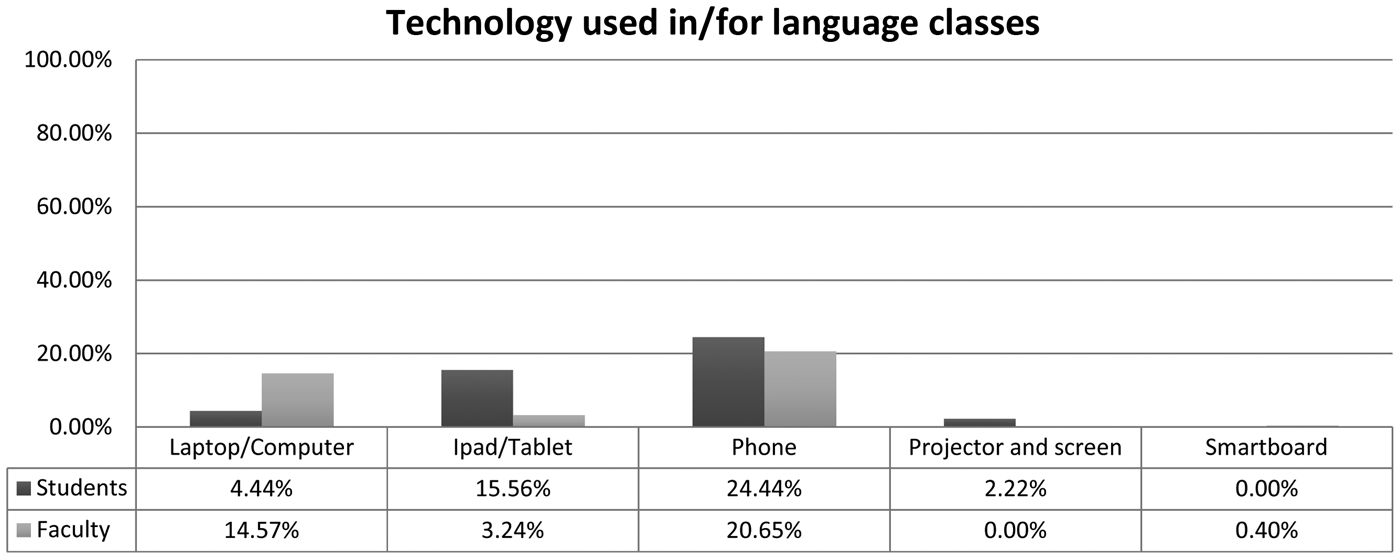
Figure 1 displays the responses regarding the hardware tools used in and for language classes. Recall that responses were grouped into the broad categories that emerged a posteriori based on what was mentioned, so not all tool types may be represented, and the responses cannot be considered exhaustive in nature.
Types of technology used in/for language classes.

What emerges from these data, first and foremost, is that technology use is still relatively minimal, at least for language classes, with even the most popular response (phones) being selected by only 25% of students and 20% of instructors. About 15% of faculty indicate that they use a computer in class, with 15% of students mentioning a tablet or iPad. (It is a bit surprising that only 2% of student responses—and no faculty responses—mentioned the LCD “projector and screen,” given that most classrooms contain these tools; we assume that these are in fact such default components of language classrooms that most respondents did not think to mention them).
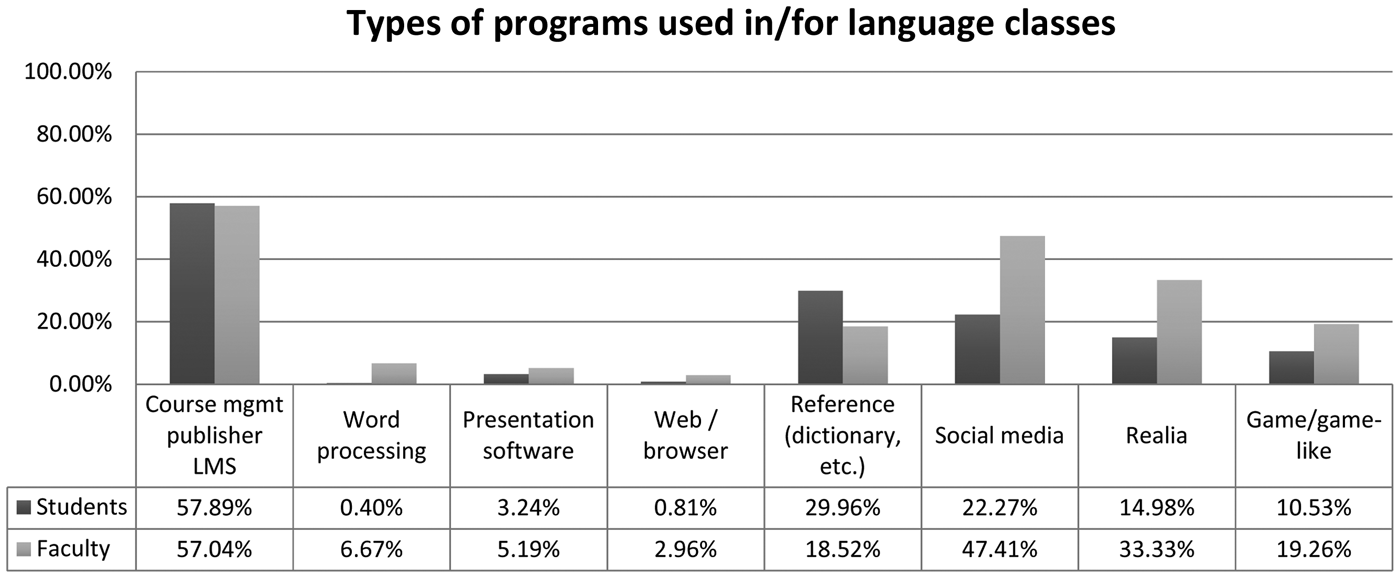
We then asked respondents to indicate the programs and applications that they used in their language classes. Answers were categorized into the following broad areas: course management tools and publisher-provided learning management systems, word processing programs, presentational software, web pages and browsers, online reference tools such as dictionaries and translators, social media tools, general realia, and games or game-like tools (Fig. 2).
Types of programs and apps used in/for language classes.

By far, the most frequently mentioned tool was the publisher-provided management system (such as iLrn, Connect or MyLanguageLabs), with almost 60% of all respondents—students and instructors alike—mentioning these. For instructors, the next most frequently mentioned type of programs were social media (47%), realia sources (33%), games and game-like language sites (19%), and reference sites (18%). For students, reference sources were the next most popular (19%), social media (22%) and realia (15%).
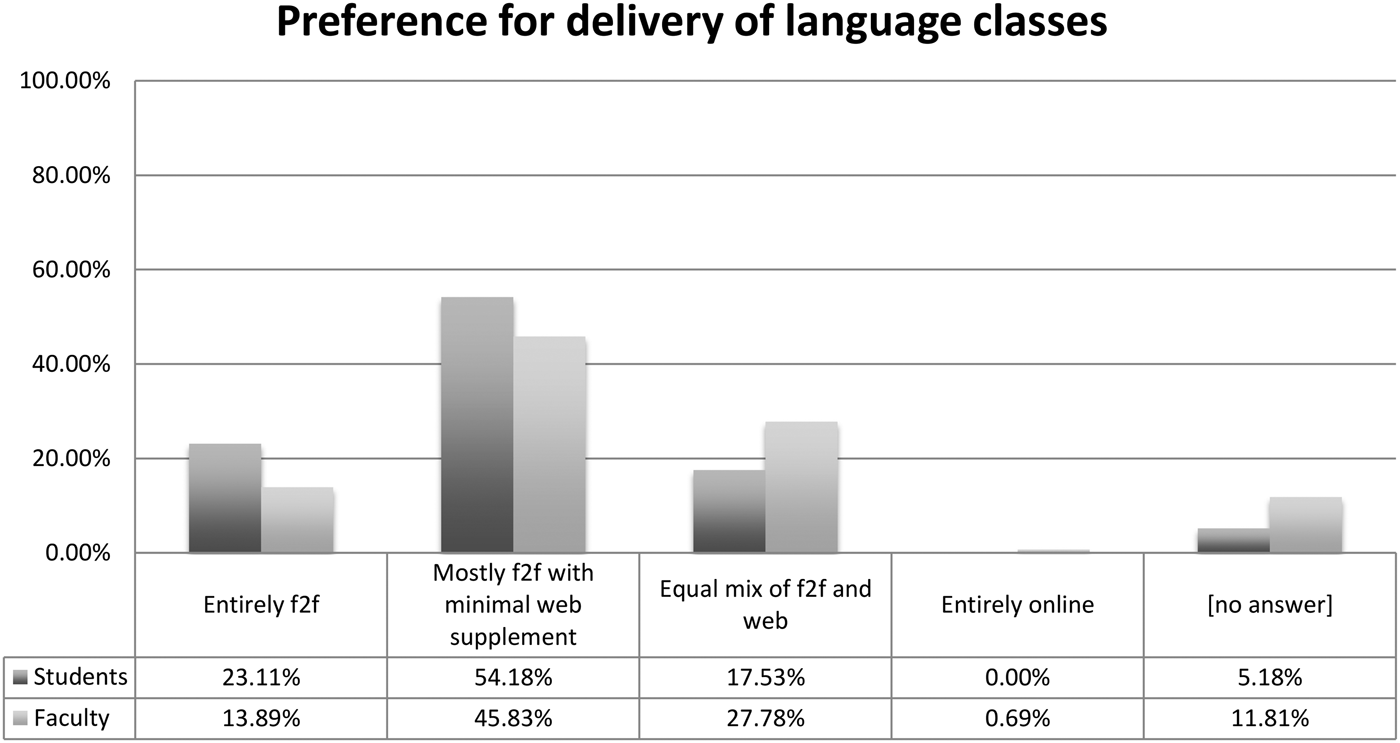
Finally, a multiple-choice question on the survey asked about students’ and instructors’ preferred delivery methods, specifically for language classes. As can be seen in Figure 3, students preferred entirely or mostly face-to-face classes (77.29%), even more so than faculty (59.72%), while the remainder of both populations preferred an equal mix of online and face-to-face components, with virtually nobody preferring fully online delivery (Figure 3).
Survey responses regarding class delivery preferences.

This dynamic is especially interesting given how prevalent hybrid and online languages classes are, with increasing pressure on departments to expand those offerings. Although we did not ask if students were specifically enrolled in online classes, we did ask if their language classes had both online and face-to-face meetings; 45% indicated that their language classes only had face-to-face meetings, and the other 55% indicated that their classes had some mixture of online components and face-to-face elements. Open-ended follow-up comments on this question show that both students and instructors recognized the importance of face-to-face interaction for class. One faculty respondent commented, “I don't think students gain as much [in hybrid classes] as they do with [face-to-face] IN PERSON encounters with classmates and their instructor,” and another faculty respondent confirmed, “There is nothing like [face-to-face].” Students also shared this general opinion, with comments such as “I personally do not like using technology for language learning” and, to note why they preferred in-person classes, “If a student has questions, they cannot be readily answered and responses are not tailored to what the student needs.” Since it seems likely that online learning is here to stay, though, we must ask ourselves: How can the profession make the best use of the technologies and tools available to maximize the online language class for students and teachers alike?
Taken together, we can use these responses to try to understand the extent to which higher education institutions have embraced technology for educational purposes, as the MLA has suggested, along with a long history of CALL scholars. We see that technology, in its broadest sense, is undoubtedly present in higher education language classes, but these results also indicate that its use is perhaps not as diverse or as widespread or widely accepted as earlier works predicted it might be. For example, the overall lack of technologies, and use of technology, mentioned by both instructors and students tells us that there is less diversity overall in terms of types of platforms and specific tools that are commonly used. There always have been and always will be innovators in the field, such as those whose work was reviewed in the previous section, and those who share their work at professional meetings or publish in CALL journals, but these findings indicate that only a minority of language educators are engaged in such innovation. The vast majority of respondents who indicated technology use in their language classes mentioned the publisher-based companion sites and/or general course management systems as their technology. While these tools undoubtedly make our lives easier and streamline certain administrative processes, we do not consider them innovative practices geared toward improving students’ language learning outcomes. In spite of advances in technologies available, these publisher-sponsored sites still tend to be computer-graded, decontextualized grammar and vocabulary activities that offer little, if any, in the way of the 5Cs (communication, cultures, connections, comparisons, and communities). Are we doing our students and our profession a disservice by allowing these online platforms to drive our language programs?
Another surprising result of the survey was in the overall preference, among both instructors and students, for face-to-face classes. Even hybrid courses, which have been touted as the best of both worlds, seem to be lacking in the respondents’ eyes. This is, of course, especially surprising since we tend to assume that our students not only are highly tech savvy but also far prefer everything online—we see that this is not categorically the case. Students commented that this resistance is due largely to the cost of publisher supplements and to frequent problems with the technology not functioning correctly, so their opinions are based more on issues beyond the technology itself. At the same time, though, if their primary experience with “using technology” involves only the publisher-produced online workbooks, it may be less surprising that they are not inspired by this use. Instructors, however, cited a variety of concerns, ranging from glitches with the technology to feeling inadequately prepared to develop pedagogically strong tasks, as well as noting the lack of time, resources, or motivation to try out new things in their curricula.
4. The Future of CALL in Higher Education
Two primary observations have emerged from our study: (a) The field of language teaching and learning as a whole has indeed made great strides in the past several decades when it comes to CALL, but (b) we still seem, in spite of all this, to be at a stage of primarily superficial use of technology in our classes. To move past this, we believe that this conversation needs to shift away from talking about technology in general, as it seems that has become a meaningless term with the ubiquity of technology resources available to us. For example, our respondents made frequent mentions of tools like PowerPoint, online dictionaries, or crossword generators as “technology” that they used—these are valuable resources but merely use digital formats to do what can be done on paper, and they do not push us to expand our teaching or our learning. Rather, we believe that as a profession we need to focus on those specific tools that can truly help both instructors and students to maximize language teaching and learning, and explore the “Web 3.0” (see, e.g., https://www.techopedia.com/definition/4923/web-30) family of social and semantic tools if we wish to fully embrace technology.
Likewise, the conversation needs to shift away from exploring onetime activities using a technology tool and toward a state of “normalized” CALL (e.g., Bax, Reference Bax2011) that would see technology as an essential, desired, and natural component of every aspect of language teaching and learning. Not only is such integration necessary to propel the field of teaching and learning forward, but it is only through such integration that will we be able to achieve the goals set out by the hallmark leaders of our profession, such as the MLA. As a field, we should be striving for a fully integrated curriculum, a foundation for lifelong learning, the ongoing expansion of languages taught (including less commonly taught languages), K–16 (i.e., kindergarten through college) alliances that promote and facilitate the study of languages across all areas of the educational community, and the expansion of our general curricula to include issues such as language for specific purposes. We continue to believe, as others (e.g., Garrett, Reference Garrett2009; Lafford, Reference Lafford2009) do, that achieving such lofty but necessary goals will only be possible through true CALL integration.
So, how do we achieve this next stage of technology normalization in our profession? To begin with, CALL researchers and practitioners must continue to investigate what tools are available, what learners and instructors prefer (and why), and what delivery methods are most appropriate for different learning goals and contexts, while also encouraging all our colleagues to explore these new avenues with us. At the same time, we must recognize that many instructors already feel overworked and underprepared to take on new challenges, and so language department administrators need to be involved as well, to incentivize professional development through additional resources (e.g., time, tools, money) and motivation. Additionally, CALL organizations must continue to support this work and provide venues for sharing and showcasing the findings. But the future cannot depend on CALL alone. Our other professional organizations—including the MLA, the American Council on the Teaching of Foreign Languages (ACTFL), the American Association of Applied Linguists, among others—must also be active contributors to the dialogue. Some of these do already support CALL work, by offering special CALL strands in their conferences, for example, or publishing special issues on technology; however, we propose that CALL cannot continue as an add-on component, but rather must be normalized at the heart of all of these organizations. Doing so will empower non-CALL practitioners to explore new opportunities, tools, and techniques, and will allow CALL scholars to provide guidance and models.