Environmental stress is strongly implicated in a diverse range of psychiatric conditions (Grant et al., Reference Grant, McMahon, Carter, Carleton, Adam, Chen, Lewis and Rudolph2014). For instance, stress reactivity is associated with the emergence and severity of psychopathology (Kendler & Gardner, Reference Kendler and Gardner2010; McLaughlin et al., Reference McLaughlin, Green, Gruber, Sampson, Zaslavsky and Kessler2012). Conversely, many mental disorders prospectively predict the occurrence of stressful life events, an effect known as stress generation (Conway, Hammen, & Brennan, Reference Conway, Hammen and Brennan2012).
Prospective studies examining links between stressful life events and psychopathology have typically focused on depression, but accumulating evidence also links stress reactivity and stress generation to anxiety, addiction, and personality pathology (Boden, Fergusson, & Horwood, Reference Boden, Fergusson and Horwood2014; Conway, Boudreaux, & Oltmanns, Reference Conway, Boudreaux and Oltmanns2018; Uliaszek et al., Reference Uliaszek, Zinbarg, Mineka, Craske, Griffith, Sutton and Hammen2012). Stress may play a particularly salient role in borderline personality disorder (BPD). Stern (Reference Stern1938), who coined the term ‘borderline,’ linked the condition to decompensation in the presence of acute stress. Others have noted that some symptoms and traits linked to BPD may serve to elicit negative experiences from the environment (Gunderson & Singer, Reference Gunderson and Singer1975). Likewise, Schmideberg (Reference Schmideberg1947) pointed out that stress and adversity occur more commonly in BPD than in other conditions. Many of these early observations converge with more recent empirical findings. Individuals diagnosed with BPD report a higher number of stressors and greater emotional reactivity following stress compared to healthy comparison subjects or subjects with other psychiatric disorders (Glaser, Van Os, Mengelers, & Myin-Germeys, Reference Glaser, Van Os, Mengelers and Myin-Germeys2008; Hepp et al., Reference Hepp, Lane, Carpenter, Niedtfeld, Brown and Trull2017; Pagano et al., Reference Pagano, Skodol, Stout, Shea, Yen, Grilo and Gunderson2004).
Historically, stressors have been divided into two types: independent, which reside primarily outside the individual's control (e.g. death of a loved one, natural disaster), and dependent, which are at least partially the result of the individual's own choices and behaviors (e.g. relationship problems, legal trouble). In two recent studies of adults living in the community, BPD symptoms prospectively predicted dependent stressful life events, consistent with a stress generation effect (Conway et al., Reference Conway, Boudreaux and Oltmanns2018; Powers, Gleason, & Oltmanns, Reference Powers, Gleason and Oltmanns2013). Importantly, however, less is known about the effects of stress among individuals diagnosed with BPD, who have a more severe clinical expression that includes suicidal behavior, self-injury, impulsive behavior, and unstable or chaotic interpersonal relationships.
Like most personality disorders, BPD is remarkably heterogeneous, with features that overlap with other conditions and span cognitive, affective, and interpersonal domains (Wright et al., Reference Wright, Hallquist, Morse, Scott, Stepp, Nolf and Pilkonis2013). Heterogeneity within BPD can complicate research on stressful life events. For example, certain features of BPD (e.g. impulsivity) may be responsible for its previously reported links to stress, whereas others may not be related to stress at all. As a result, there is a pressing need for research that can parse which of the heterogeneous features of BPD drives its prospective associations with stress.
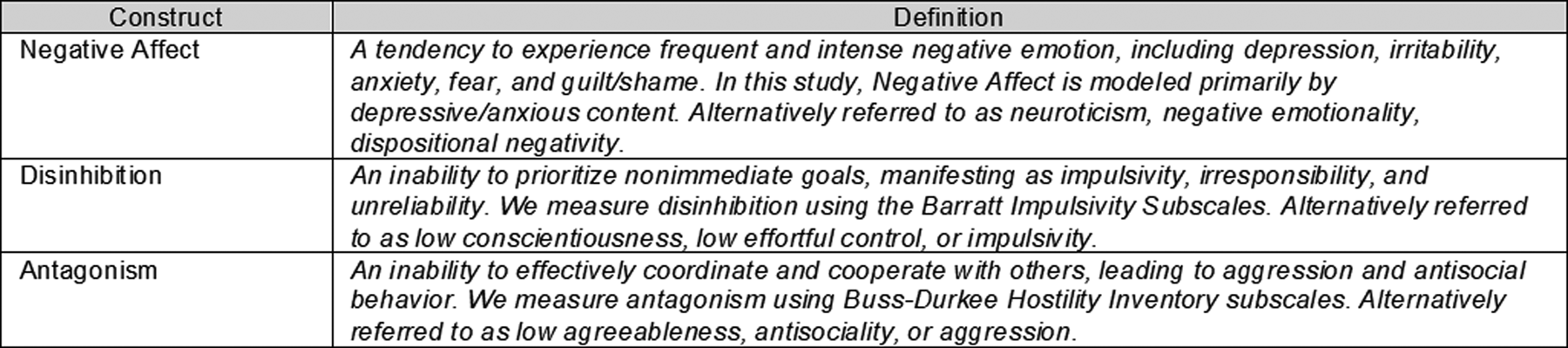
One fruitful way to parse heterogeneity within BPD is to conceptualize the disorder within an empirically derived dimensional framework, similar to those proposed within the Alternative Model of Personality Disorders for DSM-5 (AMPD) and the Hierarchical Taxonomy of Psychopathology (HiTOP) (Kotov et al., Reference Kotov, Krueger, Watson, Achenbach, Althoff, Bagby and Zimmerman2017). BPD is well-described by dimensional frameworks, with individuals diagnosed with the disorder consistently showing high levels of negative affect, antagonism, and disinhibition (Samuel & Widiger, Reference Samuel and Widiger2008; see Fig. 1). Negative affect reflects a tendency to experience frequent and intense negative emotions, including sadness, irritability, anxiety, and fear. In the present study, we operationalize negative affect using scales assessing internalizing symptoms, such as anxiety or depression. Disinhibition is associated with an inability to prioritize long-term goals, leading to careless, impulsive, and short-sighted behavior. Finally, antagonism captures an inability to effectively cooperate and coordinate with others, often manifesting in interpersonal conflict, aggression, and callousness. Interestingly, longitudinal studies have shown that changes in BPD symptoms are accompanied by corresponding changes in all three of these dimensions, suggesting that they may capture most of the phenotypic variance observed in BPD (Wright, Hopwood, & Zanarini, Reference Wright, Hopwood and Zanarini2015).
Definition and operationalization of study constructs.

Examining individual differences in negative affect, antagonism, and disinhibition (defined in Fig. 1) can help to clarify the relationship between BPD and stress, particularly the generation of dependent life stressors. In this study, we measured each dimension, as well as life stressors, in a sample of individuals diagnosed with BPD who were assessed annually for 3 years. We developed hypotheses based on previous longitudinal research in both healthy and clinical samples. For instance, previous studies have found that stressful life events are associated with prospective increases in negative affect (Jeronimus, Ormel, Aleman, Penninx, & Riese, Reference Jeronimus, Ormel, Aleman, Penninx and Riese2013; Shiner, Allen, & Masten, Reference Shiner, Allen and Masten2017), which complements clinical research linking trauma and early adversity to the emergence of BPD (Zanarini & Wedig, Reference Zanarini, Wedig, Sharp and Tackett2014). Likewise, prior studies have found that negative affect, antagonism, and disinhibition predict future dependent stressful life events (Iacovino, Bogdan, & Oltmanns, Reference Iacovino, Bogdan and Oltmanns2016; Kendler, Gardner, & Prescott, Reference Kendler, Gardner and Prescott2003; Liu & Kleiman, Reference Liu and Kleiman2012), echoing stress generation effects in BPD (Conway et al., Reference Conway, Boudreaux and Oltmanns2018; Powers et al., Reference Powers, Gleason and Oltmanns2013). We, therefore, hypothesized that experiencing a high number of stressful life events in the previous year would prospectively predict increases in negative affect among individuals diagnosed with BPD (stress reactivity), whereas higher levels of negative affect, antagonism, and disinhibition would predict future dependent stressful life events (stress generation).
Method
Participants
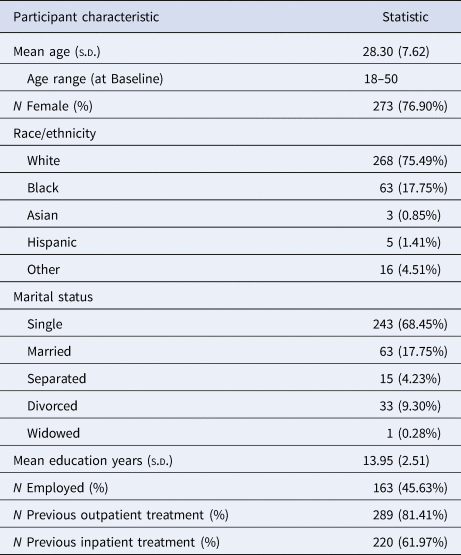
Participants were 355 individuals (77% female; Age M = 28.30, s.d. = 7.62, Range = 18–50) recruited from inpatient, outpatient, and community referral sources. For full clinical and demographic information, see Table 1. Masters-level clinicians completed initial diagnostic interviews, including the Structured Clinical Interview for DSM-IV-TR (SCID-I/P) (First, Spitzer, Gibbon, & Williams, Reference First, Spitzer, Gibbon and Williams1995) and the International Personality Disorders Examination (IPDE) (Loranger, Susman, Oldham, & Russakoff, Reference Loranger, Susman, Oldham and Russakoff1987). The original principal investigator (P.H.S.) also conducted the Diagnostic Interview for Borderline Patients (DIB) (revised version – DIB-R – used for all enrollments after 2001) (Zanarini, Gunderson, Frankenburg, & Cauncey, Reference Zanarini, Gunderson, Frankenburg and Cauncey1989). Participants were enrolled in the study if they had a probable or definite rating for a BPD diagnosis on the IPDE, and a definite rating for BPD on the DIB/DIB-R (score of 7 on the DIB, 8 on the DIB-R). Diagnoses were confirmed in a consensus conference of raters using all available data. Participants were excluded from the study for the following conditions: any past or current diagnosis of schizophrenia, delusional disorder, schizoaffective disorder, bipolar disorder, or depression with psychosis; any evidence of a central nervous system pathology or organic brain disorder; physical disorders with known psychiatric consequences; borderline or impaired intellectual functioning.
Demographic and Clinical Characteristics of the Sample

Note: Total N = 355.
The sample was heterogeneous with respect to comorbidities: over half the sample met criteria for current major depression, and over 20% met criteria for current alcohol use disorder, drug use disorder, generalized anxiety disorder, or panic disorder (see online Supplementary Table S2 for full diagnostic characterization). All subjects provided written informed consent to participate in the study. The authors assert that all procedures contributing to this work comply with the ethical standards of the relevant national and institutional committees on human experimentation and with the Helsinki Declaration of 1975, as revised in 2008.
Measures
Participants completed assessments of personality and life events in the past year at baseline and three annual follow-ups. Negative affect was measured by two self-report questionnaires – the 21-item Beck Depression Inventory (Beck, Rush, Shaw, & Emery, Reference Beck, Rush, Shaw and Emery1979) and the Symptom Checklist-90 Internalizing subscale (derived as a mean of the Depression, Anxiety, and Somatization subscales) (Derogatis, Reference Derogatis1977) – as well as the 17-item clinician-administered Hamilton Depression Rating Scale (Hamilton, Reference Hamilton1960). Disinhibition was measured by the self-rated Motor, Nonplanning, and Cognition subscales of the Barratt Impulsiveness Scales (BIS; prorated 11A version) (Barratt, Reference Barratt1965). Though the three BIS subscales were designed to explicitly assess impulsivity, they also contain content relevant to disinhibition more broadly, including items pertaining to carelessness, irresponsible spending, and distractibility. Antagonism was assessed via the Assault, Indirect Hostility, and Verbal Hostility subscales of the Buss-Durkee Hostility Inventory (Buss & Durkee, Reference Buss and Durkee1957).
Recent life events during the past year were assessed with 15 items from the Recent Life Changes Questionnaire (RLCQ) (Holmes & Rahe, Reference Holmes and Rahe1967). In order to provide measures of independent and dependent stressors that were commensurable with the published BPD literature, we selected items from the RLCQ that best aligned with the scale used by Conway et al. (Reference Conway, Boudreaux and Oltmanns2018). Ten items comprised the dependent life events scale, which included content related to interpersonal problems, financial difficulties, and legal troubles. Five additional items formed the independent life events scale, which included serious illness/injury to oneself or close others, as well as the death of a friend or family member. Items and scoring procedures used to create the independent and dependent life event scales are detailed in our online Supplementary Materials.
Statistical approach
To obtain high-quality measures of negative affect, disinhibition, and antagonism over time, we used a longitudinal latent variable approach. First, confirmatory factor analysis was used to determine whether the scales noted above were strong indicators of each latent dimension. Second, we verified that each dimension could be quantitatively compared over time by testing for longitudinal measurement invariance (Widaman, Ferrer, & Conger, Reference Widaman, Ferrer and Conger2010). This entailed comparing a series of factor models in which parameters were increasingly constrained to equivalence across assessment occasions. We began by specifying separate configural measurement models for negative affect, antagonism, and disinhibition (in which all parameters were free to vary across time), and then added equality constraints on factor loadings (i.e. weak invariance), intercepts (i.e. strong invariance), and item residual variances (i.e. strict invariance) in subsequent models. These models were compared to determine if the increasing constraints led to poorer model fit, as determined by a χ2 difference test and a change in the CFI of >0.002 (Meade, Johnson, & Braddy, Reference Meade, Johnson and Braddy2008). If the more constrained model did not provide a worse fit than its less constrained counterpart, we concluded that the corresponding test of measurement invariance was satisfied.
We then fit a series of autoregressive cross-lagged panel models to examine the associations between each latent construct and the observed dependent/independent stressful life events at each wave. Autoregressive paths examined the continuity in each construct across time, while cross-lagged paths examined the effects of stress on the dimension of interest (negative affect, disinhibition, or antagonism) and vice versa, controlling for the outcome at the previous time point. Cross-wave residual covariances for the same indicators were constrained to equality in all panel models. Maximum likelihood estimation with Huber-White robust standard errors and a robust model test statistic was used to estimate each model. Model fit was evaluated using established guidelines for the comparative fit index (CFI; close to 0.95 or above), the root mean square error of approximation (RMSEA; close to 0.06 or below), and the standardized root mean square residual (SRMR; close to 0.08 or below) (Hu & Bentler, Reference Hu and Bentler1999). In cases where global model fit did not meet these standards, we examined modification indices. Adding additional parameters (e.g. residual correlations) typically improved fit, but to avoid overfitting, we elected to do so only when there was a clear conceptual rationale. Missing data were accounted for using a full information estimation approach (Enders, Reference Enders2010). Rates of missingness for each variable included in the study are listed in online Supplementary Table S3, and the covariance coverage matrix is depicted in online Supplementary Fig. S1.
Results
Descriptive statistics
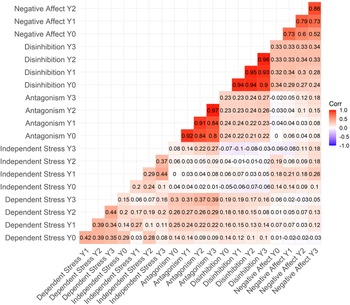
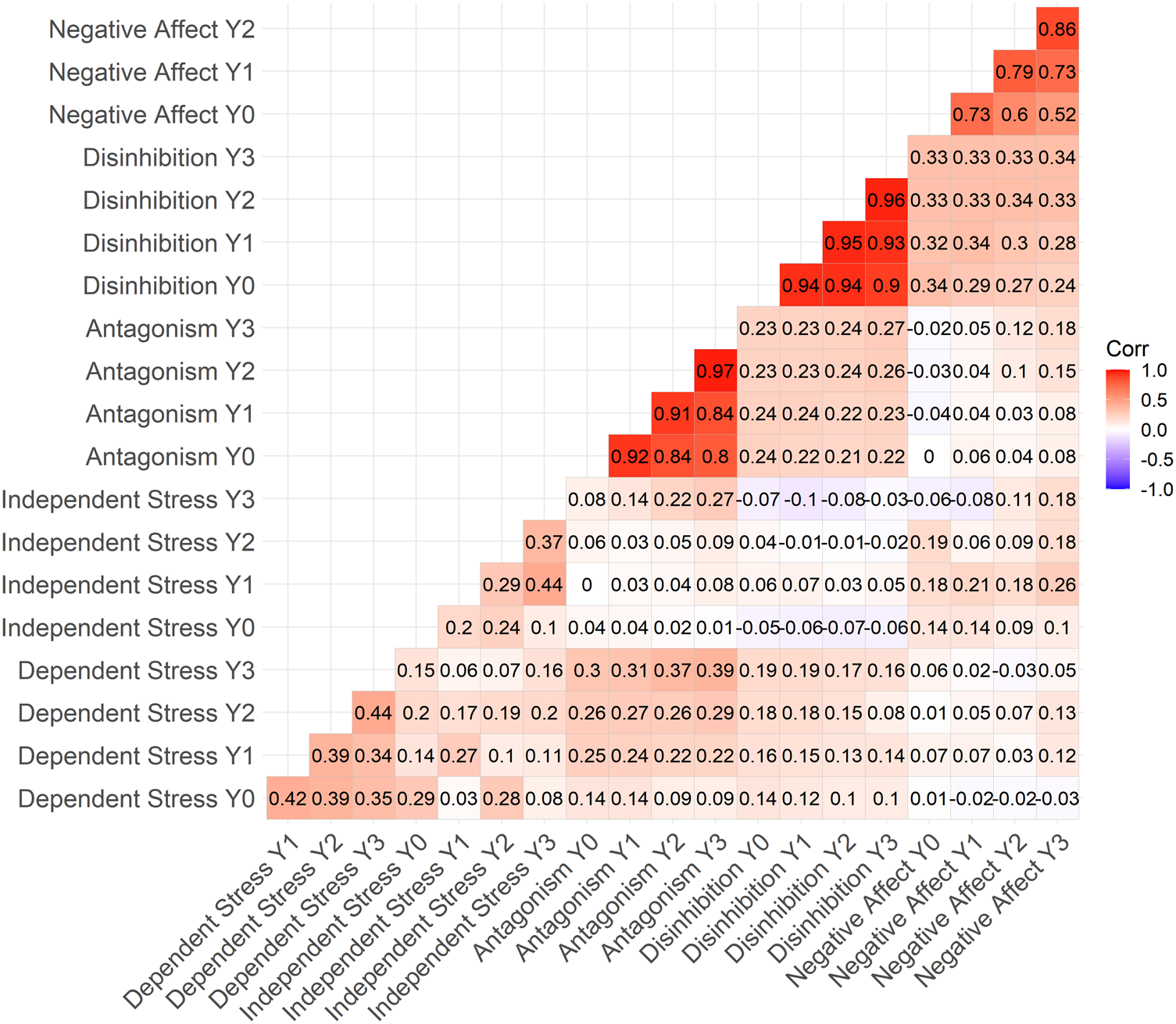
Descriptive statistics and psychometric information for all study variables, including frequency counts for independent and dependent stressful life events, are presented in online Supplementary Tables S3 and S4. Bivariate correlations among the three dimensions and two stress variables at all waves are presented in Fig. 2 (correlations among all study variables are presented in online Supplemental Fig. S2). The pattern of correlations indicated strong continuity in negative affect, disinhibition, and antagonism across waves. Antagonism and disinhibition were moderately correlated with dependent stressful life events, whereas negative affect was modestly related to independent stressful life events.
Bivariate correlations between negative affect, disinhibition, antagonism, and stressful life events.
Longitudinal measurement invariance
A detailed report of measurement invariance tests is presented in online Supplementary Table S5. Briefly, the unconstrained confirmatory factor analysis for all three dimensions demonstrated excellent fit. Adding equality constraints to factor loadings, intercepts, and residuals did not lead to a significant decrement in fit for the antagonism model, supporting strict measurement invariance. Negative affect clearly exhibited strong measurement invariance. Disinhibition exhibited weak measurement invariance. Freeing two intercepts based on modification indices led to an improvement in model fit, and subsequent evaluation of the χ2 difference test and ΔCFI yielded no difference between this model and the weak invariance model, suggesting partial strong measurement invariance (see online Supplementary Table S5 for more detail) (Byrne, Shavelson, & Muthén, Reference Byrne, Shavelson and Muthén1989). Factor loadings were moderate to strong and significant across all three models (range of loadings, Negative Affect: 0.62–0.97; Antagonism: 0.50–0.84; Disinhibition: 0.48–0.86; all p values < 0.001). Based on these results, we retained the strict measurement invariance model for antagonism, the strong invariance model for negative affect, and the partial strong invariance model for disinhibition in all subsequent analyses.
Autoregressive cross-lagged panel models
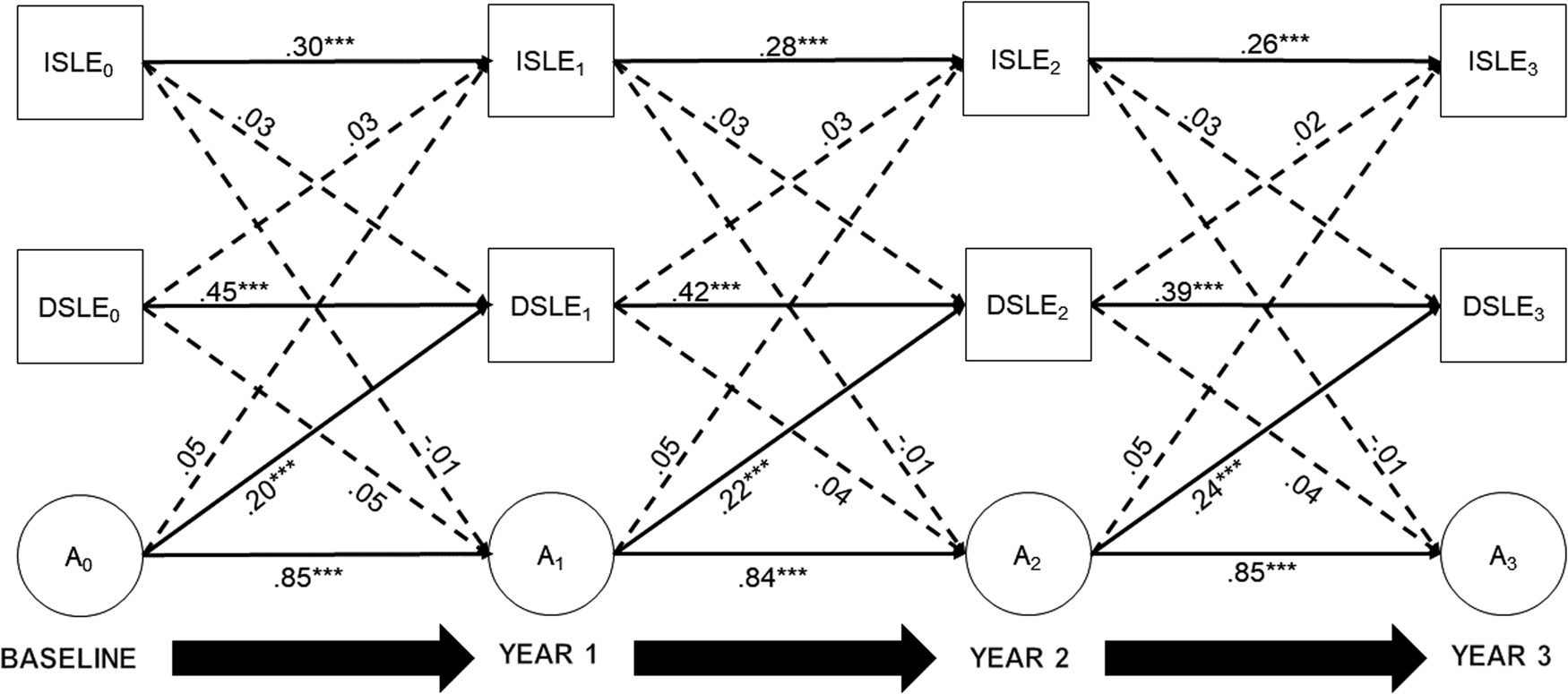
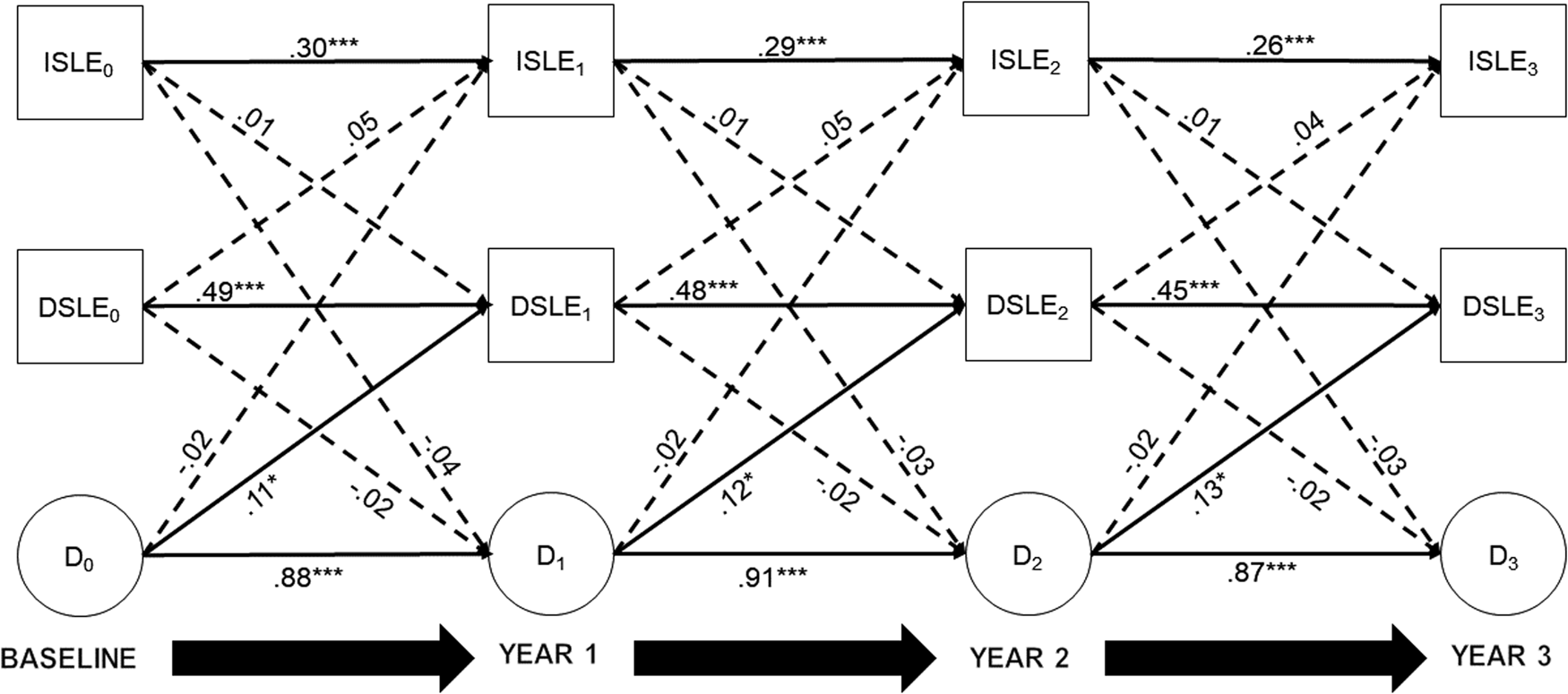
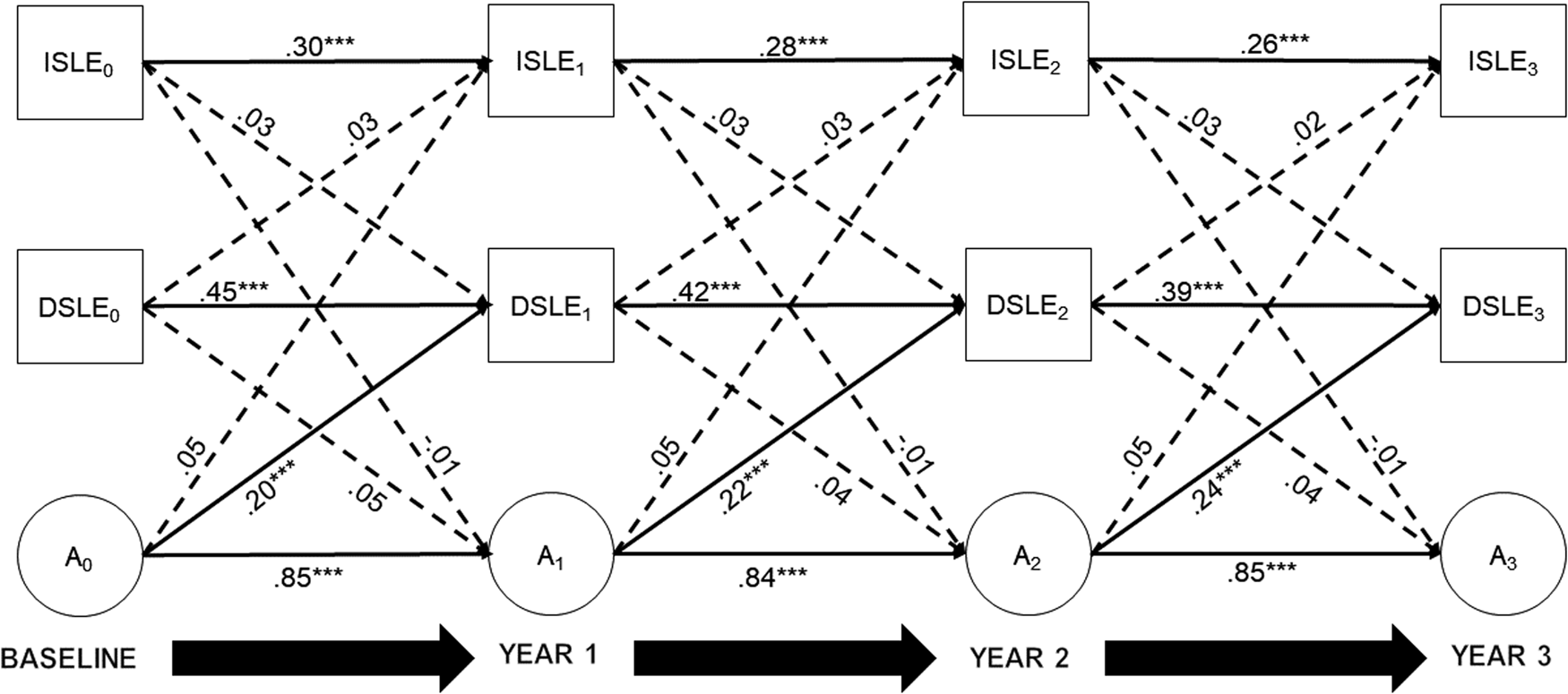
Standardized coefficients from the antagonism model are presented in Fig. 3. Unstandardized coefficients and standard errors from the model are presented in online Supplementary Table S6. The model demonstrated excellent fit to the data, χ2(183) = 254.04, p < 0.001; CFI = 0.95; RMSEA = 0.03; SRMR = 0.08. All autoregressive paths in the model were significant, indicating continuity in each construct across waves. Antagonism demonstrated strong continuity over time (β range = 0.84–0.85, p values < 0.001), whereas dependent and independent stressful life events exhibited more moderate stability (Dependent β range = 0.39–0.45; Independent β range = 0.26–0.30; all p values < 0.001). Consistent with our hypothesis, antagonism prospectively predicted dependent stressful life events over time (β range = 0.20–0.24; p values < 0.001). None of the other cross-lagged paths in the antagonism model weresignificant.
Autoregressive cross-lagged panel model between antagonism and stressful life events. *p < 0.05; **p < 0.01; ***p < 0.001.
Standardized coefficients from the disinhibition model are presented in Fig. 4. Unstandardized coefficients and standard errors from the model are presented in online Supplementary Table S7. The model fit the data well, χ2(172) = 234.72, p = 0.001; CFI = 0.96; RMSEA = 0.03; SRMR = 0.09. All autoregressive paths were significant in the model, with disinhibition exhibiting high stability over time (β range = 0.87–0.91; p values < 0.001). Disinhibition was also prospectively associated with dependent stressful life events (β range = 0.11–0.13; p values = 0.03). None of the other cross-lagged paths in the disinhibition model weresignificant.
Autoregressive cross-lagged panel model between disinhibition and stressful life events. *p < 0.05; **p < 0.01; ***p < 0.001.

The negative affect model fit the data well, χ2(174) = 263.372, p < 0.001; CFI = 0.93; RMSEA = 0.04; SRMR = 0.10. A detailed account of all model parameters is provided in online Supplementary Table S8. As in the previous two models, all autoregressive paths were significant, indicating continuity in each construct across waves. Negative affect demonstrated particularly strong continuity (β range = 0.61–0.74, p < 0.001). None of the cross-lagged paths in the model weresignificant, though there was a trend toward independent stress predicting subsequent negative affect (β range = 0.07–0.10; p = 0.06).
In a follow-up sensitivity analysis, we refit all models covarying for age, biological sex, and race to ensure that these demographic characteristics did not have a confounding influence on any of the observed effects. Results of the sensitivity analysis are presented in online Supplementary Tables S10–S12. The direction and pattern of all results were unchanged. The only change in significance occurred in the Negative Affect model, where the effect of independent stress on Negative Affect was statistically significant in the model controlling for age, sex, and race (whereas it was marginal in the model without the covariates).
Exploratory analysis: negative affect, antagonism, and disinhibition as simultaneous predictors of stress
We subsequently examined the specificity of our findings by examining whether observed associations between stressful life events and antagonism, disinhibition, and negative affect changed when all three dimensions were included simultaneously as predictors and outcomes of stress. To evaluate this question, we conducted an additional autoregressive cross-lagged model, specifying cross-lagged paths between each dimension and independent/dependent stress (cross-lagged paths among the three dimensions were omitted for parsimony). Covariances among the three dimensions were constrained to equality at each wave. Results are presented in online Supplementary Table S9. The model exhibited adequate fit to the data, χ2(914) = 1370.40, p < 0.001; CFI = 0.90; RMSEA = 0.04; SRMR = 11. As in the main analysis, all autoregressive paths were significant, with the three dimensions exhibiting strong stability over time and the stress variables exhibiting more moderate continuity. Whereas in the single dimension model, the association between independent stressful life events and subsequent negative affect was marginal, in the simultaneous model, it was statistically significant. As in the single dimension model, antagonism was prospectively associated with dependent stressful life events. The effect of disinhibition on dependent stress was qualitatively the same but reduced to a trend in the simultaneous model (p = 0.07). Overall, these results suggest that the individual effects reported above are largely unchanged when controlling for shared variance among the three dimensions.
Discussion
The primary goal of this study was to investigate dynamic, prospective associations between life stress and core features of BPD within a large clinical sample. Consistent with our hypotheses, we found strong evidence for stress generation in individuals diagnosed with BPD, which mirrors previous studies linking BPD symptoms to dependent stress (i.e. stressors that are, at least partially, of the individual's own making) in community samples (Conway et al., Reference Conway, Boudreaux and Oltmanns2018; Powers et al., Reference Powers, Gleason and Oltmanns2013). Our study adds specificity to these earlier findings by demonstrating that the link between BPD and dependent stress is primarily driven by antagonism and disinhibition, but not negative affect. In addition, our exploratory analyses indicated that the stress generative effects of antagonism and disinhibition are largely distinct from one another, representing potentially separate pathways to adversity. Prior work has shown that individuals high in antagonism struggle to develop harmonious interpersonal relationships and to abide by common social norms, which may predispose them to frequent interpersonal conflicts with peers, co-workers, and family members (Lynam & Miller, Reference Lynam and Miller2019). In contrast, those high in disinhibition are likely to struggle with planning, self-control, and diligence, all of which are likely to contribute to a host of other dependent stressors, including work tardiness, financial problems, and risk-taking behavior (Jackson & Roberts, Reference Jackson, Roberts and Widiger2017).
A variety of mechanisms likely contribute to stress generation within BPD. For instance, it is possible that individuals high on antagonism and/or disinhibition elicit more negative experiences from their environment as a result of their own behaviors (e.g. acting antagonistically toward one's boss might increase one's likelihood of getting fired). They may also vary in the way they interpret or construe environmental cues, leading to disadvantageous decision-making based on flawed information (e.g. interpreting a neutral comment as hostile may lead one to instigate a fight). Alternatively, the same individuals may select environments where dependent stressors are more likely to occur, particularly if those environments reaffirm their underlying tendencies (e.g. taking a job at a casino might enhance substance abuse and risk-taking). Future research will be needed to clarify the exact mechanisms that contribute to stress generation in BPD. In the meantime, however, our results provide strong evidence that disinhibition and antagonism are both key contributors to the ‘self-destructive’ aspects of the disorder (Gunderson & Singer, Reference Gunderson and Singer1975).
Our findings were more mixed regarding the link between stressful life events and negative affect. We did not find evidence of negative affect-driven stress generation, in contrast to previous studies of depression (Kendler et al., Reference Kendler, Gardner and Prescott2003). Notably, our latent variable for negative affect was primarily composed of depressive and anxious content, in part due to the availability of measures within this archival dataset. Externalizing forms of negative affect such as anger, frustration, or irritability were not assessed in-depth, and these constructs may have been key contributors to previous findings. Another possibility is that the clinical severity of our sample led to a remarkably high average negative affect, restricting variability between subjects and obscuring the association between negative affect and stressful life events. Future research could address these hypotheses by explicitly including measures related to anger/irritability and ensuring that participants are sampled to maintain variability in negative affect. Adopting such an approach would provide a more stringent test of the generalizability of our findings across different samples and measures of negative affect.
We also found modest evidence of a link between negative affect and stress reactivity. When modeled alone, independent and dependent stress did not predict subsequent increases in negative affect (though there was a trend for independent stress). However, when all three dimensions were entered simultaneously into a model with both stress variables, independent stressful life events predicted prospective increases in negative affect, supporting our hypothesis that high negative affect is associated with enhanced stress reactivity. The fact that this finding emerged in the model in which all three dimensions were considered together suggests that the link between independent stress and negative affect may be amplified when controlling for the variance negative affect shares with disinhibition and antagonism. Interestingly, Conway et al. (Reference Conway, Boudreaux and Oltmanns2018) also reported no initial evidence for a stress exposure effect in their study when BPD was assessed using a latent variable. However, they did find that independent stress predicted BPD symptoms as assessed by specific measures. Taken together, these findings suggest there may indeed be a small stress exposure effect present in BPD, likely specific to negative affect and independent stress, but that larger samples will be needed to detect it reliably.
Overall, our results indicate that continuous dimensions can parse heterogeneity in BPD in order to improve the prediction of stressful experiences, which may have implications for both assessment and treatment. Many, but not all, patients with BPD display elevated disinhibition and antagonism. Our results suggest that those who do may be particularly likely to benefit from interventions that reduce the problematic impulses and aggressive urges that contribute to dependent stress generation. For instance, the mindfulness module of dialectical behavior therapy (DBT) specifically improves inattention and impulsivity, suggesting it may have utility as a targeted treatment among those high on disinhibition (Carmona i Farrés et al., Reference Carmona i Farrés, Elices, Soler, Domínguez-Clavé, Martín-Blanco, Pomarol-Clotet and Pascual2019; Soler et al., Reference Soler, Valdepérez, Feliu-Soler, Pascual, Portella, Martín-Blanco and Pérez2012). Conversely, interventions that seek to improve interpersonal communication and problem-solving (e.g. DBT's interpersonal effectiveness and emotion regulation modules) may be well-suited for those high in antagonism, who often struggle to control emotional outbursts in social interactions (indeed, interpersonal effectiveness training is associated with improvements in emotion regulation; Carmona i Farrés et al., Reference Carmona i Farrés, Elices, Soler, Domínguez-Clavé, Martín-Blanco, Pomarol-Clotet and Pascual2019). Finally, while independent stressors cannot be predicted or prevented, interventions that target crisis management, often by fostering acute coping skills (e.g. DBT's distress tolerance module), may have utility for individuals with BPD who struggle to regulate negative affect following uncontrollable stressors. Thus, our results point to a number of potential hypotheses for improving outcomes through dimensional assessment and intervention. Future treatment studies should seek to test these hypotheses more rigorously in the context of controlled treatment trials.
The present study had several important strengths, including a large sample by clinical standards, a prospective longitudinal design, and rich clinical and psychometric characterization. However, it also had several limitations worth noting. Attrition was relatively high, especially following the first wave of the study, which may be indicative of the chaotic or unstable lives common in patients with BPD. Stressful life events were assessed using a self-report measure, which is susceptible to errors in reporting and does not allow for a nuanced understanding of contextual factors. We attempted to mitigate the risk of overreporting (detailed in our online Supplementary Materials), but future research should nonetheless replicate our findings using interview-based measures of life stress. A more nuanced assessment of life stress would also help to answer outstanding questions about the role of stressor timing, severity, and frequency. Pertaining to measurement, our study did not assess the moment-to-moment, within-person stability of each symptom dimension (as is often done in ecological momentary assessment) and is therefore not well-suited to address questions pertaining to intraindividual change. Studies that employ shorter timeframes and more frequent assessments might be better able to address such questions and help to clarify the moment-to-moment dynamics between stress and each symptom dimension. In addition, some of our measures varied with respect to the time horizon used to frame questions (e.g. the negative affect indicators ask about the last 1–2 weeks, whereas the disinhibition indicators do not include a timeframe). As a result, our negative affect results may not be directly analogous to studies assessing trait neuroticism.
Finally, it is important to note that our sample was comprised primarily of single, white women in young adulthood (at baseline). Though our main findings did not change when age, sex, and race were added as covariates to each model, their generalizability to more diverse samples remains unclear. Future research should also consider study designs that would enable a sufficient sample size to explicitly test how these and other demographic characteristics moderate the effects observed in our study. To consider just one example, there is evidence that younger adults experience more interpersonal stress than older adults, whereas older adults report higher health-related stressors (Jordanova et al., Reference Jordanova, Stewart, Goldberg, Bebbington, Brugha, Singleton and Meltzer2007). Interestingly, developmental research suggests antagonism and disinhibition peak in late adolescence or early adulthood (Soto, John, Gosling, & Potter, Reference Soto, John, Gosling and Potter2011), suggesting that the influx of dependent stress during this time could be related to developmental changes in personality that are observed in the general population. Study designs that include additional measurement waves and/or multiple age cohorts would be helpful for testing such a hypothesis.
In sum, our results suggest that variability in negative affect, disinhibition, and antagonism provide a more detailed characterization of the relationship between BPD and stressful life events. Uncontrollable, unavoidable stressors may exacerbate negative affect in individuals with BPD, pointing to a need to improve patients’ coping skills in the face of acute stress. Conversely, impulsive and interpersonally reactive behaviors are key precipitants to many of the recurring and potentially avoidable stressors that individuals with BPD face on a regular basis. Overall, our findings suggest that there is value in assessing and targeting these distinct features of BPD to reduce stress-related burden.
Supplementary material
The supplementary material for this article can be found at https://doi.org/10.1017/S003329172000255X.
Acknowledgements
This work was funded by the National Institutes of Health (Grant No. R01-MH048463 [to AYD and MNH], Grant No. R01-MH119399 [to MNH], and Grant No. T32-MH016804 [to TAA]). The funding agency had no role in the design and conduct of the study; the collection, management, analysis, and interpretation of the data; the preparation, review, and approval of the manuscript; or the decision to submit the manuscript for publication.
Conflict of interest
The authors have no financial interests to disclose.